Why Springs Are Matched to Your Exact Door Weight - The Danger of the Wrong Replacement
Key Takeaways
- A garage door spring carries almost all of the door's weight while the opener only guides the movement.
- Springs must be matched to your exact door weight, wire size, inside diameter, and length to balance correctly.
- A wrong or mismatched spring can snap dangerously, slam the door, burn out the opener, and snap cables.
- Universal online spring kits rarely fit a specific door and can hide a slow, costly failure.
- Irvine's marine layer, temperature swings, and high-use family garages all shorten spring life.
- Older wood doors near Turtle Rock and Northwood often need custom-matched springs, not stock parts.
- A professional install includes weighing the door, calculating the rating, and a hands-on balance test.
- Warning signs include a heavy or uneven door, loud bangs, coil gaps, and a straining opener.
In This Article
A homeowner in Woodbridge called our team last spring with a story we hear often. He had found a garage door spring online for half the price of a professional job, installed it over a weekend, and by Monday morning the door would barely lift. The spring looked identical to the old one, but it was rated for a lighter door. Within two weeks it snapped, leaving a coil hanging loose over his car.
That scenario plays out across Irvine more than most people expect. A garage door spring is not a generic part you match by eyeballing it. It is engineered to balance one specific door weight, down to the wire size and coil length.
What a Garage Door Spring Actually Does?
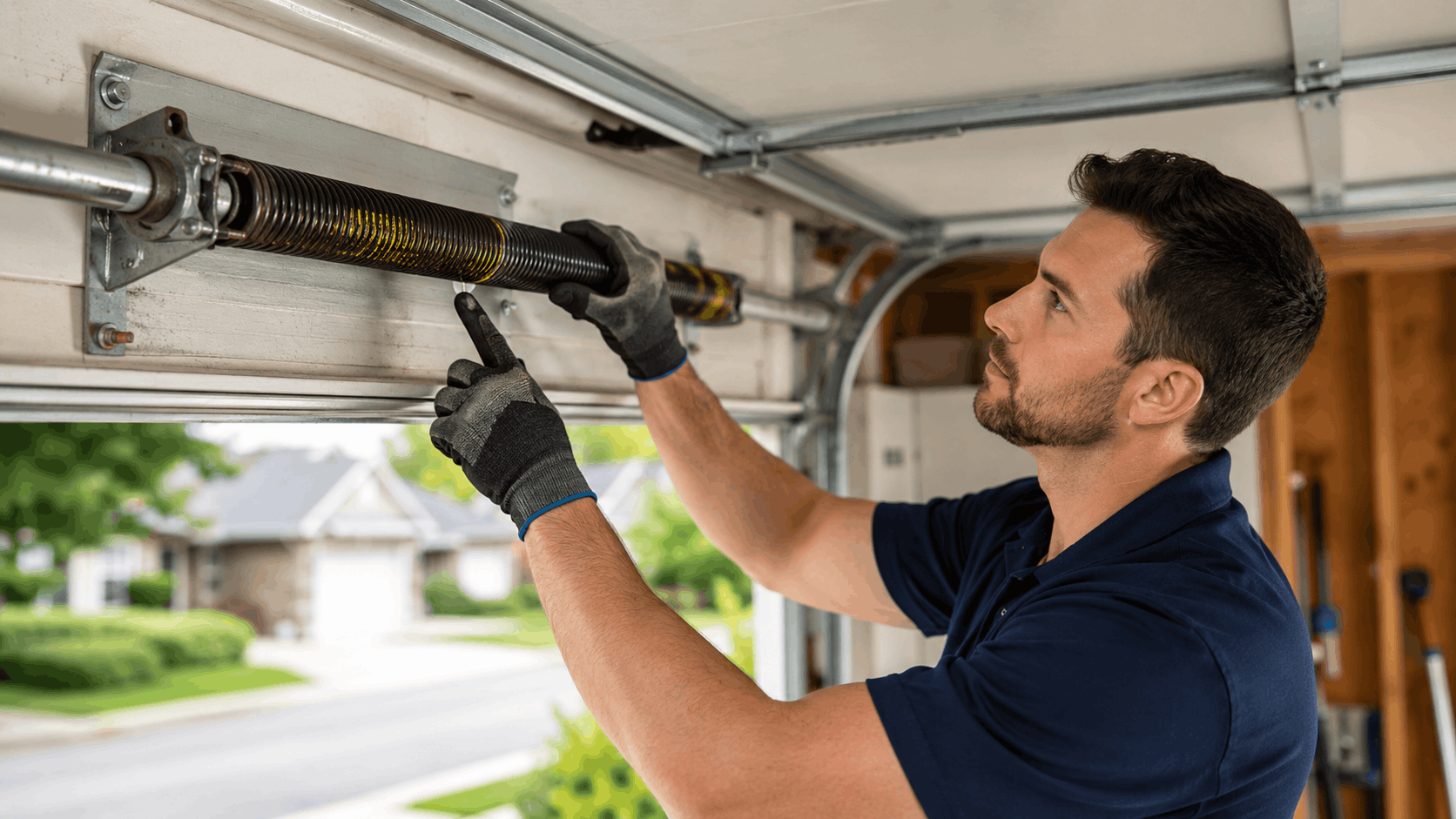
Most homeowners think the motor lifts the garage door. It does not. The garage door spring carries almost all of that weight, and the opener just guides the door along its track.
A single garage door can weigh between 130 and 350 pounds depending on the material. Without a working counterbalance system, no household motor could lift that load day after day. Here is what a spring handles behind the scenes:
- It stores mechanical energy when the door closes and releases it when the door opens
- It offsets the full weight of the panels so the door feels light
- It lets a person lift a heavy door by hand with little effort
- It protects the opener from carrying a load it was never built to handle
The torsion spring or extension spring is the muscle of the whole system. When it fails, everything else struggles.
Torsion Springs vs Extension Springs
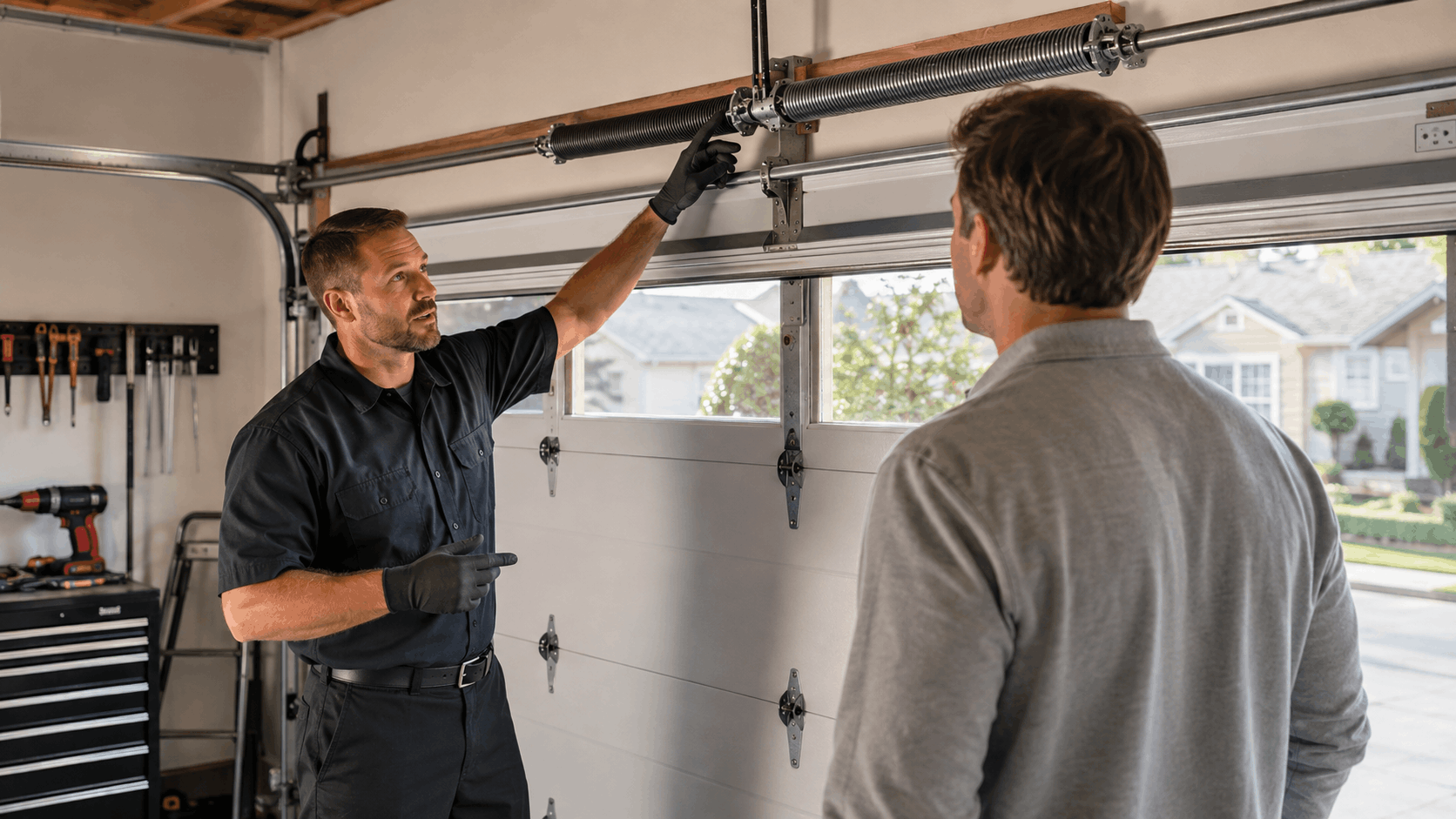
There are two main spring types found on Irvine homes, and they mount in different places. A torsion spring sits on a metal shaft above the door opening and winds tight to store energy. Newer homes in communities like Woodbury and Portola Springs almost always use torsion systems because they are safer and last longer.
An extension spring runs along the horizontal tracks on either side of the door and stretches to hold tension. These are more common on older doors and lighter single-car setups. Homes built in the 1970s and 1980s around parts of Turtle Rock still carry extension systems in many cases.
Each type balances the door differently, and they are not interchangeable. Swapping one for the other requires new hardware and careful calculation. Our team handles both, and we often recommend a spring conversion upgrade when an older extension setup keeps failing.
The right choice depends on the door weight, the headroom above the opening, and how often the door gets used. A torsion system usually handles heavier doors and higher cycle counts with more stability.
How Springs Counterbalance the Door's Weight
The word counterbalance explains the whole idea. The spring pushes back against gravity with a force equal to the door's weight. When those two forces match, the door balances at any point along its travel.
A properly matched door should feel almost weightless when lifted by hand. You can raise it halfway, let go, and it stays put. That is the sign of correct door balance, and it is exactly what we test for after every install.
When the counterbalance is off, the door fights you. Too much spring force and it drifts upward on its own. Too little and it slams toward the floor. Neither is safe, and both add wear to the whole system.
Getting the counterbalance right is not guesswork. It comes from matching the spring rating to the measured door weight, which we cover in the next section.
Why the Opener Depends on the Spring, Not the Motor
People assume a stronger garage door opener means a stronger lift. That is a common and costly mistake. The opener is not built to haul 200 pounds of steel. It only nudges an already balanced door up and down.
When a spring weakens or does not match the door, the motor takes on weight it was never designed to carry. That extra motor strain burns out gears, strips the trolley, and shortens the opener's life. We have replaced openers in Irvine that failed years early because a bad spring forced them to do the lifting.
Think of the spring as the weightlifter and the opener as the spotter. The spotter guides the motion but should never carry the full load. If your opener is straining, the real problem is often the spring, not the motor. Our opener repair and troubleshooting service starts by checking the balance first.
Get Your Free Quote
Tell us about your garage door and we'll get back to you within 30 to 60 minutes.
Why Every Spring Must Match Your Exact Door Weight
A spring is not one-size-fits-all. It is engineered to a specific door weight, and even a small mismatch throws the whole system out of balance. This is the heart of spring matching, and it is where cheap online kits go wrong.
The correct spring rating comes from three physical measurements plus the exact weight of your door. Get any of them wrong and the door will not balance. Here is what drives a proper match:
- The measured weight of the door in pounds
- The wire size of the spring
- The inside diameter of the coil
- The overall spring length
- The number of turns applied during winding
Miss on one number and the door either drifts open or crashes down. Precision here is what keeps the door safe and the opener healthy.
How Door Weight Is Measured
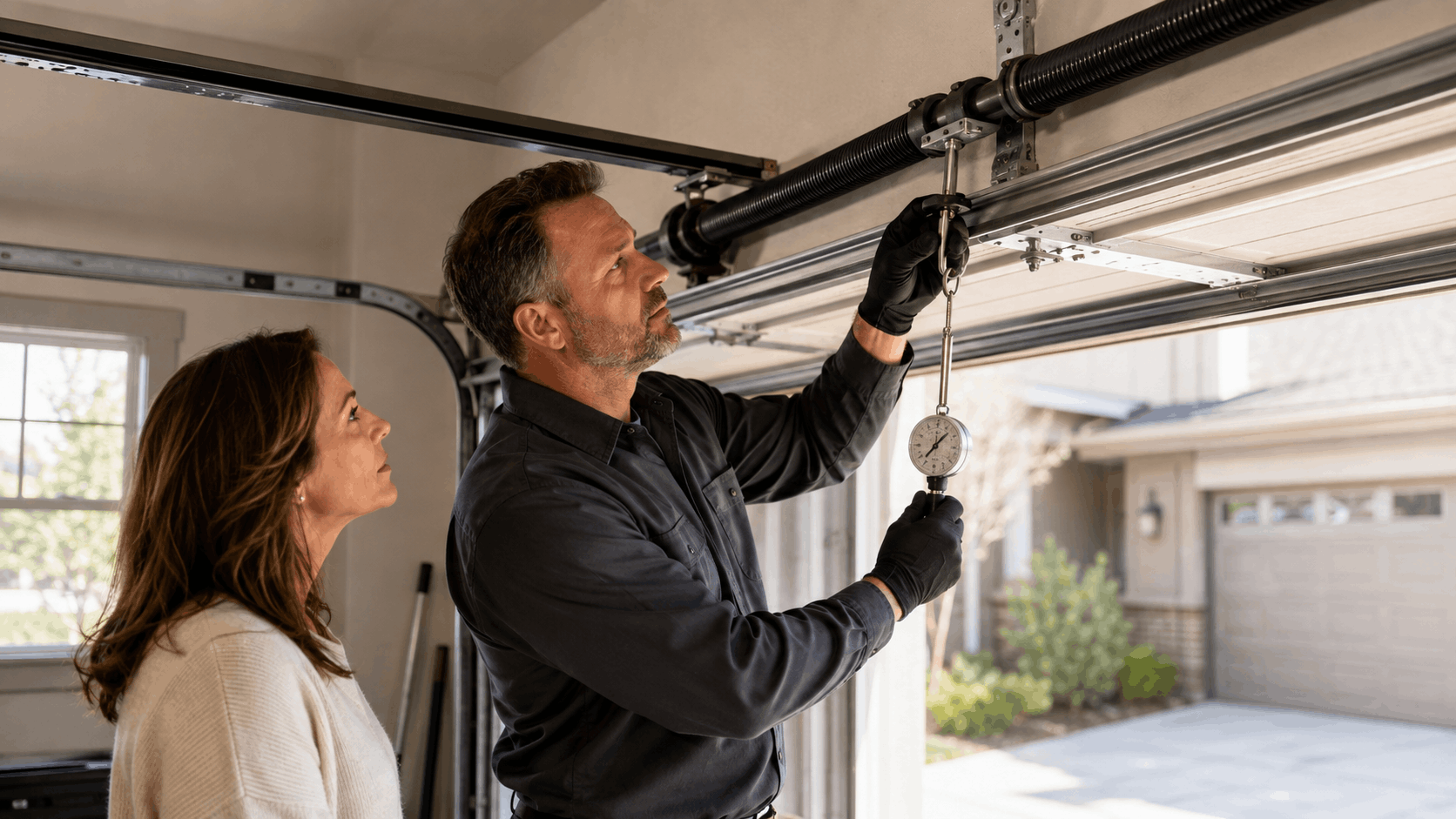
To weigh a garage door, a technician disconnects the opener and rests the bottom of the door on a scale. A standard bathroom scale or a heavy-duty luggage scale works for this. With the spring tension released, the scale reads the true door weight.
Door weight varies more than most people realize. A basic single-layer steel door might weigh 130 pounds, while an insulated door with a steel back and foam core can hit 200 pounds or more. Solid wood carriage doors and glass panel doors weigh even more.
Homes near Northwood and University Park often have upgraded insulated or custom doors added over the years. Those upgrades change the weight and demand a different spring than the original. We never assume the weight from a model number, because add-ons and repairs change everything.
Weighing the door is the first honest step. A spring chosen without it is just a guess dressed up as a fit.
Wire Size, Inside Diameter, and Length
Three spring measurements decide the rating, and all three must be correct. The wire size is the thickness of the steel wire, often measured in thousandths of an inch. A difference as small as a few thousandths changes the strength dramatically.
The inside diameter is the width of the coil where it slides onto the shaft. Common sizes are 1.75, 2.0, and 2.625 inches. Put the wrong diameter on a shaft and the spring either will not fit or will not wind safely.
The spring length ties directly to the door height and the number of turns needed. A spring that is too short or too long cannot hold the correct tension across the full travel of the door. Guessing any one of these three numbers leads to a door that fails balance, which is why our torsion spring replacement always starts with exact measurement.
These numbers are not printed on a sticker for homeowners to read easily. Pulling the right combination takes tools and experience, not a quick online search.
The Cycle Rating and Lifespan Connection
Every spring carries a cycle rating, which is how many open-and-close cycles it can survive. A standard spring is rated for around 10,000 cycles. Higher-grade springs reach 20,000, 30,000, or even more.
Cycle rating connects directly to weight matching. A spring correctly sized to the door works within its designed stress range, so it reaches its full rated life. An undersized spring overworks on every cycle and burns through its lifespan fast.
For a family that opens the door four times a day, a 10,000-cycle spring lasts roughly seven years. Bump that to eight or ten daily cycles in a busy household and the same spring might last only three or four. Matching the spring to both the weight and the usage is how we stretch that spring lifespan.
A correct spring is a long-term saving. A cheap mismatch is a short-term fix that costs more when it fails early.
Why Two-Car Doors Often Need Two Springs
Most two-car garages in Irvine use a dual spring setup. Two springs share the load of a wide, heavy door instead of forcing one spring to carry it all. This is standard across communities like Woodbridge and Great Park.
Splitting the load has real benefits. If one spring breaks, the second one keeps the door from crashing straight down, giving a safety buffer. Two balanced springs also wear more evenly and last longer than a single overloaded one.
When we service a dual spring system, we usually recommend replacing both at once. The two springs age together, so if one breaks the other is close behind. Replacing both keeps the balance even and saves a second service call. Our spring and cable repair team sizes each spring to carry its half of the measured weight.
A single spring on a heavy two-car door is a warning sign. It usually means someone cut a corner during a past repair.
Need Help in Irvine?
Urgent Garage Doors serves Irvine and all of Orange County.
The Dangers of the Wrong Replacement Spring
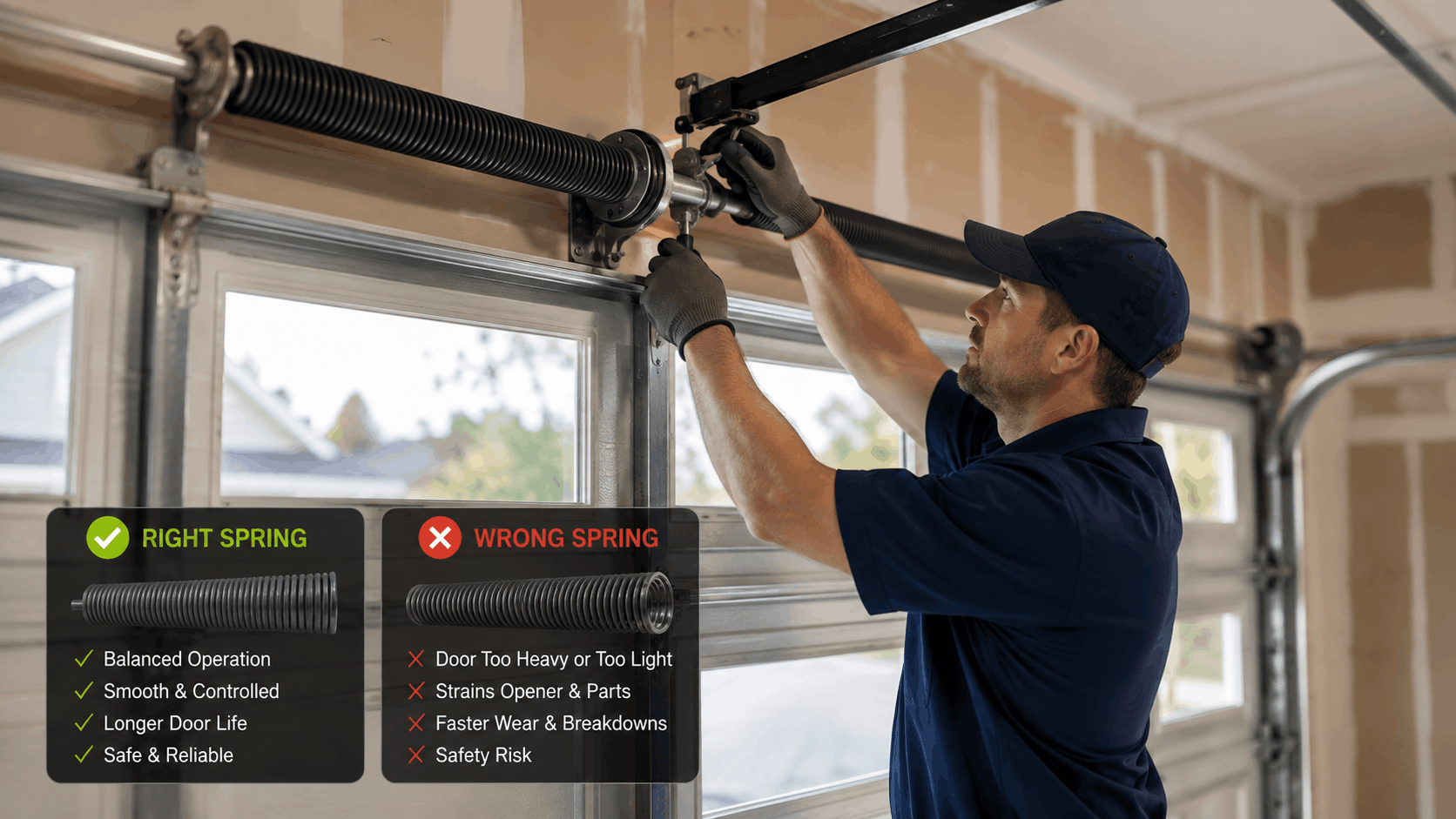
Installing the wrong spring is not just an inconvenience. It creates real safety and mechanical risks. A wrong spring stores the wrong amount of energy, and that energy has to go somewhere.
Garage door safety depends on balance. When the spring does not match the door weight, small problems turn into dangerous ones. Here is what a mismatched spring can cause:
- A sudden snap that sends metal flying
- A door that slams shut or shoots open
- A burned-out opener and stretched cables
- Voided warranties and failed HOA checks
These are not rare edge cases. We see the results of bad spring choices on Irvine driveways every week.
Sudden Spring Snap and Injury Risk
A wound torsion spring holds a large amount of stored energy. That energy is what lifts the door, but it also makes the spring dangerous when it fails. An oversized or overwound spring is under stress it was not built for.
When such a spring lets go, it can release with a violent snap. Pieces of the coil or the winding bar can fly across the garage. People have suffered broken fingers, deep cuts, and worse from a spring snap during a bad DIY job.
The danger climbs when someone winds a spring by hand without the right bars. The stored tension can rip a tool out of your grip in an instant. This is the single biggest reason we warn homeowners against solo spring work.
The U.S. Consumer Product Safety Commission has documented garage door injuries tied to spring failures. You can read their safety guidance at cpsc.gov for more detail on the risks.
A Door That Slams or Flies Open
A spring that is too weak for the door creates a slam risk. The counterbalance cannot hold the weight, so the door drops fast the moment it starts to close. That is a serious hazard for kids, pets, and cars in the path.
A spring that is too strong does the opposite. The door shoots up on its own or feels like it is trying to jump off the track. This balance failure makes the door hard to control and stresses every part of the system.
Either way, the door no longer behaves the way it should. A safe door moves smoothly and stops where you leave it. A mismatched door has a mind of its own.
We often find these problems after a homeowner or handyman installed a stock spring. A proper door balancing and tension adjustment brings the door back under control.
Burned-Out Openers and Broken Cables
When a spring does not carry its share, the opener and cables pick up the slack. The motor pulls harder on every cycle, which leads to opener failure long before its time. Gears strip, belts slip, and circuit boards overheat.
The lift cables suffer too. They are sized for a balanced door, not for hauling extra weight. An overloaded cable frays and can snap, and a broken cable often sends the door off its track.
These failures cascade. A cheap wrong spring can end up costing a new opener, new cables, and a track repair all at once. We have quoted repairs where the domino effect tripled the original savings.
Matching the spring protects the whole system. Our garage door cable repair visits often trace the root cause back to a bad spring.
Voided Warranties and Failed HOA Inspections
Many door and opener makers void the warranty if a non-matching or improperly installed spring is used. That means a future problem comes out of your own pocket. A cheap spring can cancel hundreds of dollars in coverage.
Irvine also has strict HOA communities that inspect home exteriors. Neighborhoods managed under the Irvine Company and various village associations expect doors to look and work correctly. A crooked, slamming, or noisy door can draw a violation notice.
A failed HOA inspection means letters, deadlines, and stress. Fixing it right the first time avoids that whole cycle. We keep records of our work so homeowners have proof of proper repair.
Protecting a warranty and staying in good standing with the HOA are quiet benefits of doing the job correctly. They matter more than the sticker price on a spring.
Why DIY and Online Spring Kits Cause Problems in Irvine Homes
The internet makes a DIY spring job look easy and cheap. A short video and a boxed kit seem like all you need. Local homes and conditions tell a different story.
An online spring kit is sold blind. The seller has no idea what your door weighs or how it is built. That gap between a generic part and your specific door is where most DIY spring jobs go wrong.
Generic 'One Size Fits All' Springs
A universal spring kit promises to fit many doors, but a spring that fits many doors rarely balances any one of them well. Door weights vary too much for a single spring to cover the range. The kit might raise the door, but it will not balance it.
When the fit is wrong, the door drifts, slams, or strains. The homeowner often does not notice until weeks later when the opener starts struggling. By then the damage has already begun.
We have removed plenty of universal springs that were the wrong wire size or diameter for the door. They technically turned the shaft, but they never matched the load. A wrong fit is worse than no repair because it hides a slow failure.
A spring sized to your measured door is the only real fix. Anything labeled universal is a compromise you feel every day.
The Tools and Winding Bars Homeowners Lack
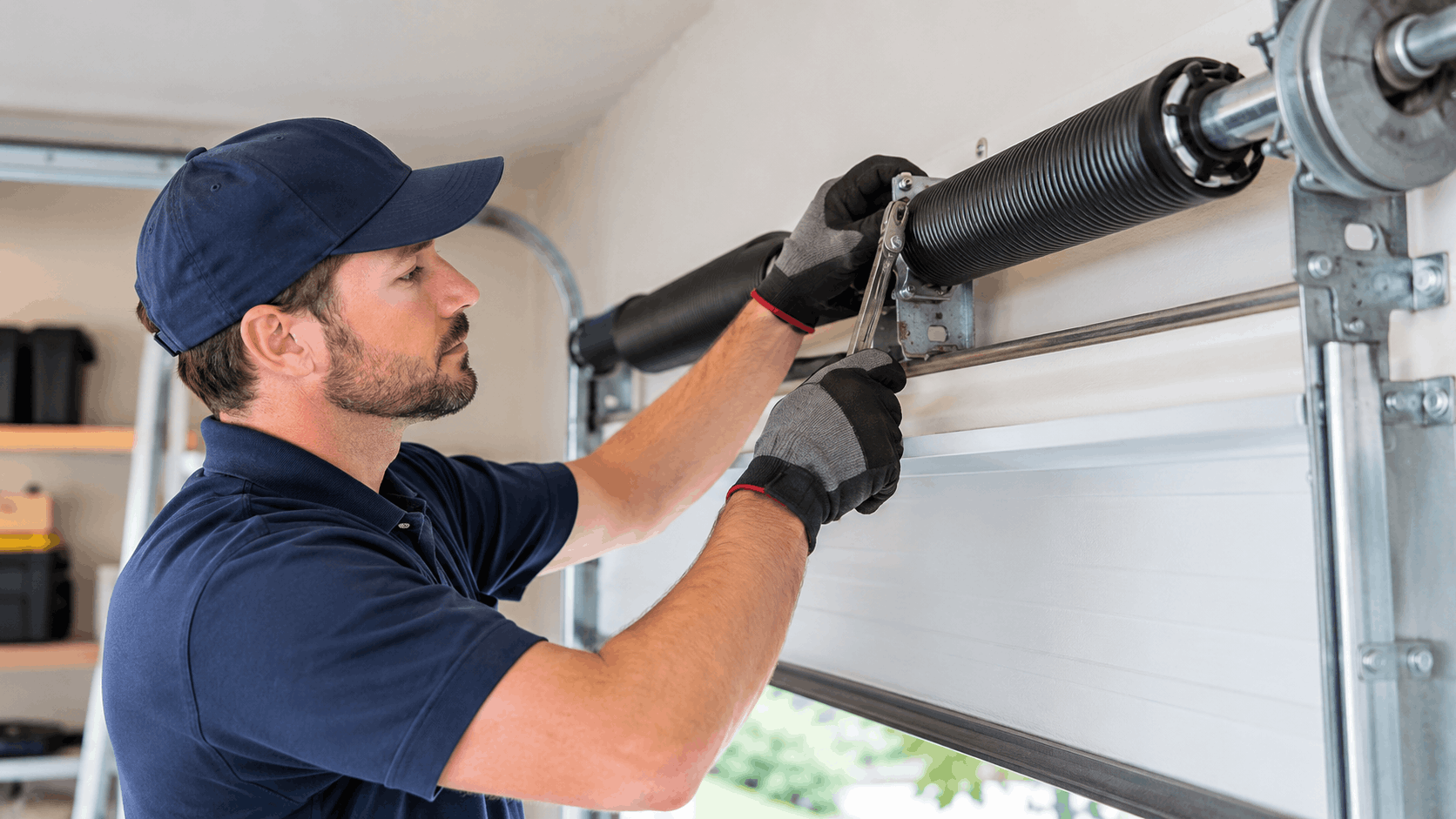
Winding a torsion spring requires proper winding bars sized to the winding cone. Homeowners often reach for a screwdriver or a random metal rod instead. That is exactly how people get hurt.
The wrong bar can slip out under spring tension and swing back with force. It can break bones or crack the shaft. The right bars fit snugly and let a trained tech control the tension turn by turn.
Beyond winding bars, the job needs vise grips, a solid ladder, and a way to lock the shaft safely. Most garages are not stocked for this. The tools are cheap compared to a hospital visit but still add up against the cost of a professional call.
We bring calibrated tools and years of practice to every spring job. That combination is what makes the difference between a safe repair and a dangerous one.
Older Doors Near Turtle Rock and Northwood
Established Irvine neighborhoods like Turtle Rock and Northwood have plenty of original wood doors from decades past. A wood door soaks up moisture and gains weight over the years. That heavier door needs a stronger, custom-matched spring, not a stock part.
A generic kit sized for a light modern steel door will never balance a heavy older wood door. The mismatch shows up fast as slamming or straining. We measure these doors carefully because their weight often surprises homeowners.
Some of these doors also use aging extension systems that need special care. We handle spring and cable repair in Turtle Rock with parts matched to the real door, not a catalog average. That is the only way to keep an older door safe.
Custom matching is not an upsell on these homes. It is the difference between a door that works and one that fails within months.
Need Help in Irvine?
Urgent Garage Doors serves Irvine and all of Orange County.
How Irvine's Climate and Homes Affect Spring Life
Irvine's climate looks mild, but it works on garage springs in ways people miss. Moisture, heat cycles, and heavy daily use all shorten spring life. Local conditions matter as much as the spring itself.
Where you live in Irvine changes how fast a spring wears. A coastal-adjacent home ages differently than an inland one. Understanding the local factors helps homeowners plan ahead instead of getting caught by a surprise break.
Coastal Air and Marine Layer Corrosion
Irvine sits close enough to the coast to catch the marine layer most mornings. That damp ocean air drifts inland and settles on metal parts. Over time the moisture feeds rust and corrosion on the spring coils.
A rusted spring loses strength and grip. The coils bind against each other, which adds friction and speeds up metal fatigue. A corroded spring often snaps years before a clean, well-oiled one would.
Homes closer to the coastal edge of Orange County feel this more. Regular lubrication slows the damage, which is part of why we push routine care. The National Weather Service tracks marine layer patterns across Southern California at weather.gov if you want to see how common it is.
A light coat of spring lubricant twice a year fights corrosion. It is one of the simplest ways to protect the investment.
High-Use Garages in Woodbury and Great Park
Newer family communities like Woodbury and Great Park see heavy daily door use. Two working parents, teen drivers, and busy weekends mean the door cycles many times a day. Every cycle counts against the spring's rated life.
A home that opens the door ten or twelve times daily burns through cycles fast. A standard 10,000-cycle spring in that home might last only a couple of years. We often recommend higher cycle ratings for these households.
A 20,000 or 30,000-cycle spring costs a bit more up front but doubles or triples the lifespan. For a high-use garage, that math favors the stronger spring every time. Our preventive maintenance plan helps track cycle count and wear before a break happens.
Matching the cycle rating to the household is part of matching the spring. Weight is only half the picture in a busy family garage.
Temperature Swings and Metal Fatigue
Irvine days can be warm while nights turn cool, especially in spring and fall. Metal expands and contracts with each temperature swing. Over years, that repeated flexing causes metal fatigue in the spring steel.
Fatigue makes the metal brittle. A spring that has cycled through thousands of hot-to-cold shifts is more likely to crack. Cold mornings are a common time for a tired spring to finally snap.
This is why so many break calls come in during the first cold snap of the season. The spring was already fatigued, and the cold pushed it over the edge. A well-matched spring handles these swings better because it is not already overstressed.
Regular inspection catches fatigue before failure. We look for tiny cracks and gaps that hint at the end of a spring's life.
How Our Team Matches Springs to Your Exact Door
Getting the right spring is a process, not a guess. Our team follows the same careful steps on every job across Irvine. That is how we deliver a balanced door that lasts.
Professional installation starts with real measurements and ends with a hands-on balance test. Here is how the process works from start to finish:
| Step | What We Do | Why It Matters |
|---|---|---|
| 1. Measure and Weigh | Weigh the door and measure the old spring | Confirms the true door weight |
| 2. Calculate Rating | Convert data into wire size, length, and turns | Produces the correct spring rating |
| 3. Install | Fit the matched spring with proper tools | Keeps the job safe and precise |
| 4. Balance Test | Check the door at the halfway point | Proves the spring matches the weight |
On-Site Weighing and Measuring
We never order a spring from a catalog based on a door model alone. Our tech comes out and measures the actual door on site. Disconnecting the opener lets us weigh the door the way we described earlier.
We also measure the existing spring's wire size, inside diameter, and length. That tells us what was installed before and whether it was even correct to begin with. Plenty of times the old spring itself was a mismatch.
Real spring measurement removes the guesswork. We work with numbers from your specific door, not an average. That is the foundation of a spring that actually balances.
This step takes a few extra minutes and saves years of trouble. It is the difference between our work and a boxed kit.
Calculating the Right Spring Rating
Once we have the weight and measurements, we calculate the correct spring rating. The door weight tells us how much lifting force the spring must provide. From there we pick the wire size, coil length, and number of turns.
Balance calibration is where experience matters. Two springs might look similar on paper but behave differently on the door. We choose the combination that holds the door steady at every point.
For heavier or high-use doors, we factor in a higher cycle rating during this step. The goal is a door that balances now and stays balanced for years. This math is what separates a lasting repair from a quick patch.
We double-check the numbers before winding anything. A careful calculation up front prevents a callback later.
Balance Testing After Installation
After the spring is installed and wound, we run a manual balance test. We lift the door halfway and let go. A properly matched door holds its position without drifting up or down.
If the door creeps in either direction, we adjust the tension. A quarter turn on the winding cone can fine-tune the balance. We repeat the test until the door sits still on its own.
This balance test is the proof that the spring matches the weight. It is a simple check that most DIY jobs skip entirely. A door tune-up at this stage catches any small issue before we leave.
We also test the opener and safety reversal at the same time. A balanced door and a smooth opener go hand in hand.
Same-Day Service Across Irvine
A broken spring can trap a car in the garage, so speed matters. We offer same-day service across Irvine and the surrounding neighborhoods. Westpark, University Park, and Portola Springs are all within our regular routes.
Our trucks carry a range of springs and the tools to match them on the spot. That means we often measure, match, and install in a single visit. No waiting days for a part to ship.
For urgent breaks, our same-day garage door repair gets a tech to your driveway fast. We know the local streets and can move between villages quickly.
Fast service does not mean rushed work. We still run the full measure-and-balance process every time.
Need Help in Irvine?
Urgent Garage Doors serves Irvine and all of Orange County.
Signs Your Spring May Be Wrong or Failing
A failing spring usually gives warning signs before it breaks. Catching them early keeps a small repair from becoming a safety problem. Here is what to watch and listen for.
These clues show up during normal daily use. Paying attention to them can save you from a door stuck shut at the worst moment. When you notice these signs, it is time for garage door repair.
The Door Feels Heavy or Uneven
Try lifting your door by hand with the opener disconnected. A balanced door lifts with light effort and stays where you leave it. A heavy door that fights you points straight to a spring problem.
An uneven lift is another red flag. If one side rises ahead of the other, a spring or cable is out of balance. That drag stresses the whole system and wears parts unevenly.
A door that suddenly feels heavier than it used to often has a weakening or mismatched spring. The change may be gradual, so people adjust without noticing. When you finally test it by hand, the difference is clear.
This simple hand test is the best early warning you have. If the door does not feel light and even, call us.
Loud Bangs, Gaps, or Visible Damage
A breaking spring makes a loud bang, almost like a gunshot in the garage. Many homeowners hear it and think something fell or a car hit the door. That sound is the spring snapping under tension.
Look at the spring itself for a visible coil gap. A healthy torsion spring is one tight, continuous coil. A two- or three-inch gap in the middle means it has already broken.
Rust, stretching, and worn coils are also warning signs. A stretched or corroded spring is living on borrowed time. Visible damage means the spring is near or past the end of its life.
If you spot a broken spring, keep the door closed and stop using the opener. Forcing it can damage the cables and track.
Opener Straining or Reversing
Listen to your opener as the door moves. A motor that grinds, hums, or struggles is working too hard. That opener straining almost always traces back to a spring not carrying its load.
A door that reverses partway up is another clue. The opener senses too much resistance and backs off as a safety feature. When the balance is off, this happens more and more often.
These symptoms overlap with sensor and track issues, so a proper diagnosis matters. Our tech checks the spring balance first because that is a common root cause. If the door will not open or close, we sort out the real problem fast.
Ignoring a straining opener leads to a burned-out motor. Fixing the spring early protects the opener you already own.
Final Thoughts
A garage door spring is a precision part, not a generic one. It has to match your exact door weight, wire size, and usage to keep the door safe and the opener healthy. A cheap online spring that looks right can slam a door, burn out a motor, or snap with dangerous force.
Irvine's coastal air, temperature swings, and busy family garages all work against springs. Matching the spring to both the weight and the local conditions is how a repair lasts for years instead of months.
If your door feels heavy, bangs, or strains, do not gamble on a boxed kit. Our team measures, calculates, and balances every spring on site across Irvine. Call Urgent Garage Doors or reach out to our team for a spring inspection and a door that lifts the way it should.
Frequently Asked Questions
- How do I know my garage door's weight?
- A technician finds the true door weight by disconnecting the opener and resting the bottom of the door on a scale. A bathroom scale or heavy-duty luggage scale works for this. With the spring tension released, the scale reads the actual weight. This number, not a model sticker, drives the correct spring choice. Insulated, wood, and glass doors all weigh differently, so on-site weighing is the only reliable way.
- Can I use any spring that looks the same size?
- No. Looks alone do not confirm a match. Two springs can look identical while differing in wire size, inside diameter, or length, and those differences change the strength completely. A spring that appears the same but is rated for a lighter door will slam or strain your door. The measurements that matter are wire size, inside diameter, coil length, and the number of turns, all matched to your door weight.
- How much does spring replacement cost in Irvine?
- Spring cost in Irvine generally ranges from about 200 to 350 dollars for a single spring job, and roughly 350 to 550 dollars for a dual spring setup. The price depends on the spring size, cycle rating, and whether cables or hardware also need work. Higher cycle springs cost more up front but last longer. We give a clear quote after measuring the door on site.
- Should I replace one spring or both?
- On a dual spring system, replacing both is usually the better long-term choice. The two springs age together, so if one breaks the other is close behind. Replacing both keeps the balance even and saves a second service call within a year. A dual spring replacement also protects the opener and cables from the strain of an uneven load. We size each spring to carry its half of the door weight.
- How long do garage door springs last?
- Spring lifespan depends on the cycle rating and daily use. A standard 10,000-cycle spring lasts about seven years for a family opening the door four times a day. Heavy use of eight to twelve cycles daily can cut that to three or four years. Higher-rated springs of 20,000 or 30,000 cycles last much longer. Coastal moisture and temperature swings in Irvine can shorten these estimates.
- Is replacing a spring myself dangerous?
- Yes, it can be. A wound torsion spring holds a large amount of stored tension, and releasing it wrong can cause serious injury. Homeowners often lack proper winding bars and use screwdrivers, which slip under load and swing back with force. Broken fingers and deep cuts happen this way. Professional tools and training control that tension safely, which is why we handle spring work rather than recommend DIY.
- Why does my new door feel heavier after a spring swap?
- A door that feels heavy after a spring swap usually means the replacement does not match the door weight. A spring rated too weak cannot balance the panels, so the door drags and fights you when lifting. It also overworks the opener on every cycle. The fix is measuring the door and installing a properly matched spring, then running a balance test to confirm it holds at the halfway point.
- Can the wrong spring damage my opener?
- Yes. An unbalanced door forces the opener to lift weight it was never built to carry. That extra load overheats the motor, strips the gears, and wears the trolley, leading to early opener damage. Many openers we replace failed years early because a mismatched spring made the motor do the lifting. Matching the spring to the door weight protects the opener and extends its working life.
- How fast can you replace a broken spring in Irvine?
- We offer same-day repair across Irvine in most cases. Our trucks carry a range of springs and the tools to measure and match them on site, so we often finish in a single visit. We cover neighborhoods like Westpark, University Park, Woodbridge, and Portola Springs on our regular routes. Call early in the day for the best chance at same-day service on a broken spring.
- Does a high-cycle spring cost more?
- Yes, a high-cycle spring costs somewhat more than a standard one. A 20,000 or 30,000-cycle spring uses more or better steel, so the part price is higher. For heavy-use homes in busy family communities, the extra cost pays off because the spring lasts two to three times longer. Fewer breaks and service calls make the higher-rated spring the cheaper choice over time for many Irvine garages.
Licensed garage door repair professionals serving Irvine and Orange County.
Licensed in California · License #1055150
Why trust Urgent Garage Doors?
Founded in 2017, Urgent Garage Doors is a licensed and insured garage door services serving Irvine and Orange County. All content is reviewed by our licensed technicians.

Need Help in Irvine?
Urgent Garage Doors serves Irvine and all of Orange County.
Related Articles
California Garage Door Spring Replacement Law: Why DIY Is Often Illegal
California law lets you fix your own garage door spring but not pay an unlicensed worker. Learn the CSLB rules, spring dangers, Irvine permits, and how to hire right.
Garage Door Replacement Guide for Portola Springs Homeowners in Irvine
A local guide to garage door replacement for Portola Springs homeowners in Irvine - covering warning signs, materials, costs, HOA rules, and the install process.

Why Anaheim Hills Homes Need Heavy-Duty Garage Door Springs
Discover why Anaheim Hills homes require heavy-duty garage door springs due to extreme temperatures, heavy insulated doors, and unique climate challenges that cause standard springs to fail prematurely.