Is a Garage Door Maintenance Plan Worth It in OC - The Breakage Math on Tune-Ups vs Repairs
Key Takeaways
- A garage door maintenance plan in OC typically costs $99 to $199 per year and includes a hands-on tune-up plus repair discounts and waived trip fees.
- Broken springs are a common failure, running $250 to $450 for torsion springs at emergency rates.
- Over five years, a maintenance plan home averages around $950 while a no-plan home averages $1,150 or more in surprise repairs.
- Coastal homes near Newport Beach face salt corrosion and benefit from biannual service, while inland Irvine and Tustin homes battle heat that dries out lubricant.
- Plans make the most sense for doors older than three years, heavy-use doors, and coastal properties; brand-new or lightly used doors may not break even right away.
- Safe DIY tasks include lubrication, tightening hardware, and cleaning sensors, but spring and cable work should always go to a trained technician.
- Warning signs like grinding noises, jerky movement, slow openers, and spring gaps mean it is time to call before a small fix becomes a big repair.
- Regular maintenance can extend door lifespan to 20-25 years, spreading the cost of full replacement over more time.
In This Article
It was a Monday morning in Woodbridge when the Nguyen family heard a sound like a gunshot from their garage. Their oldest was already running late for school at Meadow Park, and now the door would not budge. A torsion spring had snapped clean in half, and the car was stuck inside.
That single break cost them a same-day service call and a rushed repair before the afternoon carpool. It also raised a question a lot of Orange County homeowners ask us: would a garage door maintenance plan have caught this before it broke, and would it have saved real money?
What a Garage Door Maintenance Plan Actually Covers
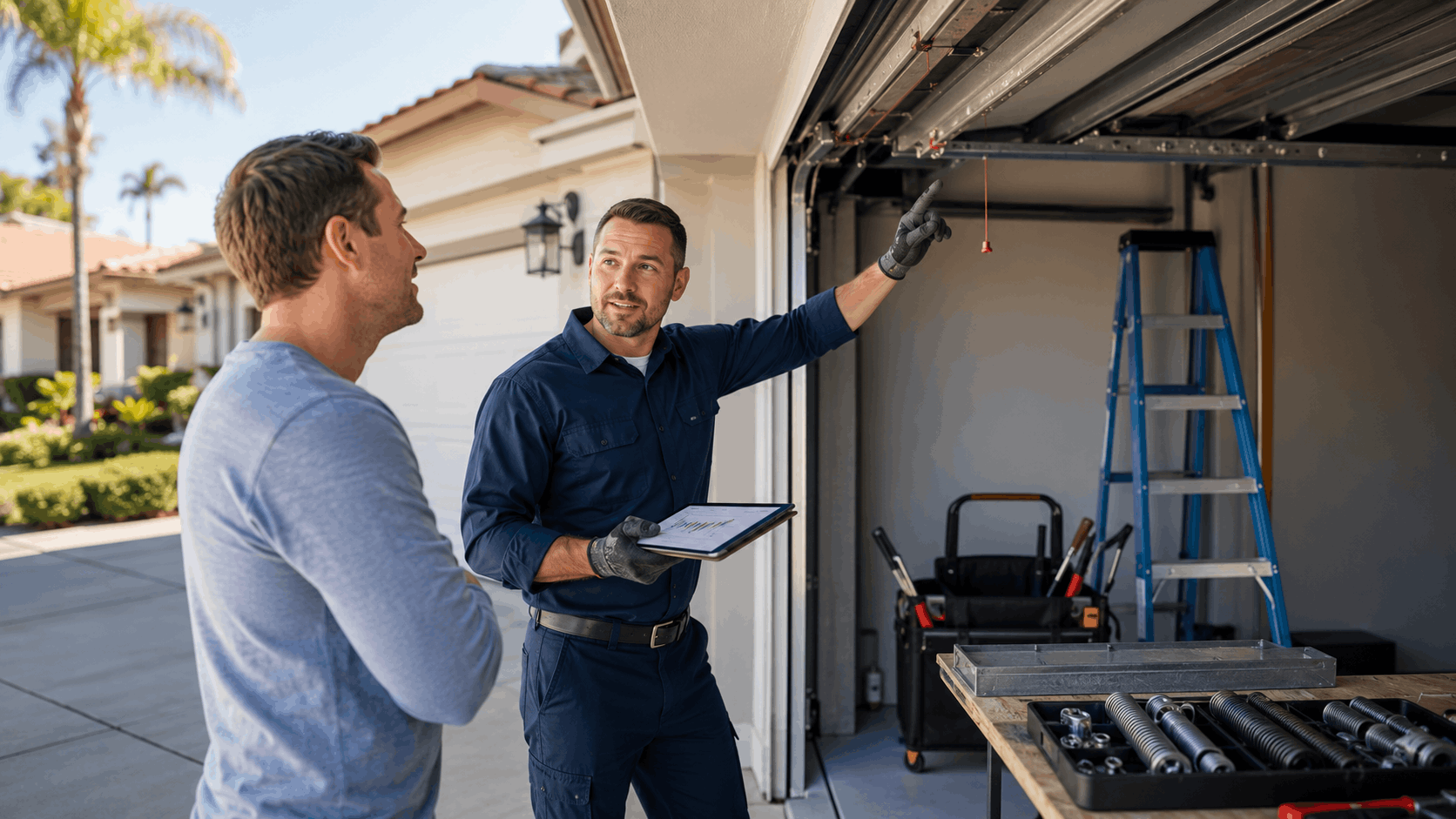
A garage door maintenance plan is a scheduled service agreement where a technician inspects, adjusts, and lubricates the moving parts of your door on a set timeline. The goal is to catch small problems while they are still cheap fixes. Most plans in Orange County run somewhere between $99 and $199 per year for a standard residential door.
There is a difference between a real hands-on tune-up and a marketing add-on. A genuine annual service means a trained person spends 30 to 60 minutes testing spring tension, balancing the door, and checking safety features. A marketing add-on is often a quick visual glance with a sticker on the wall. Knowing which one you are buying matters before you compare it to repair costs.
| Plan Type | What You Get | Typical Yearly Cost |
|---|---|---|
| Basic Tune-Up | One annual visit, lubrication, safety check | $99 - $129 |
| Standard Plan | Annual service plus repair discounts and waived trip fees | $130 - $169 |
| Premium Plan | Two visits per year, priority scheduling, larger discounts | $170 - $199 |
The Standard Tune-Up Checklist
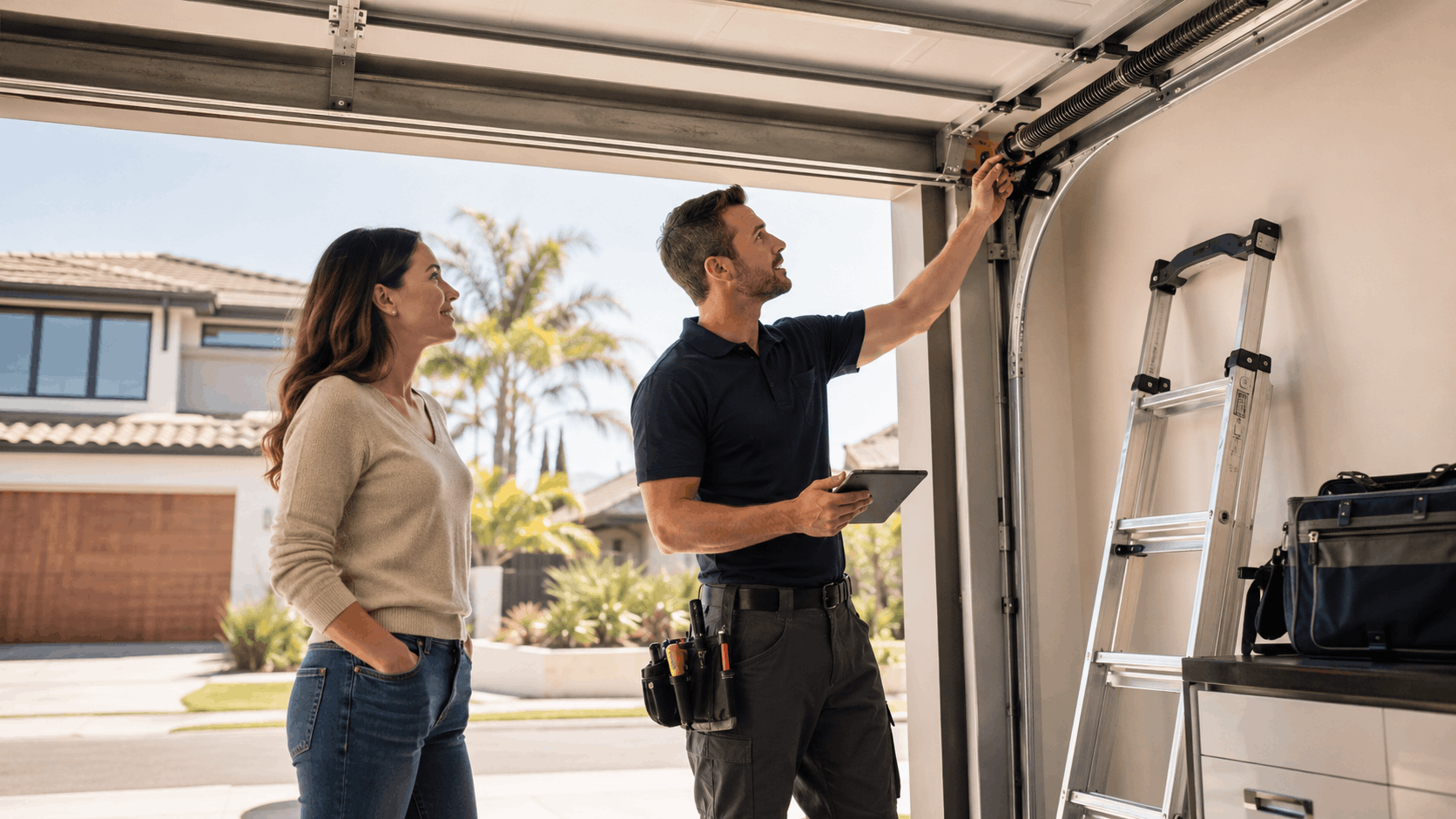
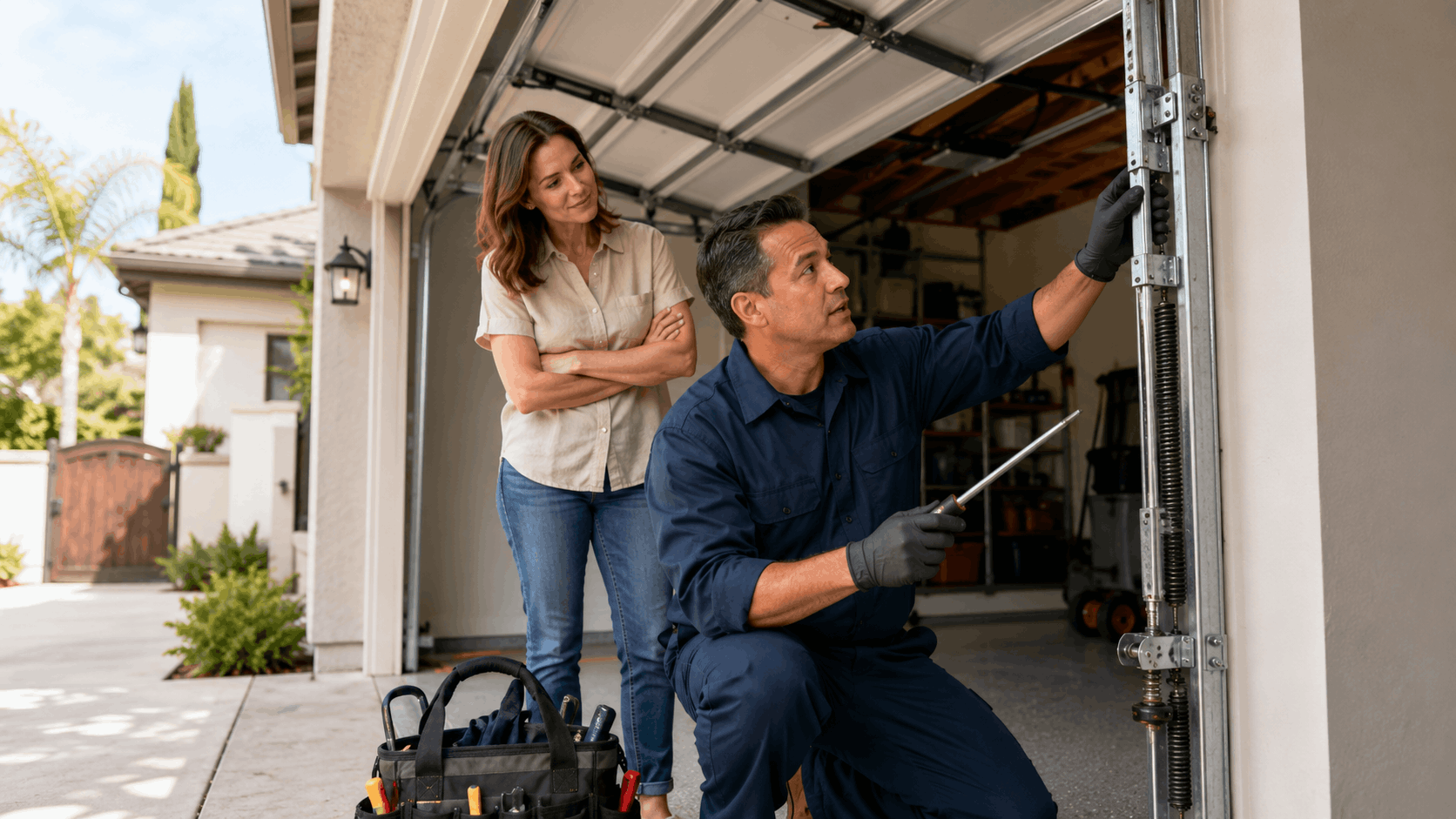
A proper tune-up starts with a spring inspection. The technician looks for gaps, rust, and stretched coils on your torsion or extension springs, then measures the tension so the door lifts evenly. Springs do the heavy lifting, so this single check prevents most sudden failures.
Next comes roller lubrication and a look at the cables. Rollers ride inside the tracks, and dry or cracked ones cause grinding and jerky movement. A tech greases the bearings, wipes down the tracks, and inspects the cables for fraying near the bottom brackets where they take the most strain.
Track alignment is another core step. Bent or loose tracks pull the door off its path, which stresses every other part. The technician tightens the mounting bolts, checks that the tracks sit plumb, and confirms the door travels straight from top to bottom.
Finally, the opener gets tested. That means checking the force settings, the auto-reverse safety feature, the photo-eye sensors, and the drive mechanism. A quick balance test at the end tells the tech whether the springs are still carrying the load correctly.
How Often Plans Schedule Visits
Most homes do fine with one annual visit. A two-car door that opens and closes four to six times a day sees roughly 1,500 to 2,000 cycles a year, which a yearly checkup handles comfortably. This is the sweet spot for a typical family in Turtle Rock or Northwood.
Heavy-use doors need biannual service. If your household runs multiple drivers, a home business, or a door that cycles more than eight times a day, two visits keep the wear in check. The same goes for detached workshops or doors used as the main entry.
Coastal humidity changes the service frequency too. Homes closer to the water pull in salty moisture that speeds up rust on springs and cables. For those properties we often recommend a second visit even when usage is light, simply because the air itself is corrosive.
Our team sets the schedule based on your door, not a one-size template. During the first visit we log the cycle count and location, then suggest whether annual or biannual service fits your situation best.
What Plans Do NOT Cover
A maintenance plan is not an insurance policy. Major part replacement, like a full torsion spring set or a new opener motor, is not included in the plan price. The plan covers inspection and adjustment, not the cost of large components that wear out.
Panel damage is another common exclusion. If a car backs into the door or a section cracks from age, that is a separate repair. The same applies to full opener swaps when a unit finally dies after 15 years of service.
These coverage limits are not a downside if you understand them. The plan keeps the door running well and flags parts before they fail. When a real part replacement is needed, that is where the member discount comes in, which softens the blow considerably.
We always spell out the exclusions in plain language before anyone signs up. Nobody should think a $150 plan covers a $400 spring job for free. Honest expectations keep our Irvine customers coming back.
Plan Perks Beyond the Tune-Up
The tune-up is only part of the value. Priority service means members jump the line when something breaks, which matters on a busy weekend when every home in Woodbridge seems to call at once. Getting seen same-day instead of waiting two days is worth real money.
Repair discounts are the other big perk. Most plans knock 10 to 20 percent off parts and labor when a repair is still needed. Over a few years, those preventive maintenance plan savings often cover the plan cost by themselves.
Waived service fees round out the membership perks. The standard trip charge, usually $49 to $89 just to get a truck to your driveway, gets dropped for members. That fee alone can offset most of a basic plan.
For Irvine homeowners who use their garage as the main door into the house, these extras add up fast. Fewer breakdowns and cheaper repairs turn a modest yearly cost into steady, predictable savings.
Get Your Free Quote
Tell us about your garage door and we'll get back to you within 30 to 60 minutes.
The Real Cost of a Broken Garage Door in Orange County
Before comparing a plan to repairs, it helps to know what repairs actually cost here. Orange County pricing runs a bit higher than the national average because of local labor rates and the cost of doing business in the area. A surprise garage door repair rarely lands under $150.
The tricky part is that failures are unpredictable. A spring can last eight years or blow at year four if it was never adjusted. When something snaps, you are often paying an emergency repair rate on top of the part itself.
| Repair Type | Typical OC Price Range | How Often It Happens |
|---|---|---|
| Torsion spring replacement | $250 - $450 | Very common |
| Extension spring replacement | $180 - $350 | Common |
| Cable repair | $120 - $220 | Common |
| Roller replacement | $100 - $200 | Moderate |
| Track repair or realignment | $150 - $300 | Moderate |
| Opener repair | $150 - $350 | Moderate |
| Opener replacement | $400 - $700 | Every 10-15 years |
Spring Replacement Price Range
Springs are the number one failure we see across Orange County. A torsion spring, the type mounted above the door on a metal shaft, typically runs $250 to $450 installed for a two-car door. The price climbs if the door uses a two-spring system, which most heavier doors do.
Extension springs, the long springs that run along the tracks on older or lighter doors, cost a little less at $180 to $350. They are more common on homes built before the mid-1990s in areas like Old Town Tustin. Either way, a broken spring stops the door cold.
Springs fail because they are rated by cycles, not years. A standard spring is built for around 10,000 cycles, which is roughly seven years of normal use. Skip maintenance and the tension drifts, the coils fatigue sooner, and the spring gives out early.
Our torsion spring replacement service always includes checking the balance afterward, since a fresh spring on a poorly balanced door just wears out again. We also offer extension spring replacement for the older track-mounted systems.
Cable, Roller, and Track Repairs
Cables and rollers are smaller jobs, but they rarely stay small when ignored. A frayed cable repair runs $120 to $220, while a set of new rollers lands between $100 and $200. Catch them early and the fix is quick and cheap.
The problem is the cascade effect. A worn cable that snaps can send the door crashing down, bend a track, and even damage a panel in one bad drop. Now a $150 cable job turns into a $500 repair with multiple parts.
Rollers work the same way. A single seized roller drags the door out of alignment, which strains the opener and grinds against the tracks. Left alone, that off-track condition needs a full off-track garage door repair instead of a five-minute roller swap.
Track repair falls in the $150 to $300 range depending on how much is bent. Our garage door cable repair and track realignment work almost always costs less when a tune-up flags the wear before the part fails outright.
Opener and Motor Failures
The garage door opener is the motor unit that does the automated lifting. A basic opener repair, such as replacing a worn gear or a bad circuit board, runs $150 to $350. Often the fix is cheaper than most people expect.
Motor replacement is a bigger decision. When the unit is more than a decade old and parts are hard to find, a full opener replacement at $400 to $700 makes more sense than pouring money into a dying motor. New units are quieter and safer too.
Power surges factor in heavily for older Orange County neighborhoods. Homes in places like Old Town Tustin and parts of Costa Mesa run on older electrical systems, and a surge can fry an opener board overnight. A surge protector is cheap insurance against that.
When it is time for a new unit, our garage door opener installation team handles the swap and can add smart access at the same time. For units worth saving, our opener repair and troubleshooting service usually gets them running again.
The Hidden Cost of Emergency Calls
The sticker price of a part is only part of the story. After-hours and weekend service carries a premium, often $75 to $150 above the normal rate. A spring that breaks at 7 p.m. on a Sunday costs more to fix than the same spring on a Tuesday morning.
Then there is the trapped-car problem. When the door will not open, your vehicle is stuck inside, and you may miss work or an appointment. That inconvenience has a real cost even if it never shows up on an invoice.
A broken door also leaves a home unsecured. A door stuck halfway open is an open invitation, and in busier areas near South Coast Metro that is a genuine worry. Many homeowners pay the emergency service fee just to close up the house safely.
Our same-day garage door repair team responds fast, and plan members skip the trip fee entirely. That is one more place where a maintenance membership quietly pays for itself.
Need Help in Irvine?
Urgent Garage Doors serves Irvine and all of Orange County.
The Breakage Math: Tune-Ups vs Repairs Side by Side
Here is the part everyone actually wants: the numbers. The comparison below uses typical Orange County prices to show how a maintenance plan stacks up against surprise repairs over time. Your own costs will differ with the door, the use it gets and where you are in the county, so treat this as the shape of the decision rather than a quote.
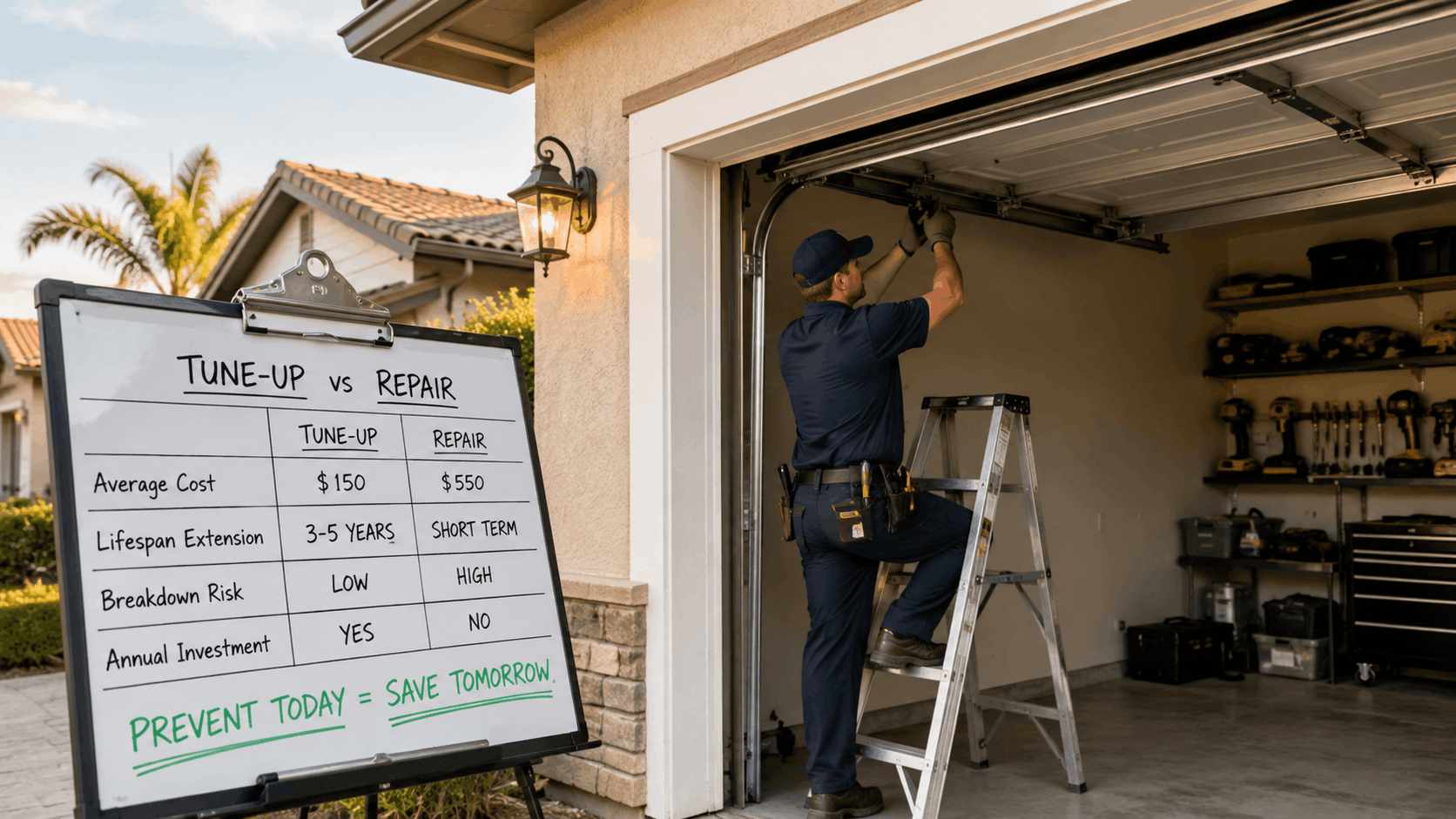
The short version is that maintenance savings come from prevention. A door that gets serviced yearly rarely hits the big-ticket failures, and when it does need a part, the member discount lowers the bill. A neglected door is a coin flip every year.
| Scenario | Year 1 | Year 3 | Year 5 | 5-Year Total |
|---|---|---|---|---|
| With annual plan ($150/yr) | $150 | $150 + $200 discounted repair | $150 | $950 |
| No plan (average repairs) | $0 | $400 spring | $250 cable + $150 emergency fee | $1,150+ |
Five-Year Cost Scenario for a Typical OC Home
Picture a two-car door in Woodbridge that opens six times a day. On a $150 annual plan, the homeowner spends $750 over five years on service. Add one discounted mid-cycle repair and the total lands near $950.
The same door with no plan sails along for a couple of years, then the spring breaks. That is $400 at emergency rates. Two years later a cable frays and takes a roller with it, another $400 with the after-hours fee.
Run the five-year budget scenario and the no-plan home spends $1,150 or more, and that assumes nothing catastrophic happens. The plan home spent less, avoided the stress, and never had a car trapped in the garage.
The gap widens on heavier-use doors and coastal homes. The more a door works and the harsher its environment, the more the plan pulls ahead in the repair math.
How Maintenance Reduces Failure Odds
Preventive maintenance works because most failures announce themselves early. A spring shows a hairline gap months before it snaps. A cable frays one strand at a time. A tech who sees the door yearly catches these signs while they are still cheap.
This is the domino effect in reverse. A $50 lubrication and adjustment keeps a roller from seizing, which keeps the door on track, which keeps the opener from straining. Skip that step and the $50 fix becomes a $400 chain reaction.
Wear detection also lets us plan repairs on your schedule. Instead of an emergency at 7 p.m., you get a heads-up that a spring is near the end of its life and a chance to replace it during a normal weekday visit at the normal rate.
Over years, this failure prevention is where the real savings live. It is not one dramatic moment, it is the steady avoidance of surprise breakdowns that would otherwise stack up.
When a Plan Does NOT Pay Off
We will be straight with you: a plan does not always make sense. A brand-new garage door with factory springs and a fresh opener is unlikely to need much for the first two or three years. During that window, a plan may cost more than you save.
Light usage changes the math too. A retired couple in a single-story Turtle Rock home who open the door once a day put very few cycles on the system. Their break-even point stretches further out because their parts simply last longer.
If your door is under three years old and barely used, an every-other-year checkup might serve you better than a full plan. We would rather tell you that honestly than sell you something you do not need.
The plan shines on doors that are five years or older, used heavily, or exposed to salt air. That is where the break-even math flips firmly in your favor.
Factoring in Door Lifespan Extension
The biggest savings do not show up on any single invoice. Regular service extends door lifespan and opener longevity, which pushes the biggest expense of all, full replacement, years down the road. A new door and opener can run $1,500 to $4,000 installed.
A well-maintained door often lasts 20 to 25 years, while a neglected one may need replacement at 12 to 15. Stretching that timeline by even five years spreads the replacement cost across far more time, which lowers your true yearly cost of ownership.
Openers respond to care the same way. Balanced doors mean the motor lifts less weight, so it runs cooler and lasts longer. A strained opener burns out gears and boards years early.
When replacement finally does arrive, our garage door installation team can walk you through options, but a good plan means you reach that day on your own timeline instead of after a breakdown.
How Orange County Climate Changes the Numbers
Where your home sits in Orange County matters more than most people think. Coastal salt air and inland heat wear parts in completely different ways. The same door can need very different care depending on its zip code.
Climate is why we do not quote a single service schedule for the whole county. A home in Newport Beach faces corrosion, while a home in inland Irvine faces heat and dried-out lubricant. Both shorten part life, just through different paths.
Salt Air Near Newport Beach and the Coast
Homes near the water breathe salty, humid air every day. That coastal humidity settles on metal parts and speeds up rust on springs and cables far sooner than inland conditions. We see corrosion on Balboa Peninsula doors that would take much longer to appear in Irvine.
Salt corrosion attacks the thin steel of a spring coil first. A rusted spring loses strength and snaps early, sometimes years ahead of its cycle rating. Cables suffer the same fate, fraying from the inside where the rust hides.
Rust prevention is the main reason coastal homes benefit from biannual service. A tech can clean and re-coat the hardware, apply corrosion-resistant lubricant, and swap parts before rust does its worst. Homes in Balboa Peninsula especially see the payoff.
For these properties, galvanized or coated springs are worth the small upcharge. They resist the salt air and hold up much longer near the coast.
Inland Heat in Irvine and Tustin
Inland neighborhoods trade salt for heat. Summer temperatures in Northwood and Turtle Rock bake the garage, and that heat stress dries out lubricant sooner than anywhere near the coast. Once the grease breaks down, metal grinds on metal.
Lubricant breakdown is the quiet killer inland. Dry rollers and hinges force the opener to work harder, which raises the motor temperature and shortens its life. Openers in hot garages fail years before those in cooler, coastal ones.
The inland climate also expands and contracts metal parts daily. That constant movement loosens hardware and shifts track alignment over a summer. A fall tune-up catches the drift before it becomes a problem.
For homes in Turtle Rock and nearby Tustin, we time visits to hit before peak summer so the door enters the hot months with fresh lubricant and tight hardware.
Older Homes vs New Developments
Age of the home matters as much as location. Aging doors in areas like Old Town Tustin often run original hardware from the 1980s or earlier. Those systems need closer attention because every part is near the end of its life.
Newer builds tell a different story. Homes in the Great Park communities and other recent developments come with modern doors, sealed openers, and higher-cycle springs. They can stretch service intervals a little further in the early years.
That said, new construction is not maintenance-free. Builder-grade hardware is often the cheapest option that meets code, so those factory rollers and springs may wear out sooner than homeowners expect once the door hits a few thousand cycles.
We treat an Old Town Tustin home and a Great Park townhome very differently. One needs restoration and close monitoring, the other needs light upkeep and a plan to upgrade builder parts as they wear.
Need Help in Irvine?
Urgent Garage Doors serves Irvine and all of Orange County.
Warning Signs Your Door Needs Service Before It Breaks
The whole point of maintenance is catching trouble early, and your door usually warns you first. Learning these garage door warning signs helps you call before a small issue becomes a stuck car. A noisy door or a slow opener is the door asking for help.
Most of our emergency calls could have been routine visits if the homeowner had acted on the first symptom. Here are the signs worth watching for.
- New or louder noises - grinding, squealing, or popping that was not there before
- Uneven movement - the door shakes, jerks, or looks crooked as it travels
- Slow or hesitant response - a lag after you press the button, or a door that reverses on its own
- Visible spring problems - a gap in the torsion spring or a door that suddenly feels heavy
Grinding, Squealing, and Popping Sounds
A noisy garage door is a common complaint we hear. A grinding sound usually points to dry rollers or worn bearings dragging in the track. It is a metal-on-metal warning that lubrication is overdue.
Squeaking and squealing tend to come from dry hinges and rollers too, but a sharp squeal can also mean the springs need attention. Customers often describe it as a fingernails-on-a-chalkboard noise every morning.
A loud pop or bang is the one to take seriously. That sound often means a spring has snapped or a cable has let go. When homeowners in Woodbridge call saying they heard a gunshot in the garage, it is almost always a broken spring.
Each noise maps to a part, and none of them get better on their own. Catching the grind before the pop is exactly what a tune-up is for.
Uneven or Jerky Movement
A door should glide up and down in one smooth motion. Jerky movement, where it stutters or pauses mid-travel, points to a cable or roller problem. Something is catching, and the door is fighting to keep moving.
An uneven door that looks crooked or higher on one side signals a track or cable issue. One cable may be stretching or slipping off its drum, letting that side lag behind the other. That imbalance strains everything else.
Left alone, a track problem gets worse with every cycle. The door drifts further out of line until a roller jumps the track completely, and then it is stuck at an angle. That is a full off-track repair instead of a quick adjustment.
If your door no longer moves in a straight, even line, that is your cue to call before it seizes entirely.
Slow Response or Reversing
A slow opener that lags after you press the button often has worn gears or a failing motor. The delay grows over time until one day it simply does not respond. Acting on the early lag saves the motor.
A door that reverses before it reaches the floor usually has a sensor issue. The photo-eye sensors near the bottom of the tracks may be dirty, knocked out of alignment, or failing. Sometimes a quick lens cleaning fixes it.
Other times, reversing points to force settings that need adjustment or a control board on its way out. Our safety sensor alignment repair handles the common sensor faults quickly.
Any change in how the opener responds is worth a look. These small opener quirks are the early chapters of a bigger failure story.
Sagging or Loose Springs
A loose spring or a visible gap in the torsion coil is a red flag you can spot yourself. Healthy torsion springs are tightly wound with no separation between the coils. A gap means the spring has already broken or is about to.
A heavy door is the other tell. If you disconnect the opener and the door slams down or is hard to lift by hand, the springs have lost their tension. They are no longer carrying the weight they should.
This is dangerous territory. A door with failing springs puts all that load on the opener and the cables, which are not built to hold it. That is when cables snap and doors come down hard.
If you see a spring gap or feel a heavy door, stop using it and call. Our door balancing and tension adjustment service restores the load to where it belongs.
What Homeowners Can Do Themselves vs Leave to a Pro
Not every task needs a technician. Some DIY garage door maintenance is genuinely safe and helps your door last longer between professional visits. The trick is knowing where the safe upkeep ends and the dangerous work begins.
We are happy to teach the safe tasks, because a homeowner who lubricates their rollers has fewer emergencies. We are just as firm about the jobs that send people to the ER. Here is the honest line.
Safe DIY Tasks Anyone Can Handle
Lubrication is the best DIY habit you can build. A few times a year, wipe the rollers, hinges, and springs, then apply a garage-door-specific lubricant. Skip the WD-40, which cleans more than it lubricates, and use a proper silicone or lithium spray.
Tightening hardware is another safe job. The vibration of daily use loosens the bolts and brackets that hold the tracks and hinges. A quick pass with a socket wrench on the visible hardware keeps everything snug and quiet.
Sensor cleaning takes two minutes and solves a lot of headaches. Wipe the small photo-eye lenses near the floor with a soft cloth, and make sure nothing is blocking their line of sight. Dirty sensors are behind many reversing-door complaints.
These simple steps stretch the time between failures and make your professional tune-ups more effective. None of them put you anywhere near the dangerous parts.
Jobs That Require a Technician
Spring adjustment is where DIY has to stop. Torsion springs hold enormous tension, and a slip while adjusting them can break bones or worse. This is not a job for a homeowner with a YouTube video and a pair of pliers.
Cable repair carries the same safety risk. The cables work directly with the springs under high load, and a cable can whip loose with real force. Replacing one wrong turns a repair into an injury.
Opener force and travel adjustments also belong with a pro. Set them wrong and the door either will not close or slams shut without the safety reverse working. Both are hazards, especially with kids or pets around.
Our team carries the right tools and training for this work through our spring and cable repair service. The cost of a pro is small next to a trip to the emergency room.
Why a Balance Test Matters
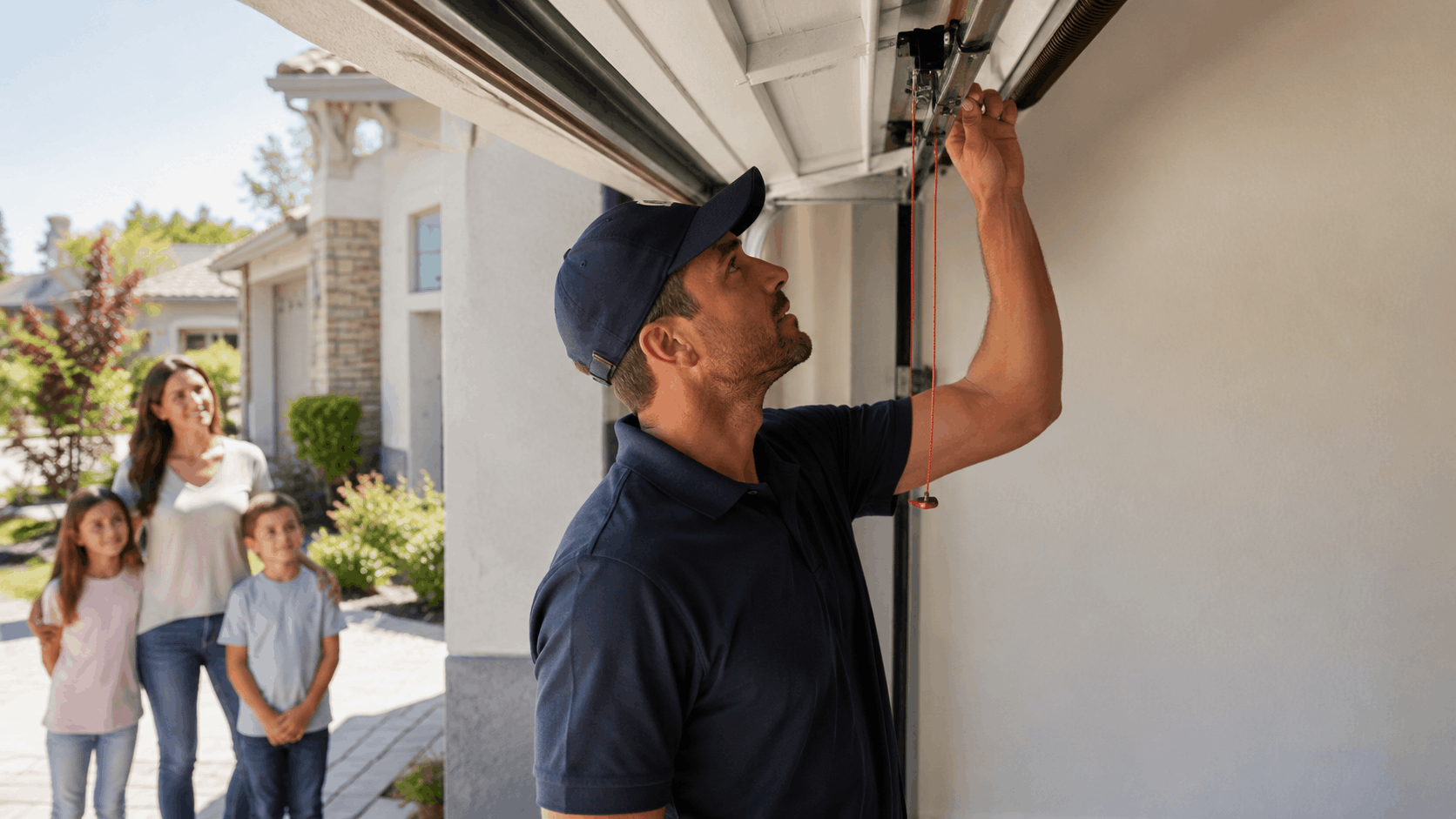
The balance test is the one diagnostic every homeowner should know. Close the door, pull the red release cord to disconnect the opener, then lift the door by hand to about waist height and let go. A balanced door stays put.
If the door slides down or shoots up, the spring tension is off. That failing result means the springs are no longer holding the door weight correctly, which is a warning of coming failure and extra strain on the opener.
Run this test a couple of times a year. It takes 30 seconds and tells you more about spring health than almost anything else you can check without tools.
If your door fails the balance test, do not try to fix the tension yourself. That is the pro line again. Reconnect the opener, use the door carefully, and schedule a service visit.
Need Help in Irvine?
Urgent Garage Doors serves Irvine and all of Orange County.
How Urgent Garage Doors Handles Maintenance in Irvine
We are a local team based in Irvine, and we work these neighborhoods every day. That means we know the doors in Woodbridge, the salt exposure in Newport, and the builder hardware in the newer Irvine villages. Our maintenance approach reflects what we actually see in these driveways.
Our goal on every visit is simple: keep your door safe, quiet, and running for years. Whether that is a plan tune-up or a one-time repair, the work is the same standard.
Our Tune-Up Process Step by Step
A visit starts with a scheduled arrival window, and our local technician calls ahead so you are not waiting around all day. When we arrive, we test the door in its current state before touching anything, so we can see the real-world symptoms.
Then comes the full service. We inspect and lubricate the springs, rollers, cables, and hinges, check and tighten the tracks, test the opener force and safety reverse, align the sensors, and run a balance test. Each step follows the same checklist so nothing gets skipped.
Before we leave, we hand over a written inspection report. It lists what we adjusted, what looks healthy, and anything showing early wear with a rough timeline. No surprises and no pressure, just a clear picture of your door.
If a repair is needed, we quote it on the spot and let you decide. You can find our full maintenance and upgrade services laid out on our site.
Service Areas Across Orange County
We cover a wide stretch of the county from our Irvine base. That includes Woodbridge, Turtle Rock, Northwood, and Portola Springs here in Irvine, plus the surrounding cities where our trucks run daily.
Beyond Irvine, we regularly serve Lake Forest, Tustin, Costa Mesa, Newport Beach, and Orange. Coastal or inland, older home or new build, we adjust the service to fit the location.
Because we know these areas, we can plan routes efficiently and reach members fast when something breaks. A tech who already works your street gets to you quicker than one crossing the county.
If you are not sure whether you are in our range, our locations page lists every city we cover across Orange County.
How Members Get Priority When Parts Fail
Even a well-maintained door eventually needs a part, and that is where membership earns its keep. Plan members get priority scheduling, which means you move to the front of the line on busy days. A stuck car in the morning gets a same-day slot.
Members also get a repair discount on parts and labor, plus the waived trip fee. Combined, those perks often cover the annual plan cost in a single repair visit.
For true emergencies, our 24/7 emergency garage door repair line keeps you covered outside normal hours. Fast response is the whole point when your home is left open or your car is trapped.
This blend of prevention and priority is what makes a plan work. You avoid most breakdowns, and the ones you cannot avoid get handled quickly and cheaper.
Final Thoughts
For most Orange County homes older than three years or in a coastal zone, a garage door maintenance plan saves money over five years and spares you the surprise breakdowns. Newer, lightly used doors can wait a bit longer, and we will tell you so honestly.
The breakage math is clear: prevention costs less than emergency repairs, and it extends the life of your whole system. Catching a worn part during a tune-up beats replacing a snapped one on a Monday morning every time.
If you want to know whether a plan makes sense for your specific door, our Irvine team is happy to take a look. Contact Urgent Garage Doors or call us today for a straightforward consultation on your garage door and the right maintenance fit.
Frequently Asked Questions
- How often should a garage door be serviced in Orange County?
- Most homes do well with one annual service visit, which handles a typical door that cycles a few times a day. Coastal homes near Newport Beach and heavy-use doors benefit from service twice a year, because salt air and high cycle counts wear parts out sooner. Our team sets the schedule based on your door's location, age, and daily use rather than a fixed rule.
- How much does a garage door tune-up cost in OC?
- A single one-time tune-up visit in Orange County typically runs $89 to $149, depending on the door and what needs adjusting. An annual maintenance plan usually costs between $99 and $199 per year, and often includes repair discounts and waived trip fees. For homes that use the garage daily, the plan usually costs less over time than paying for one-off visits and surprise repairs.
- How long do garage door springs last?
- Springs are rated by cycles rather than years, with a standard spring built for around 10,000 cycles. For an average household that opens the door four to six times a day, that works out to roughly seven to nine years. Heavy use shortens it, and rust from coastal salt air can cut it further. Regular tension adjustments during a tune-up help springs reach their full rated life.
- Does a maintenance plan really save money?
- For most homes older than three years, yes. Our five-year math shows a plan home spending around $950 including one discounted repair, while a no-plan home averages $1,150 or more once emergency springs and cables add up. The savings come from prevention and member discounts. Brand-new or very lightly used doors are the exception, where a plan may not pay off in the first couple of years.
- What is a common garage door repair?
- Broken springs top the list by a wide margin. Springs carry the full weight of the door and are rated for a limited number of cycles, so they naturally wear out and snap. When a spring breaks, the door usually will not open at all, which turns it into an urgent repair. Coastal rust and skipped maintenance both push springs to fail earlier than their rating.
- Can I do garage door maintenance myself?
- Some of it, safely. Lubricating rollers and hinges, tightening visible hardware, and cleaning the photo-eye sensors are all fine for homeowners. What you should never do yourself is adjust or replace springs and cables, since they hold dangerous tension and cause serious injuries every year. Leave any spring, cable, or opener force work to a trained technician with the proper tools.
- Why does my garage door make so much noise?
- Noise usually points to dry or worn parts. Grinding often means dry rollers or bad bearings, while squealing comes from hinges and rollers needing lubricant. A loud pop or bang is more serious and often signals a broken spring or cable. Start by lubricating the moving parts and checking for loose hardware, but a sudden bang means you should stop using the door and call a pro.
- How long does a garage door repair take?
- Common repairs are same-day jobs. A spring replacement typically takes 45 minutes to 90 minutes, cable and roller work runs about an hour, and an opener repair usually takes one to two hours. A full opener replacement or major track work can take a couple of hours. Plan members get priority scheduling, so the wait to get a technician out is usually shorter.
- Do coastal OC homes need more frequent service?
- Yes. Homes near the water, like those on Balboa Peninsula or in Seacliff, breathe salty, humid air that speeds up rust on springs and cables. That corrosion weakens metal parts and causes them to fail earlier than they would inland. We recommend twice-yearly service for coastal homes, along with coated or galvanized hardware that resists salt air much better than standard parts.
- Does Urgent Garage Doors offer same-day repairs?
- We do, and same-day service is a core part of what we offer across Orange County. Plan members receive priority scheduling, so they move to the front of the line when a door breaks unexpectedly. For after-hours failures, our 24/7 emergency line keeps you covered whenever a door leaves your home unsecured or a car trapped inside. Response times are fastest in the neighborhoods our trucks run daily.
Licensed garage door repair professionals serving Irvine and Orange County.
Licensed in California · License #1055150
Why trust Urgent Garage Doors?
Founded in 2017, Urgent Garage Doors is a licensed and insured garage door services serving Irvine and Orange County. All content is reviewed by our licensed technicians.

Need Help in Irvine?
Urgent Garage Doors serves Irvine and all of Orange County.
Related Articles
Broken Garage Door Spring Repair Cost Newport Beach vs Anaheim: Why Pricing Varies
Compare broken garage door spring repair costs in Newport Beach vs Anaheim, why coastal prices run higher, and how to read quotes without getting overcharged.
Garage Door Financing in Orange County: What Payment Options Exist and When They Make Sense
A local guide to garage door financing in Orange County, covering cash, credit cards, installment plans, and HELOCs, plus when each option makes sense for Irvine homeowners.
Garage Door Panel Replacement vs Full Door Replacement in Orange County
Should you replace one damaged garage door panel or the entire door? This guide covers costs, timelines, HOA rules, and local Orange County factors to help you decide.