Steel Gauge Explained: 24 vs 25 vs 27 and What OC Coastal Air Does to Each
Key Takeaways
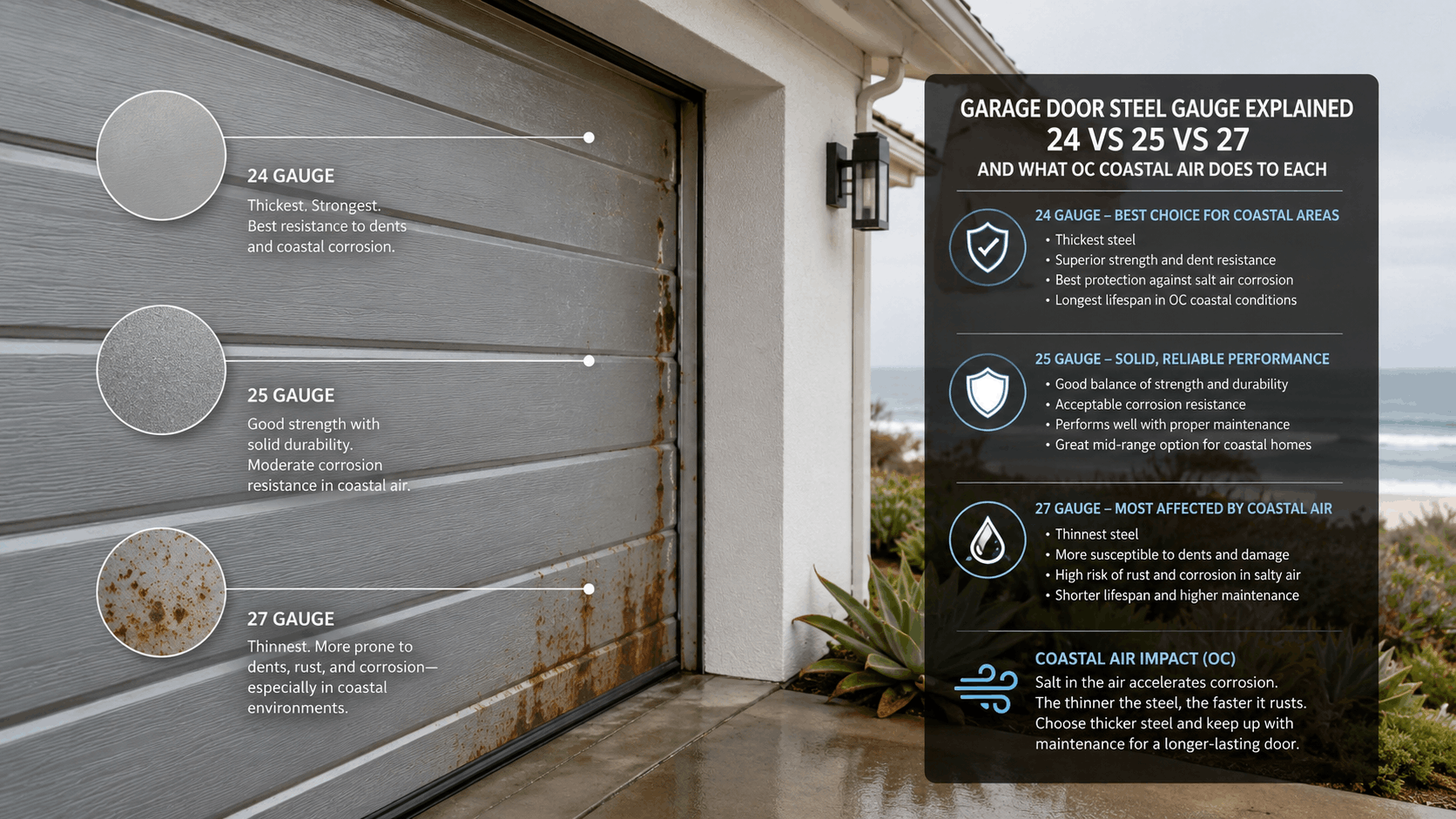
- A lower gauge number means thicker, stronger steel, so 24 gauge is heavier than 25 or 27 gauge.
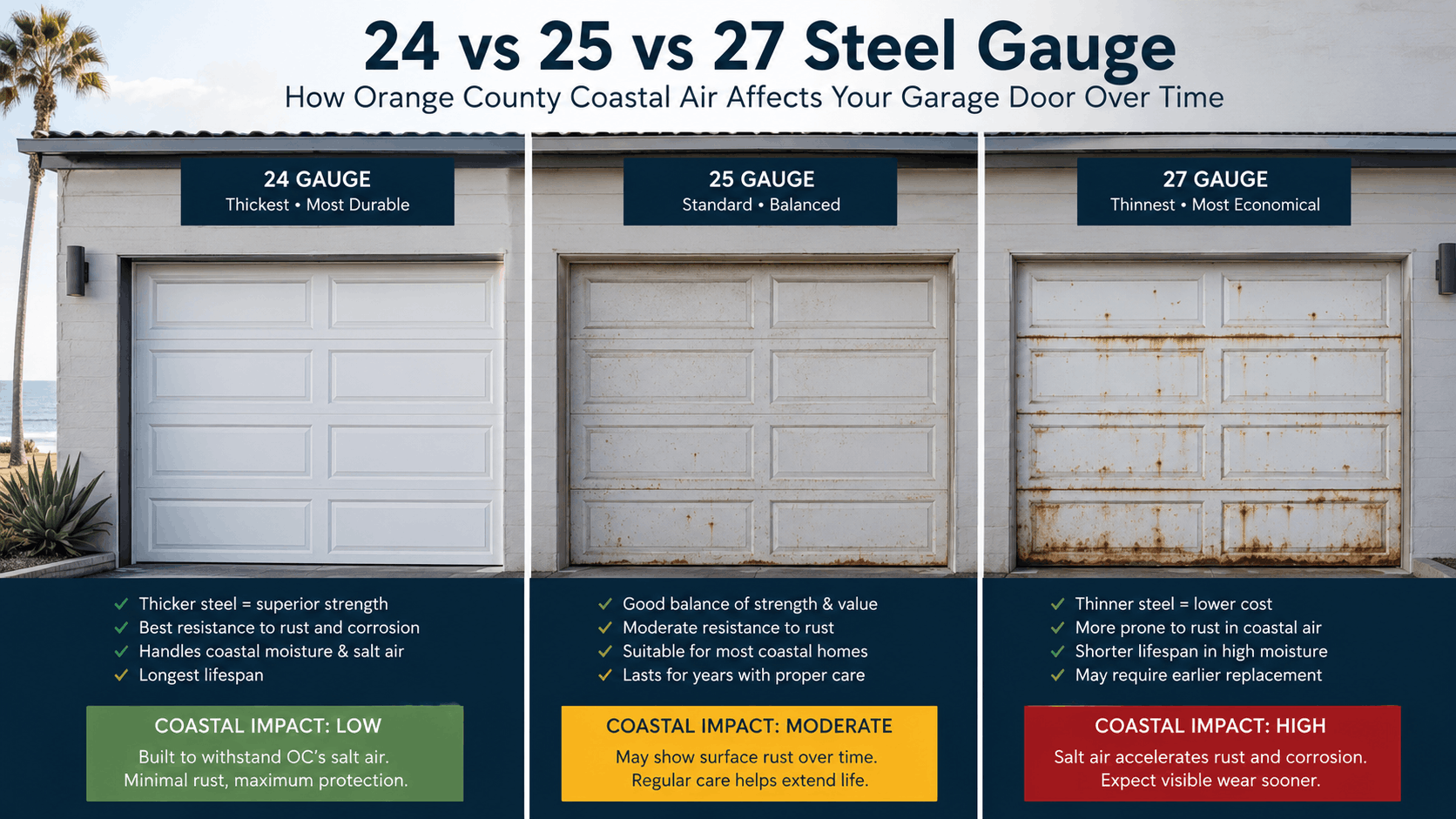
- 27 gauge is thin builder-grade steel that dents easily and rusts fast near the coast, often failing in 8 to 12 years.
- 25 gauge is the popular mid-grade choice and works well for most inland Irvine neighborhoods like Woodbridge and Northwood.
- 24 gauge with heavy galvanized coating is the best pick for coastal homes and can last 20 to 30 years with care.
- Salt, marine layer fog, and humidity in Orange County speed up rust, especially on ridges like Turtle Rock and near the Newport Coast border.
- Regular rinsing, quick paint touch-ups, and lubricated hardware add years of life to any steel door.
- Most Irvine HOA communities restrict door style and color but not gauge, so homeowners can upgrade steel while staying compliant.
- Urgent Garage Doors offers on-site assessments, installation, and same-day repair matched to each home's exact coastal exposure.
In This Article
A homeowner in Turtle Rock called us last spring about orange streaks running down her white garage door. She had lived there six years and never thought twice about the door until the paint started bubbling near the bottom panel. Her neighbor two streets over had a similar door that still looked new. The difference came down to one thing most people never think about when they buy a house: the steel gauge.
Those little numbers on the spec sheet - 24, 25, 27 - decide how thick the steel on a door actually is. And here in Orange County, where salty marine air rolls in off the water every morning, that thickness matters more than almost anywhere else in the country. A door that lasts 25 years in Arizona might start rusting in eight years a few miles from the beach.

What Steel Gauge Actually Means on a Garage Door
Steel gauge is just a way to measure how thick the sheet metal on a garage door is. The number does not tell you the price, the color, or the style. It only tells you how much actual steel stands between your garage and the outside world.
Most residential garage doors in Irvine use one of three common gauges. Here is what those numbers cover:
- 27 gauge - the thinnest common option, usually found on builder-grade doors
- 25 gauge - the middle choice most builders default to
- 24 gauge - the thickest common residential steel, built for heavy use and rough conditions
Once a homeowner knows how to read that number, choosing the right door gets a lot easier. The tricky part trips almost everyone up the first time.
Why a Lower Gauge Number Means Thicker Steel
Here is the part that confuses buyers most: a lower gauge number means thicker steel. A 24 gauge door is stronger and heavier than a 27 gauge door, even though 24 is the smaller number. It feels backwards, but that is how the system works.
The reason goes back to old manufacturing days when gauge counted how many times metal got passed through rollers to thin it out. More passes meant a higher number and a thinner sheet. So the count grew as the metal got thinner, which is why the numbers run opposite to what you would expect.
When we explain steel measurement to homeowners on a job, we tell them to think of it like this: smaller number, bigger muscle. A 24 gauge panel resists dents far better than a 27 gauge panel. That single fact changes how a door holds up to basketballs, bumpers, and years of coastal weather.
Keeping that rule in mind stops people from overpaying for a thin door or assuming a high number means high quality. Lower gauge, thicker steel. That is the whole trick.
How Gauge Is Measured in Thousandths of an Inch
Steel thickness gets measured in thousandths of an inch, and the real numbers help paint the picture. A 27 gauge panel runs roughly 0.016 to 0.018 inches thick. That is about as thick as a few sheets of printer paper stacked together.
A 25 gauge panel comes in around 0.019 to 0.022 inches. It does not sound like a huge jump, but that extra material makes a real difference in how the panel holds its shape under pressure.
A 24 gauge panel measures roughly 0.023 to 0.028 inches. Compared to 27 gauge, that is close to a 40 percent increase in thickness. A gauge chart makes the pattern clear, and the U.S. government publishes standard thickness tables that manufacturers follow. You can review official steel thickness references from the National Institute of Standards and Technology if you want the exact figures.
The takeaway is simple. Even small changes in steel thickness inches translate into big changes in strength and durability once a door faces daily use and salty air.
Single-Layer vs Double and Triple-Layer Doors
Gauge is only part of the story. How the door is built around that steel matters just as much. A single-layer door is one sheet of steel with nothing behind it. It is light, cheap, and the most likely to flex or dent.
A double-layer door adds a layer of insulation, usually polystyrene, bonded to the back of the steel. A triple-layer door sandwiches insulation between two steel skins, which stiffens the whole panel. That construction makes even a thinner outer skin behave more like a solid slab.
An insulated garage door does more than block heat. The backing supports the steel face, so it resists bowing and dents better than bare steel of the same gauge. We often steer Irvine homeowners toward an insulated steel garage door because the layer construction adds strength and cuts down on garage heat during those long summer afternoons.
So when comparing two doors, always ask about both the gauge and the layer construction. A triple-layer 25 gauge door can outperform a single-layer 24 gauge door in real-world stiffness.
Where Gauge Fits Among Other Quality Factors
Steel gauge sets the foundation for door durability, but it never works alone. The galvanized coating on the steel decides how well the panel fights rust. Thicker zinc coating buys more years before corrosion starts, especially near salt water.
Hardware quality matters too. Cheap rollers, thin tracks, and low-cycle springs wear out long before a good steel panel does. We have replaced plenty of springs on doors where the panels still looked fine, which is why our spring and cable repair crew stays busy year-round.
Finish quality rounds out the picture. A baked-on primer and topcoat holds up far better than a thin painted layer. That finish is the first defense against the salty moisture that coats Irvine doors most mornings.
The point is that gauge, galvanized coating, hardware, and finish all work together. A smart buyer weighs all four instead of chasing one number.
Get Your Free Quote
Tell us about your garage door and we'll get back to you within 30 to 60 minutes.
27 Gauge Steel: The Thin Builder-Grade Option
When a home in Irvine comes with a garage door the builder installed, there is a good chance it is 27 gauge steel. This is the thin steel door builders reach for when they want to keep costs down. It looks fine on move-in day, but it rarely holds up the way homeowners hope.
A builder grade door serves its purpose at the low end of the market. The problem is that 27 gauge steel is the thinnest common option, and near the coast that thinness turns into a liability fast.
| Feature | 27 Gauge Detail |
|---|---|
| Thickness | 0.016 - 0.018 inches |
| Typical use | Builder-grade tract homes, entry-level replacements |
| Dent resistance | Low |
| Coastal lifespan | Roughly 8 - 12 years |
| Price range | Lowest of the three |
Common Uses and Typical Price Range
27 gauge doors show up most on tract homes and budget projects. If a developer built a whole street of houses at once, the garage doors were almost certainly chosen to hit a price target. That usually means the thinnest steel that met code.
The 27 gauge price is the main appeal. An entry level door in this gauge often runs several hundred dollars less than a comparable 25 or 24 gauge model. For a house flip or a rental property far from the water, that savings can make sense.
Homeowners can often spot a 27 gauge door by feel. Push lightly on the middle of a panel and it flexes with almost no effort. That flex is the thin steel telling you what it is.
For a primary home near the coast, though, the low price up front tends to cost more later in repairs and early replacement.
How Easily It Dents and Bows
Thin steel dents easily, and 27 gauge is the easiest of the three to damage. A kid's basketball, a bumper tap while backing out, even a heavy branch in a windstorm can leave a permanent dent. Those door dents do not pop back out on their own.
Heat makes it worse in Orange County. When the afternoon sun bakes a west-facing door, thin steel expands unevenly and can develop a wavy look across the panels. That thin steel bowing shows up most on wide two-car doors with long unsupported spans.
We get calls in Woodbridge and Northwood every summer about doors that suddenly look warped. In many cases the panel was fine in spring and only started bowing once the heat climbed. Thicker steel handles that thermal stress far better.
Once a 27 gauge panel dents or bows, repair is often not practical. That is when our panel replacement service comes into play, though upgrading the whole door is sometimes the smarter spend.
Why It Struggles Closest to the Ocean
Near the water, 27 gauge steel faces its toughest test. Salt air corrosion attacks the thin steel and limited coating together, giving rust an easy path in. The less zinc protection on a budget panel, the sooner the trouble starts.
Once salt works through the coating, it reaches the bare steel underneath. On a thin 27 gauge panel there is very little metal to lose before rust eats all the way through. Coastal rust that would take years to matter on thick steel can perforate a thin panel much sooner.
Morning fog keeps the door damp for hours, which speeds the whole process. Homes along the Newport Coast border and the higher Turtle Rock ridgelines catch that moist air first. We have pulled 27 gauge doors off homes near the coast that were rusting through in under a decade.
For anyone living where they can smell the ocean, 27 gauge is the gauge we steer away from every time.
Need Help in Irvine?
Urgent Garage Doors serves Irvine and all of Orange County.
25 Gauge Steel: The Popular Middle Choice
25 gauge steel is a common residential garage door choice in Irvine, and for good reason. It sits right in the middle, offering more strength than builder-grade steel without the price jump of the heavy stuff. For a lot of homes, this mid-grade door is the sweet spot.
The question is whether the middle choice is enough for a specific location. In much of Irvine it is. Closer to the water, it depends on the coating and construction.
| Feature | 25 Gauge Detail |
|---|---|
| Thickness | 0.019 - 0.022 inches |
| Typical use | Standard residential replacements and upgrades |
| Dent resistance | Moderate |
| Coastal lifespan | Roughly 12 - 18 years |
| Price range | Mid-level |
The Balance of Cost and Strength
The 25 gauge cost lands between the budget and premium tiers, which is why builders and homeowners both gravitate to it. It usually runs a few hundred dollars more than 27 gauge and a few hundred less than 24 gauge. That middle price is easy to justify.
The strength gain over 27 gauge is real. That extra thickness resists everyday bumps and holds its shape better under heat. For a value door that still feels solid, 25 gauge delivers.
Most homeowners never notice a downside inland. The steel is stiff enough that panels do not flex much when pushed, and the door feels substantial when it moves.
For a home that sits well back from the coast, spending up to 24 gauge often is not necessary. The money can go toward better insulation, a quieter opener, or upgraded hardware instead.
How It Handles Daily Wear
Dent resistance is where 25 gauge earns its reputation. It shrugs off the small stuff that dents thin steel: a bike leaning against it, a stray ball, a light bump from a car door. Those everyday impacts leave a mark on 27 gauge but often bounce off 25 gauge.
Everyday durability also shows in how the panels age. A 25 gauge door tends to hold its finish and shape for well over a decade with basic care. The stiffer steel does not warp as readily in the summer heat.
Families with kids and busy driveways tend to be happy with this gauge. It takes the normal abuse of a household without complaint. We rarely get panel damage calls on 25 gauge doors that were not hit hard by a vehicle.
That reliability is a big part of why it stays the default recommendation for most inland Irvine homes.
Coastal Performance in Inland Irvine Neighborhoods
25 gauge holds up well in the inland performance zone, which covers a lot of Irvine. Neighborhoods farther from the water get less direct salt exposure, so a quality-coated 25 gauge door can last the better part of two decades. In Woodbridge, the marine influence is mild by the time the air reaches those streets.
Northwood Irvine sits even farther inland, tucked up near the foothills. Doors there see hot afternoons more than salty mornings, and 25 gauge handles that heat fine when the steel has a solid galvanized layer. We install a lot of mid-grade doors in that part of town without hesitation.
The same holds for Woodbury and the communities around Jeffrey Road. These areas get the occasional damp marine morning, but not the constant salt bath that coastal homes deal with. A 25 gauge door with a baked-on finish stands up to it.
For these inland pockets, stepping up to 24 gauge is a nice-to-have rather than a need. The mid-grade choice makes sound financial sense.
When to Skip It for a Thicker Option
There are times we tell homeowners to upgrade steel gauge past 25. The clearest case is proximity to the ocean. If a home sits within a couple of miles of the water or on a ridgeline that catches the marine layer, a thicker door pays off.
West-facing doors that take brutal afternoon sun are another case. The extra thickness of a 24 gauge panel resists the heat-driven bowing that can plague wide 25 gauge doors on those exposures.
High-traffic households with multiple drivers and tight driveways also benefit from stepping up. More bumps mean more chances to dent, and a thicker door absorbs them better.
Finally, homeowners who plan to stay in the house for the long haul often prefer the longevity of a thicker door. If the goal is 25 years of service near any marine influence, 24 gauge is the safer bet.
24 Gauge Steel: The Heavy-Duty Coastal Pick
24 gauge steel is the thickest common residential option, and it is the one we recommend most for homes near the coast. This heavy duty garage door costs more up front, but it earns its price in strength and years of service. Along the water, that trade often works out in the homeowner's favor.
A thick steel door feels different the moment it moves. The panels are stiff, the door is quiet, and it holds its shape through heat and impacts that would leave lesser doors dented or wavy.
| Feature | 24 Gauge Detail |
|---|---|
| Thickness | 0.023 - 0.028 inches |
| Typical use | Coastal homes, heavy-use garages, long-term owners |
| Dent resistance | High |
| Coastal lifespan | Roughly 20 - 30 years with care |
| Price range | Highest of the three |
Strength and Longevity Advantages
The extra thickness in 24 gauge steel makes it a long lasting door. Panels resist dents from bumpers, balls, and stray objects far better than thinner steel. A bump that would crater a 27 gauge panel often leaves no mark at all.
Strong steel also holds paint longer. Because the panel does not flex and bow as much, the finish stays intact instead of cracking along stress points. Cracks in the finish are exactly where rust starts, so keeping the paint solid extends the whole door's life.
Heat is less of a problem too. A 24 gauge door on a west-facing wall in Irvine keeps its flat, clean look through summer after summer. The thicker steel simply does not warp the way thin panels do.
Over 20 to 30 years, that durability adds up. Fewer repairs, fewer panel replacements, and a door that still looks right long after a cheaper option would have failed.
Better Coating Retention Against Salt Air
Thicker steel pairs naturally with heavier galvanized steel coatings, and that combination fights corrosion hard. The zinc layer sacrifices itself to protect the steel, and there is more of it to give on a premium 24 gauge panel. That buys years of corrosion resistance in salty conditions.
Even when the coating eventually wears at a spot, a 24 gauge panel has far more steel to lose before rust matters. A pinhole of corrosion on thin steel becomes a hole. On thick steel it stays a surface issue much longer.
For homes catching daily marine layer moisture, this matters enormously. The Environmental Protection Agency notes that salt and humidity speed up metal corrosion, and coastal Orange County delivers both in steady supply.
That is why we pair thick steel with quality galvanizing whenever a homeowner lives near the water. The two together give salt air the hardest possible target.
Is the Higher Price Worth It?
The straight answer on 24 gauge cost is this: near the coast, it is usually worth it. The upgrade over a 27 gauge door often runs a few hundred to around a thousand dollars depending on style and insulation. Spread over 20-plus years, that is a small annual cost.
Inland, the math shifts. A home in Portola Springs or near the Great Park may never see enough salt to justify the top gauge, so a 25 gauge door offers better door value there.
The way we frame it for customers is simple. If you can smell the ocean or your car collects salt film, buy the thick door. If you are miles inland, save the money for insulation or a smart opener.
Our garage door installation team walks every homeowner through this trade based on their exact address, so nobody overspends or underbuys.
What Orange County Coastal Air Does to Steel
Orange County coastal air is beautiful to breathe and brutal on metal. The mix of salt, humidity, and morning marine layer fog creates near-perfect conditions for rust. This coastal air corrosion is the whole reason gauge matters so much here compared to inland parts of the country.
Understanding how the air attacks steel helps homeowners protect their doors and pick the right gauge from the start. Once you know what salt air does, the case for thicker steel near the water makes itself.
How Salt and Marine Layer Fog Speed Up Rust
Salt is the problem in plain terms. Salt attracts and holds moisture, and it acts like a bridge that lets water carry an electrical charge across the steel. That charge speeds up the chemical reaction that turns iron into rust.
The marine layer makes it worse by keeping doors wet longer. Those gray mornings that hang over Irvine until midday coat every surface in fine, damp, salty mist. A door might not dry out until noon, giving salt corrosion hours to work each day.
Bare or thinly coated steel has no defense once that salty film settles in. The reaction chews through the coating first, then starts on the steel itself. Repeat that cycle every foggy morning for years and even good doors show wear.
This is why a garage door in Kansas can outlive one in coastal California by decades. The salt air and marine layer combination is that aggressive.
Distance From the Ocean and Corrosion Risk
Coastal distance is the biggest factor in how fast a door corrodes. Homes right along the water in Newport Beach or on the Balboa Peninsula sit in the harshest corrosion zone. Doors there can show rust in a handful of years without protection.
Irvine itself sits a few miles inland, which helps, but the geography still matters. The southern and western edges near the Newport Coast border and the elevated Turtle Rock ridgelines catch more marine air than the flat inland tracts. Elevation and open exposure pull that salty layer in.
Move toward the Great Park and Portola Springs and the corrosion risk drops noticeably. By the time salty air travels that far inland, much of the salt has settled out. Doors in those areas age more like inland doors than coastal ones.
We map this out mentally on every estimate. The same door lasts very different amounts of time depending on which Irvine street it hangs on.
Signs Salt Air Is Already Damaging a Door
The earliest rust signs are easy to miss until you know what to look for. Paint bubbling is one of the first. Small blisters in the finish mean corrosion is already working underneath and pushing the paint outward.
Orange or brown streaks running down from screws, hinges, or seams are another red flag. Those streaks mean metal is rusting and rinsing down the door face with each foggy morning. They tend to start at the bottom panels closest to the damp ground.
Rough or gritty spots on what used to be smooth steel signal surface corrosion taking hold. Run a hand across the door and any sandpaper-like patches are early rust. Catching these signs early can mean a cleanup and touch-up instead of a full replacement.
When we spot these signs during a visit, we let the homeowner know honestly whether a repair holds or whether the panel is too far gone.
How Coastal Air Affects Hardware and Springs Too
The steel panels are not the only victims. Tracks, rollers, hinges, and garage door springs all corrode in salty air, and they often fail before the panels do. A rusty spring can snap without warning, leaving a door stuck.
Corroded hardware also makes a door loud and rough. Rusty rollers grind in their tracks, and stiff hinges strain the opener. We hear plenty of coastal doors screeching long before the panels look bad.
Salt film creeps into every moving part, drying out lubrication and locking metal against metal. Springs and cables take the worst of it because they are under constant tension. Our torsion spring replacement crew sees rusted, weakened springs on coastal homes all the time.
So when planning for coastal conditions, think about the whole system. A great door with neglected hardware still fails early near the ocean.
Need Help in Irvine?
Urgent Garage Doors serves Irvine and all of Orange County.
Choosing the Right Gauge for Your Irvine Neighborhood
Choosing steel gauge gets a lot easier once you factor in exactly where a home sits. Irvine spans a wide range of conditions, from breezy coastal edges to dry inland tracts. The right coastal door selection depends on that specific location, not a blanket rule.
Here is how we guide homeowners across different parts of the city. The goal is an Irvine garage door that matches both the climate and the budget.
Homes Near the Coast and Newport Coast Border
Properties along the Newport Coast side of Irvine and up on the Turtle Rock ridgelines catch the most marine air. These homes sit higher and more exposed, so the salty layer reaches them first and lingers. For these addresses, we recommend 24 gauge with the best galvanized coating available.
The higher elevation in Turtle Rock means open exposure to wind coming off the water. That wind carries salt straight onto west-facing doors. Thick steel plus heavy coating is the combination that survives it.
Homes closer to the Newport Beach line, including areas near Big Canyon, deal with even more salt. There is no reason to install thin steel this close to the ocean. It simply will not last.
For these coastal-adjacent homes, spending on the heavy gauge is the smart long-term move. It buys decades instead of years.
Mid-County Communities Like Woodbridge and Quail Hill
Neighborhoods that sit between the coast and the deep inland tracts get some marine influence without the full salt load. Woodbridge Irvine is a good example. The lakes and mature trees there see damp mornings, but the salt is diluted by the time it arrives.
Quail Hill sits up against the hills near the 405, catching a bit more of the coastal air than the flatter communities. For homes here, a well-coated 25 gauge door usually holds up fine, though a step up to 24 gauge is a reasonable hedge for long-term owners.
These mid-county areas are where the decision gets closest. A homeowner planning to sell in a few years can save with 25 gauge. One staying for decades might prefer the thicker steel.
We look at the exact street and exposure before making the call. Even within Woodbridge, a door facing open sky ages differently than one tucked behind other homes.
Inland Areas Like Portola Springs and Great Park
The newer inland communities see the least salt exposure in Irvine. In Portola Springs, tucked up against the foothills, the marine layer has mostly burned off or dropped its salt before reaching the streets. A mid-grade 25 gauge door with a quality finish serves these homes well.
The Great Park Neighborhoods sit in the same inland zone. Doors there deal more with heat and dust than with salt corrosion. That means the money that would go toward heavy gauge can shift to insulation, a smart opener, or upgraded rollers instead.
For these areas, we often recommend a 25 gauge door paired with good insulation. The smart Wi-Fi opener setup tends to be a better use of the budget than the top steel gauge.
That said, west-facing inland doors still benefit from thicker steel to resist heat bowing. Exposure always factors in, even away from the coast.
HOA and Community Design Rules to Check First
Before ordering any door, homeowners should check their community rules. Most Irvine Company communities have design guidelines that limit door styles, colors, and window layouts. Picking a door the HOA rejects wastes time and money.
These Irvine HOA rules vary by village. Some communities require specific panel styles or approved color palettes to keep the streetscape consistent. Others limit which decorative hardware you can add.
The good news is that gauge itself is rarely restricted, since it is not visible from the street. That means a homeowner can usually upgrade to thick coastal-grade steel while still matching the required look. You get durability and approval at the same time.
We help clients read their design guidelines and pick a compliant door before anything gets ordered. It saves a lot of headaches with the architectural review board.

How to Protect Any Steel Door From Coastal Damage
No matter which gauge a home has, good garage door maintenance stretches its life near the coast. A few simple habits prevent rust and keep a door working smoothly for years. Coastal door care is not complicated, it just needs to be consistent.
Here are the steps we recommend to every Irvine homeowner living where the marine layer reaches.
Washing Off Salt Buildup on a Schedule
The single best thing a coastal homeowner can do is rinse the door regularly. Washing garage door surfaces with plain water knocks off the salt film before it settles into the finish. A garden hose and five minutes is all it takes.
For homes near the water, we suggest rinsing a couple of times a month. Farther inland, once a month is plenty. The point of salt removal is to break the cycle before corrosion gets a foothold.
Add a mild soap wash every few months for a deeper clean. Use a soft cloth or sponge, not a stiff brush that scratches the finish. Scratches open the door to rust, which defeats the purpose.
This one habit does more to protect a coastal door than almost anything else. Salt cannot corrode steel it never gets to sit on.
Touching Up Chips and Scratches Fast
Every chip and scratch in the finish is an open door for rust. Fixing paint touch up spots quickly stops corrosion before it spreads under the coating. A small chip today becomes a rust streak in a few months if ignored.
Keep a small bottle of matching touch-up paint on hand. When a chip appears, clean the spot, let it dry, and dab on the paint. That two-minute fix is real rust prevention.
Pay special attention to the bottom panels and edges. Those areas take the most moisture and the most bumps, so they chip first. Catching them early keeps rust from creeping in from the ground up.
On coastal doors, a quick monthly walk-around to spot new chips pays off. Small fixes prevent big repairs later.
Keeping Hardware Lubricated and Rust-Free
Moving parts need attention too. Learning to lubricate garage door hardware keeps salt air from seizing rollers, hinges, and springs. Dry metal in salty air rusts and grinds fast.
Use a garage-door-rated lubricant, not household oil that attracts grit. Apply it to the rollers, hinges, and springs a few times a year, more often near the coast. Wipe off any excess so it does not collect dust.
Hardware care also means watching for early rust on tracks and cables. If something looks corroded or sounds rough, address it before it fails. A seized roller can throw a door off its tracks.
For homeowners who would rather not handle it, our preventive maintenance plan keeps the whole system lubricated and inspected on a schedule.
When to Call for a Professional Inspection
Some warning signs mean it is time for a garage door inspection in Irvine by a technician. A door that suddenly gets loud, jerky, or slow may have corroded hardware or a weakening spring. Those are safety issues worth checking.
Visible rust spreading across panels, springs, or cables is another reason to call. Our team can tell whether a cleanup and touch-up will hold or whether professional repair or replacement makes more sense. Guessing on a rusted spring is not worth the risk.
If a door will not open or close properly, do not force it. That often points to a track, spring, or opener problem that needs a trained eye. Our repair crew for doors that will not open or close handles these calls across Irvine daily.
A yearly inspection catches small coastal problems before they become expensive ones. It is the cheapest insurance a homeowner can buy for a garage door near the ocean.
Need Help in Irvine?
Urgent Garage Doors serves Irvine and all of Orange County.
How the Team at Urgent Garage Doors Helps Irvine Homeowners Choose
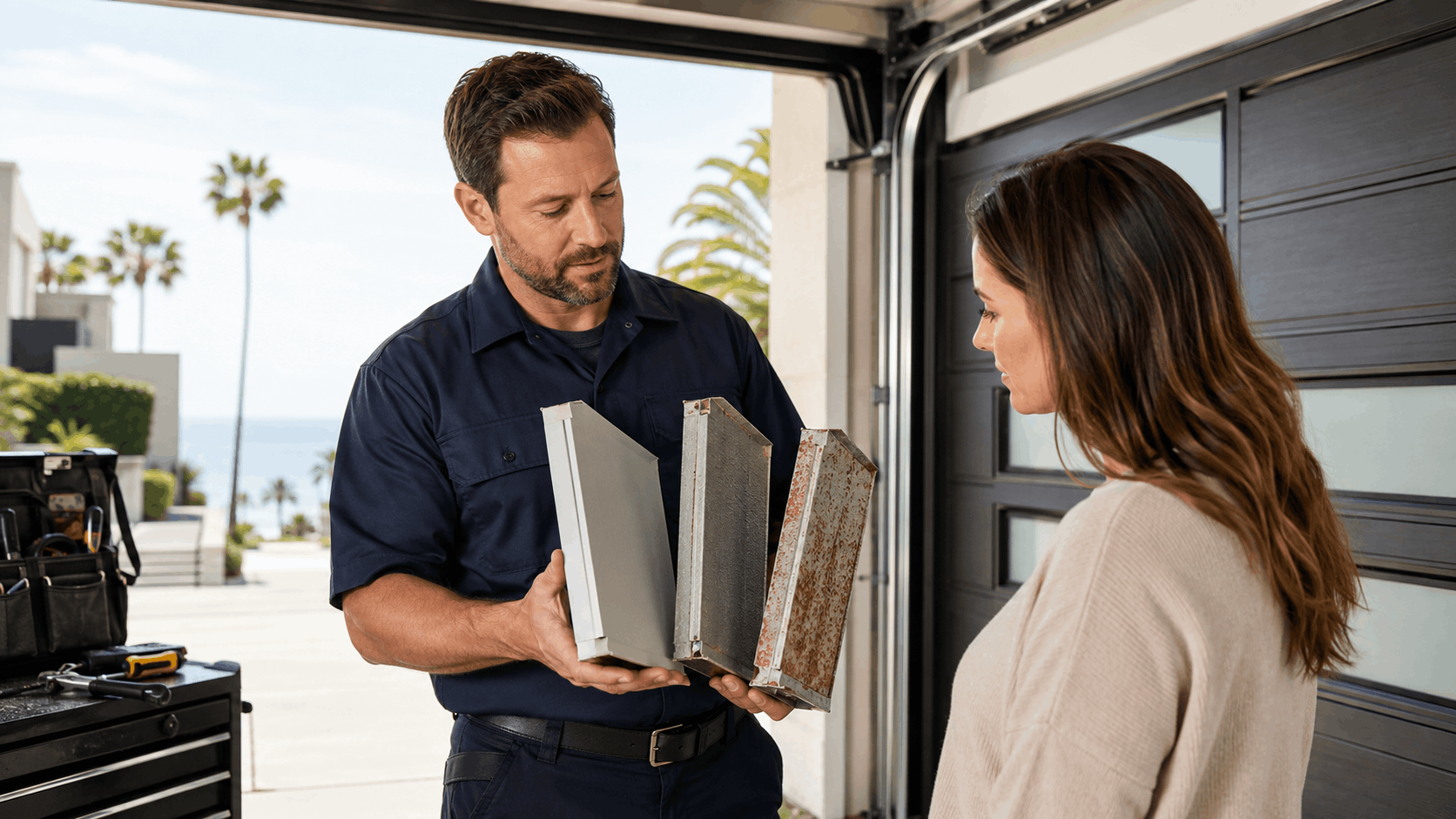
At Urgent Garage Doors, we help Irvine homeowners pick the right gauge for their exact home, not a one-size guess. Our Irvine garage door service covers everything from door installation to urgent repairs. The goal is a door that fits the location, the budget, and the community rules.
We work these streets every day, so we know how the coast, the sun, and the neighborhoods differ across the city. That local knowledge shapes every recommendation we make.
On-Site Assessments Based on Your Exact Location
Every job starts with an on-site assessment. We look at how far the home sits from the water, which direction the door faces, and how much sun it takes each afternoon. Those three factors drive our coastal recommendation more than any spec sheet.
A door on an exposed Turtle Rock ridge gets a different recommendation than one tucked into inland Portola Springs. We factor in elevation and wind exposure, not just a zip code. That is how a homeowner ends up with the right gauge instead of too much or too little.
We also check the existing hardware, tracks, and opener during the visit. Sometimes the smart move is upgrading the door and refreshing the hardware together. Seeing the whole picture lets us give honest advice.
By the end of the assessment, the homeowner knows exactly which gauge and coating suit their home and why.
Installation and Same-Day Repair Options
Our services cover the full range of garage door needs. New garage door installation, panel replacement, spring and cable work, opener setup, and urgent fixes across Irvine. Whatever a home needs, our crew handles it.
When a door fails suddenly, we move fast. Our same-day garage door repair keeps families from being stuck with an open or jammed garage. A broken spring or off-track door is not something that should wait days.
For planned upgrades, we schedule installs at a convenient time and walk through the options first. There is no pressure to overbuy. We match the door to the actual need and location.
From emergencies to full replacements, the team keeps Irvine garages working through every season and every marine layer morning.
Matching Doors to HOA and Coastal Conditions
Picking a door that satisfies both the HOA and the salt air takes some know-how. We help homeowners choose an HOA approved door that also stands up to coastal conditions. The two goals do not have to compete.
Because gauge is invisible from the street, a homeowner can install a heavy coastal-grade door in the exact style and color the community requires. We know the common design guidelines across Irvine villages and steer clients toward compliant choices.
We also match coatings and finishes to the exposure. A home near the water gets the heavier galvanizing and a durable baked-on finish that survives salt. A coastal grade door done right satisfies the review board and lasts for decades.
Homeowners can reach out through our contact page to set up an assessment and get a straight recommendation for their street.
Final Thoughts
Steel gauge comes down to a simple rule: the lower the number, the thicker and stronger the steel. In coastal Orange County, that thickness decides how long a door survives the salt, fog, and sun. 27 gauge fits budget projects far inland, 25 gauge suits most of Irvine, and 24 gauge is the pick for homes near the water.
Where a home sits matters as much as the gauge itself. Coastal ridges and Newport-facing streets need heavy steel and good coating, while inland communities can get by with a solid mid-grade door and a smarter budget elsewhere.
Whatever gauge a home has, regular rinsing, quick paint fixes, and lubricated hardware add years of life. If you want a door matched to your exact Irvine street and community rules, call Urgent Garage Doors for an on-site assessment. Our team will help you choose steel that stands up to the coast and looks right for your home.
Frequently Asked Questions
- Which steel gauge is best for a garage door near the coast?
- For homes near the coast, 24 gauge steel with a quality galvanized coating is the strongest common pick. The thicker steel resists dents and heat bowing, and the heavier zinc coating gives salt air a much harder target. Combined, they can add a decade or more of life compared to thin builder-grade steel. If you can smell the ocean or your car collects salt film, 24 gauge is the safe choice.
- Is 24 gauge really that much stronger than 25 or 27?
- Yes, the differences are real. 24 gauge runs about 0.023 to 0.028 inches thick, 25 gauge about 0.019 to 0.022, and 27 gauge only 0.016 to 0.018. That makes 24 gauge close to 40 percent thicker than 27 gauge. In practice, 24 gauge shrugs off bumps that dent 27 gauge, holds paint longer, and resists the heat warping that plagues thinner panels on sunny Irvine walls.
- Does a lower gauge number mean a better door?
- A lower gauge number means thicker steel, which is generally stronger. But the gauge number alone does not make a door good. The galvanized coating, the hardware quality, the insulation layers, and the finish all matter too. A well-built 25 gauge door with heavy coating can outlast a cheap 24 gauge door with thin galvanizing. Look at the whole package, not just the gauge.
- How long does a steel garage door last near the ocean?
- Near the ocean, lifespan depends heavily on gauge and care. A 27 gauge door often lasts only 8 to 12 years in salty air. A 25 gauge door with good coating runs 12 to 18 years. A 24 gauge door with heavy galvanizing can reach 20 to 30 years when rinsed and maintained. Inland Irvine homes see longer life from every gauge because there is less salt.
- How much more does a 24 gauge door cost than a 27 gauge?
- The price difference varies by style and insulation, but a 24 gauge door typically costs a few hundred dollars to around a thousand dollars more than a comparable 27 gauge door. 25 gauge lands in the middle. Spread over 20-plus years of service near the coast, the upgrade cost per year is small. For coastal homes, the extra spend usually pays for itself in avoided repairs and delayed replacement.
- Can I stop rust on a door that already has it?
- Sometimes. If the rust is surface-level, you can sand the spot, treat it, prime it, and repaint to stop it from spreading. Early corrosion caught before it eats through the steel responds well to treatment. But once rust has perforated a panel or spread across large areas, panel replacement or a new door makes more sense. A technician can tell you which situation you are dealing with.
- Do inland Irvine homes need heavy gauge steel too?
- Usually not. Inland areas like Portola Springs and the Great Park Neighborhoods get far less salt exposure because the marine layer drops most of its salt before reaching those streets. A quality-coated 25 gauge door serves inland Irvine homes well. The money saved can go toward insulation or a smart opener. West-facing inland doors still benefit from thicker steel to resist heat bowing, though.
- How often should I wash a coastal garage door?
- For homes close to the water, rinse the door with plain water a couple of times a month to remove salt film before it settles into the finish. Farther inland but still within marine reach, once a month works. Add a mild soap wash every few months for a deeper clean, using a soft cloth to avoid scratching. Regular rinsing is the cheapest and most effective rust prevention available.
- Will my HOA in Irvine let me pick any door I want?
- Probably not any door. Most Irvine Company communities have design guidelines that limit door styles, colors, and window layouts to keep streets consistent. The good news is that steel gauge is rarely restricted since it is not visible from the street, so you can still upgrade to heavy coastal-grade steel in the required style. Check your community's architectural guidelines before ordering, or let our team help you find a compliant option.
- How do I know what gauge my current door is?
- It is not always obvious. The original order paperwork or manufacturer sticker inside the garage sometimes lists the gauge. A quick field test is to press the center of a panel; heavy flex suggests 27 gauge, while a stiff panel points to 24 or 25. The most reliable way is to have a technician measure the steel thickness during a visit. Our crew can identify your door's gauge and recommend whether an upgrade is worth it.
Licensed garage door repair professionals serving Irvine and Orange County.
Licensed in California · License #1055150
Why trust Urgent Garage Doors?
Founded in 2017, Urgent Garage Doors is a licensed and insured garage door services serving Irvine and Orange County. All content is reviewed by our licensed technicians.

Need Help in Irvine?
Urgent Garage Doors serves Irvine and all of Orange County.
Related Articles

Best Garage Door Brands for Coastal Orange County
Discover the best garage door brands for coastal Orange County homes that resist salt air corrosion, handle marine layer moisture, and maintain performance despite coastal winds.
Emerald Bay Laguna Beach Garage Door Service: Private Community Authorized Repair
A local guide to Emerald Bay garage door service, covering gated access, coastal salt corrosion, HOA rules, rust-resistant parts, and fast repair from Irvine.
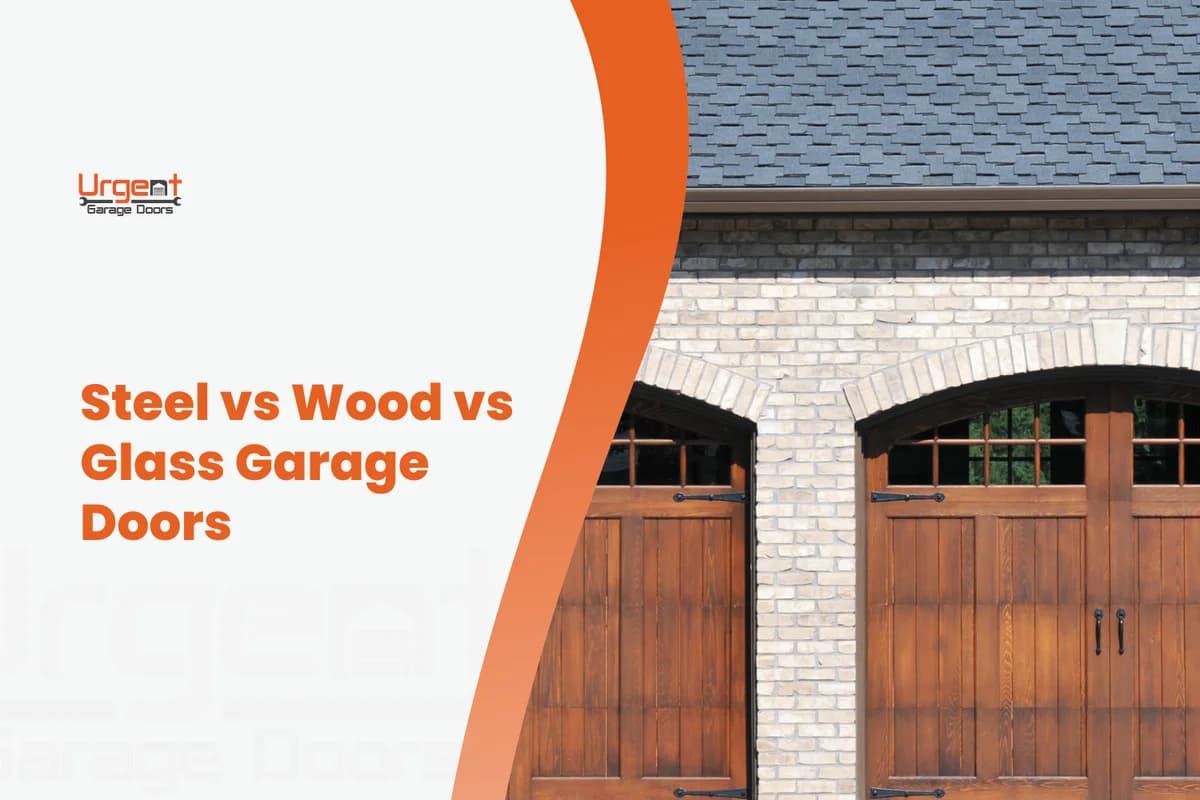
Steel vs Wood vs Glass Garage Doors for Orange County Homes
Compare steel, wood, and glass garage doors for Orange County. Durability, maintenance, cost, and coastal considerations. Irvine to Newport Beach.