Garage Door Slamming Shut Orange County: Dangerous Failure Mode Guide
Key Takeaways
- A garage door slams shut when the counterbalance fails, usually from a broken torsion spring or snapped lift cable.
- Residential doors weigh 130 to 250 pounds, so a free-fall is a real crush and property damage risk to kids, pets, and cars.
- Warning signs include loud pops, grinding, jerky movement, a door that feels heavy by hand, and visible rust or frayed cables.
- Coastal salt air near Newport Beach and inland heat swings in Turtle Rock and Portola Springs speed up spring and cable wear.
- If your door slams, stop using it immediately, clear the area, secure it closed, and unplug the opener.
- Never attempt DIY spring repair because torsion springs hold dangerous stored tension that can cause serious injury.
- Replace both springs at once and use matched parts to keep the door balanced and prevent a repeat failure.
- Yearly professional tune-ups plus monthly home checks catch worn parts early and prevent dangerous slamming failures.
In This Article
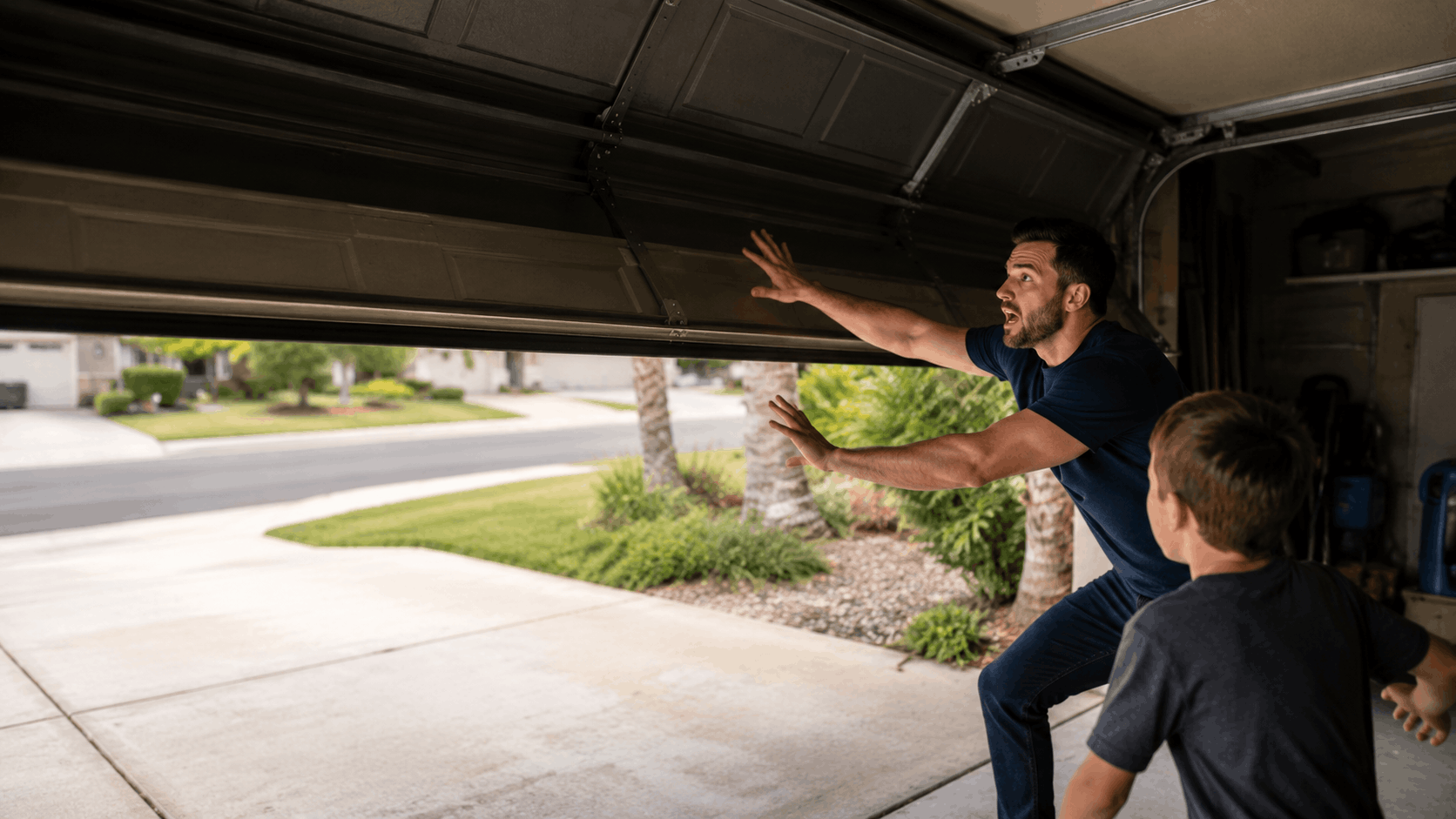
An Irvine homeowner backs the car out of the driveway on a Woodbridge morning, taps the remote, and watches the garage door come crashing down with a bang loud enough to shake the whole street. No slow, quiet close. Just a violent drop that lands hard on the concrete. If that has happened to you, or your door is starting to move in a way that feels wrong, you are looking at one of the most dangerous failure modes a garage door can have.
A door that slams shut is not a small annoyance. A residential garage door can weigh well over 150 pounds, and when the parts that hold it back fail, gravity takes over fast. That is a real risk to kids, pets, cars, and anyone standing in the doorway at the wrong moment.
Why a Garage Door Slams Shut Instead of Closing Gently?
A garage door that slams down is telling you something important. The system that controls its weight has stopped doing its job. When everything works right, that heavy door floats down under control. When it fails, the door becomes a falling object.
Here is what a healthy system depends on and what breaks it:
- A working counterbalance system that offsets the door's weight
- Springs under proper tension holding most of the load
- Cables that carry the door evenly on both sides
- Smooth tracks and rollers that let the door glide, not stick and jump
When any of those fail, garage door slamming is often the first dramatic sign of a bigger door failure.
How a Balanced Garage Door Is Supposed to Move
A properly set up door barely feels heavy. The magic behind that is the counterbalance, usually a torsion spring mounted on a bar above the opening. That spring stores energy when the door is down and releases it slowly as the door rises, then absorbs it again on the way down.
Because the spring carries most of the load, the opener only needs to guide the door, not lift its full weight. That is why a balanced door will hold its position halfway up when you disconnect the opener. It sits there, calm, instead of dropping or shooting up.
A good smooth descent looks almost boring. The door moves at a steady pace from top to bottom, hits the floor softly, and seals against the weather strip without a bang. There is no jerking, no sudden lurch, and no loud metallic pop.
Cables work in partnership with the spring. They run from the bottom bracket up to the drum near the spring, keeping tension even on both sides. When springs and cables are matched and adjusted right, the whole thing feels effortless by hand.
The Physics of a Sudden Drop
Most single-car doors in Irvine weigh between 130 and 180 pounds. Larger double doors, insulated steel models, and custom wood carriage doors can push past 250 pounds. That is a serious amount of mass hanging above your head every day.
When the counterbalance fails, the door weight is no longer held back. Gravity pulls it straight down, and the falling force at the bottom is far greater than the resting weight suggests. A 150-pound door dropping several feet can hit with the force of a small car bumper strike.
That force is enough to crush a foot, break a car hood, or snap a bicycle in half. The injury risk is highest for anyone standing directly under the door when it lets go, because there is almost no time to react. A drop like this happens in under a second.
This is why we treat a slamming door as an urgent safety problem, not a cosmetic one. The door already showed it cannot hold its own weight, and the next drop could land on something, or someone, that matters.
The Difference Between a Slam and a Slow Sag
Not every failing door slams. Some sag. Learning the difference helps you describe the problem and understand how urgent it is.
A violent slam usually points to a sudden loss of counterbalance, like a snapped spring or a broken cable. The door has nothing holding it back, so it free-falls the last stretch. This is the most dangerous version and needs attention right away.
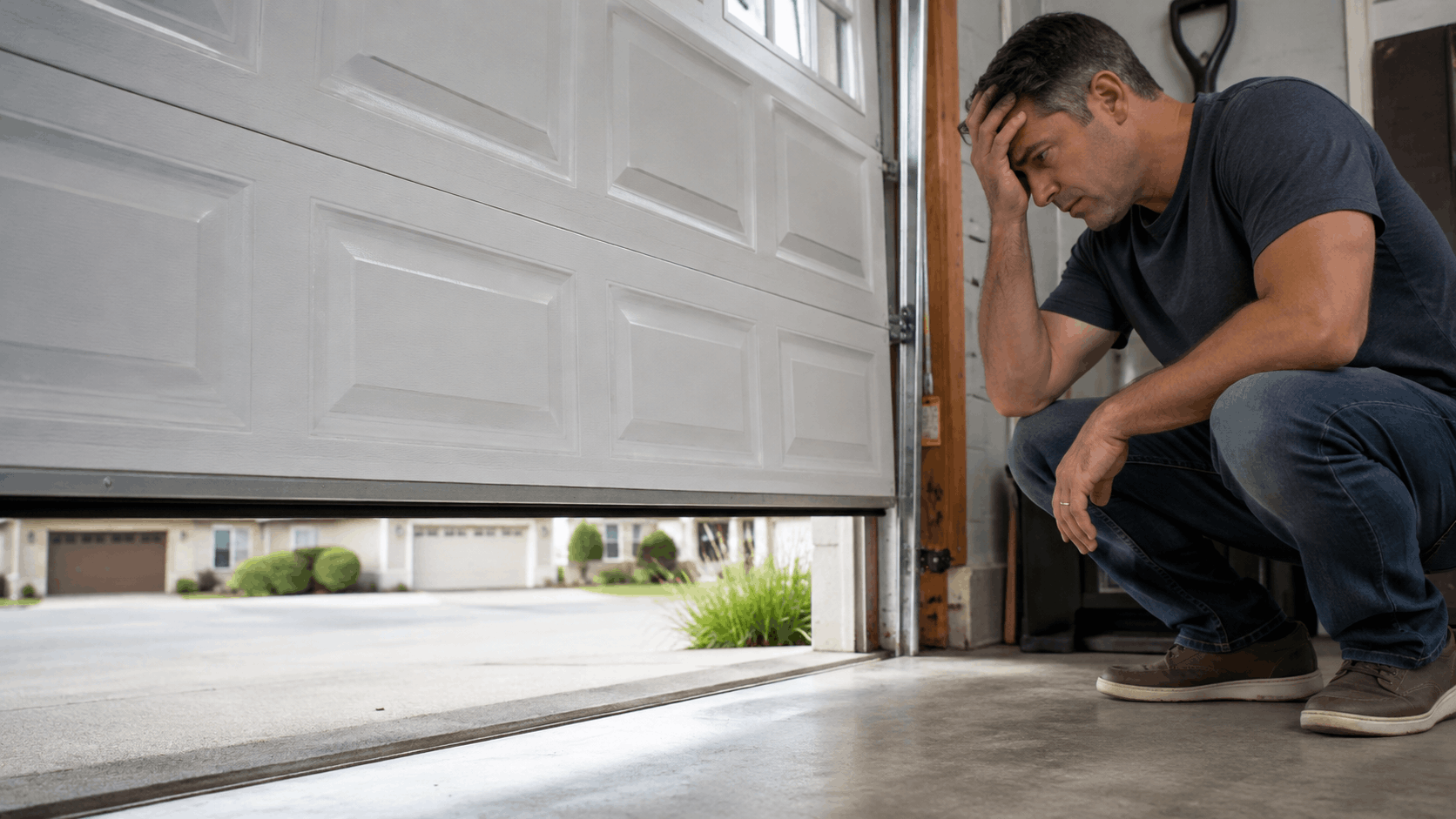
A slow door sag or uneven close is different. Here the door still has some support, but the balance is off. One side may drift lower than the other, or the door may settle a few inches after it looks closed. That points to stretched cables, a spring losing tension, or a bent track.
Both are warning symptoms worth a call, but a slam means stop using the door now. A slow sag gives you a little more time, though not much. Our door balancing and tension adjustment service handles both cases before they turn into a crash.
Get Your Free Quote
Tell us about your garage door and we'll get back to you within 30 to 60 minutes.
The Common Causes We See Across Orange County Homes
After years of service calls from Turtle Rock to Newport Beach, the same handful of failures show up again and again. Local conditions play a big part, from salt air near the coast to hot inland afternoons that bake garage hardware.
Here are the usual suspects behind a slamming door:
- A broken spring that removed the counterbalance
- A cable failure that let one side drop
- A worn opener with a stripped gear
- Rust and metal fatigue from years of coastal or heat exposure
Each one needs a different fix, which is why proper garage door repair starts with a real diagnosis, not a guess.
Broken or Worn Torsion Springs
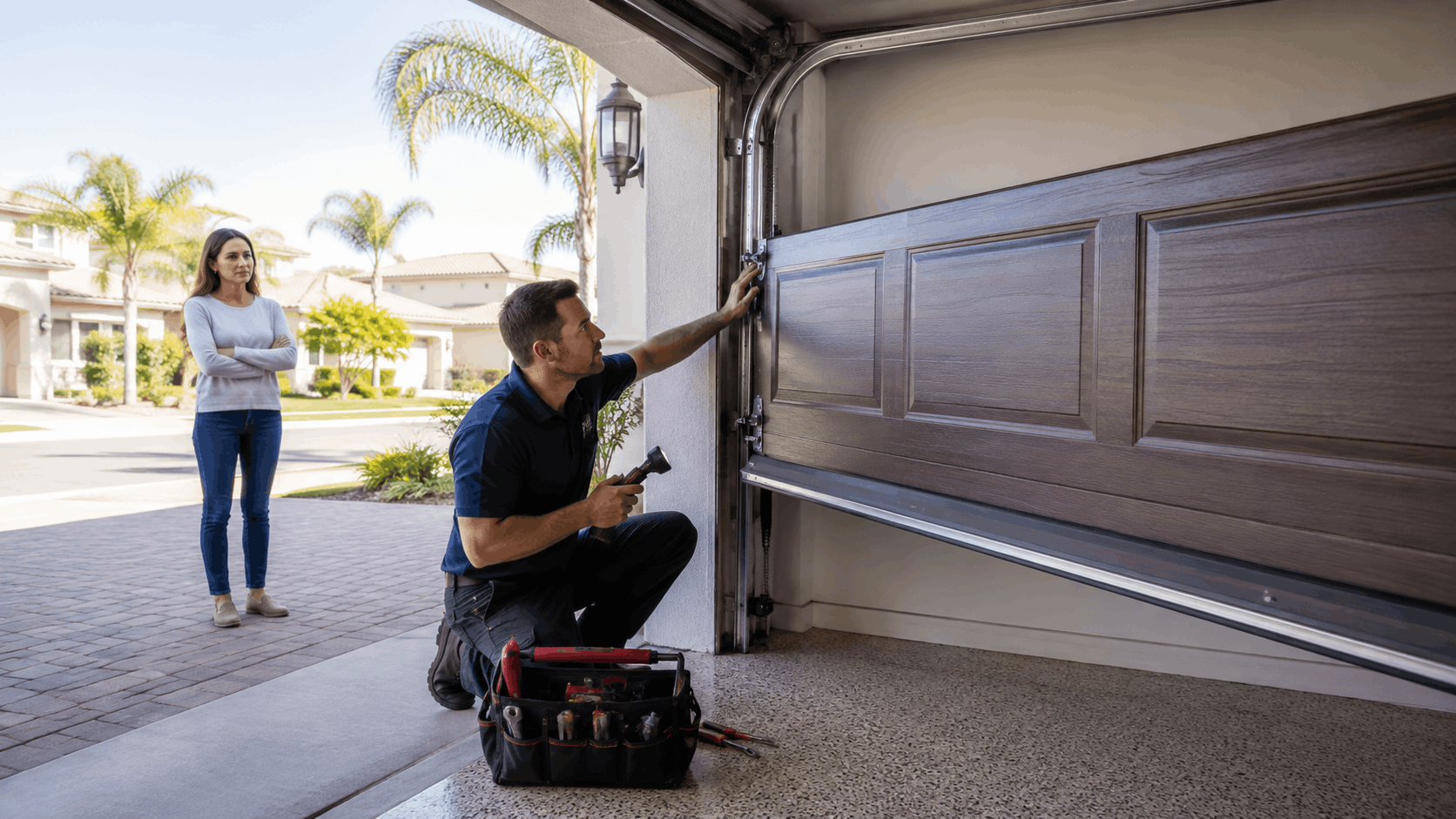
A very common cause we find is a broken torsion spring. When that spring snaps, the counterbalance disappears in an instant. The opener suddenly has to lift the door's full weight, which it was never built to do, so the door either refuses to open or crashes down when closing.
Torsion springs are rated by cycles. A standard spring is good for around 10,000 cycles, which is roughly seven to ten years for an average family. Homes near schools in Northwood or busy households in Woodbridge that open the door many times a day can burn through that spring lifespan in three or four years.
You can often see the failure. A snapped spring shows a visible gap in the coil, like someone cut it with a saw. Sometimes you hear it too, a loud bang from the garage that sounds like a gunshot when the tension releases.
When a spring goes, we handle it with proper torsion spring replacement using components matched to your door's weight. Guessing on spring size is exactly how doors end up slamming again.
Frayed or Snapped Lift Cables
The lift cable on each side does the heavy carrying, transferring the spring's stored energy to the door. These steel cables take constant strain, and over time strands begin to fray. A frayed cable is a warning that a cable snap is coming.
When one cable breaks, the door loses support on that side. It tilts, jams in the track, and can crash down at an angle. A tilted crash is especially rough on the door panels and the track, and it often wedges the door where it is hard to open by hand.
Cables and springs work as a team, so a broken spring frequently damages a cable at the same time, and vice versa. We usually inspect both together during any garage door cable repair visit.
Frayed cables show up as small metal splinters near the bottom bracket or the drum. If you run a rag along the cable and it snags, that is your sign. Do not wait for it to let go on its own.
Failing Opener or Stripped Gears
Sometimes the springs and cables are fine, but the opener itself is the weak link. A worn carriage or a stripped gear can let the door slip off its drive point and drop sooner than it should. This is an opener failure, not a hardware failure, and the fix is different.
Most chain and belt openers use a plastic drive gear that wears down over years of use. When those teeth strip, the motor may run and hum while the door barely moves, or the door may release and fall. You might also see the trolley disconnect on its own.
Telling opener trouble apart from spring trouble matters. If the door is heavy to lift by hand with the opener disconnected, the problem is the counterbalance. If it lifts easily by hand but the motor struggles, the opener gear or logic board is likely the cause.
Our opener repair and troubleshooting service pinpoints which part is failing so you are not paying to replace hardware that was never broken.
Coastal Air and Heat Wear in Local Homes
Orange County geography shapes how fast parts wear out. Homes near the coast in Newport Beach or Balboa Peninsula deal with salt air corrosion that eats at springs, cables, and brackets. Salt speeds up rust in ways inland homes never see.
We often pull rusted cables off doors in coastal neighborhoods that look decades older than they are. Rust weakens steel, and weak steel snaps under load. That is a direct path from ocean breeze to a slamming door.
Inland Irvine areas like Portola Springs and Turtle Rock face a different problem. Big temperature swings between hot afternoons and cool nights cause metal fatigue as parts expand and contract day after day. Springs lose their temper sooner in that cycle.
This climate wear is why we recommend more frequent checks in Orange County than the national average. If you live near the water, our spring and cable repair in Balboa Peninsula team knows exactly what salt does to hardware here.
Need Help in Irvine?
Urgent Garage Doors serves Irvine and all of Orange County.
Warning Signs Before the Door Fails Completely
A slamming door almost never happens without warning. In most cases the door was dropping hints for weeks. Catching those warning signs early is the difference between a routine repair and a dangerous crash.
Watch and listen for these clues:
- New or louder garage door noise during operation
- A door that feels heavy or drags on one side
- Jerky, uneven movement
- Visible rust, gaps, or loose parts that point to door imbalance
If you notice any of these, stop and take a closer look before the next cycle.
Loud Bangs, Popping, or Grinding Noises
Sound is one of the earliest and clearest warnings. A sharp spring pop is the loudest, a single bang that often means the torsion spring just failed. If you hear that, do not open the door again until it is checked.
A grinding noise usually comes from dry or worn rollers dragging in the track, or from an opener gear starting to strip. Grinding gets worse over time, so it is a good reason to schedule service soon rather than later.
Rattling and clunking often mean loose hardware, worn hinges, or a roller coming out of alignment. These door sounds are not emergencies on their own, but they add up. A noisy door is a door telling you its parts are wearing down.
Our quiet roller hardware upgrade often solves the noise while also catching the underlying wear that causes it. Quiet operation and safe operation tend to go hand in hand.
The Door Feels Heavy or Uneven by Hand
The balance test is the single best home check you can do. With the door closed, pull the red release cord to disconnect the opener. Then lift the door by hand about halfway and let go.
A balanced door will stay roughly where you left it. A heavy door that slams back down, or one that is hard to lift at all, has lost spring tension. That is a clear signal the counterbalance is failing and a crash could follow.
Do this manual test gently and keep your feet clear. If the door feels like it wants to drop hard, do not force it up higher. Lower it carefully or leave it down and call for service.
If the door drifts or feels uneven side to side, that points to cable or spring imbalance. Either way, a failed balance test means the door needs professional attention before it is used again.
Jerky Movement or Sudden Speed Changes
A healthy door moves at one steady speed. When you see jerky movement, hitching, or a door that suddenly speeds up near the bottom, the counterbalance is losing its grip on the weight.
Speeding up at the end of the close is a red flag. It means gravity is starting to win over the spring, and the door is edging toward a full slam. A change in door speed like this should never be ignored.
Hitching or pausing partway can also signal a track problem or an obstruction. Sometimes it is a roller catching on a bent section of track, which stresses the whole system unevenly.
Any of these point to a counterbalance issue that will get worse. We would rather adjust tension now than replace crushed panels later. A quick service call stops the slide before it becomes a slam.
Visible Gaps, Rust, or Loose Hardware
A five-minute visual inspection catches a surprising number of problems. Look at the torsion spring above the door for a gap or break in the coil. A separated spring is the clearest sign trouble is here.
Check the cables for rust, kinks, or splayed strands near the bottom brackets. Frayed cable strands sticking out like a wire brush mean the cable is close to snapping. Coastal homes in San Clemente and Newport Beach see this early.
Scan the brackets, hinges, and roller carriers for loose hardware. Bolts back out over time from vibration, and a loose bottom bracket is dangerous because it holds cable tension. Never tighten that specific bracket yourself.
A quick visual inspection once a month is a habit worth building. If anything looks off, our team can confirm it fast. Booking a check through our contact page takes only a minute.
The Real Dangers of a Slamming Garage Door
It is easy to shrug off a loud door until you think about what is actually happening. A door that slams is a heavy object dropping without control. Garage door safety matters because the consequences range from a dented car to a serious injury or major property damage.
Here is what is truly at stake when a door fails.
Risk to Children and Pets
Kids and pets are the biggest concern. A small child chasing a ball into the garage, or a dog trotting out to the driveway, can be directly under the door when it drops. There is no time to pull them clear.
The crush risk is severe because of the door's weight and the speed of the fall. Even a door equipped with an auto-reverse safety feature will not protect against a mechanical free-fall, because that safety system only works when the opener controls the door.
Child safety and pet safety both depend on the door being kept from cycling once it shows signs of failure. Teach kids to stay out from under a moving door as a rule, but a failing door removes even that margin.
If you have young children in a busy Woodbridge or Northwood household, treat any slamming door as an immediate reason to keep everyone away from the garage opening until it is fixed.
Damage to Vehicles and Belongings
A dropping door does not care what is under it. We have seen crushed hoods, shattered windshields, and dented roofs from a door landing on a car parked halfway in. Vehicle damage from a door slam can run into thousands of dollars.
Bikes, storage bins, and anything stacked near the door opening are also at risk. A falling door can flatten belongings you thought were safely out of the way.
The door itself takes a beating too. A slam or a tilted crash bends tracks and cracks panels, turning a spring repair into a much bigger job. Panel damage often means ordering replacement sections, which our panel replacement service can handle.
Preventing that property loss is far cheaper than fixing it. Stopping use at the first sign of failure keeps a small repair from becoming a pile of damaged parts.
Stored Spring Energy and Repair Hazards
Here is the part that surprises people. A torsion spring holds a huge amount of spring tension, even when the door is sitting still. That energy has to go somewhere, and if it releases suddenly during a repair, it moves with violent force.
This is why DIY danger is real with garage doors. Every year, homeowners are hurt trying to swap springs with the wrong tools. A winding bar that slips can break bones, knock out teeth, or worse.
The U.S. Consumer Product Safety Commission has documented serious injuries tied to garage door spring work. The repair hazard is not exaggerated.
Trained technicians use proper winding bars, clamps, and a step-by-step process to control that stored energy safely. This is one job where the cost of a pro is far less than the cost of a mistake.
Need Help in Irvine?
Urgent Garage Doors serves Irvine and all of Orange County.
What to Do the Moment Your Door Starts Slamming
If your door just slammed or is starting to drop hard, act now. A calm, quick response keeps people safe and prevents more damage. Here is the safety steps plan we give callers dealing with an emergency garage door problem or a door won't close situation.
Stop Using the Door Right Away
The first rule is simple. Stop cycling the door. Every open and close puts more strain on already failing parts and raises the chance of a harder crash.
Keep people and pets clear of the opening, and move any vehicle out from under the door if it is safe to do so. Do not walk under a door that is partly open and unstable.
Clear the area and treat the garage opening as off limits. Safety first is not just a slogan here, it is the difference between a repair bill and a hospital visit.
If the door is stuck partway, leave it. Do not try to yank it up or force it down. Let a technician handle a door that is caught under load.
How to Safely Secure the Door in Place
If the door is fully closed, you can help keep it that way. Many doors have a manual slide lock or a T-handle lock on the side. Engaging that manual lock keeps the door from being opened accidentally.
If the opener still has power, unplug it so no one can hit the remote and send the failing door into motion. A powered opener on a broken door is a liability.
To secure door position, some technicians will place locking pliers on the track above a roller as a temporary hold. Only do this if the door is fully down and you can reach the track safely.
The goal of this safety hold is to freeze the door until help arrives. It is a stopgap, not a repair, so still schedule service promptly.
When to Call for Emergency Service
Not every problem needs a midnight call, but a slamming door often does. If the door is stuck open, cannot be secured, or is blocking a car you need, that is an emergency service situation.
A security concern also counts. A garage that will not close leaves your home open, and near busier streets in Irvine that is a real worry. In those cases, our 24/7 emergency garage door repair team can come out fast.
If the door is safely closed and locked, and no one needs the garage, a next-day visit may be fine. Either way, do not use the door in the meantime.
We offer same-day repair across Irvine and nearby areas, so most slamming-door calls are handled the same day you reach out. Fast response keeps a bad day from getting worse.
How Our Irvine Team Diagnoses and Fixes the Problem
When we arrive for a garage door repair Irvine homeowners can trust, we do not just swap the obvious part and leave. We check the whole system so the fix actually lasts. Here is what to expect from start to finish.
Full Balance and Hardware Inspection
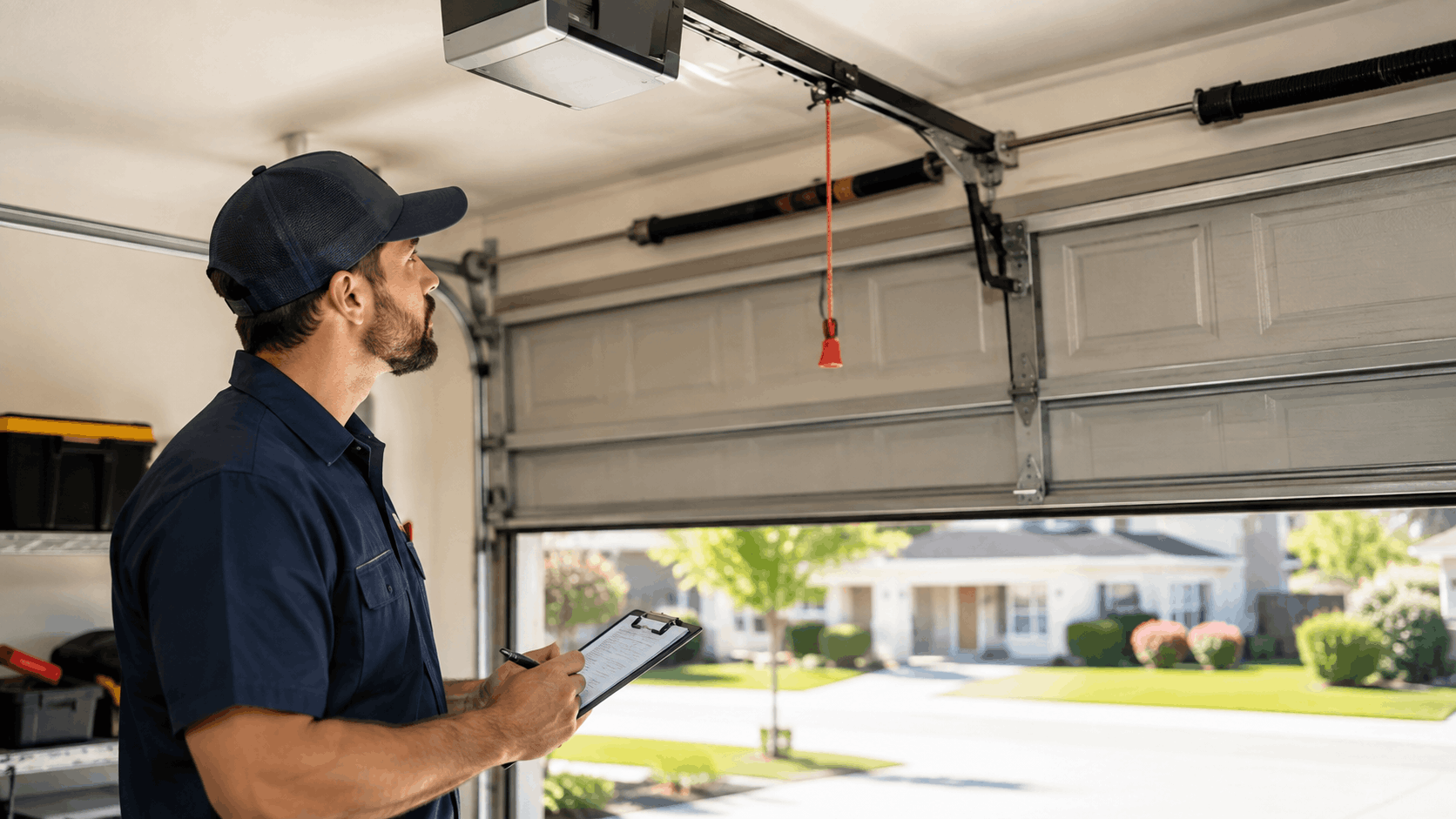
Every visit starts with an inspection. We disconnect the opener and run a balance check to see how the door behaves on its own. That one test tells us whether the counterbalance is the root problem.
Then we do a full hardware review. We look at spring condition and cycle wear, cable strands, roller wear, hinge play, track alignment, and the opener drive. Slamming doors often have more than one worn part.
We also check for the local wear patterns we know well, like coastal rust or heat-fatigued springs. Finding every weak point matters, because fixing one failing part while ignoring another just leads to a repeat crash.
By the end of the inspection, we can explain exactly what failed and why. No mystery, no vague guesses, just a clear picture of your door's condition.
Spring and Cable Replacement Done Safely
When a spring or cable is the culprit, we handle the tensioned parts with the right tools and technique. Proper winding bars and clamps let us control the stored energy through the entire job.
For spring replacement, we size the new spring to your door's actual weight and cycle needs. A door in a high-traffic home gets a higher-cycle spring so it lasts longer. Matched springs keep the door balanced from day one.
Cable replacement uses the correct gauge and length, seated properly on the drums so both sides carry evenly. Using matched parts is what keeps the door from sagging or slamming again.
Because springs usually wear together, we often recommend doing both at once. Our spring and cable repair service is built around getting this right the first time.
Opener Repair and Safety Sensor Testing
If the opener is the issue, we address it directly. Opener repair may mean replacing a stripped drive gear, fixing the carriage, or in some cases recommending a new unit if the motor is near the end of its life.
After any repair, we test the safety systems. We confirm the auto-reverse works by checking that the door reverses when it meets resistance. This feature is required on modern openers for good reason.
We also align and test the safety sensors, the photo-eyes near the floor. If those are misaligned, the door may not reverse when something is in the path. Our safety sensor alignment repair makes sure they do their job.
These safety checks are the last line of defense. Even a well-tuned door benefits from working sensors, so we never skip this step.
Serving Irvine and Surrounding Orange County Communities
Our roots are in Irvine, and we know its neighborhoods block by block. We service Woodbridge, Turtle Rock, Northwood, Portola Springs, and the rest of the city daily.
Beyond Irvine, our Orange County service reaches nearby cities as well. We cover Newport Beach, Tustin, Costa Mesa, and more.
Knowing the local streets helps us plan the route, and knowing the local climate means smarter repairs. A coastal home near the water gets rust-aware attention that an inland home may not need.
Wherever you are in the area, we bring the same careful process. You can see the full list of areas we cover on our locations page.
Need Help in Irvine?
Urgent Garage Doors serves Irvine and all of Orange County.
Preventing a Slamming Door Before It Happens
The best slamming-door story is the one that never happens. Regular garage door maintenance catches worn springs and frayed cables long before they fail. A little preventive care saves you from an emergency and protects your family.
Here is how to keep your door healthy in the Orange County climate.
Routine Lubrication and Hardware Checks
A simple maintenance schedule goes a long way. Every three to six months, apply a garage-door-rated lubrication to the springs, hinges, rollers, and bearings. Skip the tracks, which should stay clean and dry.
Good lubrication cuts friction, reduces noise, and slows wear on moving parts. It also helps fight the corrosion that coastal air brings. A well-oiled spring lasts longer than a dry, rusty one.
Do a quick hardware check at the same time. Snug up loose bolts on hinges and brackets, but never touch the bottom bracket or spring hardware, which hold dangerous tension.
Also run the balance test a couple times a year. A door that starts feeling heavy is telling you the springs are aging. Catching that early keeps a slam off your calendar.
Annual Professional Safety Tune-Ups
Home checks help, but a yearly professional tune-up catches what the eye misses. During an annual service we measure spring tension, inspect every cable strand, test the opener force settings, and check the safety features.
This safety check often spots a cable that is 80 percent frayed or a spring nearing the end of its cycle life. Replacing those on your schedule beats replacing them after a crash.
A tune-up also keeps the door quiet and smooth, which most homeowners appreciate day to day. Small adjustments now prevent big repairs later.
Our preventive maintenance plan makes yearly service easy to remember. For homes that cycle the door many times a day, we may suggest checking twice a year.
Guarding Against Coastal and Heat Damage
Local climate deserves special attention. If you live near the coast in San Clemente, Newport Beach, or the Balboa Peninsula, salt air is the enemy of steel. Corrosion protection starts with regular lubrication and rust-resistant hardware.
We can install galvanized or coated components that hold up better against ocean moisture. Wiping down hardware and keeping it lubricated slows the rust that leads to snapped cables.
Inland Irvine homes face heat damage instead. Big daily temperature swings in areas like Turtle Rock and Portola Springs fatigue springs sooner. Higher-cycle springs and regular tension checks help offset that.
A little coastal care or heat-aware maintenance tailored to your neighborhood makes a real difference. The International Code Council sets safety standards worth following, and our team applies them to local conditions.
Final Thoughts
A garage door that slams shut is one of the clearest safety warnings a home can give. It almost always traces back to a lost counterbalance, usually a broken spring or a snapped cable, and it puts people, pets, and property directly at risk.
The good news is that these failures give warning signs first, and they are fixable by trained hands. Listen for pops and grinding, run the balance test now and then, and never use a door that has already slammed. If you catch the signs early, you avoid the crash entirely.
Whether you are in Woodbridge, Turtle Rock, or anywhere across Orange County, our team is ready to help fast and fix it right.
Frequently Asked Questions
- Why does my garage door slam shut suddenly?
- A sudden slam almost always means the counterbalance failed. A common causes are a broken torsion spring or a snapped lift cable, both of which remove the support that holds the door's weight. Once that support is gone, gravity pulls the door straight down with nothing to slow it. Stop using the door and have it inspected before the next cycle turns into a harder crash.
- Is a slamming garage door dangerous?
- Yes, very. A residential door can weigh 130 to 250 pounds, and when it free-falls it hits with crushing force. That is a genuine risk to children, pets, cars, and anyone in the doorway. It also damages panels and tracks with each drop. Stop using the door right away, keep the area clear, and call for professional repair rather than cycling it again.
- Can I keep using the door until it is repaired?
- No. Every open and close puts more strain on the failing parts and raises the chance of a full crash. Continued use can also damage cables, panels, and the opener, turning a simple spring fix into a much larger repair. Secure the door in the closed position if you can, unplug the opener, and keep it out of use until a technician inspects it.
- How much does it cost to fix a slamming garage door?
- Costs vary by part and door size. As a general range, spring replacement often runs a couple hundred dollars, cable replacement is usually a bit less, and opener repairs depend on whether a gear or the whole unit is involved. A full inspection gives you an exact figure. We provide a clear quote before any work starts so there are no surprises.
- How long does the repair take?
- Most spring and cable replacements take about one to two hours once a technician is on site. A straightforward torsion spring swap is often done in under an hour. Jobs involving bent tracks, damaged panels, or opener replacement can take longer. Since we stock common parts on our trucks, many slamming-door repairs are completed in a single same-day visit.
- Should I replace one spring or both?
- On a two-spring system, we usually recommend replacing both at once. The springs wear at the same rate, so if one broke, the other is close behind. Replacing both keeps the door balanced, saves you a second service call soon, and avoids uneven tension that can stress the new spring. It is the more cost-effective choice over the life of the door.
- Can I replace a garage door spring myself?
- We strongly advise against it. Torsion springs hold intense tension even when the door is still, and a slip during the job can cause serious injury. Every year homeowners are hurt attempting this without the right winding bars and clamps. A trained technician has the tools and process to release that energy safely. The cost of professional service is far less than an emergency room visit.
- Does the coastal air in Orange County damage my garage door?
- It does. Salt air near the coast in places like Newport Beach and San Clemente speeds up rust on springs, cables, and brackets. Rusted steel weakens and snaps sooner than steel in a dry inland area. If you live near the water, more frequent lubrication, rust-resistant hardware, and regular inspections help your door last much longer.
- How often should I have my garage door inspected?
- We recommend a professional inspection once a year for most homes. Households that open the door many times a day, or homes near the coast, may benefit from a check twice a year. In between, do a quick monthly visual look at the springs and cables and run the balance test a couple times a year. Early attention prevents dangerous failures.
- Do you offer emergency service in Irvine and nearby cities?
- Yes. We provide same-day and 24/7 emergency garage door repair across Irvine and the surrounding Orange County communities, including Woodbridge, Turtle Rock, Northwood, Tustin, Costa Mesa, and Newport Beach. A slamming or stuck door that leaves your home unsecured counts as an emergency, and our team responds quickly to make it safe and get it working again. A slamming garage door is a problem you can solve before anyone gets hurt. If your door is dropping hard, feeling heavy, or making sounds it never made before, reach out to Urgent Garage Doors today. Our Irvine team offers same-day and emergency service across Orange County, and we will inspect, diagnose, and fix the real cause. Contact us or call to schedule a consultation and get your door moving safely again.
Licensed garage door repair professionals serving Irvine and Orange County.
Licensed in California · License #1055150
Why trust Urgent Garage Doors?
Founded in 2017, Urgent Garage Doors is a licensed and insured garage door services serving Irvine and Orange County. All content is reviewed by our licensed technicians.

Need Help in Irvine?
Urgent Garage Doors serves Irvine and all of Orange County.
Related Articles
Garage Door Failure Modes in Earthquake Country: What Actually Breaks First
A local guide to how garage doors fail during earthquakes near Irvine, what breaks first, and how to prepare your door before the next tremor hits.
Best Garage Door Size and Fit Guide for Orange County Homes
Garage door size and fit guide for Orange County. Single vs double, standard sizes, custom widths. Old Town Tustin narrow lots to Northwood Pointe 3-car.
The Orange County Garage Door Guide by Home Era: 1950s Tract, 70s-80s South County, 90s Irvine, 2010s Great Park
A garage door guide for Orange County by home era - 1950s tract homes, 70s-80s South County, 90s Irvine villages, and 2010s Great Park builds.