Safety & Prevention
Fire-Zone Garage Doors in Turtle Rock for Homes Backing the Open Space Preserve
Key Takeaways
- The 2025 OSFM Fire Hazard Severity Zone map, adopted by Irvine effective July 23 2025, expanded fire hazard zones into Turtle Rock, unlike Woodbridge, Northwood and University Park.
- On a permitted project in a mapped zone, the door material, bottom seal and frame gaps become code questions tied to the address, zone class and permit application date.
- Very High zone projects must use fire-resistive construction under California Building Code Chapter 7A and Residential Code section R327; Title 24 Part 2 covers wind load while Part 6 only applies to conditioned space.
- Turtle Rock was built from the late 1960s through 1995, so the tract and build era decide the job, and pre-1993 openers in older tracts predate the federal entrapment-protection mandate.
- SB 969 requires a battery backup on any residential opener sold or installed in California since July 1 2019, with a $1,000 penalty; garage door work requires a C-61/D-28 license, not C-28.
- A standard torsion spring is rated around 10,000 cycles, roughly seven years at four cycles a day; cables are inspected with springs and an owner should never touch a torsion spring.
- Turtle Rock has multiple tract-based associations and some tracts with none, so the governing association and the permit position must be confirmed for the exact address.
In This Article
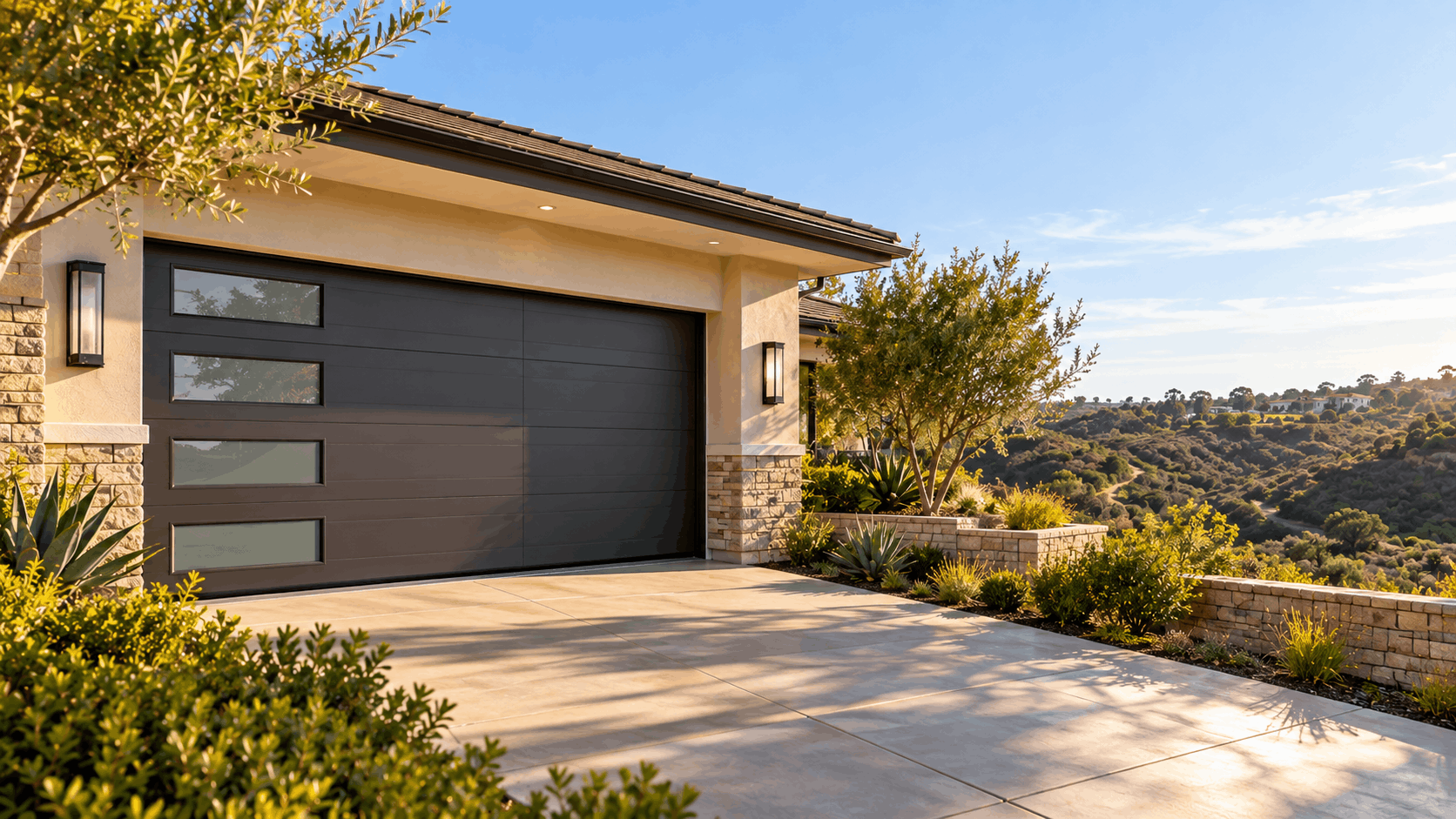
On the upper streets of Turtle Rock, the homes that wrap the terraced San Joaquin Hills and back onto Bommer Canyon Open Space Preserve now sit inside California's 2025 fire hazard severity zone map. That single change turned a routine garage door replacement into something with code weight behind it. A garage door is an exterior opening, and on a hillside lot with open space at the fence line, it stands directly in a wildfire exposure path.
That matters because on a permitted project in a mapped zone, three things stop being style choices and become code questions: the door material, the seal at the bottom, and the gaps around the frame. The answer to each depends on the address, the zone class and the date the permit application is filed. It is not a preference and it is not a sales upsell.
Why Turtle Rock's Fire Zone Status Changed in 2025?
Turtle Rock sat in a different spot before 2025 than it does now. The fire hazard severity zone framework that governs building and fire code on a permitted project was rewritten at the state level, Irvine adopted the new map, and Turtle Rock was named among the areas where the zones expanded. For an owner planning a door replacement, that shift decides whether fire-resistive requirements come into play at all.
None of this makes an existing door illegal or forces an owner to rip anything out. It changes what a permitted project has to meet, and it changes which of the two maps applies to that permit. The practical trigger is the application date, and the practical question is the zone class at the specific address.
The March 2025 State Fire Marshal Map and Irvine's June Adoption
In March 2025 the California Office of the State Fire Marshal released its updated Local Responsibility Area Fire Hazard Severity Zone map. This is the statewide map that classifies developed land inside city limits by wildfire hazard, and it replaced the version Irvine had been working from since 2012.
Irvine adopted the new OSFM map without amendment by ordinance in June 2025. Adopting it without amendment means the city took the state's zone boundaries as drawn rather than redrawing them locally. The ordinance took effect on July 23 2025, which became the date that separates the old map from the new one for permit purposes.
The 2025 map classifies land into three tiers: Moderate, High and Very High. Those tiers are not cosmetic. The higher the class on a permitted project, the more the exterior openings, materials and construction methods are pulled into the fire code, which is exactly why the class at a given Turtle Rock address is worth checking before a door order is placed.
Turtle Rock Was Named in the Expansion, Woodbridge and Northwood Were Not
The city states that the 2025 update expanded fire hazard zones into a specific set of villages, and Turtle Rock is on that list. Alongside it are Orchard Hills, Woodbury, Portola Springs, Quail Hill, Laguna Altura, Los Olivos and Irvine Spectrum. That is the city's own naming, not a general characterization.
Just as telling is what the city does not name. Woodbridge, Northwood and University Park do not appear in the expansion list. That puts Turtle Rock in a different position from those flatland villages, because the terraced hillside terrain and the open space at its edge are precisely the conditions the fire hazard framework maps for.
For a homeowner, the takeaway is not to assume Turtle Rock behaves like the rest of Irvine on a fire-zone question. A neighbor in Woodbridge replacing a door faces a different code picture than a Turtle Rock owner on a street backing the preserve. The village's inclusion is the reason this guide exists.
Homes Backing Bommer Canyon and the San Joaquin Hills
Turtle Rock was the first hillside village on the Irvine Ranch, with homes arranged around the terraced San Joaquin Hills so the hilltops stay open. Many lots back directly onto open space, with Bommer Canyon Open Space Preserve, part of the old Irvine Ranch cattle camp, nearby. That open space is the fuel side of a wildfire exposure path.
A garage door on one of those lots is one of the largest exterior openings on the house, and it faces the same exposure as any wall or window in a fire path. That is the physical reason the door material, the bottom seal and the frame gaps carry code weight here rather than in a fully built-out interior street.
The city's own presentation ties the standards to real events, citing the 1980 Panorama Fire, the 1991 Oak Hills Firestorm, the 2007 Santiago Fire and the 2020 Silverado Fire as the history behind the code. Those are the fires that shaped the requirements now reaching the upper Turtle Rock streets.
How the Permit Application Date Decides Which Map Applies
The date on the permit application is what decides which map governs a project. Projects with a permit application dated after July 23 2025 must comply with the building and fire code requirements where the project sits in a 2025 FHSZ area. Projects submitted before that date remain subject to the 2012 map areas instead.
That cutoff is why two neighbors doing similar work can land under different rules, purely on timing. It also means an owner cannot answer the fire-zone question from memory of the old map; the 2012 boundaries no longer control a new application.
An owner can check their own address on the OSFM FHSZ viewer or through the Orange County Fire Authority. We recommend confirming the zone class for the exact parcel before ordering a door, because the answer drives the material and seal specification on any permitted replacement. You can read more about wildfire zone mapping at the California Office of the State Fire Marshal.
Get Your Free Quote
Tell us about your garage door and we'll get back to you fast.
What Fire Code Asks of a Garage Door in a Mapped Zone
Once an address sits in a mapped zone and a permit is in play, the fire code turns general good practice into specific requirements. The three areas it looks at on a garage door are the material the door is made of, the seal where the door meets the slab, and the gaps around the frame where embers could pass. Each answer is tied to the address, the zone class and the application date.
The table below lays out how those pieces connect. None of it replaces a conversation with the Irvine building department, which is the authority on any specific parcel, but it shows the shape of the questions a permitted project answers.
| Element | What the code looks at | What decides the answer |
|---|---|---|
| Door material | Fire-resistive construction and exterior wildfire exposure methods | Zone class and whether Chapter 7A / R327 applies |
| Bottom seal | The gap where the door meets the slab as an ember path | Address, zone class, application date |
| Frame gaps | Openings around the door frame in the exposure path | Address, zone class, application date |
| Wind load | Structural resistance under Title 24 Part 2 (CBC) | Ridgeline exposure and the CBC edition in effect |
| Insulation / energy | Title 24 Part 6, only for conditioned space | Whether the garage is conditioned (ADU, converted room) |
Chapter 7A and R327 for Very High Zone Projects
Buildings in Very High zones must be built using the fire-resistive features in California Building Code Chapter 7A and California Residential Code section R327. Those sections cover materials and construction methods for exterior wildfire exposure, the parts of a home that face flame contact and ember intrusion during a wildfire.
For a garage door, that framework is what pushes the material and the sealing details from preference into requirement on a permitted Very High zone project. The door is an exterior opening in the path Chapter 7A and R327 are written to address, so it is evaluated the same way other exterior components are.
The zones themselves come from a statewide process. California Government Code section 51178 directs CAL FIRE to identify and map these zones using consistent statewide criteria, which is why the Irvine map and the maps in neighboring cities are built on the same rules rather than local guesswork. That consistency is also why the OSFM viewer can answer the question for any address.
The Bottom Seal and Frame Gaps Are Code Questions, Not Preferences
On a normal interior street, a bottom seal is about keeping out water, dust and drafts. In a mapped zone, that same seal is also about keeping embers from passing under the door, so it becomes a code question on a permitted project rather than a comfort choice.
The gaps around the frame work the same way. Because the door is an exterior opening, the openings around its frame are part of the exposure path, and on a permitted replacement in a mapped zone they are evaluated against the applicable fire requirements. The exact detail depends on the address, the zone class and the permit application date.
We do not guess a product or a rating for this, and neither should an owner. The building department confirms what a specific parcel needs, and the right seal and frame detailing follow from that answer. Our part is installing to whatever the confirmed requirement is, then verifying the door seats and seals correctly against the slab. Our weatherseal and insulation retrofit work is where a lot of that sealing detail gets handled.
Where Title 24 Part 2 Wind Load Fits and Where Part 6 Does Not
Title 24 is the entire California Building Standards Code, not just an energy rule, and the distinction matters on these streets. Part 2 is the California Building Code, and it covers structural provisions including wind load. The 2025 edition took effect January 1 2026 and adopts wind resistance derived from ASCE 7-22; the prior 2022 edition, effective January 1 2023, referenced ASCE 7-16.
Wind load is a real consideration on Turtle Rock's upper ridgeline streets, where wind is a constant. A large door panel is a wind surface, and the structural side of Part 2 is the correct reference for that, not the energy code.
Part 6 is the California Energy Code, and it governs conditioned space only. It applies to a garage when that garage is conditioned, such as an ADU or a converted room, and sets U-factor and envelope requirements by climate zone there. It does not govern an ordinary unconditioned garage, because the energy boundary is the wall between the garage and the living space, not the garage door itself.
Why the City Dimension-and-Structure Exemption Needs a Second Look Here
Irvine lists an exemption for replacement windows and doors having the same dimension as those being replaced and not requiring any change to the structural frame or opening size. On its face, a like-for-like door swap that keeps the opening the same can fall under that exemption.
The catch in a mapped zone is that the exemption is about dimension and structure, not about fire exposure. Even an exempt replacement must still conform to all technical codes and city, county and state ordinances on weatherproofing, security and energy efficiency. So the exemption does not settle the fire-zone question by itself.
For that reason, an owner in a 2025 FHSZ area should confirm the position with the building department rather than assume a same-dimension swap is free of fire requirements. The city also advises consulting the homeowners association. This is the point to verify with the source before ordering, because the answer changes with the address and the zone class.
Need Help in Irvine?
Urgent Garage Doors serves Irvine and all of Orange County.
Build Eras and Tracts That Decide the Job in Turtle Rock
Turtle Rock was built across multiple decades, from the late 1960s through 1995, so the tract matters more here than the village name. The age of the door, the opener and the springs drives the work, and that age tracks the tract far more reliably than it tracks the look of the house today.
What the original builder installed sets the starting point for any replacement. A late-1960s ranch home and a 1995 Summit home began with different hardware, different door types and different opener technology, which is why we establish the tract and build era before anything else on a Turtle Rock job.
Broadmoor and the Late-1960s Ranch Homes
Broadmoor is one of the earliest tracts, with homes dating to the late 1960s and early 1970s. They were built in the California ranch style of the era, with single-storey layouts, post-and-beam construction and large lots on hilly terrain. Broadmoor is the part of Turtle Rock where single-storey homes are common.
Those single-storey ranch layouts change the practical side of a garage job. Headroom, the framing above the door and the way the opener mounts all follow from that original construction, and a door replacement has to work with what the builder put in fifty-some years ago.
Because these homes predate modern requirements, the original door and opener they carried came before today's safety mandates existed. That is the honest frame for a Broadmoor system: it started life before the rules that govern a new opener today.
The Hills, the Terraces, Highlands Garden and the Summit
The majority of the village was built through the 1970s and 1980s. That stretch includes the Hills, the Terraces and Highlands Garden, which introduced Mediterranean and transitional styles alongside the original ranch aesthetic. The look diversified even as the underlying hillside pattern stayed the same.
The Summit tract was completed in 1995, at the tail end of the village's build-out. A 1995 home started with more recent hardware than a Broadmoor home, which matters when we date an opener or a spring set against the federal safety timeline.
Turtle Rock Glen is a 50-home townhome enclave, a different housing form again. Townhome hardware, shared structures and association rules can all differ from the single-family tracts, which is one more reason the specific tract drives the job rather than a village-wide assumption.
Pre-1993 Openers Behind Remodeled Interiors
Doors and openers from the late 1960s and 1970s tracts predate the January 1 1993 federal requirement for external entrapment protection. An opener of that vintage was never built to carry the photo-eye system that a modern opener must have, because the rule did not exist when it was made.
The trap is that many early homes have been extensively remodeled while original systems remain behind the finish. A beautifully updated interior tells you nothing about the age of the door, the opener or the springs, which may be decades older than the kitchen.
We date the opener directly rather than reading the interior. If it comes from before 1993, it predates the federal entrapment-protection mandate, and a replacement brings the safety hardware up to current standard. Our opener repair and troubleshooting service starts with that age check.
Turtle Rock Is Not Turtle Ridge or Turtle Rock Crest
Turtle Rock, Turtle Rock Crest and Turtle Ridge are three different places on the same ridgeline, with different financing and association structures. A customer who says Turtle Ridge is not describing Turtle Rock, and the distinction changes which association and which rules apply.
That is not a technicality. The association that governs an address, the CC&Rs that control an exterior change, and the approval path all depend on which of these places the home actually sits in. Getting the name right is the first step to getting the approvals right.
One financing detail that is settled: Turtle Rock carries no Mello-Roos, having been built before the mechanism existed. That is a Turtle Rock fact specifically, and it does not automatically extend to the neighboring ridgeline communities, which is another reason to pin down the exact place.
Hillside and Open Space Conditions That Affect Your Door
Turtle Rock's setting shapes how a door behaves day to day. The terraced hillside, the open space at the fence line and the ridgeline wind all act on the door's balance, its track alignment, its seals and its photo eyes. The point here is what those conditions do, not any claim about how fast a part wears.
Understanding the mechanism helps an owner read their own door. A door that reverses, drifts or binds is usually responding to something physical in this environment, and knowing which condition is at work points to the right fix.
Settling on Graded Hillside Lots and Track Alignment
The village sits in the San Joaquin Hills on terraced ground, so driveway grade varies sharply street to street. Homes were built on graded hillside lots, and over decades those lots settle, which is simply the ground and the slab shifting slightly as they age.
That settling reaches the garage. A door's balance and track alignment are affected when the structure around them moves, because the tracks are fixed to a building that is no longer in exactly the position it held when the door was installed. Small shifts show up as a door that rubs, pulls to one side or no longer sits level.
This is why a balance and alignment check carries extra weight on these streets. On a graded hillside lot, we do not assume the original setup still holds; we verify the door is balanced and the tracks are true against how the structure has settled. Our track repair and realignment service handles the correction when the tracks have drifted.
Dust and Plant Debris From the Preserve in Tracks and Beams
Homes backing onto Bommer Canyon open space sit next to a source of dust, plant debris and wildlife. That material does not stay on the far side of the fence. It finds its way into garage door tracks and across the photo-eye beams that keep the door from closing on an obstruction.
Here is what it does. Debris coats a sensor lens and breaks the beam, which tells the opener something is in the way even when the driveway is clear. Grit packs into a bottom seal so the seal stops flattening cleanly against the slab, which lets the very gap a fire zone cares about creep back open.
These are physical, visible effects, not abstract wear. A quick look at the sensor lenses and the seal line often explains a door that has started misbehaving, and cleaning the lenses and clearing the tracks resolves a lot of it. Our safety sensor alignment and repair service covers the beam side of that.
Ridgeline Wind on the Upper Streets
Ridgeline wind is a constant on the upper Turtle Rock streets. That wind is a carrier: it moves dust and plant debris off the open space and into the tracks, the seals and the photo-eye lenses, which is the same material that fouls beams and packs seals when it settles.
The wind also puts a direct load on the door panel itself, which is where the Part 2 structural side comes back in. A large door on an exposed ridgeline street is a wind surface, and that is a real consideration on a permitted replacement.
In a fire zone, the frame gaps and the seals matter twice over because of this. They are code questions for ember intrusion, and they are also the very details wind-driven grit works loose over time. Keeping them tight serves both the fire requirement and everyday function, so on these streets they earn closer attention than on a sheltered interior lot.
Why a Door Reverses for No Visible Reason Here
A door that reverses for no visible reason is one of the most common calls we get, and the cause is usually the photo eyes. Photo-eye faults, misalignment and blocked beams are the most frequent reason a closing door stops and rolls back up with nothing obviously in its way.
On streets backing Bommer Canyon, this is a frequent call precisely because the open space feeds dust and debris onto the sensor lenses. A thin film on a lens or a slight knock that throws a sensor out of alignment is enough to break the beam, and the opener does exactly what it is designed to do and reverses.
An owner can test this safely. With the door closing, break the beam with an object low near the floor and confirm the door stops and reverses. If it reverses with nothing there, clean the lenses and check the two sensors face each other squarely before assuming the opener has failed. The fix is often a wipe and a small realignment, not a new part.
Approvals: Association and City Permit for a Turtle Rock Door
Getting a Turtle Rock door approved runs on two tracks at once. One is figuring out which association, if any, governs the address and what its architectural rules require. The other is confirming the city permit position, which the fire zone overlays with its own requirements. Both are decided by the specific parcel, not by a village-wide rule.
We sort this out before work starts, because the answers genuinely change street by street, and an owner who assumes the wrong association or skips a needed permit can end up redoing paperwork or the job itself.
Which Association, If Any, Governs the Address
Turtle Rock has multiple associations organized by tract rather than one village-wide body. Turtle Rock Pointe, the Summit and other tracts each carry their own CC&Rs and dues, so the rules that control an exterior change are not uniform across the village.
Some single-family tracts in Turtle Rock have no association at all. That is a real possibility here, not a hope, and it means an owner cannot assume there is an architectural committee to satisfy without checking.
The first step on any job is establishing which association, if any, governs that specific address, because the answer changes street by street. We start there so the approval path is correct from the outset rather than discovered halfway through.
Street-Facing Doors as an Exterior Modification
Most Orange County master-planned communities treat a garage door as a street-facing exterior modification requiring written architectural approval before installation. Where an association governs the address, that written approval usually has to be in hand before the door goes up, not after.
Approval from a master association does not substitute for a city building permit where one applies. The two are separate tracks: the association controls appearance and the exterior change under its CC&Rs, while the city controls the building side. Clearing one does not clear the other.
Because the association picture varies so much across Turtle Rock's tracts, the right move is to check with the specific association that governs the address about what its architectural submittal requires. That is where the color, panel style and material rules, if any, will be spelled out for that tract.
The Irvine Building Permit Position and the Fire Zone Overlap
In Irvine, a building permit is generally required to erect, construct, enlarge, alter, repair, move, improve, remove, convert or demolish a building or structure. The city exempts same-dimension door replacements that do not change the structural frame or opening size, but that exemption is narrow.
Structural work is what typically triggers a permit. Widening an opening or altering the header is the kind of change that pulls a job into permit territory rather than a like-for-like swap. And a needed permit does more than add paperwork: it removes the under-$1,000 unlicensed-work exemption entirely, so the work has to go through a licensed contractor.
The city's Permit Processing Center is reachable at 949-724-6313 and the Development Assistance Counter at 949-724-6308. In a mapped fire zone, the exemption does not automatically settle the question, so those are the numbers to confirm the position before ordering. More on the city's process is available through the City of Irvine.
Confirm the Position for Your Exact Address
The permit position is decided by the city with jurisdiction over the specific address, not by a single regional rule. Irvine, unincorporated county areas and neighboring cities each run their own building departments, and Turtle Rock sits within Irvine's.
In a mapped fire zone, an owner should confirm with the building department rather than assume the same-dimension exemption settles everything. The fire requirements ride on top of the structural exemption, and only the department can confirm what a particular parcel in a particular zone class needs.
This is the verify-with-the-source step worth taking early, before a door is ordered. Getting the zone class, the permit position and the association path confirmed up front keeps the job on one track instead of stalling when a requirement surfaces late. We help owners make those confirmations for their exact address.
Need Help in Irvine?
Urgent Garage Doors serves Irvine and all of Orange County.
Licensing, Battery Backup and the Law That Applies to Your Job
A Turtle Rock door replacement sits under several California laws at once. The contractor classification, the battery backup requirement and the entrapment-protection timeline all apply, and the older Turtle Rock tracts make the entrapment dates especially relevant. Here is what governs the work:
- The contractor classification - who is legally allowed to do the work.
- SB 969 battery backup - what a replacement opener must include statewide.
- Entrapment-protection dates - what an older opener predates.
- The unlicensed-work and written-contract thresholds - two separate dollar rules that are easily confused.
The Right License Is C-61/D-28, Not C-28
California garage door work is licensed by the Contractors State License Board under classification C-61/D-28, Doors, Gates and Activating Devices. That scope covers sectional and rolling doors, torsion and extension spring systems, operators, control boards, safety sensors and activating devices, which is the full range of what a garage door job involves.
C-28 is Lock and Security Equipment. It is not the garage door license, and this work does not require a Class B general building license either. An owner checking a contractor should look for C-61/D-28 specifically.
A license can be verified free at cslb.ca.gov, where the classification, status, bond and workers compensation are all public record. Urgent Garage Doors holds California license #1055150, and we encourage owners to confirm it. You can verify any contractor through the Contractors State License Board.
Battery Backup Is Required by SB 969
SB 969 (Dodd, Chapter 621, Statutes of 2018) requires every residential automatic garage door opener manufactured for sale, sold, offered for sale or installed in California on or after July 1 2019 to have a battery backup designed to operate during an electrical outage. Violations carry a $1,000 civil penalty.
Since that date, a replacement residential garage door may not be installed connected to an opener that does not comply. The law was passed after deaths in the 2017 Northern California wildfires, where people could not open their garage doors during power cuts. It is statewide and applies to residential openers.
The battery backup is a legal requirement, not a paid upgrade tier. When we install a replacement opener in Turtle Rock, the backup is part of meeting the law, and it comes from SB 969, not the energy code or a fire-zone rule. Our battery backup installation service covers this directly.
Entrapment Protection and the Pre-1993 Openers in Older Tracts
California required openers to be manufactured with an automatic reverse device and sensor under AB 3600 (Polanco, Chapter 1336, Statutes of 1990). Federal law then covered openers manufactured for the United States after January 1 1993. UL 325 is the standard those entrapment-protection devices are built to.
For an old Broadmoor or early-1970s Turtle Rock opener, the honest line is simple: units made before 1993 predate the federal entrapment-protection mandate. Dates like 2011 or 1995 are wrong for describing when that requirement took hold.
Those pre-1993 openers are not illegal to own, but they lack the external entrapment protection every modern opener must have. The manufacturer position is that pre-1993 openers should be replaced rather than repaired, which is why we date the opener before recommending a path.
The $1,000 Threshold and the Written Contract Rule
Two dollar rules are easy to confuse. AB 2622 (Chapter 240, Statutes of 2024) raised the unlicensed-work exemption in Business and Professions Code section 7048 from $500 to $1,000, effective January 1 2025. That exemption also fails at any value if the work requires a building permit or if the person employs anyone on the job, and a job cannot be split into sub-$1,000 slices.
Separately, Business and Professions Code section 7159 requires a written home improvement contract for work over $500. That is a contract requirement, not a licensing threshold, and the two figures should not be merged.
For a fire-zone Turtle Rock replacement, both often apply: the value and permit needs point to a licensed contractor, and the written-contract rule means the price and scope are put in writing. We provide that written contract as a matter of course.
Springs, Cables and the Balance Test on Hillside Lots
The mechanical side of a Turtle Rock job runs on cycle rating and inspection, not on weather guesses. Springs are rated in cycles, cables wear alongside them, and a heavier fire-resistant door changes the spring math. There are safe tests an owner can run, and one component an owner must never touch.
On graded hillside lots where settling already affects balance, getting the spring and cable side right the first time matters, because a second failure weeks later is avoidable with a proper inspection.
Cycle Rating, Not a Weather Guess
A torsion spring is rated in cycles by the manufacturer, where one cycle is one full open and close. A standard residential spring is commonly rated around 10,000 cycles. That rating, not a story about heat or coastal air, is how spring life is measured.
Usage turns that rating into years. A door cycled four times a day reaches 10,000 cycles in roughly seven years. A door that is the household's main entrance and cycles far more often gets there sooner, while a lightly used door lasts longer.
So the honest answer to how long a spring lasts is the rating paired with the daily use, not a multiplier tied to distance from the coast or exposure to wind. We look at the spring's rating and the door's real cycle count to judge where it stands.
Why Cables Get Inspected When Springs Are Replaced
Springs do not wear in isolation. Cables, drums, rollers, hinges and bearings all wear alongside them, and replacing a spring without inspecting the cables is how a second failure follows weeks later. A fresh spring on frayed cable is a job half done.
The door weight side matters too. A heavier fire-resistant replacement door needs springs matched to its actual weight and height, not reuse of the old set. Springs are sized to the specific door, so a heavier material calls for a matched spring rather than the existing one.
That is why our spring work always includes a cable and hardware inspection, and why a new door gets springs calculated to what it actually weighs. Our garage door cable repair service is part of that same inspection.
The Balance, Photo-Eye and 2x4 Tests an Owner Can Run
Three tests are safe for an owner to run. The balance test: disconnect the opener with the release cord, raise the door to waist height, and a correctly balanced door stays put rather than falling or rising. A door that will not hold position is a spring problem, not an opener problem.
The photo-eye test: with the door closing, break the beam with an object low near the floor, and the door must stop and reverse. The 2x4 test: lay a 2x4 flat across the opening under the door, and on closing the door must reverse within two seconds of contact.
These tests tell an owner a lot before they call anyone. A door failing the balance test points at the springs; a door failing the photo-eye or 2x4 test points at the safety system. We run all three as part of a diagnostic on a hillside lot. Our door balancing and tension adjustment service handles the balance correction.
Springs Are the One Thing to Leave Alone
A torsion spring stores enough energy to cause serious injury. It is wound under high tension with bars against a fixed cone, and a slip during winding or unwinding can badly hurt the person holding the bars.
For that reason, an owner must never adjust, wind, unwind or replace a torsion spring. This is not caution for its own sake; it is the one part of the system where a mistake is dangerous rather than merely inconvenient.
The safe check to run instead is the auto-reverse test: lay a flat 2x4 on the floor in the door's path, confirm the door reverses on contact, and check the photo-eye beam is aligned and unobstructed. Leave the spring itself to a technician with the bars and the training. Our torsion spring replacement service does that work safely.
Choosing a Door and Opener for a Turtle Rock Fire-Zone Home
Picking a door and opener for a home backing the preserve means tying each choice to the local condition and the fire zone rather than to a brochure. Drive type follows the home's layout, insulation follows whether the garage is conditioned, door type follows the tract's age, and material follows the zone class.
These are decisions worth making deliberately, because on a hillside fire-zone lot the wrong choice is harder to live with and a permitted project pins some of them down anyway.
Chain, Belt or Jackshaft on These Streets
There are three opener drive types. Chain drives are the traditional workhorse. Belt drives are quieter, which matters for rooms above the garage. Jackshaft units mount on the wall and drive the torsion bar, and they are used where headroom is limited or storage occupies the ceiling.
Turtle Rock's layouts point to different choices. The single-storey Broadmoor ranch homes often have no living space directly above the garage, so noise is less of a driver there. Two-storey homes in the later tracts, where a bedroom sits over the garage, are where a belt drive earns its keep.
A jackshaft makes sense where a homeowner has built out ceiling storage or where the headroom is tight on a hillside garage. We match the drive to the actual garage rather than defaulting to one type. Our garage door opener installation service covers all three.
Insulation and R-Value Where the Garage Is Conditioned
Insulation is rated in R-value, and it matters most where the garage is conditioned, used as a workshop or gym, or shares a wall or ceiling with living space. In those cases a higher R-value door helps hold the temperature the space is being kept at.
The energy code distinction is worth keeping straight. The energy boundary is the wall between the garage and the living space, not the garage door itself. An ordinary unconditioned attached garage sits outside the conditioned envelope, so Part 6 does not govern its door.
Where a Turtle Rock garage has been converted to a conditioned room or an ADU, Part 6 applies to it as it would to any conditioned space, and the door choice changes accordingly. We ask how the garage is used before recommending an R-value, because that use decides whether insulation is comfort or code.
Sectional Versus Tilt-Up in the Oldest Tracts
Sectional doors and one-piece tilt-up doors are different products with different hardware. A sectional door runs in horizontal panels on tracks; a tilt-up is a single slab that swings out and up as one piece. They do not share the same spring, track and mounting setup.
Many pre-1960s garages still carry tilt-ups, and while Turtle Rock's oldest Broadmoor homes date to the late 1960s, some of the earliest garages may still run original one-piece hardware. That changes the job, because converting from a tilt-up to a sectional is a different scope than a sectional-to-sectional swap.
We check which product is actually installed before quoting, since the hardware underneath decides the work. Our sectional garage door replacement service handles both the like-for-like and the conversion path.
Matching Materials to the Fire Zone and the Frame Gaps
In a mapped zone, the door material, the bottom seal and the frame gaps are code questions tied to the address and the zone class, not open choices. A permitted project answers them against Chapter 7A or R327 where a Very High zone applies, and the fire-resistive construction methods those sections set out govern the material.
An insulated steel door, for example, behaves very differently in an exposure path than a lighter or less substantial panel, and the sealing details around it are part of the same picture. The goal is a door and a seal that together close the ember paths the fire code is written to address.
Because the specifics turn on the exact parcel and zone class, we confirm them with the building department for the address before ordering. That keeps the material and seal choice on the right side of the code from the start. Our insulated steel garage door service is a common fit for these homes.
Need Help in Irvine?
Urgent Garage Doors serves Irvine and all of Orange County.
How Urgent Garage Doors Handles a Turtle Rock Fire-Zone Job
A fire-zone replacement in Turtle Rock runs in a clear order: diagnose the door and the lot, establish the tract and the code picture, put a price in writing, and coordinate the permit and association for the exact address. Here is how that works on the ground.
The On-Site Diagnostic on a Graded Lot
The diagnostic starts by establishing the tract and build era, because on these streets that drives the job more than anything visible on the surface. A Broadmoor ranch and a Summit home begin from different hardware, and knowing which we are on shapes everything after.
From there we check balance and track alignment against how the hillside lot has settled, inspect the cables and springs together, and verify the photo-eye alignment. We also confirm the opener's age against the January 1 1993 federal date, since a pre-1993 unit lacks the entrapment protection a modern opener carries.
That full picture, tract, balance, hardware condition and opener age, is what a real diagnostic on a graded Turtle Rock lot produces. It tells the owner what the door actually needs rather than guessing from the age of the house or the finish of the interior.
A Written Price Before Any Work Starts
We provide a written price before any work starts. That is also a legal expectation: Business and Professions Code section 7159 requires a written home improvement contract for work over $500, so the scope and price are set down before we begin.
For a fire-resistant replacement in a mapped zone, the price is built against springs matched to the door's actual weight, not a reused set from a lighter old door. A heavier door needs heavier springs, and that is priced in rather than discovered later.
Nothing about the number changes once the work is underway unless the scope itself changes with the owner's agreement. The written price is the whole point of putting it in writing first.
Response Window and Service Across Irvine
Our confirmed response window is 30 to 60 minutes, and the team works across Irvine and the surrounding Orange County cities. That covers the Turtle Rock streets around Turtle Rock Drive and the upper ridgeline near Bommer Canyon, the exact area this guide is about.
Because we run these streets regularly, we know the terraced grades, the open-space exposure and the wind on the upper blocks before we arrive. That familiarity shortens the diagnostic, because we are not learning the neighborhood on the first call.
Whether it is an urgent repair or a planned fire-zone replacement, the same team serves the village and the wider Turtle Rock area. Our 24/7 emergency repair service covers the times a door fails when you least expect it.
Permit and Association Coordination for Your Address
Before a fire-zone replacement, we help confirm the permit position with the Irvine building department and identify the correct association for the specific address. Both answers change street by street in Turtle Rock, so we pin them to the parcel rather than to the village.
That means confirming the 2025 zone class for the address, checking whether the same-dimension exemption applies or a permit is triggered, and finding which tract association, if any, governs the exterior change. This is the second point where verifying with the source matters, and we do it with the owner before the door is ordered.
Getting those confirmations in hand up front keeps a fire-zone job on a single track from diagnosis to installation. It is the difference between a smooth replacement and one that stalls when a requirement surfaces at the wrong moment.
Getting Your Turtle Rock Fire-Zone Door Right
The 2025 map put Turtle Rock's hillside streets in a new position, and for homes backing Bommer Canyon that means a garage door replacement carries real code weight around material, the bottom seal and the frame gaps. The specifics turn on the exact address, the zone class and the permit application date, and the tract's build era decides how old the door, opener and springs really are behind a remodeled interior.
Our work starts with an on-site diagnostic that establishes the tract, checks balance and tracks against hillside settling, inspects cables with springs, verifies the photo eyes and dates the opener against the 1993 federal line. We put the price in writing before any work begins, with springs matched to the actual weight of a heavier fire-resistant door, and we help confirm the permit position with the Irvine building department and the correct association for the address.
If your Turtle Rock home backs the open space and you are weighing a fire-zone door or opener replacement, call Urgent Garage Doors to schedule a diagnostic and get a written price for your exact address. We work these streets every week and will confirm the zone, permit and approval path with you before anything is ordered.
Frequently Asked Questions
- Is my Turtle Rock home in a fire hazard zone now?
- Very possibly. The 2025 Fire Hazard Severity Zone update expanded fire hazard zones into Turtle Rock, effective July 23 2025, and the city names Turtle Rock among the areas affected. Zones are classified Moderate, High and Very High. Because the boundaries follow the terrain, not every parcel lands the same way, so check your exact address on the OSFM FHSZ viewer or with the Orange County Fire Authority before assuming a class.
- Does a garage door replacement in a fire zone need a permit in Irvine?
- It depends on the work. Irvine exempts same-dimension door replacements that do not change the structural frame or opening size, but structural work like widening an opening or altering the header triggers a permit. In a mapped zone, the exemption does not automatically settle the fire requirements, so confirm with the building department. A needed permit also removes the under-$1,000 unlicensed-work exemption, meaning the job must go through a licensed contractor.
- Do I have to get a battery backup opener in California?
- Yes. SB 969 requires every residential automatic garage door opener sold or installed in California on or after July 1 2019 to have a battery backup designed to operate during a power outage, with a $1,000 civil penalty for violations. A replacement residential door may not be connected to a non-compliant opener. It is a legal requirement statewide, not an optional upgrade, and it came from the 2017 Northern California wildfire deaths.
- My opener is from the 1970s. Is it still legal?
- Owning it is not illegal. Openers made before January 1 1993 predate the federal entrapment-protection mandate, so they lack the external entrapment protection, the photo eyes, that every modern opener must have. The manufacturer position is that pre-1993 openers should be replaced rather than repaired. In the older Broadmoor and early-1970s Turtle Rock tracts these units are common, so we date the opener and recommend replacement where it predates the mandate.
- What license should a garage door contractor in Irvine hold?
- The correct CSLB classification is C-61/D-28, Doors, Gates and Activating Devices, which covers sectional and rolling doors, spring systems, operators, control boards, safety sensors and activating devices. C-28 is Lock and Security Equipment and is not the garage door license, and this work does not require a Class B general building license. You can verify any license free at cslb.ca.gov, including classification, status, bond and workers compensation. Urgent Garage Doors holds California license #1055150.
- Which HOA approves my garage door in Turtle Rock?
- That depends on the exact address. Turtle Rock has multiple associations organized by tract rather than one village-wide body, so Turtle Rock Pointe, the Summit and other tracts each carry their own CC&Rs. Some single-family tracts have no association at all. The first step is establishing which association, if any, governs your specific address, because the answer changes street by street. We help identify the correct one before a replacement.
- Why does my garage door keep reversing on its own?
- Photo-eye faults, misalignment and blocked beams are the most common cause of a door that reverses for no visible reason. On streets backing Bommer Canyon open space, dust and plant debris coat the sensor lenses and break the beam, so the opener reverses even with a clear driveway. Run the photo-eye test: with the door closing, break the beam near the floor and confirm it reverses. Often cleaning the lenses and realigning the sensors resolves it.
- Can I replace my own garage door spring?
- No. A torsion spring stores enough energy to cause serious injury and is wound under high tension with bars against a fixed cone, so an owner should never adjust, wind, unwind or replace one. The safe owner tests are the balance test after disconnecting the opener, the photo-eye test, and the 2x4 auto-reverse check where the door must reverse within two seconds of contact. Leave the spring itself to a technician with the right tools and training.
- How long do garage door springs last in Turtle Rock?
- A standard torsion spring is commonly rated around 10,000 cycles, which is roughly seven years at four cycles a day. A door used as the main entrance cycles more and reaches that sooner. On graded Turtle Rock hillside lots, decades of settling can affect balance, which stresses the system, so the spring's rating and the door's daily use matter more than any guess tied to heat, wind or distance from the coast.
- How fast can Urgent Garage Doors reach a Turtle Rock home?
- Our confirmed response window is 30 to 60 minutes, and we serve Turtle Rock and the wider Irvine area, including the streets around Turtle Rock Drive and the upper ridgeline near Bommer Canyon. A diagnostic and a written price come before any work starts, so you know the scope and the cost up front. For a fire-zone replacement we also help confirm the permit and association position for your address first.
U
Licensed garage door repair professionals serving Irvine and Orange County.
Licensed in California · License #1055150
Why trust Urgent Garage Doors?
Founded in 2017, Urgent Garage Doors is a licensed and insured garage door services serving Irvine and Orange County. All content is reviewed by our licensed technicians.

Need Help in Irvine?
Urgent Garage Doors serves Irvine and all of Orange County.
Related Articles

Cost Guides
Best Quiet Opener Choice for Turtle Rock and Hillside Irvine Homes
Discover the best quiet garage door openers for Turtle Rock and Hillside Irvine homes. Compare belt vs chain drives, explore top models, and learn installation tips.
How-To Guides
Garage Door Replacement in Woodbridge and Turtle Rock Irvine: Village Standards and HOA Approvals
A local guide to garage door replacement in Woodbridge and Turtle Rock Irvine, covering village standards, HOA approvals, city permits, door choices, and real cost ranges.
Maintenance
Turtle Rock Garage Door Seals and Tracks Against Canyon Wind Off Bommer Canyon
Ridgeline wind off Bommer Canyon drives dust into Turtle Rock garage door seals and tracks. Here is why seals fail, how tracks drift on hillside lots, and how we fix it.