Tips & Advice
Coastal Zone Rules and Your Balboa Island Garage Door: When a Swap Becomes a Permit

Key Takeaways
- Replacing a door in the same opening at the same size usually stays on the simple path, while widening the opening or altering the header is structural work that can require a coastal development permit and a building permit.
- Nearly every Newport Beach property is in the Coastal Zone and Balboa Island is entirely coastal, so the permit position should be confirmed per address with the Permit Center at 100 Civic Center Drive, 949-644-3309.
- The island's narrow alleys and undersized, low-headroom openings mean smaller vehicles, custom-width doors, low-headroom track kits, and jackshaft openers are normal, and the opening must be measured before quoting.
- On-street parking is restricted from May 15 to September 15, so booking work off-season or early in the morning avoids parking trouble for the service vehicle.
- Constant harbor salt and humidity corrode cables from the inside before they fail, so cable inspection and a twice-yearly maintenance cycle matter more on the island than inland.
- SB 969 requires battery backup on residential openers sold or installed in California since July 1, 2019, and openers made before January 1, 1993 predate the federal entrapment-protection mandate.
- Garage door work is licensed under C-61/D-28, not C-28; the unlicensed-work exemption rose to $1,000 on January 1, 2025 but fails if a permit is required or anyone is employed.
In This Article
Picture an owner standing in one of Balboa Island's narrow alleys, looking at a tired garage door, wondering whether a fresh one means a trip to city hall. The honest answer is simpler than most people fear. Replacing a door in the existing opening with one of the same dimensions is a very different proposition from changing the opening itself, and it is the second kind of work that can pull a job into coastal review.
Nearly every property in Newport Beach sits in the Coastal Zone, and Balboa Island is entirely coastal. That means exterior work gets a second layer of review on top of the usual building rules. A like-for-like swap in the same opening generally stays on the lighter path, while widening the opening or altering the header is the structural work that triggers more paperwork.
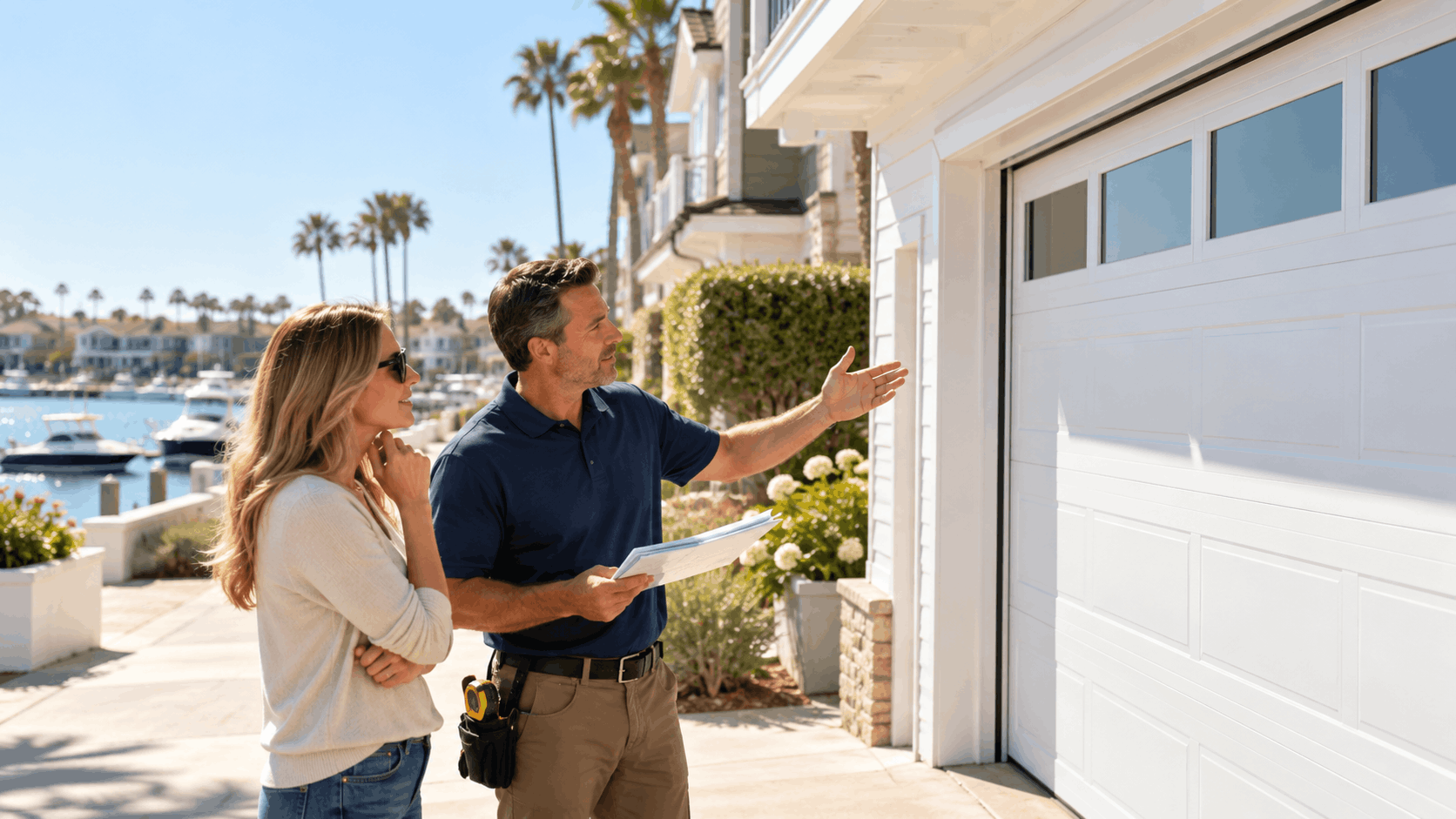
The Short Answer: When a Door Swap Needs a Permit on Balboa Island?
Let us place the dividing line where an owner can actually see it. On Balboa Island, the permit question is rarely about the door being new and more about what the installation touches. Because the whole island sits in the Coastal Zone, the city looks closely at anything that changes an exterior wall or an opening.
A plain door swap and a reframe live on opposite sides of that line. One keeps the opening and structure exactly as they are. The other changes the hole in the wall, and that is where a coastal development permit and a building permit can enter the picture. Knowing which side your job sits on saves weeks of guesswork.
Same Opening, Same Size: Usually the Simple Path
When a technician pulls an old door out and sets a new one of the same dimensions back into the same framed opening, nothing structural changes. The header above the door, the jambs on each side, and the overall rough opening stay exactly as the original builder left them. That is the lighter case, and it is the most common garage door swap on the island.
Structural work is generally what triggers a building permit, not a like-for-like door replacement. If the header is not touched, the opening is not widened, and the wall around it stays intact, the job is usually a straightforward product swap. The new door simply matches the footprint of the one it replaces.
This matters on Balboa Island because so many garages were built to older, undersized dimensions. Keeping the same opening means a custom-width door is often ordered to fit what is already there, rather than cutting the wall to fit a standard door. Matching the existing opening keeps the paperwork light and the schedule short.
Even on the simple path, the door still has to meet current opener and safety rules, which we cover further down. A same-size swap keeps you out of the structural review, but it does not exempt the opener from California law. Those are two separate questions that owners often blur together.
Changing the Opening or the Structure: The Longer Road
The moment a project widens the opening or alters the structure around it, the job changes character. Cutting the wall to make the door taller or wider, moving a jamb, or reworking the header is structural work. On a coastal property, that is the kind of change that can require a coastal development permit before or alongside a building permit.
Any work touching exterior walls or openings draws coastal review because the island is entirely within the Coastal Zone. The review is not about punishing improvement. It exists to look at how exterior changes affect the coastal setting, and a reframed garage opening is a clear exterior change to the structure.
Because of this, a reframe should be planned as a project with a timeline, not a same-day fix. An owner who wants a larger door to fit a modern vehicle, for example, is taking on structural work that carries a different approval path than a straight replacement. The door itself may be the easy part; the opening is what the city examines.
Our advice to island owners considering a wider or taller opening is to treat the structural question first and the door selection second. Once the opening is approved and framed, choosing and installing the door follows the same steps as any other garage door installation. Getting the sequence right keeps the project moving instead of stalling at the permit counter.
Why the Permit Position Is Confirmed Per Address
There is no single island-wide rule that answers the permit question for every garage. The decision belongs to the city with jurisdiction over the specific address, and in this case that is Newport Beach. What applies to one property may differ from the garage three doors down, depending on what the work involves.
That is why we tell owners to confirm the position for their own property rather than assuming. The Newport Beach Permit Center is the authority on whether a given job needs a building permit, a coastal development permit, or neither. An owner who calls ahead with the specifics of their job gets a clear answer before any door is ordered.
Confirming per address also protects the owner on the licensing side, which we explain later. When a permit is required, the rules about who can legally perform the work change. So the permit question is not just a formality; it shapes who is allowed to touch the job and how the contract is handled.
The short version is that the city answers the permit question for your exact address. For anything beyond a same-size swap, a quick confirmation with the Permit Center removes the guesswork and sets the right expectations for timing.
Get Your Free Quote
Tell us about your garage door and we'll get back to you fast.
What the Coastal Zone Means for a Garage Door Here
Balboa Island is not a place where coastal rules occasionally apply. Nearly every property in Newport Beach sits in the Coastal Zone, and the island is coastal from one street end to the next. That second layer of review is a permanent feature of working on exterior walls here.
For a garage door, the coastal layer matters most when the work touches the opening or the structure. A product swap in the same opening is one thing. Altering exterior walls is another, and a coastal development permit can come into play. The table below shows how the common scenarios line up.
| Scope of Work | Touches Exterior Opening? | Likely Review Path |
|---|---|---|
| Same-size door in existing opening | No change to opening | Usually the simple path, confirm per address |
| New opener on existing door | No | Must meet opener laws, no structural review |
| Widening or raising the opening | Yes | Can require coastal and building permits |
| Altering the header or framing | Yes | Structural, longer coastal process possible |
Work That Touches Exterior Walls or Openings Draws Review
The reason a swap and a reframe are treated so differently comes down to the exterior wall. A garage door opening is part of the building's outer face, and in the Coastal Zone the outer face is exactly what review looks at. Keep the opening the same and you have changed a product, not the structure.
Change the size of the opening and you have altered an exterior wall, which is the kind of work that can draw coastal review. This is not a quirk of Balboa Island alone; it follows from the property sitting inside the Coastal Zone. The garage door opening is treated like any other exterior opening when its dimensions change.
Owners sometimes assume a bigger door is a cosmetic upgrade. In coastal terms, enlarging the opening is a structural and exterior change at once. That combination is why we separate the door decision from the opening decision when we scope an island project.
Understanding this split helps an owner budget both time and expectations. A same-opening replacement can often be scheduled like a normal service job. A reframe needs the city involved first, and the garage door simply follows once the structure is settled.
How to Check If Your Property Is in the Coastal Zone
Owners do not have to guess whether their lot is coastal. The Newport Beach Address Search Tool tells an owner whether a property sits in the Coastal Zone. On Balboa Island the answer is effectively always yes, but checking the exact address removes any doubt before a project starts.
City staff guide applicants through the documentation when a coastal review is involved. That means an owner is not left to interpret the rules alone. A short conversation with the city clarifies what a specific job requires and what paperwork, if any, needs to accompany it.
We encourage owners to check their address and ask the city rather than assuming one way or the other. It costs nothing and it prevents the worst outcome, which is ordering a door for a wider opening only to learn the opening change needs review. A few minutes up front saves a stalled project.
For properties on the island, the coastal status is a known quantity, but the scope of the work is not. That is the piece the owner and the city confirm together. Once the scope is clear, the review path follows naturally.
Coastal Timelines Are Weeks and Months, Not Days
The most important expectation to set is time. A coastal process is measured in weeks and months rather than days. An owner planning a structural change, like widening the opening, should build that timeline into the schedule from the start.
This is very different from a same-size swap, which can often be handled quickly as a straightforward replacement. The long timeline attaches to the coastal and structural review, not to the door installation itself. Once approvals are in hand, fitting the door is the fast part.
The Newport Beach Permit Center is the place to start for timing questions. It is located at 100 Civic Center Drive, and the phone number is 949-644-3309. An early call lets an owner learn the likely path before committing to a reframe.
Planning ahead is the practical takeaway. If a project needs coastal review, start that conversation weeks before you hope to see the finished door. For a simple replacement, the city can usually confirm that the lighter path applies, and the job moves on a normal schedule.
Need Help in Irvine?
Urgent Garage Doors serves Irvine and all of Orange County.
Alley Garages and Island Access That Shape the Job
On Balboa Island, the day is decided before any door goes up. The island was dredged into being between 1908 and 1909 by William S. Collins, and the grid of small lots, narrow streets, and alleys he laid out survives. Standard lots run just 30 by 85 feet.
Garages sit off those alleys rather than off the street frontage, and the alleys are narrow enough that a full-size vehicle cannot always get in, turn, or work. Openings are undersized by modern standards. That combination of tight access and small openings shapes everything from the vehicle we send to the door we order.
Narrow Alleys and Smaller Service Vehicles
The city's own guidance on temporary street use notes that some tight residential areas, Balboa Island specifically, cannot accommodate larger vehicles. That is not a complaint about the island; it is a planning fact that a garage door crew has to respect. A truck that works fine on the mainland may not fit the alley behind a Balboa Island garage.
So we confirm alley width and access before dispatch. Knowing the route and the space ahead of time lets us plan for a smaller vehicle when the alley demands it. Showing up with the wrong truck wastes the owner's time and ours.
Tight access also means a crew often carries material further than on a mainland job. Panels, tracks, springs, and tools may need to be walked in from wherever the vehicle can legitimately stop. Planning for that carry is part of scoping an island job properly.
None of this is a problem when it is expected. It becomes a problem only when a crew assumes mainland access and finds an alley that will not take the truck. Confirming access first keeps the install on schedule and off the ticket book.
Undersized Openings and Low Headroom
Island garages are small, often single-bay, with low headroom and limited backroom. A standard off-the-shelf door and a standard opener frequently do not fit these spaces. That is the norm on Balboa Island, not the exception.
The solutions are specific. Custom-width doors are ordered to match openings that do not conform to modern standard sizes. Low-headroom track kits let a sectional door roll up where the ceiling clearance is tight. And a jackshaft opener, mounted beside the torsion bar rather than on a ceiling rail, works where there is no room overhead for a traditional operator.
These are normal answers here rather than special requests. When the ceiling is low or storage occupies the overhead space, a jackshaft operator is often the sensible choice. Our garage door opener installation team selects the drive type to match the room the garage actually has.
Choosing the right hardware for the space is what keeps an island door working smoothly for years. Forcing a standard door into a nonstandard opening causes binding, uneven travel, and premature wear. Matching the product to the opening avoids all of that.
Measure Before Quoting on the Island
Assuming a standard opening on Balboa Island is how a job goes wrong on the day. The only reliable approach is to measure the opening, the headroom, and the backroom before any quote is given. Numbers on paper beat assumptions every time.
Measuring tells us whether a custom-width door is needed, whether a low-headroom track kit applies, and whether a jackshaft opener is the right call. Those decisions change the parts list and the price, so they belong at the front of the process, not the day of installation.
A proper measurement also confirms the door will clear any obstructions inside the garage. Low ceilings on the island often carry storage, lighting, or framing that affects track placement. Catching that before ordering prevents a return trip and a reorder.
For island owners, measuring first is simply how a reliable quote is built. It respects the quirks of century-old construction and the small footprints Collins laid out. When the measurements drive the order, the door fits the first time.
Summer Parking Rules That Decide When Work Happens
On Balboa Island, the calendar sets the schedule as much as the job does. From mid-May to mid-September, the streets fill and a service vehicle has nowhere legitimate to sit. Parking, not labor, often decides when island work can happen.
Parking is on-street only across the island, reached by the Marine Avenue bridge or the three-car Balboa Island Ferry. During the restricted season, that limited supply gets even tighter. Planning around it is the difference between a smooth visit and a parking citation.
The May 15 to September 15 Restricted Season
Parking on public streets in the restricted residential zone is limited from May 15 to September 15 each year. During that window, only vehicles displaying a valid permit may park. For a service vehicle without a resident permit, that effectively removes legitimate parking across the island.
Permit holders must still comply with all other parking regulations, including the 72-hour ordinance. The permit is not a free pass; it works within the broader rules. That detail matters for anyone coordinating access for a longer job.
The practical effect is that from mid-May to mid-September the streets are full and a service vehicle has no clear place to sit. A crew planning an island install during these months has to think carefully about where the vehicle will legally stand while the work happens.
This is a seasonal reality unique to dense island neighborhoods like this one. Mainland jobs rarely face the same constraint. On Balboa Island it is a planning factor we build into the schedule from the first call.
Resident Permits and How Many Are Allowed
For residents, the permit system has specific limits. Newport Island residents may purchase up to three permits per residence, in any combination of permanent and guest permits. Proof of residence is required to obtain them.
If a permit is lost or stolen, a $24 replacement fee applies. Those are the numbers residents work with when managing their own parking and that of their guests during the season. For a contractor, the takeaway is that resident permits are limited and spoken for.
Because the permits belong to the residence and are capped, a service vehicle cannot simply rely on borrowing one for the day. The household's permits are usually needed for the household's own vehicles and guests. That is another reason scheduling around the season matters.
Property managers coordinating work on rental units run into this constantly. With a substantial short-term and seasonal rental population on the island, parking during changeover days in season is tight for everyone. Knowing the permit limits helps set realistic expectations for when a crew can get to the property.
Booking Off-Season or Early Morning
The clean solution is timing. Booking island work outside the restricted season, between mid-September and mid-May, sidesteps the parking crunch entirely. That is the easiest window for a service vehicle to find a legitimate place to stop.
When work has to happen during the season, early morning is the next best option. Getting on the island before the streets fill gives a crew a better chance of parking legally and working without a ticket. The difference between a smooth job and a citation often comes down to the hour the truck arrives.
We factor this into scheduling whenever we take an island call. If a job can wait for the off-season, we say so. If it cannot, we aim for an early slot and confirm access ahead of time.
For owners and property managers, planning the timing is part of planning the repair. A door that fails in July can still be handled, but the parking and access realities shape how and when. Thinking about the season early keeps the whole project easier.
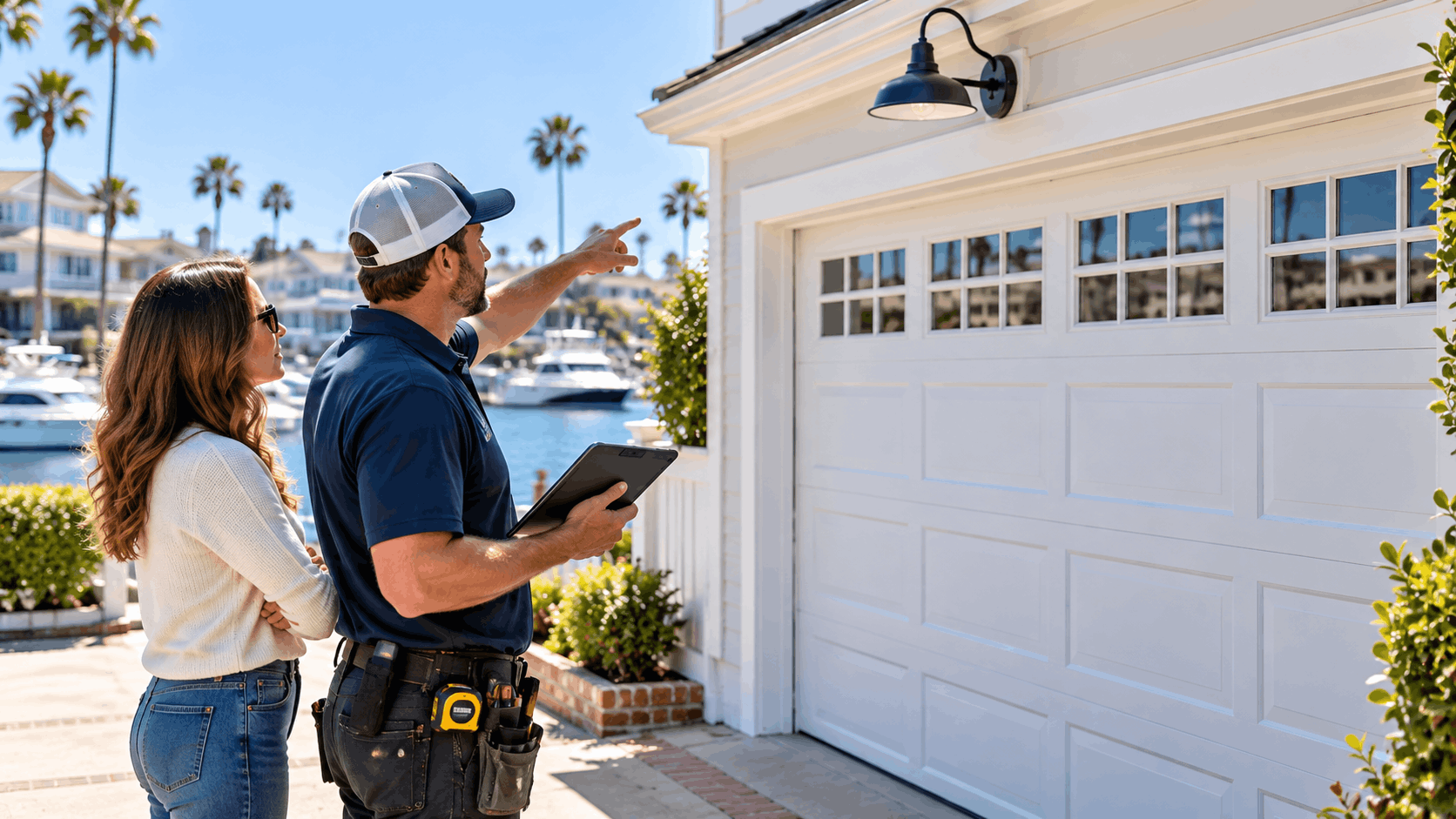
Salt Air and Why Island Hardware Needs Closer Inspection
Balboa Island sits in Newport Harbor with water on every side, so humidity and airborne salt are constant rather than seasonal. That setting changes what wears out on a garage door and how it fails. Hardware that might coast along for years inland faces a harder environment here.
Springs, cables, drums, rollers, hinges, fasteners, and track all corrode in this air. Corrosion does not add a magic multiplier, but it does bring metal parts to the end of their cycle rating earlier than they would reach it in a dry inland tract. That is why inspection carries more weight on the island than almost anywhere in the service area.
Cables That Fray From the Inside
Of all the hardware, cables deserve the closest attention here. Lift cables are made of twisted steel strands, and in constant harbor humidity and salt they corrode from the inside before the damage shows on the surface. A cable can look passable and already be compromised within its strands.
That is why cables in particular fray from the inside before they fail. By the time a frayed strand is visible on the outside, the cable has often lost real strength. On the island, waiting for visible damage is waiting too long.
This is the reason cable inspection matters more on Balboa Island than almost anywhere else we work. Checking cables during service, and replacing them at the first sign of internal corrosion, prevents a sudden failure that can drop a door. Our garage door cable repair work on the island always includes a careful look at the full length of each cable.
Replacing a spring without inspecting cables is how a second failure follows weeks later. Because the same corrosive air that tires a spring also attacks the cables beside it, we treat them as a set. Fixing one and ignoring the other invites a repeat visit.
Steel Door Bottoms That Rust From the Base Up
Steel doors on the island show their own pattern of wear. The bottom section rusts from the base upward, where it sits closest to damp ground and the salt-laden air pools lowest. That is the first place rust takes hold on a steel door here.
The bottom section also carries the weather seal and takes the most contact with moisture every time the door closes against the slab. Combine that with constant harbor humidity and the lower panel becomes the weak point. Rust there can spread and compromise the panel's edge over time.
Understanding where the rust starts tells an owner what a repair actually solves. Sometimes a panel replacement addresses a rusted bottom section without replacing the whole door. Other times, widespread corrosion means a full replacement is the honest answer.
Either way, the fix should match the damage. Replacing a rusted bottom panel on an otherwise sound door restores the seal and the look. Catching it early keeps a localized problem from becoming a whole-door problem.
Coated Hardware and a Twice-Yearly Cycle
The practical defenses against island corrosion are well established. Galvanized and stainless hardware stands up to salt air far better than bare steel. Coated springs resist the surface corrosion that shortens the life of uncoated ones.
Choosing these materials from the start gives island hardware a fighting chance against the environment. When we install or repair on Balboa Island, we favor corrosion-resistant components wherever the budget and the door allow. It is the difference between parts that last their rating and parts that fall short of it.
Regular inspection is the other half of the answer. A twice-yearly maintenance cycle is defensible on this island in a way it would not be in an inland tract. Two checks a year catch internal cable corrosion, rust starting at a panel base, and worn rollers before they fail.
A preventive maintenance plan built around that twice-yearly rhythm fits the island's conditions. It keeps hardware in service longer and spots the early signs that only show up when you look closely. On the harbor, looking closely twice a year is simply good sense.
Need Help in Irvine?
Urgent Garage Doors serves Irvine and all of Orange County.
Opener Laws Every Island Replacement Must Meet
A garage door opener on the island is not just a convenience; it is governed by California and federal law. When a door is replaced, the opener has to meet current rules. A power cut on the island makes those rules more than paperwork, because a jammed door can trap a car in an alley with nowhere to go.
Three separate laws apply, each with its own date and purpose. Keeping them distinct matters, because they are often blurred together. Below, each one stands on its own.
Battery Backup Under SB 969
SB 969, signed in 2018, requires every residential automatic garage door opener manufactured for sale, sold, offered for sale, or installed in California on or after July 1, 2019, to have a battery backup designed to operate during an electrical outage. Violations carry a $1,000 civil penalty. Since that date, a replacement residential garage door may not be installed connected to a non-compliant opener.
The law was passed after deaths in the 2017 Northern California wildfires, where people could not open their garage doors during power cuts. The purpose is evacuation when the grid goes down and a resident cannot lift a heavy door by hand. It applies statewide and to residential openers.
On Balboa Island, where garages open onto narrow alleys, the logic hits home. A power cut and a jammed door leave a car stuck with no easy way out. A battery backup keeps the door operable when the power fails.
Because this is a legal requirement, battery backup comes with a compliant opener on a California replacement, not as an optional extra. Our battery backup installation work reflects that the feature is part of meeting the law, not an upsell.
Entrapment Protection and the 1993 Line
California moved early on auto-reverse. AB 3600, enacted in 1990, required California openers to be manufactured with an automatic reverse device and sensor. Federal law followed for openers manufactured for the United States after January 1, 1993.
California Health and Safety Code section 19890 has required entrapment protection sensors on openers since January 1, 1993. In practice that means a non-contact photo-eye system, mounted on each side of the opening no higher than six inches off the floor, that stops and reverses the door when the beam is broken. The door must also reverse within two seconds of contacting an obstruction.
The honest line for an old island opener is that a unit made before 1993 predates the federal entrapment-protection mandate. It is not illegal to own, but it lacks the external sensor protection every modern opener must have. When such an opener is replaced, the new unit brings the photo eyes and compliant reverse with it.
Photo-eye faults, misalignment, and blocked beams are the most common cause of a door that reverses for no visible reason. On the island, airborne debris and a bumped bracket can knock a beam out of line. Our safety sensor alignment repair service brings the beam back into line so the door behaves.
Why a Century of Island Stock Means No Two Garages Match
Balboa Island carries a century of building history, from original cottages through mid-century rebuilds to contemporary replacements on the same small footprints. Two neighboring garages can be eighty years apart in hardware. That range is part of what makes island work unlike a uniform tract.
In the older stock, openers may predate the January 1, 1993 federal requirement for external entrapment protection entirely. A garage that has not been touched in decades can still run an opener with no photo eyes at all. When that opener is replaced, it needs the sensors and a compliant unit to meet current law.
This mixed stock means a crew cannot assume anything about what is behind a given door. One garage may hold a modern operator; the next may hold hardware from before the sensor mandate. Each is assessed on its own before any replacement.
When an old opener is replaced, the opener and smart access upgrade brings the garage up to current standards for both safety and battery backup. That is how a century-old garage gets a compliant, modern operator without guesswork. The age of the stock is exactly why measuring and assessing come first.
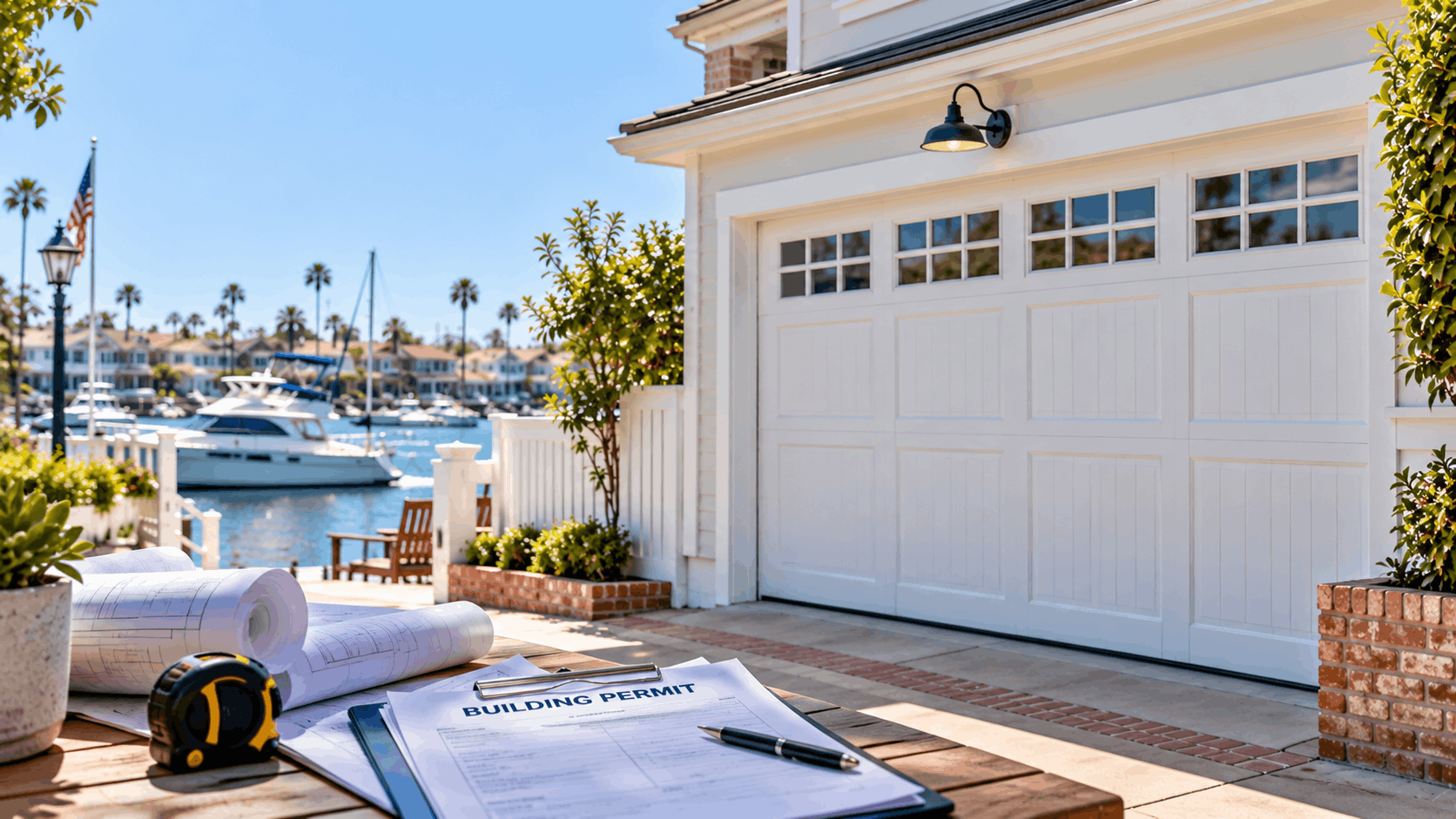
Licensing and Who Is Allowed to Do the Work
Knowing who may legally perform garage door work protects an owner as much as any permit does. California licenses this trade, and there are money thresholds people hear about and often confuse. Getting these right helps an owner tell a licensed job from an unlicensed one.
On Balboa Island, the licensing question links directly to the permit question. When a job needs a permit, the rules about who can do the work tighten. Here is how the pieces fit together.
The Correct Classification Is C-61/D-28
Garage door work in California is licensed by the Contractors State License Board under classification C-61/D-28, Doors, Gates and Activating Devices. It is a subclassification of the C-61 Limited Specialty category. That scope covers sectional and rolling doors, torsion and extension spring systems, operators, control boards, safety sensors, and activating devices.
In plain terms, that classification is the one that covers the full range of garage door work, from a spring replacement to a complete install with a new opener. It is the right credential to look for when hiring for this trade. The scope matches the work that happens behind an island alley door.
C-28 is a different classification entirely. C-28 is Lock and Security Equipment, and it is not the garage door license. Garage door work is also not a Class B general building job. An owner checking credentials should look specifically for C-61/D-28.
Urgent Garage Doors holds California license #1055150. Verifying the classification before work starts confirms the contractor is licensed for the actual work being done. The classification, not just the presence of a license, is what matters.
The $1,000 Unlicensed Exemption and Its Conditions
People often repeat an old figure about small jobs. Assembly Bill 2622, effective January 1, 2025, raised the unlicensed-work exemption in Business and Professions Code section 7048 from $500 to $1,000 in combined labor, materials, and other costs. A great deal of older advice still prints $500; the current number is $1,000.
The exemption carries conditions, and they matter on the island. It fails if the work requires a building permit of any kind. It also fails if the person employs anyone on the job. And a job cannot be split into sub-$1,000 slices to stay under the line.
On Balboa Island, where structural work can require a permit, needing that permit removes the exemption entirely. So a reframe that pulls a permit is not a candidate for unlicensed work at any dollar figure. The permit requirement and the licensing requirement move together.
For most meaningful garage door work, licensed work is the straightforward and compliant path. The exemption applies to genuinely small, permit-free, one-person jobs and nothing more. Understanding its three conditions keeps an owner clear of trouble.
The Separate Written Contract Rule
A different $500 figure exists, and it is easy to confuse with the licensing exemption. Business and Professions Code section 7159 requires a written home improvement contract for work over $500. That is a contract requirement, not a licensing threshold, and the two should not be merged.
So one $1,000 figure governs when unlicensed work is permitted, and a separate $500 figure governs when a written home improvement contract is required. They come from different statutes and serve different purposes. Keeping them straight prevents a lot of misunderstanding.
The written contract rule protects the owner by putting the scope and price on paper for work above $500. It is a legal requirement that applies regardless of the contractor. An owner should expect a written contract for any job that clears that threshold.
A license, its classification, status, bond, and workers compensation are all public record. Any owner can verify a contractor free at cslb.ca.gov. Checking the license number against the C-61/D-28 classification takes a minute and confirms the contractor is cleared for the work.
Need Help in Irvine?
Urgent Garage Doors serves Irvine and all of Orange County.
How Urgent Garage Doors Handles a Balboa Island Job
Island work rewards preparation, so our approach starts well before the truck rolls. Balboa Island's alleys, undersized openings, parking seasons, and salt air all shape how we scope and schedule a job. We plan around those realities rather than against them.
From the first call to the finished door, the goal is to arrive ready and leave the garage working safely and legally. That means confirming access, measuring carefully, pricing clearly, and meeting the opener laws that apply to every California replacement. Here is how that plays out.
Confirming Access and Measuring Before the Truck Rolls
We confirm alley width and access before dispatch, because the island cannot always take a full-size vehicle. Knowing the alley ahead of time lets us plan for a smaller vehicle when the space demands it, and prepare to carry material further than a mainland job would require. That planning keeps the visit smooth and legal.
We also measure the opening, the headroom, and the backroom before quoting. Island garages rarely match a standard opening, so a measurement drives the order. A custom-width door, a low-headroom track kit, or a jackshaft opener may be the right answer, and we identify that from the numbers rather than assuming.
This front-loaded work is what keeps an island install on track. Confirming access and measuring first means the correct door and hardware arrive the first time. It also means the schedule accounts for parking season and alley constraints before anyone is standing in the alley.
For an owner or a property manager who is not on site, this preparation matters even more. With a large share of island properties rented, the person authorizing the work is often not the person living there. Clear access confirmation and accurate measurements keep everyone informed and the job moving.
A Written Price and the Brands We Work On
A written price is available before work begins when the job calls for it or the customer asks. It puts the scope and cost on paper so an owner knows what to expect before any tools come out. For work over $500, California also requires a written home improvement contract, which keeps the terms clear in writing.
We work on all garage door brands, so island owners are not limited by what the original builder installed. That includes LiftMaster, Chamberlain, Genie, Craftsman, Clopay, Amarr, Wayne Dalton, and CHI. Whatever is behind the alley door, we can service or replace it.
Working across brands matters on an island with a century of mixed stock. One garage may hold a modern LiftMaster opener; the next may hold decades-old hardware that predates current safety rules. Our range lets us handle both without sending the owner elsewhere.
Whether the job is a spring, a cable, a panel, or a full replacement, the written price and the brand coverage give an owner a clear path forward. The quote reflects the island realities we measured up front, not a mainland assumption.
Response Across Orange County From the Irvine Storefront
We take emergency calls 24 hours a day, 7 days a week, every day of the year including holidays. The response window is 30 to 60 minutes across Orange County. On Balboa Island, that response is paired with confirming alley width and access before dispatch, so the crew arrives ready for the space.
The work runs from our storefront at 76 Ashford, Irvine, CA 92618, and the main number is (949) 529-7743. Urgent Garage Doors was founded in 2017 and holds California license #1055150, verifiable free at cslb.ca.gov. Island owners can reach the same team for emergency and scheduled work alike.
For more on our coverage in the area, see our Newport Beach service page and the full list of garage door services we provide. Those pages lay out the repairs and installations available to island properties and the surrounding harbor neighborhoods.
When a door fails behind an island alley, the combination of 24/7 availability and access confirmation means help arrives prepared. That is what island conditions call for, and it is how we handle a Balboa Island call from the first ring.
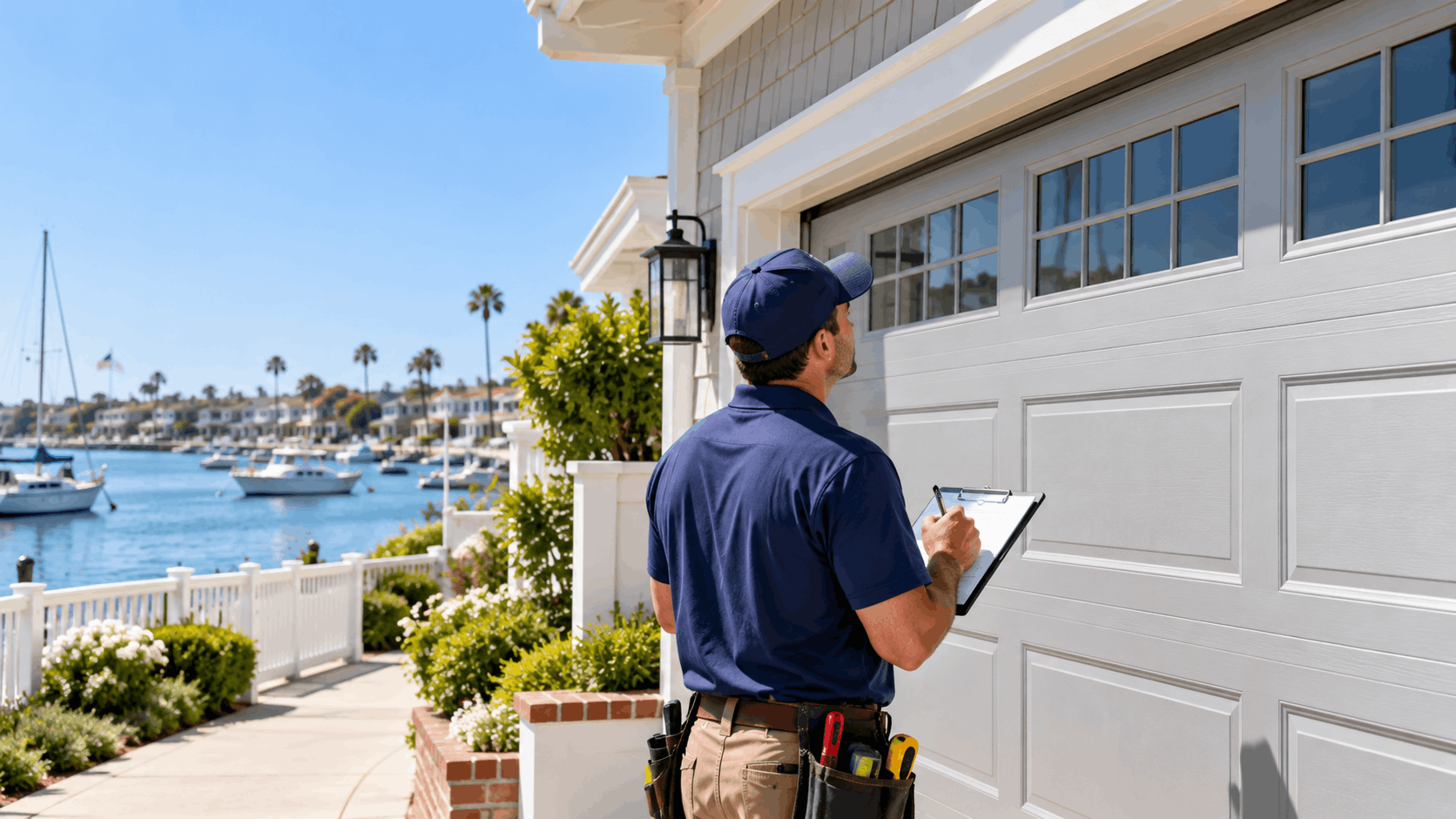
Getting Your Balboa Island Door Handled
Reach us at (949) 529-7743 for a diagnostic that confirms alley access, measures the opening, and sets a written price before work begins when the job calls for it. We run from the Irvine storefront under California license #1055150, and the next step is a call so we can confirm the access and timing for your specific address on the island.
Frequently Asked Questions
- Does replacing a garage door on Balboa Island need a Coastal Development Permit?
- It depends on what the work touches. Replacing a door in an existing opening with one of the same dimensions is different from changing the opening. Structural work, such as widening the opening or altering the header, is what can pull a job into coastal review and require a coastal development permit. Because the island is entirely in the Coastal Zone, confirm the position for your exact address with the Newport Beach Permit Center before ordering a door.
- How do I find out if my property is in the Coastal Zone?
- Use the Newport Beach Address Search Tool, which tells an owner whether a property sits in the Coastal Zone. On Balboa Island the answer is effectively always yes, but checking your exact address removes doubt. City staff guide applicants through the documentation when coastal review applies. The Permit Center is at 100 Civic Center Drive, and the phone number is 949-644-3309. Checking the address and asking the city beats assuming.
- What triggers a building permit for a garage door here?
- Structural work generally triggers a permit, not a like-for-like door swap. Widening the opening or altering the header is the kind of work that pulls a permit, while replacing a door in the same opening at the same size usually does not. The decision belongs to the city with jurisdiction over the address, which for Balboa Island is Newport Beach. Confirm your specific job with the Permit Center so you know the path before any work begins.
- Why does my new opener come with a battery backup?
- Because California law requires it. SB 969 requires every residential automatic garage door opener sold or installed in California on or after July 1, 2019, to have a battery backup designed to operate during an electrical outage. Violations carry a $1,000 civil penalty, and a replacement residential garage door may not be installed connected to a non-compliant opener. The feature matters on the island, where a power cut and a jammed door can trap a car in an alley.
- Can a standard off-the-shelf door fit my alley garage?
- Often it cannot. Island garages are small, frequently single-bay, with low headroom and limited backroom, so a standard off-the-shelf door and opener often do not fit. Custom-width doors, low-headroom track kits, and jackshaft openers mounted beside the torsion bar are common solutions here. The only reliable approach is to measure the opening, headroom, and backroom before quoting. Measuring first prevents a job from going wrong on the day of installation.
- Why do island garage cables fail sooner than the manufacturer rating suggests?
- The harbor setting is the reason. Balboa Island sits in the water on every side, so humidity and airborne salt are constant. That corrosion brings cables to the end of their cycle rating earlier, and cables in particular fray from the inside before they fail. By the time damage shows on the outside, the cable has often lost real strength. That is why cable inspection matters more here than almost anywhere else we serve.
- When is the best time of year to schedule garage door work on the island?
- Outside the restricted parking season is easiest. Parking on public streets in the restricted residential zone is limited from May 15 to September 15, when only permitted vehicles may park. During those months the streets fill and a service vehicle has nowhere legitimate to sit. Booking work between mid-September and mid-May, or early in the morning within the season, avoids parking trouble for the crew and reduces the risk of a ticket.
- What license should a garage door contractor hold in California?
- The classification is C-61/D-28, Doors, Gates and Activating Devices, issued by the Contractors State License Board. It covers sectional and rolling doors, spring systems, operators, control boards, safety sensors, and activating devices. C-28 is Lock and Security Equipment and is not the garage door license, and the work does not require a Class B general building license. A license can be verified free at cslb.ca.gov, where the number, classification, status, bond, and workers compensation are public record.
- Can I legally do the work myself if it is a small job?
- Only within narrow limits. The unlicensed-work exemption in Business and Professions Code section 7048 rose to $1,000 on January 1, 2025, counting combined labor and materials. But it fails if the work requires a building permit of any kind, or if the person employs anyone on the job, and a job cannot be split into smaller slices to stay under the line. On Balboa Island, structural work that needs a permit removes the exemption entirely.
- How fast can a technician reach Balboa Island in an emergency?
- Urgent Garage Doors takes emergency calls 24 hours a day, 7 days a week, including holidays, with a 30 to 60 minute response window across Orange County. For island calls, alley width and access are confirmed before dispatch so the crew arrives with the right vehicle and a plan to carry material in. That preparation is part of responding to a Balboa Island emergency, where the alleys and parking seasons shape how the crew reaches the garage.
U
Licensed garage door repair professionals serving Irvine and Orange County.
Licensed in California · License #1055150
Why trust Urgent Garage Doors?
Founded in 2017, Urgent Garage Doors is a licensed and insured garage door services serving Irvine and Orange County. All content is reviewed by our licensed technicians.

Need Help in Irvine?
Urgent Garage Doors serves Irvine and all of Orange County.
Related Articles

Tips & Advice
Best Garage Door Brands for Coastal Orange County
Discover the best garage door brands for coastal Orange County homes that resist salt air corrosion, handle marine layer moisture, and maintain performance despite coastal winds.

Tips & Advice
California Wind Load Ratings for Garage Doors: Coastal vs Inland Requirements
Coastal and inland California garage doors face very different wind load ratings. Learn what PSF ratings mean, how code applies, and how to pick the right rated door.