Garage Door Roller and Hinge Replacement in 1980s Costa Mesa Condos

Need Garage Door Help? Contact Us Now
Fast local service. Upfront pricing.
Get Your Free Quote
Tell us about your garage door and we'll get back to you within 30 to 60 minutes.
Key Takeaways
- Builder-grade steel rollers and thin hinges on 1970s and 1980s South Coast Metro condos reach the end of their service life, and frequent daily use as a main entrance speeds the wear.
- Grinding, squealing and a jerky door point to rollers; cracked knuckles and oval mounting holes point to hinges; a door that will not hold position when disconnected is a spring problem.
- Sealed nylon rollers run quieter than worn steel, which helps in tuck-under and tandem garages with bedrooms above; heavier doors may need steel or heavy-duty rollers matched to the track.
- Typical Orange County ranges are a quiet roller and hardware upgrade at $150 to $300 and track repair and realignment at $125 to $300, presented as typical ranges, not a quote.
- A like-for-like hardware repair usually needs no permit and usually falls outside Davis-Stirling architectural review, but the Costa Mesa building division and the association confirm the position.
- Santa Ana Heights is often listed as Costa Mesa but permits may run through Newport Beach, so confirm jurisdiction from the parcel record rather than the postal town.
- Owners should never touch the springs, which store enough energy to cause serious injury; springs are rated in cycles, commonly around 10,000, roughly seven years at four cycles a day.
- Urgent Garage Doors holds CSLB license #1055150, classification C-61/D-28, verifiable free at cslb.ca.gov, and responds 24/7 within 30 to 60 minutes across Orange County.
In This Article
A resident near South Coast Plaza called us about a door that had started to grind and jump each time it ran. In a tandem garage off one of those shared motor courts, the sound carries, and by the time they phoned, the panels were shifting enough that the door caught at the top of the track. Nothing was broken in a dramatic way. The rollers had simply worn out, and two hinges had cracked at the joint.
That is a familiar scene on the townhome streets around South Coast Metro. The condos built here in the 1970s and 1980s came with builder-grade steel rollers and thin steel hinges, and those parts have been running for decades. When they go, the door tells you before it fails outright: a steel-on-steel rattle, a squeal at the curve, and a jerk as the door climbs or drops.
Why 1980s Costa Mesa Condo Doors Wear Out Their Rollers and Hinges?
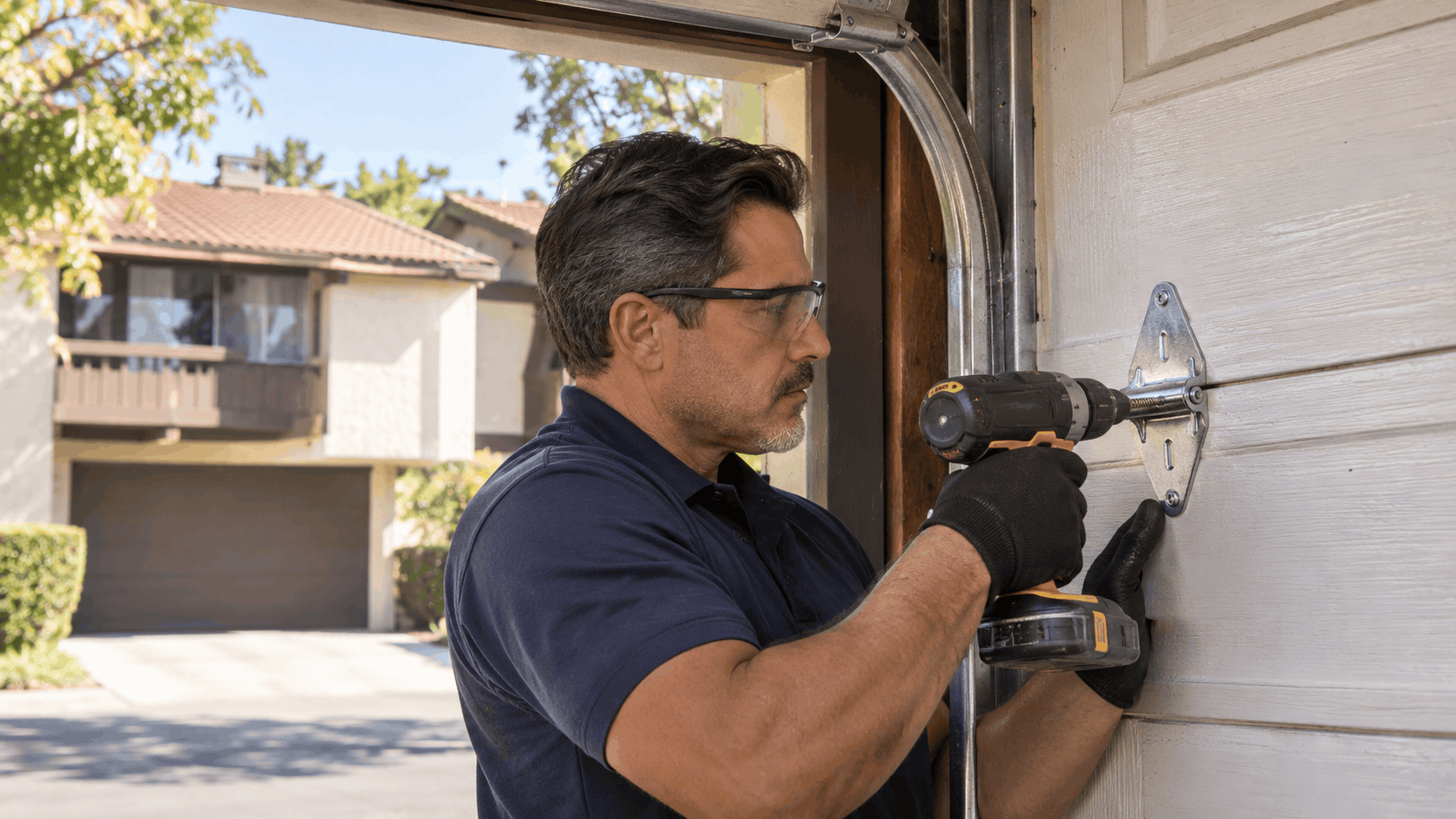
The build era decides most of these jobs. The attached condominium and townhome product put up around Costa Mesa in the 1970s and 1980s came with hardware sized to get the door moving and little more. Decades later, the original sectional door rollers and door hinges on these 1980s condos are at the end of their service life, and daily use has finished the job.
A sectional door is a stack of panels that bends around a curved track as it rises. Every one of those moving joints relies on a roller and a hinge. When the hardware is new, the motion is smooth and quiet. When it wears, the whole assembly starts to fight itself.
| Part | What it does | What failure looks like |
|---|---|---|
| Roller | Rides inside the track and lets the panel travel up and over | Grinding, squealing, a door that jumps or binds at the curve |
| Hinge | Joins the panels and holds the roller stems in place | Cracks at the knuckle, bent plates, oval mounting holes |
| Track | Guides the rollers along a fixed path | Door wanders, catches, or pops out of the channel |
What Rollers and Hinges Do on a Sectional Door
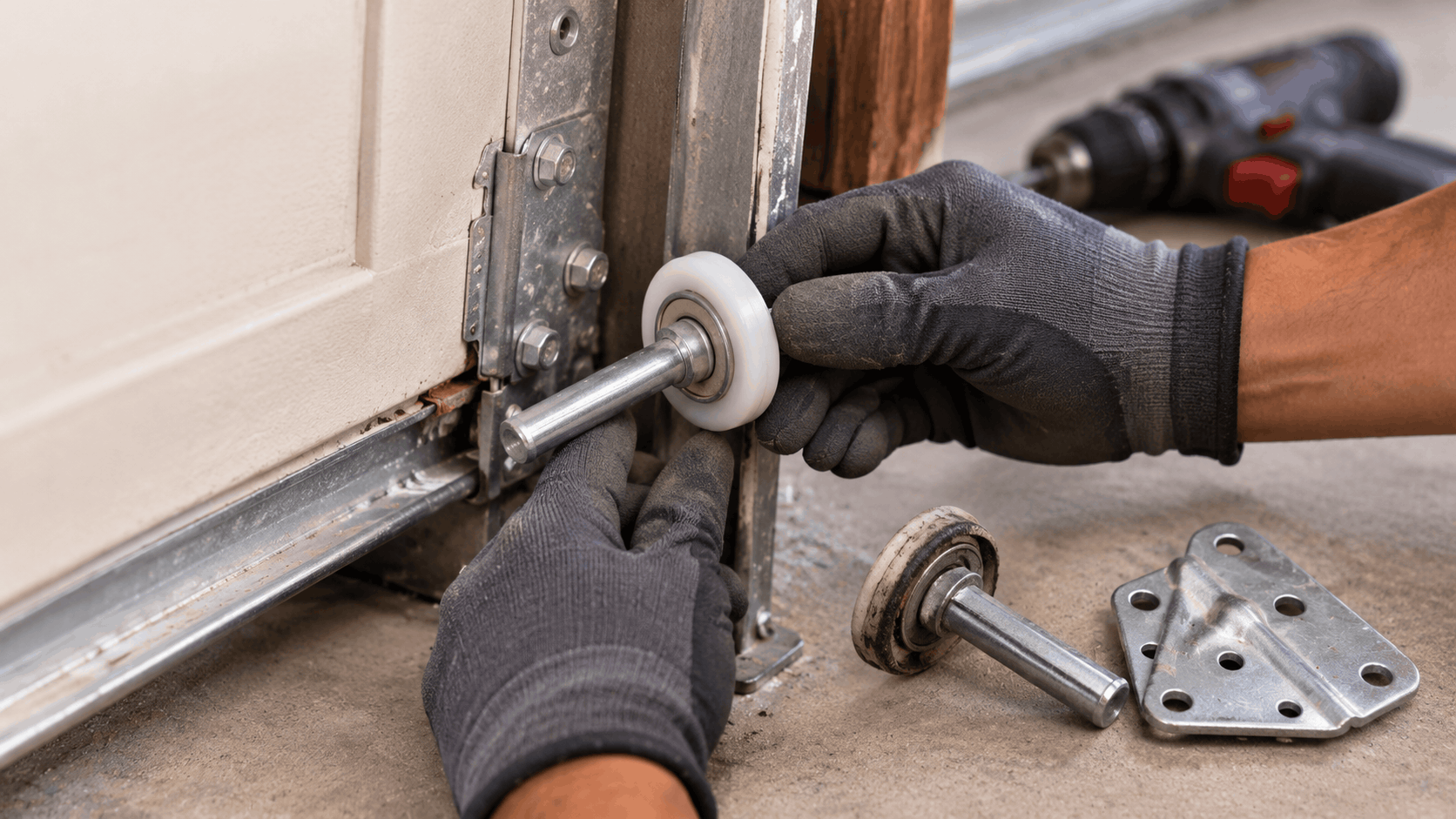
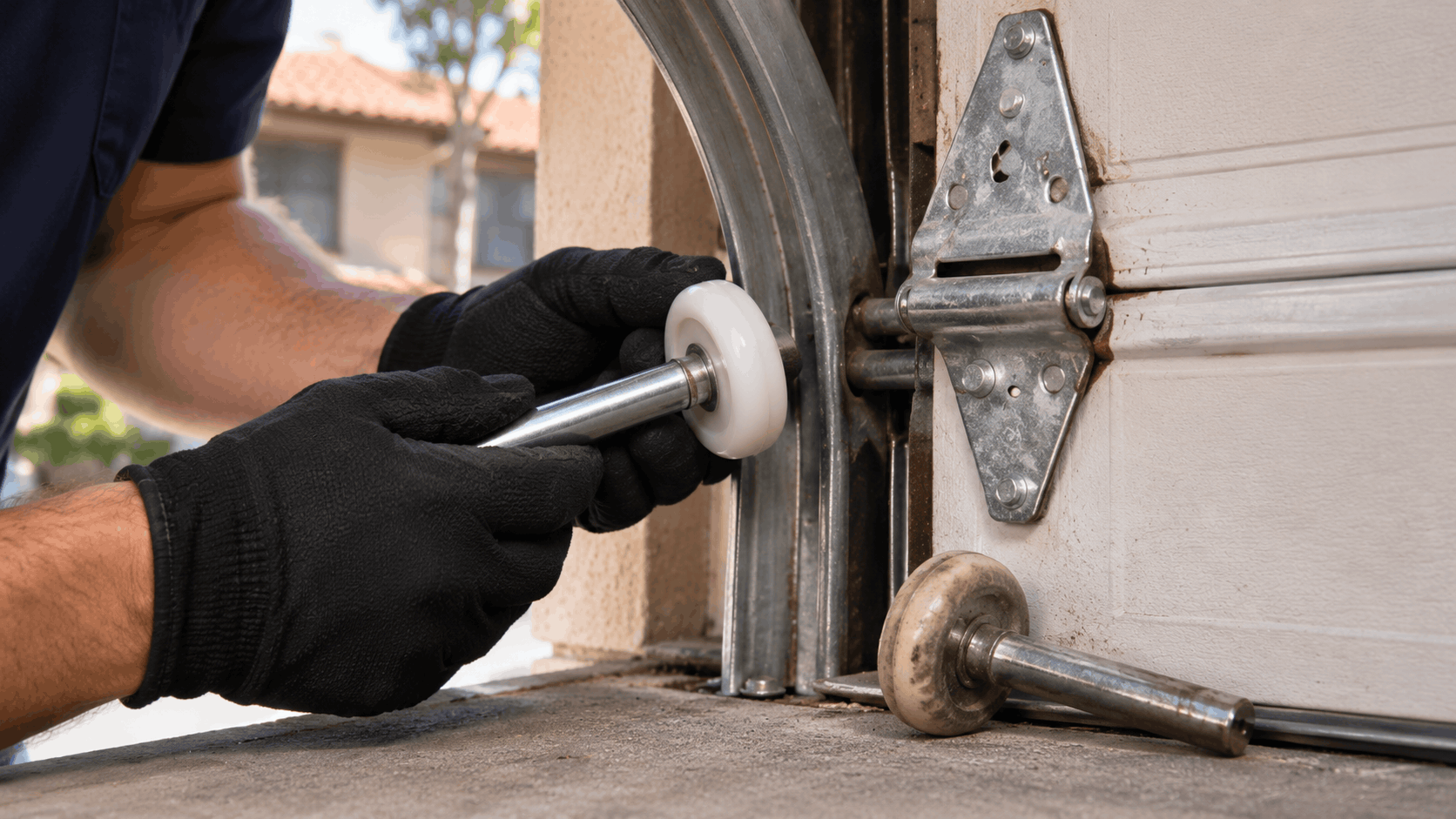
Rollers are the small wheels at the edge of each panel. Their stems slot into the hinges, and the wheel itself rides inside the metal track that runs up the wall and back across the ceiling. As the opener pulls the door, the rollers carry the weight around the curved section where vertical track meets horizontal.
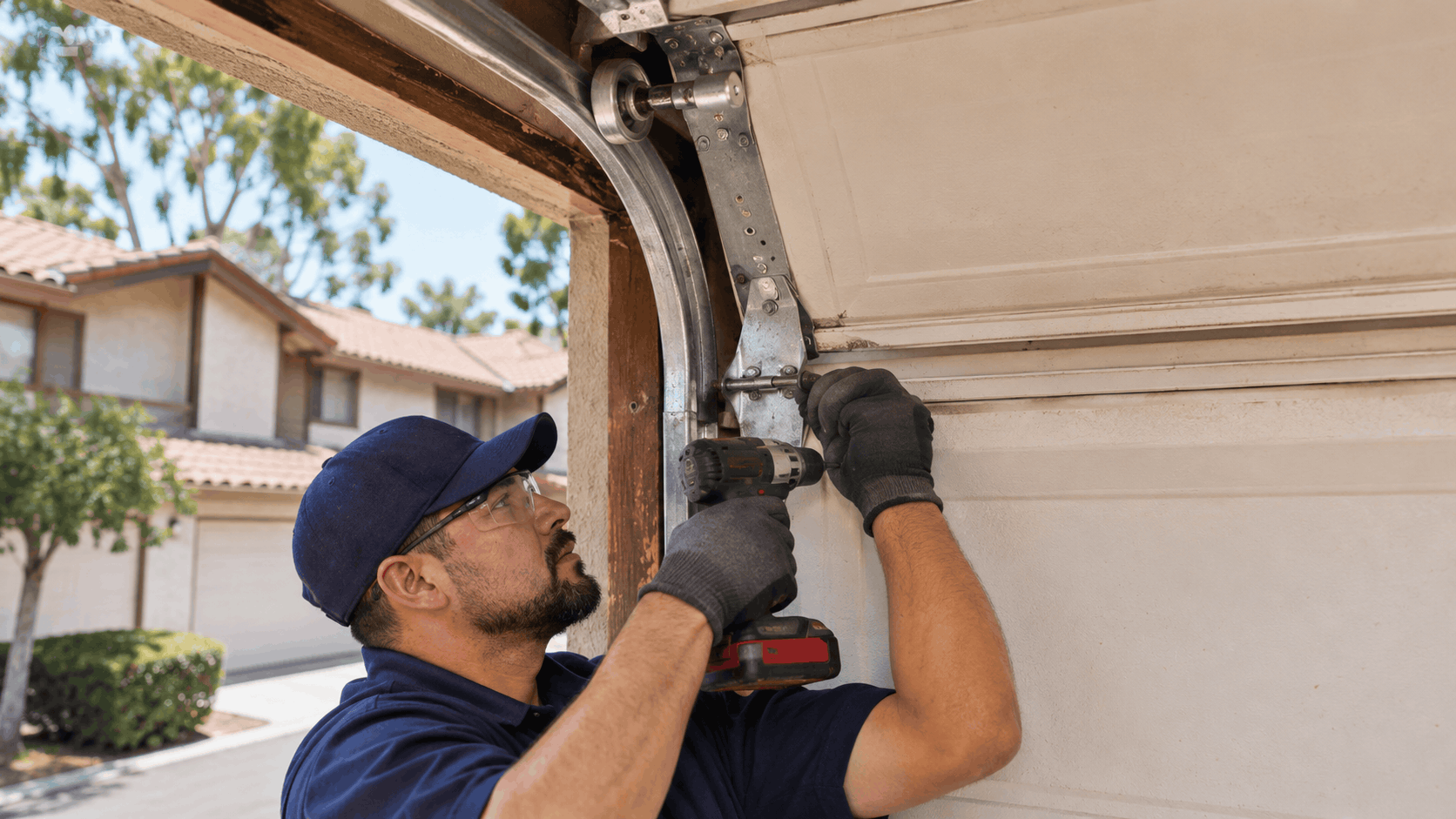
Hinges sit between the panels and bolt them together along each horizontal joint. They flex as the door bends around the curve, and the end and center hinges also hold the roller stems. A healthy hinge keeps the panels square to each other and the rollers seated where they belong.
When rollers wear, the nylon or steel wheel develops flat spots or the bearing loosens, so the wheel no longer spins true. When a hinge cracks or its holes stretch, the panel it holds can shift sideways. Either problem lets the door jump, grind, and over time walk itself out of the track.
That is why these two parts get discussed together. They share the load at every joint, and a failure in one puts more strain on the other. Replacing both at once restores the smooth path the door was built to follow.
The South Coast Metro and 1980s Condo Build Era
South Coast Metro is the dense quarter around South Coast Plaza and the Segerstrom Center, built out heavily in the 1970s and 1980s as attached condominiums and townhomes. The garages here come with shared driveways, motor courts, and plenty of tuck-under and tandem parking. The door product that went into those units was standard builder hardware for the day.
Standard for the day meant steel rollers with exposed stems and thin steel hinges stamped from light-gauge metal. That hardware was never meant to run for forty years. It was specified to get a new door operating at a price, and it has been cycling ever since.
By now the original rollers on many of these doors have lost their smoothness and the hinges have fatigued at the flex points. The parts are not defective. They have simply reached the end of a long service life, which is exactly what you would expect from the build era. Our work across the South Coast Metro condos runs into this constantly.
The tandem and tuck-under layouts add their own wrinkle. A door that sits directly under a bedroom or beside a neighbor's parking space makes every grind and rattle louder and harder to ignore, which is often why the call comes in.
Daily Use and the Door as a Main Entrance
For a lot of condo residents, the garage is the way in and out of the home. They pull in from work, raise the door in the morning, and the pattern repeats. On a door used as the main entrance, the cycle count climbs fast, because every trip is another full open and close.
Each cycle works the nylon or steel of a roller a little further and flexes every hinge one more time. A door opened four times a day runs more than fourteen hundred cycles a year. On hardware that has been in place since the 1980s, that is a lot of travel for parts that were never high-grade to begin with.
The wear shows up first where the motion is hardest. Rollers lose their bearings and start to drag or chatter, and hinges open up at the knuckle, the folded joint where the plates pivot. Once the knuckle loosens, the panel it holds can rock, and the roller on that hinge no longer tracks straight.
High cycle counts do not break hardware overnight. They grind it down steadily until the door starts telling you something is wrong. That is the point most residents notice and reach for the phone.
Marine Layer on the Westside vs Inland Streets
The marine layer reaches the western neighborhoods of Costa Mesa harder than the inland streets near the 405. On the Westside, corrosion on tracks and hardware is a regular part of the conversation, in a way it is not a few miles inland.
Moist air carries grit, and that moisture and grit work into roller bearings and settle on the track. On a roller with an exposed stem and an open bearing, that mix accelerates the drag you already get from age. The metal surfaces that should glide start to bite.
Corrosion does not invent a new failure. It brings an already-aging roller or hinge to the end of its service earlier than the same part would reach inland. The honest way to put it is that a west-side door often shows wear sooner, not by any fixed amount, but because the exposure is simply harder on the hardware.
Inland, the bigger factor is seasonal temperature swing, which stresses older hinges and can warp wood sections. Both conditions land on the same parts. They just arrive by different routes, which is why we look closely at the hardware's condition rather than its age alone.
Get Your Free Quote
Tell us about your garage door and we'll get back to you within 30 to 60 minutes.
How to Tell Your Rollers or Hinges Need Replacing
You can get a long way diagnosing a noisy garage door before anyone comes out. Worn rollers and a cracked hinge each give off their own signs, and the difference matters because it points to what the fix will involve. This section stays on rollers and hinges. Springs are a separate matter, and one you should never test by hand.
The Sounds That Point to Worn Rollers
Rollers are usually the loud ones. When the wheel develops flat spots or the bearing fails, you get grinding, a high squeal, and a steel-on-steel rattle as the door moves. The sound rises and falls with the door's travel rather than coming from one fixed spot.
A door on worn rollers also tends to jerk. Instead of a smooth glide, it moves in small stops and starts as each dragging roller catches and releases. You can feel this if you watch the panels climb; they do not rise as one clean sheet.
In a condo with living space above the garage, the noise is impossible to miss. The structure carries it straight up into the bedroom, and a 6 a.m. departure becomes everyone's alarm clock. That is often the trigger that moves a worn-roller job from "someday" to "this week."
If the noise is a grinding rattle that tracks the door's motion, rollers are the first thing to suspect. The fix is a set of fresh rollers, and in most cases the door runs quiet again right away.
Cracked Hinges and Elongated Holes
A failing hinge looks different from a worn roller. Check the plates along each horizontal joint. A cracked hinge usually splits at the knuckle, the folded pivot point, or shows a plate that has bent out of flat.
The other tell is the mounting holes. On a tired hinge, the round holes stretch into ovals as the bolts work back and forth over years of cycling. Once a hole goes oval, the hinge shifts under load instead of holding firm.
When a hinge moves like that, the panel it connects stops sitting square. You will see panels that no longer line up cleanly, with a gap that opens or a corner that sits proud of the one above it. That panel misalignment puts the roller on that hinge at a bad angle in the track.
Left alone, a cracked or loose hinge gets worse because every cycle pulls on the weak point. One failing hinge also loads up its neighbors, so a single crack can turn into several. Catching it early keeps the repair to the hinges that have actually gone.
A Door That Jumps, Binds or Comes Off Track
Put worn rollers and loose hinges together and the door starts to wander. Instead of running straight, it drifts in the track, binds at the curve where vertical meets horizontal, and in the worst case pops a roller clean out of the channel. That is an off-track door, and it is where a hardware problem turns into an emergency.
What the owner sees is a door that hesitates or catches at a certain height every time, or one that looks crooked, with one side higher than the other. Sometimes a roller sits visibly outside the track lip. The door may stop responding to the opener because it is physically jammed.
This gets worse the longer it runs. Each cycle that forces a misaligned door through the curve bends the track a little more and stresses the next hinge in line. A door that merely jumped last month can be fully off its track this month.
If your door has reached the binding or off-track stage, stop running it. Continuing to cycle a jammed door can bend the track or damage panels. Our off-track door repair gets the door back in its channel and the worn hardware replaced in one visit.
What You Can Safely Check Yourself
There is plenty an owner can check without any risk. Watch the door run through a full cycle and listen for where the noise comes from and when. Look along the track at the roller stems and at each hinge plate by eye. You are looking for cracks, bends, oval holes, and any roller wheel that is chewed up or wobbling.
You can also note whether the door runs crooked or catches at a particular point. All of that is useful information to hand a technician, and none of it requires touching anything under tension. A phone video of the door running, with the sound on, tells us a great deal before we arrive.
Here is the firm line: never touch, adjust, wind, or unwind the springs. A torsion spring stores enough energy to cause serious injury, and it releases that energy instantly if a winding bar slips. This is not a job for an owner, no matter how handy.
Keep your inspection to looking and listening. If the door will not hold its position or something is clearly under load, leave it and call. The rollers and hinges are safe to look at; the spring system is not something to probe by hand.
Need Help in Irvine?
Urgent Garage Doors serves Irvine and all of Orange County.
Nylon vs Steel Rollers and Choosing the Right Hinges
Once a door needs new hardware, there is a real choice to make. Nylon rollers and steel rollers behave differently, hinge numbers matter for alignment, and the parts have to match the actual door. Getting this right is the difference between a door that runs quiet for years and one that is back to grinding before long.
| Roller type | Best for | Trade-off |
|---|---|---|
| Sealed nylon with bearings | Quiet operation, condos with rooms above the garage | Lighter duty than heavy steel on very wide doors |
| Steel with bearings | Wider or heavier doors needing extra load capacity | Runs louder than nylon, especially as it ages |
Nylon Rollers and Quieter Operation
Sealed nylon rollers with bearings are the upgrade most condo owners want. The nylon wheel runs against the steel track far more quietly than a bare steel roller, and the sealed bearing keeps grit out of the moving part. The result is a smooth, soft-sounding door.
That quiet matters most in exactly the layouts South Coast Metro is full of: tuck-under and tandem garages with bedrooms directly above. A door on fresh nylon rollers stops broadcasting its every move through the floor of the room upstairs. For a lot of residents, that alone is the reason to call.
The bearings are the other half of the story. Cheap rollers skip the bearing and let the stem spin in a plain sleeve, which wears fast and gets noisy. Sealed-bearing nylon rollers hold their smoothness far longer because the bearing carries the load and the seal keeps contaminants out.
We handle this as a quiet roller and hardware upgrade, replacing the full set rather than one or two. A mixed set of old and new rollers never runs as smoothly as a matched set does.
When Steel or Heavy-Duty Rollers Make Sense
Nylon is not the answer for every door. On wider or heavier doors, steel rollers and heavier-duty options carry the load better. Some larger condo and townhome doors, or doors in a heavier material, do better on hardware rated for the weight they actually carry.
The point is to match the roller to the door, not to pick a type on reputation alone. A roller has to suit the door's width and weight, and a heavier door asks more of every wheel in the track. Undersized rollers on a heavy door simply wear out again.
Two measurements decide the fit regardless of material: the roller count and the stem length. The number of rollers has to match the number of hinge and bracket positions, and the stem has to be the right length to seat the wheel properly in the track. A stem that is too long or too short rides wrong no matter how good the roller is.
This is why a proper hardware job starts with reading the door and the track, not grabbing a generic set off the shelf. The right call keeps the door running true and the new hardware lasting as it should.
Matching Hinges to Door Width and Panel Position
Hinges are numbered by position on the door, and the number is not cosmetic. It tells you where that hinge belongs and what load it carries. Using the right hinge at each joint keeps the panels aligned and the door square.
The hinges in the body of the door join the panels, while the end hinges and center hinges also hold the roller stems. An end hinge sits at the side of the door where the roller meets the vertical track, and a center hinge carries a roller stem across the width. Those roller-bearing hinges take more load than a plain intermediate hinge.
Put the wrong hinge in the wrong spot and the alignment suffers. A hinge that is not rated for the roller it carries, or sized for a different panel joint, lets the panel drift out of line. From there you are back to the jumping and binding that started the whole problem.
Matching hinges to the door width and to each panel position is part of doing the job once. When the hinges are right for their place, the panels stack cleanly and the rollers all track where they should.
Inspecting Cables, Bearings and Tracks at the Same Time
Rollers and hinges do not wear in isolation. The cables, drums, and bearings that make up the rest of the lift system wear on the same timeline, because they have all been cycling together since the door went in. Replacing rollers while ignoring the cables is how a second failure shows up a few weeks later.
Cables fray strand by strand before they let go, and a cable near the end of its life can snap soon after you have paid for a roller job. The bearings at the ends of the torsion tube, and the drums the cables wind onto, show their own wear. A quick look at all of them while the hardware is open costs little and catches a lot.
The track itself deserves the same attention. A door that has been running on worn rollers often bends or dents the track at the curve, and fresh rollers in a damaged track will not run clean. Where the track needs it, a track repair and realignment is part of the same visit.
A full hardware look pays off because it turns one trip into a lasting fix. If a cable is near its end, we would rather replace it now than have you call again when it snaps. Our cable repair fits naturally alongside a roller and hinge job.
What Roller and Hinge Replacement Costs in Costa Mesa?
Roller and hinge work falls into a few typical Orange County ranges, and knowing them up front helps you plan. These are typical market ranges for the area, not a quote and not a fixed price from us. The price for your specific door depends on your door, and it is given in writing before work begins.
| Job | Typical Orange County range |
|---|---|
| Quiet roller and hardware upgrade | $150 to $300 |
| Door balancing and tension adjustment | $75 to $150 |
| Track repair and realignment | $125 to $300 |
Typical Ranges for the Work Involved
For a roller and hinge job, the closest listed range is the quiet roller and hardware upgrade at $150 to $300. That covers swapping the worn rollers and hardware for a fresh, quieter set across the whole door rather than patching one or two.
If the door also needs its balance reset after the new hardware goes in, door balancing and tension adjustment runs $75 to $150. Balance is checked and corrected so the door holds its position and the opener does not fight an uneven load.
Where the track has been knocked out of line by a door running on worn rollers, track repair and realignment runs $125 to $300. That straightens or replaces the damaged section so the new rollers have a clean channel to run in.
These are typical ranges for the area, named to the job each belongs to. Which of them applies to your door depends on what the inspection finds, and more than one may be in play if the door needs several things addressed.
What Changes the Price on a Condo Door
Several things move the figure on a condo door. Door width is the first, because a wider door has more rollers and more hinges, and the part count drives the labor and materials. A standard single door and a wide double door are not the same job.
Whether cables or bearings also need work is the next factor. If a frayed cable or a failing bearing turns up during the inspection, addressing it adds to the visit, though it saves a second trip later. A clean door with sound cables costs less than one that needs the full hardware refresh.
Access is a real variable in South Coast Metro. A tandem or motor-court garage can mean tight working room, cars to move, and shared space to work around, and that affects how long the job takes. A straightforward attached garage with open access is quicker than a packed tandem bay.
None of these are guesses once a technician has seen the door. The inspection reads the width, the part count, the cable and bearing condition, and the access, and the price follows from what is actually there.
A Written Price Before Work Begins
A written price is available before work begins, when the job calls for it or the customer asks. That gives you the number for your specific door, tied to what the inspection found, rather than a range off a page.
There is also a legal requirement that backs this up. California Business and Professions Code section 7159 requires a written home improvement contract for any work over $500. That is state law, not a company policy, and it protects the homeowner by putting the terms in writing.
For a roller and hinge job that comes in under that figure, the contract requirement may not apply, but you can still get the price in writing. Many owners and property managers prefer a written figure for their records regardless of the amount.
The point is simple. You see the number before any tools come out, and the written price reflects your door, not an average.
Need Help in Irvine?
Urgent Garage Doors serves Irvine and all of Orange County.
Association Approval and Permits for Condo Garage Work
Condo work in Costa Mesa runs into two separate questions: does the association need to approve it, and does the city need a permit. For a roller and hinge repair, the answers usually come out in the owner's favor, because this is interior hardware, not a visible change to the outside of the door. Still, it pays to know how each one works.
When Architectural Review Applies
Association-governed streets in Costa Mesa operate under California's Davis-Stirling Common Interest Development Act. Architectural review under those rules typically covers the things a neighbor can see: door style, panel design, color, and visible exterior hardware. That is the territory of a new door or a changed look, not a hardware repair.
Replacing rollers and hinges is interior work. The rollers ride inside the track and the hinges sit between the panels, none of which changes the appearance of the door from the street. In most cases that puts a roller and hinge job outside what architectural review is meant to catch.
That said, the association is the authority on its own rules, and some have requirements broader than the typical case. Confirming with the association before the work is the safe move, and for a hardware repair that confirmation is usually quick.
Where the association review does bite is a full door replacement, where style and color come into play. For that kind of job, approval comes before the order, because a door fitted without it can be required to come out at the owner's cost.
Permits Through the City of Costa Mesa
For addresses inside the city, permits, plan check, and inspections run through the City of Costa Mesa building division. Whether a given job needs a permit is confirmed for the specific address, not assumed from a county-wide rule.
A like-for-like hardware repair that alters no structure generally does not need a permit. Swapping worn rollers and cracked hinges for new ones leaves the opening, the header, and the framing untouched, which is the kind of work that normally sits outside the permit requirement.
Where a permit does come in is structural work. Altering the opening or changing the header is what triggers a permit, and that is a different job from a hardware repair. A roller and hinge replacement does not touch any of that.
If there is any doubt about a particular address, the building division is the body that confirms the position. We will tell you where the line sits, and the city has the final word for your specific job.
The Santa Ana Heights Jurisdiction Trap
Here is a trap worth knowing. Santa Ana Heights, the area between Upper Newport Bay, Santa Ana Avenue, Bristol Street, and Bayview Terrace near John Wayne Airport, is commonly listed as a Costa Mesa area. Its permits, though, run through the City of Newport Beach or whichever jurisdiction the parcel record shows.
That matters because a permit from the wrong city does not cover the address. If a job there did need a permit and it was pulled from Costa Mesa by mistake, it would not be valid. The postal town is not a reliable guide to which building department has authority.
The fix is to confirm the jurisdiction from the parcel record, not the mailing address. The parcel tells you which city or agency actually governs that piece of land, and that is the one whose permit counts.
For a straightforward roller and hinge repair, this is usually a non-issue, since the work rarely needs a permit anywhere. But for any work near the airport that might touch structure, confirming authority from the parcel is the first step. If you are closer to the water, our Newport Beach coverage handles those addresses too.
Renters, Owners and Who Authorizes the Work
Costa Mesa is a city where more homes are rented than owned, so a large share of these calls involve a chain of people rather than one. When a door fails on a rented condo, the resident usually calls the landlord or the property manager, not the contractor directly.
That changes how the job gets scheduled. The person who authorizes and pays for the work is often not the person living behind the door. A property manager may need to approve the repair, coordinate access, and sign off on the price before anything happens.
We work with that arrangement regularly. We can coordinate scheduling with a property manager or landlord, give them the written price for approval, and arrange access with the resident. It adds a step, but it is a normal part of condo work here.
If you rent, the quickest path is to report the failed door to whoever manages the property. They can authorize the work and we handle the rest, including fitting the visit around the resident's schedule.
Why a Full Hardware Check Protects a 1980s Condo Door
A roller and hinge replacement does its best work when it is part of a wider hardware look. On a door that has been running since the 1980s, the parts have aged as a set, and checking them together catches the problem you did not call about. Each item below ties to a problem it solves.
The Auto-Reverse and Photo-Eye Safety Check
The safe test to run on any opener is the auto-reverse check. Lay a flat 2x4 on the floor in the door's path and close the door; it should reverse the moment it contacts the board. That confirms the door reverses on contact the way it must.
The second half is the photo eye. These are the small sensors mounted on each side of the opening near the floor, and the beam between them must be aligned and unobstructed. Breaking the beam while the door closes should stop and reverse the door.
Photo-eye faults, misalignment, and blocked beams are the most common cause of a door that reverses for no visible reason. A sensor knocked out of line, or a lens coated with the grit the marine layer carries into the garage, breaks the beam and the door refuses to close. It feels like an opener fault but is often just the eyes.
Checking the auto-reverse and the photo eyes alongside a hardware job means the door leaves working safely, not just quietly. If the sensors are the real issue, our safety sensor alignment and repair sorts them in the same visit.
Balance, Cables and Drums After New Hardware
After new rollers and hinges go in, the technician checks the door's balance. The balance test means disconnecting the opener and raising the door to waist height; a correctly balanced door stays put rather than falling or rising. A door that will not hold position points to a spring issue, not a hardware one.
Balance matters because an unbalanced door drags on the new hardware and the opener. If the door is pulling heavy on one side, the fresh rollers and hinges take more load than they should, and you lose some of the benefit of replacing them.
The cables and drums get checked at the same time for the reason covered earlier: they wear on the same clock as the rollers and hinges. A cable near its end or a worn drum is the kind of thing that fails just after a repair if it is left unlooked. Catching it now keeps one failure from leading to another.
This is why the hardware check is wider than the two parts you called about. The lift system works as a whole, and a door that is balanced with sound cables and drums holds its new hardware far longer.
Why Springs Are the One Thing an Owner Must Not Touch
Springs are the one component an owner should never touch, and this is the place to say it plainly. A torsion spring stores enough energy to cause serious injury, and it releases that energy instantly if a winding bar slips. No owner should adjust, wind, unwind, or replace one.
That warning is not about being careful. It is about a part under extreme tension that gives no second chance when it goes wrong. The skills and bars needed to handle one safely are exactly why this is left to a technician.
Springs are rated in cycles rather than years, commonly around 10,000 for a standard spring. A door opened four times a day reaches that in roughly seven years. Corrosion and undersizing bring that forward, which is why a spring can give out sooner on a hard-used condo door.
If the balance test points to a spring, that is spring work for the technician, kept separate from the roller and hinge job. The hardware you can look at; the spring you leave alone.
A Written Report of What Was Found
A preventive maintenance visit includes a written report of what was found and what is recommended. For a condo owner or a property manager, that record is worth having. It documents the door's condition at a point in time and flags anything approaching the end of its life.
On a rented unit, the report gives the property manager something concrete. Instead of a verbal "the door's a bit worn," they have a written list of what is sound, what was replaced, and what to watch. That makes budgeting and future decisions far easier.
The report also helps the owner understand the door as a system. If the cables are fine today but showing early wear, the report says so, and nobody is surprised when they come up again down the line. It is a plan, not a sales list.
Our preventive maintenance plan builds this report into every visit. The door gets checked over, the findings are written down, and the owner keeps the record.
Need Help in Irvine?
Urgent Garage Doors serves Irvine and all of Orange County.
How Urgent Garage Doors Handles Roller and Hinge Jobs in Costa Mesa
We work on these doors across Costa Mesa, and the roller and hinge job is one we know well on the 1980s condo product here. From the first call to the finished door, the goal is a repair that lasts and a door that runs the way it was built to.
Serving the Condos Around South Coast Metro and Beyond
We cover the full spread of Costa Mesa neighborhoods. That means the attached townhomes around South Coast Plaza and the Segerstrom Center, the association-governed tracts near Orange Coast College over by College Park and Halecrest, and the Eastside cottages south of 17th Street with their alley and rear-loaded garages.
Each of those areas brings its own version of the job. The South Coast Metro condos deal with tight tandem and motor-court access. The tracts near Orange Coast College often sit under association rules. The Eastside alley-loaded garages, many now with accessory dwelling units, have their own access quirks.
Knowing the neighborhoods means we show up ready for what we will find. A tandem garage in a dense condo block is a different setup from a detached alley garage behind an Eastside house, and we plan the visit accordingly.
Our storefront sits at 76 Ashford in Irvine, which keeps us close to the whole area. From there we reach Costa Mesa, Newport Beach, and the rest of central Orange County without a long haul.
Licensed, Verified and Stocked for the Job
Garage door work in California is licensed under CSLB classification C-61/D-28, Doors, Gates and Activating Devices. That classification covers sectional doors, torsion and extension spring systems, operators, control boards, safety sensors, and the activating devices, which is exactly the hardware a roller and hinge job touches.
Urgent Garage Doors holds California contractors license #1055150, and you can verify it free at cslb.ca.gov, where the classification, status, bond, and workers compensation are all public record. It is worth a check on any contractor you hire. One note on classifications: C-28 is Lock and Security Equipment, a different license, not the garage door one.
Our trucks carry common torsion spring sizes and the usual roller and hardware parts. That means many of these repairs finish on the same visit rather than waiting on a parts order. We do not promise every job wraps in one trip, but a standard roller and hinge replacement often does.
Carrying the parts also matters for the full hardware check. If the inspection turns up a worn roller set or a hinge we did not expect, there is a good chance the replacement is already on the truck.
24/7 Response Across Orange County
Urgent Garage Doors was founded in 2017 and has more than eight years of experience on Orange County doors. We take emergency calls 24 hours a day, 7 days a week, every day of the year including holidays, with a 30 to 60 minute response window across Orange County.
That around-the-clock response matters most when a door binds or comes off its track and will not close, leaving a garage open overnight. A door that has jumped its track on worn rollers is exactly the kind of problem that does not wait for business hours.
For new door installations, we offer a free on-site estimate, and removing and hauling away the old door is included in a new door install. That is separate from a roller and hinge repair, but it is there when a door is past repairing.
Our Google Local Services listing carries the Google Guarantee badge, and we work on all the major brands, LiftMaster, Chamberlain, Genie, Craftsman, Clopay, Amarr, Wayne Dalton, and CHI. The hardware on your 1980s condo door, whatever the brand, is familiar ground.
Get Your Costa Mesa Condo Door Running Quiet Again
If your door is grinding, jumping, or binding on worn rollers and cracked hinges, the fix is a hardware job we handle across Costa Mesa, with the written price in your hands before any tools come out. Call Urgent Garage Doors at (949) 529-7743 and we will get a technician out to read the door, check the cables and balance alongside the rollers and hinges, and get it running quiet again.
Frequently Asked Questions
- How do I know if it is the rollers, the hinges or the springs?
- Grinding, squealing, and a door that jerks as it moves usually point to worn rollers. Cracked plates, oval mounting holes, and panels that no longer line up point to hinges. If you disconnect the opener and the door will not hold its position at waist height, that is a spring problem. Never touch, adjust, or try to replace a spring yourself, because it stores enough energy to cause serious injury.
- How much does roller and hinge replacement cost in Costa Mesa?
- The closest typical Orange County ranges are a quiet roller and hardware upgrade at $150 to $300, and track repair and realignment at $125 to $300 if the track was knocked out of line. These are typical ranges for the area, not a quote or a fixed price. The figure for your specific door depends on the width, part count, cable and bearing condition, and access, and it is given in writing before work begins.
- Are nylon rollers worth it for a condo with bedrooms above the garage?
- Yes, for that layout especially. Sealed nylon rollers with bearings run quieter and smoother than worn steel, and the structure in a tuck-under or tandem garage carries noise straight up into the room above. A full set of fresh nylon rollers cuts the grinding and rattling that a 6 a.m. departure sends into an upstairs bedroom. The sealed bearing also keeps grit out, so the quiet lasts.
- Do I need association approval to replace rollers and hinges?
- Usually not. Architectural review under California's Davis-Stirling Act typically covers visible exterior changes like door style, panel design, color, and visible hardware. Rollers and hinges are interior parts that do not change how the door looks from the street, so they normally sit outside that review. Still, the association is the authority on its own rules, so confirming with it before the work is the safe move, and for a hardware repair that confirmation is quick.
- Does this repair need a permit in Costa Mesa?
- A like-for-like hardware repair that alters no structure generally does not need a permit. Replacing worn rollers and cracked hinges leaves the opening, header, and framing untouched, which is the kind of work that normally falls outside the permit requirement. For addresses inside the city, the City of Costa Mesa building division confirms the position for the specific address. Structural work, like altering the opening or header, is what triggers a permit.
- My condo is listed as Costa Mesa but near the airport. Who issues the permit?
- That is likely Santa Ana Heights, near John Wayne Airport, which is commonly listed as a Costa Mesa area but whose permits run through the City of Newport Beach or whichever jurisdiction the parcel record shows. A permit from the wrong city does not cover the address, so confirm the authority from the parcel record rather than the postal town. For a roller and hinge repair that rarely needs a permit anywhere, this matters most if any structural work is involved.
- Can roller and hinge replacement be done in one visit?
- Often, yes. Our trucks carry common torsion spring sizes and the usual roller and hardware parts, so many of these repairs finish on the same visit rather than waiting on a parts order. We do not promise every job wraps in one trip, since the inspection might turn up a cable, bearing, or track issue that adds to the work. A standard roller and hinge replacement, though, usually comes together in a single visit.
- I rent my condo. Who should call about the door?
- As a renter, you usually report the failed door to your landlord or property manager, who authorizes and pays for the repair. More homes in Costa Mesa are rented than owned, so this is a common situation for us. We can coordinate scheduling with the property manager or landlord, provide the written price for their approval, and arrange access with you as the resident. Reporting it to whoever manages the property is the quickest path.
- Should the technician check anything else while replacing rollers and hinges?
- Yes. Cables, drums, and bearings wear alongside rollers and hinges because they all cycle together, so a full look prevents a second failure weeks later. A cable near its end or a worn bearing is far cheaper to catch now than after it fails. The technician also runs the auto-reverse and photo-eye safety check, laying a flat 2x4 in the door's path to confirm it reverses on contact and checking the beam is aligned and unobstructed.
- Is Urgent Garage Doors licensed for this work?
- Yes. Urgent Garage Doors holds California contractors license #1055150, classification C-61/D-28, Doors, Gates and Activating Devices, which covers sectional doors, spring systems, operators, safety sensors, and activating devices. You can verify it free at cslb.ca.gov, where the classification, status, bond, and workers compensation are all public record. Note that C-28 is a separate license for Lock and Security Equipment, not the garage door classification, so look for C-61/D-28.
Licensed garage door repair professionals serving Irvine and Orange County.
Licensed in California · License #1055150
Why trust Urgent Garage Doors?
Founded in 2017, Urgent Garage Doors is a licensed and insured garage door services serving Irvine and Orange County. All content is reviewed by our licensed technicians.
Need Help in Irvine?
Urgent Garage Doors serves Irvine and all of Orange County.
Related Articles
24/7 Emergency Garage Door Repair in Costa Mesa and What Response Times Really Look Like
What 24/7 emergency garage door repair really looks like in Costa Mesa: a 30 to 60 minute response, the failures behind after-hours calls, honest cost ranges and how calls get handled.
Garage Door Repairs Costa Mesa Buyers Ask For After a Home Inspection
The garage door repairs Costa Mesa buyers ask for after a home inspection, from photo-eye and spring fixes to battery backup, with local causes, costs and permit rules.
How Much Does Garage Door Spring Replacement Cost in Eastside Costa Mesa?
Garage door spring replacement cost in Eastside Costa Mesa depends on spring type, cycle rating and cable condition. Here is what drives the price near the Back Bay.