How-To Guides
Woodbridge Garage Door Approval: The WVA Application, the $50 Fee and the 2 to 4 Week Review
Key Takeaways
- Nearly all exterior changes in Woodbridge need Woodbridge Village Association approval before work starts, and garage doors are a reviewed item.
- The Home Improvement Application carries a $50 plan processing fee, review runs 2 to 4 weeks, and the approval letter expires 6 months from issue.
- Submit at 31 Creek Road, the owner portal, or architectural@wva.org, and check with Community Relations before buying the door.
- Attached townhomes and condos answer to a sub-HOA as well as the WVA, so start both approvals at the same time to overlap the reviews.
- Treatments that draw attention to the door are prohibited, and The Gables tracts carry a high-contrast colour rule that differs from the rest of the village.
- A like-for-like swap falls under the City of Irvine replacement exemption, while widening the opening or altering the header needs a permit; confirm for your address.
- Garage door work is licensed under C-61/D-28, not C-28, and SB 969 requires battery backup on residential openers installed on or after July 1 2019.
- Openers from the 1975 to 1985 phases predate the 1993 federal entrapment protection rule, so many have no photo eyes, and homes near the lakes see faster spring and cable corrosion.
In This Article
An owner inside the Yale Loop decides it is time for a new garage door. The old one groans, the paint has chalked, and a fresh Cape Cod look would lift the whole front of the house. Then a neighbor mentions the word approval, and the plan slows down before a single truck is booked. In Woodbridge, the paperwork comes before the install, not after.
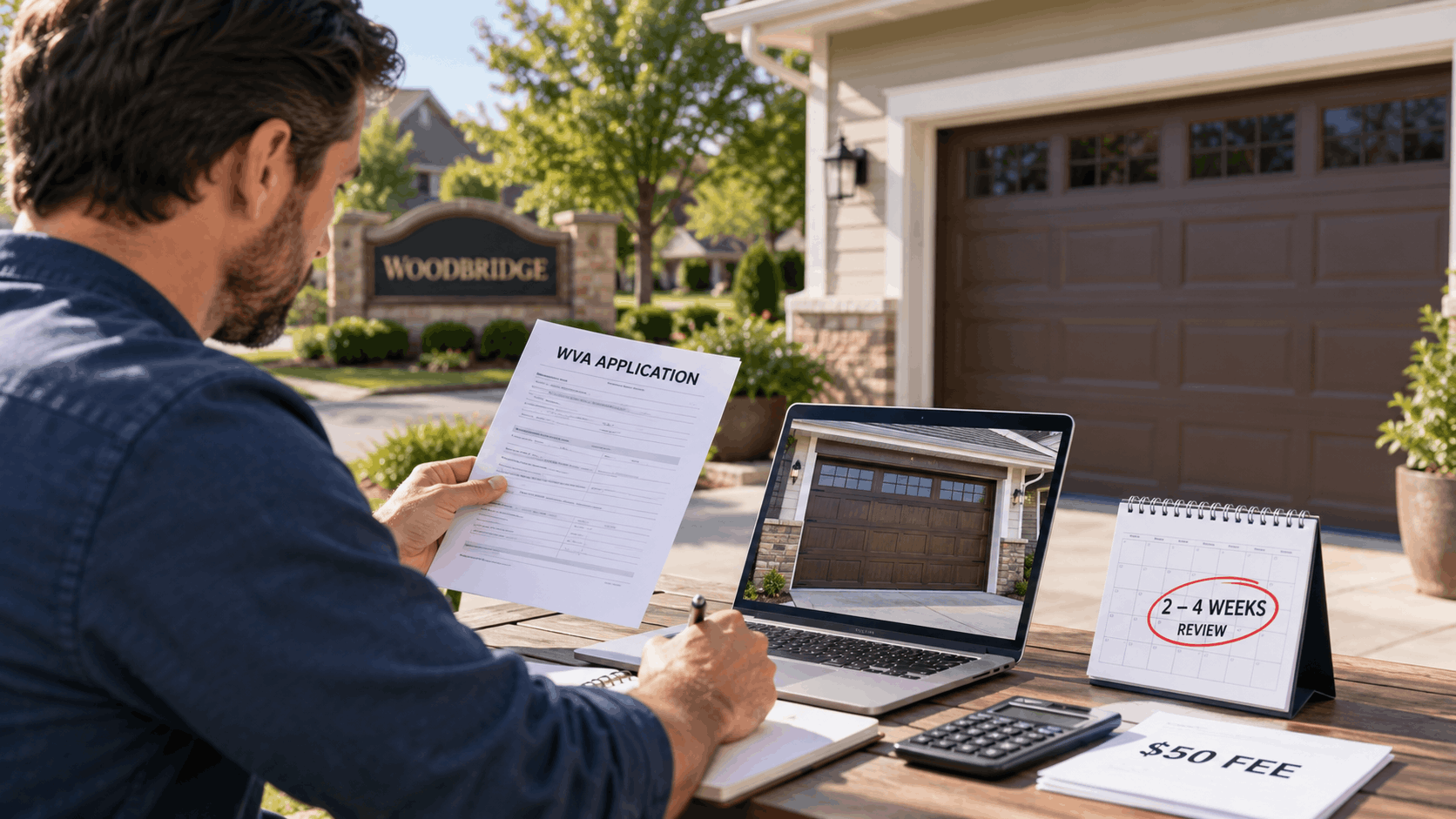
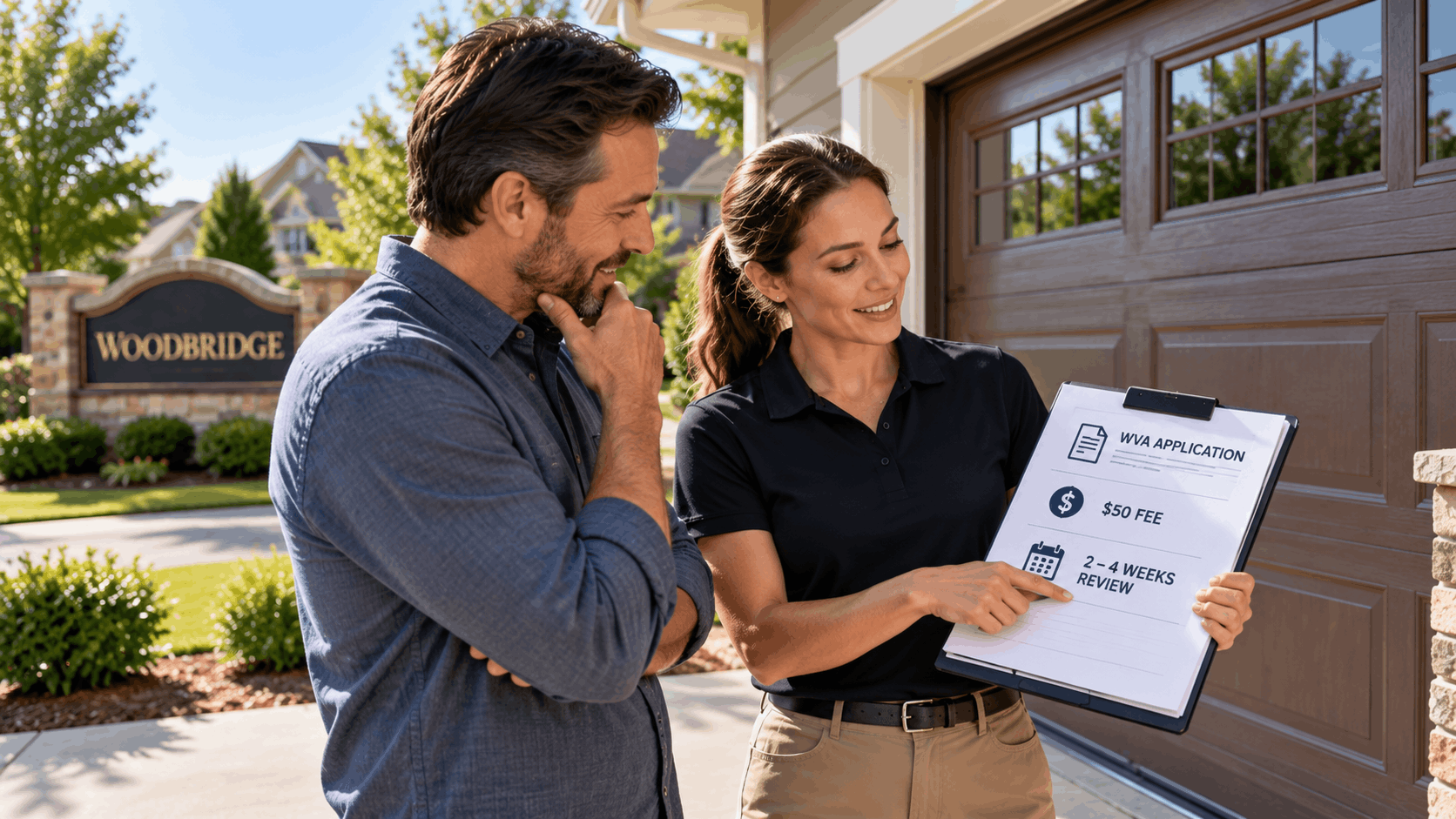
Here is the short answer. Nearly all exterior changes in Woodbridge need Woodbridge Village Association approval before work starts, and a garage door is one of the reviewed items. The Home Improvement Application carries a $50 plan processing fee, review runs 2 to 4 weeks, and the approval letter expires 6 months from issue. Miss that window and the owner reapplies.

Why Woodbridge Requires Approval Before a New Garage Door?
The Woodbridge Village Association reviews garage doors as part of its Architectural Guidelines and Standards, and that review has to happen before work commences. A garage door faces the street, so it counts as an exterior modification the association cares about. The village keeps a consistent look, and the door is a big part of that look.
This is a separate track from any City of Irvine permit. Getting one does not get the other. An owner planning a new door in Woodbridge is really planning two things at once: the association's garage door approval and, where it applies, the city's permit position for the address.
We bring this up first because the biggest delays we see are not mechanical. They come from ordering a door before the WVA has signed off, then discovering the colour or style needs a change. Start with the association guidelines and the rest of the job falls into place.
The WVA Is the Master Association, Seated at 31 Creek Road
The Woodbridge Village Association was incorporated in 1976 and serves as the master association for the village. It is seated at 31 Creek Road in Irvine, and it has sub-associations beneath it. That structure is the first thing a homeowner needs to understand before planning a door.
For a detached home, the master association is usually the single body reviewing the work. For an attached home, a townhome or a condominium, there is a sub-HOA in the picture too. The master association sets the village-wide standards, and the sub-association can add its own layer on top.
Knowing which body reviews your door decides where the paperwork goes and how many approvals you need. It also decides your timeline, since two reviews take longer than one if they run back to back. We always confirm the tract first, because Woodbridge holds many distinct tracts and the path depends on which one a home sits in.
The WVA also runs Community Relations staff who can point an owner to the right steps before anything is ordered. That single phone call or email early on saves more grief than any other step in the process.
Garage Doors Are a Reviewed Item
Garage doors are among the exterior improvements the WVA reviews. The association states that its Architectural Guidelines and Standards require nearly all exterior improvements to be approved before work commences. A door swap is not an exception to that.
That means the review applies whether an owner is changing the colour, changing the style, or replacing a tired door with a fresh one that looks nothing like a change from the street. If it is an exterior change, the safe assumption is that it needs approval first.
We treat every Woodbridge door as a reviewed item from the first phone call. It costs nothing to confirm with the WVA and it protects the owner from installing something that has to come back off. Approval before work is the rule, not a formality to skip.
The association also recommends checking with Community Relations staff in advance to follow the right steps. That advice exists because the fastest way to a clean approval is to ask what the reviewers expect before the application is even filed.
Why the Cape Cod Look Drives the Rules
Woodbridge is uniformly New England Cape Cod, which is unique among Irvine villages. That single fact shapes the whole review. A garage door here sits against painted wood trim and siding, not the stucco of newer villages like Portola Springs or Turtle Rock.
Because the facade is painted wood, colour and appearance carry real weight in the review. The reviewers are protecting a consistent New England look across 41 distinct tracts. A door that would blend into a stucco village can read as wrong against Cape Cod siding.
That is why colour matching in Woodbridge is a paint-to-wood question, not a paint-to-stucco one. The door has to sit comfortably next to the trim and siding it borders. Owners who bring us a colour chip early get a much smoother review than those who pick a shade after the door is on order.
If you want the design side handled with the Cape Cod look in mind, our team can help you plan a carriage house style door that fits the village character before the application ever goes in.
Approval Is Not a City Permit and a Permit Is Not Approval
The association approval and the city permit are two separate tracks. One does not stand in for the other. Owners get tripped up when they assume clearing the WVA means the city is handled, or the other way around.
The City of Irvine itself says homeowners should consult their homeowners association to see whether a project is allowed under the CC&Rs. The city also states plainly that a permit does not substitute for association approval. That is the city telling residents to run both tracks.
So the honest picture is this. The WVA decides whether the door is allowed under the village's architectural guidelines. The city decides whether the physical work needs a building permit. A like-for-like door swap and a job that widens the opening land in very different places on the city side, which we cover further down.
For most owners the practical takeaway is simple. File the WVA application, and separately confirm the permit position for the specific address. Do not assume clearing one clears the other.
Get Your Free Quote
Tell us about your garage door and we'll get back to you fast.
The Home Improvement Application, Step by Step
The WVA Home Improvement Application is the form that starts the review. It is not complicated, but a large share of Irvine households are foreign-born and many owners are filing association paperwork for the first time, so clear steps matter more than jargon here. The goal is a complete application that the reviewers can act on without coming back for more.
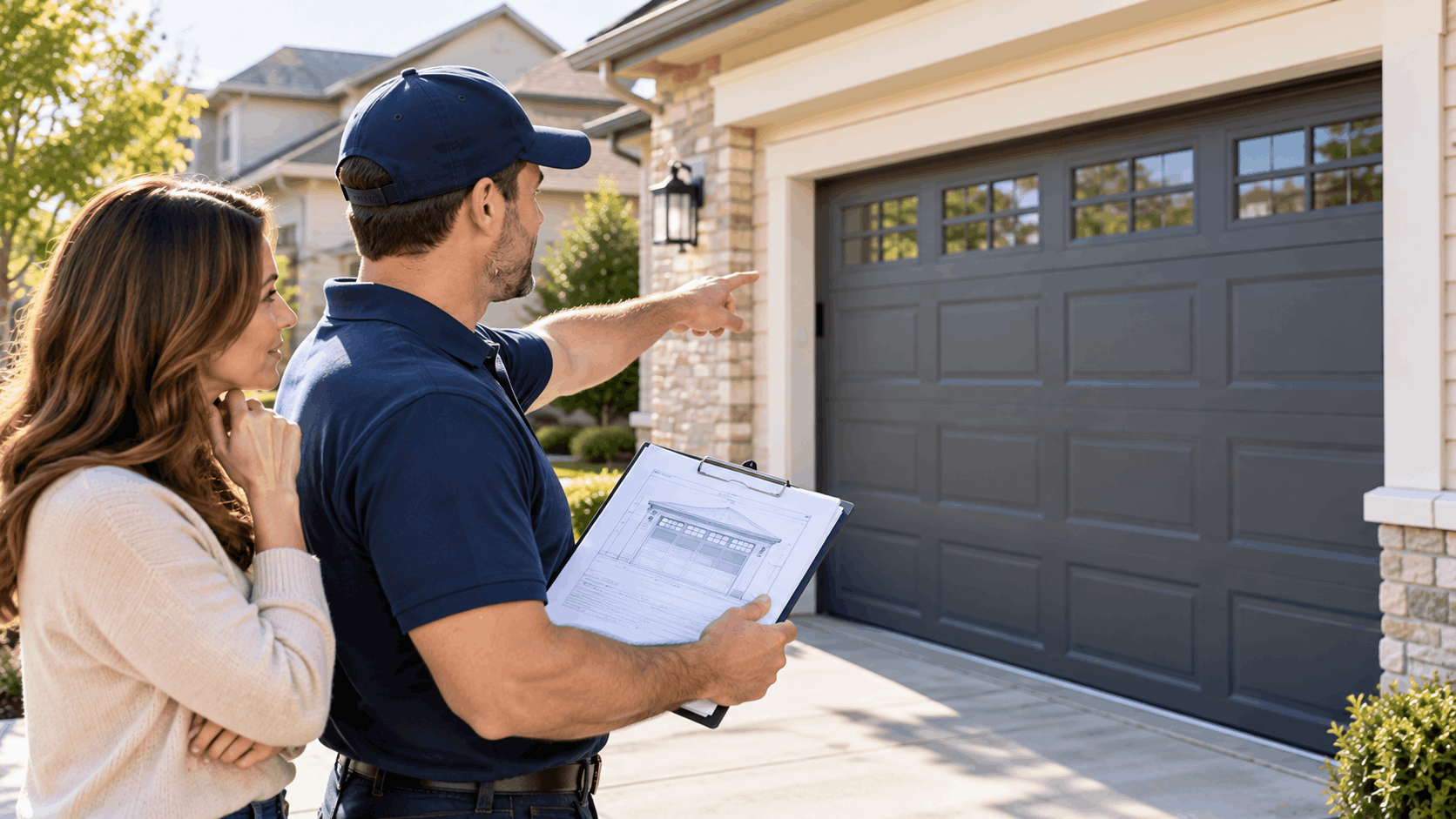
The steps run in a logical order. Talk to Community Relations, gather the door details, fill out the application, pay the $50 plan processing fee, and submit through one of three routes. Then the 2 to 4 week review begins.
Below is a plain view of what the process looks like from start to submitted.
| Step | What the owner does | Detail |
|---|---|---|
| 1 | Contact Community Relations | Confirm the right steps and any tract-specific rules before buying |
| 2 | Choose a compliant door and colour | Match to painted wood trim, no attention-drawing treatments |
| 3 | Complete the Home Improvement Application | Door appearance, colour, confirmation opening is unchanged |
| 4 | Pay the $50 plan processing fee | One-off fee that comes with the application |
| 5 | Submit | 31 Creek Road, the owner portal, or architectural@wva.org |
| 6 | Wait for the review | 2 to 4 weeks, then an approval letter |
What Goes on the Application
The application asks for detail on the proposed door. That means what the door will look like, its colour, and confirmation that the opening size is not changing. The reviewers are checking the door against the village's Architectural Guidelines and Standards, so appearance is the heart of what they need.
For a straightforward replacement, the strongest application shows the door style and finish and states plainly that the structural frame and opening stay the same. A like-for-like swap is easier to approve when it is obviously like-for-like on paper. Clear application details cut down on back-and-forth.
Where an owner is changing the look, expect the review to focus harder on how the new door reads against the Cape Cod facade. That is not a reason to avoid a change, only a reason to document the door appearance carefully. Give the reviewers a clear picture and the decision is easier for them to make.
Keep the facts to what is true about the specific door. We help owners assemble the door appearance and colour information so the application reflects exactly what will be installed, not a rough idea that shifts later.
Three Ways to Submit: 31 Creek Road, the Owner Portal, or Email
The WVA gives three submission routes. Applications go to 31 Creek Road, the owner portal, or architectural@wva.org. An owner can pick whichever route fits how they prefer to handle paperwork.
The owner portal suits people who like to track everything online and keep a digital record. Email to architectural@wva.org works for owners who want to attach the door details and send them in one message. Dropping the application at 31 Creek Road is there for anyone who prefers to hand it in.
Whichever route you use, the association recommends checking with Community Relations staff in advance to follow the right steps. A quick check confirms the current form, the fee, and anything specific to your tract before you submit. That step alone prevents the most common resubmissions.
We are happy to help owners get the package ready for whichever route they choose, so the submission is complete the first time. A complete first submission is the single biggest factor in landing inside the shorter end of the review window.
Talk to Community Relations Before You Buy the Door
The WVA recommends contacting Community Relations staff in advance, and that advice is worth taking seriously. The reason is simple: it is far better to pick a compliant door before ordering than to discover a problem after the door arrives. A conversation up front saves a return and a delay.
Community Relations can flag anything specific to your tract, including colour rules that differ from the rest of the village. That matters in Woodbridge because some tracts carry their own standards. Buying a door that already fits those standards is the whole point of asking first.
We build this call into how we plan a Woodbridge job. Before an owner commits to a door, we encourage confirming the direction with the association so the choice is compliant from the start. That way the application, the door, and the install all line up.
Skipping this step is where money gets wasted. A door ordered against the wrong colour rule is not a small fix. A five-minute check in advance is cheaper than any correction after the fact.
Plain-Language Help for First-Time Applicants
Most Irvine households rent rather than own, so the person who owns a Woodbridge home may not deal with association paperwork often. Many owners here are filing a Home Improvement Application for the first time. Clear explanation beats jargon every time in that situation.
Irvine is also very diverse, with a large foreign-born population and many households where English is a second language. Plain, direct language about what the form asks and where it goes is genuinely more useful than trade shorthand. We keep our guidance simple for exactly that reason.
For a first-time applicant, the process comes down to a handful of clear steps: check with the association, pick a compliant door, fill out the form with the door details, pay the fee, submit, and wait for the letter. Broken down that way, association paperwork stops feeling like a barrier.
If an owner wants a hand reading the form or understanding what a section is asking for, we walk through it with them. Getting the plain-language version right the first time is how first-time applicants avoid a second round.
Need Help in Irvine?
Urgent Garage Doors serves Irvine and all of Orange County.
The $50 Plan Processing Fee
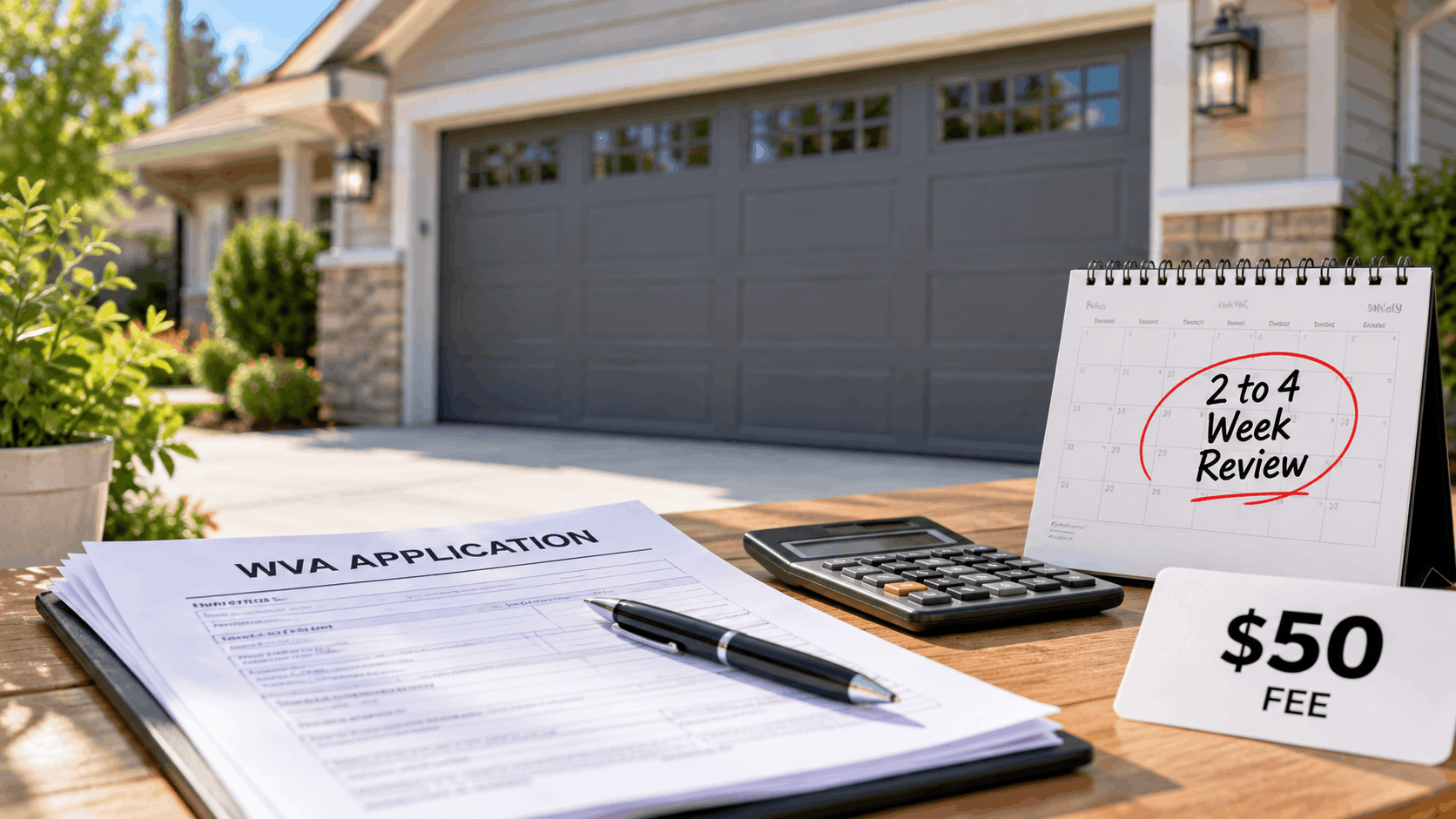
The Home Improvement Application carries a $50 plan processing fee. It is the cost of the WVA reviewing the plan, and it is separate from the price of the door and the install. Owners should budget for it as part of the project, but it is a small line item next to the door itself.
Woodbridge also carries no Mello-Roos, unlike Stonegate, Portola Springs and Great Park. So an owner here pays association dues without a community facilities district layered on top. That is a real difference in the ongoing cost of living in the village, though it does not change the one-off $50 for a door project.
Below we break down what the fee covers, who pays it, and how it sits alongside the other costs an owner faces.
What the $50 Covers
The $50 plan processing fee covers the WVA's review of the plan. It pays for the association to look at the proposed door against its Architectural Guidelines and Standards and issue a decision. It is a processing cost, not a payment toward the door.
That distinction matters for budgeting. The fee is separate from the door and the install, which are quoted by the installer. An owner is paying the association to review, and separately paying the contractor to supply and fit the door.
Because it is tied to the application, the fee comes at the front of the project, before the install. It is part of getting approval, which is the first gate a Woodbridge door has to clear. Think of it as the cost of entering the review, not the cost of the outcome.
For most door projects the $50 is a minor figure against the full cost of a new door and professional installation. It is worth paying attention to only because it lands early, before any work begins.
Who Pays: Owner Costs and the Rental Reality
The owner-occupied housing rate in Irvine is 43.8 percent, which means most households rent. In Woodbridge that plays out in a familiar way: the person who calls about a garage door and the person who pays for it are not always the same. A tenant may notice a broken door, but the owner is the one who files the application.
The Home Improvement Application and the $50 fee are the owner's responsibility. The association reviews changes to the property, and the property owner is the party accountable for exterior modifications under the CC&Rs. A renter cannot approve or authorise an exterior change on their own.
So when a rental home in Woodbridge needs a new door, the practical path runs through the owner. The owner files, pays the fee, and holds the approval letter. We are used to coordinating with owners and property managers to keep that clean.
For owner-occupiers, the picture is simpler. The person living in the home is the same person filing the application and paying the fee, and can move at their own pace once they know the steps.
No Mello-Roos, but Dues and This Fee Still Apply
Woodbridge carries no Mello-Roos, which sets it apart from newer Irvine communities like Stonegate, Portola Springs and Great Park. Those communities sit inside a community facilities district that adds a special tax on top of association dues. Woodbridge owners avoid that layer.
What Woodbridge owners do pay is association dues to the WVA. Those dues fund the village's shared amenities and its architectural review function, among other things. The $50 plan processing fee is separate from dues and is a one-off tied to a specific project.
So the cost picture for a door has three parts: the door and install cost, the one-off $50 application fee, and the ongoing dues an owner already pays regardless of the project. Only the first two are project costs, and only the $50 is unique to the approval process.
Knowing there is no Mello-Roos here does not change the door budget, but it helps owners see the fee in context. A $50 one-off is a small addition against dues that are already in place.
The 2 to 4 Week Review and the 6-Month Window
Two dates run the timeline in Woodbridge. Review of the Home Improvement Application runs 2 to 4 weeks, and the approval letter expires 6 months from issue. Plan the install around both and the project stays smooth.
The mistake owners make is treating approval as instant or treating the letter as open-ended. It is neither. The review takes real time, and the approval has a shelf life. Get the sequence right and neither one causes a problem.
Below we cover what happens during the review, what the 6-month window means, and the order of steps that keeps an owner from paying twice.
What Happens During the 2 to 4 Weeks
During the 2 to 4 week window, the WVA reviews the application against its Architectural Guidelines and Standards. The reviewers look at the door's appearance and colour and confirm it fits the village. This is the period where the association makes its decision.
The owner's job during this time is to wait for the approval letter before booking the install. Scheduling a crew before the letter arrives is a gamble, because the review could ask for a change. It is better to hold until the decision is in hand.
A complete, clear application tends to move through the shorter end of that window. An application with missing detail or an unclear colour choice can drift toward the longer end while the reviewers seek clarification. That is another reason to get the door appearance details right the first time.
We time our involvement to this reality. We help prepare the application, then wait for the approval letter with the owner before locking in an install date. That keeps the crew's visit landing after the decision, not before it.
The Approval Letter Expires in 6 Months
The approval letter expires 6 months from issue. That is the window an owner has to get the door installed. Miss it, and the owner has to reapply, which means starting the review over.
Six months sounds like plenty, and for a straightforward door it is. The trap is treating approval as a task done and then letting the project sit. A door ordered and installed within a few weeks of the letter is well inside the window with room to spare.
The practical advice is to schedule the install once the letter arrives, not months later. Book the crew, confirm the door, and get it fitted while the approval is fresh. There is no benefit to running down the clock.
If a delay is unavoidable, keep an eye on the expiry date. Reapplying is not the end of the world, but it means another review cycle and another $50 fee. Better to install inside the first window.
Sequencing Order, Approval, and Install
The order that avoids paying twice runs like this. Check with Community Relations, file the application, wait 2 to 4 weeks, order the door on approval, and install inside the 6-month window. Each step sets up the next.
The reason this order matters is that it puts the association decision before the money is committed to a specific door. Order the door first and get a rejection, and the owner is left with a door that does not fit the guidelines. Order after approval and the door matches what the WVA already said yes to.
It also spaces the two time constraints correctly. The review runs first, then the 6-month clock starts at the approval letter. Booking the install after the letter arrives means the whole install sits comfortably inside that window.
We plan every Woodbridge job in this sequence. It is the simplest way to avoid a resubmission, a wasted fee, or a door that has to come back off. Follow the order and the project runs once, cleanly.

Attached Homes Need Two Approvals at Once
Townhome and condominium owners in Woodbridge answer to a sub-HOA as well as the Woodbridge Village Association. That means those owners can need two approvals for one door. Detached homeowners usually deal with the WVA alone.
The single most useful piece of advice for attached homes is to start both approvals at once. Run them in parallel, not one after the other, so the review windows overlap instead of stacking into a much longer wait.
Below we break down who falls under a sub-association, why starting both at once matters, and how the detached path differs.
Townhomes and Condos Answer to a Sub-Association
Attached homes, meaning townhomes and condominiums, sit under a sub-HOA beneath the WVA. Both bodies may review a garage door. The master association sets the village standards, and the sub-association handles its own tract-level rules.
For an attached home, that structure means the door can face two reviews. One from the sub-HOA closest to the home, and one from the WVA as the master association. Each has its own process and its own decision.
This is not double the work in effort, but it is two separate approvals to secure before the install. An owner of a townhome or condo needs to account for both from the start. Missing one leaves the project incomplete even if the other says yes.
We confirm the sub-association situation early for any attached home in Woodbridge. Knowing which sub-HOA is involved decides where the second application goes and how its timeline lines up with the WVA's.
Start Both at the Same Time, Not in Sequence
The smart move with two approvals is to start both at the same time. If an owner files with the sub-HOA, waits for that decision, then files with the WVA, the two review windows stack. That can turn a few weeks into a couple of months.
Filing both at once lets the review windows overlap. While the sub-association is looking at the door, the WVA can be looking too. The two run in parallel, and the owner is waiting on the later of the two decisions rather than the sum of both.
This matters because of the 6-month approval window on the WVA side. Stacking reviews eats into the calendar before the install clock even starts. Parallel review keeps the whole process tight.
When we help an attached-home owner in Woodbridge, we encourage getting both applications moving together. It is the same paperwork effort either way, but the timeline is far shorter when the reviews overlap.
Detached Homeowners Deal With the WVA Alone
Detached homeowners in Woodbridge generally deal with the WVA directly. There is no sub-HOA layer to clear, so the review is a single approval. That is a simpler path than attached homes face.
The catch is that the village holds 41 distinct tracts of detached homes, townhomes and condominiums. The path depends on the tract a home sits in. Even a detached home benefits from confirming its exact situation, because tract-level rules still apply within the village.
For most detached owners, the process is one application, one $50 fee, one 2 to 4 week review, and one approval letter with a 6-month life. Clean and straightforward when the door fits the guidelines.
We still confirm the tract for a detached home before treating it as a single approval. It takes a moment, and it rules out any surprise from a tract-specific standard, especially on colour, which we cover next.
Need Help in Irvine?
Urgent Garage Doors serves Irvine and all of Orange County.
Colour and Appearance Rules That Trip People Up
Woodbridge has appearance rules that surprise owners who have lived in other communities. Treatments that draw attention to the door are prohibited. And The Gables tracts carry a high-contrast colour rule that differs from the rest of the village.
These rules exist to protect the uniform Cape Cod look. A door here is meant to read as part of the painted wood facade, not as a standout feature. Get the colour and finish wrong and the review comes back, which is why colour is worth getting right before ordering.
Below we cover the no-attention rule, the Gables exception, and why colour matching in Woodbridge is a paint-to-wood question.
Nothing That Draws Attention to the Door
Treatments that draw attention to the door are prohibited in Woodbridge. The intent is to keep the door reading as part of the Cape Cod facade rather than a feature that stands out. The door should recede into the front of the house, not announce itself.
In practice that rules out loud finishes, high-contrast accents on a standard tract, and anything that turns the door into a focal point. The village look is calm and consistent, and the door is expected to fit that. Owners who want a statement door will find the guidelines steer them elsewhere.
This is not a limit on quality or style, only on flash. A well-made door in a compliant finish can still look excellent. It just needs to blend into the facade rather than compete with it.
We keep this rule in mind when helping owners choose a door. The goal is a door that improves the home and passes review because it sits quietly within the village look. That is the balance the guidelines are after.
The Gables High-Contrast Rule
The Gables tracts carry a high-contrast colour rule that differs from the rest of the village. So a colour that suits a neighbouring tract can be wrong in The Gables. This is one of the clearest cases where the tract, not just the village, decides the answer.
The lesson is that an owner cannot assume a colour that fits next door will fit their own tract. The Gables plays by a different standard. Copying a neighbour's door is exactly how an owner ends up with a rejected application.
This is a big reason we push the Community Relations check before buying. Confirming the tract-specific colour rule up front avoids ordering a door that suits the wrong standard. For The Gables in particular, that check is not optional in spirit.
If a home sits in The Gables, treat the colour choice as tract-specific from the start. Verify the high-contrast rule with the association, then choose a door that fits it. That order keeps the review clean.
Matching Paint to Wood, Not Stucco
Because Woodbridge is Cape Cod with painted wood trim and siding, colour matching is a paint-to-wood question. That is different from the paint-to-stucco matching in newer Irvine villages. The surfaces the door sits against are painted wood, so the door colour has to work with wood tones and trim.
Paint reads differently against wood siding than against stucco. Texture, sheen and the surrounding trim all shift how a colour looks in place. A shade that works on a stucco village can look off against Cape Cod siding, even at the same colour code.
Several Woodbridge tracts were originally built with natural shake roofs, since replaced in many tracts with steel or cement imitations. That history reinforces how much the village leans into a traditional New England palette. The door should sit within that palette.
When we help an owner pick a colour, we look at it against the actual trim and siding of the home, not a generic chart. Matching paint to wood in context is how the door ends up looking right and passing review. It is a small step that makes a real difference in Woodbridge.
The City Permit Question for a Woodbridge Door
Beyond the WVA, there is the City of Irvine permit question. Whether a garage door needs a city permit depends on what the work actually does to the structure, and it is decided by the city for the specific address. Confirm the permit position for your address rather than assuming a single rule.
The good news for most owners is that a like-for-like door swap falls under a city exemption. The work that needs a permit is structural: widening the opening, altering the header, or changing the frame. Below we lay out both sides and where to confirm.
Like-for-Like Swaps Fall Under the Exemption
The City of Irvine lists an exemption for replacement windows and doors of the same dimension as those being replaced, with no change to the structural frame or opening size. A like-for-like garage door swap falls under that exemption. So a straight replacement of the same size door generally does not need a building permit.
That said, the exemption comes with a condition. The city states such replacements must still conform to all technical codes and city, county and state ordinances on weather proofing, security and energy efficiency. The exemption is from the permit, not from the codes.
For most Woodbridge owners replacing a tired door with a new one of the same size, this is the path. The opening stays the same, the frame is untouched, and the swap sits inside the exemption. The door still has to meet applicable standards.
This is where a licensed installer earns their keep. A same-dimension door fitted to code keeps the owner inside the exemption cleanly, with the technical requirements handled properly.
Widening the Opening or Altering the Header Needs a Permit
The exemption stops the moment the work goes structural. Widening the opening, altering the header, or changing the structural frame does not fall under the same-dimension exemption. That kind of work needs a city permit.
The reason is straightforward. Changing the opening or the header affects how the structure carries load above the garage. The city reviews that work to confirm it is done safely and to code. A door swap does not touch that, but a resize does.
This distinction also matters for the licensing threshold. When a job requires a building permit of any kind, the unlicensed-work exemption in state law no longer applies. Structural garage work is licensed work, full stop.
If an owner is thinking about a wider door or a different opening, that is a permitted job and a bigger conversation. We handle those as the structural jobs they are, with the permit and the licensed work that go with them.
Where to Confirm and Who to Call
The city is the authority on whether a permit applies to a specific address. To confirm, an owner can reach the Permit Processing Center at 949-724-6313 or the Development Assistance Counter at 949-724-6308. Permitting runs through the city's online portal.
We recommend confirming the permit position for the specific address before the install, especially if there is any question about whether the opening is changing. A two-minute call settles it. The city would rather answer the question than issue a correction later.
For most like-for-like swaps the answer is that the exemption applies, but confirming it in writing protects the owner. For anything structural, the city will walk through the permit process. Either way, the city's own guidance is to consult both the city and the association.
You can read the city's permit guidance directly at the City of Irvine website, and verify contractor licensing at the Contractors State License Board. We confirm the permit position as part of planning any Woodbridge install.
Woodbridge Sits Outside the 2025 Fire Zone Expansion
In March 2025 the California Office of the State Fire Marshal released an updated Fire Hazard Severity Zone map, and Irvine adopted it by ordinance effective July 23 2025. The city says the 2025 update expanded fire hazard zones into Orchard Hills, Woodbury, Portola Springs, Quail Hill, Turtle Rock, Laguna Altura, Los Olivos and Irvine Spectrum.
Woodbridge is not among the villages the city names in that expansion. So Woodbridge sits outside the newly expanded zones, while several other Irvine villages do not. That is a real difference when discussing materials and fire code requirements for new construction or major permitted work.
For a standard door swap in Woodbridge, this is background rather than a hurdle. But it is worth knowing that the village's zone status differs from villages like Turtle Rock or Quail Hill. Owners there face fire code considerations that Woodbridge owners generally do not.
Projects with a permit application dated after July 23 2025 must comply with the fire code where the project sits in a 2025 zone. Since Woodbridge sits outside the expansion, a like-for-like door swap here is not caught by that change.
What the Door Itself Needs to Meet, Beyond Approval
Approval clears the door for appearance. The door and opener still have to meet the licensing and code rules that apply to any California installation. These are separate from the WVA and separate from the city permit, and they follow the door regardless of the village.
The main items are the right contractor licence, the SB 969 battery backup requirement, and the entrapment protection that older Woodbridge openers often lack. Below we cover each accurately, plus why springs and cables wear faster near the lakes.
The Right Licence: C-61/D-28
Garage door work in California is licensed under classification C-61/D-28, Doors, Gates and Activating Devices. That scope covers sectional and rolling doors, torsion and extension spring systems, operators, control boards, safety sensors and activating devices. It is the correct licence for the trade.
C-28 is Lock and Security Equipment and is not the garage door licence. This work does not require a Class B general building licence either. If a contractor describes garage door work as C-28, that is a signal to look closer.
A licence can be verified free at cslb.ca.gov, where the classification, status, bond and workers compensation are all public record. Any owner can check a contractor before hiring. It takes a minute and it protects the home.
Urgent Garage Doors holds California licence #1055150. Owners are welcome to verify it before any work begins. We would rather an owner check than wonder.
SB 969 Battery Backup on New Openers
SB 969 requires every residential automatic garage door opener manufactured for sale, sold, offered for sale or installed in California on or after July 1 2019 to have a battery backup designed to operate during an electrical outage. A replacement residential garage door may not be installed connected to a non-compliant opener. Violations carry a $1,000 civil penalty.
This is a statewide, residential law. It is not a fire-zone rule, not a city rule, and not an association rule. It applies in Woodbridge the same as anywhere in California, and it comes from SB 969, not from the energy code.
The law was passed after deaths in the 2017 Northern California wildfires, where people could not open their garage doors during power cuts. Battery backup means the door still opens when the grid is down. That is the purpose behind the requirement.
For a Woodbridge owner installing a new door or opener, battery backup is part of the job, not an optional upgrade tier. Our battery backup installation keeps a new opener compliant with SB 969 from day one.
Older Openers Near the Lakes and Photo Eyes
Doors and openers from the 1975 to 1985 phases predate the January 1 1993 federal requirement for external entrapment protection. A large share of original openers in Woodbridge have no photo eyes. That is a direct result of the village's build era.
Photo eyes are the sensors mounted on each side of the opening, no higher than six inches off the floor, that stop and reverse the door when the beam is broken. California required auto-reverse under AB 3600 in 1990, and the federal mandate covered openers manufactured after 1993. Openers made before then predate that protection.
An owner can run a safe check at home. Lay a flat 2x4 on the floor in the door's path and confirm the door reverses on contact. Also check that the photo-eye beam, if the opener has one, is aligned and unobstructed. That auto-reverse test is the safe test to rely on.
If an original opener has no photo eyes, that is a strong reason to look at replacement. Our opener installation brings an old setup up to current entrapment protection, and adds the SB 969 battery backup at the same time.
Why Springs and Cables Wear Faster by the Lakes
Woodbridge is built around two lakes, split into North Lake and South Lake halves. Homes closest to either lake sit in the most humid pocket of the village. That humidity shows up as faster corrosion on springs, cables and rollers than inland tracts of the same age and build.
Here is why it matters for the hardware. A cable in a humid pocket corrodes strand by strand from the surface in, so it frays before it snaps. Replacing a corroded spring without inspecting the cables is how a second failure follows weeks later. The two wear together near the water.
Need Help in Irvine?
Urgent Garage Doors serves Irvine and all of Orange County.
How Urgent Garage Doors Handles a Woodbridge Job
Once approval is in hand, the install should be simple and predictable. That comes down to how the job is run: a diagnostic first, a written price before any work starts, a clear response window, and a warranty on the work. We tie all of that to the 6-month approval window and the permit position for the address.
Below we walk through how we handle a Woodbridge door from the first visit to the finished install.
The Diagnostic and Written Price First
Every job starts with an on-site diagnostic. We look at the door, the opener, the springs, the cables and the tracks, and we identify exactly what the job involves. That way the plan matches the actual condition of the equipment, not a guess over the phone.
After the diagnostic, the owner gets a written price before any work starts. No work begins until the owner has seen the number and agreed to it. The written price means no surprises when the job is done.
This matters in Woodbridge because the door is often only part of the picture. Near the lakes, corroded cables or worn rollers may show up alongside a spring, and the diagnostic catches them. The written price reflects the real scope so the fix is complete.
For work over $500, California law also requires a written home improvement contract, which is a separate contract rule from the licensing threshold. Our written price and paperwork keep both handled properly.
Timing the Install to the Approval Letter
We schedule the install to land inside the 6-month approval window. Once the WVA approval letter arrives, we book the crew so the door goes in while the approval is fresh. That keeps the owner well clear of the expiry date and the need to reapply.
We also confirm the permit position for the specific address before installing. For a like-for-like swap that usually means confirming the city exemption applies. For any structural change, that means the permit is in place before work starts.
Timing the whole sequence is where our experience in the village pays off. We know the review runs 2 to 4 weeks, we know the letter lasts 6 months, and we plan backward from the install to fit both. The owner does not have to track the dates alone.
If a home is an attached townhome or condo needing two approvals, we account for both before setting the install date. The crew arrives once every approval is secured and the permit position is confirmed.
Response Window and Warranty
For urgent problems, our response window is 30 to 60 minutes. A door stuck open, a snapped spring, or a car trapped inside is not something an owner should wait days on. We move quickly when the door will not work.
Our work carries a warranty, so the owner is covered after the install. If something we fitted has an issue, we stand behind it. That is part of hiring a licensed contractor rather than taking a chance on unlicensed work.
And the licence is verifiable. Urgent Garage Doors holds California licence #1055150, and any owner can confirm it at cslb.ca.gov along with our classification, status, bond and workers compensation. We invite owners to check before hiring.
Whether it is a planned replacement after WVA approval or an emergency, our emergency repair team and our install crews work the Woodbridge tracts regularly, from Pinewood on the northern edge to the tracts around both lakes.
Getting Your Woodbridge Door Done Right
A new garage door in Woodbridge runs on a clear order. Check with the WVA's Community Relations, file the Home Improvement Application with the $50 fee, wait through the 2 to 4 week review, order the door on approval, and install inside the 6-month window. Attached homes start both the sub-HOA and WVA approvals at once, and every owner confirms the city permit position for their address.
The details that catch people are the Cape Cod colour rules, the Gables high-contrast standard, and the older openers from the 1975 to 1985 phases that have no photo eyes. Near North Lake and South Lake, the humid pocket wears springs and cables faster, so those homes plan door work a little sooner. All of it is manageable when the sequence is right.
We work these tracts every week and handle the whole path with owners. Our job starts with an on-site diagnostic and a written price before any work begins, times the install to land inside your approval window, confirms the permit position for your address, and backs the work with a warranty. For urgent problems our response window is 30 to 60 minutes, and our licence, #1055150, is verifiable at cslb.ca.gov. Call Urgent Garage Doors to book a diagnostic once your WVA approval letter is in hand, or reach us through our contact page to start planning the job.
Frequently Asked Questions
- Do I need WVA approval to replace my garage door in Woodbridge?
- Yes. Garage doors are among the exterior improvements the Woodbridge Village Association reviews under its Architectural Guidelines and Standards, and nearly all exterior changes must be approved before work commences. That applies whether you are changing the colour, changing the style, or replacing a tired door with a new one of the same look. File the Home Improvement Application and wait for the approval letter before booking any install.
- How much is the Woodbridge Home Improvement Application fee?
- The Home Improvement Application carries a $50 plan processing fee. It is paid by the property owner and it covers the WVA's review of the plan against its guidelines. The fee is separate from the cost of the door and the install, which are quoted by your installer. It is a one-off tied to the project, not an ongoing charge, and Woodbridge carries no Mello-Roos on top of association dues.
- How long does the WVA review take?
- Review runs 2 to 4 weeks. During that time the WVA reviews your application against its Architectural Guidelines and Standards and decides on the proposed door. Wait for the approval letter before booking the install, since scheduling a crew earlier risks the review asking for a change. A complete application with clear door appearance and colour details tends to move through the shorter end of that window.
- How long is the WVA approval good for?
- The approval letter expires 6 months from issue. The install has to happen inside that window, or you reapply and start the review over, including the $50 fee. Six months is comfortable for a straightforward door, so the best move is to schedule the install once the letter arrives rather than letting the approval sit. Do not run down the clock.
- Where do I submit the application?
- There are three routes. You can submit at 31 Creek Road, through the owner portal, or by email to architectural@wva.org. Whichever you choose, the WVA recommends checking with Community Relations staff in advance to follow the right steps and confirm anything specific to your tract. That check confirms the current form, the fee, and any colour rules before you submit, which prevents the most common resubmissions.
- I own a townhome. Do I need two approvals?
- Often yes. Attached homes, meaning townhomes and condominiums, answer to a sub-HOA as well as the Woodbridge Village Association, so two approvals can be needed for one door. Start both at the same time rather than one after the other, so the review windows overlap instead of stacking into a much longer wait. Detached homes generally deal with the WVA alone, though the path still depends on the tract.
- Can I pick any colour for my garage door?
- No. Treatments that draw attention to the door are prohibited, because the door is meant to read as part of the Cape Cod facade rather than a feature. The Gables tracts also carry a high-contrast colour rule that differs from the rest of the village, so a colour that suits a neighbouring tract can be wrong there. Confirm your tract's rule with Community Relations before buying, since colour matching here is a paint-to-wood question.
- Do I also need a City of Irvine permit?
- It depends on the work. A like-for-like swap of the same dimension with no change to the structural frame or opening size falls under the City of Irvine's replacement exemption. Widening the opening, altering the header, or changing the frame needs a permit. Confirm the position for your specific address with the Permit Processing Center at 949-724-6313 or the Development Assistance Counter at 949-724-6308.
- Does my new opener need a battery backup?
- Yes. SB 969 requires residential automatic garage door openers manufactured, sold or installed in California on or after July 1 2019 to have a battery backup that operates during a power outage. A replacement residential door may not be installed connected to a non-compliant opener, and violations carry a $1,000 civil penalty. It is a statewide residential law passed after the 2017 wildfires, not a fire-zone or association rule, and battery backup is a requirement rather than a paid upgrade.
- Can I start the install before approval to save time?
- No. The WVA requires approval before work commences, so installing first is against the guidelines and risks having to undo the work. If the review comes back asking for a change, a door already fitted has to come off. The order that saves time is to check with Community Relations, apply, wait for the letter, order the door on approval, and install inside the 6-month window.
U
Licensed garage door repair professionals serving Irvine and Orange County.
Licensed in California · License #1055150
Why trust Urgent Garage Doors?
Founded in 2017, Urgent Garage Doors is a licensed and insured garage door services serving Irvine and Orange County. All content is reviewed by our licensed technicians.

Need Help in Irvine?
Urgent Garage Doors serves Irvine and all of Orange County.
Related Articles
How-To Guides
Coto de Caza HOA Garage Door Approval: Custom Estate Standards
A local guide to Coto de Caza HOA garage door approval, estate design standards, the ARC process, costs, and how Urgent Garage Doors keeps estates compliant.
How-To Guides
Garage Door Replacement in Woodbridge and Turtle Rock Irvine: Village Standards and HOA Approvals
A local guide to garage door replacement in Woodbridge and Turtle Rock Irvine, covering village standards, HOA approvals, city permits, door choices, and real cost ranges.
How-To Guides
Irvine Master Plan Garage Door Standards: What's Required for Approval
A local guide to Irvine master plan garage door standards, covering HOA approval, approved materials, colors, permits, and how rules differ across villages.