Emergency Garage Door Repair in Huntington Beach: What to Do at Night
Key Takeaways
- Salt air near Huntington Harbour and Downtown speeds up rust on springs and cables, causing failures years earlier than inland homes.
- The moment a door breaks at night, stop using it, clear the area, and never pull the release cord if a spring or cable is broken.
- Safe DIY checks include swapping remote batteries, cleaning safety sensors, resetting a breaker, and lubricating rollers with silicone spray.
- Broken torsion springs, snapped cables, off-track doors, and burnt-out openers all need a trained technician due to high tension and injury risk.
- Nighttime repair costs run roughly 200 to 450 dollars for springs, 150 to 300 for cables and rollers, and up to 700 for a full opener replacement, plus an after-hours fee.
- Urgent Garage Doors dispatches from Irvine via the 405, with a 30 to 60 minute response to Huntington Beach neighborhoods at night.
- Coastal homes should clean hardware every couple months, use corrosion-resistant parts, and book a professional tune-up twice a year to prevent emergencies.
In This Article
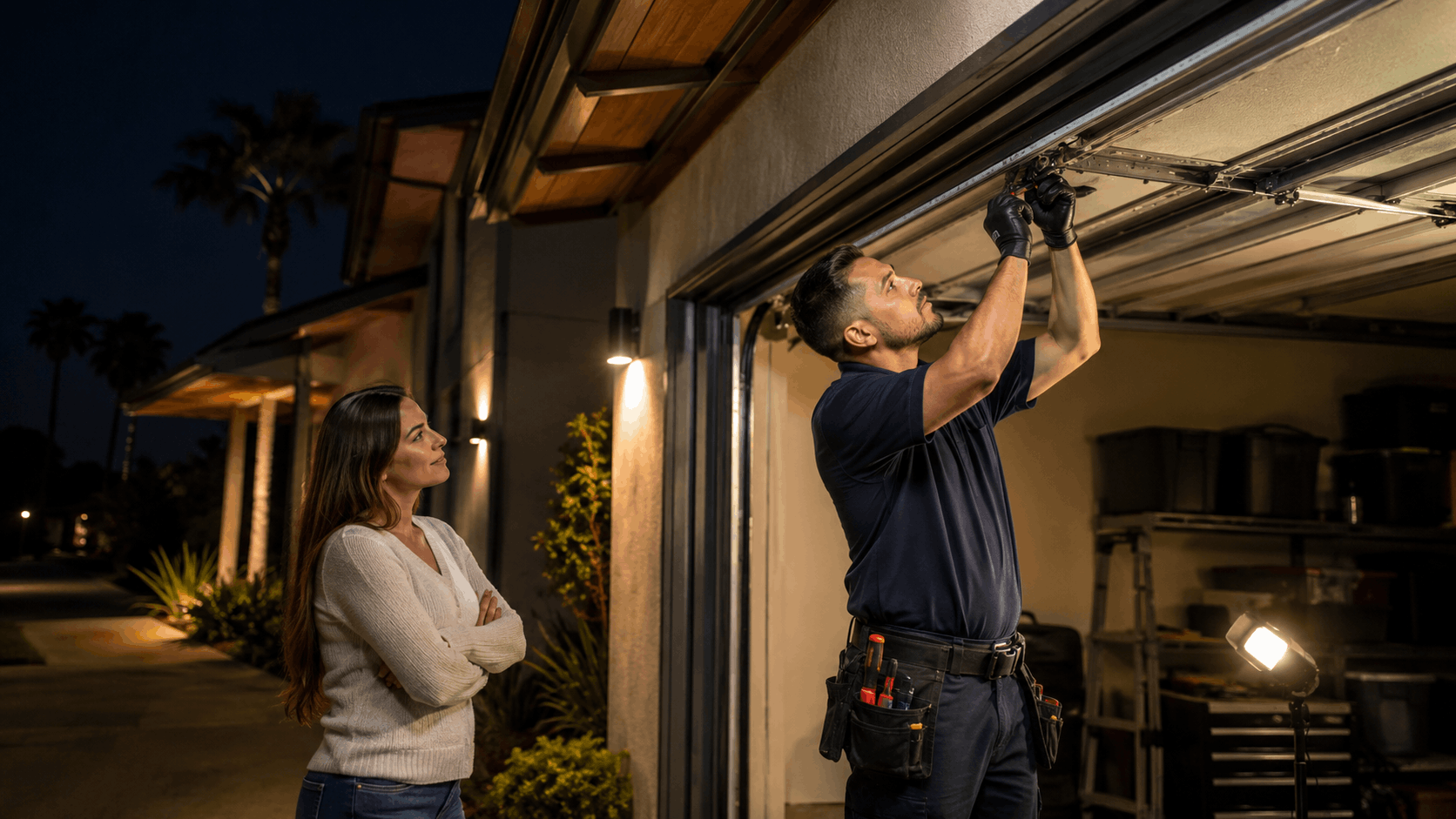
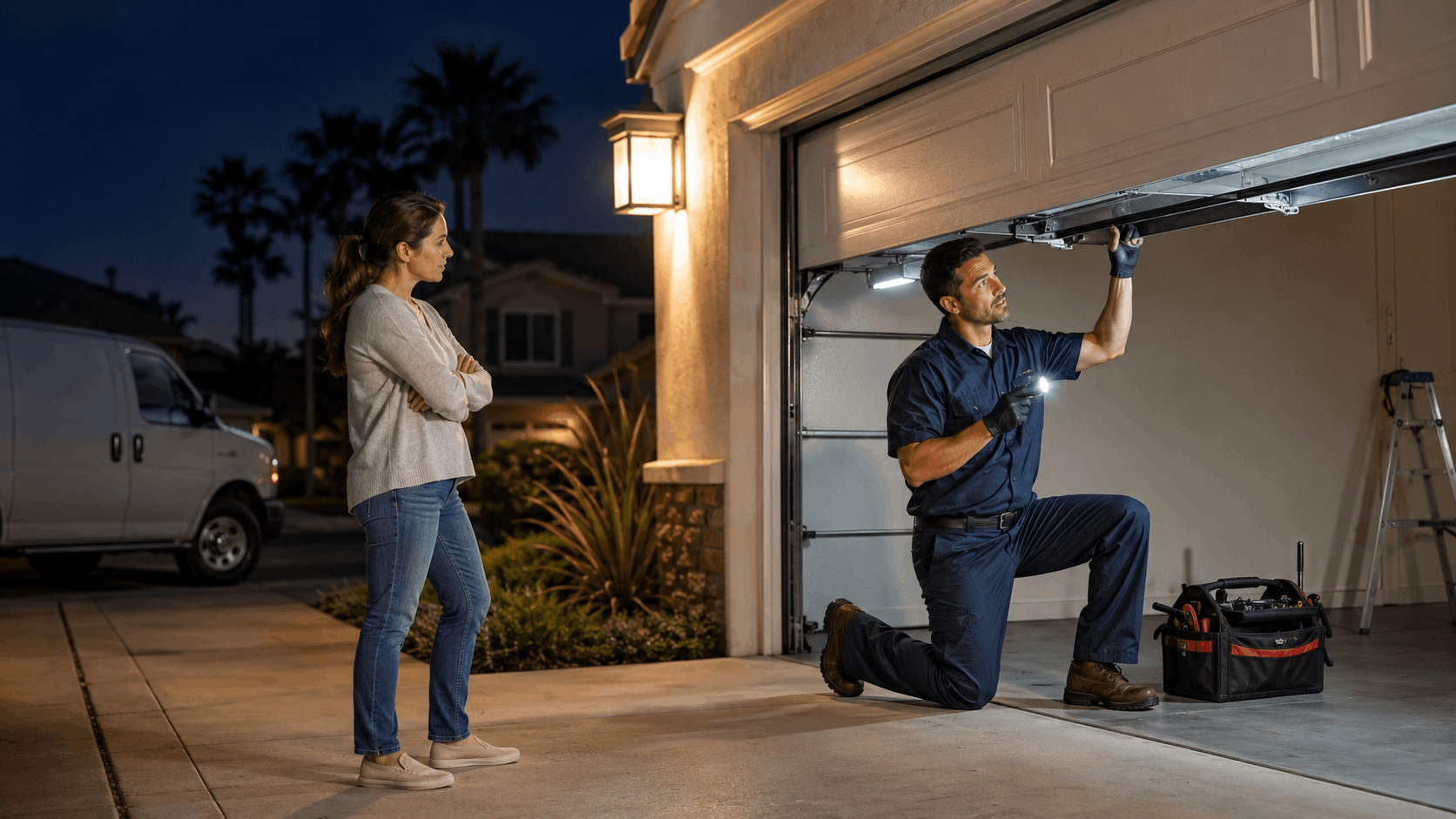
It is almost midnight near Downtown Huntington Beach. A homeowner pulls into the driveway after a late shift, hits the remote, and the garage door lurches, then hangs crooked with a loud bang. The car is stuck outside, the door will not close, and every repair shop seems shut for the night. If that sounds familiar, you are not alone.
Late-night garage door failures happen more often than most people think, especially in a beach town where salt air chews through metal parts sooner than it does inland. A snapped spring, a jumped track, or a dead opener does not wait for business hours. It picks the worst possible moment, usually when the whole family is home and the garage is the main way in and out.
Let's talk through why doors fail after dark, the safe steps to take the second it happens, which small fixes a homeowner can try, and which jobs need a trained pro. Our team at Urgent Garage Doors, based in Irvine, answers emergency garage door repair calls across Huntington Beach at night, so we will also explain how after-hours service actually works and what it costs.
Why Garage Doors Fail at Night in Huntington Beach
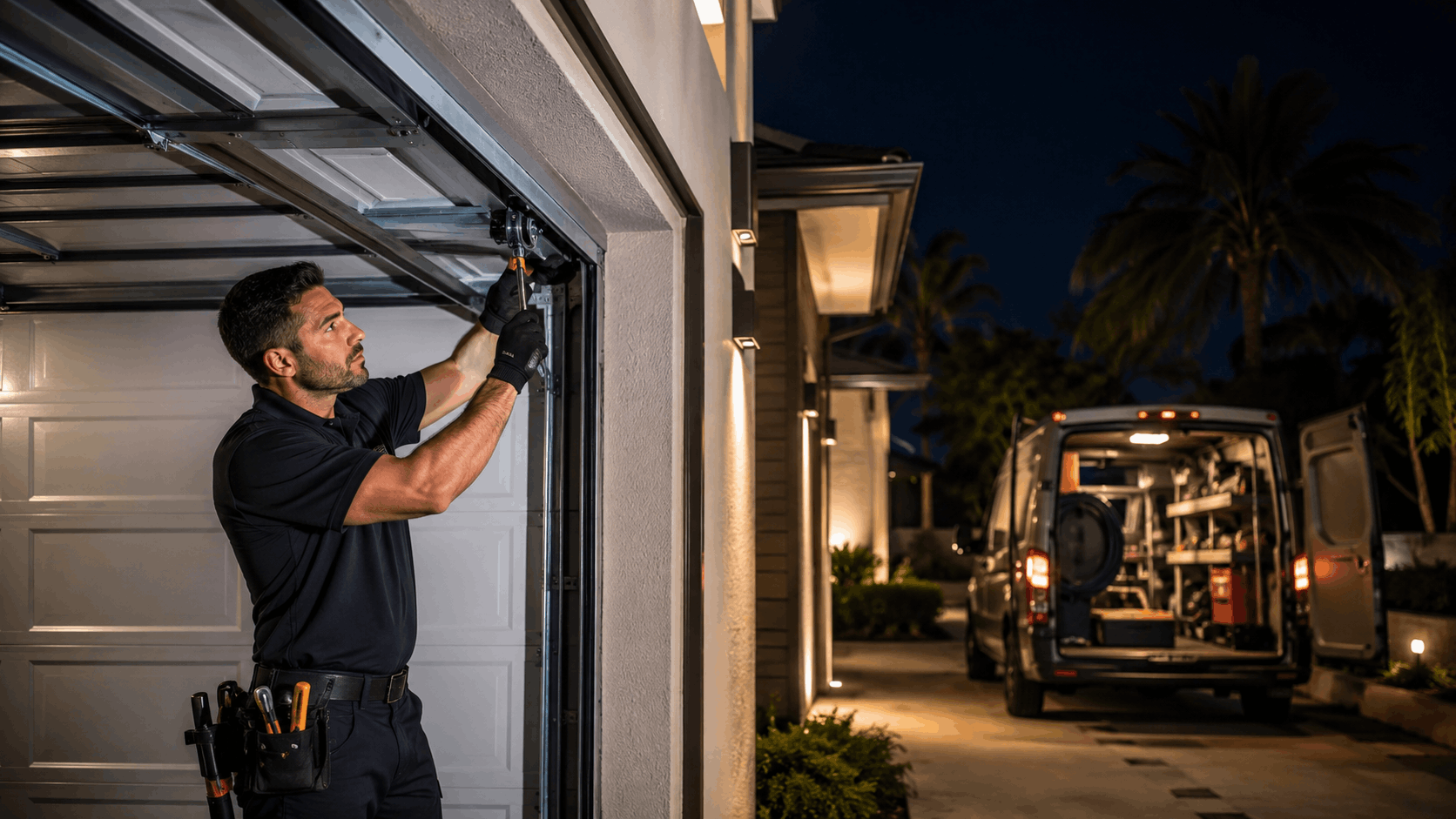
Most nighttime garage door failure has a cause that was building for weeks or months. The door does not break at 11 p.m. by accident. It breaks then because that final cycle at the end of a busy day was the one that pushed a worn part past its limit.
Huntington Beach adds its own twist. The coastal setting speeds up wear on hardware that would last longer a few miles inland. Salt, moisture, and heavy daily use all stack up. Here are the usual culprits behind a nighttime breakdown:
- Salt air corrosion on springs, rollers, and cables
- Worn torsion springs that snap after years of cycles
- Power outages and aging openers in older homes
- Doors that slip off track from loose rollers or a bump
Salt Air and Coastal Corrosion Near the Beach
Ocean moisture is hard on metal. In neighborhoods like Downtown and Huntington Harbour, the salt air settles on springs, rollers, and hinges every single night. Over time that thin salty film turns into rust, and rust eats away at the metal until it weakens.
We see this a lot on homes within a mile of the water. A standard galvanized spring that might last seven to ten years inland can start showing rust in as little as three to five years near the harbor. Rusted springs lose flexibility, which makes them brittle and far more likely to crack.
Cables suffer too. The thin steel strands fray at the bottom where water pools, and a frayed cable is a cable getting ready to snap. If a home sits right on a canal in Huntington Harbour or a block off the beach, corrosion is the number one reason for surprise failures.
The fix is not just replacing parts. It is choosing corrosion-resistant hardware and keeping up with cleaning. We often recommend our spring and cable repair service with rust-resistant components for homes near the coast, because standard parts simply do not hold up as long.
Worn Springs and Cables That Snap After Hours
Torsion springs do the heavy lifting on a garage door. They counterbalance the weight so the opener and your arms do not have to. Every time the door opens and closes, that counts as one cycle, and springs are rated for a set number of cycles before they wear out.
Most standard torsion springs are rated for about 10,000 cycles. For a family that opens the door four or five times a day, that works out to roughly seven to ten years. A busy household that uses the door eight times a day can burn through that rating in four or five years.
Here is why they snap at night. The door gets heavy use during the day as people come and go. That last closing cycle in the evening is often the one that finishes off a spring already near the end of its life. You hear a sound like a firecracker, and suddenly the door is too heavy to lift.
When a spring or cable goes, the door loses its balance completely. Our torsion spring replacement work handles this, and we always suggest replacing springs in pairs so the second one does not fail a few weeks later.
Power Outages and Opener Problems in Older Homes
Older homes near Oldtown and along Adams Ave were often built before modern electrical demands. Their circuits can be touchy, and a power outage or a tripped breaker will leave an electric opener dead in the water.
When the power goes out, an electric opener has no way to move the door. Some newer models have battery backups, but many older units do not. So a homeowner comes home during an outage, and the door simply will not respond to the remote.
Aging openers are their own problem. A motor that has run for fifteen or twenty years can burn out with no warning, usually during a heavy-use moment. The gears strip, the motor hums but does nothing, or the unit just goes silent.
We service and replace older units through our opener repair and troubleshooting work. In coastal homes, the salt air also corrodes the internal contacts and circuit boards over time, which makes an old opener even more likely to quit at the wrong hour.
Off-Track Doors From Everyday Wear
A garage door rides up and down on metal tracks with the help of small rollers. When rollers wear out or a bracket loosens, the door can jump off its track. It often happens when someone bumps the door with a car bumper or a bike.
You may not notice the damage right away. The door keeps working for a while, then one late-night closing is the moment it finally slides sideways and jams. Now you have a heavy door hanging crooked in the opening.
An off-track door is a safety risk. It can lean, fall, or drop suddenly if the rollers pop free on the other side too. Trying to force it back up usually bends the panels and makes the repair bigger.
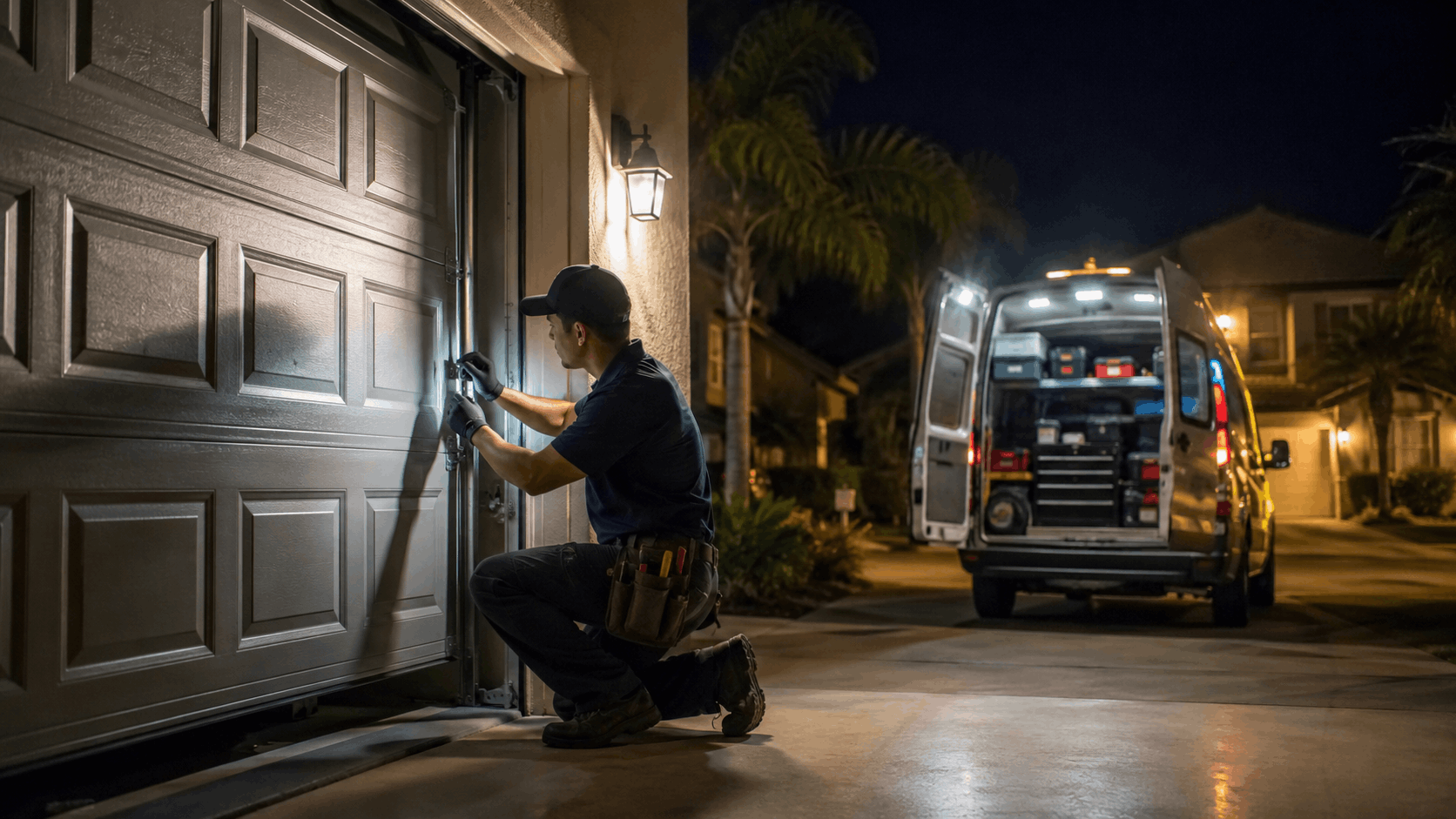
This is a job for a technician with the right tools. Our off-track garage door repair team resets the door safely and checks the rollers and alignment so it does not happen again the next week.
Get Your Free Quote
Tell us about your garage door and we'll get back to you within 30 to 60 minutes.
First Steps to Take When Your Door Breaks After Dark
The first few minutes after a door fails matter a lot. Panic leads to forcing things, and forcing a broken door leads to injuries and bigger repair bills. Staying calm and following a few garage door emergency steps keeps everyone safe.
Nighttime repair is easier when the homeowner has already made the area safe. Here is what to do the moment the door acts up, with safety as the goal every step of the way.
Stop Using the Door and Clear the Area
The instant a door makes a loud bang, hangs crooked, or refuses to move, stop pressing the button. Repeated presses on a stuck door can strip the opener gears or bend more panels. The door is telling you something is wrong, so listen to it.
Step back and get a clear view of the whole door. Look for a broken spring above the door, a loose cable dangling down, or a panel that has slipped out of the track. Do not put your hands on the door while you look.
Keep kids and pets well away from the opening. A door under tension or hanging off balance can move without warning, and a heavy panel can cause serious harm. Treat the whole area like a hazard zone until you know what is going on.
Forcing the door open by hand is one of the more common ways people get hurt. If a spring is broken, the full weight of the door - often 150 pounds or more - has nothing holding it back. That weight can crash down fast.
Check the Emergency Release Cord
Every automatic opener has a red emergency release cord hanging from the trolley near the center of the door. Pulling it disconnects the door from the opener so you can move it by hand. This is helpful during a power outage.
To use it, make sure the door is fully closed first if you can. Pull the red cord straight down and back toward the motor. That releases the trolley and puts the door into manual mode.
Here is the big warning. Do not pull the release cord if you see a broken spring or a snapped cable. Once you disconnect the opener, nothing holds the door up, and a door with a failed spring will slam down the moment it is free.
If the door came off track or a spring is clearly broken, leave the cord alone and wait for help. The release cord is for power outages and stuck openers, not for mechanical failures where the counterbalance system is gone.
Secure the Home if the Door Won't Close
A garage door that will not close leaves the home wide open all night. That is a real security worry, especially in busier areas near Beach Blvd where foot and car traffic runs late. An open garage is an invitation nobody wants to send.
If the door is stuck open, park a vehicle across the opening to block access. Pull it close to the door line so there is not enough room for someone to slip past. This is a simple way to cover the gap until morning.
Lock the interior door between the garage and the house. Most break-ins through a garage happen because that inner door was left unlocked. Turn on exterior lights too, since a well-lit driveway discourages anyone from getting curious.
Move bikes, tools, and anything valuable out of easy reach or into the house for the night. Then call for after-hours service so the door can be secured properly. Overnight protection is a stopgap, not a real fix.
Know When to Wait Until a Technician Arrives
Some problems can wait a short while for a professional, and some should never be touched by a homeowner. Knowing the difference keeps people out of the emergency room. When in doubt, wait for the technician to arrive.
A broken spring, a snapped cable, or a door off its track all fall into the wait category. These systems hold serious tension, and a wrong move can cause injury or make the damage worse. There is no safe DIY shortcut for high-tension parts.
Simple issues like a dead remote battery or a blocked sensor are fine to check yourself. We cover those in the next section. The line is drawn at anything involving springs, cables, or heavy panels.
Setting the right expectation helps. A door secured for the night and repaired the next day is a good outcome. A rushed DIY attempt that ends in a hospital visit is not. Patience here protects both the home and the people in it.
Need Help in Irvine?
Urgent Garage Doors serves Irvine and all of Orange County.
Problems You Can Safely Handle Yourself
Not every garage door hiccup needs a service call. Some are quick, safe fixes that a homeowner can try in a few minutes. Knowing basic troubleshooting can save a late-night call for something minor.
These DIY garage door fixes are all low-risk because none of them involve the high-tension spring or cable system. Here are the safe repairs worth trying before you pick up the phone:
- Swapping dead batteries in the remote or keypad
- Cleaning and realigning the safety sensors
- Checking the breaker and the opener's power plug
- Lubricating noisy rollers and hinges
Replacing Dead Remote or Keypad Batteries
A dead battery is the sneakiest culprit. When a remote stops working, people assume the whole opener died. Often the fix is a fresh battery that costs a couple dollars.
Most remotes use a small coin-cell battery, usually a CR2032 or CR2016. Keypads mounted outside the garage often take a 9-volt or a set of AA or AAA batteries. Pop the cover, note the battery type, and swap in a new one.
Test the door after replacing the battery. If the remote works again, problem solved. If the wall button inside the garage works but the remote does not even with a new battery, the remote may need reprogramming instead.
If reprogramming gives trouble, our keypad and remote programming service can sort out the signal quickly. Keeping a spare battery in a kitchen drawer saves a lot of late-night frustration.
Clearing Sensor Blockages and Realigning Photo Eyes
Modern openers have two small safety sensors, called photo eyes, mounted near the floor on each side of the door. They shoot an invisible beam across the opening. If anything breaks that beam, the door will not close as a safety measure.
Often the door will not close because a broom, a leaf, a cobweb, or a stray box is blocking one sensor. Look at the little indicator lights on each sensor. A steady light usually means good, and a blinking or dark light points to a blockage or misalignment.
Wipe both sensor lenses gently with a soft cloth. Salt air near the coast leaves a film that can fog them up. Then make sure both sensors point straight at each other, since a bump can knock one slightly out of line.
If the lights still will not go steady after cleaning and adjusting, the sensors may need professional alignment. Our safety sensor alignment repair handles stubborn cases where the wiring or bracket has shifted.
Resetting a Tripped Breaker or Unplugged Opener
Before deciding the opener is dead, check its power. It is easy to overlook, but a tripped breaker or an unplugged cord is a common and harmless cause. Older homes near Oldtown sometimes have circuits that trip under load.
Look at the ceiling outlet where the opener plugs in. Sometimes a cord works loose or a cleaning bump knocks the plug half out. Push it back in firmly and try the door again.
Then check the breaker panel. Find the breaker for the garage and see if it has flipped to the middle or off position. Flip it fully off, then back on, and test the opener once more.
If the breaker trips again right away, stop and call a professional. A breaker that keeps tripping points to a wiring problem or a failing motor, and that is not a DIY fix. Older coastal homes especially deserve a careful look at the wiring here.
Lubricating Noisy Rollers and Hinges
A door that grinds, squeaks, or sticks is often just thirsty for lubricant. Metal parts rubbing dry make noise and wear out sooner. A quick lube job can quiet things down and free up a sticky door in minutes.
Use a silicone-based spray or a garage-door-specific lubricant. Do not use WD-40, since it is a cleaner and degreaser, not a long-lasting lubricant, and it can attract dust. Apply the lube to the rollers, hinges, and springs, then run the door a few times to spread it.
Near the coast, regular lubrication also slows corrosion by putting a protective film on the metal. Homes in Huntington Harbour benefit from lubing every few months instead of once a year. It is a small habit that pays off.
If the noise stays loud even after lubing, the rollers themselves may be worn out. Our quiet roller hardware upgrade swaps noisy old rollers for smooth nylon ones that run much quieter.
Repairs That Need a Professional Right Away
There is a firm line between safe DIY tasks and dangerous jobs. Cross that line, and a small problem can turn into a hospital visit. The repairs below all involve high tension or heavy weight, and they need trained hands.
Professional garage repair exists because these parts can hurt people badly. Here is where a homeowner should step back and let our emergency service team take over.
Broken Torsion Springs Under High Tension
Torsion springs sit above the door and hold an enormous amount of stored energy. When wound, a single spring can hold hundreds of pounds of force. That force is what lets a person lift a heavy door with one hand.
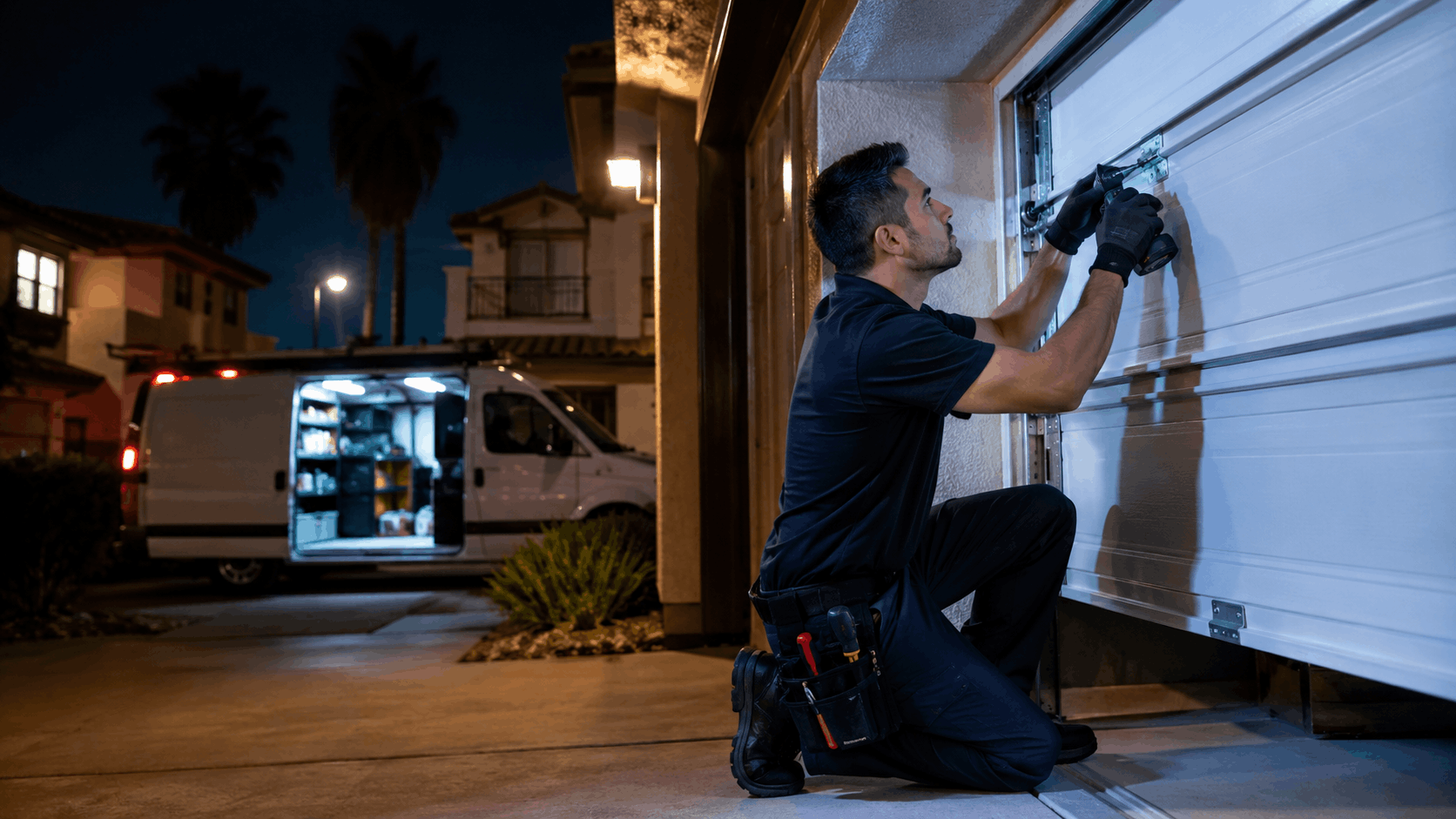
When a spring breaks, that energy releases in an instant. Trying to replace one without the right winding bars and technique can send metal flying or crush a hand. Every year people are seriously hurt trying to do this themselves.
A technician uses proper winding bars, clamps, and safety steps to control the tension. We also measure the door weight to fit the correct spring, since the wrong size ruins the balance and shortens the life of the new spring.
This is exactly why we send a trained tech for spring work through our torsion spring replacement service. The injury risk is simply too high for a do-it-yourself job.
Snapped Cables and Door Imbalance
The lift cables work hand in hand with the springs to raise and lower the door evenly. When one cable snaps, the door loses balance and hangs crooked, with one side dropping lower than the other. It looks wrong because it is wrong.
A crooked door is unstable. It can bind in the track, twist the panels, or drop suddenly if the second cable gives out too. Nobody should be standing under it while it is in that state.
Cables wind around a drum under tension, and rewinding them correctly takes skill. Set them wrong and the door will still be off balance, which strains the opener and the remaining hardware. It is a precise job.
Our garage door cable repair team rewinds the cables properly and rebalances the door so it moves level and smooth again.
Doors Off the Track or Bent Panels
An off-track door is heavy and unpredictable. When it comes off the rail, it can lean into a parked car, catch on the frame, or fall entirely. A dented or bent panel makes the whole thing weaker and harder to move.
People often try to shove the door back onto the track. That almost always makes it worse by bending the track or cracking more panels. The rollers need to be seated correctly, and the track has to be straight for the door to run.
A technician relieves the tension, guides the rollers back into place, and checks the track for damage. If a panel is bent beyond use, it gets replaced. We handle badly damaged sections through panel replacement so the door looks and works like new.
Doing this at night protects the vehicles in and around the garage. A leaning door left overnight can shift and cause damage while everyone sleeps.
Opener Motor Burnout and Circuit Board Failure
Openers do not last forever. After many years, the motor can burn out or the circuit board can fry. Signs include a humming motor that does not move the door, no response at all, or the opener running then stopping halfway.
Coastal homes see this sooner. Salt air corrodes the internal contacts and board components, so an opener near the beach may fail years earlier than one inland. A burnt-out motor is not a repair, it is a replacement.
Swapping an opener involves electrical wiring, mounting, and safety-sensor hookup, plus programming the new unit. A pro makes sure the safety reverse works and the force settings are correct, which protects people and pets.
We install modern, quieter units through our garage door opener installation service, and many customers upgrade to a model with battery backup so a power outage never traps them again.
Need Help in Irvine?
Urgent Garage Doors serves Irvine and all of Orange County.
How Urgent Garage Doors Handles After-Hours Calls
When a door fails at midnight, homeowners want to know two things. Can someone actually come tonight, and how long will it take. Our after-hours service is built around answering both fast.
Here is how the emergency response works from the first call to the moment the door is safe again:
- A quick phone diagnosis to understand the problem
- A tech dispatched from Irvine with a stocked truck
- An on-site safety check and clear plan
- A temporary fix or full repair depending on the situation
Driving Routes and Response Times From Irvine
Our home base in Irvine sits a straight shot from Huntington Beach down the 405 freeway. During the day that drive can crawl, but late at night the 405 opens up and the trip moves quickly. Lighter traffic is one upside of an after-hours call.
From Irvine to most Huntington Beach neighborhoods, the drive runs roughly 25 to 40 minutes at night depending on the exact address. Homes near Beach Blvd and the 405 exit are on the shorter end. Spots out toward Bolsa Chica take a little longer.
We give an honest arrival window when we take the call. There is no point promising ten minutes when the drive is thirty. A realistic time lets the homeowner plan and stay calm.
If a customer needs the fastest possible turnaround, our same-day garage door repair option covers urgent daytime and evening needs across the area too.
What Technicians Diagnose On-Site
When a tech arrives, the first move is a safety check. They look at the springs, cables, track, and panels to spot the failure and any hidden damage. This takes just a few minutes and tells them exactly what the door needs.
Our trucks carry the parts that break most often. That means torsion springs in common sizes, lift cables, rollers, hinges, brackets, and opener parts. Carrying stock lets us finish many repairs on the first visit instead of scheduling a return.
The tech explains what they found in plain language. No jargon dumped on a tired homeowner at midnight. They point to the broken part, describe what caused it, and lay out the options.
For coastal homes we also flag corrosion that could cause the next failure. Catching a rusting cable before it snaps saves another late-night call down the road.
Temporary Fixes Versus Full Repairs at Night
Most repairs get finished on the spot. A broken spring or snapped cable is usually fixed the same night with the parts on the truck. That gets the door working before the tech leaves.
Sometimes a full repair needs a part that is not standard stock, like a custom panel or a special opener. In those cases the tech secures the door for the night so the home stays safe, then returns with the part. Security comes first.
Securing the door might mean locking it in the closed position or blocking the opening so it cannot be forced. The homeowner knows exactly what will happen next and when the follow-up visit is set.
We always aim to leave the home safe, whether that is a complete repair for a door that won't open or close or a temporary fix with a scheduled return. Nobody gets left with a wide-open garage overnight.
Neighborhoods Served Across Huntington Beach
Our team knows Huntington Beach street by street. We work regularly in Huntington Harbour, where the canal-side homes see the heaviest salt corrosion. Those properties need rust-resistant parts more than almost anywhere in the county.
We also cover Southeast Huntington Beach, the Adams Ave corridor, Oldtown, and the areas around Downtown near Main Street. Each has its own mix of older and newer homes with different common problems.
Out toward Bolsa Chica and the wetlands, homes deal with damp ocean air and older openers. We handle the coastal neighborhood of Seacliff emergency garage door repair along with the rest of the city.
That local familiarity means we know the fastest routes and the typical door problems in each pocket of town. It shaves time off every after-hours call.
What Nighttime Garage Door Repair Costs in Huntington Beach
Cost is the first question on most homeowners' minds at midnight. Nobody wants a surprise bill on top of a broken door. Here are honest ranges and a breakdown of what drives the price up or down.
Emergency pricing in Huntington Beach depends on the part, the door, and the time of the call. These are estimates, and the real number comes after the tech sees the door.
Typical Price Ranges for Common Repairs
Spring replacement is one of the more common jobs. A torsion spring replacement typically runs between 200 and 450 dollars depending on the spring size and whether one or both need replacing. We recommend doing both at once since they wear together.
Cable replacement usually falls between 150 and 300 dollars. Roller replacement runs a similar range depending on how many need swapping and the roller quality chosen. These are moderate repairs that a stocked truck can finish quickly.
Opener repairs vary widely. A minor fix like a gear or logic board might be 150 to 350 dollars, while a full opener replacement often runs 400 to 700 dollars including the unit and installation. Battery-backup models sit at the higher end.
These numbers are ballpark figures for planning. The door size, part quality, and the specific failure all move the final price, so treat them as a starting point rather than a quote.
How After-Hours and Weekend Rates Work
Late-night and weekend calls usually carry a higher rate than a standard weekday appointment. The reason is simple. A tech is on call, driving out, and working during off hours, which costs more to staff.
Most companies, including ours, charge a service or trip fee for after-hours visits. That fee covers the dispatch and travel, and it is often credited toward the repair once work is approved. We tell customers the fee up front on the phone.
Weekend rates fall somewhere between standard weekday and deep overnight pricing. A Saturday afternoon call costs less than a 2 a.m. emergency. The exact surcharge depends on the hour and the day.
We are transparent about surcharges before dispatching. No homeowner should be surprised by a fee they never heard about. If the timing allows, waiting until morning can save money on non-urgent problems.
Factors That Change Your Final Bill
Several things move the price. Door size matters, since a large two-car or oversized door needs bigger springs and heavier hardware than a single door. Bigger parts cost more.
Part quality is another factor. A basic builder-grade spring costs less than a high-cycle spring rated for 20,000 or more cycles. Near the coast, we often suggest the higher-cycle or corrosion-resistant parts because they last far longer in salt air.
Corrosion damage itself can raise the bill. When rust has spread from a broken spring to the cables, drums, or brackets, more parts need replacing at once. Catching problems early keeps the repair small.
The type of opener, custom panels, and difficult access can all add to the total too. A tech gives the full picture on-site so the homeowner sees exactly what drives the number.
Getting a Clear Quote Before Work Begins
No work should ever start without the homeowner knowing the price. Our techs give a clear estimate, verbal or written, before touching a wrench. That way the customer decides with full information.
The quote breaks down parts and labor so there is nothing hidden. If the tech finds extra damage after opening things up, they stop and explain the new number before continuing. Approval always comes first.
This upfront approach removes the fear of a shock bill. A homeowner at midnight already has enough stress without wondering what the final charge will be. Clear numbers keep trust intact.
If the estimate feels like too much for the moment, a temporary secure-and-return plan is always an option. We would rather earn a repeat customer than pressure anyone into a rushed decision.
Need Help in Irvine?
Urgent Garage Doors serves Irvine and all of Orange County.
Preventing the Next Nighttime Emergency
Most late-night breakdowns can be prevented with a little upkeep. Garage door maintenance is cheap compared to an emergency call. In a coastal town, prevention matters even more because salt air never stops working against the hardware.
A few simple habits catch problems during daylight, when a repair is calm and cheaper. Here is how to stay ahead of trouble.
A Simple Seasonal Maintenance Checklist
A few times a year, walk through a quick maintenance routine. Look at the springs for rust or gaps, check the cables for fraying, and watch the rollers as the door moves for any wobble or grinding.
Test the door balance too. Close the door, pull the release cord, and lift the door by hand to about waist height. A balanced door stays put on its own. If it slams down or shoots up, the springs are out of adjustment and need attention.
Lubricate the moving parts during each check with silicone spray. Tighten any loose bolts on the hinges and brackets while you are at it. These small tasks take fifteen minutes and prevent a lot of surprises.
For homeowners who would rather leave it to a pro, our preventive maintenance plan handles the full inspection on a schedule so nothing gets missed.
Fighting Rust and Salt Buildup Near the Coast
Homes near the ocean face constant salt exposure. Wiping down the springs, tracks, and hardware every couple of months removes the salty film before it turns to rust. A damp cloth followed by a dry one does the trick.
After cleaning, apply a fresh coat of silicone lubricant to protect the metal. This film acts as a barrier against moisture. In Huntington Harbour and the beachfront zones, this habit can add years to the life of the hardware.
When parts wear out near the coast, choose corrosion-resistant replacements. Galvanized or coated springs, nylon rollers, and stainless hardware all hold up far better in salt air. The small extra cost pays for itself in fewer failures.
Homes right on a canal or a block from the sand should be extra diligent. The closer to the water, the heavier the corrosion, so a two-month cleaning schedule beats waiting for a rusty spring to snap.
Signs Your Door Is About to Fail
Doors usually warn you before they quit. A grinding or squealing noise means the rollers or hinges need attention. A door that moves slower than it used to, or jerks as it travels, points to a weakening spring or a binding track.
Watch for a door that looks uneven as it closes, with one side lower than the other. That hints at a stretching cable or a spring losing strength. A loud pop or bang is the sound of a spring on its way out.
If the opener strains, hums, or reverses for no reason, it may be fighting a door that is out of balance. Do not ignore these clues. They are the door asking for help before it fails completely.
Acting on these signs during the day is far better than dealing with a total breakdown at night. A daytime repair is calmer, cheaper, and on your schedule instead of an emergency.
When to Schedule a Professional Tune-Up
Most doors benefit from a professional inspection once a year. For homes near the coast with heavy use, twice a year is the smarter choice because the salt air speeds up wear. More cycles and more moisture mean more frequent checks.
A tune-up covers the spring tension, cable condition, roller wear, track alignment, and opener safety features. The tech catches small problems and fixes them before they become emergencies. It is the cheapest insurance against a midnight failure.
Homes with older openers or original springs deserve special attention. If a door has never had a professional look and it is more than seven years old, now is the time. Waiting invites a breakdown.
Scheduling a tune-up keeps the emergency calls away. We would rather do a quiet daytime inspection than a stressful overnight repair, and our customers feel the same. A little planning goes a long way.
Final Thoughts
A garage door that fails at night feels like a crisis, but it does not have to be. Stay calm, stop using the door, clear the area, and secure the home. Try the safe DIY checks like batteries and sensors, and leave springs, cables, and off-track doors to a pro.
Salt air makes Huntington Beach doors wear out sooner, so regular cleaning and a yearly or twice-yearly tune-up prevent most late-night surprises. When trouble does strike after dark, help is a phone call away.
Our team at Urgent Garage Doors responds to nighttime emergencies across Huntington Beach from our base in Irvine, with stocked trucks and honest pricing. If a door breaks tonight or you want to schedule a preventive check, contact us or call anytime. We will get the door safe and working again.
Frequently Asked Questions
- What should someone do first when a garage door breaks at night?
- Stop pressing the button right away, since forcing a broken door causes more damage. Step back and keep kids and pets away from the opening. Look for an obvious broken spring or off-track panel without touching the door. If it is only a power issue, the release cord may help. For anything involving springs or cables, wait and call for help.
- Is it safe to fix a broken spring without a technician?
- No. Torsion springs hold hundreds of pounds of force, and a slip during replacement can cause serious injury or worse. The job needs proper winding bars, clamps, and training to control that tension safely. Every year people are hurt trying this at home. A trained technician replaces springs quickly and safely, so this repair should always be left to a pro.
- How fast can a technician reach Huntington Beach from Irvine at night?
- The drive down the 405 freeway from Irvine to most Huntington Beach neighborhoods usually takes about 25 to 40 minutes late at night. Lighter overnight traffic makes the trip easier than during the day. Homes near the Beach Blvd exit are on the quicker end, while spots out toward Bolsa Chica take a little longer. We give an honest arrival window on the call.
- How much does emergency garage door repair usually cost?
- Spring replacement typically runs 200 to 450 dollars, cable and roller work around 150 to 300 dollars, and opener repairs from 150 up to 700 dollars for a full replacement. After-hours and weekend calls add a service fee that is often credited toward the repair. Door size, part quality, and corrosion damage all affect the final bill, so treat these as estimates.
- Why is the ocean air near Huntington Harbour so hard on doors?
- Salt air settles on springs, cables, and hardware every night and speeds up rust. Rust weakens the metal, making springs brittle and cables likely to fray and snap. Near the canals and beachfront, standard parts can start rusting in three to five years instead of lasting seven to ten. Corrosion-resistant parts and regular cleaning slow this down considerably.
- Can a garage door be left open overnight safely?
- Leaving a garage wide open all night is a real security risk, especially in busier areas near Beach Blvd. If the door will not close, park a car across the opening to block access and lock the interior door to the house. Turn on exterior lights and move valuables inside. Then call for after-hours service to secure or repair the door properly.
- What does the emergency release cord actually do?
- The red release cord disconnects the door from the opener so you can move it by hand, which helps during a power outage. Pull it straight down and back to release the trolley. Do not use it if a spring is broken or a cable has snapped, because nothing will hold the door up and it can slam down. It is for power issues, not mechanical failures.
- How can homeowners tell if it's the opener or the door itself?
- Pull the release cord and lift the door by hand. If the door moves smoothly and stays balanced, the problem is likely the opener, such as a dead battery, tripped breaker, or motor issue. If the door is heavy, crooked, or stuck by hand, the trouble is mechanical, like a broken spring or cable. That simple test separates the two quickly.
- How often should a garage door be serviced near the coast?
- Homes near the ocean should have a professional tune-up twice a year because salt air speeds up wear. Inland homes can usually get by with a yearly inspection. A tune-up checks spring tension, cable condition, rollers, track alignment, and opener safety features. Frequent checks catch small problems during the day before they turn into a midnight breakdown.
- Does Urgent Garage Doors offer same-night repairs in Huntington Beach?
- Yes. Our team responds to after-hours emergencies across Huntington Beach from our base in Irvine, with trucks stocked for common repairs. Many jobs like broken springs and snapped cables get finished the same night. When a special part is needed, we secure the door for the night and return to complete the repair. Call anytime to start the process.
Licensed garage door repair professionals serving Irvine and Orange County.
Licensed in California · License #1055150
Why trust Urgent Garage Doors?
Founded in 2017, Urgent Garage Doors is a licensed and insured garage door services serving Irvine and Orange County. All content is reviewed by our licensed technicians.

Need Help in Irvine?
Urgent Garage Doors serves Irvine and all of Orange County.
Related Articles
Coto de Caza Garage Door Repair: Custom Estate Doors and Emergency Service
Skilled garage door repair for Coto de Caza estates - custom wood door restoration, emergency service through the gate, spring and opener replacement, and local maintenance.

Emergency Garage Door Repair in Irvine Villages: Gate Codes, Association Quiet Hours, and Our Protocol
How Urgent Garage Doors handles emergency garage door repair in Irvine's gated villages, from gate codes and guard lists to HOA quiet hours and our step-by-step repair protocol.
Emergency Garage Door Repair in Newport Coast: Same-Day Service for Pelican Hill and Crystal Cove
A local guide to emergency garage door repair in Newport Coast, covering common failures, same-day service for Pelican Hill and Crystal Cove, costs, and prevention.