Cost Guides
How Much Does Garage Door Spring Replacement Cost on Lido Isle?
Key Takeaways
- Torsion spring replacement typically runs $150 to $300 and extension spring $150 to $250 in Orange County, with the final price given in writing before work begins.
- A spring job rarely stands alone: cables, drums, rollers and bearings wear with the spring, and a cable repair of $150 to $300 often belongs in the same visit.
- Lido Isle's constant salt humidity corrodes steel hardware, and cables fray from the inside out, so coated hardware and frequent inspection address the cause.
- Standard springs are rated around 10,000 cycles, roughly seven to twelve years, and far less where the street-facing garage is the main entrance.
- Owners can run the balance test safely, but a torsion spring stores enough energy to cause serious injury and is never a DIY job.
- Compact original garages, rebuilds on original footprints and jackshaft openers mean measuring before quoting is required, not optional.
- Garage door work is licensed under C-61/D-28, not C-28, and the unlicensed-work exemption rose to $1,000 under AB 2622 effective January 1, 2025.
- Urgent Garage Doors offers 24/7 service with a 30 to 60 minute Orange County response window and confirms Via street access before dispatch.
In This Article
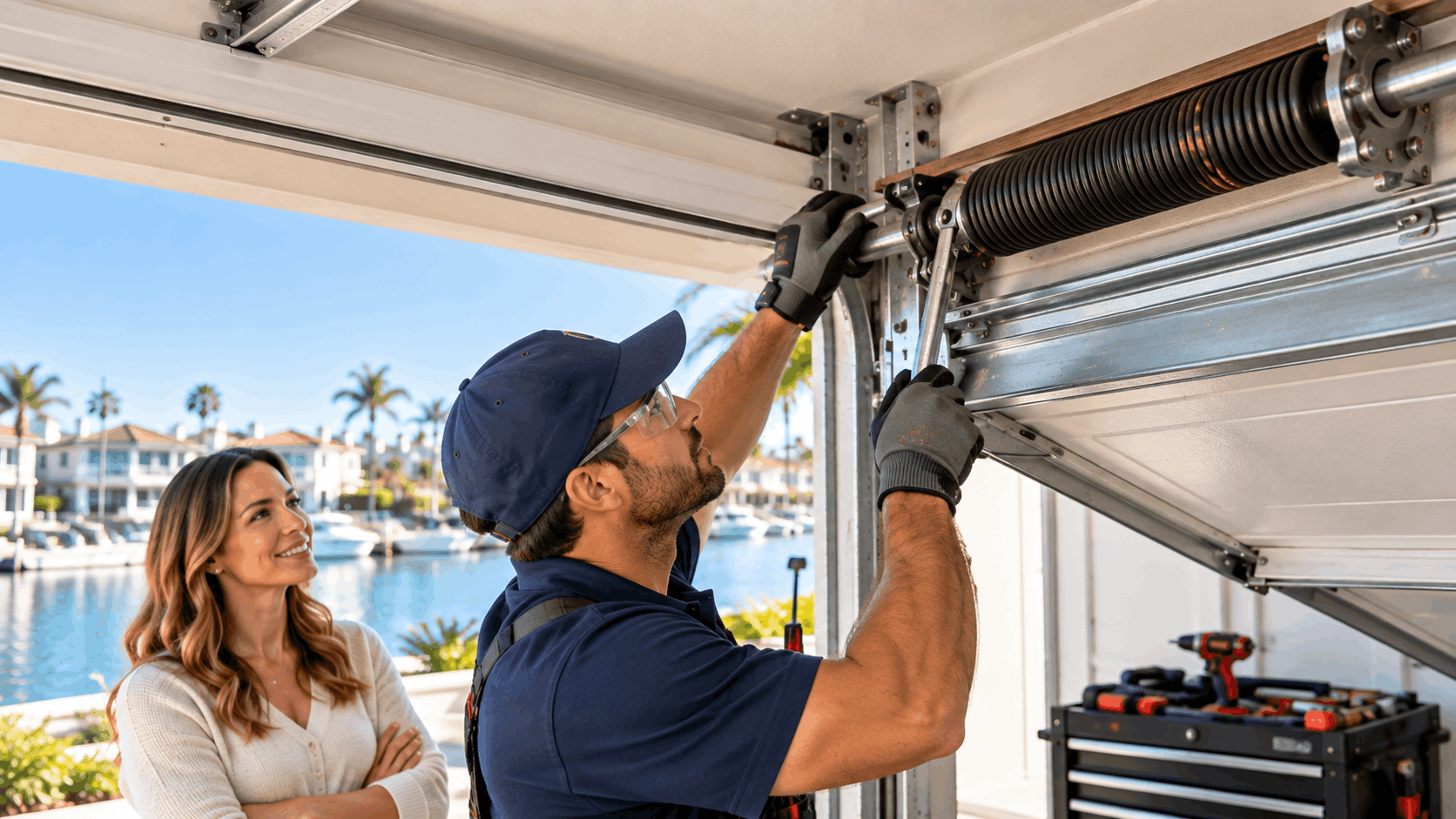
A spring that lets go on a bay-front Via street tends to announce itself with a bang, and then a door that will not move at all. On Lido Isle, where the garage is almost always street-facing and often the only way a car reaches the house, a broken spring is more than an inconvenience. Owners want one answer first: what does it cost to fix?
Here it is up front. In Orange County, torsion spring replacement typically runs $150 to $300, and extension spring replacement typically runs $150 to $250. Those are typical market ranges, not a fixed quote, and the real number for a specific door depends on that door. The price is given in writing before work begins.
What makes Lido Isle different from a mainland job is the setting. The island sits in Newport Harbor, surrounded by salt-laden air that works on steel hardware year round. The garages are compact originals, often rebuilt on the same footprint. And there is one bridge in and out. All three shape how a spring job goes, and we will walk through each one.
Garage Door Spring Replacement Cost on Lido Isle at a Glance
Before anyone reads further, here are the typical ranges a Lido Isle owner should expect. Every figure below is a typical Orange County market range, not a quote from us and not a fixed price. The actual cost for a given garage is set after the door is diagnosed and put in writing before any work starts.
| Job | Typical Orange County Range |
|---|---|
| Torsion spring replacement | $150 to $300 |
| Extension spring replacement | $150 to $250 |
| Spring conversion (extension to torsion) | $150 to $350 |
| Cable repair | $150 to $300 |
| Door that will not open or close (diagnostic) | $85 to $250 |
| Door balancing and tension adjustment | $75 to $150 |
Typical Torsion and Extension Spring Prices
The two most common spring jobs are the two most common prices. A torsion spring replacement on a Lido Isle door typically falls in the $150 to $300 range across Orange County. Torsion springs sit on a bar above the opening and carry most residential doors, which is why they are the system most island garages use.
An extension spring replacement typically runs $150 to $250. Extension springs stretch along the horizontal tracks on each side of the door and are more common on older or lighter setups. Where a door still runs on an aging extension pair, an owner will often ask whether it is worth moving to torsion.
That move is a spring conversion, and it typically runs $150 to $350. A spring conversion upgrade replaces the extension system with a torsion bar and springs, which many island doors benefit from given their weight and daily use. The spread in each range reflects door size, spring type and whatever else the door needs, which is why a written price beats a phone guess.
None of these figures should be read as a flat rate. They are the band a typical door lands in. A heavier custom door, a high-cycle spring or paired springs on a wide opening will sit toward the top of the range, while a standard single spring on a compact door sits lower.
Why a Spring Job Is Rarely Just a Spring
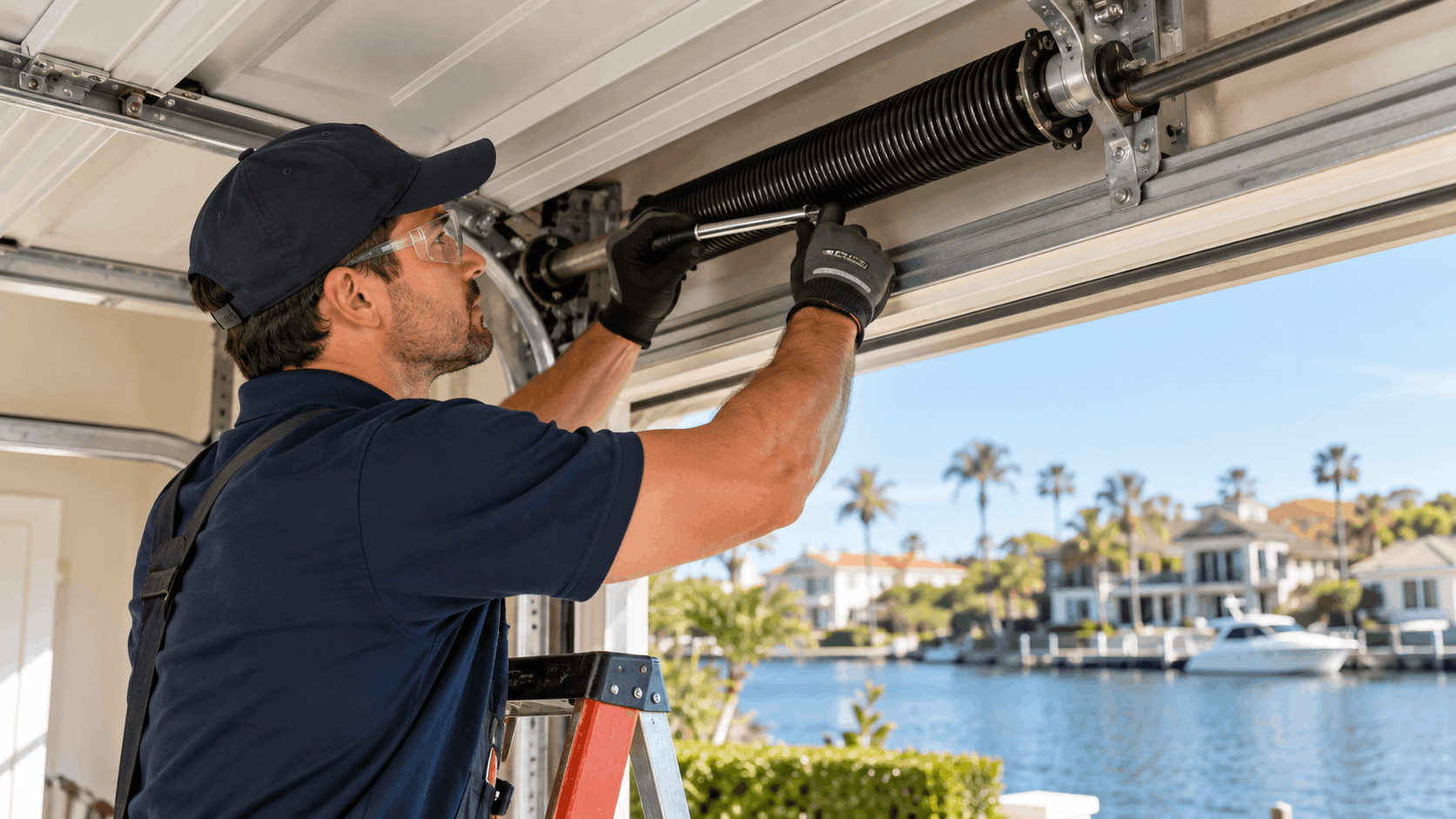
Springs do not wear alone. Cables, drums, rollers, hinges and bearings all move through the same cycles and sit in the same salt air, so they age on the same clock. When a spring breaks after years of use, the parts around it are often close behind.
That is why a thorough fix may add cable repair, which typically runs $150 to $300. On a door within a few blocks of the water, a garage door cable repair often belongs in the same visit, because the cable may already be corroding on the inside where no one can see it.
Replacing a spring while ignoring worn hardware is how a second failure follows weeks later. A fresh spring puts full load back onto frayed cables, pitted drums and dry bearings, and the weakest of those is the next to go. The owner then pays for a second call that a single inspection could have folded into the first.
A good spring visit is really a hardware inspection with a spring at the center of it. The technician checks the cables for fraying, the drums for grooving, the rollers for drag and the bearings for play, then prices the whole picture. That is the difference between fixing the door and fixing the symptom.
What a Written Price Covers Before Work Starts
The final price depends on the specific door: its size, its weight, the spring type it needs and the condition of the hardware around the spring. That is why a figure is set after the door is looked at, not before. A written price is available before work begins, given when the job calls for it or when the customer asks.
California also has a contract rule that owners should know. Under Business and Professions Code section 7159, a home improvement contract must be in writing for work over $500. That is a contract requirement, and it is separate from the licensing rules covered later in this article.
Most single-spring jobs land below that $500 threshold, so the written contract rule tends to come into play on larger repairs where springs, cables and other hardware are replaced together. Either way, an owner is entitled to see the numbers before tools come out.
A clear estimate also protects against surprises. When the cable, roller and bearing condition is called out in writing alongside the spring, the owner decides what gets done rather than learning about it after the fact. That is how a spring call stays predictable on a street where a return trip costs everyone time.
Get Your Free Quote
Tell us about your garage door and we'll get back to you fast.
What Actually Drives the Price on a Lido Isle Door?
Two neighbors on the same Via can get two different numbers for what sounds like the same job. That is not inconsistency. The spring replacement price factors come down to the door itself, the spring rating, the hardware it needs and the system it runs. Here is what moves the figure up or down.
Door Weight, Height and Material
Springs are not one-size-fits-all. They are sized to the actual door weight and height, because the spring has to counterbalance the exact load it lifts. A spring matched to a light single door will fail fast under a heavy one, and a spring that is too strong will not let the door sit.
Lido Isle complicates this because so many homes have been rebuilt. A modern three-story house may carry a heavier or custom door on an original-width opening, and that door needs springs matched to it rather than a reuse of whatever came off. Heavier doors in solid wood, glass-and-aluminum or insulated steel all change the counterbalance math.
Correct spring sizing is what keeps the door balanced and the opener from straining. It is also why reusing an old spring on a new or heavier door is a mistake, not a savings. The right part costs what it costs, and matching it to the door is the whole point of the job.
Door height matters too. A taller door travels farther per cycle and may need a longer spring or a different wind count, which can affect both the part and the labor. On a rebuilt island home with an oversized opening, these details are set by measurement, not assumption.
Standard Versus High-Cycle Springs
Standard residential springs are commonly rated around 10,000 cycles, where one cycle is a full open and close. For a typical household that works out to roughly seven to twelve years of service. For a home where the garage is the main entrance and the door runs several times a day, it is far less.
The cycle rating is the honest way to think about spring life, because it ties to how often the door actually moves. A family that runs the door for every trip in and out burns through cycles quickly, and on a one-bridge island where the car leaves and returns through that single garage, use adds up.
A high-cycle spring is rated for more cycles and costs more than a standard spring. It suits a home with heavy daily use, because paying once for a longer-lived spring beats paying repeatedly for a standard one that keeps reaching the end of its rating.
Whether the upgrade pays off depends on the household. A lightly used second garage may never need more than a standard spring, while a primary street-facing entrance that cycles four or more times a day is exactly where high-cycle hardware earns its higher price.
Galvanized and Coated Hardware for Bay Air
On Lido Isle, hardware choice is a price factor in its own right. The island is surrounded by harbor water, so salt-laden humidity is constant rather than seasonal. That environment is the reason galvanized hardware, coated springs and stainless fasteners are justified here on the mechanics.
Galvanized and coated components resist corrosion better than bare steel, which is why they belong on a door this close to the water. The coating does not change what the spring does, but it slows the surface corrosion that forms on unprotected steel in humid, salty air.
Choosing that hardware can shift the final price slightly, because coated and stainless parts cost more than plain ones. On a bay-front Via, that is money spent where the environment actually works on the metal, and it is a reasonable trade for a door that lives in salt humidity every day.
The alternative is replacing bare hardware more often as surface corrosion takes hold. For owners planning to keep a home for years, specifying coated springs and stainless fasteners up front is the more sensible path, and it is one worth discussing when the price is set.
Torsion Versus Extension Systems
The torsion system uses springs wound on a bar above the door, and the extension system uses springs that stretch along the horizontal tracks. Torsion is the more controlled, longer-lasting setup and is what most modern doors use, which is why many island doors run torsion or are good candidates to.
When a door still runs on extension springs, a spring conversion to torsion typically runs $150 to $350. The conversion changes the cost because it swaps the whole system rather than a single part, adding the torsion bar, mounting and matched springs.
A torsion setup suits many Lido Isle doors because it handles weight more evenly and tends to last longer under daily use. For a heavier rebuilt door on a compact opening, torsion is often the better match, and the conversion is a one-time cost that changes how the door operates going forward.
Not every door needs the conversion. Where an extension system is in good shape and the door is light, a straightforward extension replacement keeps the cost lower. The right call depends on the door, the use and the condition of the existing hardware.
Need Help in Irvine?
Urgent Garage Doors serves Irvine and all of Orange County.
Why Springs Fail Sooner Than Owners Expect on the Island
Owners on the island often feel their springs do not last as long as a friend's inland. The reason is the harbor. Lido Isle is a dredged island surrounded by water, and that puts every piece of steel hardware in constant contact with salt humidity. Here is what salt air corrosion does, how it drives spring failure and cable fraying, and what the repair actually solves.
Constant Salt-Laden Humidity, Not Seasonal
Inland, humidity swings with the weather. On Lido Isle, the island is ringed by harbor water, so salt humidity is a constant condition rather than a seasonal one. The hardware is never really dry in the way an inland garage can be.
That constant exposure works on every steel component. Springs, cables, drums, rollers, hinges and fasteners all corrosion over time, because salt in the air accelerates the surface chemistry that eats bare steel. It is the same mechanism that pits boat fittings and rails along the harbor.
The practical response is twofold. First, inspect more often than an inland owner would, so corrosion is caught before it reaches a cable or a spring coil. Second, choose galvanized and coated hardware with stainless fasteners, which stand up to the salt far better than plain steel.
This is why a twice-yearly inspection cycle is justified on the island on the mechanics alone. A door a few blocks from the water simply lives in a harder environment than the same door in Turtle Rock, and the maintenance rhythm should reflect that.
Cables That Fray From the Inside Out
Lift cables are the quiet failure point near the water. They cable fray from the inside before the damage shows on the surface, so a cable can look serviceable while strands inside the twist are already corroding. That is inside-out corrosion, and it is exactly the kind of fault that hides.
The consequence is that a corroded cable can snap without warning. There is no slow visible decline to prompt a call, so the first sign is often the failure itself, sometimes alongside the spring it shares the load with.
This is why cable inspection pairs with any spring job on a door within a few blocks of the water. A technician checks the cable for internal fraying, surface corrosion and broken strands near the drum and the bottom bracket, where damp sits longest.
Catching a frayed cable during a spring visit is what prevents the second failure. Replacing both the spring and a compromised cable in one trip restores the door to a known-good state, rather than putting a fresh spring back onto a cable that is about to let go.
Bay-Side Versus Inland Via Streets
The island is not uniform. Homes on the bay side take the worst of the salt exposure, and the difference between a bay-front Via street frontage and one a few streets inland is visible in how the hardware ages. Technicians who work the island see the contrast on the parts themselves.
What the exposure does is bring salt-laden moisture into direct and frequent contact with steel. On a bay-front garage, that contact is near constant, which is why bay-side hardware shows corrosion and pitting that an inland garage on the same island may not.
The honest frame is what the exposure does, not a multiplier on how fast. Salt humidity drives corrosion on springs, cables and fasteners, and homes closest to the water sit in the most of it. That is a reason to inspect bay-side doors more often and to specify coated hardware there.
It also shapes the conversation about parts. On a bay-front Via, galvanized springs and stainless fasteners are an easy recommendation, because the environment on that frontage is as demanding as it gets on the island.
Cycle Rating Is the Honest Measure
The clearest way to judge a spring is its cycle rating. A torsion spring is rated in cycles by the manufacturer, commonly around 10,000 for a standard spring. A door cycled four times a day reaches 10,000 cycles in roughly seven years, which is a useful benchmark for a busy island household.
Corrosion fits into that picture by bringing a spring to the end of its cycle rating. The salt air does not add a mystery number to the equation; it works on the steel while the spring runs through the cycles it was built for. The result is a spring that reaches its rated end in the normal way, having lived in a harder environment.
That is why the right basis for judging a spring is spring age and door use together. An owner who knows roughly how old the springs are and how often the door runs can estimate where the spring sits against its rating.
For island homes, that math argues for proactive inspection. A door nearing seven years of four-a-day use is near a standard spring's rating, and checking it before it breaks is cheaper and far less disruptive than a snapped spring on a narrow Via.
How to Tell Your Spring Is the Problem
Before calling, an owner can confirm whether the trouble is the spring or the opener using safe tests only. A balance test, a look for broken spring signs and the knowledge of which safe tests are safe will save a wasted service call. One thing stays off limits entirely: a torsion spring is never a do-it-yourself job.
The Balance Test an Owner Can Run
The balance test is the single most useful check an owner can do. Disconnect the opener by pulling the release cord, then lift the door by hand to about waist height and let go.
A correctly balanced door stays put at waist height. It does not drop to the floor or drift upward on its own. The springs are doing their job of counterbalancing the door's weight so the door holds wherever it is left.
If the door will not hold position, that is a spring problem, not an opener problem. A door that falls has springs that can no longer carry the weight, and a door that rises has too much tension. Either way, the fix is in the spring system.
This test matters because it separates two different repairs. Owners often assume a door that will not open is an opener fault, when the balance test points straight at the springs. Running it first means the right technician shows up with the right parts.
Signs the Spring Has Already Broken
Some failures are obvious. The clearest broken spring sign is a visible gap in the torsion spring coil above the door, where the spring has separated into two pieces. If an owner can see daylight through a break in the coil, the spring is done.
Other signs are behavioral. A door won't open by hand, or the opener strains, lifts a few inches and reverses, because the motor is now trying to lift the full weight the spring used to carry. An opener is not built to lift a door alone, so it protests and gives up.
Diagnosing a dead door falls in the door that will not open or close range, which typically runs $85 to $250 in Orange County. That covers the diagnostic visit to confirm what failed before any parts are quoted. A door that will not open or close often traces back to a spring on an older island garage.
Forcing a door with a broken spring is how a bad day gets worse. The door is heavy and unbalanced, and trying to muscle it or run the opener repeatedly can damage the opener, the tracks or the panels. Once the balance test or a visible break points to the spring, the move is to stop and call.
Why Owners Must Never Touch a Torsion Spring
This is the hard line of the whole job. A torsion spring stores enough energy to cause serious injury. It is wound tight with winding bars against a fixed cone, and all that stored force is held in a part most people assume is just a coil of metal.
Because of that stored energy, owners should never adjust, wind, unwind or replace a torsion spring. The torsion spring danger is real: a spring that slips off the winding bars during an amateur attempt can strike with enough force to break bones or worse. This is specialized work for a reason.
The safe check an owner can run instead is the manufacturer's auto-reverse check. Lay a flat two-by-four on the floor in the door's path and confirm the door reverses when it contacts the board, and check that the photo-eye beam is aligned and unobstructed.
That test tells an owner the safety systems work without ever touching the spring. It confirms the door reverses on an obstruction, which is what the entrapment protection is built to do. Everything to do with winding, tension and spring replacement stays with a licensed technician.
What Fits an Original Lido Isle Garage
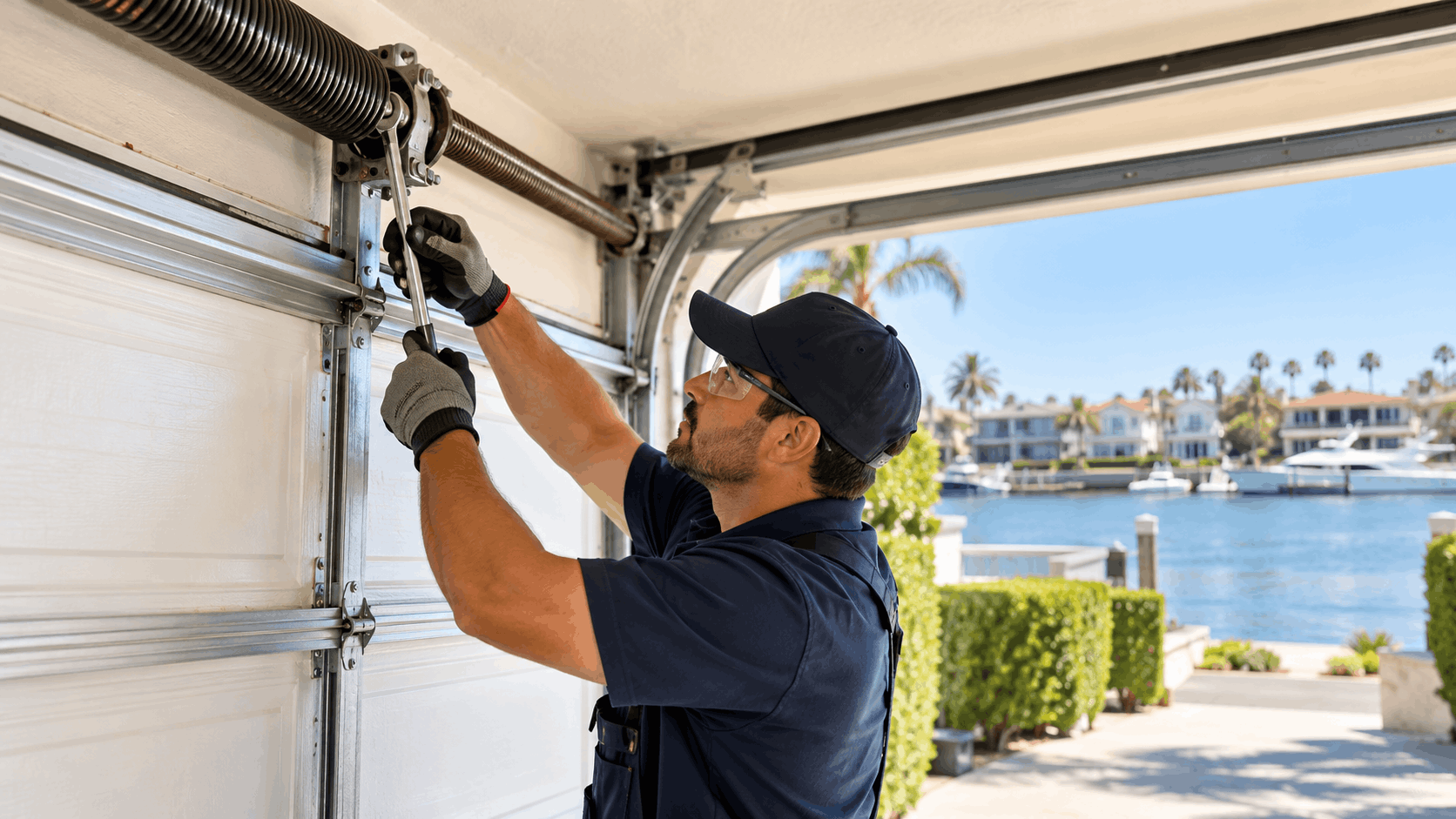
The island's garages shape the job as much as the door does. Many are original and compact garage builds, which means a spring call can involve more than swapping a part. The constraints touch both scheduling and cost, and they are the reason measuring comes before quoting.
Compact Openings and Limited Headroom
Original Lido Isle garages were built compact. They have narrow openings and limited headroom and backroom, which means standard off-the-shelf hardware does not always fit the way it would in a newer mainland garage.
Limited low headroom is the common catch. A standard torsion assembly needs a certain amount of clearance above the door, and an original island garage may not have it. That is where a track kit designed for low headroom comes in, routing the door and hardware to fit a tight ceiling.
A narrow opening changes the spring and hardware sizing too. A custom-width door needs springs and cables matched to its exact dimensions, not pulled from a standard stock size. These are routine situations on the island, but they are situations that need the right parts on the truck.
None of this is a problem for a technician who works the island, but it is why a Lido Isle spring job is not always a quick stock swap. Getting the right low-headroom kit or custom-width hardware to the house is part of doing the job correctly the first time.
Rebuilds on Original Footprints
Many Lido Isle homes have been rebuilt, and most were rebuilt on their original footprint. That produces an unusual mix: a modern three-story house can still sit on an original-width garage opening, so the shiny new frontage hides an old-dimension garage.
The result is that newer and heavier doors often hang in older-sized openings. A rebuild may have added a heavier glass or solid door while keeping the compact opening, which changes both the spring sizing and the hardware that fits.
This is exactly why measuring before quoting is required rather than good practice. Two island homes that look nothing alike from the street may share an opening size, and a rebuilt home may defy the assumption that a modern house has a modern-sized garage.
A measured quote prevents the wrong parts showing up. On an island where a return trip means crossing the bridge again and finding a place to park a second time, measuring first is how the job stays on one visit.
Jackshaft Openers and Spring Access
Where headroom is tight, many island garages use a jackshaft opener mounted at the side of the door on the torsion bar rather than a motor hung from the ceiling. These wall-mounted units drive the torsion bar directly and free up the ceiling, which matters in a low-clearance garage.
A jackshaft setup changes how a technician reaches the springs. Because the opener sits at the torsion bar, spring access involves working around the drive unit, and the technician accounts for that when planning the repair. It is a different sequence than clearing a ceiling-mounted chain drive.
The opener type also shapes what gets checked alongside the spring. On a jackshaft door, the torsion bar, the drive coupling and the springs are all in the same zone of work, so inspecting them together is natural during a spring job.
For owners weighing an opener upgrade, a jackshaft is often the sensible choice on a compact island garage. If an opener question comes up during a spring visit, the garage door opener installation options for low-headroom garages are worth a conversation.
Need Help in Irvine?
Urgent Garage Doors serves Irvine and all of Orange County.
Getting a Service Truck Onto Lido Isle
Access is its own factor on the island, and it touches timing more than price. The single bridge access, the Via streets and the harbor season all affect service timing, so a few minutes of planning before dispatch keeps a spring call smooth.
One Bridge In and Out
Lido Isle is reached by a single bridge from Via Lido, and that bridge is the only way on or off. There is no alternative route, so everything coming to or leaving the island crosses the same span.
That one fact shapes scheduling. Timing around bridge traffic matters more than it would on the mainland, because a backup at the bridge affects arrival in a way a mainland side street never would. A spring call is planned with that single access point in mind.
The bridge also raises the stakes on a stuck door. On a one-bridge island, a car trapped behind a dead garage door cannot simply be moved to another street, which is part of why a prompt response matters here.
None of this changes the price of the spring itself. It changes how the visit is timed, and it is a reason the access and parking situation is confirmed before a truck heads over Via Lido rather than sorted out on arrival.
Narrow Via Streets and Parking
The Via grid is narrow by design. Curb space is limited and residents park close to their own frontage, so there is less room for a service vehicle than on a standard mainland street.
A truck blocking a Via street affects more households than the same truck on the mainland, because the streets are tight and the island is dense. That is why where the truck can legitimately sit is confirmed before dispatch rather than figured out once a technician arrives.
Limited curb space and parking also mean crews often carry material farther than on a standard job. Homes with strand frontage have no vehicle access on the water side at all, so every part and tool goes in and out through the street-facing garage.
For the owner, this is mostly invisible if the planning is done right. Confirming parking ahead of time keeps the visit from stalling and keeps a neighbor's frontage clear, which matters on streets where everyone parks close to home.
Best Times to Book Around the Season
Summer changes the island. Visitors, boat traffic and full streets arrive across the harbor communities, the same rhythm that governs Balboa Island and the Peninsula. During peak season, the bridge and the Via streets are busier, which affects seasonal booking.
The practical advice is to book island work outside peak season where possible, or early in the day during it. An early appointment gets ahead of summer traffic and the midday crush of visitors and boats.
A broken spring rarely waits for a convenient season, of course. When a spring fails in July, it still needs fixing, and the planning around bridge traffic and parking simply matters more that week than it would in the off-season.
For planned work, such as a conversion or a proactive spring replacement on an aging door, choosing an off-peak window or an early appointment makes the whole visit easier for everyone on the street.
Licensing and Permits for Spring Work on Lido Isle
Who is legally allowed to do this work, and whether a permit applies, are questions worth getting right. For a spring job they touch cost mainly through who can do the work legally. There is also a common licensing mix-up worth correcting.
- The correct license is C-61/D-28, Doors, Gates and Activating Devices, not C-28.
- C-28 is Lock and Security Equipment and is not the garage door license.
- A license is verified free at cslb.ca.gov, where classification, status, bond and workers compensation are public record.
- The unlicensed-work exemption is now $1,000, raised from $500 by AB 2622 effective January 1, 2025.
The Correct License Is C-61/D-28
Garage door work in California is licensed under C-61/D-28, Doors, Gates and Activating Devices, a subclassification of the C-61 Limited Specialty category. That scope covers sectional and rolling doors, torsion and extension spring systems, operators, control boards, safety sensors and activating devices.
It is worth stating plainly that C-28 is not the garage door license. C-28 is Lock and Security Equipment, a different classification for a different trade. A spring job is not lock work and does not require a Class B general building license either.
An owner can confirm any contractor's standing through the CSLB. License verification is free at cslb.ca.gov, and the number, classification, status, bond and workers compensation all show up as public record.
Urgent Garage Doors holds California license #1055150, which an owner can look up the same way. Checking the license before hiring is a quick step that confirms the contractor is cleared for the exact work a spring job involves.
The $1,000 Unlicensed-Work Threshold
AB 2622 rewrote Business and Professions Code section 7048 effective January 1, 2025, raising the unlicensed exemption from $500 to $1,000 in combined labor, materials and other costs. A lot of older advice, including some of the CSLB's own, still prints $500, but the current figure is $1,000.
The exemption also fails in two other ways. It fails at any value if the work requires a building permit of any kind, and it fails if the person doing the work employs anyone on the job. A job also cannot be split into sub-$1,000 slices to slip under the line.
For a spring job, the dollar line is almost beside the point. A spring replacement is specialized work with a serious injury risk, which is the real reason it belongs with a licensed contractor rather than an unlicensed handyman working under an exemption.
The stored energy in a torsion spring does not care about a threshold. The exemption governs what is legal for low-value work; it does not make winding a loaded torsion spring a safe thing for an untrained person to attempt.
Permits, Association and Coastal Review
A spring replacement in an existing opening is a different matter from changing the structure. Swapping springs and cables does not alter the opening, the header or the exterior appearance of the door, so it is not the kind of work that typically pulls a project into review.
Because of that, a spring repair with no structural change generally does not touch association or coastal zone review the way a new door or an altered opening can. The Lido Isle Community Association reviews how the island looks from the street, and a door that looks identical after a spring fix has not changed that view.
That said, permit jurisdiction rests with the city, not with a rule of thumb. Newport Beach, through its Permit Center at 100 Civic Center Drive, is the authority on whether any given job needs a permit, and nearly every island property sits in the Coastal Zone. For a spring-only repair, the honest position is that the city with jurisdiction confirms it for the specific address.
Where a project does grow into changing the opening or altering the structure, that is when association review and coastal review come into play, and the practical order is association first, then city. A straightforward spring job rarely reaches that point.
Need Help in Irvine?
Urgent Garage Doors serves Irvine and all of Orange County.
How Urgent Garage Doors Handles a Lido Isle Spring Job
A spring call on the island follows a clear process from the first ring to the finished door. Here is how Urgent Garage Doors approaches a spring replacement service across Orange County, with the island's access and salt air built into the plan.
Diagnosis and a Written Price Before Work
The visit starts with a diagnosis. The team confirms whether the fault is the spring, the opener or the balance, often using the same checks an owner can run, then inspects the door as a system rather than a single part.
That inspection includes a cable check alongside the spring, which matters on a door this close to the water where cables fray from the inside. Drums, rollers, hinges and bearings get looked at too, so the whole load path is assessed before anything is priced.
A written price is available before work starts, given when the job calls for it or when the customer asks. The number reflects the specific door, the spring type it needs and any hardware the inspection turns up, so the owner decides with the full picture in front of them.
Where the job involves springs, cables and other hardware together, that written detail is what keeps the repair from turning into a second call later. A spring and cable repair visit is built around fixing the door once, not patching the symptom.
24/7 Service and the Response Window
A spring does not break on a schedule. Urgent Garage Doors takes emergency calls and responds 24/7 service, 24 hours a day, seven days a week, every day of the year including holidays.
The confirmed response window is 30 to 60 minutes across Orange County. For a Lido Isle call, the access and parking are confirmed before dispatch so the crew crosses the bridge knowing where the truck will sit.
Fast emergency response matters more on a one-bridge island than almost anywhere. A car stuck behind a dead door cannot be relocated to another street, so getting the door working again restores the only vehicle access the home has.
For an urgent failure, the 24/7 emergency garage door repair line is the fastest route to a technician, day or night. A broken spring on a Friday evening gets the same attention as one on a Tuesday morning.
Working on Every Brand From the Irvine Storefront
The team works out of the Irvine storefront at 76 Ashford, Irvine, CA 92618, and covers Lido Isle and the rest of Orange County from there. The main line is (949) 529-7743.
Urgent Garage Doors works on all brands, including LiftMaster, Chamberlain, Genie, Craftsman, Clopay, Amarr, Wayne Dalton and CHI. That matters on an island where neighboring garages can be decades apart in hardware, from mid-century originals to contemporary rebuilds.
For bay-air homes, coated hardware, galvanized springs and stainless fasteners are available, which is the right specification on a frontage ringed by salt humidity. Matching the hardware to the environment is part of how a spring job on the water holds up.
Founded in 2017, the company brings more than eight years of Orange County work to island jobs, and its Google Local Services listing carries the Google Guarantee badge. Owners planning ahead can also look at a preventive maintenance plan to keep salt-exposed hardware inspected on a regular cycle.

Getting Your Lido Isle Spring Fixed
A broken spring on the island is a diagnose-first job: confirm the fault, check the cables and hardware alongside the spring, and get a written price before any work starts. Coated hardware for bay air and the right low-headroom parts are part of doing it once.
Call Urgent Garage Doors at (949) 529-7743 for 24/7 emergency service across Orange County, and the team will confirm access to your Via street before heading over the bridge.
Frequently Asked Questions
- How much does garage door spring replacement cost on Lido Isle?
- Typical Orange County ranges apply: torsion spring replacement runs $150 to $300, and extension spring replacement runs $150 to $250. A spring conversion from extension to torsion runs $150 to $350. These are typical market ranges, not a fixed quote. The actual price depends on the specific door, its weight and the hardware it needs, and it is given in writing before work begins.
- Why do my springs keep breaking near the water?
- Lido Isle sits in Newport Harbor, so salt-laden humidity is constant rather than seasonal. That air works on steel, and springs, cables, drums, rollers, hinges and fasteners all corrode over time. Addressing the cause means inspecting more often than an inland home would and choosing galvanized or coated hardware with stainless fasteners, which stand up to the salt far better than plain steel on a bay-front garage.
- How long should a garage door spring last?
- Standard residential springs are commonly rated around 10,000 cycles, where one cycle is a full open and close. For a typical household that works out to roughly seven to twelve years. It is far less where the garage is the main entrance and the door runs several times a day. A door cycled four times a day reaches 10,000 cycles in roughly seven years.
- Can I replace a garage door spring myself?
- No. A torsion spring stores enough energy to cause serious injury and is wound with bars against a fixed cone. Owners should never adjust, wind, unwind or replace one, because a spring that slips during an amateur attempt can strike with real force. The safe check an owner can run instead is the auto-reverse test with a flat two-by-four, which never involves touching the spring itself.
- Should the cables be replaced with the spring?
- On the island, often yes. Cables fray from the inside out, so a cable can look fine on the surface while strands inside are corroding, and it can snap without warning. Inspecting and frequently replacing the cables with the spring prevents a second failure weeks later, when a fresh spring puts full load back onto a cable that was already near the end.
- How do I know if it is the spring or the opener?
- Run the balance test. Disconnect the opener with the release cord, raise the door by hand to about waist height, and let go. A correctly balanced door stays put. A door that falls to the floor or drifts upward has a spring problem, not an opener problem. That simple check points to the right repair before a technician is even called.
- Do I need a permit to replace a garage door spring on Lido Isle?
- A spring replacement in an existing opening with no structural change is different from altering the opening or the header. Spring and cable work does not change how the door looks or the structure around it. Still, permits are decided by the city with jurisdiction, and nearly every island property sits in the Coastal Zone, so the Newport Beach Permit Center confirms the position for the specific address.
- What license should a garage door contractor hold?
- The correct classification is C-61/D-28, Doors, Gates and Activating Devices, which covers torsion and extension spring systems. It is not C-28, which is Lock and Security Equipment, and it is not a Class B general building license. A license can be verified free at cslb.ca.gov, where classification, status, bond and workers compensation are public record. Urgent Garage Doors holds California license #1055150.
- Are high-cycle springs worth it for an island home?
- They can be. High-cycle springs are rated for more cycles than a standard spring and cost more. They suit a home with heavy daily use, especially where the street-facing garage is the main entrance and the door runs four or more times a day. On a one-bridge island where the car leaves and returns through that garage, the longer-lived spring often earns its higher price.
- How fast can someone reach Lido Isle for an emergency spring repair?
- Urgent Garage Doors offers 24/7 service, every day of the year including holidays, with a confirmed response window of 30 to 60 minutes across Orange County. For the island, the access and parking are confirmed before dispatch, so the crew crosses the single bridge from Via Lido knowing where the truck can legitimately sit on the narrow Via streets.
U
Licensed garage door repair professionals serving Irvine and Orange County.
Licensed in California · License #1055150
Why trust Urgent Garage Doors?
Founded in 2017, Urgent Garage Doors is a licensed and insured garage door services serving Irvine and Orange County. All content is reviewed by our licensed technicians.

Need Help in Irvine?
Urgent Garage Doors serves Irvine and all of Orange County.
Related Articles
Cost Guides
How Much Does Garage Door Spring Replacement Cost in Eastside Costa Mesa?
Garage door spring replacement cost in Eastside Costa Mesa depends on spring type, cycle rating and cable condition. Here is what drives the price near the Back Bay.
Cost Guides
Garage Door Spring Replacement Cost Irvine: Single vs Double Torsion Pricing
Compare single vs double torsion spring replacement costs in Irvine, from honest price ranges to warning signs, DIY dangers, and how to spot a fair quote.
Cost Guides
Northpark Irvine Garage Door Service: 1990s-Era Spring Replacement Costs
What 1990s-era garage door springs cost to replace in Northpark Irvine, why they fail, warning signs to watch for, and how to choose an honest local service.