Santa Ana Winds Off Peters Canyon and What They Do to Tustin Ranch Garage Door Seals and Struts

Need Garage Door Help? Contact Us Now
Fast local service. Upfront pricing.
Get Your Free Quote
Tell us about your garage door and we'll get back to you within 30 to 60 minutes.
Key Takeaways
- Wind off Peters Canyon carries dust and eucalyptus debris onto park-edge Tustin Ranch garages, packing grit into bottom seals so they stop flattening against the slab.
- Position decides exposure: park-edge and eucalyptus-lined streets collect far more grit and litter than interior tracts between Jamboree Road and Irvine Boulevard.
- Debris coats photo-eye lenses no higher than six inches off the floor and breaks the beam, the most common cause of a door that reverses for no visible reason.
- Homes near the man-made lakes see humidity feed corrosion, which brings springs, cables and rollers to the end of their cycle rating earlier.
- Most Tustin Ranch housing is thirty to forty years old, so seals, struts and hardware are at or past design life when the wind exposure lands on them.
- Typical Orange County ranges: weatherseal and insulation retrofit $150 to $400, track realignment $125 to $300, sensor alignment $75 to $150, torsion spring $150 to $300.
- Garage door work is licensed under C-61/D-28, not C-28; verify free at cslb.ca.gov, and Urgent Garage Doors holds California license #1055150.
- Urgent Garage Doors offers 24/7 emergency service with a 30 to 60 minute response window across Orange County and a written price before work begins.
In This Article
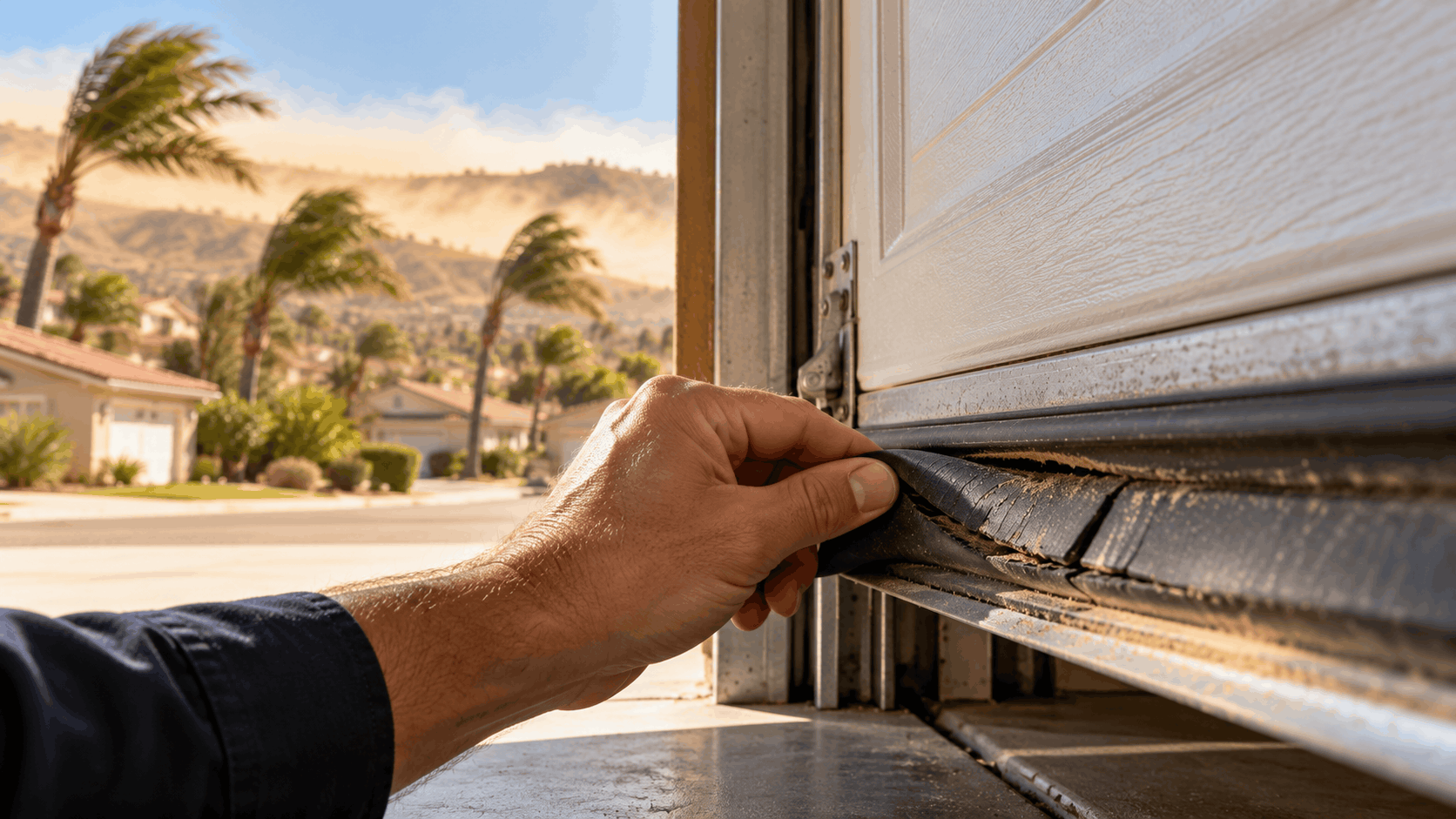
Drive the northeastern edge of Tustin Ranch on a gusty afternoon and you can watch it happen. Wind pours off the open land around Peters Canyon Regional Park, picks up dust and bark, and drops it against the garages facing the park. The homes on those streets take the brunt of it, and their garage door seals and struts show it first.
What that wind does is not dramatic. Grit works its way into the bottom seal so the rubber no longer flattens against the slab. Debris coats the side and top weatherstripping. Leaf litter packs into the tracks. None of it happens overnight, but it adds up to a door that lets in drafts, light and dirt, and sometimes one that reverses for no reason anyone can see.
Why Peters Canyon Winds Reach Tustin Ranch Garages?
Tustin Ranch sits in ZIP code 92782, framed by Jamboree Road, Tustin Ranch Road, Portola Parkway and Irvine Boulevard. The northeastern corner of the community runs right up against open parkland, and that is where the exposure is highest. The interior tracts, tucked between the main roads, sit behind rows of homes that break the wind before it reaches them.
Tustin Ranch wind is not a special weather event. It is the ordinary movement of air across a large stretch of undeveloped land that then meets a wall of houses. The first row of garages facing that open space catches what the land carries, which on these streets means dust, grit and plant debris lifted off the canyon and the parkways.
The homes most affected are the ones on the park edge. Understanding where you sit in the community tells you a lot about how often your seals and tracks need attention. A home three streets in sees far less than a home that looks out over Peters Canyon.
The 340-Acre Park on the Northeastern Edge
Peters Canyon Regional Park is a 340-acre park at the northeastern edge of Tustin Ranch. It is coastal scrub, marshes and meadows, with native sycamores, black willows and cottonwoods ringing Peters Canyon Reservoir. Trails cross it for hikers, mountain bikers and equestrians, and the land stays open rather than built.
Open space like this is exactly what lets wind build and carry. There are no houses or dense structures across most of the park to slow the air or catch the material it picks up. So wind off the canyon arrives at the nearest garages still carrying the dust and plant debris it gathered on the way.
That is the mechanism behind most of the seal complaints on these streets. The wind itself is harmless to a garage door. What it carries is the problem, because fine grit and bits of bark are abrasive and they settle into every gap and channel the door has.
Homes on the park edge take wind off the canyon plus dust and plant debris from the open space. That is why seals, struts and track cleanliness come up more often on those streets than on the interior tracts, where the same door in the same year of build simply does not collect as much.
Which Streets Catch the Most
Position matters more than anything else here. A garage facing the park edge sits in the direct path of what the open space sends its way. A garage on an interior street between Jamboree Road and Irvine Boulevard is shielded by everything in front of it, so it gathers far less.
This is about exposure, not about one door being built worse than another. Two identical doors, installed the same week by the same builder, will age differently depending on where they sit. The park-edge door collects more grit and debris simply because more of it arrives.
We keep that in mind when a homeowner on the edge calls about a seal that is already failing while a neighbor a few blocks in has no complaints. The difference is usually the wind path, not the product. The fix is the same, but the park-edge home tends to need it sooner and may need it again.
If you live on one of these streets, it helps to think of seal and track care as regular upkeep rather than a one-time repair. The exposure does not stop, so staying ahead of it is the practical approach. You can read more about ongoing care on our maintenance and upgrades page.
Eucalyptus and the Debris That Rides the Wind
The community uses a single plant palette along its spine, and informal eucalyptus plantings run down from the hillside along the parkways into the neighborhoods. Those trees tie the individual tracts together visually, but they also shed. Eucalyptus drops bark and leaf litter steadily, and plenty of it.
On the streets those trees line, wind carries that bark and leaf litter straight into driveways and door tracks. It is the same mechanism we see in Northwood over in Irvine, where parkway trees feed debris into the hardware below them. The litter does not stay on the ground. It gets lifted and moved.
Once bark and leaf fragments reach the door, they settle into the tracks and press against the seals. Bark in particular is fibrous and holds together, so it wedges into the roller path and the bottom channel rather than blowing straight through. That is why clearing debris is part of nearly every seal and track job on these streets.
So the picture on a park-edge, eucalyptus-lined street is two sources at once. Wind off the canyon brings dust and grit, and the parkway trees add bark and leaf litter. Both end up in the same places on the door, and both work against the seal and the smooth travel of the rollers.
Get Your Free Quote
Tell us about your garage door and we'll get back to you within 30 to 60 minutes.
What Wind-Borne Grit Does to a Garage Door Seal
A garage door seal is simple in design and it depends on contact. The bottom seal is a strip of flexible rubber or vinyl that flattens against the concrete when the door closes, closing the gap along the slab. The side and top weatherstripping does the same against the jamb and header. When that contact is clean and complete, the door keeps out drafts, water and debris.
Wind-borne grit breaks that contact. Fine dust and plant debris pack into the seal and the channels that hold it, and the rubber loses its ability to flatten and compress. Once that happens, the seal no longer meets the surface it is supposed to meet, and gaps open up.
Here is how the different parts of the seal fail and what each failure looks like from the driveway.
| Part of the seal | What the grit does | What the homeowner sees |
|---|---|---|
| Bottom seal (astragal) | Grit packs in so it stops flattening against the slab | Light under the closed door, leaf litter inside, drafts along the floor |
| Side weatherstripping | Debris coats the retainer so the strip stops meeting the jamb | Gaps along the sides, dust streaks on the inner wall |
| Top seal | Debris coats the top retainer and the strip stops sealing the header | Light or draft along the top edge of the door |
Grit Packs Into the Bottom Seal
The bottom seal does the hardest work on any garage door because it has to conform to the concrete, which is rarely perfectly flat. When the door closes, the rubber is supposed to squash down and fill every low spot along the slab. That is what keeps the floor line tight.
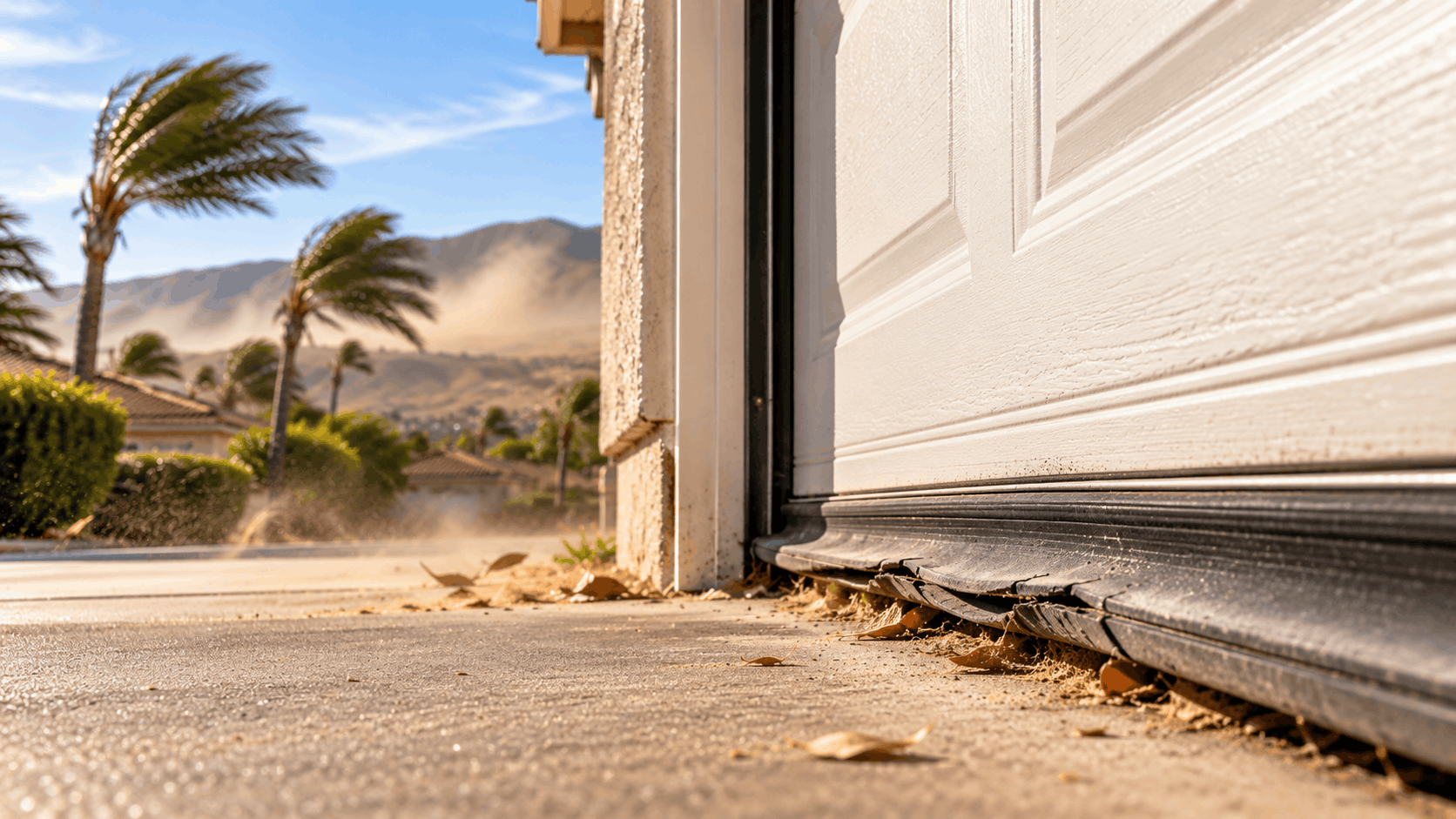
Wind-driven dust and plant debris pack into that bottom seal and into the retainer that holds it. As the grit builds up, the rubber can no longer flatten the way it did when it was new and clean. It stays stiff and partly open, and a gap appears along the slab.
Once that gap exists, everything the wind is already carrying has an easy way in. More dust, more leaf litter, and water when it rains all find the opening. The seal that was meant to keep the garage closed off becomes the weakest point.
Replacing worn bottom weatherstripping restores the flatten-and-compress action, and clearing the retainer of packed grit is part of doing it right. On park-edge homes we often find the seal is not torn so much as clogged and compressed past its useful shape. Our weatherseal and insulation retrofit service covers this directly.
Side and Top Weatherstripping
The side and top weatherstripping seals the door against the frame rather than the floor. It sits in retainers along the jambs and the header, and it works the same way the bottom seal does, by pressing a flexible strip against a fixed surface. When it is clean, the door closes into a continuous seal all the way around.
Wind-driven debris coats the side and top retainers and the strips they hold. Fine grit builds up where the strip meets the frame, and over time the strip stops making full contact. The material also stiffens and cracks with age, which the grit accelerates by working into every small split.
What a homeowner sees is light and draft along the sides and the top of a closed door. On a bright day you can stand inside the closed garage and see daylight tracing the edges where the strip has stopped sealing. Dust streaks often appear on the inner wall near those gaps.
The fix is to clean the retainers and replace the weatherstripping where it has hardened or pulled away. On a door that still runs well mechanically, this is often all that is needed to stop the drafts and the dirt, and it is a far smaller job than replacing the door itself.
The Signs You Can See From the Driveway
You do not need any tools to spot a failing seal. The clearest sign is light under a closed door, visible along the bottom edge when you look at it from inside the garage on a sunny day. A tight seal shows no light. A gap shows a bright line.
Drafts are the next tell. If you feel air moving along the floor or the edges when the door is shut, the seal is not meeting its surface anymore. On the windy park-edge streets, that draft often carries a little dust with it, which you can feel and sometimes smell.
Leaf litter inside the garage is a plain giveaway. If bark and dried leaves are collecting on the floor near the door with the door closed, something is getting past the seal. That is common on the eucalyptus-lined streets where there is plenty of litter to get in.
Finally, look at the seal itself. A healthy bottom seal compresses visibly when the door closes. One that stays rounded and stiff, or that is split and packed with grit, has stopped doing its job. These are the plain tells a neighbor would point out, and any one of them is worth a closer look.
Need Help in Irvine?
Urgent Garage Doors serves Irvine and all of Orange County.
Struts, Tracks and the Rest of the Door in Canyon Wind
Seals are the most visible casualty of canyon wind, but they are not the only one. The same debris that clogs the seal gets into the tracks and onto the moving parts, and it changes how the door runs. A door that drags, shudders or reverses often has debris in the system rather than a broken component.
Struts, tracks and rollers all depend on clean, smooth travel. When grit and bark pack into the places they move, the door works harder, and parts that are already near the end of their service life give out sooner. On the homes near the man-made lakes, humidity adds corrosion to the mix.
The point is to look at the whole door, not just the one part that is obviously failing. Clearing the tracks and checking the hardware together is how a repair actually holds, rather than coming back in a few weeks as a new problem.
What Struts Do and Why Wide Doors Need Them
A strut is a horizontal reinforcing bar fixed across the back of a door section. Its job is to keep a wide panel from flexing and sagging as the door lifts and lowers. The wider the door, the more it wants to bend in the middle, and the more it needs struts to stay rigid.
Tustin Ranch has three-car garages on the larger tracts, and those wide doors rely on struts to run true. A heavy, wide door without adequate reinforcement will bow, and that bowing throws the rollers off their line in the track. So strut condition and track alignment are tied together on these doors.
On park-edge streets, strut and track questions come up more because the debris that collects there works against smooth travel. When a door already carries the weight of a three-car span, any added drag from grit in the tracks shows up faster as uneven or noisy operation.
When we service a wide door on these streets, we check that the struts are sound and properly fastened along with the track line. A loose or bent strut, or a door flexing because it never had enough reinforcement, is worth catching before it bends a panel or pulls a roller out of the track.
Debris in the Tracks
The tracks guide the rollers, and they need to stay clear for the door to run smoothly. On eucalyptus-lined streets, bark, leaf litter and grit pack into the tracks steadily. Bark is the worst offender because it is fibrous and wedges in rather than falling out.
When debris builds up in the track, the rollers cannot travel cleanly. They catch, drag or skip, and the door runs rough, noisy or uneven. In bad cases the roller rides up on packed debris and starts to come off its line, which is how a door ends up off track entirely.
This is why clearing the tracks is part of the fix, not an optional extra. Replacing a roller or adjusting tension does nothing if the track is still full of bark and grit. The debris has to come out first, and the track has to be checked for the dents and bends that rough running can cause over time.
If the tracks are bent or pulled out of alignment from debris and rough travel, they need to be straightened or realigned. Our track repair and realignment service handles that, and we pair it with a roller check so the door runs quietly afterward.
Humidity Near the Lakes and Corrosion
Nearly all the communities in Tustin Ranch surround the Tustin Ranch Golf Club, an 18-hole course opened in 1989 and dotted with several man-made lakes. Those lakes add local humidity for the homes closest to them. It is a small effect over a short distance, but it is real for the nearest streets.
Humidity does one thing to garage door hardware: it feeds corrosion. Metal springs, cables and rollers corrode in damp air, and corrosion brings a part to the end of its cycle rating earlier than it would reach it in dry conditions. The spring still has its rated cycle life, but rust shortens how many of those cycles it actually survives.
A torsion spring is rated in cycles, commonly around 10,000 for a standard spring, where one cycle is a full open and close. A door used four times a day reaches that in roughly seven years. Corrosion on a lakeside street means the spring may give out before it hits its rated number, because rust weakens the steel.
The same is true for cables and rollers near the lakes. Corroded cable frays from the outside in, and a corroded roller binds and drags. When we service a home close to the water, we look at all of it together, because replacing a corroded spring while leaving a corroded cable in place invites a second failure soon after.
Debris on the Photo-Eye Lenses
Every modern opener has photo eyes mounted on each side of the opening, no higher than six inches off the floor. They send an invisible beam across the doorway, and if anything breaks that beam while the door is closing, the door stops and reverses. It is the non-contact safety system required on openers manufactured for the United States after January 1, 1993.
Those lenses sit low, right where wind-carried dust settles. On park-edge and eucalyptus-lined streets, fine grit coats the lenses, and once enough builds up it blocks or scatters the beam. The opener reads that as an obstruction and refuses to close, or reverses partway down.
This is the most common cause of a door that reverses for no visible reason. There is nothing in the doorway, nothing wrong with the opener, and yet the door backs up every time. Nine times out of ten on these streets, a dusty lens or a sensor knocked slightly out of alignment is the answer.
Wiping the lenses clean and checking that the two eyes point straight at each other often solves it on the spot. If the sensors have drifted out of alignment or a wire has worked loose, our safety sensor alignment and repair service sets them right.
A Simple Test Routine for Park-Edge Homeowners
There are three safe tests any homeowner can run to catch seal, sensor and balance problems early. They take a few minutes, need no tools beyond a scrap of lumber, and they tell you whether the door is working the way it should. On the windy park-edge streets, running them every so often is worth the time.
These are general safety checks that the manufacturers themselves recommend. They do not involve touching anything dangerous, and they catch the problems that canyon wind tends to cause. If a door fails any of them, that is the signal to look closer or call for service.
Here is the routine, one test at a time.
The Photo-Eye Test
With the door closing, break the beam with an object and the door must stop and reverse. Press the button to start the door down, then wave a broom handle or a box through the beam path near the floor. A working system reverses the door immediately.
This test matters most on park-edge streets because wind-coated lenses are exactly what causes it to fail. If the door does not reverse when you break the beam, the first thing to check is whether the lenses are dirty. A quick wipe often restores the response.
If the lenses are clean and the door still will not reverse, the sensors may be out of alignment or wired wrong. That is not a seal problem, it is a safety system fault, and it needs attention because the auto-reverse is the feature that protects a child or a pet in the doorway.
Running this test after a windy stretch is good practice near the canyon. The dust does not announce itself, and a door that quietly stops reversing has lost a safety function you want working. A thirty-second check catches it.
The Two-by-Four Test
Lay a 2x4 flat across the opening, directly under the door in its closing path. Close the door with the opener. When the door contacts the board, it must reverse within two seconds. This is the contact-reverse test, and it confirms the door senses an obstruction by force.
This is a separate safety system from the photo eyes. The photo eyes catch something in the beam before contact. The contact reverse catches something the door physically touches. Both are required, and both need to work. The 2x4 test checks the second one.
If the door does not reverse within two seconds of hitting the board, or if it keeps pushing down, the force setting or the opener itself needs adjustment. A door that will not reverse on contact is a safety hazard, because it will keep closing on whatever is in its way.
Using a flat 2x4 gives a consistent height to test against. Do not use anything you care about, since the point is to let the door hit it. If the door passes, both safety systems are doing their jobs, and that is one less thing to worry about on a windy street.
The Balance Test and What It Rules In or Out
The balance test separates a spring problem from an opener problem, and it is the most useful diagnostic a homeowner can run. Pull the release cord to disconnect the door from the opener, then raise the door by hand to about waist height and let go. A correctly balanced door stays put.
If the door holds its position, the springs are carrying the weight the way they should, and any trouble you are having is likely with the opener or the tracks. If the door falls or rises on its own, that is a spring problem, not an opener problem. The springs are no longer balancing the door's weight.
This matters near the lakes, where corrosion shortens spring life. A door that will not hold position after a few years on a humid street is a classic sign the springs have reached the end of their useful cycle life early. The balance test catches it before the spring fails completely.
Here is the one firm rule: springs are the one thing an owner must not touch. A torsion spring stores enough energy to cause serious injury and is wound with bars against a fixed cone. Run the balance test to diagnose, then call a professional. Our door balancing and tension adjustment service handles the part you should never attempt yourself.
Why the Build Era Makes This Matter in Tustin Ranch?
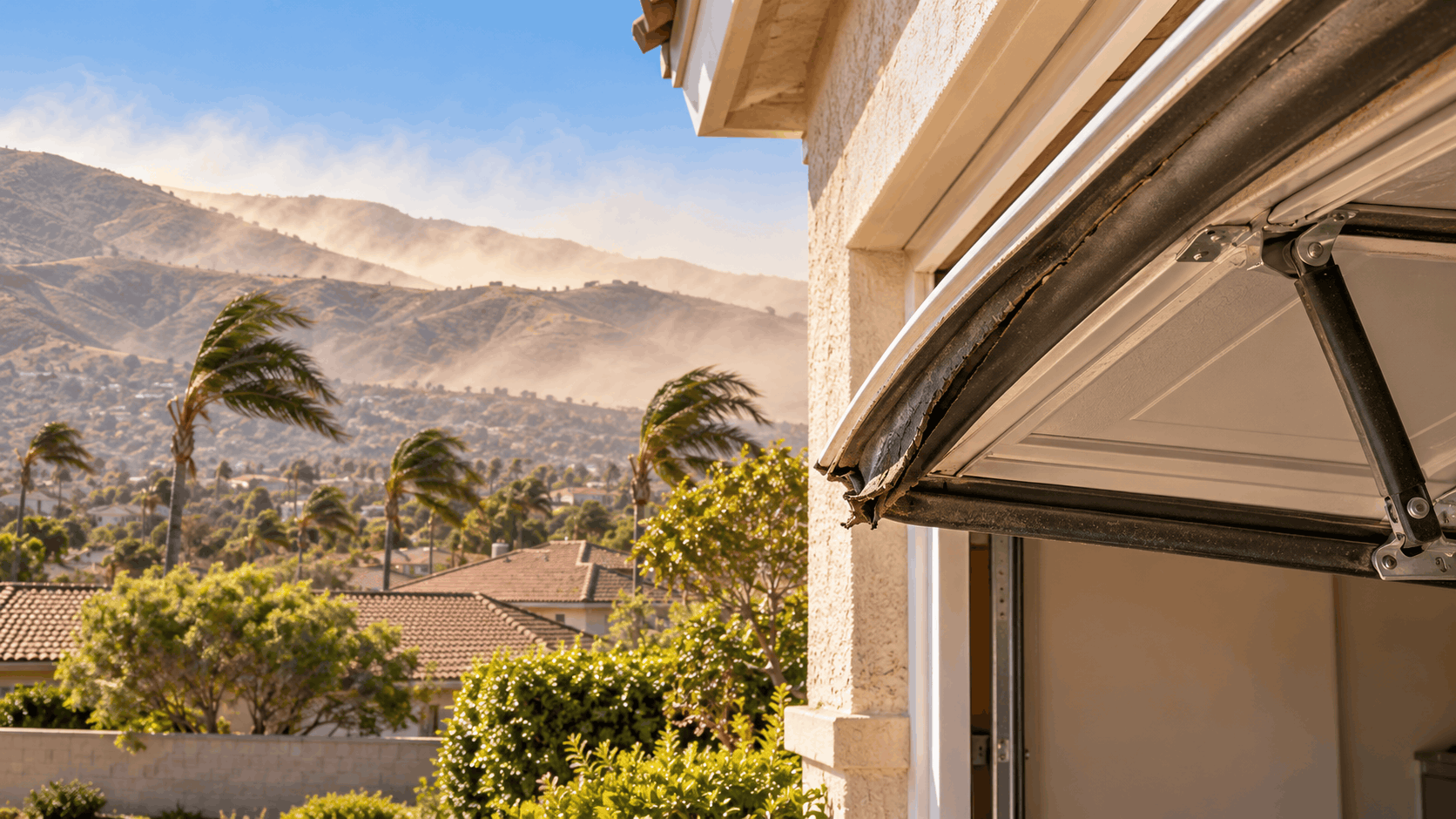
Canyon wind would be a slow nuisance on new construction. In Tustin Ranch it lands on housing that is mostly thirty to forty years old, which changes everything. The seals, struts and hardware taking the wind are already at or past their design life across whole tracts at once.
This is the single most useful fact about door work in this community. In newer Irvine villages like Portola Springs or around the Great Park, most calls are first-failure maintenance on young hardware. In Tustin Ranch, the wind exposure meets parts that were due for attention anyway, so the two problems arrive together.
Knowing the history explains why so many doors here need seal and hardware work at the same time, and why it tends to roll through a neighborhood rather than hitting one isolated house.
A Citrus Ranch Turned Planned Community
Tustin Ranch was historically part of the Irvine Ranch and was a citrus ranch before the 1980s. The Irvine Company decided to build the planned community in 1982, the County of Orange approved it for construction in 1986, and the city annexed it to Tustin in 1986, forming the 92782 ZIP code.
Although no citrus remains on the plan, almost all the community streets are named after components of the former ranch. That naming is the quiet reminder of what the land was. The homes went up where groves once stood, and the development replaced farming with a master-planned neighborhood.
That origin sets the timeline that matters for door work. The community was created on a specific schedule, and the housing followed in a concentrated stretch rather than trickling in over many decades. Whole tracts share a build year, which means they share an age.
When a community is built in waves like this, its hardware ages in waves too. The doors, springs and openers installed across a tract during the same construction year all approach the end of their service life around the same time. That is why seal and spring calls cluster on these streets.
Thirty to Forty Year Old Doors and Seals
Development ran primarily through the late 1980s and 1990s, with some infill continuing into the 2000s. That puts the bulk of the housing at thirty to forty years old today, and with it the original doors, springs, cables, track and openers where they have not already been replaced.
Seals and weatherstripping do not last that long. Rubber and vinyl stiffen, crack and lose their flexibility over decades, and a seal that old has usually hardened well past the point of flattening against the slab. The canyon grit simply finishes off a seal that was already near done.
The same is true for the retainers, the rollers and the springs behind the door. A standard spring rated around 10,000 cycles reaches that number in roughly seven to twelve years for a typical household, so a thirty to forty year old door is often on its second or third set, or overdue for one.
This is why wind exposure in Tustin Ranch lands on parts already due for attention. The fix usually means more than swapping a seal. It means looking at the whole door, because the seal failing is often the first visible sign of hardware that is all reaching the same point at once.
Mission Revival Facades and Seal Choices
The housing here is contemporary Mission Revival and Mediterranean in character, mostly built in the 1990s. Warm colors, red-tiled roofs, stucco facades and small front patios define the look, on curved streets lined with palms, pines and lemon-scented gum trees.
A garage door on these streets has to read right against warm stucco under red tile. It is the same matching problem we handle in Westpark over in Irvine, rather than the painted-wood look of a place like Woodbridge. A panel profile that reads wrong against a Mission Revival elevation is the usual reason an association submission comes back.
A seal replacement does not change the appearance of the door, so it does not raise the same architectural question. But a full door replacement does, and the color and panel style have to suit the elevation. That is worth knowing before you decide between fixing the seal and replacing the whole door.
The housing also ranges from townhomes and condominiums through single-family homes to golf course estates, so door size, weight and price vary enormously inside one community. A seal on a condo door and a seal on a three-car estate door are different jobs, which is why a price depends on the specific garage.
Need Help in Irvine?
Urgent Garage Doors serves Irvine and all of Orange County.
What a Seal and Strut Repair Actually Costs Here?
The jobs that solve canyon-wind seal and strut problems fall into a handful of typical Orange County ranges. These are market ranges for the area so a homeowner knows what to expect. They are not a quote, and the actual price for a specific garage is given in writing before work begins.
Where a home sits changes which jobs it needs. A park-edge home may need only a seal and track cleaning. A lakeside home with corroded hardware may need spring and cable work on top. Here are the ranges that apply to each piece of the problem.
| Job | Typical Orange County range |
|---|---|
| Weatherseal and insulation retrofit | $150 to $400 |
| Track repair and realignment | $125 to $300 |
| Safety sensor alignment and repair | $75 to $150 |
| Torsion spring replacement | $150 to $300 |
| Cable repair | $150 to $300 |
| Preventive maintenance visit | $99 to $149 per visit |
Weatherseal and Insulation Retrofit
Replacing worn seals falls under the weatherseal and insulation retrofit range of $150 to $400. This is the main job for the drafts, light and leaf litter that canyon wind causes, and for most park-edge homes it is the whole fix.
What moves the number within that range is the door and the scope. A single-car door needing only its bottom seal sits at the lower end. A wide three-car door needing bottom, side and top weatherstripping, with retainers cleaned or replaced, sits higher. The size and the amount of material drive it.
Insulation work, if it is included, also affects the figure. Some homeowners pair a seal retrofit with insulation where the garage is used as a workshop or shares a wall with living space. That adds material and labor to the job.
Because the door and its condition decide the price, the written figure comes after we see the door. The range tells you the territory, and the specific number reflects your actual garage. Our weatherseal and insulation retrofit page covers the service.
Track Repair, Realignment and Sensor Alignment
When debris in the tracks has bent or misaligned them, track repair and realignment runs $125 to $300. This addresses the rough, noisy or uneven travel that packed bark and grit cause, and it includes straightening or realigning the track so the rollers run true again.
Coated photo-eye lenses fall under safety sensor alignment and repair at $75 to $150. This covers cleaning the lenses, realigning the two sensors so their beam lines up, and fixing a loose wire or connection where that is the cause of a door reversing for no visible reason.
These two jobs often come up together on park-edge and eucalyptus-lined streets, because the same wind-carried debris that packs the tracks also coats the sensors. Clearing both at once is efficient and leaves the door running and sensing the way it should.
Which job your door needs depends on what the debris has done. A track that is only dirty needs cleaning, which is minor. A track that has been bent by rough travel needs realignment, which is the service range above. The inspection tells us which.
When Corrosion Reaches the Springs and Cables
For homes near the lakes, where humidity feeds corrosion, torsion spring replacement runs $150 to $300 and cable repair runs $150 to $300. Corrosion brings these parts to the end of their cycle rating earlier, so lakeside homes see spring and cable work sooner than drier streets.
A torsion spring is sized to the actual weight and height of the door, so the replacement is matched to your door rather than a standard part pulled off a shelf. On a heavier three-car door, the spring is sized accordingly, which is part of why the range exists.
The important point is that springs and cables wear together. Replacing a corroded spring while leaving a corroded cable in place invites a second failure weeks later, when the cable frays or snaps. That is why we inspect cables whenever we replace a spring.
Both jobs are covered under our spring and cable repair service. On a lakeside home showing corrosion, it is worth having both looked at together so the repair holds rather than coming back as a new problem.
Preventive Maintenance to Stay Ahead of the Wind
On streets with steady wind exposure, a preventive maintenance visit at $99 to $149 per visit is the practical way to stay ahead of the problem. Rather than waiting for a seal to fail or a door to reverse, a scheduled visit catches the buildup before it causes trouble.
Each preventive maintenance visit includes a written report of what was found and what is recommended. That report tells you the condition of the seals, tracks, rollers, cables, springs and sensors, so you know what is holding up and what is nearing the end of its life.
For a park-edge or lakeside home, that report is worth having because the exposure is ongoing. Knowing a spring is corroding or a seal is close to done lets you plan the work rather than face it as an emergency on a day the door will not close.
The visit is a small cost against the larger repairs it heads off. Our preventive maintenance plan is built for exactly this kind of ongoing exposure, and it keeps the whole door on your radar instead of just the part that failed last.
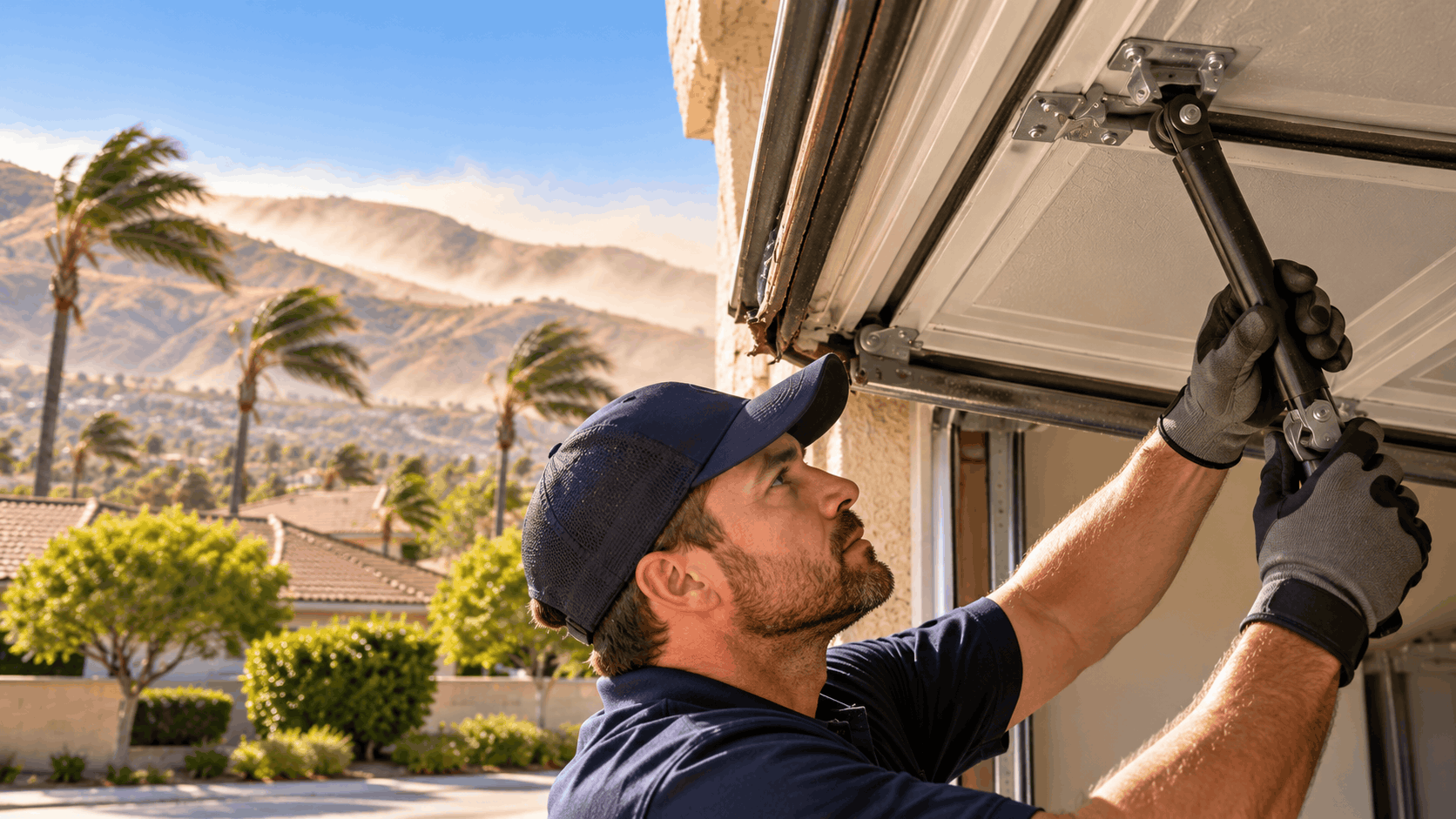
Approvals and Permits Before Any Door Work in Tustin Ranch
Door work in Tustin Ranch runs on two separate tracks, and clearing one does not clear the other. There is community association architectural review, and there is a city building permit. Plus there is the licensing that applies to whoever does the work. A seal or strut repair is far simpler on this front than a full door replacement, but it helps to know how the tracks run.
For a seal, a track realignment or a sensor repair, neither track usually comes into play, because nothing structural changes and the door's appearance stays the same. For a full door swap, both can apply. Here is how each one works.
Which Association Covers the Address
Tustin Ranch is governed by community associations rather than one single village body. Named associations include the San Miguel Community Association among others, and each has its own architectural review and CC&Rs. HOA dues and Mello-Roos special taxes are both standard throughout the area.
The first practical step on any visible door job is identifying which association covers the address. The approved palette, the panel styles and the submission route all change from one association to the next, so the answer depends entirely on where the home sits.
Several gated communities sit inside Tustin Ranch, which adds a scheduling variable. Contractor clearance and gate access have to be arranged before a crew can get to the door, so we account for that when we book a job on those streets.
A seal or strut repair does not change the street-facing look of the door, so it is a different matter from a full door swap. The association question weighs most heavily when you are replacing the door itself, which is when the panel profile and color have to match the approved palette.
The City of Tustin Permit Track
Association approval does not clear a city permit, and the two are decided separately. The City of Tustin Planning Division can be reached at 714-573-3140, and permits and inspection requests run through the EnerGov CSS portal. The permit position is confirmed by the city for the specific address.
Structural work, such as widening an opening or altering the header, is generally what triggers a permit. A like-for-like repair or replacement that does not touch the structure is a different situation, and the building department is the authority on any given job.
A seal or strut repair is not structural work. It replaces worn weatherstripping or reinforces a panel without changing the opening or the framing, so it does not raise the kind of question a permit addresses. The heavier permit questions come up with structural changes, not routine seal and hardware work.
For any job where you are unsure, the city with jurisdiction confirms the position for your specific address. We can point you to the right office, but the building department has the final word on whether a given job needs a permit.
Licensing for Garage Door Work
Garage door work in California is licensed by the Contractors State License Board under classification C-61/D-28, Doors, Gates and Activating Devices. That scope covers sectional and rolling doors, torsion and extension spring systems, operators, control boards, safety sensors and activating devices. C-28 is Lock and Security Equipment and is not the garage door license.
A license is verified free at cslb.ca.gov, where classification, status, bond and workers compensation are all public record. Urgent Garage Doors holds California license #1055150. Checking a contractor's license before work starts is a simple step worth taking.
The unlicensed-work exemption in Business and Professions Code section 7048 was raised from $500 to $1,000 by AB 2622, effective January 1, 2025. The exemption also fails if the work requires a building permit of any kind or if the person employs anyone on the job, and a job cannot be split into smaller slices to stay under the figure.
A separate rule is often confused with it. Business and Professions Code section 7159 requires a written home improvement contract for work over $500. That is a contract requirement, not a licensing threshold, and the two sit at different figures for different reasons.
Need Help in Irvine?
Urgent Garage Doors serves Irvine and all of Orange County.
How Our Team Handles Seal and Strut Work in Tustin Ranch
When we take a seal or strut call on the park-edge streets, we treat the whole door as the patient, not just the part that prompted the call. Canyon wind and the community's build era mean the visible problem is usually one of several that are close together, and handling them as a group is how the repair holds.
Here is how a job runs, from the inspection to the written price, drawing on how our team actually works these neighborhoods.
Inspecting the Whole Door, Not Just the Seal
We start by checking the seals, struts, tracks, rollers, cables and photo eyes together. A failing seal on a thirty-year-old door often sits alongside stiff rollers, a corroding cable or a sensor that has drifted, and finding all of it in one visit prevents a second failure weeks later.
This matters most near the lakes, where corrosion works on several metal parts at once. Replacing a spring while ignoring a frayed cable is how a homeowner ends up calling again soon after. We look at the cables whenever we touch the springs, every time.
The inspection is also where we separate a seal problem from a spring problem, using the same balance check a homeowner can run. If the door will not hold position, the springs are the issue, and we tell you that plainly rather than selling you a seal that will not fix it.
For new door installations, we offer a free on-site estimate, and removing and hauling away the old door is included in a new door installation. On a repair, the inspection tells us exactly what the door needs so there are no surprises later.
Truck Stock and Same-Visit Repairs
Our trucks carry common torsion spring sizes, so a spring replacement is often completed on the same visit. On a lakeside home where corrosion has brought a spring to the end of its cycle life, that means the door is frequently back in service the same day rather than waiting on a part.
We cannot promise every job finishes on the first visit, because an unusual door size or an uncommon part may need to be ordered. But for the routine spring, seal and track work that canyon wind and build era produce in Tustin Ranch, the parts are usually on the truck.
Carrying stock also means the inspection can turn into the repair in one trip when you want it to. If we find a corroded cable alongside a tired spring, we can often address both while we are there rather than scheduling a return.
Each preventive maintenance visit includes a written report of what was found and what is recommended. That report is yours to keep, and it gives you a clear picture of the whole door's condition so you can plan the next step on your own timeline.
Response Window and Written Price
We take emergency calls and respond 24 hours a day, 7 days a week, every day of the year including holidays. The response window is 30 to 60 minutes anywhere in Orange County, so a door stuck open on a windy night does not have to wait until morning.
A written price is available before work begins, and we provide it when the job calls for it or when you ask. That way you know the number before any tools come out, and it reflects your actual door rather than a general estimate over the phone.
Separately, California Business and Professions Code section 7159 requires a written home improvement contract for work over $500. That is the law, and it sits alongside our own practice of giving you a clear price up front.
For the full picture on a stuck or damaged door, our emergency garage door repair service covers the park-edge streets and the rest of Tustin.
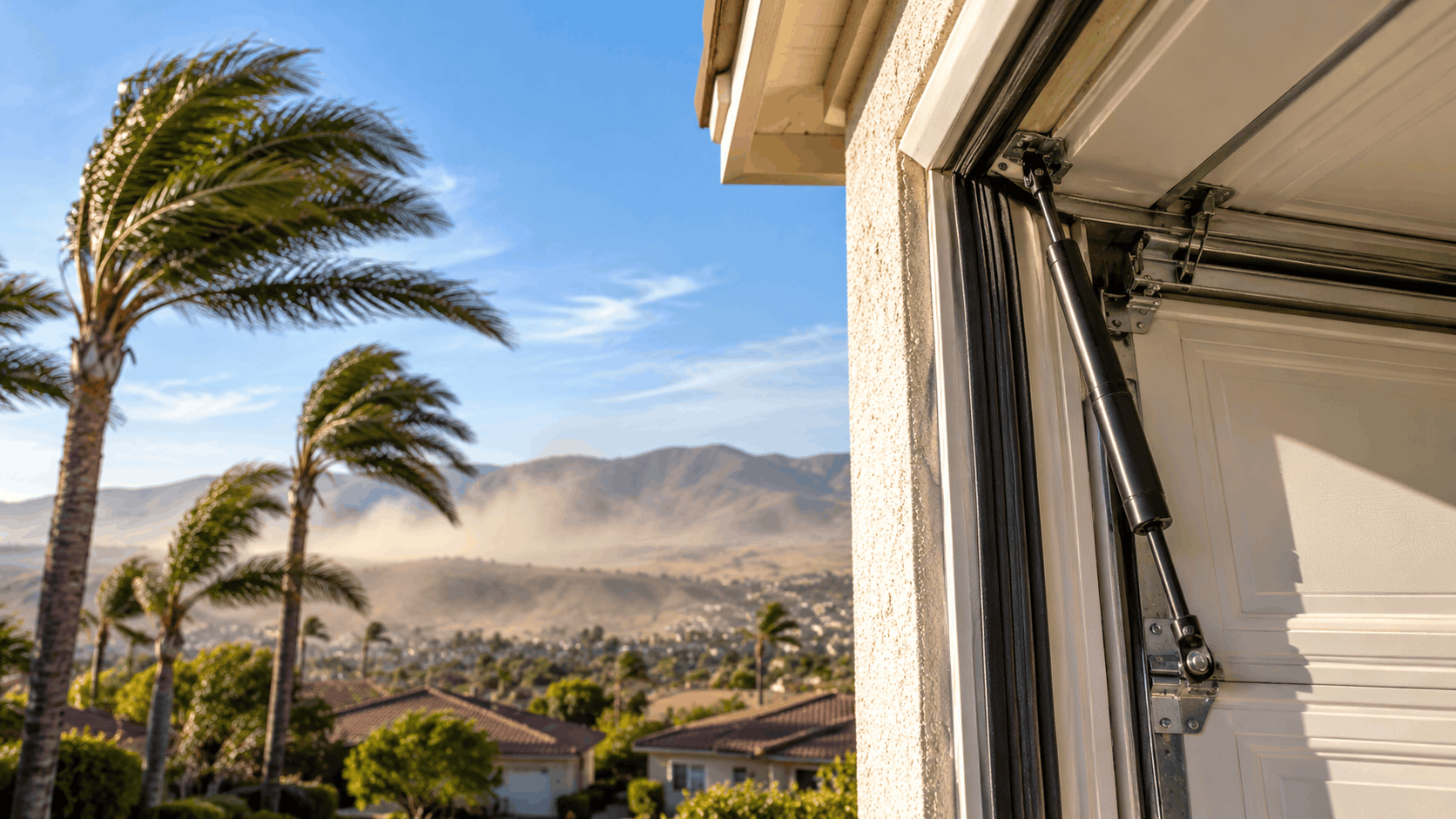
Keeping the Wind Out of Your Garage
If drafts, light under the door or leaf litter inside the garage have shown up on your park-edge or lakeside street, our team inspects the whole door, gives you a written price before work starts, and carries common springs on the truck so many repairs finish the same visit. Call Urgent Garage Doors at (949) 529-7743 to get a seal, track or spring issue looked at.
Frequently Asked Questions
- Why is my Tustin Ranch garage door letting in drafts and leaf litter?
- Wind off Peters Canyon carries dust and plant debris that pack into the bottom seal, so the rubber stops flattening against the slab and a gap opens along the floor. That same debris coats the side and top weatherstripping until it no longer meets the frame. Drafts, light under a closed door and leaf litter collecting inside are all signs the seals have stopped sealing and need replacing.
- What does a weatherseal replacement cost near Peters Canyon?
- Weatherseal and insulation retrofit runs $150 to $400 as a typical Orange County range, not a quote. Where your door lands within it depends on size and scope, with a single bottom seal at the low end and a wide three-car door needing bottom, side and top weatherstripping at the higher end. The actual written price for your specific garage is given before work begins.
- Why does my door reverse for no reason on windy days?
- Wind-carried dust coats the photo-eye lenses, which sit no higher than six inches off the floor, and a coated lens blocks or scatters the beam. The opener reads that as an obstruction and reverses the door even though nothing is in the way. Wiping the lenses often fixes it. If the sensors have drifted out of alignment, sensor alignment and repair runs $75 to $150.
- Do homes near the Tustin Ranch lakes have different problems?
- Yes. The man-made lakes around the Tustin Ranch Golf Club add local humidity for the closest homes, and humidity feeds corrosion. Corrosion brings springs, cables and rollers to the end of their cycle rating earlier, so lakeside homes tend to need spring and cable work sooner than drier streets in the same community. We inspect the cables whenever we replace a spring on these homes.
- Can I clean the tracks and seal myself?
- Clearing bark, leaf litter and grit from the tracks is reasonable owner upkeep, and keeping the photo-eye lenses wiped clean is fine too. But springs are the one thing an owner must never touch, because a torsion spring stores enough energy to cause serious injury. For diagnosis, run the 2x4 contact-reverse check and the photo-eye test, then call a professional for anything involving the springs.
- How do I know if it is a seal problem or a spring problem?
- Run the balance test. Pull the release cord to disconnect the opener, raise the door by hand to about waist height, and let go. A balanced door stays put, which means the springs are fine and your issue is elsewhere. A door that falls or rises on its own is a spring problem, not an opener or seal problem, and the springs need professional attention.
- Do I need HOA approval to replace my garage door in Tustin Ranch?
- Most associations treat a street-facing garage door as an exterior modification needing written approval before installation, and the covering association, such as the San Miguel Community Association among others, is confirmed per address. The approved palette and panel styles change by association. A seal or strut repair is a different matter from a full door swap, since it does not change the door's appearance.
- Is a permit required for garage door seal or strut work?
- The permit position is confirmed by the City of Tustin for your specific address through its Planning Division at 714-573-3140, with requests running through the EnerGov CSS portal. Structural work, such as widening an opening or altering the header, is generally what triggers a permit. A like-for-like seal or strut repair does not touch the structure, so it is a different situation from structural changes.
- What classification should a garage door contractor hold in California?
- The classification is C-61/D-28, Doors, Gates and Activating Devices, which covers sectional and rolling doors, spring systems, operators, control boards, safety sensors and activating devices. C-28 is Lock and Security Equipment and is not the garage door license. You can verify any contractor free at cslb.ca.gov, where status, bond and workers compensation are public. Urgent Garage Doors holds California license #1055150.
- How fast can someone come out for a stuck or damaged door?
- We offer 24/7 emergency service, every day of the year including holidays, with a response window of 30 to 60 minutes anywhere in Orange County. Our trucks carry common torsion spring sizes, so a spring replacement is often completed on the same visit rather than waiting on a part. A written price is available before work begins.
Licensed garage door repair professionals serving Irvine and Orange County.
Licensed in California · License #1055150
Why trust Urgent Garage Doors?
Founded in 2017, Urgent Garage Doors is a licensed and insured garage door services serving Irvine and Orange County. All content is reviewed by our licensed technicians.
Need Help in Irvine?
Urgent Garage Doors serves Irvine and all of Orange County.
Related Articles
Foothill Ranch Lake Forest Garage Door Service: Tract Home Service Plans
How garage door service plans work for identical-build tract homes in Foothill Ranch and Lake Forest, from matched maintenance to HOA-compliant repairs and local response.
Turtle Rock Garage Door Seals and Tracks Against Canyon Wind Off Bommer Canyon
Ridgeline wind off Bommer Canyon drives dust into Turtle Rock garage door seals and tracks. Here is why seals fail, how tracks drift on hillside lots, and how we fix it.
What Our Tustin Garage Door Calls Show About Old Town, the Ranch and Legacy
What our Tustin garage door calls reveal district by district, from Old Town approvals and North Tustin county permits to high-wear Tustin Ranch springs and the state rules behind every opener swap.