What a Quail Hill Master Association Garage Door Submittal Needs to Clear

Need Garage Door Help? Contact Us Now
Fast local service. Upfront pricing.
Get Your Free Quote
Tell us about your garage door and we'll get back to you within 30 to 60 minutes.
Key Takeaways
- A Quail Hill garage door change always needs written architectural approval from the Quail Hill Community Association before installation, because the Irvine Company planned the whole village under one design framework.
- Match the door to the specific enclave, not the village, since D.R. Horton, Shea Homes, Standard Pacific and William Lyon Homes delivered different door packages under the shared framework.
- Association approval does not replace a City of Irvine building permit; Irvine lists a same-dimension door exemption, but structural work like widening an opening or altering the header triggers a permit.
- Quail Hill is inside Irvine's 2025 Fire Hazard Severity Zone map, effective July 23 2025, so on a permitted project the door material, bottom seal and frame gaps become code questions tied to Chapter 7A and R327.
- SB 969 requires a battery backup on a replacement residential opener installed on or after July 1 2019, with a $1,000 civil penalty, and it is a legal requirement rather than an optional upgrade.
- Garage door work is licensed under C-61/D-28, not C-28 or a Class B general building license, and a license is verifiable free at cslb.ca.gov; Urgent Garage Doors holds #1055150.
- Open space and ridgeline wind send dust and debris into tracks and photo-eye lenses on edge and upper lots, so seal, material and cleaning choices matter more here.
- Typical Orange County door ranges run from $800 for a sectional replacement to $6,500+ for custom projects, with the written price given before work begins.
In This Article
A Quail Hill garage door submittal needs written architectural approval from the Quail Hill Community Association before any installation, along with confirmation of the city permit position for the specific address. That is the short answer, and it holds for every home in the village because Quail Hill was planned start to finish under one design framework. There is no enclave where the answer to who approves a door change is nobody.
Picture a homeowner on Shady Canyon Drive or over near Knollcrest who has finally settled on a new door after years of a tired, noisy one. The temptation is to call an installer and have it swapped next week. In Quail Hill that step comes after the association sees the plan, not before, and skipping it can mean taking a brand new door back down.

Why Quail Hill Always Has an Architectural Path
Every garage door change in Quail Hill runs through the master association, and that is a direct result of how the village was built. Development began in 2000 with the Irvine Company planning 100 percent of the homes under a single set of design guidelines. There was no second builder writing a competing rulebook, so the design control is uniform across the whole village.
That matters because in some Irvine neighborhoods the rules are a patchwork left by different builders. Quail Hill is not one of them. The framework is consistent, the controls are strict, and a door is one of the most visible exterior elements a home has.
So when an owner asks whether they really need approval for a door swap, the honest answer here is yes, every time. The architectural path exists by design, and the door installation should be planned around it.
One Master Plan, Strict Design Control
Development in Quail Hill began in 2000, and the Irvine Company planned all of the homes under strict design guidelines. That single-author approach sets the village apart from places like Northwood or Turtle Rock, where multiple builders delivered homes under their own rules over a longer span. In Quail Hill the look was controlled from the first grading permit forward.
Because of that, all homes sit within a mandatory homeowners association that holds controls over physical changes to private property. A garage door is private property, but it faces the street, and that combination puts it squarely inside the association's authority. There is no opt-out and no gray area about whether the rules apply to a given lot.
For a homeowner, this is actually helpful once you understand it. The design guidelines give a clear target, so a door that fits the framework tends to clear review more smoothly than a wildcard choice would. The work is defining what fits before the order is placed, not after.
The practical lesson is simple. Treat the design guidelines as the starting point for choosing a door, not as a hurdle to clear at the end. An installer who knows the village can help line up a door that reads correctly for the home before anything is submitted.
The Door Is a Street-Facing Exterior Change
Most Orange County master-planned communities treat a garage door as a street-facing exterior modification, and that classification is why written architectural approval is required before installation. A garage door is often the single largest flat surface a passerby sees on a home. Changing its style, material or color changes the streetscape the whole village shares.
Associations care about that because the collective appearance is part of what the community protects. A door that clashes with the surrounding elevations stands out immediately, and once it is up it is expensive to reverse. The submittal step is how the association keeps that from happening quietly, one house at a time.
This is the reason a submittal exists at all in Quail Hill. The door is not treated like an interior repair that nobody sees. It is treated like a visible, lasting change to the exterior, so it goes through a review before the first bracket is mounted.
For the owner, the takeaway is to build approval into the schedule from the start. The install date depends on the approval date, so the two have to be planned together rather than in sequence after the fact.
Who Governs the Village
The master association for the village is the Quail Hill Community Association, and it governs physical changes across Quail Hill. When a door submittal goes in, this is the body that reviews it against the design framework. Naming it plainly matters because owners sometimes assume there is no one to ask, and here there always is.
The City of Irvine itself advises owners to consult the homeowners association, which lines up with how the village works. The city handles permits and codes, the association handles the architectural fit, and both tracks can apply to the same door. They are separate reviews with separate purposes.
Owners should contact the Quail Hill Community Association directly to confirm its exact submittal requirements, forms and review timeline for their address. Those details can change, and the association is the authority on its own process. We can help prepare the drawings and product details the submittal usually calls for, but the approval itself comes from the association.
Get Your Free Quote
Tell us about your garage door and we'll get back to you within 30 to 60 minutes.
Matching the Door to the Enclave, Not the Village
The most common mistake owners make is treating Quail Hill as one uniform look. It is not. Several builders delivered homes under the shared Irvine Company framework, so elevations and door packages vary from enclave to enclave. A door that is perfect two streets over may be wrong for your elevation.
That is why the submittal has to match the replacement to the specific enclave, not to the village as a whole. The design framework is common, but the door style that reads as correct depends on which builder produced your tract and what package came with that elevation. Getting this right up front saves a rejected submittal later.
Several Builders, One Framework
Homes in Quail Hill were built by several well-known builders, including D.R. Horton, Shea Homes, Standard Pacific Homes and William Lyon Homes. All of them worked inside the same design framework, which keeps the village coherent, but each brought its own elevations and door packages to its tracts. The result is real variation in door style from one enclave to the next.
Because of that, matching the enclave matters more than matching the village. A carriage-style panel that suits one builder's elevation can look out of place on another's, even though both are in Quail Hill. The common framework sets the boundaries, but the builder's original package sets the baseline a replacement should respect.
This is where local knowledge earns its keep. Knowing which builder delivered your street, and what the original door looked like, tells you what the association expects to see. A door chosen on that basis has a far better chance of clearing review on the first pass.
For owners, the step is to identify the enclave and the original door package before shopping for a replacement. That single piece of information shapes the whole submittal and keeps the choice anchored to what belongs on the home.
What the Submittal Usually Shows
In general trade terms, an architectural submittal for a garage door presents the proposed door style, the material, the color, and how the door relates to the home's existing elevation. Associations want to see the door in context, not just a product photo. A clear picture of the home with the proposed door mocked up or described tells the reviewer what they need.
The material and color choices usually carry weight because they drive how the door reads from the street. A steel door finished to match the trim, a carriage-house look with decorative hardware, or a modern glass panel each send a very different signal. The submittal explains which direction the owner is taking and why it fits.
The association confirms its exact requirements for the specific address, so the smartest move is to ask what the submittal package must include before assembling it. Some reviewers want more detail than others, and the forms can change. Working from the current requirements avoids a resubmission.
We often help owners put the product details together, including the door model, material spec and finish, so the submittal reads cleanly. The clearer the package, the easier it is for the association to say yes without a round of questions.
Housing Range and Why It Changes the Door
Quail Hill homes range from just over 800 square feet to more than 5,000 square feet, spread across single-family homes and townhomes. That spread is wide, and it means the product type and size depend heavily on which enclave and home you are working with. A townhome door and a large single-family door are different projects.
The square footage of the home tends to track with the scale of the garage and the door opening. Larger homes often carry wider or taller openings, sometimes double doors, while townhomes may have a single standard opening. The submittal has to describe the actual door for the actual opening, not a generic size.
This range also shapes what styles look right. A door that suits a compact townhome elevation can look undersized on a large custom home, and vice versa. Matching the door to the home's scale is part of matching it to the enclave.
For the owner, the point is that there is no single Quail Hill door. The right choice depends on the home's size, the opening, and the enclave, and the submittal should reflect all three. A free on-site look at the opening is the fastest way to pin those down.
Choosing a Door That Fits the Opening and the Springs
A door choice is not only about looks. Springs are sized to the actual weight and height of the door, so a replacement in a heavier material needs springs matched to it rather than reuse of the existing set. Swap a light door for a heavy insulated one and the old springs will be undersized.
That connects straight to the submittal decision. If an owner picks a heavier carriage-house or custom door, the hardware behind it has to be sized to carry that weight. Torsion springs rated for the new door's weight keep it balanced and let the opener work the way it should.
Skipping this leads to real problems. An underpowered spring set strains the opener, wears faster toward the end of its cycle rating, and leaves a door that does not hold position. The right approach is to pick the door, then size the torsion springs and check the cables to match it.
So the submittal choice and the mechanical build go hand in hand. Choosing a door the hardware can carry is part of doing the job once. We size springs to the specific door and inspect the cables at the same time, since replacing a spring without checking cables is how a second failure follows.

Need Help in Irvine?
Urgent Garage Doors serves Irvine and all of Orange County.
The City of Irvine Permit Position for a Door Swap
Approval from the Quail Hill Community Association clears the architectural track, but it does not answer the city's question. The City of Irvine building department treats a door replacement under its own rules, and association approval does not substitute for a city building permit where one applies. These are two separate steps that both have to be handled.
Irvine does list an exemption for same-dimension door replacements, which covers many straightforward swaps. The limits on that exemption, and the point where structural work triggers a permit, are what owners need to understand before they assume no permit is needed.
The Same-Dimension Exemption
The City of Irvine lists an exemption for replacement windows and doors having the same dimension as those being replaced, where the work does not require any change to the structural frame or opening size. For a like-for-like garage door swap into the existing opening, that exemption is the relevant language. The door changes, the opening does not.
That exemption is not a free pass on everything, though. Even an exempt replacement must still conform to all technical codes and to city, county and state ordinances on weather proofing, security and energy efficiency. The door still has to meet the rules that apply to it, exemption or not.
So the exemption is about the permit paperwork, not about dropping standards. A door seated in the same opening, with proper weather sealing and compliant hardware, fits inside it. A door that forces any change to the opening size or structural frame falls outside it.
Owners in a mapped fire zone, which includes Quail Hill, should confirm with the building department rather than assume the exemption settles the question. The fire zone adds code considerations that can change the picture, which is covered further below.
When a Permit Gets Triggered
A building permit is generally required to erect, construct, enlarge, alter, repair, move, improve, remove, convert or demolish a building or structure. For garage doors, the usual trigger is structural work, not the door itself. Widening an opening or altering the header changes the structure, and that is what generally brings a permit into play.
Say an owner wants to turn two single openings into one wide double, or raise the header for a taller door. That is structural work on the opening, and it moves the project well past a simple swap. At that point the same-dimension exemption no longer applies and the permit question is live.
A straight replacement into the existing opening, with no change to the frame or header, is a different animal. The structure stays as it is and the door drops into the same space. That is the case the exemption is written for.
Because the position depends on exactly what the project touches, the city with jurisdiction confirms it for the specific job. In Quail Hill that is the City of Irvine. When a job widens an opening or alters the header, plan on the permit and the licensed work rules that come with it.
Approval and Permit Are Two Separate Steps
It bears repeating because owners conflate them: approval from the master association does not substitute for a city building permit where one applies. The submittal clears the association's architectural review. The permit question is answered by the City of Irvine building department. One does not cover the other.
The cleanest way to think about it is two tracks running at once. The Quail Hill Community Association reviews whether the door fits the village design. The city reviews whether the work meets code and needs a permit. A door project can pass one track and still owe the other.
For the permit side, owners can reach the City of Irvine Permit Processing Center at 949-724-6313 to confirm the position for their address and project. That number belongs to the city, not to us, and it is the right place to settle the permit question directly.
Handled together, the two steps are not a burden, just a sequence. Get the association submittal moving, confirm the city position, and the install lands inside both sets of rules. We coordinate our scheduling around both so the door goes up once, correctly.
Fire Hazard Zone Questions for Mapped Quail Hill Streets
Quail Hill sits inside a mapped fire hazard zone under Irvine's 2025 update, and that changes the door conversation on permitted projects. When the fire zone applies, the door material and seals stop being pure preference and become code questions. The submittal and the permit now interact with the zone rules.
This sets Quail Hill apart from flatter villages that were not added to the mapped zones. For owners here, it is worth understanding how the zone status touches a door project and when it actually bites.
Quail Hill Is Inside a Mapped Zone
In March 2025 the California Office of the State Fire Marshal released its updated Local Responsibility Area Fire Hazard Severity Zone map. Irvine adopted it without amendment by ordinance in June 2025, replacing the 2012 map, effective July 23 2025, with zones classified Moderate, High and Very High. That update expanded fire hazard zones into Quail Hill among other villages.
This is a real change from the prior map. Quail Hill is now inside a mapped zone, which sets it apart from Woodbridge, Northwood and University Park, which the city did not list in the expansion. A homeowner in Woodbridge is in a different position than one in Quail Hill on this point.
The hillside setting is part of why. Quail Hill is a hillside village wrapped by roughly 600 acres of open space, which is exactly the kind of wildland interface the map targets. The landforms that make the village attractive also put it on a wildfire exposure path.
Owners can check their own address on the OSFM Fire Hazard Severity Zone viewer or through the Orange County Fire Authority to confirm the zone class for their lot. The class matters, because the strictest construction requirements attach to the Very High zone.
What the Zone Means for the Door
A garage door is a large exterior opening sitting on a wildfire exposure path. On a permitted project in a mapped zone, that makes the material, the bottom seal and the gaps around the frame into code questions rather than style choices. The door is treated as part of the home's exterior defense.
Buildings in Very High zones use the fire-resistive features in California Building Code Chapter 7A and California Residential Code section R327, which cover materials and construction methods for exterior wildfire exposure. For a door, that focus lands on the opening itself. The concern is embers finding a way in through gaps or vulnerable materials.
The bottom seal and the frame gaps matter because embers are small and wind-driven. A seal that flattens tight to the slab and a frame with controlled gaps reduce the paths an ember can use. A well-fitted bottom seal does double duty here, keeping weather and debris out and closing a wildfire path.
So in a mapped Quail Hill zone, the submittal and the install should account for these details from the start. Choosing the material and seals with the zone in mind avoids a redo later. The exact requirements turn on the zone class, so they get confirmed for the address.
The Answer Depends on Address, Zone Class and Permit Date
The zone rules do not apply to every project uniformly. New construction or major renovation with a permit application dated after July 23 2025 in a 2025 fire hazard zone area must comply with the updated requirements. Earlier submittals remain under the 2012 map. The permit application date is the dividing line.
That means three things decide the answer for any given door: the address, the zone class, and the permit application date. A Very High zone lot with a post-July 2025 permit carries the full Chapter 7A and R327 considerations. A project that predates the effective date or sits outside a mapped zone is in a different position.
For a straightforward like-for-like swap that qualifies for the same-dimension exemption, the permit trigger may not fire at all. But in a mapped zone, that is exactly why the city advises confirming rather than assuming. The fire zone can add code questions even to work an owner expected to be exempt.
The way to settle it is to check the address and zone class with the City of Irvine building department or the Orange County Fire Authority, and to confirm the permit application date treatment for the specific project. We build those answers into the plan before ordering a door, so the material and seals match what the zone requires.
The Legal Rules That Ride Along With Any Replacement
Beyond the association and the city, a set of state rules apply the moment a door or opener is installed or replaced in Quail Hill. These are not Quail Hill rules and not fire-zone rules. They are statewide laws that land on any California door project, and they keep the submittal and the install inside the law.
Battery backup, the correct contractor license, the written contract rule and the entrapment protection history are four distinct points. Each one matters for a replacement here, so each is covered on its own.
Battery Backup Comes With a Replacement Opener
SB 969, signed in 2018 and operative July 1 2019, requires every residential automatic garage door opener installed in California on or after that date to have a battery backup designed to operate during an electrical outage. The penalty for a violation is a $1,000 civil penalty. This is state law, statewide, and residential.
Since July 1 2019, a replacement residential garage door may not be installed connected to an opener that does not comply. So if a Quail Hill owner replaces a door and the project touches the opener, the opener that door connects to needs a battery backup. It is not optional on a replacement.
The law came out of the 2017 Northern California wildfires, where people could not open garage doors during power cuts and some died as a result. The backup exists so a resident can get the door open when the grid is down. That purpose fits Quail Hill's hillside, open-space setting closely.
Battery backup is a legal requirement on a qualifying replacement, not a paid upgrade tier. When we handle a replacement that involves the opener, a compliant unit with battery backup is part of the job, not an extra an owner has to ask for. SB 969 is the authority here, not the energy code.
The Right License for the Work
California garage door work is licensed by the Contractors State License Board under classification C-61/D-28, Doors, Gates and Activating Devices. That scope covers sectional and rolling doors, torsion and extension spring systems, operators, control boards, safety sensors and activating devices. It is the classification that fits this trade.
There is a common mix-up worth clearing. C-28 is Lock and Security Equipment, and it is not the garage door license. Garage door work is also not Class B general building work. The correct classification for a door, spring or opener job is C-61/D-28.
An owner can verify any license free at cslb.ca.gov, where the classification, status, bond and workers compensation are all public record. That takes a minute and tells you whether the contractor is properly licensed for the work. It is worth doing before anyone touches a door.
Urgent Garage Doors holds California license #1055150, verifiable free at cslb.ca.gov. Checking a license is a simple protection, and the public record is there precisely so homeowners can use it. For a submittal that will attach to a city permit, having licensed work behind it keeps the project clean.
Written Contract and the Unlicensed-Work Limit
Two separate figures get confused here, so they are worth keeping apart. California Business and Professions Code section 7159 requires a written home improvement contract for work over $500. That is a contract requirement, not a licensing threshold. Over $500 in home improvement work, the contract goes in writing.
The other figure is the unlicensed-work exemption in Business and Professions Code section 7048. AB 2622, Chapter 240 of the Statutes of 2024, raised that exemption from $500 to $1,000 effective January 1 2025. Below $1,000 in combined labor, materials and other costs, the work may fall under the exemption.
But that exemption now fails under three conditions. It fails if the work requires a building permit of any kind, it fails if the person employs anyone on the job, and a job cannot be split into sub-$1,000 slices. In a mapped fire zone where a permit may be required, that first condition is live.
So the two rules sit at two different dollar figures for two different purposes. The $500 is a contract rule. The $1,000 is a licensing exemption with conditions. Keeping them straight matters when an owner is deciding how a project is handled and documented.
Entrapment Protection on Quail Hill Openers
Because Quail Hill development began in 2000, the openers here postdate the January 1 1993 federal entrapment protection requirement. That means photo eyes are present on these openers by design. The small sensors mounted low on each side of the opening are standard on everything installed in this village.
The history behind that is worth knowing. California required openers to be manufactured with an automatic reverse device and sensor under AB 3600, Chapter 1336 of the Statutes of 1990. Federal law then covered openers manufactured for the United States after 1993. California was first by a few years.
So the honest line for an old opener anywhere is that units made before 1993 predate the federal entrapment protection mandate. That does not describe Quail Hill openers, which all came later. Here the question is not whether photo eyes exist, but whether they are aligned and working.
The safe check any owner can run is the manufacturer's auto-reverse test. Lay a flat 2x4 on the floor in the door's path and confirm the door reverses on contact, then check that the photo-eye beam is aligned and unobstructed. A door reversing for no visible reason is most often a photo-eye alignment issue, which is covered more below.
Need Help in Irvine?
Urgent Garage Doors serves Irvine and all of Orange County.
Local Conditions That Shape the Door Choice Here
Quail Hill's setting is not just scenery. The open space, the ridgeline wind and the dust that comes off the preserve reach garage hardware, especially on edge lots and upper streets. Those conditions should inform what a submittal describes for material and seal choice, because they affect how the door performs over time.
Understanding what the setting does, without overstating it, helps an owner choose a door and seals that hold up. The point is what the condition physically does to the hardware, not a made-up rate of wear.
Open Space on the Village Edge
Roughly 600 acres of permanently protected open space adjoin the village, identified for preservation under the City of Irvine's Open Space Agreement approved by voters in 1988. The Quail Hill Loop Trail, a two-mile natural surface trail, runs from the Quail Hill Trailhead near 34 Shady Canyon Drive. That preserve is the defining feature of the village.
It also sits right against the homes on the edge lots. Dust, plant debris, seeds and wildlife from the preserve reach garage tracks and photo-eye beams on those lots. The same open space that makes the village attractive sends fine material toward the hardware closest to it.
What that debris does is concrete. It collects in tracks, coats sensor lenses, and packs into seals. A photo-eye lens with a film of dust can read the beam as broken and stop a door for no visible reason, which is one of the most common causes of a door that reverses on its own.
For edge-lot owners, this argues for durable seals and regular track and lens cleaning. The submittal choice of seal and the upkeep after install both matter more on these lots than on an interior street away from the preserve.
Ridgeline Wind on the Upper Streets
Quail Hill is built around knolls and ridgelines, and ridgeline wind is a constant on the upper streets. That wind is why seals, struts and track cleanliness come up more often on the hilltop lots than on the flat villages across Irvine. The exposure is simply higher up where the homes catch the ridge.
Wind does specific things to a door. It carries dust and plant debris into tracks, seals and photo-eye lenses, moving material that would otherwise settle. Grit blown into a bottom seal can pack in until the seal stops flattening against the slab, which lets more under the door the next time.
Struts and solid hardware matter on a windy ridge because a wide or tall door catches the pressure. A door that flexes in gusts stresses its panels and tracks. Choosing a door built for the span, with the right bracing, keeps it stable where the wind is strongest.
So on the upper Quail Hill streets, the seal and hardware choices in a submittal carry extra weight. A door spec that accounts for wind-driven debris and pressure holds up better than one chosen only on looks. Keeping tracks clean is part of that same picture.
How This Informs the Submittal
Pulling the setting together, the submittal should account for a bottom seal and weatherstripping that hold up to the debris the preserve and the wind push toward the opening. A seal that seats tightly and resists packing keeps weather and grit out, and on an edge lot that is doing real work. The seal choice is not an afterthought here.
The photo-eye lenses deserve the same attention. Debris coats a sensor and breaks the beam, so a door on an exposed lot can stop closing simply because the lens is dirty. That is a cleaning issue more than a hardware failure, and it is the single most common reason a Quail Hill door reverses for no obvious cause.
Track cleanliness ties into both. Dust and plant debris that settle in a track make a door run rough and wear the rollers against the grit. Keeping the tracks clear, alongside the lenses, keeps the door moving the way it should and reduces the odd faults owners call about.
None of this calls for an exotic door. It calls for sensible seal and material choices in the submittal, plus upkeep after install. A preventive maintenance visit that cleans tracks and lenses and checks the seal keeps an edge-lot or ridge-top door reliable through the seasons.

What a Quail Hill Door Project Typically Costs
Cost depends on the specific garage, but it helps to know the typical Orange County ranges before a submittal goes in. These are typical market ranges for the area, not a quote from Urgent Garage Doors and not a fixed price. The actual price for a specific garage is given in writing before work begins.
The figures below cover doors, openers and the hardware that often rides along with a replacement. Because Quail Hill spans townhomes to large custom homes, the range that applies to a given home depends on the enclave and the door type.
New Door Installation Ranges
For new doors installed, the typical Orange County ranges are: sectional garage door replacement $800 to $2,500; insulated steel garage door $900 to $2,500; carriage-house garage door $1,200 to $4,500; modern glass garage door $1,800 to $4,500; and custom garage door projects $1,800 to $6,500+. These are typical ranges for the area, not a quote.
Where a home lands in those ranges depends on the door type the enclave calls for. A townhome with a single standard opening and a sectional door sits near the lower end. A large custom home with a wide carriage-house or custom door sits higher.
Material and size drive the spread. An insulated steel door costs more than a basic sectional, and a modern glass panel or a custom build costs more again. The door that matches your enclave and opening is what sets the realistic range for your home.
Because the submittal has to describe the actual door, the cost conversation and the design conversation happen together. Once the door type is settled against the enclave, the range narrows. The exact figure comes in writing before any work starts.
Opener and Battery Backup Ranges
For openers, the typical ranges are: opener installation $250 to $600, with belt drive costing more than chain drive; battery backup installation $200 to $400; smart Wi-Fi opener and MyQ setup $150 to $300; and keypad and remote programming $45 to $85. Belt drives run quieter, which matters where a room sits above the garage.
Battery backup is worth calling out separately. On a qualifying residential replacement it is a legal requirement under SB 969, not an optional tier an owner chooses to add. When a replacement touches the opener, the compliant backup is part of the job.
Smart features are genuinely optional. A Wi-Fi opener and MyQ setup lets an owner operate and monitor the door from a phone, which some want and some skip. Keypad and remote programming is the small final step that gets the new opener working for everyone in the household.
So the opener side of a Quail Hill project usually combines a required backup with a chosen drive type and any smart features the owner wants. The ranges above give a realistic picture before the written price is prepared.
Springs and Hardware That Ride Along
A new door rarely stands alone. Typical ranges for the hardware that often comes with it are: torsion spring replacement $150 to $300; cable repair $150 to $300; quiet roller and hardware upgrade $150 to $300; and weatherseal and insulation retrofit $150 to $400. A heavier door needs matched springs, and the cables should be inspected at the same time.
The spring point connects back to the door choice. Because springs are sized to the door's actual weight and height, a heavier replacement door gets a spring set matched to it, not the old one reused. That is part of why the door and the hardware are planned together.
Cables deserve a look whenever springs are touched. Replacing a spring without inspecting the cables is how a second failure follows weeks later. Checking them in the same visit catches wear before it becomes a breakdown.
On Quail Hill's edge and ridge lots, the weatherseal and quiet roller upgrades earn their place given the dust and wind. A fresh seal keeps debris out, and quiet rollers run smoother through a cleaner track. These are the small items that make a new door feel finished.
Need Help in Irvine?
Urgent Garage Doors serves Irvine and all of Orange County.
How Urgent Garage Doors Handles a Quail Hill Submittal and Install
On a Quail Hill door project, our team works the submittal and the install as one coordinated job. That means lining up the enclave match that helps the submittal clear, handling the door and hardware correctly, and being available across Orange County when an owner needs us. The goal is a door that goes up once and fits the village.
Everything below is how we actually work, drawn from confirmed facts about the business. The association approval itself comes from the Quail Hill Community Association, and the permit position from the City of Irvine, but we prepare the project so both tracks move smoothly.
Free On-Site Estimate and Haul-Away
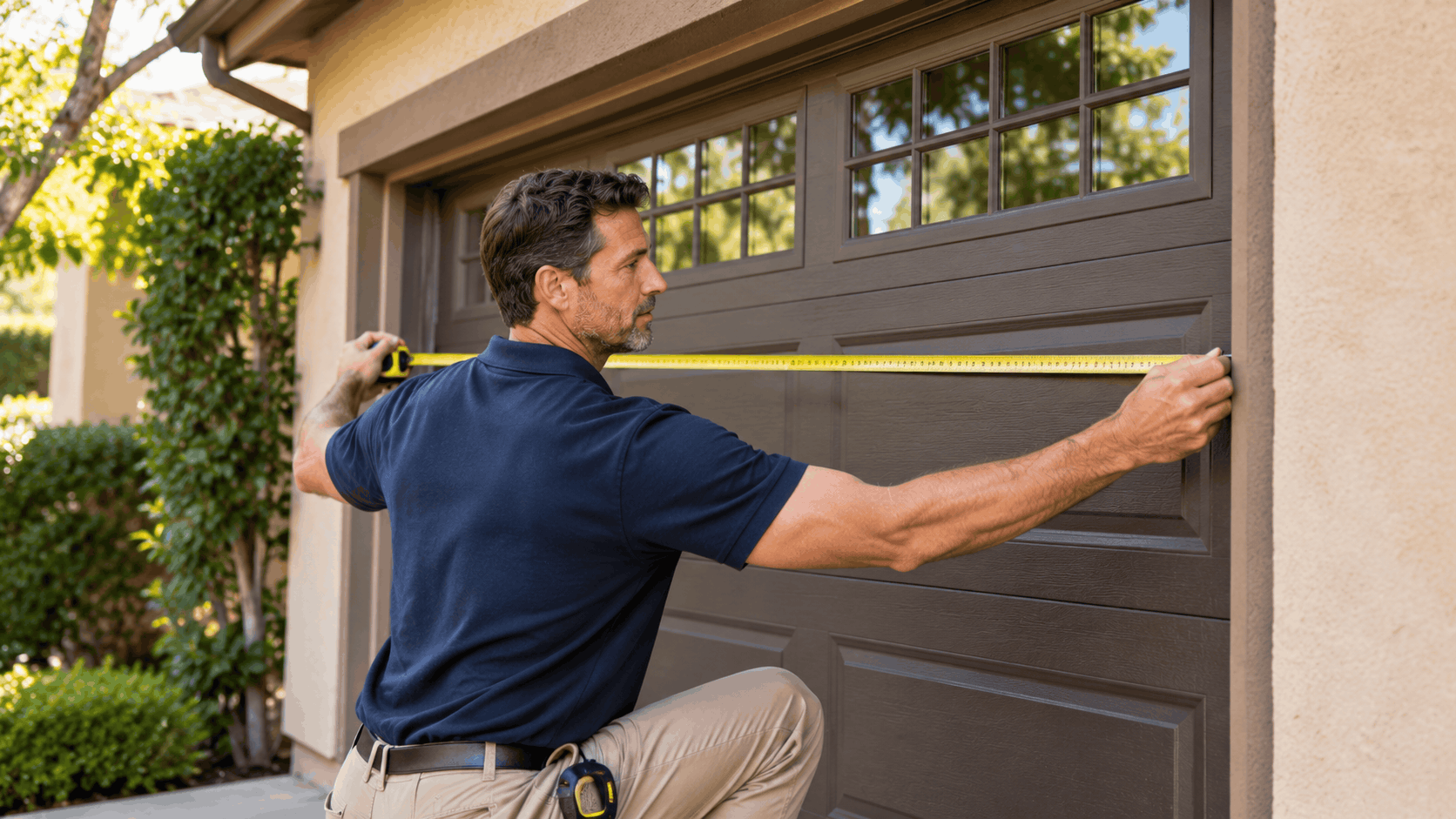
Urgent Garage Doors offers a free on-site estimate for new garage door installations. Coming to the home lets us measure the actual opening, see the enclave and elevation, and talk through the door types that fit before anything is ordered. That visit is the fastest way to turn a vague plan into a specific submittal.
Removing and hauling away the old door is included in a new door installation. An owner does not have to arrange disposal of a heavy old door separately. When the new door goes up, the old one leaves with us as part of the job.
A written price is available before work begins, and we provide it when the job calls for it or the customer asks. Separately, California Business and Professions Code section 7159 requires a written home improvement contract for work over $500, which is a legal requirement the contract satisfies.
So an owner can see the opening measured, the door options discussed, and the price in writing before committing. That order of operations keeps surprises out of a project that already has an association and a city to satisfy.
Matching the Door and Carrying the Parts
We work on all garage door brands, including LiftMaster, Chamberlain, Genie, Craftsman, Clopay, Amarr, Wayne Dalton and CHI. That range matters for a submittal, because it lets us match a replacement to the enclave across many product lines rather than pushing one brand. The right door for the elevation is the one that fits, whatever name is on it.
Our trucks carry common torsion spring sizes, so a spring job is often completed on the same visit. For a village where first-generation springs and rollers are reaching replacement age, that means a spring issue found during a door project can often be handled on the spot rather than on a return trip.
The storefront is at 76 Ashford, Irvine, CA 92618, which keeps us close to Quail Hill and the rest of Irvine. Being local means we know the villages, the enclaves and how the surrounding cities differ, which helps when matching a door to a specific tract.
Each preventive maintenance visit also includes a written report of what was found and what is recommended. On an edge or ridge lot, that report flags the seal, track and sensor items the setting tends to produce, so an owner knows what to watch.
Response Across Orange County, Every Day
Urgent Garage Doors runs 24/7 emergency service, taking calls and responding 24 hours a day, 7 days a week, every day of the year including holidays. The response window is 30 to 60 minutes anywhere in Orange County. If a door fails at a bad time during or after a project, we can reach Quail Hill quickly.
The company holds California license CSLB #1055150, verifiable free at cslb.ca.gov, under the C-61/D-28 classification that fits garage door work. An owner can confirm the license, status, bond and workers compensation on the public record in a minute. Licensed work keeps a project clean when it attaches to a city permit.
Urgent Garage Doors was founded in 2017 and has more than eight years of experience across Orange County's cities and villages. That local track record is why we can match a door to a Quail Hill enclave and know how the fire zone and the hillside setting bear on the choice.
For emergency repair or a planned replacement, the same team handles both. A submittal today and a breakdown next year reach the same company that knows the home.
Getting Your Quail Hill Door Project Moving
A Quail Hill door starts with the association submittal and the city permit position, then the door that matches your enclave. Our team handles the measurements, the enclave match and the hardware in one coordinated job, with a free on-site estimate for a new installation and a written price before work begins.
Call Urgent Garage Doors at (949) 529-7743 to set up the on-site estimate, and we will line up the door and the details your submittal needs to clear.
Frequently Asked Questions
- Does a Quail Hill garage door change need association approval?
- Yes. A garage door is a street-facing exterior change, and the Quail Hill Community Association controls physical changes to private property across the village. Because all homes sit in a mandatory HOA under one design framework, there is always an architectural path, and the answer to who approves is never nobody. Confirm the association's exact submittal requirements, forms and timeline for your address before ordering a door.
- Does association approval replace a city permit?
- No. Approval from the master association does not substitute for a City of Irvine building permit where one applies. They are two separate tracks: the association reviews whether the door fits the village design, and the city reviews whether the work needs a permit and meets code. The city with jurisdiction confirms the permit position for the specific job, so both have to be handled for the same door.
- Does a same-size door replacement need a permit in Irvine?
- Irvine lists an exemption for replacement doors of the same dimension that do not change the structural frame or opening size. Such replacements must still conform to all technical codes on weather proofing, security and energy efficiency. In a mapped fire zone, which includes Quail Hill, confirm with the City of Irvine building department rather than assume the exemption settles it, since the zone can add code questions.
- Is Quail Hill in a fire hazard zone?
- Yes. Irvine adopted the updated Fire Hazard Severity Zone map effective July 23 2025, replacing the 2012 map, and the city states the update expanded zones into Quail Hill. On a permitted project in a mapped zone, the door material, bottom seal and frame gaps become code questions. The exact requirements depend on the address, the zone class and the permit application date, confirmed with the building department or Orange County Fire Authority.
- Do I have to add a battery backup when I replace my door?
- On a qualifying replacement, yes. Under SB 969, effective July 1 2019, a replacement residential garage door may not be installed connected to an opener without a battery backup. It is a legal requirement with a $1,000 civil penalty, not an optional upgrade. The law was passed after the 2017 Northern California wildfires so a resident can open the door when the power is out.
- What license should the installer hold?
- California garage door work is licensed under C-61/D-28, Doors, Gates and Activating Devices, which covers sectional doors, spring systems, operators and safety sensors. C-28 is Lock and Security Equipment and is not the garage door license, and the work does not require a Class B general building license. Verify any license free at cslb.ca.gov, where classification, status, bond and workers compensation are public record. Urgent Garage Doors holds license #1055150.
- How much does a new garage door cost in Quail Hill?
- Typical Orange County ranges are sectional replacement $800 to $2,500, insulated steel $900 to $2,500, carriage-house $1,200 to $4,500, modern glass $1,800 to $4,500, and custom projects $1,800 to $6,500+. These are typical ranges for the area, not a quote. Because Quail Hill spans townhomes to large custom homes, the range that applies depends on the enclave and door type. The price for a specific garage is given in writing before work begins.
- Why do my door and sensors act up more on an edge lot?
- Edge lots sit against roughly 600 acres of open space, and dust, plant debris and seeds from the preserve reach tracks and photo-eye lenses. Debris coats a sensor and breaks the beam, which stops a door from closing for no visible reason. Ridgeline wind on the upper streets moves that material toward the opening. Keeping tracks and photo-eye lenses clean helps the door run the way it should.
- Do I need a written contract for the work?
- California Business and Professions Code section 7159 requires a written home improvement contract for work over $500. That is a contract requirement, not a licensing threshold. It is separate from the unlicensed-work exemption in section 7048, which AB 2622 raised to $1,000 effective January 1 2025, and which fails if a permit is required or the person employs anyone. The two figures serve different purposes and should not be merged.
- How fast can Urgent Garage Doors reach Quail Hill?
- Urgent Garage Doors runs 24/7 emergency service with a 30 to 60 minute response window across Orange County. One thing to keep in mind is that Quail Hill has limited entry points, giving it an island character with no through traffic. If there is a closure or accident at one of the few access points, a crew routes around it rather than through it, which can affect arrival.
Licensed garage door repair professionals serving Irvine and Orange County.
Licensed in California · License #1055150
Why trust Urgent Garage Doors?
Founded in 2017, Urgent Garage Doors is a licensed and insured garage door services serving Irvine and Orange County. All content is reviewed by our licensed technicians.
Need Help in Irvine?
Urgent Garage Doors serves Irvine and all of Orange County.
Related Articles
Irvine Master Plan Garage Door Standards: What's Required for Approval
A local guide to Irvine master plan garage door standards, covering HOA approval, approved materials, colors, permits, and how rules differ across villages.
Quail Hill Garage Doors by Enclave: Styles, Widths and What Each Builder Installed
Quail Hill garage doors vary by enclave because several builders worked under one Irvine Company framework. A guide to styles, widths, approval and matched replacement.
Quail Hill Irvine Garage Door Repair: Common Failures in 2000s Construction
Quail Hill homes built in the 2000s share predictable garage door failures. Learn the common problems with springs, cables, rollers, openers, and panels - and how to fix them.