Can You Replace Just One Garage Door Panel in Costa Mesa?

Need Garage Door Help? Contact Us Now
Fast local service. Upfront pricing.
Get Your Free Quote
Tell us about your garage door and we'll get back to you within 30 to 60 minutes.
Key Takeaways
- A single garage door panel can usually be replaced if the door is a sectional, the model and profile are still manufactured, the damage is limited to one or two sections, and the rest of the door is sound.
- A discontinued profile, widespread corrosion, warping across sections, or a one-piece tilt-up door all point toward a full replacement instead of a single panel.
- Panel matching depends on brand, model and profile; our team works on Clopay, Amarr, Wayne Dalton, CHI, LiftMaster and more, and older College Park and Halecrest tract homes often carry discontinued profiles.
- West-side Costa Mesa doors near the Santa Ana River see marine-layer corrosion first, while inland temperature swing warps wood doors, and each cause changes whether one panel fixes the problem.
- A panel swap is the time to inspect springs (commonly rated around 10,000 cycles, roughly seven years at four cycles a day), cables and hardware, and to match springs if a heavier section changes the door weight.
- Typical ranges: panel replacement $250 to $800 per panel, sectional door replacement $800 to $2,500, insulated steel door $900 to $2,500; the written price for a specific door is given before work begins.
- Association-governed streets review style, color and hardware under Davis-Stirling before the order, and the City of Costa Mesa building division confirms any permit question for the address; Santa Ana Heights permits may run through Newport Beach.
- Urgent Garage Doors holds CSLB license #1055150 under C-61/D-28, offers 24/7 emergency service with a 30 to 60 minute response across Orange County, and stocks common torsion springs for same-visit repairs.
In This Article
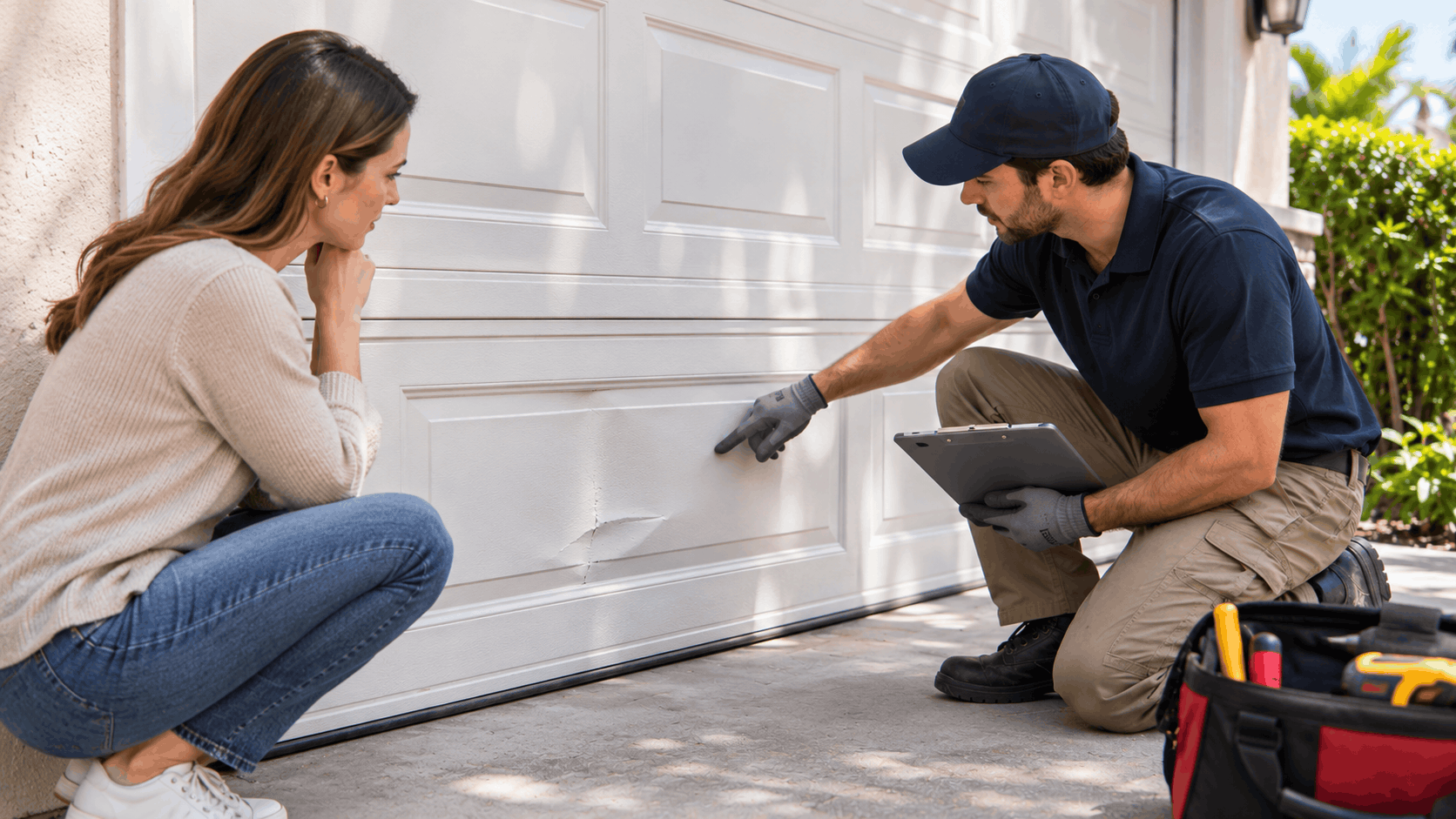
Someone backs out of an Eastside alley garage a little too fast, catches the bottom section with the bumper, and now there is a deep crease across the lowest panel. The rest of the door looks fine. The question that follows is always the same: does the whole door have to go, or can just that one dented section come out?
The honest answer is yes, one panel can often be replaced, as long as the door is a sectional model that is still manufactured, the damage is limited to one or two sections, and the rest of the door is sound. Age, color matching and the condition of the springs and cables decide the rest. A clean dent on a recent door is the best case. A discontinued profile or rust spreading across several sections points a different direction.
The Short Answer: When One Panel Is Enough
A single panel replacement makes sense more often than people expect, but only when a handful of conditions line up. The garage door section that failed has to be part of a sectional door, the model has to still be in production, the damage has to be contained, and the rest of the door needs to be in good working order.
Here is a quick way to see where a given door is likely to land.
| Situation | Single panel likely? | Why |
|---|---|---|
| Clean dent on one section, recent door | Yes | Matchable profile, sound hardware |
| Two adjacent dented sections | Possibly | Still cheaper than full door if model is current |
| Discontinued model or profile | No | No matching section available |
| Rust or warping across multiple sections | No | Damage is not contained to one panel |
| One-piece tilt-up door | No | Not built from stacked sections |
If a door falls into the top two rows, a panel replacement is worth pricing before anyone talks about a full door.
What Has to Be True for a Panel Swap to Work
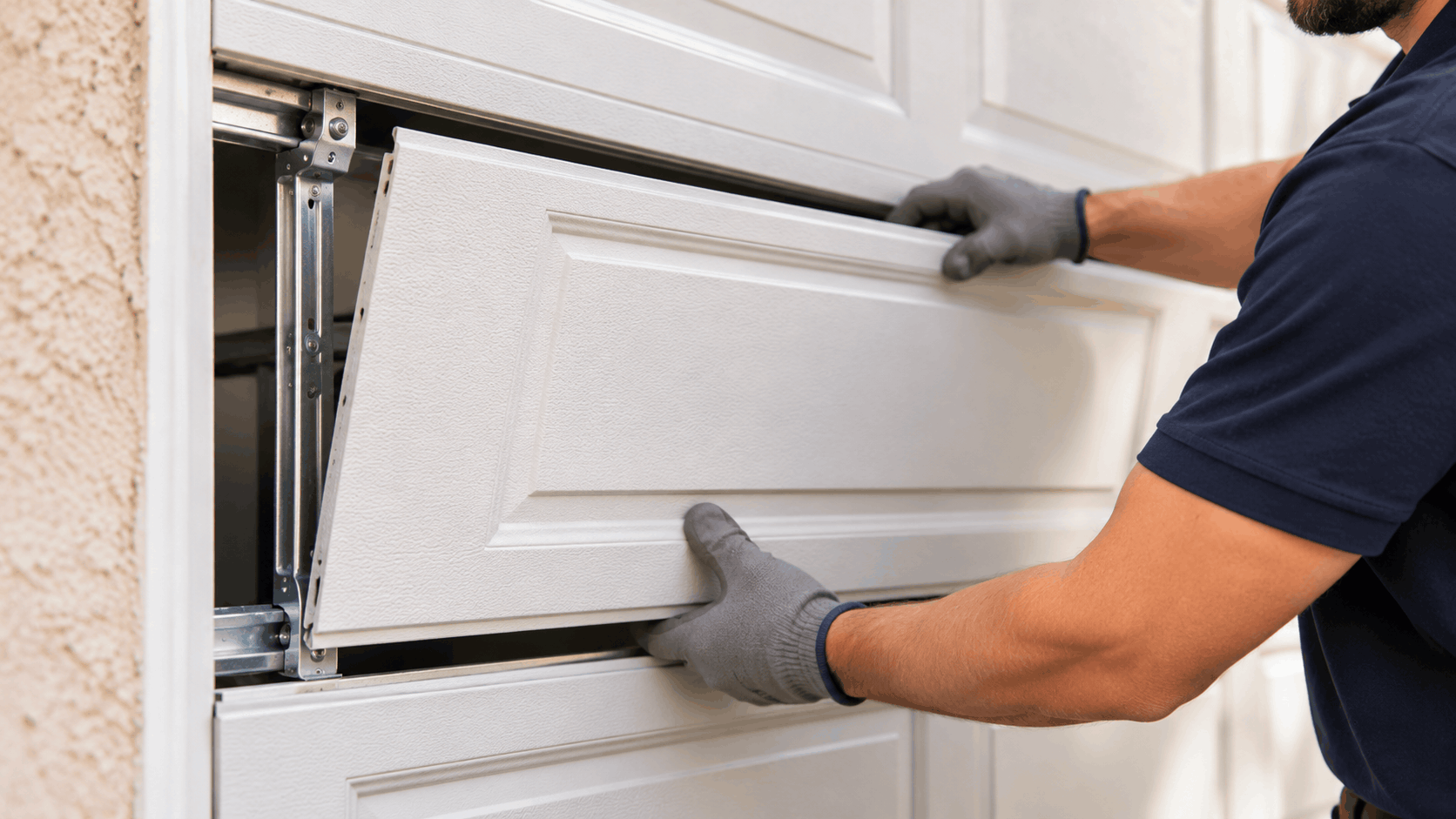
The first requirement is that the door is a sectional door, meaning it is built from horizontal panels stacked on top of each other and joined with hinges. That construction is what allows a single section to be unhinged and swapped without taking the entire door apart. Almost every attached front-facing garage built in Costa Mesa from the 1960s onward is a sectional, so this condition is usually met.
The second requirement is that the exact panel profile is still manufactured. A panel profile is the raised pattern pressed into the steel, the long or short panel design, the groove spacing, and the surface texture. If the maker still produces that profile in the right width and height, a matching section can be ordered. If the profile was retired, the match falls apart no matter how good the rest of the door looks.
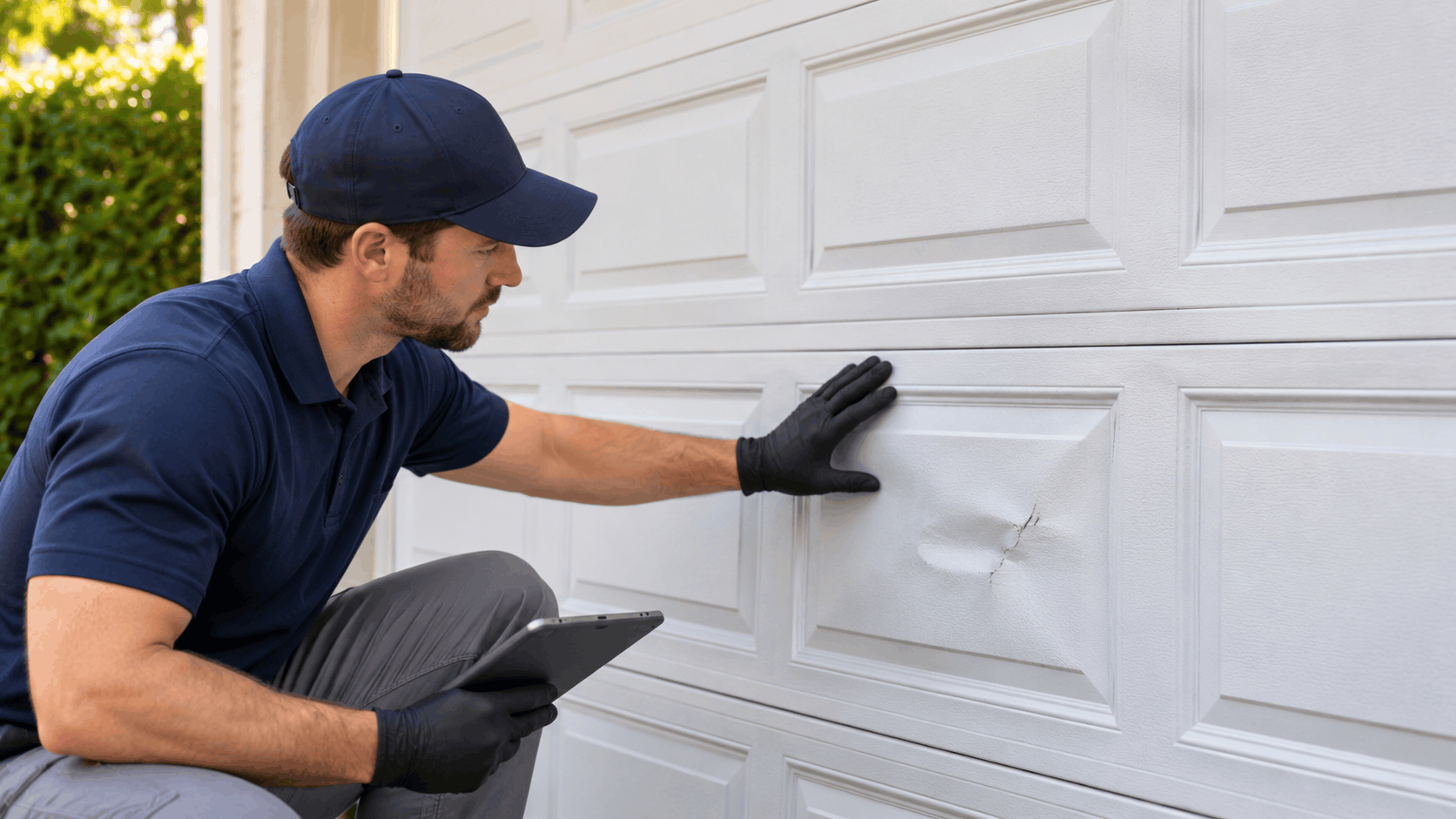
The third requirement is that the damage is contained to one or two sections. A crease across the bottom panel is one panel. A ripple running up three sections is a different conversation. Replacing two adjacent sections can still beat a full door on price, but past that point the math shifts.
The last requirement is that the rest of the door, the hardware and the springs, are in good shape. There is little sense putting a fresh section into a door whose cables are fraying and whose spring is near the end of its cycle life. A panel swap is the moment to check all of it at once.
When Replacing One Panel Is Not Realistic
The clearest case against a single panel is a discontinued door. When a manufacturer stops making a profile, there is no new section to order that will line up with the surviving panels. A used section pulled from a scrap door rarely matches the color or wear, so a discontinued profile almost always means a full door.
Widespread rust is the second case. When corrosion has worked into several sections, the cables or the tracks, one fresh panel sitting among corroded ones solves nothing and the next failure is already waiting. This shows up on older steel doors where moisture has been getting in for years.
Warping is the third. A wood section that has cupped or twisted from years of heat and sun is usually a sign the whole door has aged the same way, so replacing one board leaves the rest to follow. The grain, the thickness and the finish on a new section rarely blend with weathered wood anyway.
A one-piece tilt-up door is the fourth. These older doors are a single slab rather than stacked panels, so there is no section to remove. Multiple damaged sections on any door type usually tips the decision toward replacement as well, since the cost of several panels starts to rival a new door that comes with fresh hardware.
Sectional vs One-Piece Doors in Costa Mesa
A sectional door is the standard across most of Costa Mesa. It is assembled from four to five horizontal panels connected by hinges, riding up into the ceiling on rollers and tracks. Because each panel is its own part, a damaged one can be unhinged and a replacement set in its place. That modular design is the whole reason a single-panel repair exists.
A one-piece tilt-up door is a different product entirely. The door is one rigid slab that swings out and up on a pivoting frame, with no individual sections to separate. Many pre-1960s garages still carry these, and they turn up on some of the older Eastside cottages and the small houses and duplexes on the Westside near the Santa Ana River.
If a tilt-up is dented or cracked, there is no panel to swap. The repair is either a patch, which rarely looks right, or a full replacement, which is usually the moment owners move to a modern sectional door for the safety features and smoother operation. The hardware on these old doors is a different kit altogether.
Knowing which type is on the garage is the first thing to settle, because it decides whether a panel conversation is even on the table. A sectional opens the door to a repair. A one-piece closes it.
Get Your Free Quote
Tell us about your garage door and we'll get back to you within 30 to 60 minutes.
Finding a Matching Panel for Your Door
Once a door is confirmed as a sectional in sound condition, the real work is panel matching. This is the single biggest obstacle to a one-section repair, and it is where most jobs either go forward or turn into a full door. The section has to match on brand, model and profile, not just on size.
A panel that is close but not exact stands out the moment the door is closed and the light hits it. The goal is a section that reads as part of the original door, not a repair.
Why the Brand and Model Matter
Garage door panels are brand and model specific. A section built for one maker will not hinge, seat or match against a door from another, and even within one brand the profiles change over the years. That is why identifying the exact product is step one, before anything is ordered.
Our team works on all the major garage door brands, including Clopay, Amarr, Wayne Dalton, CHI, LiftMaster, Chamberlain, Genie and Craftsman. Each of these runs its own panel lines with distinct profiles, widths and surface textures, so a match depends on pinning down the maker and the specific model, not just the general look.
The identifying details usually live on a label inside the door, on the back of a panel or on the hardware, and the panel profile itself is a strong clue. We read those details, confirm the model is current, and check that the right width and height are available before quoting a section. Guessing at a match wastes an order and a trip.
When the model is current and the profile is still made, the match is usually straightforward and the repair moves ahead. When it is not, the search ends and the decision shifts to a full door.
Discontinued Panels and Older Doors
Costa Mesa is postwar California development, and the build era decides a lot here. The 1950s and 1960s tract homes in College Park, Halecrest and the Baker Street tracts northeast of the city, near Orange Coast College with the 405 behind them, often carry doors old enough that the original profile is no longer made.
Halecrest was annexed into the city in 1955, part of the wave when a newly incorporated Costa Mesa was building critical mass. Doors from that era, if they have never been replaced, are prime candidates for a discontinued panel. A section that was standard decades ago simply is not produced anymore.
When the panel is discontinued, a single-section repair is off the table and a full door becomes the realistic path. There is no new part that will line up with the survivors, and a mismatched section looks worse than the damage it was meant to fix.
This is not a knock on the door. It is just what happens when a product line retires. The upside is that a full replacement on an older home brings modern safety hardware and a door matched to the current weight, which an aging door rarely still has.
Color and Finish Matching on a Sun-Faded Door
Even when the correct panel is available, color is its own hurdle. A door that has sat in the sun for years has faded from its original shade, so a brand-new section in the factory color can look obviously newer than the panels around it. The profile matches perfectly and the color does not.
Inland Costa Mesa, the neighborhoods along Newport and Harbor Boulevards and the flat-street tracts near the 405, takes strong sun exposure, and that is what shifts older paint over time. Mesa Del Mar and Mesa Woods, the 1960s middle of the city, are the kind of areas where a door has had decades of that exposure.
The fix for a visible color gap is usually painting the door after the section is in, so the new and old panels end up the same shade. On a steel door that is a practical option. On an association-governed street, any repaint has to match an approved color, which is a point to settle before the brush comes out.
A reader weighing a single panel should know the section may need paint to disappear into the door. It is a small added step, but it is the difference between a repair that reads as original and one that announces itself.
Need Help in Irvine?
Urgent Garage Doors serves Irvine and all of Orange County.
What Caused the Panel Damage and Why It Matters?
The cause of the panel damage changes whether one section actually fixes the problem. A clean dent from a single impact is contained. Rust or warping is usually a symptom of something affecting the whole door, which a single panel will not cure. Where a door sits in Costa Mesa often tells you which kind of damage to expect.
| Cause | Where it shows up | Single panel fix? |
|---|---|---|
| Vehicle impact dent | Shared driveways, tandem parking, South Coast Metro | Usually yes |
| Corrosion on steel | Westside near the Santa Ana River | Often no if spread |
| Wood warping | Inland tracts with temperature swing | Usually no |
Dents and Impact Damage
A vehicle backing into the bottom section is the most common dented door we see. It happens on shared driveways, motor courts and tandem parking setups, which describes a lot of the attached 1970s and 1980s condos and townhomes in South Coast Metro around South Coast Plaza and the Segerstrom Center. Tight turns and someone else's car in the way lead to bumper meeting bottom panel.
The good news is that a clean single-section dent is the best case for a one-panel swap. The impact is contained to the bottom panel, the sections above are untouched, and the hardware usually survives. If the model is current, this is close to a textbook repair.
The one thing to check is whether the impact knocked the door off its rollers or bent the track. A hard enough hit can do both, which turns a simple panel job into a track and off-track repair as well. That is part of why the whole door gets looked at, not just the dent.
When the dent is clean and the rest of the door is sound, a bottom panel swap restores the door to full working order without the cost of a full replacement. It is the scenario that makes single-panel repair worth asking about in the first place.
Corrosion on West-Side Doors
The marine layer reaches the western neighborhoods of Costa Mesa harder than the inland streets near the 405. On the Westside, west and northwest of 17th Street toward the Santa Ana River, salt-laden air settles in and corrosion on springs, cables and tracks becomes a west-side conversation first. Rust on steel panels tends to show up here before it shows up inland.
When rust appears on one steel section, the sections next to it and the hardware behind the door are usually dealing with the same exposure. Corrosion does not respect panel lines. It works across the door, into the cables and along the tracks, which is why rust spread across sections points to a whole-door discussion rather than a single swap.
Corrosion also matters for the parts an owner cannot see. It brings a spring to the end of its cycle rating earlier and it eats into cables, which is dangerous because a corroded cable can fray before it snaps. A cable inspection belongs in any west-side panel job.
If the rust is isolated to one fresh scratch on an otherwise sound door, a single panel can still work. If it has spread, replacing one section leaves the corroded ones in place and the next failure is a matter of time. That is the honest line for a Westside Costa Mesa door.
Warping and Weather Stress on Wood Doors
Inland, the bigger enemy is seasonal temperature swing, which warps wood doors and stresses older hardware. A wood door expands and contracts as the heat rises and falls through the year, and over time that movement cups, twists or splits individual boards. The Eastside cottages and ranch houses and the older Westside houses are where wood doors still turn up.
A warped wood section is rarely a one-panel problem. If one board has moved, the others have been through the same cycles and are likely to follow. The whole door has aged together, so swapping a single section leaves the rest of the door on the same path.
Matching wood is also harder than matching steel. Grain, species, thickness and finish all have to line up, and a new board against weathered wood tends to stand out even after staining. That pushes a warped wood door toward full replacement more often than a steel door.
When a wood door starts warping, it is usually telling the owner its service life is ending. A full replacement, often to an insulated steel door that holds its shape better in the inland swing, tends to be the smarter move than chasing one bad board at a time.
Why a New Panel Means Checking the Whole Door?
A panel is one part of a system, and the system is what makes the door safe to operate. A one-section swap is the right moment to inspect the springs, the cables and the hardware, because the door is already being worked on and the whole garage door system has to function together once the new section is in.
Skipping that inspection is how a second failure follows weeks after the first repair. A real fix looks at the whole door, not just the panel that got hit.
Springs, Cables and Balance
A torsion spring is rated in cycles, not years. One cycle is one full open and close, and a standard residential spring is commonly rated around 10,000 cycles. A door opened about four times a day reaches that in roughly seven years, sooner where the garage is the main entrance and the door runs several times a day.
Cables, drums, rollers, hinges and bearings wear alongside the springs. Replacing a spring without inspecting the cables is how a second failure arrives a few weeks later, because the cable was already fraying when the spring let go. A panel swap is a chance to catch a spring near the end of its cycle rating before it fails on its own.
If the door is seven or more years old and has never had spring work, the odds are the cycle count is high. Finding that during a panel job means it can be handled in the same visit rather than as a separate spring and cable repair call later.
Balance ties it all together. A door that does not rise and fall smoothly is putting extra load on the opener and the hardware, and a fresh panel does not fix a balance problem underneath it. Checking balance is part of closing out the job properly.
Weight Changes With a Heavier Panel
Springs are sized to the actual weight and height of the door. They are wound to counterbalance a specific load, which is what lets a heavy door feel light enough for the opener to lift and for the door to hold position when balanced.
If a replacement section is a heavier material than the original, the door weight shifts. A steel section standing in for a lighter original, or an insulated panel replacing a hollow one, adds load the existing springs were never sized for. The springs have to be matched to the new actual weight, not simply reused.
Reusing undersized springs against a heavier door leaves the door dragging, the opener straining and the balance off. It also shortens the life of the springs because they are working outside their rating. This is why the material of the replacement panel matters, not just its size.
When a panel swap changes the door weight, matching the springs is part of the same job. It is one of the reasons a professional measures and weighs rather than assuming the old springs will carry a new section.
The Safety Tests to Run After the Work
Once the panel is in and the door is balanced, a few tests confirm the door is safe. The balance test is first: with the opener disconnected by the release cord, the door is raised to waist height, and a correctly balanced door stays put rather than drifting up or falling. A door that will not hold position is a spring problem, not an opener problem.
The photo-eye test checks the non-contact safety system. With the door closing, breaking the beam with an object should make the door stop and reverse. Blocked, misaligned or dirty photo eyes are the most common reason a door reverses for no visible reason, so this test is worth running after any work.
The 2x4 auto-reverse test checks the contact-reverse. A 2x4 laid flat across the opening should cause the door to reverse within two seconds of touching it on the way down. Both tests together are how a door meets the entrapment protection that California has required since AB 3600 in 1990 and federal rules have required on openers made after January 1, 1993.
One firm rule: an owner should never adjust, wind, unwind or replace a torsion spring. A torsion spring stores enough energy to cause serious injury and releases it instantly if a winding bar slips. The safe tests above are fine for an owner to run. The spring itself is for a licensed technician only. If the door fails a test, our sensor and safety work covers the fix.
One Panel vs a Full Door Replacement
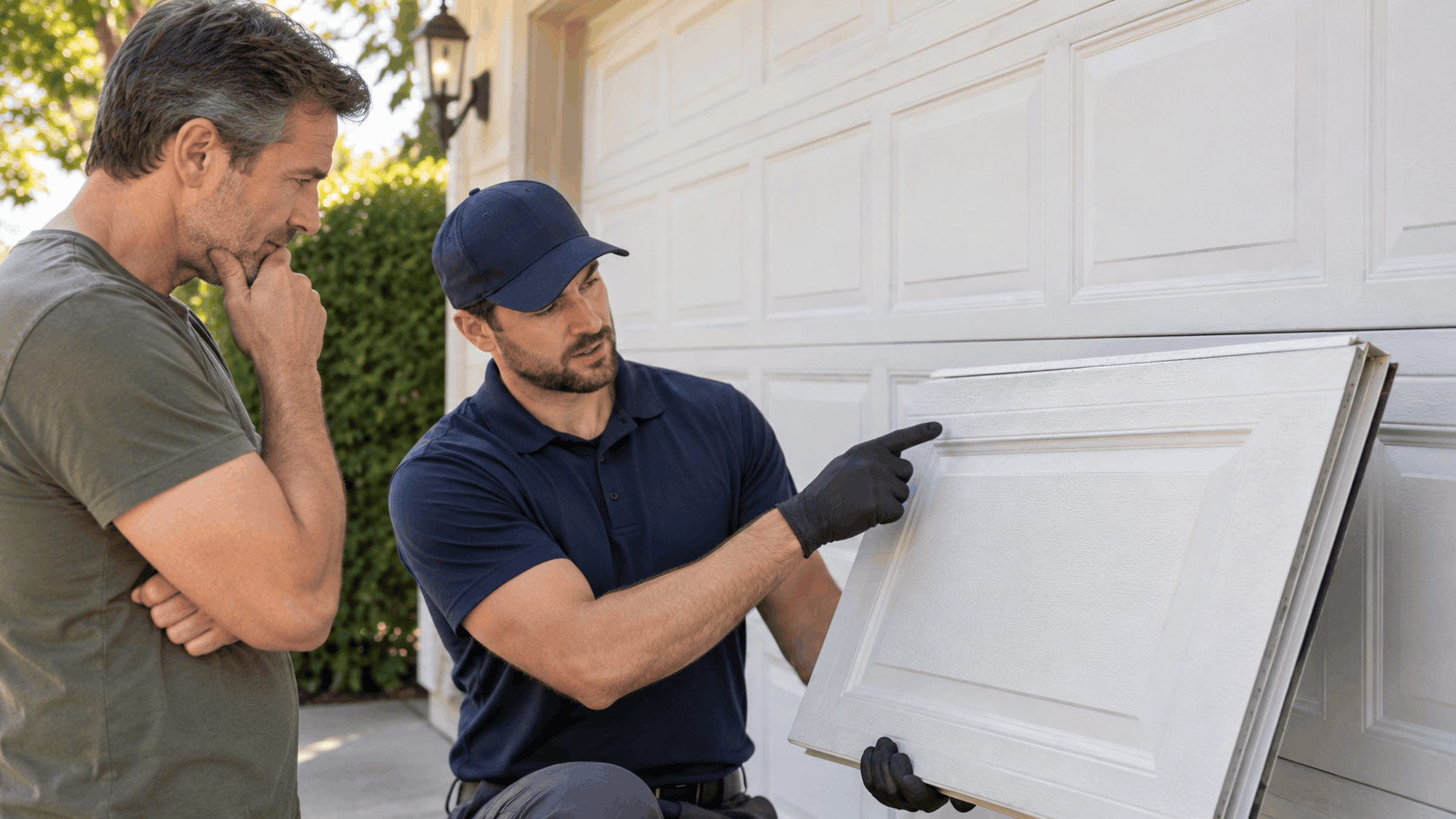
Deciding between a single panel and a whole door comes down to a few practical tradeoffs: the condition of the rest of the door, whether the profile is still made, how much of it is damaged, and the age of the hardware. There is no single rule, but the pattern is clear once a door is inspected.
The panel vs full door decision is about value over the next several years, not just the price of the repair today.
When a Panel Swap Saves Money
A single panel is the clear winner when the door is recent, the damaged section is clean and matchable, and the hardware is sound. In that case there is no reason to pay for a whole door when one section restores it. This is the bottom-panel dent on a five-year-old steel sectional.
The savings are real because the panel is a fraction of a full door and the hardware stays in place. A matchable profile on a current model keeps the repair simple, and the door looks and works as it did before the damage.
The condition of the springs and cables is what protects that saving. If they are sound, the panel swap is a true fix. If they are near end of life, factoring their replacement into the decision keeps the repair from becoming the first of two bills.
For a door that checks those boxes, a panel repair is the straightforward call and the cheaper one.
When a Full Door Is the Smarter Buy
Several damaged sections, a discontinued profile, heavy corrosion or an aging door often make a full door replacement the better value. Once two or three panels are involved, the cost of sections approaches the cost of a new door that comes with fresh hardware and a full warranty from the maker. A discontinued profile removes the choice entirely.
Heavy corrosion on a west-side door and widespread warping on an inland wood door both point the same way, because a single new section among compromised ones does not stop the underlying problem. An older door that has already had spring work and hardware repairs is usually at the point where a clean start costs less over time.
When a full door is the call, haul-away of the old door is included with a new installation, so the old sections and hardware leave with the crew. That removes the disposal headache that otherwise lands on the owner.
A full sectional door replacement also resets the clock on the hardware, so the next several years are repair-free in a way a patched old door cannot promise.
Insulation and Upgrade Opportunities
A full door swap is also the moment to improve R-value where it matters. Insulation is rated in R-value, and it matters most where the garage is conditioned, used as a workshop or gym, or shares a wall or ceiling with living space. A converted Eastside or Westside live-work space is exactly the kind of setup where an insulated door earns its keep.
The Westside, with its live-work lofts beside small houses and duplexes, has plenty of garages doing double duty as studios and shops. The Eastside cottages often carry accessory dwelling units. In both cases the garage door can be part of the thermal boundary, and an insulated steel door helps hold temperature.
It is worth being precise here: the energy code boundary is the wall between the garage and the living space, not the garage door itself, so an ordinary unconditioned garage is not required to have an insulated door. Where the garage is actually conditioned, as an ADU or a converted room, insulation becomes a real consideration.
A full replacement is the practical time to make that upgrade, since retrofitting insulation to an old door rarely matches the performance of a door built for it. If the space is used and conditioned, the R-value question is worth raising during the estimate.
Need Help in Irvine?
Urgent Garage Doors serves Irvine and all of Orange County.
What a Panel or Door Job Costs in Costa Mesa?
Cost is usually the deciding factor, so here are the typical market ranges for garage door work in Orange County. These are typical area ranges, not a quote or a fixed price from us. The actual price for a specific garage depends on that garage and is given in writing before work begins.
Use these to compare a panel swap against a full door and to understand what a worn spring or cable might add.
Typical Panel Replacement Ranges
For a single section, panel replacement runs $250 to $800 per panel as a typical Orange County range. The spread reflects the size of the section, the material, the brand and whether painting is needed to match a faded door.
The number of damaged sections drives the total. One clean bottom panel sits at the lower end of the range. Two adjacent sections double the panel count and move the total up, which is part of why multiple damaged panels start to favor a full door.
A current, matchable profile keeps a panel job in this range. A discontinued one takes it off the table entirely, since there is no section to price. Confirming the model is available comes before any panel figure is meaningful.
The written price for the specific door, with the exact section identified and any paint or hardware accounted for, is given before work starts. The range here is for planning, not for the final number on a particular garage.
Typical Full Door Ranges
For comparison, a sectional garage door replacement runs $800 to $2,500, and an insulated steel garage door runs $900 to $2,500. These are the ranges to weigh a panel swap against when several sections are damaged or the profile is discontinued.
When the damaged-panel total starts climbing toward the low end of the full-door range, the full door usually becomes the better value, because it comes with new hardware and a maker's warranty rather than fresh sections on an aging frame. That crossover is the practical reason to get both numbers.
An insulated steel door sits at the slightly higher end for the added material, which is the trade-off for better temperature control on a conditioned garage. A standard sectional is the baseline for an unconditioned garage where insulation is not a factor.
Haul-away of the old door is included with a full installation, so the full-door figures cover removal and disposal of the old sections and hardware. That is one less cost to carry separately.
Related Costs That May Come Up
A panel job sometimes turns up a worn spring or cable, and those change the total. Torsion spring replacement runs $150 to $300, and cable repair runs $150 to $300. Finding these during a panel inspection is the point of looking at the whole door, because handling them in the same visit beats a second trip.
Whether the spring or cable needs attention depends on the door's age and cycle count, not on the panel damage itself. A seven-year door reaching its cycle rating may need the spring regardless. A corroded west-side cable may need replacing whether or not a panel is swapped.
One legal point matters on cost: California Business and Professions Code section 7159 requires a written home improvement contract for work over $500. That is a contract requirement, and it applies once a job crosses that figure, so a larger panel-and-spring job will come with a written contract.
These related figures are typical area ranges like the others. The written price for the specific door accounts for exactly what the inspection finds, so the owner is not guessing at the total.
Permits, HOA Approval and Local Rules
A couple of local approval points bear on a panel or door change in Costa Mesa, and whether each one applies depends on the property. Association rules and city permits are separate things, and both are settled by the specific address rather than by a single county-wide rule.
Getting these right before the order avoids a door that has to come back out or a job that stalls at the building counter.
Association Approval on Governed Streets
Association-governed streets operate under California's Davis-Stirling Common Interest Development Act. That includes the 1970s and 1980s attached condos and townhomes in South Coast Metro and parts of the association-governed product in College Park. On those streets, architectural review typically covers door style, panel design, color and visible hardware.
Because a garage door is a street-facing feature, the review applies to a replacement and often to a visible change like a repaint to match a new section. The approval has to come before the order, not after, because a door fitted without it can be required to come out at the owner's cost.
For a single panel that matches the existing door exactly, the review is usually simpler, but a color change triggered by a faded door is the kind of detail an association will want to see. Confirming the approval path with the association first keeps the repair from stalling.
Owners on a governed street should start the architectural review early, since it can add time to the schedule. The South Coast Metro condos and townhomes are the clearest example of where this applies in Costa Mesa.
When a Permit Comes Into Play
A like-for-like swap that alters no structure generally does not need a building permit. A panel replacement that keeps the same opening and header falls into that category most of the time. Altering the opening or changing the header is the kind of structural work that does trigger a permit.
The City of Costa Mesa building division handles permits, plan check and inspections for addresses inside the city, and it confirms the position for the specific address. That is the authority to rely on rather than a blanket assumption, because the answer can turn on details of the particular job.
The permit question matters twice over, because a job that requires a permit also loses the under-$1,000 unlicensed-work exemption in Business and Professions Code section 7048. A permitted job goes to a licensed contractor whatever its size.
For a straightforward panel swap on an existing opening, the permit question is usually a quick confirmation. For anything that touches the structure, checking with the building division first is the right step.
The Santa Ana Heights Jurisdiction Trap
Santa Ana Heights, between Upper Newport Bay, Santa Ana Avenue, Bristol Street and Bayview Terrace next to John Wayne Airport, is commonly listed as a Costa Mesa area. Its permits, though, run through the City of Newport Beach or whichever jurisdiction the parcel record shows.
That is a real trap, because a permit pulled from the wrong city does not cover the address. The authority is confirmed from the parcel record, not from the postal town on the mailing address.
For a panel job this rarely comes up, since a like-for-like swap usually needs no permit. But if the work touches the structure, the first step is confirming which jurisdiction actually governs the parcel. A property owner near the airport should check this before assuming Costa Mesa is the authority.
When in doubt, the parcel record settles it. Confirming the jurisdiction up front is far easier than unwinding a permit filed with the wrong city. You can verify any contractor's license and standing at cslb.ca.gov while you are sorting the paperwork.
Need Help in Irvine?
Urgent Garage Doors serves Irvine and all of Orange County.
How Urgent Garage Doors Handles a Panel Replacement
Our approach to a panel job starts with figuring out whether one section is even the right fix, then confirming it can be matched, then checking the door around it. We work across Costa Mesa and the rest of Orange County, and we carry the parts to finish common work on the same visit.
The goal is a repair that actually holds, not just a fresh panel on a tired door.
Identifying the Panel and Checking the Door
The first step is panel identification: reading the brand, model and profile so we know exactly what section the door takes and whether it is still made. That determines whether a single-panel repair is possible at all before anything is ordered.
With the panel identified, we inspect the springs, cables and hardware, because a new section belongs on a door whose system is sound. A spring near the end of its cycle rating or a fraying cable found now can be handled in the same visit rather than failing weeks later.
If the inspection shows the damage is too widespread, the profile is discontinued, or the hardware is worn enough that a full door is the better value, we offer a free on-site estimate for a new door install. That way the owner has both numbers and can decide on real figures.
Catching the whole picture during one visit is what keeps a panel repair from becoming the first of several calls. It is the difference between fixing the dent and fixing the door.
A Written Price Before Work Starts
A written price is available before work begins, so the owner sees the number before anyone picks up a tool. That covers the panel, any paint or hardware, and any spring or cable work the inspection turns up.
For work over $500, California law requires a written home improvement contract under Business and Professions Code section 7159, so a larger job comes with that contract as a matter of course. It is a legal requirement, not just a courtesy.
Having the price in writing before work starts means no surprises when the job is done. The owner approves the number, and the scope is set before the first panel comes off.
If the decision shifts to a full door, the free on-site estimate gives that price in writing too, so the comparison between a panel and a door is made on real figures rather than guesses.
Service Across Costa Mesa and Response Times
We serve Mesa Verde, the Eastside, the Westside, South Coast Metro and the rest of Costa Mesa, along with the surrounding Orange County cities. The storefront is at 76 Ashford, Irvine, CA 92618, and the crew works across the county from there.
Our trucks carry common torsion spring sizes, so when a panel inspection turns up a worn spring, the replacement is often done on the same visit rather than scheduled for later. That keeps a two-part problem to one trip where the stock allows.
We offer 24/7 emergency service, every day of the year including holidays, with a 30 to 60 minute response window across Orange County. A door stuck open after an impact is a security problem, and that is the kind of call the emergency team handles.
Urgent Garage Doors holds California license CSLB #1055150 under classification C-61/D-28, Doors, Gates and Activating Devices, which is the correct classification for garage door work. The license, classification, status, bond and workers compensation are all public record and verifiable free at cslb.ca.gov.
Getting Your Panel Replacement Sorted
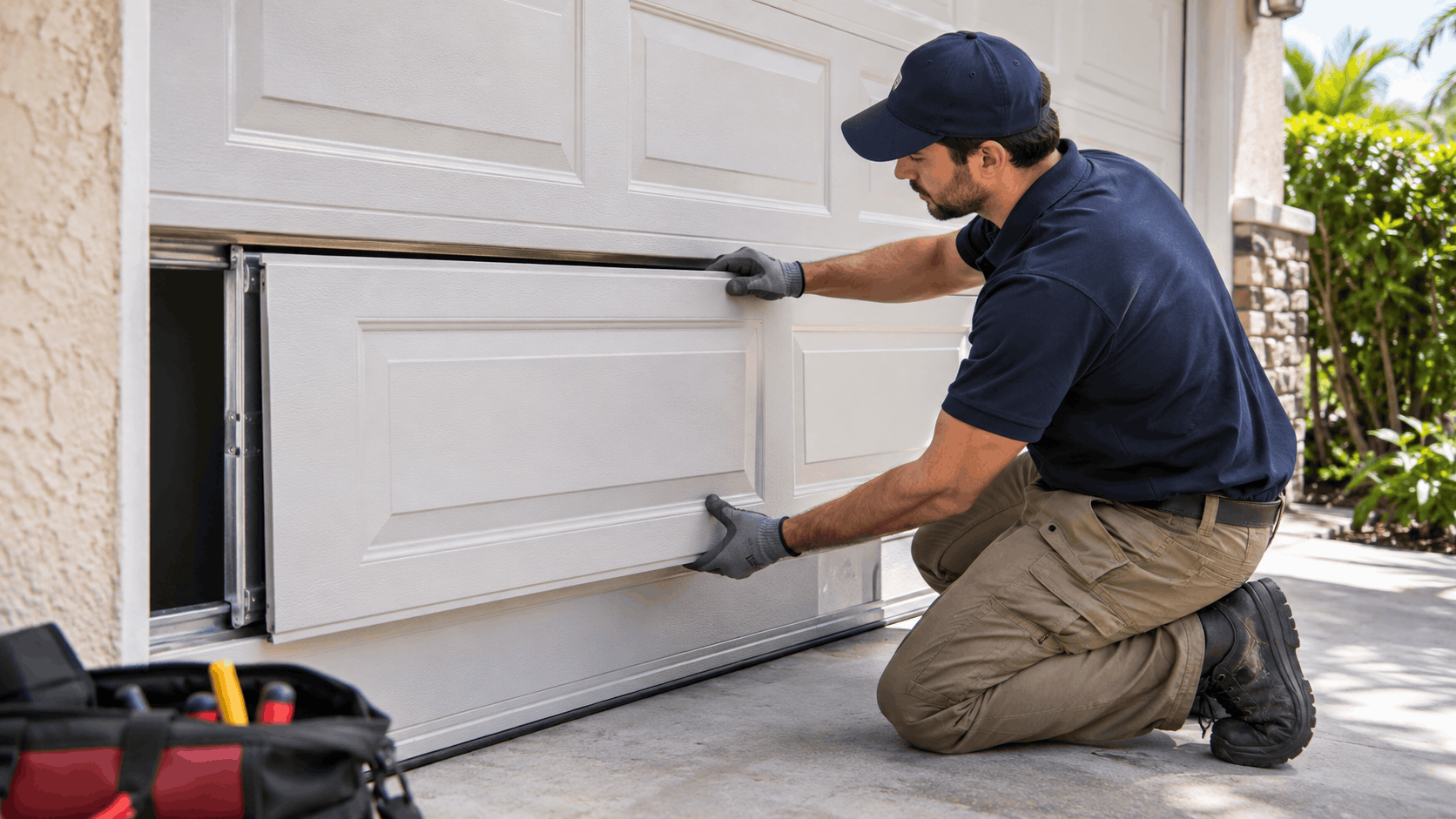
Whether one section does the job or the door is ready for a full replacement comes down to matching the panel, checking the springs and cables, and knowing the local rules for the address. We identify the exact panel, inspect the whole door, and put the price in writing before any work starts.
Call Urgent Garage Doors at (949) 529-7743 to have the damaged panel looked at, or book a free on-site estimate if a new door turns out to be the better call.
Frequently Asked Questions
- Can you replace just one garage door panel?
- Yes, if the door is a sectional, the damaged panel is still manufactured, and the rest of the door is sound. A clean single-section dent on a current model is the best case. It does not work when the profile is discontinued, when rust or warping has spread across several sections, or when the door is a one-piece tilt-up with no individual sections to remove. The springs and hardware get checked either way.
- How much does a single garage door panel cost in Costa Mesa?
- Panel replacement runs $250 to $800 per panel as a typical Orange County range. The spread reflects the section size, the material, the brand and whether painting is needed to match a faded door. The number of damaged sections drives the total, so two panels cost roughly double one. The final price for a specific door is given in writing before work begins, after the exact section is identified.
- What if my garage door model is no longer made?
- A discontinued panel usually means a full door, because there is no matching section to order and a mismatched one looks worse than the damage. This is common on the older 1950s and 1960s tract homes in College Park, Halecrest and the Baker Street tracts, where original profiles have been retired. The upside of a full replacement on an older home is modern safety hardware and springs matched to the current door weight.
- Will a new panel match my faded door?
- A correct panel can still look newer than the sections around it, because years of inland Costa Mesa sun shift the original paint over time. The profile matches but the color may not. Painting the door after the new section is in evens out the color so the repair reads as original. On an association-governed street, any repaint has to match an approved color, so confirm that before the brush comes out.
- Is it cheaper to replace one panel or the whole door?
- One clean, matchable section is usually cheaper than a full door. The math shifts when several sections are damaged, the profile is discontinued, or corrosion and age have reached the hardware. A sectional garage door replacement runs $800 to $2,500 and an insulated steel garage door runs $900 to $2,500, so once the panel total climbs toward the low end of those ranges, a full door with new hardware and haul-away becomes the better value.
- Do I need HOA approval to change a panel in Costa Mesa?
- On association-governed streets, yes. Under the Davis-Stirling Act, architectural review covers door style, panel design, color and visible hardware, and that includes the 1970s and 1980s South Coast Metro condos and parts of College Park. Approval has to come before the order, because a door fitted without it can be required to come out at the owner's cost. A matching single panel is usually simpler to approve than a color change.
- Do I need a permit to replace a garage door panel?
- A like-for-like swap that alters no structure generally does not need a permit. Altering the opening or the header does. The City of Costa Mesa building division confirms the position for the specific address, so rely on that rather than a blanket assumption. A permit also removes the under-$1,000 unlicensed-work exemption, so any permitted job goes to a licensed contractor whatever its size.
- Can I replace a garage door panel myself?
- It is not a safe DIY job, because a panel swap involves the spring and cable system. A torsion spring stores enough energy to cause serious injury and releases it instantly if a winding bar slips, so an owner should never adjust, wind, unwind or replace one. The safe checks an owner can run are the balance test, the photo-eye test and the 2x4 auto-reverse test. The panel and spring work goes to a licensed contractor.
- Can one panel be replaced on a one-piece tilt-up door?
- No. A one-piece tilt-up door is a single rigid slab rather than stacked sections, so there is no panel to remove and swap. These older doors still turn up on some Eastside cottages and Westside houses and duplexes. A damaged tilt-up is either patched, which rarely looks right, or fully replaced, and most owners use the chance to move to a modern sectional with current safety hardware.
- How fast can someone come out in Costa Mesa?
- We offer 24/7 emergency service, every day of the year, with a 30 to 60 minute response window across Orange County. A door stuck open after a vehicle impact is a security concern, so it is treated as urgent. Our trucks carry common torsion spring sizes, so if a panel inspection turns up a worn spring, the related repair is often finished on the same visit rather than scheduled for later.
Licensed garage door repair professionals serving Irvine and Orange County.
Licensed in California · License #1055150
Why trust Urgent Garage Doors?
Founded in 2017, Urgent Garage Doors is a licensed and insured garage door services serving Irvine and Orange County. All content is reviewed by our licensed technicians.
Need Help in Irvine?
Urgent Garage Doors serves Irvine and all of Orange County.
Related Articles
24/7 Emergency Garage Door Repair in Costa Mesa and What Response Times Really Look Like
What 24/7 emergency garage door repair really looks like in Costa Mesa: a 30 to 60 minute response, the failures behind after-hours calls, honest cost ranges and how calls get handled.
Garage Door Repairs Costa Mesa Buyers Ask For After a Home Inspection
The garage door repairs Costa Mesa buyers ask for after a home inspection, from photo-eye and spring fixes to battery backup, with local causes, costs and permit rules.
How Much Does Garage Door Spring Replacement Cost in Eastside Costa Mesa?
Garage door spring replacement cost in Eastside Costa Mesa depends on spring type, cycle rating and cable condition. Here is what drives the price near the Back Bay.