What Fails First on Woodbridge Garage Doors After Forty-Five Years in the 1976 to 1985 Tracts

Need Garage Door Help? Contact Us Now
Fast local service. Upfront pricing.
Get Your Free Quote
Tell us about your garage door and we'll get back to you within 30 to 60 minutes.
Key Takeaways
- On 1975 to 1985 Woodbridge doors the torsion spring fails first, followed closely by cables, rollers, bearings and the original pre-1993 opener.
- A standard torsion spring is rated around 10,000 cycles, roughly seven years at four uses a day, so forty-five-year-old doors are far past any original set.
- Homes nearest North Lake and South Lake sit in the most humid pocket of the village, which drives corrosion that brings metal parts to the end of their cycle rating sooner.
- Openers from the 1975 to 1985 phases predate the January 1, 1993 federal entrapment-protection mandate, so many original units have no photo eyes.
- SB 969 requires a battery backup on any residential opener installed or replaced in California since July 1, 2019, so a replacement comes with one.
- The Woodbridge Village Association reviews garage doors with a $50 application fee, a 2 to 4 week review and a 6-month approval window, and attached homes may need sub-HOA approval too.
- Irvine exempts a same-dimension door swap with no change to the frame or opening, while widening the opening or altering the header triggers a permit.
- Owners must never service a torsion spring themselves; the safe checks are the balance test, the photo-eye test and the two-by-four test.
In This Article
Walk the Yale Loop on a quiet morning and you can still spot them: original Cape Cod homes near South Lake, built in the late 1970s, running the same garage door hardware they left the factory with. The paint on the wood trim has been refreshed a few times. The door itself, with its soft hum and slow crawl, has not. On a door that old, the question is not whether something will fail, but what goes first.
The honest answer is the torsion spring. Springs reach their cycle rating before anything else, and when one lets go on a forty-five-year-old door, the cables, rollers, drums and bearings are usually right behind it. Many of these homes also carry the original opener, a unit built before photo eyes were required, which makes it the oldest and least safe part in the garage. Homes closest to North Lake and South Lake sit in the most humid pocket of the village, and that moisture brings metal parts to the end of their rated life earlier than the same parts on inland tracts.
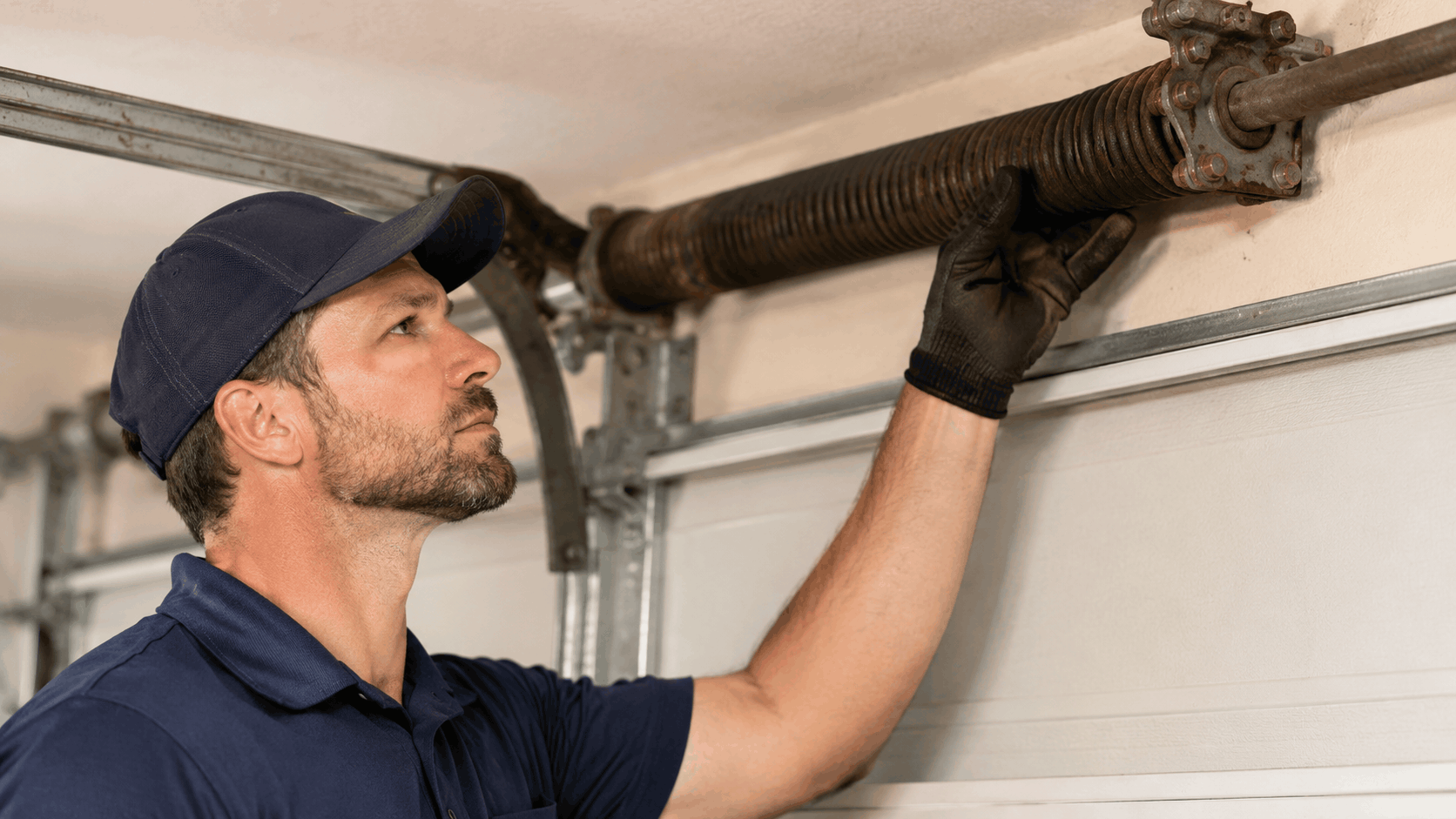
The Short Answer: What Goes First on a Forty-Five-Year-Old Woodbridge Door
On the detached and attached homes built in the 1975 to 1985 phases, the failure order is remarkably consistent. The spring goes first because it does the most work every single day. Then the parts that share that workload - cables, rollers, hinges and bearings - start to show their own age. The opener, often untouched since the Reagan administration, is usually the last thing anyone thinks about and frequently the most dangerous.
Build era and daily use drive the pattern. A door installed in a 1970s Woodbridge tract has cycled open and closed tens of thousands of times. Spring failure is simply the mechanical arithmetic of a part designed around a cycle rating meeting a door that has blown past that number many times over.
| Component | Typical failure order | Why it fails on an old Woodbridge door |
|---|---|---|
| Torsion spring | First | Reaches its cycle rating after years of daily lifting |
| Cables and drums | Close behind | Wear alongside the spring, fray from corrosion near the lakes |
| Rollers, hinges, bearings | Close behind | Grind and seize after decades of travel on the track |
| Opener | Oldest, most dangerous | Pre-1993 units predate required photo eyes |
Torsion Springs Reach Their Cycle Rating First
A standard residential torsion spring is rated by the manufacturer for around 10,000 cycles. One cycle is one full open and one full close. For a typical household cycling the door four times a day, that works out to roughly seven years. Even at lighter use, a ten to twelve year life is about the ceiling for a standard set.
Now do the math on a door from the 1975 to 1985 Woodbridge tracts. A forty-five-year-old door is far past any original spring set, and almost certainly past several replacement sets too. If an owner still has the factory springs, they are running on borrowed time by a wide margin.
Springs are sized to the actual weight and height of the door, not picked off a generic shelf. A heavier wood or insulated door needs a heavier-rated spring than a light aluminum one. That sizing matters because the wrong spring either fails early or leaves the door unbalanced, which puts load on every other part. When a spring reaches the end of its life, a correct replacement is matched to the door it serves, which is why our torsion spring replacement work starts with weighing and measuring the door.
Cables, Rollers and Bearings Follow Close Behind
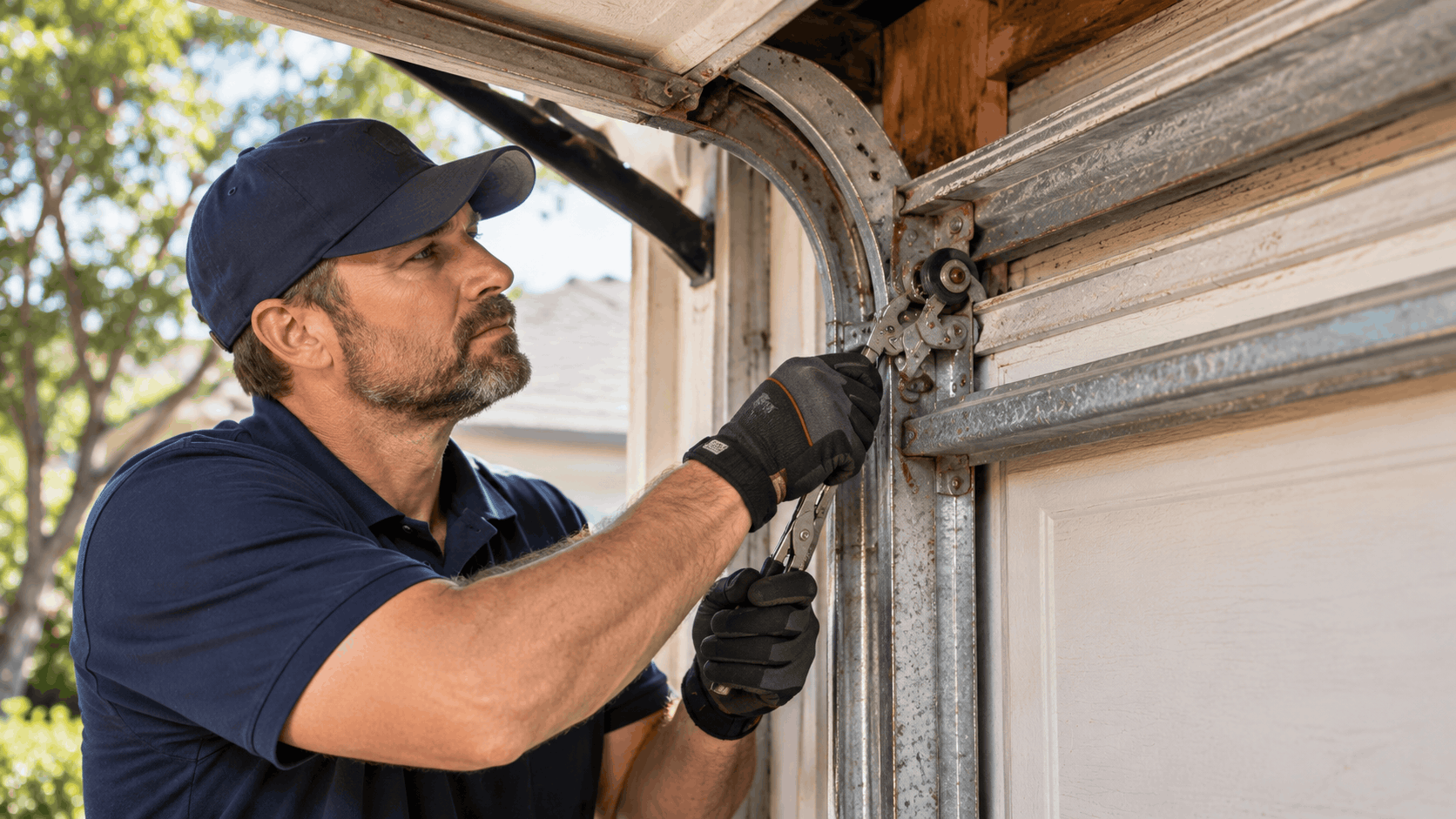
The spring does not work alone. Lift cables, drums, rollers, hinges and the center and end bearings all carry part of the door's weight and motion every cycle. They wear on the same clock as the spring, so a door old enough to break a spring is old enough to have tired cables and rollers too.
Cables are the quiet threat. A frayed cable near the water corrodes from the inside out, so strands break one at a time before the cable finally snaps. Rollers lose their nylon or wear flat on the stem, and hinges develop play that lets the sections sag and bind in the track.
Replacing a spring while ignoring worn cables is how a second failure arrives weeks later. The fresh spring loads a frayed cable that was already near the end, and the owner calls again for a repair they thought was finished. Inspecting the cables and drums at the same time as the spring is the only way to avoid back-to-back service calls.
The Original Opener Is Often the Oldest Thing in the Garage
Openers installed during the 1975 to 1985 phases predate the January 1, 1993 federal entrapment-protection mandate. That means a large share of original units in Woodbridge have no photo eyes, the two small sensors mounted low on each side of the opening that stop a closing door when the beam between them breaks.
An opener this old relies on contact reverse alone, if it reverses reliably at all. It has no non-contact system to catch a child, a pet or a bag of groceries in the door's path. That is a safety gap, not just an age issue.
When the spring finally breaks, the opener often takes the blame because that is the motor the owner hears straining. In reality the opener is a separate, older problem that the spring failure simply exposed. We look at both together so the real cause is fixed and the safety gap is closed at the same time.
Get Your Free Quote
Tell us about your garage door and we'll get back to you within 30 to 60 minutes.
Why Woodbridge Doors Age the Way They Do?
Woodbridge is unlike any other Irvine village, and that shapes how its garage doors age. The Irvine Company started the village in 1975 and it was substantially complete by the early 1990s, with one later tract, The Branches, added in 2013. Most of the housing stock is late 1970s and 1980s, which puts the original hardware squarely in the pre-safety-mandate era.
The architecture is uniformly New England Cape Cod, with painted wood trim and siding instead of the stucco you see in newer villages. Two lakes sit at the center, ringed by the four-lane Yale Loop, with San Diego Creek running through the middle. Those features are not just scenery. They decide which homes see the most moisture and how a door and its trim weather over decades.
The Lakeside Humidity Pocket Near North Lake and South Lake
Homes closest to either lake sit in the most humid pocket of the village. Both North Lake and South Lake are shallow, three to six feet deep, and the constant surface water keeps the air around the nearest tracts damper than the inland blocks.
That humidity shows up as faster corrosion on springs, cables and rollers than on inland tracts of the same age and build. The metal does not wear out from a magic multiplier. Moisture simply brings a part to the end of its cycle rating sooner, because rust attacks the steel while the door keeps cycling.
The Yale Loop connects every housing block, and San Diego Creek carries moisture right through the center. Residents describe a location as inside or outside the loop, and a crew routing a call thinks the same way. A door a short walk from the water tends to show corrosion on the coil and frayed strands on the cable earlier than an identical door several blocks inland.
New England Cape Cod Framing and Painted Wood Trim
The Cape Cod look means a Woodbridge garage door sits against painted wood trim and siding, not the stucco surround common in later Irvine villages. That makes color and trim a paint-to-wood question rather than a paint-to-stucco one.
Wood trim moves with moisture and temperature in a way stucco does not. It swells, dries and takes paint differently, so the trim and the weather seal that meets it age on their own timeline alongside the door itself. When trim softens or the paint film breaks down, water finds its way to fasteners and the back of the jamb.
Several tracts were originally built with natural shake roofs, since replaced in many tracts with steel or cement imitating other materials. The point for a door is that these are older, wood-framed openings. Mounting new hardware means landing it into sound wood, and matching a replacement door means thinking about how it reads against painted siding, which in the Gables tracts comes with its own color rule covered further down.
Original Hardware From the 1975 to 1985 Phases
Because the village was substantially complete by the early 1990s, most original systems predate modern safety hardware. The springs, the cables, the rollers and especially the opener were specified under the standards of their day, not today's.
Daily use as a main entrance pushes a door's cycle count up fast. Many Woodbridge garages are the family's primary way in and out, so the door may cycle well beyond four times a day. That drives springs to their cycle rating faster than the same spring on a door used only on weekends.
Original hardware also tends to be the lightweight, lower-cycle hardware that was standard on the budget doors of the era. When these parts are replaced today, there is a chance to move up to quieter rollers and better hardware that stand up to the village's conditions.
What Local Conditions Do to Tracks and Seals
Woodbridge is a heavily planted village, from the dense pepper trees on Pinewood to the continuous privet hedge that screens the community. All that greenery drops leaves, seeds and fine plant debris, and some of it works into the moving parts of a garage door.
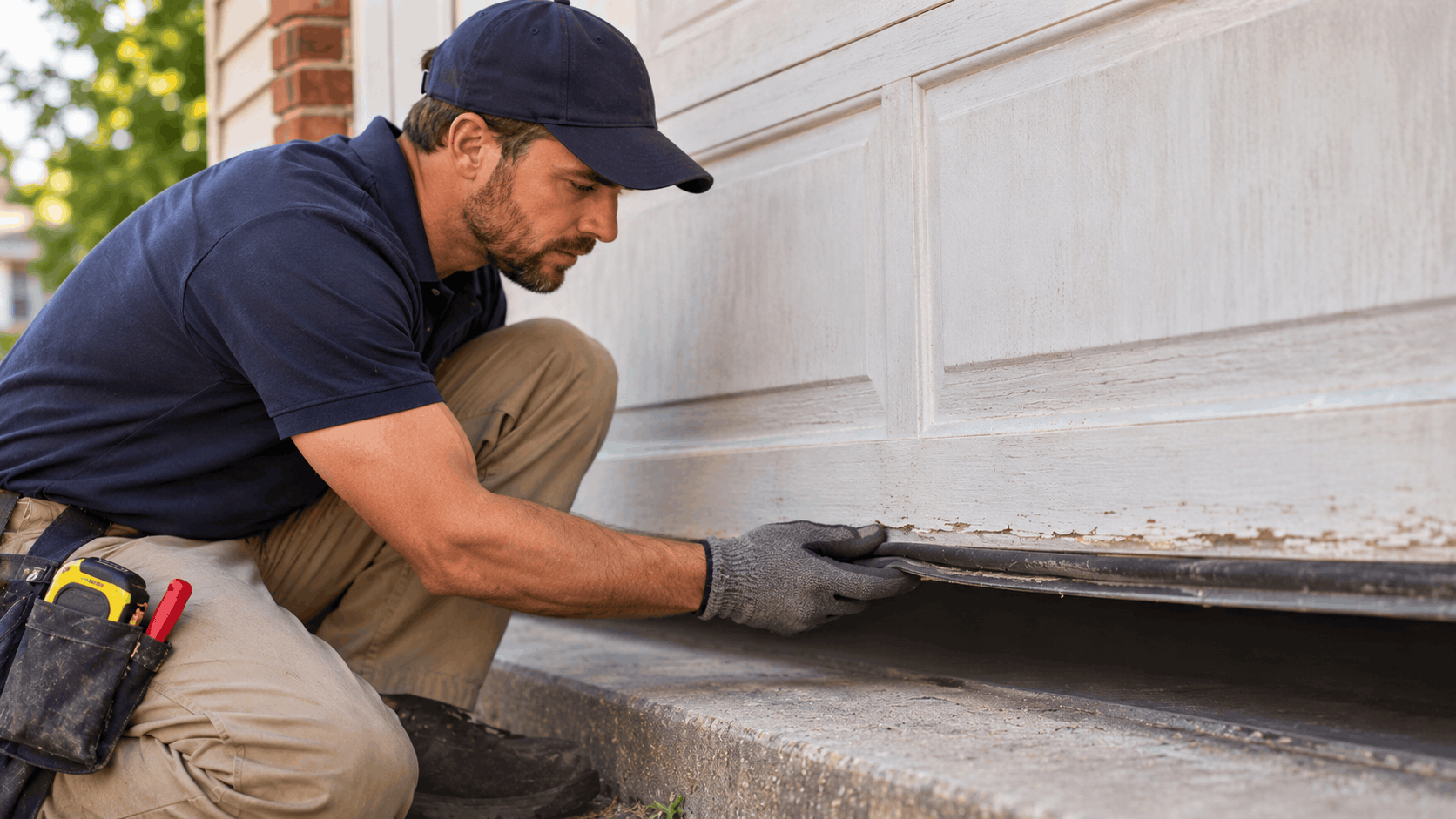
Debris and plant matter collect in the tracks, in the weather seal and on the photo-eye lenses. Grit packs into a seal so it stops flattening against the slab, which lets drafts and water under the door. A coated sensor lens breaks the beam, and the door reverses for no reason the owner can see.
None of this is about a part wearing some fixed amount faster. It is about what the local conditions physically do: they load the tracks with debris, pack the seal with grit and coat the sensor so it misreads. Clearing the tracks, refreshing the weather seal and wiping the lenses keeps an older door running the way it should.
Need Help in Irvine?
Urgent Garage Doors serves Irvine and all of Orange County.
Spring Failure in Detail and Why Owners Must Not Touch It
Since the spring is the part that fails first, it deserves the most attention. A broken torsion spring is the single most common reason a Woodbridge door suddenly will not open, and it is also the part an owner must never attempt to service alone.
When a spring breaks, the door loses the counterbalance that makes it feel light. A sectional door can weigh well over a hundred pounds, and the spring is what offsets that weight. Lose the spring and the full weight lands on the cables, the opener and, if someone tries to lift it, their back.
Signs a Spring Has Reached the End of Its Life
The classic sign is a loud bang from the garage, often heard from inside the house, like something heavy hitting the concrete. That is the spring releasing its stored energy all at once when the steel finally fails.
After that, the door will not lift, or the opener strains, hums and stops partway. Many owners find the door feels twice as heavy by hand, because it now has no counterbalance at all. Trying to force it up is exactly how people get hurt.
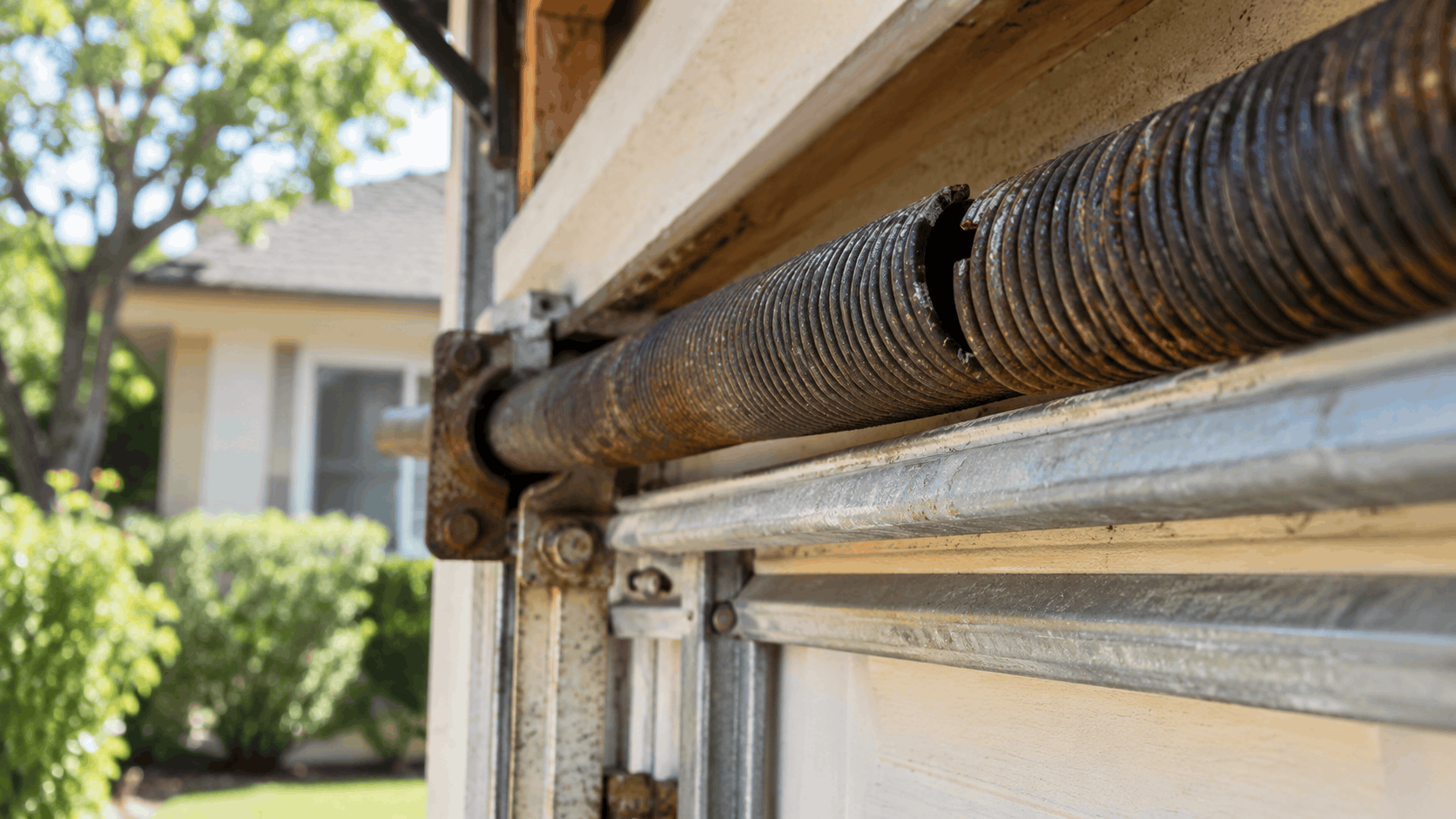
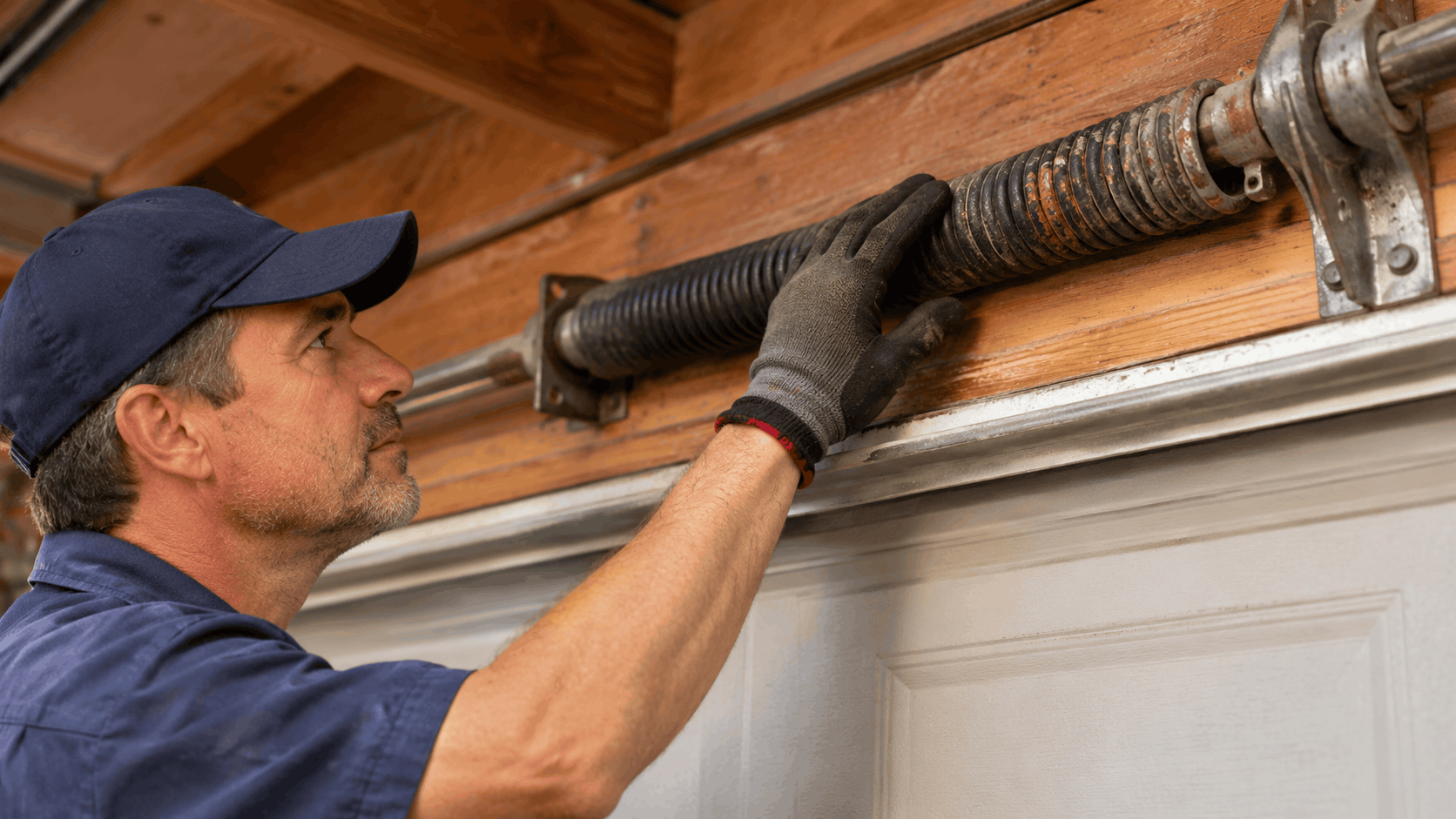
Look along the spring on the shaft above the door. A clean gap in the coil, where the spring has separated into two pieces, is the plainest confirmation. If the door suddenly refuses to open and the opener grinds against a dead weight, treat it as a spring until a tech confirms otherwise, and call for a door that will not open or close.
Why a Torsion Spring Is Not a DIY Job
A torsion spring stores an enormous amount of energy when wound, enough to cause serious injury or worse. It is wound under high tension and held with winding bars against a fixed cone on the shaft. There is no safe margin for error.
If a winding bar slips, or a cone is released incorrectly, that stored energy comes out instantly and violently. The bars become projectiles and hands get caught in the path. This is why the safety line is absolute: an owner must never adjust, wind, unwind or replace a torsion spring.
The job calls for the right bars, the right cones, springs sized to the door and the training to balance the system afterward. A licensed technician does this work every day with the correct tools. The cost of professional spring work is small next to a trip to the emergency room, which is the real alternative when a homeowner tries it.
The Balance Test Owners Can Run Safely
There is one safe check an owner can do that points straight at the spring. With the door down, pull the release cord to disconnect the opener. This puts the door in manual mode so you are feeling the door and its spring, not the motor.
Lift the door by hand to about waist height and let go. A correctly balanced door with a healthy spring stays put where you leave it. The spring is doing its job of offsetting the door's weight.
If the door falls shut or drifts upward on its own, the balance is off, and that is a spring problem, not an opener problem. Do not keep operating the door in that state. Our door balancing and tension adjustment service corrects exactly this, and if the test fails, reconnect the opener and call rather than wrestling the door.
Matching New Springs to the Actual Door
Springs are not one-size-fits-all. They are sized to the door's real weight and height, so a replacement set has to match the door on the garage, not a generic assumption. Guessing here leaves the door unbalanced and shortens the life of the new spring.
High-cycle springs exist for heavy daily use and for doors that serve as the main entrance, which describes a lot of Woodbridge garages. A high-cycle spring is rated for more cycles than a standard set, so it lasts longer under the same demanding use. For a door cycled many times a day, the upgrade often pays for itself in time between service calls.
If an owner is replacing the door itself with a heavier material, the springs must be matched to the new door rather than reused from the old one. A heavier insulated steel or carriage-house door needs more counterbalance than a light original door, and reusing the old set guarantees an early failure. Where owners switch spring systems entirely, our spring conversion work handles the sizing and setup.
The Pre-1993 Opener Problem in Older Tracts
So many original openers in Woodbridge lack photo eyes because the whole village's early hardware predates the rules that require them. An opener from the 1975 to 1985 phases was built before any federal entrapment-protection mandate, and it shows.
These units often still run, which is part of the trap. They lift and lower, so owners assume they are fine, while the actual safety systems a modern opener must have simply are not present. Knowing how to tell, what the law now requires, and when replacement beats repair keeps an old garage safe.
How to Tell If an Opener Predates the Safety Mandate
California moved first. AB 3600, passed in 1990, required openers to be manufactured with an automatic reverse device and sensor. Federal law followed for openers manufactured for the United States after 1993.
So the honest line for an old opener is simple: a unit made before 1993 predates the federal entrapment-protection mandate. Dates you may see floated elsewhere, like 1995 or 2011, are wrong for this rule.
The quickest field check is to look for the photo eyes. Modern openers have two small sensors mounted low on each side of the opening, wired back to the motor. An opener with no photo eyes mounted near the floor on each side predates the mandate, which fits a large share of untouched Woodbridge garages.
What UL 325 Requires of a Modern Opener
UL 325 is the safety standard a modern opener is built to, and in practice it is satisfied two ways at once. First, the door must reverse within two seconds of contacting an obstruction. That is the contact reverse, the mechanical catch when the door physically meets something.
Second, nearly all openers add a non-contact system, the photo eyes. These are mounted on each side of the opening no higher than six inches off the floor. When the beam between them is broken while the door is closing, the door stops and reverses before it ever touches whatever is in the way.
Together that gives two layers of protection, one that catches contact and one that catches the obstruction before contact. The photo-eye test and the two-by-four test, covered later, are how an owner confirms both layers still work on their door.
Repair or Replace an Old Opener
The manufacturer position, LiftMaster being one example, is that pre-1993 openers should be replaced rather than repaired, because they lack the entrapment protection every modern opener must have. Pouring money into a forty-year-old motor keeps an unsafe unit in service.
Replacement is also a chance to pick the right drive. Chain drives are the workhorse and the most affordable. Belt drives run quieter, which matters for the many Woodbridge homes with a bedroom or bonus room over the garage. Jackshaft units mount on the wall and drive the torsion bar directly, used where headroom is tight or storage fills the ceiling.
A pre-1993 opener is not illegal to own, but it does not have the safety systems a current opener carries. When the time comes, our opener installation team matches the drive type to the garage, and simpler faults on newer units can often be handled through opener repair and troubleshooting.
Battery Backup and the Law When You Replace in Woodbridge
There is one more rule that comes into play the moment an opener is installed or replaced in California, and it is easy to confuse with the entrapment rules above. It is a separate law, from a later year, with its own purpose. Keeping the dates apart matters.
This rule is about power outages, not about catching obstructions. It requires a battery backup so a resident can still open the door when the grid is down. For a Woodbridge owner replacing an aging opener, it changes what comes in the box.
What SB 969 Requires
SB 969, signed in 2018 and operative July 1, 2019, requires every residential automatic garage door opener manufactured for sale, sold, offered for sale or installed in California on or after that date to have a battery backup designed to operate during an electrical outage. Violations carry a $1,000 civil penalty.
The law was passed in response to deaths in the 2017 Northern California wildfires, where people could not open their garage doors during power cuts. The purpose is evacuation when the grid goes down and a resident cannot lift a heavy door by hand.
Since that date, a replacement residential garage door may not be installed connected to an opener that does not comply. The backup is built into the opener itself, so our battery backup installation is part of bringing an old Woodbridge garage up to current law.
It Applies to Installation and Replacement, Not Sitting Hardware
The rule applies to installation and replacement, not to leaving an existing opener in place. It does not force an owner to upgrade an opener that is simply sitting there and working.
So the old pre-1993 unit humming in a Woodbridge garage is not suddenly illegal to keep using. The law triggers when that unit is finally replaced.
That means a homeowner replacing an opener in Woodbridge is buying a battery backup unit whether or not they asked for one. It comes with the compliant opener as a matter of law, not as something added on request.
Why It Is Not an Upgrade Tier or a Fire-Zone Rule
Battery backup is a statewide legal requirement for residential openers, not a paid add-on that a company offers as a premium tier. Owners should expect it built into any compliant replacement, full stop.
It is also not a fire-zone, city or association rule. The requirement comes from SB 969 and applies statewide, not from Title 24, the energy code, and not from Title 19. It is tied to residential openers, not commercial operators.
So whether a home sits near South Lake or anywhere else in the village, the same rule applies when the opener is replaced. There is no local exemption and no premium version of it.
Need Help in Irvine?
Urgent Garage Doors serves Irvine and all of Orange County.
Woodbridge Association Approval and Irvine Permits
A garage door faces the street, which makes it a reviewed exterior change in Woodbridge. Before the first wrench turns on a visible door swap, there is paperwork, and it starts with the association. The city permit question is separate and turns on whether the opening itself changes.
Woodbridge is one of Irvine's oldest and most structured communities, with a master association and sub-associations beneath it. Getting the approvals right up front saves an owner from tearing out and redoing work later. The city of Irvine itself tells homeowners to check with their association, because a permit does not substitute for association approval.
Getting WVA Approval Before Work Starts
The Woodbridge Village Association, incorporated in 1976 and seated at 31 Creek Road, is the master association. Its Architectural Guidelines and Standards require nearly all exterior improvements to be approved before work commences, and garage doors are among the reviewed items.
The Home Improvement Application carries a $50 plan processing fee. Review runs 2 to 4 weeks, so this is not a same-week decision and should be started early. The approval letter expires 6 months from issue, which means the install has to happen inside that window or the owner reapplies.
Applications go to 31 Creek Road, the owner portal, or architectural@wva.org. The WVA recommends checking with Community Relations staff in advance to follow the right steps before starting, which is worth doing so the application lands complete the first time.
Two Approvals for Attached Homes and Color Rules
Attached homes, meaning townhomes and condominiums, answer to a sub-HOA as well as the WVA. Those owners can need two approvals for one door, and the smart move is to start both at once rather than in sequence, so the timelines overlap instead of stacking.
Treatments that draw attention to the door are prohibited across the village, in keeping with the uniform Cape Cod look. A door is meant to blend with the painted wood trim and siding, not stand out from it.
The Gables tracts carry a high-contrast color rule that differs from the rest of the village. A color that suits a neighboring tract can be wrong in the Gables, so owners there should confirm the color standard for their specific tract before ordering anything.
When the City of Irvine Requires a Permit
Irvine's building code generally requires a permit to erect, alter, repair or remove a structure, but the city lists an exemption for replacement doors having the same dimension as those being replaced, with no change to the structural frame or opening size. Such replacements must still conform to all technical codes on weatherproofing, security and energy efficiency.
So a like-for-like garage door swap in Irvine falls under that exemption. Widening the opening, altering the header or changing the structural frame does not, and that kind of work triggers a permit. Needing a permit also removes the under-$1,000 unlicensed-work exemption, which is one more reason structural changes belong with a licensed contractor.
The city with jurisdiction confirms the position for the specific job, so an owner planning anything beyond a straight swap should check with the Irvine building department. The Permit Processing Center is reached at 949-724-6313 and the Development Assistance Counter at 949-724-6308. A city permit never substitutes for WVA approval, and the two run on separate tracks.
What These Repairs Typically Cost in Orange County?
Owners want a sense of the numbers before they call. The ranges below are typical market ranges for garage door work in Orange County. They are not a quote and not a fixed price from us. The actual price for a specific garage depends on that garage and is given in writing before work begins.
These are presented so a reader knows what to expect for the parts that fail first on an older Woodbridge door. For any job over $500, California law requires a written home improvement contract, which is a legal protection for the homeowner.
| Job | Typical Orange County range |
|---|---|
| Torsion spring replacement | $150 to $300 |
| Extension spring replacement | $150 to $250 |
| Spring conversion | $150 to $350 |
| Cable repair | $150 to $300 |
| Opener installation | $250 to $600 |
| Opener repair | $75 to $200 |
| Battery backup installation | $200 to $400 |
| Smart Wi-Fi opener and MyQ setup | $150 to $300 |
| Quiet roller and hardware upgrade | $150 to $300 |
| Track repair and realignment | $125 to $300 |
| Safety sensor alignment and repair | $75 to $150 |
| Door balancing and tension adjustment | $75 to $150 |
Springs and Cables
Torsion spring replacement typically runs $150 to $300 in Orange County, and extension spring replacement typically runs $150 to $250. The difference reflects the spring type the door uses.
Spring conversion, moving from one spring system to another, typically runs $150 to $350. Cable repair typically runs $150 to $300.
On a forty-five-year-old Woodbridge door, these are the jobs that come up first and often come up together. A spring and a cable near the lakes tend to reach the end of their life around the same time, so pricing one without inspecting the other rarely tells the whole story.
Openers and Battery Backup
Opener installation typically runs $250 to $600, with a belt drive costing more than a chain drive. The belt is the quieter choice for the many Woodbridge homes with living space above the garage.
Opener repair typically runs $75 to $200, though on a pre-1993 unit replacement is the manufacturer position rather than repair. Battery backup installation typically runs $200 to $400, and since SB 969 the backup comes built into any compliant replacement opener.
Smart Wi-Fi opener and MyQ setup typically runs $150 to $300 for owners who want phone control and activity alerts. Our smart Wi-Fi opener and MyQ setup covers that configuration.
Rollers, Tracks and Safety Sensors
Quiet roller and hardware upgrade typically runs $150 to $300, which is a meaningful difference for a bedroom over the garage. Track repair and realignment typically runs $125 to $300, often needed on older doors where debris and age have pulled the track out of true.
Safety sensor alignment and repair typically runs $75 to $150, and this is frequently the fix for a door that reverses on its own. Door balancing and tension adjustment also typically runs $75 to $150.
Any of these jobs over $500 requires a written home improvement contract under California law. For sensor faults specifically, our safety sensor alignment and repair and track repair and realignment services address the two most common reasons an older door misbehaves.
Why Pairing Repairs Protects the Budget
The parts that fail first on these doors share a lifespan. Replacing a spring while the cables and rollers are already worn invites a second service call weeks later, when the fresh spring loads a tired cable past its limit.
Inspecting all the moving parts at once is how owners avoid back-to-back failures. A tech who weighs the door, checks the cables, spins the rollers and tests the opener in one visit can bundle the work that is genuinely due.
That approach saves a repeat trip charge and the frustration of a door that breaks again right after a repair. On a forty-five-year-old system, treating the door as a system rather than a single part is the honest path.
Safety Tests a Woodbridge Owner Can Run This Weekend
Three simple tests let any homeowner catch failing parts early, and they are well suited to the older doors common in these tracts. None of them involve touching the spring. They take a few minutes and tell you a lot about whether a door is safe and healthy.
Run them on a weekend morning with the car out of the way. If any test fails, stop using the door normally and call for service rather than risking the door or a person.
The Photo-Eye Test
With the door closing, wave an object through the opening to break the beam between the two low sensors. The door must stop and reverse. If it keeps closing, the safety system is not working.
Misaligned or blocked beams are the most common cause of a door that reverses for no visible reason. On a Woodbridge door, plant debris and dust coating the lens is a frequent culprit, since the village is so heavily planted.
If the sensors are dirty, wipe the lenses gently and try again. If the door still ignores the beam or reverses randomly after cleaning, the sensors likely need alignment or repair. This test only works on openers that actually have photo eyes, which many pre-1993 Woodbridge units do not.
The Two-by-Four Test
Lay a 2x4 flat across the opening, on the floor in the door's path. Close the door with the opener. When the door meets the board, it must reverse within two seconds of contact.
This is the auto-reverse check on contact, the mechanical safety layer that catches an obstruction the door physically touches. A door that does not reverse, or that keeps pushing against the board, has a contact-reverse fault that needs attention.
On an older opener, a weak or failing contact reverse is a sign the unit is past its safe life. Combined with a missing set of photo eyes, it is a strong case for replacing rather than repairing the opener.
What the Balance Test Tells You About the Spring
Run the balance test described earlier: release the opener, lift the door to waist height, and see if it stays put. That one check reads the health of the spring directly.
A door that will not hold position, that falls shut or drifts up, points straight at the spring. That is a job for a licensed technician, never a DIY fix, because of the stored energy in a torsion spring.
If the balance test fails, reconnect the opener so the door is not left in a dangerous manual state, and call. For a door that is unsafe to operate, our emergency garage door repair team can get it stabilized.
Need Help in Irvine?
Urgent Garage Doors serves Irvine and all of Orange County.
How Urgent Garage Doors Handles an Aging Woodbridge Door
We work these Woodbridge tracts regularly, from the detached homes inside the Yale Loop to the attached townhomes that answer to a sub-HOA. An aging door is treated as a whole system, not a single broken part, because that is what actually prevents a repeat failure.
Here is how a visit to a 1975 to 1985 Woodbridge door typically goes, drawing on what we actually offer.
Diagnosis Across Every Moving Part
The team inspects the springs, cables, rollers, hinges, bearings and the opener together. On a door this old, a broken spring almost always sits alongside worn cables and tired rollers, so checking everything at once keeps a fresh spring from loading a cable that is about to fail.
That full inspection is the difference between a lasting repair and a second call two weeks later. We look at the balance, the track, the fasteners in the wood jamb and the condition of the opener and its safety systems.
We carry common torsion spring sizes on our trucks, so a spring replacement is often completed on the same visit. Having the right spring on board means less waiting for the owner, though the exact job always depends on what the door needs.
Licensed Work and a Written Price
Urgent Garage Doors holds California license CSLB #1055150 under classification C-61/D-28, Doors, Gates and Activating Devices. That license, its status, bond and workers compensation can be verified free at cslb.ca.gov, where it is all public record.
We can give a written price before work begins, and we do when the job calls for it or the customer asks. For any work over $500, a written home improvement contract is required under California law, which protects the homeowner.
For owners thinking about a full door replacement, we offer a free on-site estimate, and removing and hauling away the old door is included with a new door installation. Our garage door installation work covers the sizing and permitting questions that come with swapping a door in Woodbridge.
Response Time Across Irvine
We take emergency calls 24 hours a day, 7 days a week, every day of the year including holidays. The response window is 30 to 60 minutes anywhere in Orange County, which covers every tract in Woodbridge.
The storefront is at 76 Ashford, Irvine, CA 92618, a short drive from the village. We work on all garage door brands, including LiftMaster, Chamberlain, Genie, Craftsman, Clopay, Amarr, Wayne Dalton and CHI.
Whether the call is a broken spring near South Lake or an old opener that will not close, the same crew and the same trucks cover the whole village. Our Woodbridge maintenance and upgrades page has more on the work we do right here.
Getting Your Aging Woodbridge Door Back in Shape
A forty-five-year-old door is a system that has outlived its original spring, and usually its cables, rollers and opener too. We inspect every moving part together, give you a written price before the work starts when the job calls for it, and carry common torsion springs on the truck so many repairs finish the same visit.
Call Urgent Garage Doors at (949) 529-7743 for 24/7 service across Orange County, or reach our team through the contact page to set up a visit for your Woodbridge home.
Frequently Asked Questions
- What usually fails first on a forty-five-year-old Woodbridge garage door?
- Torsion springs reach their cycle rating first and are the most common first failure. They do the heaviest work on every open and close, so on a door built in the 1975 to 1985 tracts they give out before anything else. Cables, rollers and bearings follow close behind, since they wear on the same clock. The original pre-1993 opener is usually the oldest part and the one lacking photo eyes.
- How long should a garage door spring last?
- A standard torsion spring is rated by the manufacturer for around 10,000 cycles, one cycle being a full open and close. For a typical household cycling the door four times a day, that works out to roughly seven years. On a Woodbridge home where the garage is the main entrance and the door cycles many times daily, a standard spring reaches that number noticeably faster, which is where high-cycle springs make sense.
- Why do springs and cables near the Woodbridge lakes wear sooner?
- Homes closest to North Lake and South Lake sit in the most humid pocket of the village, since both lakes are shallow and keep the surrounding air damp. That moisture drives corrosion on springs, cables and rollers, which brings those parts to the end of their cycle rating earlier than the same parts on inland tracts of the same age and build. A cable near the water tends to fray from corrosion before it ever snaps.
- Is it legal to keep an opener with no photo eyes?
- Yes, a pre-1993 opener is not illegal to own. But it lacks the entrapment protection every modern opener must have, including the photo eyes that stop a closing door when the beam breaks. The manufacturer position, LiftMaster for example, is that pre-1993 openers should be replaced rather than repaired, because they cannot be brought up to current safety standards with a repair.
- Do I need a battery backup if I replace my opener?
- Yes. SB 969 requires every residential automatic garage door opener sold or installed in California on or after July 1, 2019 to have a battery backup that operates during an electrical outage. The backup comes built into any compliant replacement opener, so a Woodbridge owner replacing an opener gets one whether or not they asked for it. It does not force you to upgrade an opener that is simply sitting in service.
- Do I need WVA approval to change my garage door?
- Yes. Garage doors are a reviewed exterior item under the Woodbridge Village Association's Architectural Guidelines, and nearly all exterior improvements must be approved before work begins. The Home Improvement Application carries a $50 plan processing fee, review runs 2 to 4 weeks, and the approval letter expires 6 months from issue. Attached townhomes and condos answer to a sub-HOA as well, so those owners may need two approvals and should start both at once.
- Does Irvine require a permit for a garage door replacement?
- Irvine lists an exemption for replacing a door of the same dimension with no change to the structural frame or opening size, so a like-for-like swap falls under that exemption. Widening the opening or altering the header does not, and that work triggers a permit. The city with jurisdiction confirms the position for the specific job, and a permit never substitutes for WVA approval.
- Can I replace a broken spring myself?
- No. A torsion spring stores enough energy to cause serious injury and is wound under high tension with bars against a fixed cone. An owner must never adjust, wind, unwind or replace one. The only safe spring-related check for a homeowner is the balance test, and if it fails, the repair belongs to a licensed technician with the correct tools and a spring sized to the door.
- How much does a spring or opener repair cost in the area?
- Typical Orange County ranges are torsion spring replacement $150 to $300, opener repair $75 to $200, and opener installation $250 to $600, with a belt drive costing more than a chain drive. These are typical market ranges, not a quote. The actual price for a specific garage depends on that garage and is given in writing before work begins, and California law requires a written home improvement contract for work over $500.
- How fast can someone come out to a Woodbridge home?
- We take emergency calls 24 hours a day, 7 days a week, every day of the year, and the response window is 30 to 60 minutes anywhere in Orange County, which covers every tract in Woodbridge. The storefront at 76 Ashford in Irvine sits a short drive from the village, so a crew can reach homes inside or outside the Yale Loop quickly for a broken spring or a door stuck shut.
Licensed garage door repair professionals serving Irvine and Orange County.
Licensed in California · License #1055150
Why trust Urgent Garage Doors?
Founded in 2017, Urgent Garage Doors is a licensed and insured garage door services serving Irvine and Orange County. All content is reviewed by our licensed technicians.
Need Help in Irvine?
Urgent Garage Doors serves Irvine and all of Orange County.
Related Articles
Garage Door Cable Replacement on Balboa Island After Salt Corrosion
Salt air off Newport Harbor corrodes garage door cables from the inside out on Balboa Island. Learn the warning signs, the repair, costs, and how access and the Coastal Zone shape the job.
Garage Door Roller and Hinge Replacement in Tustin Ranch at Thirty Years
Tustin Ranch homes built in the late 1980s and 1990s have rollers and hinges at or past design life. Learn the signs, the fix, the cost ranges and how the local team handles the job.

Woodbury Irvine Garage Door Service: Builder-Grade Issues at 10-15 Years
Woodbury Irvine homes built 2004-2012 are hitting the 10-15 year garage door failure window. Learn the warning signs, repair costs, HOA rules, and local service options.