Tips & Advice
California Wind Load Ratings for Garage Doors: Coastal vs Inland Requirements
Key Takeaways
- Wind load ratings measure how much wind pressure a garage door can take, shown as PSF design pressure on the door's label.
- The garage door is the largest opening in most homes, so a failure there can lead to roof and wall damage across the whole structure.
- The California Building Code sets minimum wind speeds and design pressures, and local city amendments in places like Irvine can make the rules stricter.
- Coastal homes near Newport Coast, Corona del Mar, and Balboa Peninsula need higher PSF ratings and corrosion-resistant hardware to fight salt air.
- Inland Irvine homes near Turtle Rock and Portola Springs face sudden Santa Ana gusts and canyon wind, so ratings still matter even if base pressures are lower.
- A wind rating only holds if the door is installed to manufacturer specs and maintained, with seasonal checks for corrosion on the coast and dust inland.
- Retrofit kits with struts can reinforce a sound door, but bowed, rusted, or worn doors are better replaced with a new rated unit.
- A full garage door replacement in Irvine usually needs a permit and inspection to confirm the door meets its required design pressure.
In This Article
Every fall, when the Santa Ana winds start howling down through the canyons and off the ocean, our phones light up. A homeowner near the Balboa Peninsula watches her garage door flex and rattle in a strong gust. A family up in Turtle Rock hears a bang and finds the bottom panel bowed inward after a dry, windy night. These calls are common across Orange County, and they almost always trace back to one thing: a garage door that was never built to handle the wind load it faced.
Wind load ratings are the quiet detail most people ignore until something goes wrong. They tell you how much wind pressure a garage door can take before it buckles, blows in, or tears loose from its tracks. In California, the rules that govern those ratings are not the same everywhere. A home two miles from the water in Newport Coast may need a very different door than one tucked into a Woodbridge cul-de-sac inland.
What Wind Load Ratings Actually Mean for a Garage Door
A wind load rating is a number that tells you how much force a garage door can resist without failing. It is measured in pounds per square foot, and it accounts for both the wind pushing against the door and the wind trying to pull it outward. Most homeowners never think about it because a garage door looks solid and heavy.
The problem is that a garage door is a large, flat surface with moving parts. When a strong wind gust hits it, that door has to transfer a huge amount of force into the walls and the header above it. If the rating is too low, the door becomes the first thing to give out.
- The rating covers both inward and outward pressure
- It is tied to your local wind speed and exposure
- A higher number means a stronger, better-braced door
- The rating only holds if the door is installed correctly
How Wind Pressure Pushes and Pulls on a Door
Wind does not just blow straight at your house in one direction. When a gust hits the front of your garage, it creates positive pressure that pushes the panels inward toward your cars and storage. That is the force most people picture when they think about wind damage.
At the same time, wind flowing over and around the house creates negative pressure on other faces. This suction tries to pull the door outward, away from the opening. A single wind gust can hit a door with both forces at once as it swirls around the building.
This push and pull is what makes garage doors bow in the middle or pop out of their tracks. The panels are wide, so even moderate wind pressure adds up to thousands of pounds of total force. A rated door is engineered to hold its shape under that combined load.
We have seen doors along the coast that survived years of normal weather fail in a single strong storm. The failure almost always starts at the weakest panel joint, where positive and negative pressure work against each other. That is exactly what the rating is built to prevent.
Why the Garage Door Is a Home's Weakest Point
For most houses in Orange County, the garage door is the largest opening in the entire structure. A double door can span 16 feet or more, which is a massive area for wind to press against. That size alone makes it the most vulnerable spot on the whole building.
When a garage door blows in during a wind event, the danger does not stop at the door. Suddenly the wind is inside the garage, pushing up on the roof and out against the walls. This internal pressure is a leading cause of structural failure in high wind.
Once wind gets under the roof, it can lift trusses, blow off shingles, and cause serious roof damage in seconds. Insurance adjusters see this pattern over and over after big storms. A failed garage door often means tens of thousands of dollars in repairs that spread far beyond the garage itself.
This is why building codes treat the garage door as a critical part of the home's wind resistance. Protecting that one large opening protects the entire structure. It is the single upgrade with the biggest payoff during a wind event.
Reading a Wind Load Rating Label
Every wind-rated garage door carries a label, usually on the inside of one of the panels or the track. This label lists the design pressure, shown as a PSF number for both positive and negative loads. A door rated for +30/-33 PSF, for example, can take 30 pounds per square foot pushing in and 33 pounds pulling out.
The label also references the testing standard the door met and often the wind speed it was designed for. Higher PSF numbers mean the door passed tougher tests and can handle stronger conditions. Coastal doors carry higher numbers than most inland doors.
If you cannot find a label, that usually means the door was never rated at all. Many older homes across Irvine and the surrounding cities have builder-grade doors with no wind rating on record. When we service a door, checking for that label is one of the first things our team does.
Knowing your door's PSF rating lets you compare it against what your address actually requires. If the number falls short, the door may not pass inspection during a replacement or upgrade. It also tells you whether reinforcement is even possible.
Terms Homeowners Hear: DP, ASCE, and PSF
When people shop for a rated door, they run into a wall of acronyms. DP stands for design pressure, which is the same PSF number we just described. It is the core rating that says how much wind force the door can handle.
ASCE 7 is a national standard from the American Society of Civil Engineers that engineers use to calculate wind loads. The California Building Code pulls its wind rules from this document. You can read more about the standard through the American Society of Civil Engineers.
Wind speed shows up as a number in miles per hour, based on the fastest gusts your area is expected to see. A higher design wind speed means a higher required design pressure for your door. These three terms work together to define what your home needs.
You do not need an engineering degree to use these terms. Just remember that DP and PSF describe the door, while ASCE 7 and wind speed describe the demand placed on it. Match the two and you have the right door.
Get Your Free Quote
Tell us about your garage door and we'll get back to you fast.
California Building Code and Wind Load Requirements
The California Building Code, or CBC, sets the baseline for how strong a garage door must be. It borrows wind load math from the ASCE standard and applies it based on where your home sits. Local cities then layer their own amendments on top of the state rules.
For garage doors specifically, this means the door you buy has to meet a minimum design pressure for your wind zone. When you replace a door, a building permit may be required, and an inspector may check the rating. These wind load requirements are not optional in most cases.
| Factor | What It Controls | Who Sets It |
|---|---|---|
| Basic wind speed | Minimum design pressure | State CBC / ASCE 7 |
| Exposure category | Terrain and surroundings adjustment | Local building department |
| Local amendments | Extra requirements per city | City building department |
| Permit and inspection | Verification of compliance | City inspector |
How the CBC Sets Minimum Wind Speeds
The CBC uses a basic wind speed map to divide the state into zones. Each zone has an assigned wind speed in miles per hour, which reflects the strongest gusts expected there. Most of Orange County falls in the range of about 95 to 110 mph for standard homes.
That basic wind speed feeds directly into the required design pressure for your garage door. A higher mapped wind speed pushes the required PSF number up. This is why the same door model may pass in one area and fail in another.
The wind speed map is not something homeowners usually read on their own. Builders, engineers, and inspectors reference it during permit review. You can find the underlying rules through the California Building Standards Commission.
When our team quotes a rated door, we start with the mapped wind speed for the property. From there we work out the minimum rating and then recommend a door that meets or beats it. That keeps the install compliant from day one.
Local Amendments from City Building Departments
State code is only the starting point. Cities across Orange County can adopt local amendments that make the rules stricter for their area. These changes account for local terrain, past storm damage, or fire concerns.
The Irvine building department, for example, reviews permits with an eye on the city's mix of coastal influence and canyon exposure. A home in one part of the city may face different expectations than one a few miles away. Code compliance means meeting both the state rule and the local one, whichever is tougher.
Nearby cities like Newport Beach and Costa Mesa often have their own take on wind and coastal requirements too. This is why a door that passed in one city is not automatically fine in the next. Checking the specific city's rules before buying saves headaches later.
We deal with these local building departments regularly, so we know which cities ask for what. When we handle a permit for a client, we build the paperwork to match that city's exact standard. It keeps the inspection smooth and avoids costly do-overs.
When a Permit and Inspection Are Required
Not every garage door job needs a permit, but a full replacement usually does. Swapping the entire door and often the tracks changes a structural element of the home. That triggers the permit and inspection process in most Orange County cities.
During inspection, the inspector checks that the installed door matches its rated design pressure. They look at how the tracks are anchored, whether the required struts are present, and whether the label is intact. A missing or wrong rating can fail the inspection.
Simple repairs, like a torsion spring replacement or a new roller, generally do not need a permit. The line gets crossed when you replace the door itself or alter the structure. When in doubt, our team confirms the requirement before starting.
Getting a permit is not just red tape. It creates a record that your door meets code, which matters for resale and insurance. We handle this step for clients so they are covered if a claim or sale ever comes up.
Exposure Categories and Your Property
Wind exposure categories describe what surrounds your home and how that affects wind. Category B covers areas with lots of trees, buildings, and obstructions that slow the wind down. Most suburban interior neighborhoods fall here.
Category C applies to open terrain with scattered obstructions, like flat open field areas or homes on the edge of development. Wind moves faster over open ground, so the required design pressure climbs. Category D is the harshest, covering homes near open water where nothing slows the wind.
Your exposure category can raise your required rating even if your mapped wind speed stays the same. A home facing an open canyon or the ocean often lands in C or D. That single factor can push a door from a modest rating up to a much stronger one.
When we survey a property, we look at the terrain in every direction. A house backing up to open hills or water needs a harder look than one buried in a dense tract. That survey shapes the exact door we recommend.
Need Help in Irvine?
Urgent Garage Doors serves Irvine and all of Orange County.
Coastal Wind Load Requirements in Southern California
Homes near the water face the toughest wind conditions in the county. There is nothing offshore to slow the wind before it slams into the house. On top of that, salt air chews through hardware that holds a door's rating together.
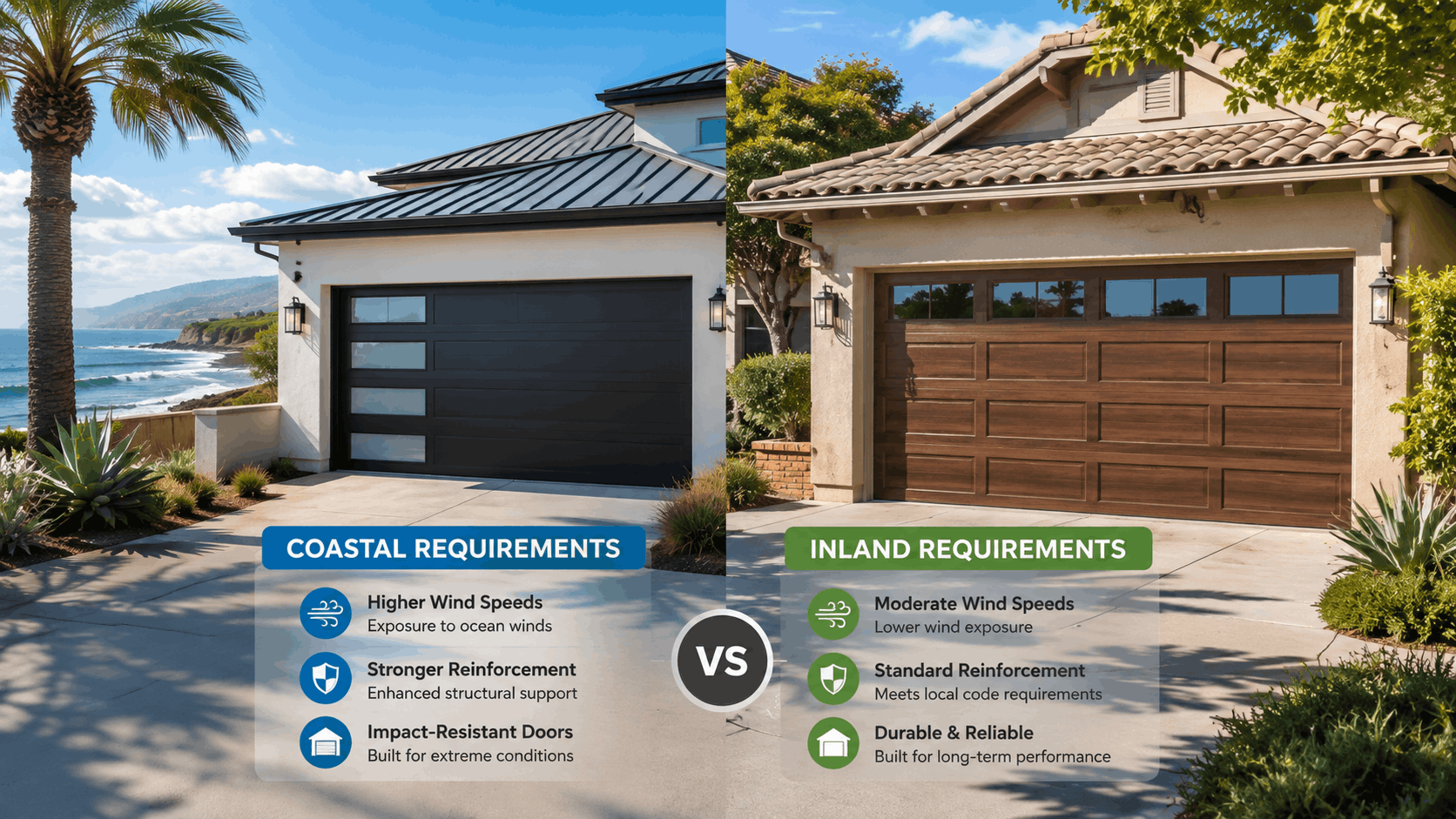
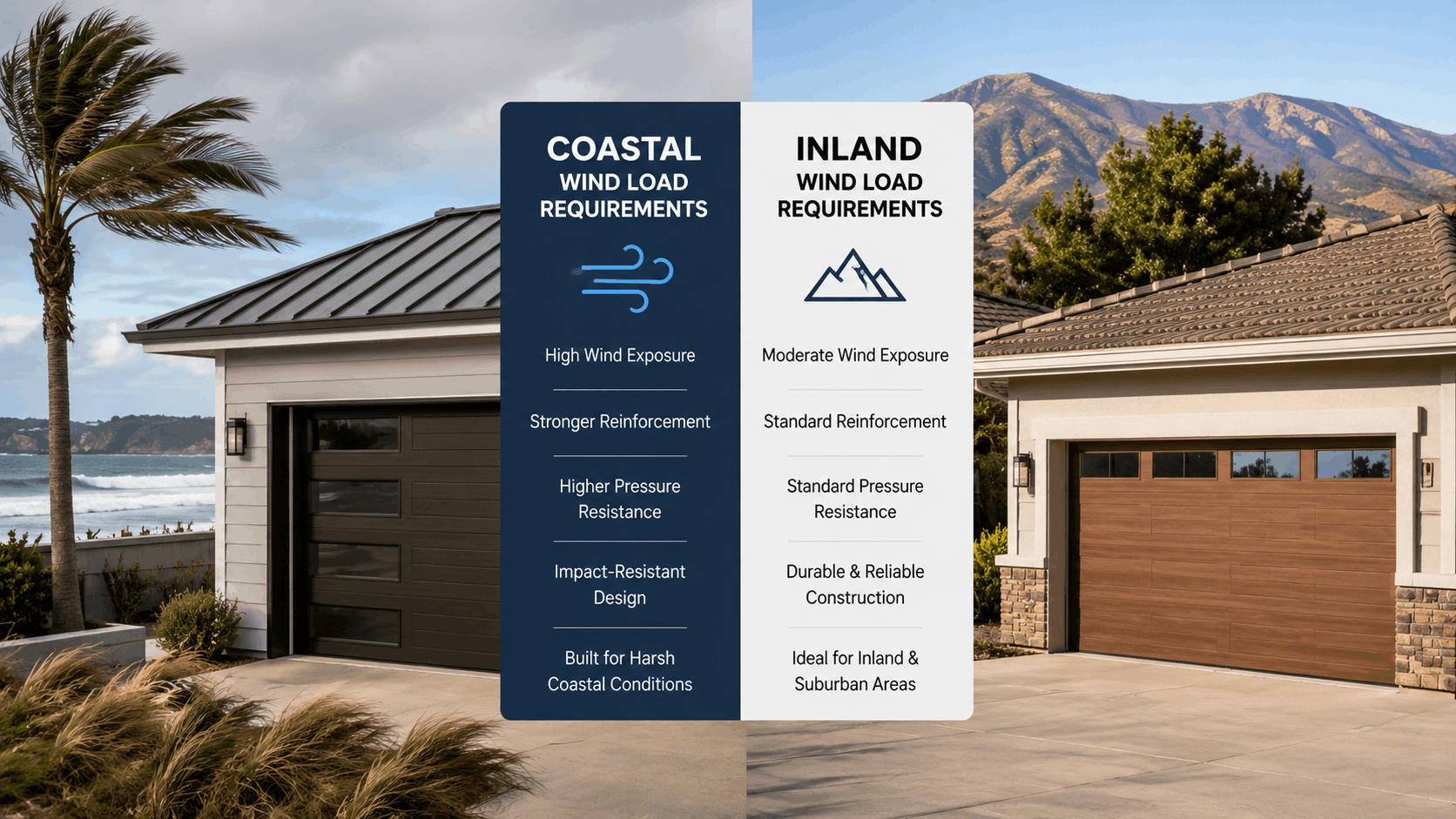
Coastal wind load requirements are stricter for a reason. A high wind zone near the ocean demands higher design pressures and corrosion-resistant parts. Homes in these areas need doors built to a different standard than inland tracts.
- Higher required PSF ratings than inland zones
- Salt air corrosion attacks tracks and hardware
- Open exposure to the ocean raises the load
- Reinforcement and coatings matter more
Higher Design Pressures Near the Ocean
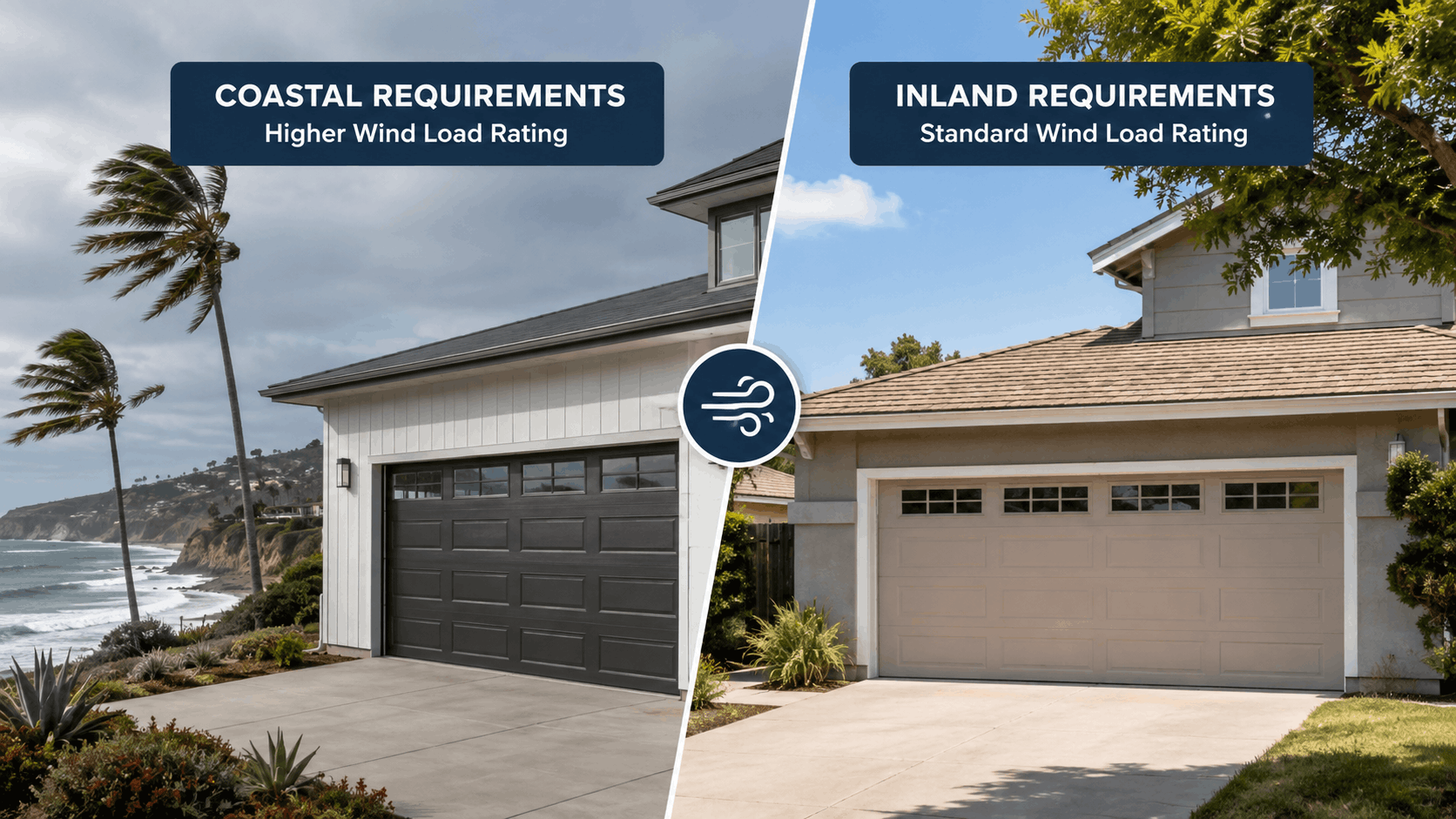
Coastal properties often sit in exposure category C or D, which drives the design pressure up. A door that would pass inland at +25/-25 PSF may need +35/-40 PSF near the water. That jump reflects the raw force of unobstructed ocean wind.
The coastal zone also sees more sustained wind, not just brief gusts. Doors here get worked harder over their whole lifespan, not only during storms. A higher PSF rating gives the margin needed to survive years of that pounding.
Homeowners near the water in areas served by our Newport Beach team often are surprised at the rating they need. The number can be noticeably higher than what a friend inland was told. That is the ocean exposure at work.
We size coastal doors to the PSF rating the property actually requires, then add a buffer where it makes sense. Cutting it close on a coastal home is a gamble we do not recommend. The cost difference is small next to the risk of a blown-in door.
Salt Air and Corrosion on Rated Hardware
Salt air is relentless on metal. Near Newport Beach and Laguna, the salt in the air settles on hinges, tracks, springs, and the reinforcement struts that hold a door's rating. Over time, that corrosion weakens the very parts the rating depends on.
A door can start with a strong rating and quietly lose it as the hardware rusts. Rusted hinges crack, corroded struts lose strength, and pitted tracks let rollers bind. When those parts fail, the door no longer performs to its label.
This is why galvanized hardware and stainless fasteners matter so much on the coast. Galvanized and coated parts resist salt far longer than plain steel. Down in South Laguna, we see the difference clearly between homes that used coated hardware and those that did not.
Regular service is part of keeping a coastal door rated. We inspect and swap corroded parts before they compromise the whole system. A little upkeep protects the big investment in the door itself.
Neighborhoods That Feel the Ocean Wind Most
Some Orange County neighborhoods take the ocean wind full force. Corona del Mar sits on bluffs that catch steady onshore wind with little to block it. Newport Coast homes on the higher lots face the same exposed conditions.
The Balboa Peninsula is another spot where wind and salt hit hard from multiple directions. Homes there are nearly surrounded by water, so exposure is about as high as it gets. Our Balboa Peninsula service area keeps us busy with wind and corrosion work.
These coastal neighborhoods share a pattern. The homes closest to open water and on higher ground need the strongest doors. A house one street back and shielded by other buildings may need a little less, but not much.
We know these streets because we work them constantly. When a homeowner in one of these areas calls, we already have a good idea of the rating and hardware they will need. Local knowledge saves guesswork.
Reinforcement Options for Coastal Doors
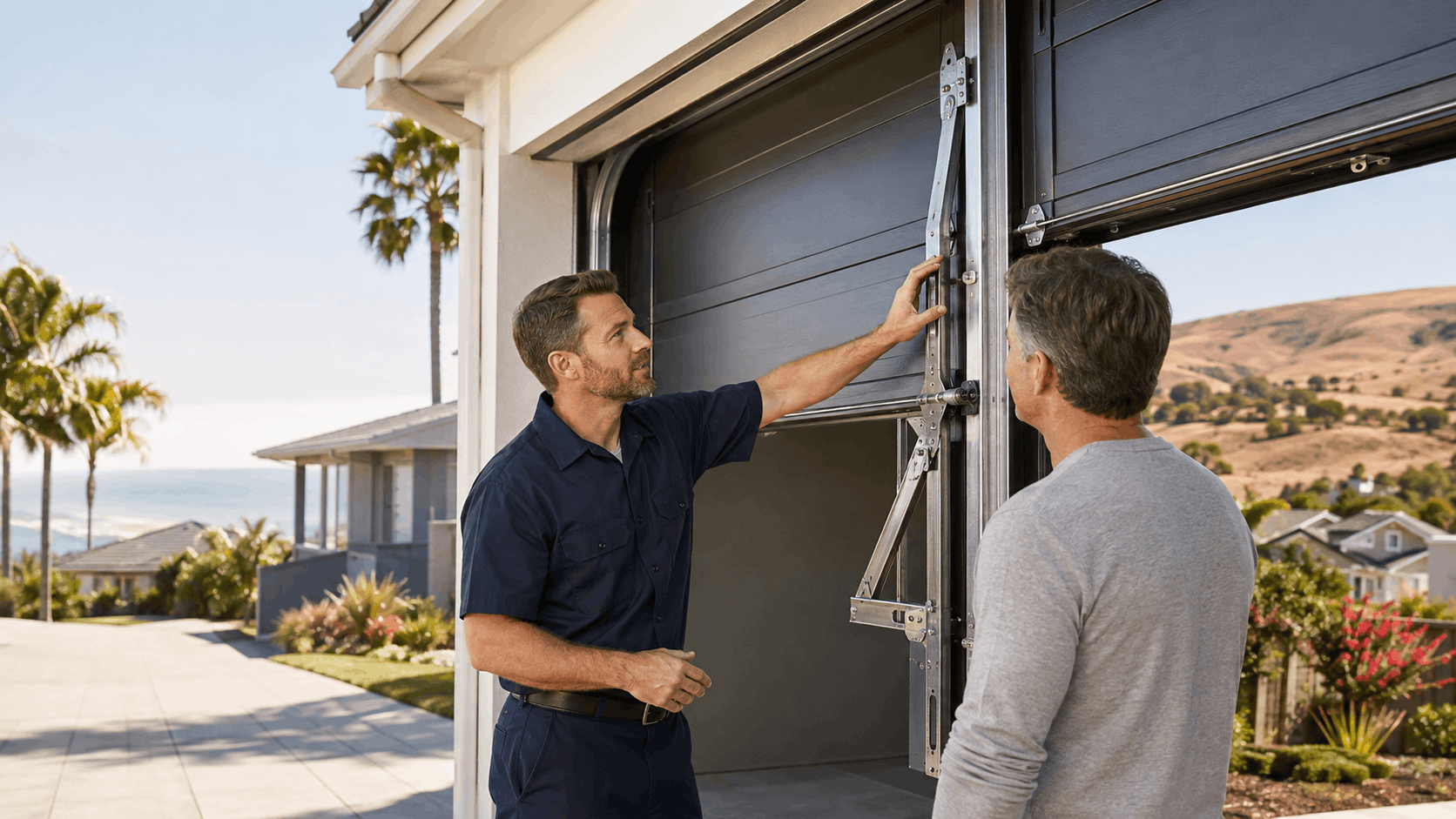
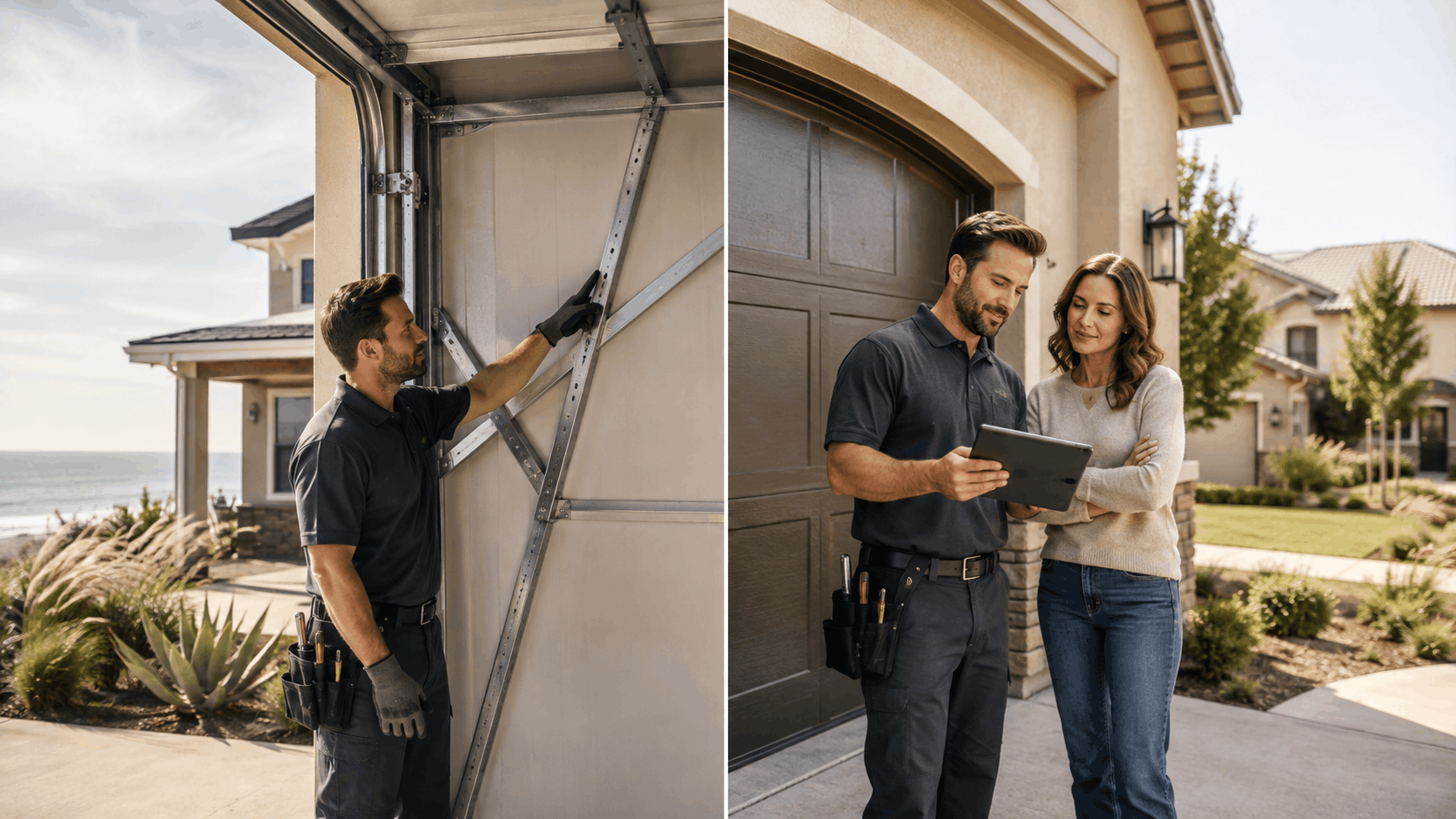
A coastal door often needs reinforcement to hit its required rating. Wind struts are horizontal braces bolted across the back of each panel to stiffen it against bowing. The more struts a door carries, the higher its design pressure can climb.
Heavier gauge steel is another route. A lower gauge number means thicker steel, which resists both wind and dents. Coastal doors frequently use a heavier steel gauge than the builder-grade minimum found inland.
For homes that want glass, impact-rated glass panels keep the look without giving up strength. Standard glass can shatter under a strong gust, but impact glass is built to hold. Our modern glass garage door installs can be specified with the right glass for coastal exposure.
Choosing the right mix of struts, gauge, and glass is where experience pays off. We match the reinforcement to the exact rating the home needs. That way the door looks good and holds up when the wind arrives.
Inland Wind Load Requirements Around Irvine
Inland homes face a different kind of wind. Instead of steady ocean pressure, they deal with dry, sudden bursts that funnel through canyons and valleys. The Santa Ana winds are the main event, and they can be violent when they arrive.
Inland wind load ratings are often lower than coastal ones, but the risk is real. A strong canyon wind or a Santa Ana gust can still push a weak door past its limit. Homes near the foothills feel this most.
Santa Ana Winds and Sudden Gust Loads
Santa Ana winds are dry, seasonal winds that blow from the desert toward the coast. They pick up speed as they squeeze through mountain passes and canyons. By the time they reach Irvine neighborhoods, a single gust load can hit hard and without much warning.
What makes these winds tricky is their suddenness. A calm afternoon can turn into a series of sharp gusts in minutes. A door rated for steady wind may still get jolted by a Santa Ana burst that spikes well above the average.
These seasonal winds usually peak from fall into winter. That is when we get the most inland calls about rattling, bowing, or off-track doors. The pattern is predictable enough that we plan for it every year.
An inland door does not need coastal-level ratings, but it does need enough margin to shrug off a strong gust. We factor the Santa Ana pattern into our recommendations for foothill and canyon-adjacent homes. Ignoring it is how doors fail during wind season.
Canyon and Foothill Communities With Higher Exposure
Not all inland homes face the same wind. Communities near the foothills and open canyons catch stronger wind than homes buried in flat tracts. Turtle Rock, with its elevation and canyon edges, sees more wind than many people expect.
Portola Springs sits closer to the open hills on the eastern side of Irvine, which raises its exposure. Homes on the outer edges of these communities face wind with less around them to slow it down. We service both areas often, including Turtle Rock and Portola Springs.
The foothill effect can bump a home from exposure category B into C. That change alone raises the required design pressure. Two homes in the same city can end up needing different doors based on this.
When we survey a foothill or canyon home, we treat the exposure seriously. These are the inland properties most likely to need extra reinforcement. Getting the rating right here matters more than in a sheltered interior tract.
HOA Rules in Master-Planned Communities
Irvine is full of master-planned communities with their own design rules. Woodbridge, one of the older planned villages, has HOA guidelines that govern how garage doors look. The Great Park Neighborhoods have their own set of standards too.
These HOA rules usually cover color, style, and panel design rather than the wind rating itself. But they narrow your choices, so you have to find a door that is both HOA-approved and properly rated. That is not always as simple as it sounds.
We work with homeowners in Woodbridge and across the Great Park area to find doors that clear both hurdles. The right door meets the wind requirement and satisfies the HOA design committee. Skipping the HOA step can mean tearing out a brand new door.
Our familiarity with these communities speeds the whole process. We know which door lines tend to get HOA approval in each village. That saves clients from submitting choices that get bounced back.
Lower Base Pressures but Real Risks
Inland ratings are generally lower than coastal ones. A sheltered Irvine tract home might need a design pressure well below what a Newport Coast home requires. That lower number can tempt people to treat wind rating as a non-issue.
That would be a mistake. A single strong wind event can still exceed the capacity of an unrated or worn-out door. Every wind season we see inland doors fail because they had no rating to begin with.
There is also the fire angle. Santa Ana wind season overlaps with fire season, and a compromised door can let embers and wind into a garage. A solid, well-sealed door adds a layer of protection during those dangerous stretches.
So even inland, the rating matters. We help homeowners pick an inland rating that handles the realistic worst case for their spot. It is cheap insurance against a very expensive failure.
Coastal vs Inland: Side-by-Side Comparison
Homeowners planning a purchase want a straight comparison. The coastal vs inland question comes down to a few clear differences in rating, materials, and cost. This wind load comparison should make the choice easier.
The right garage door rating depends on where your home sits and what surrounds it. The table below lays out the typical contrasts we see across Orange County. Use it as a starting point, then confirm your exact requirement.
| Factor | Coastal Homes | Inland Homes |
|---|---|---|
| Typical PSF range | +30 to +45 PSF | +20 to +30 PSF |
| Exposure category | C or D | Mostly B, some C |
| Main threat | Steady ocean wind, salt | Santa Ana gusts, fire |
| Recommended hardware | Galvanized, stainless | Standard coated steel |
| Cost range (installed) | $1,800 to $4,500+ | $1,200 to $3,000 |
Rating Numbers and PSF Differences
The clearest difference is the PSF range. Coastal doors commonly land in the +30 to +45 PSF band, while inland doors often sit in the +20 to +30 range. That gap reflects the harsher exposure near the water.
These numbers are typical, not universal. A specific address can push higher or lower depending on its exposure category and local amendments. A rating comparison based on the map alone can miss the terrain factor.
The design pressure you need is the floor, not the ceiling. Buying a door a step above the minimum gives you margin for a bad storm. On the coast especially, that margin is worth the small added cost.
We always pull the actual required design pressure for a property before quoting. That way the rating comparison is based on real numbers, not a general guess. It keeps the door properly matched.
Material and Finish Choices
Material choice shifts with the environment. Coastal homes benefit from galvanized steel, aluminum, or composite panels with a corrosion-resistant finish. The salt air punishes any exposed bare metal.
Inland homes deal with dry heat and dust rather than salt. Standard coated steel holds up well there, though the coating still matters under strong sun. A quality finish protects the panel color and resists fading.
The finish is not just cosmetic. A good coating slows corrosion on the coast and resists chalking inland. Choosing the right coating for your zone extends the life of the door by years.
Our team steers coastal clients toward corrosion-resistant packages and inland clients toward heat-stable finishes. The material and finish should match the enemy your door will face. That single decision drives long-term durability.
Cost Ranges and Long-Term Value
Cost tracks with the rating and materials. Inland rated doors installed often run roughly $1,200 to $3,000. Coastal doors with higher ratings and corrosion-resistant hardware can run from $1,800 to $4,500 or more.
The higher coastal price buys real long-term value. A properly rated, corrosion-resistant door survives years of salt and wind that would destroy a cheaper unit. Spread over its lifespan, the extra cost is small.
Cutting corners usually costs more later. A door that fails in a storm brings repair bills far above the savings. Durability is the smarter measure than the sticker price alone.
When we quote a garage door installation, we lay out the cost against the expected lifespan. Homeowners can then see the value, not just the price. That helps them choose with confidence.
How to Confirm Which Zone Your Home Falls In
Do not guess your wind zone. Start by checking the CBC wind speed map and noting your basic wind speed. Then look at your surroundings to estimate your exposure category.
The most reliable step is to call your local building department. They can confirm the required design pressure for your address, including any local amendments. This zone lookup removes the uncertainty.
Your city's building department knows its own rules better than any online tool. For Irvine homes, a quick call clarifies the exact requirement. Nearby cities each have their own contact for this.
We handle this confirmation for our clients as part of the quote. We check the map, assess the exposure, and verify with the building department when needed. That way the door we install is matched to the real zone requirement.
Need Help in Irvine?
Urgent Garage Doors serves Irvine and all of Orange County.
Choosing a Wind-Rated Garage Door for Your Home
Picking a wind-rated garage door comes down to matching the rating, the material, and the features to your home. The goal is a door that meets your wind requirement, fits your style, and stays in budget. Reinforcement fills the gap when a standard door falls short.
The choice is easier once you know your zone and required design pressure. From there, the material and options follow. We walk homeowners through each step so the final door fits the address and the family.
Matching the Rating to Your Address
The first rule is simple: the door rating must meet or exceed your address's wind requirement. If your property needs +30 PSF, a +25 door will not pass and should not be trusted. Aim for the requirement or a step above.
Buying above the minimum is a smart move in high-exposure spots. A coastal or foothill home gains real protection from that extra margin. The cost bump for one rating step up is usually modest.
Never assume a door is rated just because it looks sturdy. Many stock doors carry no rating at all. Checking the label against your address requirement is the only way to be sure.
We size every door to the specific property, not a generic guess. The door rating we recommend is tied to your exact wind requirement and exposure. That match is the foundation of a safe install.
Steel, Aluminum, and Composite Options
A steel door is the most common choice and handles wind well when properly gauged and strutted. Heavier gauge steel resists both wind and impact. An insulated steel garage door adds strength and temperature control at once.
Aluminum is lighter and resists corrosion, which makes it attractive near the coast. It can dent more easily than steel, so glass-and-aluminum designs often pair with impact glass. The trade-off is weight and cost.
Composite doors mimic wood while resisting rot and salt. They hold up well in coastal conditions where real wood would fail. For homes wanting a wood look on the water, composite is often the practical answer.
Each material performs differently under wind and salt. We match the material to the zone and the look the homeowner wants. That balance gives a door that lasts and still fits the neighborhood style.
Insulation, Windows, and Rating Impact
Insulation does more than control temperature. Insulated panels are usually thicker and stiffer, which can support a higher wind rating. A door with a solid R-value often braces better against bowing.
Window panels cut the other way. Adding glass can lower a door's rating unless impact-rated glass and proper framing are used. The window count and placement affect how much wind the door can take.
The trick is balancing looks and strength. A homeowner who wants a row of windows can still get a strong door with the right glass spec. It just needs to be planned, not added as an afterthought.
We explain how each option shifts the rating before the order goes in. That way the finished door has the insulation and windows the family wants without sacrificing the wind rating. The plan comes together on paper first.
Retrofit Kits Versus Full Replacement
Sometimes an existing door can be reinforced instead of replaced. A retrofit kit adds wind struts and bracing to a sound door, raising its resistance. If the panels and hardware are in good shape, this can be a cost-effective fix.
Bracing works best on doors that are structurally solid to begin with. If the panels are already bowed, rusted, or damaged, adding struts will not restore the rating. At that point a full replacement is the honest answer.
Age matters too. An older door with worn tracks and corroded hardware is usually not worth reinforcing. The money is better spent on a new rated door with a fresh warranty.
We assess each door on its own merits. When bracing makes sense, we say so, and when replacement is smarter, we explain why. Our maintenance and upgrade team handles both paths honestly.
Installation, Maintenance, and Keeping the Rating Valid
A wind rating is only as good as the installation and upkeep behind it. Even the strongest door loses its rating if it is anchored wrong or left to corrode. Keeping the wind rating valid takes proper installation and steady maintenance.
This is especially true in California's tough conditions. Salt on the coast and heat and dust inland both wear on a door. Regular attention keeps the rating you paid for intact.
Why Proper Installation Protects the Rating
A door's rating assumes it was installed exactly to the manufacturer's specs. That means the right anchoring into the framing, the correct fasteners, and every required strut in place. Skip any of those and the rating no longer applies.
Incorrect anchoring is a common failure point. If the tracks are not bolted into solid framing, the whole door can tear loose in a strong wind. The panels might hold, but the connection to the house gives way.
Missing struts are another silent problem. A door rated with three struts installed with two is not rated anymore. Cutting that corner voids the whole rating and the protection it was supposed to give.
We install rated doors strictly to spec, with every anchor and strut the rating requires. That discipline is what makes the label mean something. A perfect door installed poorly is still a weak door.
Seasonal Checks for Coastal and Inland Homes
Different zones need different maintenance checklists. Coastal homes should be checked for salt corrosion on hinges, springs, tracks, and struts a couple of times a year. Rinsing salt off and lubricating moving parts slows the damage.
Inland homes battle dust and heat instead. Dust builds up in tracks and rollers, and heat can dry out lubrication fast. A seasonal cleaning and re-lube keeps the door moving smoothly through Santa Ana season.
Both zones benefit from tightening bolts and checking the balance. Wind and daily use loosen hardware over time. A quick seasonal pass catches small issues before they grow.
Our preventive maintenance plan is built around these seasonal needs. We tune the checklist to whether the home is coastal or inland. That keeps the rating and the door performing year after year.
Signs a Door No Longer Meets Its Rating
Doors give warning signs before they fail. Bent struts are a clear red flag, since a bowed strut cannot brace the panel anymore. If you see a strut that is no longer straight, the rating is compromised.
Rust is another warning, especially on the coast. Rust on hinges, springs, or fasteners means those parts are losing strength. Rust around the track anchors is particularly serious.
A loose track or panel bowing tells you the door is already flexing more than it should. Panel bowing under moderate wind means the door cannot handle a strong gust. These signs call for prompt attention.
If you notice any of these, get the door inspected before wind season peaks. Our team can tell you whether a repair restores the rating or a replacement is needed. Catching it early is always cheaper.
How Our Irvine Team Handles Rated Installs
Urgent Garage Doors works across Irvine and the surrounding coastal and inland communities every day. We handle rated installs from the first survey through the final inspection. That includes verifying your wind zone and pulling the right permit.
Our installation service follows manufacturer specs to the letter so your rating holds. We anchor into solid framing, install every required strut, and confirm the label matches your requirement. From the coast in Newport Beach to the foothills in Irvine, we adjust the build to the local conditions.
We also service rated doors long after the install. Seasonal maintenance, hardware swaps, and rating checks keep your door compliant over its life. For urgent problems, our same-day repair service keeps homes protected.
Our team knows the neighborhoods, the building departments, and the wind patterns here. That local knowledge shows up in every rated door we install. It is the difference between a door that passes inspection and one that lasts through the storms.
Need Help in Irvine?
Urgent Garage Doors serves Irvine and all of Orange County.
Final Thoughts
Wind load ratings are not fine print. They decide whether your garage door holds firm or blows in when a strong gust arrives. Coastal homes need higher ratings and corrosion-resistant parts, while inland homes need enough margin for a Santa Ana burst.
The right door for your home depends on your exact address, exposure, and local code. Match the rating to the requirement, choose the right material for your zone, and keep up with maintenance so the rating stays valid.
If you want help sizing a wind-rated door for your Orange County home, our team is ready. Call Urgent Garage Doors or reach out for a consultation, and we will confirm your zone, recommend the right rated door, and handle the install from start to finish.
Frequently Asked Questions
Do garage doors in Irvine need a wind load rating?
In most cases, yes. When you replace a garage door in Irvine, the California Building Code and local amendments set a minimum design pressure your door must meet. The exact rating depends on your property's wind speed zone and exposure. A full replacement usually triggers a permit and inspection, where the inspector verifies the door's rating. Our team confirms the requirement for your address before ordering any door.
How do I know if my home is in a coastal or inland wind zone?
Start with the CBC basic wind speed map and note your assigned wind speed. Then look at your surroundings, since open water or open hills raise your exposure category. The most reliable step is calling your local building department, which can confirm the required design pressure for your exact address. We handle this lookup for clients, checking the map, assessing exposure, and verifying with the city so the door matches the true zone.
What is the difference between coastal and inland ratings?
Coastal doors typically need higher design pressures, often +30 to +45 PSF, because there is nothing to slow the ocean wind. Inland doors usually run +20 to +30 PSF. Coastal homes also need corrosion-resistant hardware to fight salt air, while inland homes deal with heat and dust. The coastal door costs more but survives harsher conditions. Both need enough margin to handle the worst realistic wind event for their location.
How much does a wind-rated garage door cost?
In Orange County, an inland rated door installed generally runs about $1,200 to $3,000. Coastal doors with higher ratings and corrosion-resistant hardware often run $1,800 to $4,500 or more. The price depends on the rating, material, insulation, and window options. The higher coastal cost buys real durability against salt and wind. We quote each door against its expected lifespan so you can weigh cost against long-term value.
Can I add wind struts to my existing garage door?
Sometimes. If your door's panels and hardware are structurally sound, a retrofit kit with wind struts and bracing can raise its resistance. This works best on doors that are in good shape to begin with. If the panels are already bowed, rusted, or the tracks are worn, bracing will not restore the rating and a full replacement is the smarter move. We assess each door honestly before recommending either path.
Do Santa Ana winds require a stronger door inland?
Santa Ana winds create sudden, sharp gusts that can spike well above average wind speeds, especially in canyon and foothill areas like Turtle Rock and Portola Springs. Inland doors do not need coastal-level ratings, but they do need enough margin to shrug off a strong gust. Homes with higher exposure near open hills often need a step up in rating. We factor the Santa Ana pattern into every inland recommendation.
Does salt air really damage rated hardware near the coast?
Yes, and it happens faster than most homeowners expect. Salt settles on hinges, tracks, springs, and struts, corroding the parts that hold a door's rating together. A door can start strong and lose its rating as hardware rusts. Near Newport Beach and Laguna, galvanized and stainless hardware last far longer than plain steel. Regular inspection and part replacement keep a coastal door performing to its label over time.
Will a wind rating lower my insurance costs?
It can. Some insurers offer discounts for homes with wind-rated, permitted garage doors because they reduce the risk of major storm damage. A rated door also creates a documented record that your home meets code, which helps with claims. Benefits vary by carrier, so check with your insurance company directly. Either way, a rated door lowers your risk of expensive roof and wall damage during a wind event.
Do I need a permit to replace my garage door in Irvine?
A full garage door replacement usually requires a permit in Irvine, since it changes a structural element of the home. During inspection, the inspector confirms the door meets its rated design pressure and is anchored and strutted correctly. Simple repairs like a spring or roller swap generally do not need a permit. We handle the permit paperwork for clients and build the install to match Irvine's exact standard.
How long does a wind-rated door installation take?
Most standard wind-rated door installations take about three to five hours once the door is on site. Coastal doors with extra reinforcement or custom features may take a bit longer. If a permit and inspection are required, the inspection is scheduled separately and can add a day or two to the overall timeline. We give each client a clear schedule up front so there are no surprises on install day.
Frequently Asked Questions
- Do garage doors in Irvine need a wind load rating?
- In most cases, yes. When you replace a garage door in Irvine, the California Building Code and local amendments set a minimum design pressure your door must meet. The exact rating depends on your property's wind speed zone and exposure. A full replacement usually triggers a permit and inspection, where the inspector verifies the door's rating. Our team confirms the requirement for your address before ordering any door.
- How do I know if my home is in a coastal or inland wind zone?
- Start with the CBC basic wind speed map and note your assigned wind speed. Then look at your surroundings, since open water or open hills raise your exposure category. The most reliable step is calling your local building department, which can confirm the required design pressure for your exact address. We handle this lookup for clients, checking the map, assessing exposure, and verifying with the city so the door matches the true zone.
- What is the difference between coastal and inland ratings?
- Coastal doors typically need higher design pressures, often +30 to +45 PSF, because there is nothing to slow the ocean wind. Inland doors usually run +20 to +30 PSF. Coastal homes also need corrosion-resistant hardware to fight salt air, while inland homes deal with heat and dust. The coastal door costs more but survives harsher conditions. Both need enough margin to handle the worst realistic wind event for their location.
- How much does a wind-rated garage door cost?
- In Orange County, an inland rated door installed generally runs about $1,200 to $3,000. Coastal doors with higher ratings and corrosion-resistant hardware often run $1,800 to $4,500 or more. The price depends on the rating, material, insulation, and window options. The higher coastal cost buys real durability against salt and wind. We quote each door against its expected lifespan so you can weigh cost against long-term value.
- Can I add wind struts to my existing garage door?
- Sometimes. If your door's panels and hardware are structurally sound, a retrofit kit with wind struts and bracing can raise its resistance. This works best on doors that are in good shape to begin with. If the panels are already bowed, rusted, or the tracks are worn, bracing will not restore the rating and a full replacement is the smarter move. We assess each door honestly before recommending either path.
- Do Santa Ana winds require a stronger door inland?
- Santa Ana winds create sudden, sharp gusts that can spike well above average wind speeds, especially in canyon and foothill areas like Turtle Rock and Portola Springs. Inland doors do not need coastal-level ratings, but they do need enough margin to shrug off a strong gust. Homes with higher exposure near open hills often need a step up in rating. We factor the Santa Ana pattern into every inland recommendation.
- Does salt air really damage rated hardware near the coast?
- Yes, and it happens faster than most homeowners expect. Salt settles on hinges, tracks, springs, and struts, corroding the parts that hold a door's rating together. A door can start strong and lose its rating as hardware rusts. Near Newport Beach and Laguna, galvanized and stainless hardware last far longer than plain steel. Regular inspection and part replacement keep a coastal door performing to its label over time.
- Will a wind rating lower my insurance costs?
- It can. Some insurers offer discounts for homes with wind-rated, permitted garage doors because they reduce the risk of major storm damage. A rated door also creates a documented record that your home meets code, which helps with claims. Benefits vary by carrier, so check with your insurance company directly. Either way, a rated door lowers your risk of expensive roof and wall damage during a wind event.
- Do I need a permit to replace my garage door in Irvine?
- A full garage door replacement usually requires a permit in Irvine, since it changes a structural element of the home. During inspection, the inspector confirms the door meets its rated design pressure and is anchored and strutted correctly. Simple repairs like a spring or roller swap generally do not need a permit. We handle the permit paperwork for clients and build the install to match Irvine's exact standard.
- How long does a wind-rated door installation take?
- Most standard wind-rated door installations take about three to five hours once the door is on site. Coastal doors with extra reinforcement or custom features may take a bit longer. If a permit and inspection are required, the inspection is scheduled separately and can add a day or two to the overall timeline. We give each client a clear schedule up front so there are no surprises on install day.
U
Licensed garage door repair professionals serving Irvine and Orange County.
Licensed in California · License #1055150
Why trust Urgent Garage Doors?
Founded in 2017, Urgent Garage Doors is a licensed and insured garage door services serving Irvine and Orange County. All content is reviewed by our licensed technicians.

Need Help in Irvine?
Urgent Garage Doors serves Irvine and all of Orange County.
Related Articles

Tips & Advice
Best Garage Door Brands for Coastal Orange County
Discover the best garage door brands for coastal Orange County homes that resist salt air corrosion, handle marine layer moisture, and maintain performance despite coastal winds.
How-To Guides
Garage Door Insurance Claims in California: What's Covered After Wind Damage
Learn what California homeowners insurance covers after Santa Ana wind damages your garage door, how to document a claim, and how Irvine homeowners get fast repairs.
Tips & Advice
Orange County Building Code for Garage Door Wind Load: Title 24 Updates
Learn how 2022 Title 24 updates affect Orange County garage door wind load requirements, permitting steps, and how to get a compliant installation in Irvine.