California Garage Door Spring Replacement Law: Why DIY Is Often Illegal
Key Takeaways
- California law lets homeowners work on their own garage door, but paying an unlicensed person for a job over $500 is illegal for that worker under CSLB rules.
- A wound torsion spring stores several hundred pounds of force and causes broken fingers, facial cuts, and hand fractures in failed DIY attempts.
- A simple spring-only swap in Irvine usually needs no permit, but full door replacement or structural changes can trigger city and HOA review.
- DIY or unlicensed spring work can lead to denied insurance claims and personal liability if a family member or guest is later injured.
- Warning signs of a failing spring include a loud bang, a suddenly heavy door, crooked movement, a separated coil, and heavy rust from coastal salt air.
- A professional replacement includes correct spring sizing, controlled winding with proper bars, a balance test, and an opener safety check.
- Verify any contractor's CSLB license, get a written estimate, and avoid cash-only operators before hiring garage door help in Irvine.
- Local crews based in Irvine stay close to stuck doors and often complete same-day repairs by carrying common spring sizes on the truck.
In This Article
A homeowner in Woodbridge called us last spring after a rough Saturday morning. He had watched a quick video, ordered a spring online, and tried to swap it himself before his kids' soccer game. Halfway through the job, the winding bar slipped and slammed into the wall, leaving a dent and a scare he still talks about.
Stories like his are common across Irvine. People assume a garage door spring is a simple part, like a light bulb or a battery. What they do not realize is that a wound torsion spring stores enough force to break bones, and that paying an unlicensed person to install one can put a homeowner on the wrong side of California law.
What California Law Actually Says About Garage Door Work
There is a lot of confusion about California contractor law and garage doors. Some folks think any repair requires a permit. Others believe they can hire the cheapest handyman on a neighborhood app with zero risk. The reality sits in the middle, and it comes down to who is doing the work and how much money changes hands.
California draws a line based on the total cost of a job. Once that dollar figure crosses a threshold, a garage door license becomes a legal requirement for anyone charging for the work. Spring replacement almost always lands above that line once labor and parts are added together.
| Situation | License Required? | Legal Status |
|---|---|---|
| Homeowner works on own home, no pay involved | No | Legal, but risky |
| Paid job over $500 (labor + materials) | Yes (CSLB license) | Required by law |
| Hiring an unlicensed person for a paid repair over $500 | N/A | Illegal for the worker |
| Licensed, bonded contractor doing the work | Yes | Fully compliant |
The CSLB License Requirement Explained
The Contractors State License Board, known as the CSLB, oversees who can legally charge for construction and repair work in California. The agency sets a clear money threshold. Any job where combined labor and materials total $500 or more requires a licensed contractor.
A garage door spring replacement in Orange County usually runs well past that figure once you count the spring, the cables, and the labor. That means the person you pay to do the work needs a valid contractor license. Working without one on a job that size is a violation for the worker, not a gray area.
Homeowners can verify any contractor license on the official CSLB website in about a minute. We tell every customer to look up our license before we ever touch their door. You can check any license number through the California Contractors State License Board lookup tool.
The threshold protects you as much as it protects the state. A licensed contractor has proven experience, carries insurance, and answers to a regulating body if something goes wrong. That accountability does not exist with an unlicensed operator.
The Difference Between DIY and Hiring Unlicensed Help
Here is where people get tripped up. California law does not forbid a homeowner from working on their own property. You are allowed to repair your own garage door spring on a house you own and live in.
The legal trouble starts the moment money enters the picture with an unlicensed contractor. If you pay someone without a license for a job over $500, that person is breaking the law. You also lose the protections that come with hiring a licensed professional.
Homeowner rights on your own property are real, but they come with full responsibility. If you do the work yourself and it fails, no license board, no bond, and no insurance stands between you and the outcome. Every dollar and every injury falls on you.
Many of the cheap offers people find online come from unlicensed workers. The low price looks great until a spring installs wrong, the door crashes, or someone gets hurt. That is when the true cost of skipping a licensed crew shows up.
How Irvine and Orange County Building Codes Apply
State law is only one layer. The Irvine building department and Orange County code both add local rules that interact with California requirements. These standards govern how garage systems are installed and what triggers inspection.
For a straight spring swap that keeps the existing door and opening, local code usually does not demand a permit. The picture changes when the work touches the structure, the header, or the full door assembly. Then the Irvine building department steps in.
Master-planned neighborhoods across Irvine add another set of expectations through their homeowner associations. A repair that looks fine to the city can still run afoul of community rules on appearance. We help homeowners in Woodbridge and beyond sort out which rules apply to their specific job.
Knowing how these three layers stack up saves headaches. State law sets the license threshold, Orange County code sets construction standards, and the city plus the HOA handle the local details. A crew that works Irvine daily already knows how they fit together.
Get Your Free Quote
Tell us about your garage door and we'll get back to you within 30 to 60 minutes.
Why Garage Door Springs Are So Dangerous to Replace
People underestimate springs because they look small and quiet on the wall. Then they hear the stories. Torsion spring danger is real, and a single mistake during a swap can send someone to an emergency room off Sand Canyon.
The reason comes down to stored energy. A garage door spring holds a tremendous amount of spring tension so that a 150 to 300 pound door lifts with ease. That same force turns dangerous the moment it releases without control.
- A wound torsion spring can hold several hundred pounds of force in a tight coil.
- Winding bars can whip loose if a hand slips, striking the face, arm, or head.
- Cables under load can snap and cut like a wire whip.
- A dropped door can crush fingers, hands, or feet in a fraction of a second.
How Much Tension a Spring Actually Holds
A standard torsion spring on an Irvine double-car door gets wound with 25 to 30 quarter-turns during installation. Each turn adds torsion spring force to the coil. By the end, the spring stores enough wound tension to lift a door that weighs as much as a full-grown adult.
When that energy releases in a controlled way through winding bars, the door glides. When it releases suddenly because a bar slips or a spring breaks mid-wind, the force has nowhere safe to go. It travels through whatever is closest, and that is often a hand or a face.
We have measured older springs that were still holding heavy load even after they looked worn out. The tension does not fade just because the metal is rusty. That surprise is exactly what catches DIY attempts off guard.
This is why proper tools and technique matter so much. Two solid winding bars sized to the spring, a steady grip, and a known sequence keep the force under control. Skip any of that and the spring controls you.
Common Injuries From DIY Spring Attempts
The injuries we hear about follow a pattern. Broken fingers top the list, usually from a hand caught between the winding cone and the wall. A DIY accident often ends with a trip to Hoag or a local urgent care.
Facial cuts and broken teeth come next, caused by a winding bar snapping upward when a spring releases early. We have seen homeowners describe a bar that flew past their head by inches. The ones who got hit rarely try the job again.
Hand and wrist fractures happen when a spring lets go while the door is partly up. The full weight drops, and reflexes are too slow to pull clear. A garage door injury like this can mean weeks of recovery and lost work.
None of these are rare freak events. They are the predictable result of an amateur handling stored energy without the right training or gear. That is the whole reason the license threshold exists.
Why Torsion and Extension Springs Differ in Risk
Not all springs work the same way, and each carries its own hazard. A torsion spring mounts above the door on a metal shaft and twists to store energy. An extension spring runs alongside the tracks and stretches instead.
Torsion systems concentrate their danger during winding and unwinding. The whole load sits on that shaft, and the winding bars are the only thing controlling it. A slip at the wrong second is where most serious injuries occur.
Extension springs carry a different risk. When one breaks or comes loose under stretch, it can launch across the garage like a projectile. Safety cables running through the spring are supposed to catch it, but many older Irvine homes never had them installed.
Our team handles both types, whether it is a torsion spring replacement or an extension spring replacement. Knowing which system a door uses is the first step to handling it safely. Guessing wrong is how people get hurt.
Need Help in Irvine?
Urgent Garage Doors serves Irvine and all of Orange County.
Do You Need a Permit for Spring Replacement in Irvine?
This is the question homeowners type into their phones the moment a spring snaps. The short answer is that a simple spring swap usually does not need an Irvine permit for garage door work. The longer answer depends on what else the job involves.
The city cares about structural and safety changes, not routine part replacement. A spring replacement permit rarely comes into play when the door and opening stay the same. Things shift once the scope grows.
When a Permit Is Typically Required
A building permit usually gets triggered by bigger work, not a spring by itself. Replacing the entire door, changing the size of the opening, or altering the header framing are the common triggers. Those touch the structure, and the city wants to inspect them.
If a homeowner decides to move from an old system to a new setup during the repair, that can also cross the line. A full sectional garage door replacement is a different animal than a spring swap. We flag that difference before any work begins.
New construction and additions almost always require paperwork. If you are adding a garage or rebuilding one after damage, expect the Irvine building department to be involved. A spring on an existing, unchanged door is the case where they usually are not.
When a permit does apply, pulling it protects you. The inspection confirms the work meets code, which matters later for resale and insurance. We handle that process so homeowners do not have to guess.
How HOA Rules Add Another Layer
Irvine is full of master-planned communities, and each one has its own association guidelines. An Irvine HOA often cares about how a garage door looks from the street, even if the city does not. Color, panel style, and window design can all be regulated.
Communities like Woodbridge, Turtle Rock, and Northwood set standards that keep the neighborhood consistent. A spring swap that stays hidden inside the garage rarely triggers HOA review. Swapping to a new door with a different look almost always does.
We have worked with homeowners in Turtle Rock who needed board approval before changing the face of their door. Skipping that step can mean a letter from the HOA and a demand to redo the work. It is easier to check first.
For a pure spring or cable repair, the HOA is usually not a concern. The moment appearance changes, it becomes part of the plan. We help sort out which category a job falls into during the first visit.
Consequences of Skipping Required Permits
Skipping a permit that was actually required can follow a homeowner for years. A permit violation can bring fines from the city and an order to open up finished work for inspection. That costs far more than doing it right the first time.
Home resale is where unpermitted work often surfaces. Buyers and their agents ask about permits, and an inspector may flag work that was never signed off. That can stall a sale or force a price cut right before closing.
Insurance is the third pressure point. If a claim ties back to unpermitted work, an insurer can push back on coverage. A repair that saved a few hundred dollars can turn into a much larger loss.
The safe path is simple. For routine spring work, no permit is usually needed, so there is nothing to skip. For larger jobs, pulling the permit keeps resale and insurance clean.
How Insurance and Liability Change With DIY Repairs
A botched spring job does more than dent a wall. It can change how homeowner insurance and garage door coverage respond if something goes wrong later. Liability from a DIY repair can land squarely on the person who did the work.
Orange County homeowners often assume their policy covers any accident. The truth is more nuanced. How the work was done, and who did it, both affect whether a claim gets paid.
| Scenario | Likely Insurance Outcome | Who Holds Liability |
|---|---|---|
| Licensed contractor does the repair | Covered, contractor insured | Contractor and their insurer |
| Homeowner DIY, injury to guest later | May be denied or disputed | Homeowner |
| Unlicensed worker hired, job fails | Claim often denied | Homeowner |
| Unpermitted structural work | Coverage at risk | Homeowner |
When Home Insurance Denies a Claim
Insurers read the fine print when a claim comes in. If damage traces back to unpermitted work or an unlicensed repair, an insurance claim denial becomes a real risk. The company can argue the loss came from work that did not meet standards.
Say a DIY spring installs wrong and the door crashes onto a car in the driveway. The homeowner files a claim expecting a payout. If the adjuster learns the repair was done outside the rules, the claim can stall or die.
Unpermitted work makes this worse. When a permit was required and skipped, the insurer has a clear reason to question coverage. That is a costly surprise at the exact wrong moment.
Licensed work leaves a clean paper trail. An invoice from a bonded contractor, plus any needed permit, shows the job was done properly. That record is what keeps a claim on solid ground.
Liability if a Family Member or Guest Gets Hurt
Picture a spring that a homeowner installed months ago finally letting go. A visiting relative is standing under the door when it drops. Homeowner liability now comes into play, and the stakes are high.
When a failed repair injures someone, an injury claim can follow. Medical bills, lost wages, and legal costs can all land on the homeowner. That exposure dwarfs whatever was saved by skipping a professional.
Guests and family members have the right to seek compensation when a home hazard hurts them. A door that fell because of a bad DIY job is exactly the kind of hazard that leads to a claim. The person who did the work carries the responsibility.
This is one of the quiet reasons professional installation matters. It is not only about the door working. It is about who stands behind the repair if it ever fails.
Why Licensed Work Comes With Protection
A bonded contractor carries protections that shield the homeowner. The bond and insurance mean that if the work fails or causes damage, there is a party responsible beyond the homeowner. That safety net is missing with DIY or unlicensed help.
An insured technician working on your door brings their own liability coverage. If an accident happens during the job, that coverage responds, not your homeowner policy. The risk shifts off your shoulders.
Licensing also means the work meets a known standard. The contractor answers to the CSLB, so there is real accountability if a job goes sideways. That structure exists to protect the customer.
When our team completes a repair, the homeowner has documentation and backing. That paperwork matters for insurance, resale, and simple confidence that the door is safe. It is part of what separates licensed service from a cash-only side job.
Need Help in Irvine?
Urgent Garage Doors serves Irvine and all of Orange County.
Signs Your Garage Door Spring Is Failing
Most homeowners describe a broken garage door spring in the same handful of ways. Catching the spring failure signs early can save you from a door stuck shut on a busy morning. Here is what our crews look for on Irvine service calls.
- A loud bang from the garage with no clear cause
- A door that suddenly feels far too heavy to lift by hand
- A door that opens crooked or stops partway
- A visible gap in the spring coil
- Rust and flaking on the spring surface
The Loud Bang and Sudden Door Failure
A common call starts with a story about a gunshot noise. A homeowner hears a sharp spring snap noise from the garage, sometimes in the middle of the night. Nothing else seems wrong at first.
The next morning, the door will not open. A broken torsion spring cannot lift the door, so the opener strains or the door stays put. That is when the phone rings.
The bang is the coil breaking under load and releasing its stored energy in an instant. It sounds alarming because it is. That single crack is the sound of the part that did all the lifting giving out.
If a door won't open and a loud bang came first, the spring is the prime suspect. We recommend leaving the door alone and calling for help rather than forcing it. Forcing it can damage the opener or the door itself.
A Heavy Door or Uneven Movement
Sometimes the failure is quieter. A homeowner notices the door feels heavier than it used to when they lift it by hand. A heavy garage door is a classic sign the spring is losing its ability to counterbalance the weight.
Uneven movement is another tell. If the door rises crooked, sags on one side, or jerks as it travels, a spring or cable issue is often behind it. An uneven door is trying to tell you something is off balance.
On two-spring systems, one weak or broken spring throws the whole door out of balance. The good spring cannot carry the full load alone. The result is a door that moves wrong and puts extra strain on the opener.
These symptoms are easy to dismiss until the door stops entirely. Acting on them early usually means a simpler, cheaper repair. Our balancing and tension adjustment service often catches these problems before a full break.
Gaps in the Spring and Visible Wear
A quick visual check tells a lot. A healthy torsion spring is one tight, continuous coil. A separated coil, where you see a gap of an inch or two in the middle, means the spring has already broken.
Wear shows up as rust and rough, flaky metal. A rusted spring is weaker and closer to failure than a clean one. The corrosion eats into the metal and speeds up fatigue.
We tell homeowners to look but never touch. A spring that looks broken can still hold surprising tension in parts of the coil. A visual inspection from a safe distance is enough to know it is time to call.
If you spot a gap or heavy rust, treat the door as out of service. Running it in that condition risks more damage and a possible injury. A quick photo sent to our team helps us arrive with the right parts.
Why Irvine's Coastal Air Speeds Up Corrosion
Irvine sits close enough to the coast that salt air reaches many neighborhoods. Coastal corrosion is a real factor for springs on homes toward the ocean side of the city. The moisture and salt shorten spring life.
Homes closer to Newport Beach and the coastal edge see more spring rust than those inland near the foothills. The difference can be a few years of spring life. We see more corroded springs on that side of town.
Salt air settles on metal and starts oxidation that clean, dry air would not. Over time that rust weakens the coil and brings the break sooner. It is a slow process that hides until the spring finally snaps.
For homes in these areas, a coated or galvanized spring can help resist the salt. Regular maintenance also catches rust before it does real harm. Our preventive maintenance plan keeps an eye on springs in these higher-corrosion zones.
What a Professional Spring Replacement Looks Like
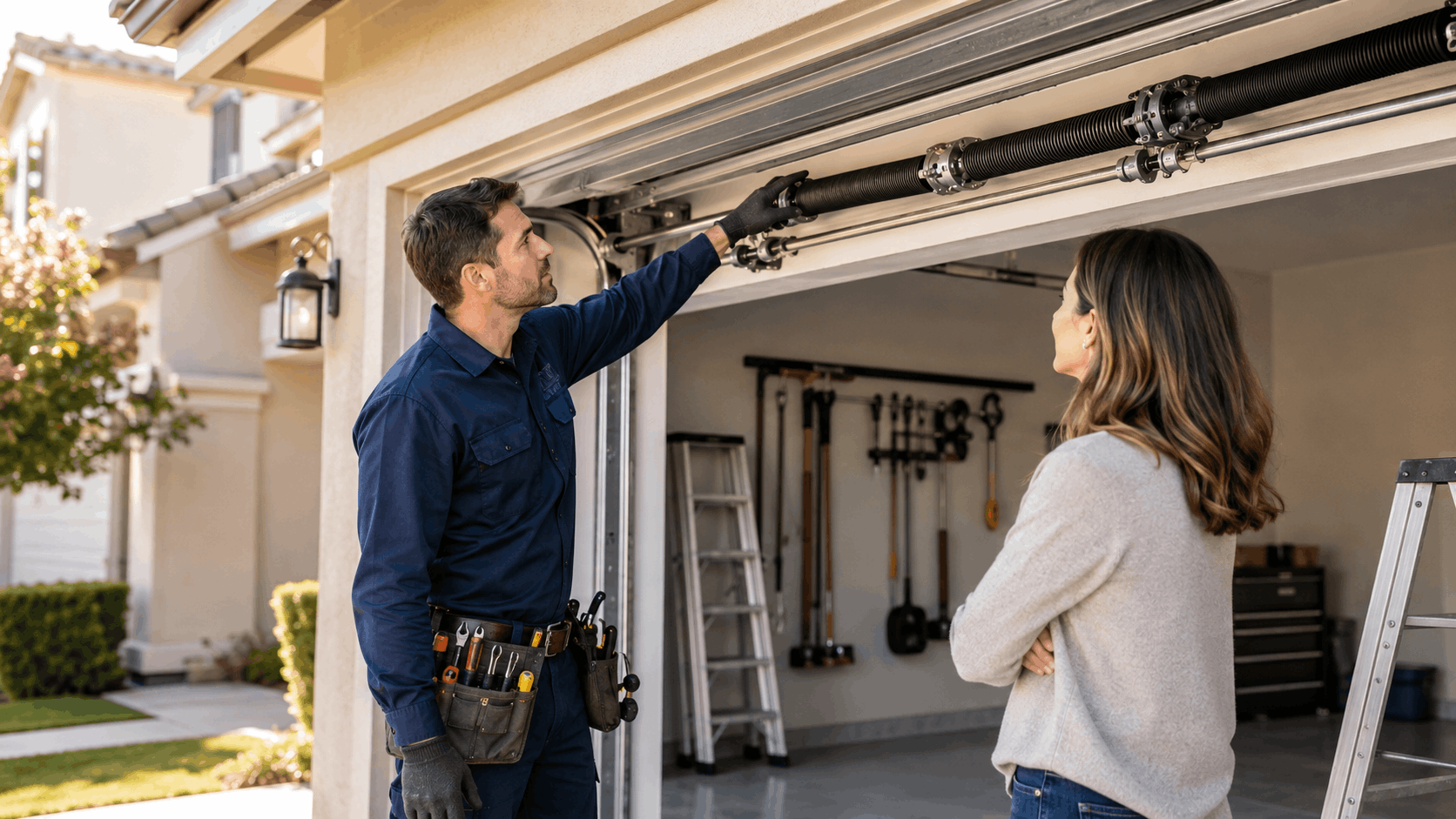
Homeowners often ask what they are actually paying for with professional spring replacement. Knowing the steps helps set expectations for the visit. A proper garage door service in Irvine follows a clear sequence from start to finish.
The goal is a door that lifts smoothly, sits balanced, and works safely for years. Getting there takes the right parts, the right tools, and a technician who knows the process cold. Here is how our crews handle it.
Inspection and Correct Spring Sizing
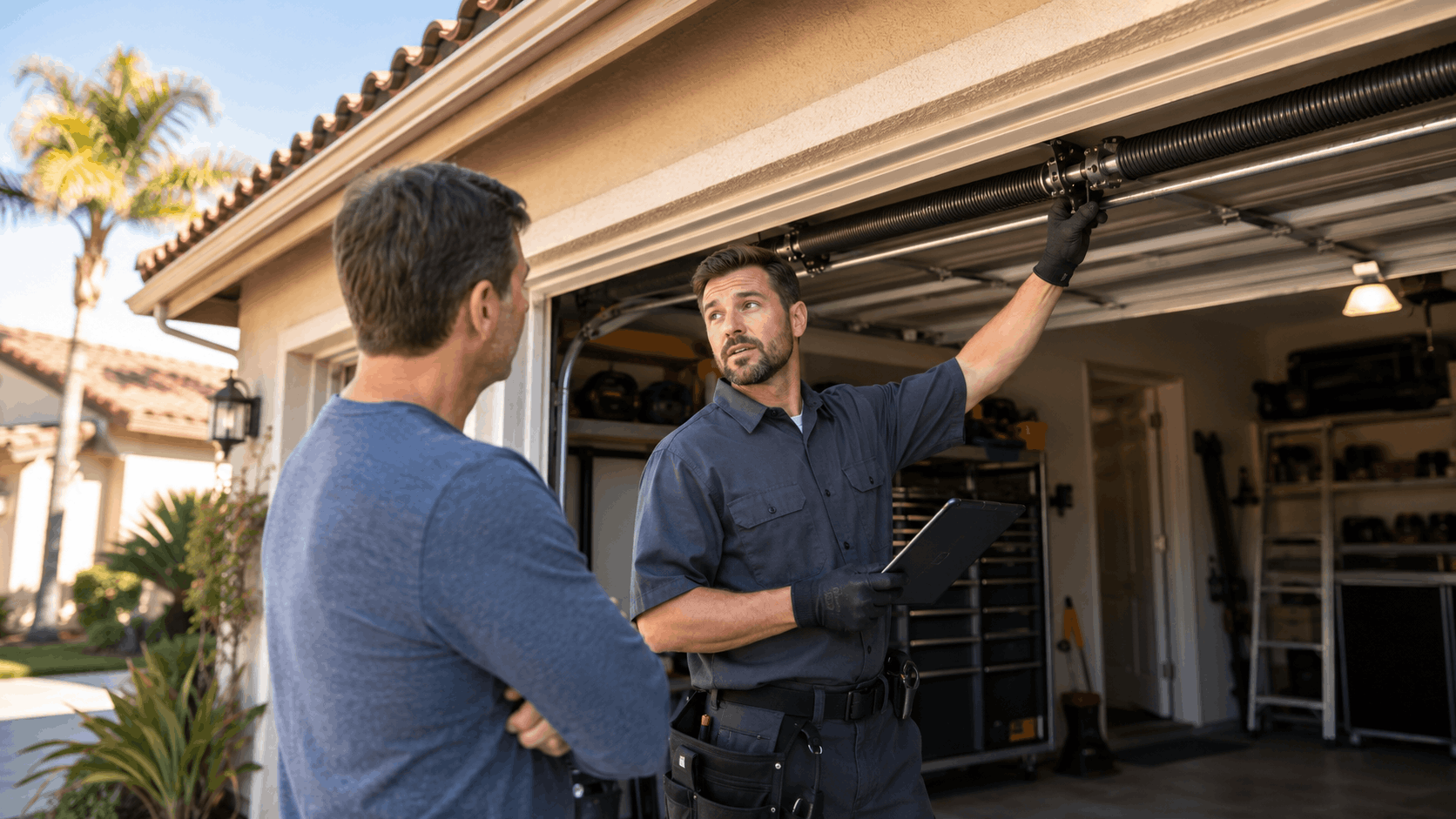
The visit starts with measurement, not with pulling parts. Correct spring sizing depends on three numbers: wire size, spring length, and inside diameter. Get any one wrong and the door will not balance.
We weigh the door or calculate its weight to match the spring to the load. A spring that is too weak leaves the door heavy, while one too strong makes it slam open. Proper door weight balance is what makes the door feel light in your hand.
The inspection also checks the cables, rollers, and track while we are there. A broken spring sometimes signals wear elsewhere in the system. Catching a fraying cable at the same time saves a second trip.
Only after the measurements are set do we order or install the matching spring. Skipping this step is exactly how DIY jobs go wrong. The wrong spring is worse than no spring for how the door performs.
Safe Tension Release and Winding
Releasing the old spring safely is where training earns its keep. We use proper winding bars sized to the spring, never a screwdriver or random rod. That single tool choice separates a safe job from a dangerous one.
The technician unwinds the old spring in controlled quarter-turns, keeping the bars locked and hands clear. Tension setting on the new spring follows the same careful rhythm. Each turn is counted and deliberate.
The winding process brings the door to the exact balance point the manufacturer intended. Too few turns and the door drags. Too many and it becomes hard to close. Precision here is the whole point.
This controlled handling of stored energy is why the job belongs with a professional. The same forces that injure DIY attempts stay under control in trained hands. Our crews do this every day, so the sequence is second nature.
Balance Testing and Opener Check
Once the spring is wound, the real test begins. We lift the door by hand to the halfway point and let go. A balanced door holds its position instead of dropping or flying up. That balance test confirms the spring is set right.
Next we check the opener. The opener force gets tested so the safety reverse works and the motor is not straining. A door that is properly sprung takes load off the opener and extends its life.
We also test the safety sensors and the auto-reverse feature. These protect kids, pets, and cars from a closing door. If the sensors are off, our safety sensor alignment repair gets them back in line.
Only when the door passes every check do we call the job done. A smooth, balanced, safe door is the standard. Anything less means more adjustment before we leave.
How Long the Job Takes in a Typical Irvine Home
Timeframe is the other thing homeowners want to know. A single spring on a standard Irvine door usually takes about 45 minutes to an hour. That covers inspection, replacement, and testing.
A double spring system runs a bit longer, often 60 to 90 minutes. Two springs mean more winding and balancing, but it is still same-day work. Most repairs wrap up in a single visit.
Older doors or badly corroded hardware can add time. If cables or the shaft need attention too, the visit stretches accordingly. We give a realistic window before starting so there are no surprises.
For most homes across Portola Springs, Woodbury, and the newer Great Park villages, a broken spring is a same-day fix. We stock common spring sizes on our trucks to keep it that way. A stuck door rarely has to wait until tomorrow.
Need Help in Irvine?
Urgent Garage Doors serves Irvine and all of Orange County.
How to Hire a Licensed Garage Door Company the Right Way
Choosing a licensed garage door company does not have to be complicated. A short checklist keeps you clear of the low-ball operators who cut corners. Here is what our team recommends verifying before you hire garage door help in Irvine.
The cheapest quote is not always the real price. Unlicensed work can cost far more once repairs, injuries, or insurance problems pile up. A little checking upfront protects the whole investment.
Verifying a CSLB License Number
Start with the license number. A legitimate contractor will give theirs without hesitation. A quick CSLB lookup on the state website tells you if it is active and in good standing.
The lookup shows the license status, the classification, and any bond or insurance on file. It takes about a minute and settles the biggest question right away. License verification is the single most useful step a homeowner can take.
If a company dodges the request or gives a number that does not check out, that is your answer. A real business is proud of its license. Ours is listed and easy to confirm.
We encourage every customer to run this check before we arrive. It builds trust and protects them. There is no downside to confirming who you are hiring.
Red Flags of Unlicensed Operators
Certain warning signs show up again and again. Cash-only demands are one of the clearest unlicensed red flags. A legitimate contractor accepts multiple payment methods and provides a receipt.
No written estimate is another. A real company puts the price in writing before work starts, listing parts and labor. Vague verbal quotes that change at the end are a setup for surprise charges.
Prices that seem far too low usually hide a catch. Below-market quotes often come from workers with no license, no insurance, and no accountability. The savings vanish when the job fails.
Watch also for pressure tactics and unmarked vehicles. A trustworthy crew shows up in a branded truck with proper tools. When several red flags appear together, walk away and call a licensed company.
Why Local Response Time Matters in Irvine
A stuck door is an urgent problem, and local response time makes a real difference. A company that knows the routes through Great Park, Spectrum, and Woodbury can plan the route to a homeowner well. That local knowledge cuts the wait.
Traffic around the Spectrum and the 405 can turn a short drive into a long one for a crew coming from outside the area. Our team already knows the fastest paths through each neighborhood. That means quicker arrival when a spring snaps.
Being based in Irvine also means we stock the parts common to local doors. Many homes in the same community use similar spring sizes. We arrive ready to fix it rather than ordering a part and coming back.
For a truly stuck door, our same day garage door repair gets a technician out fast. When a car is trapped inside and you need to get to work, speed matters. Local crews deliver it best.
Final Thoughts
A garage door spring looks simple, but it holds enough force to cause real harm and enough legal weight to cause real trouble. California law lets you work on your own home, yet it draws a firm line at paying an unlicensed person for the job. The safer and smarter move is almost always a licensed, insured crew.
Between the injury risk, the permit questions, and the insurance exposure, a DIY spring swap rarely pays off. A professional handles the tension safely, matches the spring correctly, and leaves you with a balanced door and clean paperwork. That protection is worth far more than a cheap online part.
If your spring has snapped or your door suddenly feels heavy, reach out to Urgent Garage Doors here in Irvine. Our licensed team covers Woodbridge, Turtle Rock, Portola Springs, and every neighborhood in between. Contact us or call for a fast consultation and a safe, code-compliant repair.
Frequently Asked Questions
- Is it illegal to replace my own garage door spring in California?
- No, it is not illegal to work on your own home. California law lets a homeowner repair a garage door spring on a property they own and occupy. The law is broken when you pay an unlicensed person for a job over $500. That worker needs a CSLB license to charge for it. Doing it yourself is legal but carries real injury and liability risk.
- Do I need a permit to replace a garage door spring in Irvine?
- For a spring-only swap that keeps the existing door and opening, the Irvine building department usually does not require a permit. Permits typically come into play with a full door replacement, a change to the opening size, or structural work on the header. If your project stays limited to the spring and cables, paperwork is rarely needed. We confirm the requirements before starting any job.
- How much does professional spring replacement cost?
- In the Orange County area, a single torsion spring replacement usually runs somewhere in the range of $200 to $350, including parts and labor. A double-spring system typically falls between $300 and $500 since both springs are replaced together. Prices vary with spring size, door weight, and any added cable or hardware work. We provide a written estimate before touching the door.
- How long does a garage door spring last?
- Springs are rated by cycles, with a standard spring good for around 10,000 cycles. One cycle is one full open and close. For a household that uses the door four times a day, that works out to roughly 7 to 10 years. Higher-cycle springs last longer. Coastal salt air and heavy daily use can shorten that lifespan noticeably.
- Can I use my garage door with a broken spring?
- No, running a door with a broken spring is a bad idea. Without the spring to counterbalance the weight, the opener strains against the full load and can burn out. The door can also drop suddenly, risking damage or injury. Leave the door closed and call for repair. Forcing it usually turns a simple spring fix into a larger, costlier one.
- Why do garage door springs break?
- Metal fatigue is the main cause. Every open and close cycle flexes the coil until it eventually gives out, which is why cycle count matters so much. Rust from moisture and coastal salt air speeds up the process. Cold weather makes the metal more brittle, so breaks often happen on chilly mornings. Poor maintenance and improper spring sizing also cut spring life short.
- Should both springs be replaced at once?
- Yes, on a two-spring system we usually recommend replacing both. The springs share the same age and cycle count, so when one breaks the other is close behind. Swapping both at once keeps the door balanced and saves you a second service call within months. It is the more economical choice over time, even though only one spring failed first.
- What happens if I hire an unlicensed contractor and something goes wrong?
- You carry most of the exposure. An unlicensed worker on a paid job over $500 is violating California law, and you lose the protection a bond or insurance would provide. If the repair fails or someone gets hurt, the liability can fall on you. Insurance may also deny a related claim. The low upfront price often turns into a much larger loss.
- How fast can a company respond to a broken spring in Irvine?
- A local crew can often reach an Irvine home the same day, and emergency calls get a 30 to 60 minute response. Response time depends on traffic around the Spectrum and the 405 and how busy the schedule is. Because our team is based in Irvine and stocks common spring sizes, we usually fix the door on the first visit rather than coming back later.
- Does homeowner insurance cover garage door spring damage?
- It depends on the cause. Normal wear and tear, which is what breaks most springs, is generally not covered by homeowner insurance. Damage from a covered event like a fire or certain accidents may qualify. Claims can also be denied if the repair was done by an unlicensed worker or involved unpermitted work. Check your policy and keep licensed repair records.
Licensed garage door repair professionals serving Irvine and Orange County.
Licensed in California · License #1055150
Why trust Urgent Garage Doors?
Founded in 2017, Urgent Garage Doors is a licensed and insured garage door services serving Irvine and Orange County. All content is reviewed by our licensed technicians.

Need Help in Irvine?
Urgent Garage Doors serves Irvine and all of Orange County.
Related Articles
California SB 969: The Garage Door Opener Battery Backup Law (And What It Means When a Spring Breaks)
SB 969 requires battery backup on every residential garage door opener sold or installed in California since 1 July 2019. It sets no rules about springs, but a broken spring often starts the conversation.
Garage Door Spring Replacement Cost Irvine: Single vs Double Torsion Pricing
Compare single vs double torsion spring replacement costs in Irvine, from honest price ranges to warning signs, DIY dangers, and how to spot a fair quote.

Mission Viejo Garage Door Service: 1980s-90s Spring Replacement Pricing
Honest pricing and practical advice on garage door spring replacement for 1980s-90s Mission Viejo homes, covering spring types, costs, local factors, and safety.