Broken Garage Door Spring in Old Town Tustin and What Happens in the Next Two Hours
Key Takeaways
- A broken torsion spring announces itself with a loud bang, then the door feels like dead weight and the opener strains without lifting it.
- Stop using the opener immediately and never touch the spring, which stores enough energy to cause serious injury.
- A torsion spring replacement runs a typical $150 to $300 in Orange County, with a written price given before any work begins.
- Springs are rated in cycles, commonly around 10,000, roughly seven years at four cycles a day, so Old Town's aged original hardware is often well past its count.
- Repairing a spring is mechanical work, but changing the door in the Cultural Resources District can trigger a no-fee Certificate of Appropriateness plus a building permit.
- Garage door work is licensed under C-61/D-28, not C-28, and can be verified free at cslb.ca.gov where Urgent Garage Doors holds license #1055150.
- Openers made before January 1 1993 predate federal entrapment protection, and any replacement opener in California must have SB 969 battery backup.
- Cables, drums and rollers age alongside the spring, so inspecting them at the same visit prevents a second failure weeks later.
In This Article
A broken garage door spring in an Old Town Tustin garage usually announces itself with a loud bang, almost like a firecracker going off inside the garage. Right after that, the door will not open. The opener motor hums or clicks but the door sits there like dead weight. If that just happened to you, here is the short version: stop using the opener, do not touch the spring, check the coil on the bar above the door for a two to three inch gap, and call a licensed garage door contractor. A torsion spring replacement in Orange County typically runs $150 to $300, with a written price given before any work starts.
These old garages off the alleys fail the way they do for a plain reason. Old Town holds the oldest housing in Tustin, and many of those detached garages still carry original hardware that has cycled far past what the springs were rated to handle. A spring is rated in cycles, not years, and decades of daily use eventually catch up with it.
Below we walk through how to tell a snapped spring from an opener fault, exactly what to do in the two hours after it breaks, what the repair costs, the design-review wrinkle that only applies inside the Cultural Resources District, and the safety and code checks that matter once the door moves again.
The First Signs a Spring Has Broken, Not the Opener
In the first few minutes after a door quits, people often blame the opener and keep hitting the button. That is the worst thing to do with a broken spring. The faster you can tell a snapped spring from an opener or track fault, the sooner you stop making the damage worse and call the right trade.
Here is a quick way to sort the three apart before anyone touches anything.
| Symptom | Likely Cause | What You Hear or See |
|---|---|---|
| Loud bang, then door won't move, opener strains | Broken torsion spring | A sharp snap, then dead-weight door and a straining or clicking opener |
| Door reverses partway down for no reason | Photo-eye fault or misalignment | Door starts closing then rolls back up, lights may blink |
| Door binds, grinds or comes off the rollers | Track problem | Scraping or grinding, door visibly crooked in the opening |
| Opener runs but nothing moves | Stripped gear or disconnected trolley | Motor hums, carriage moves but door stays put |
The Loud Bang and the Door That Won't Budge
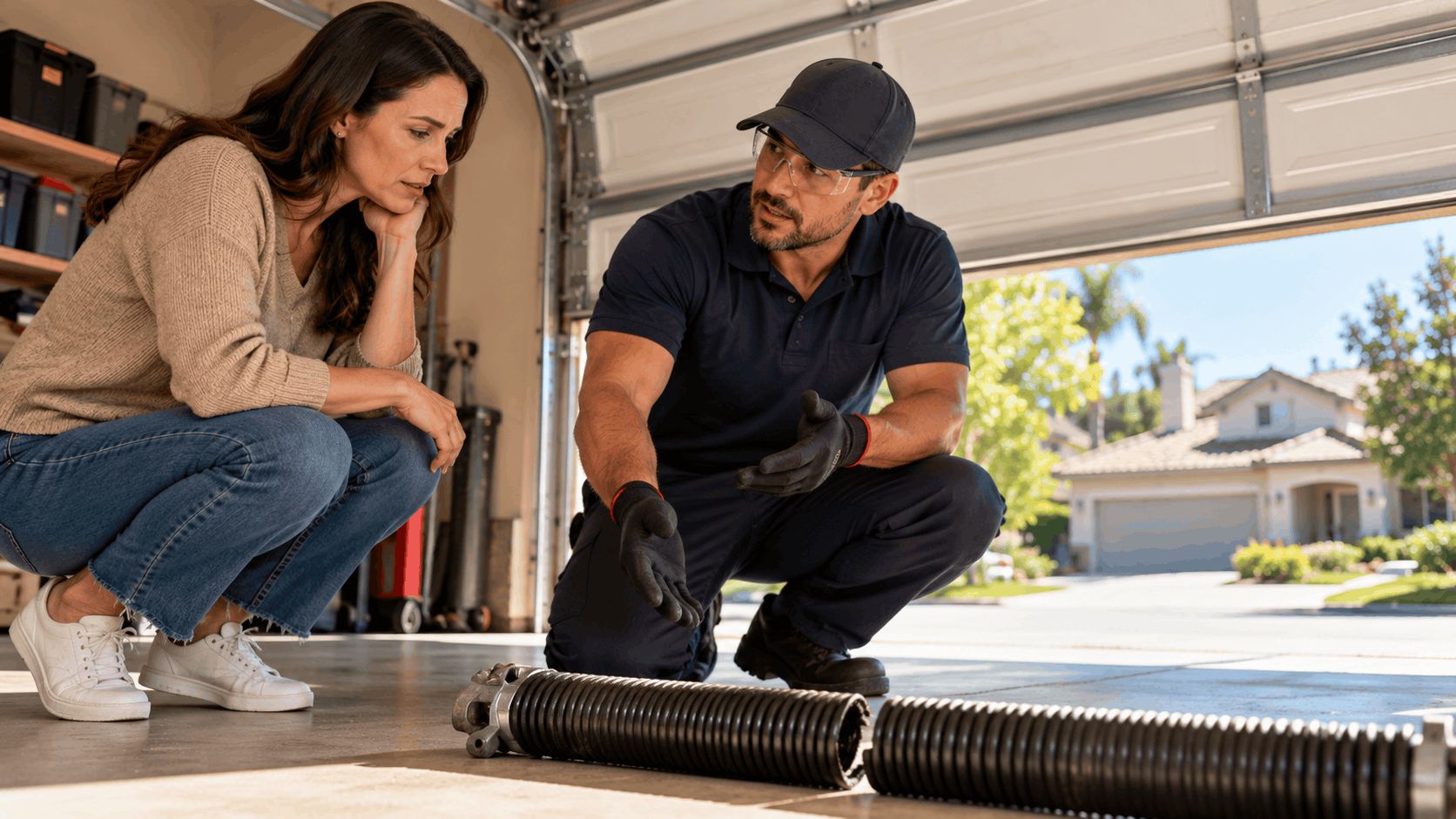
When a broken torsion spring lets go, it releases all its stored energy at once. That is the loud bang people describe as a gunshot or a heavy object falling in the garage. The sound is the coil snapping and the broken ends spinning on the bar.
After that spring snap sound, the door loses the counterweight that made it feel light. A sectional door can weigh well over a hundred pounds, and a solid wood one-piece tilt-up in Old Town can weigh more. Without the spring doing its job, that full weight sits on the opener or on your arms.
That is why the garage door won't open and feels like dead weight. A chain or belt opener is built to guide a balanced door, not to lift the whole weight by itself. When you press the button, the motor strains, the chain may jerk, or the opener clicks and gives up. If you hear that straining and the door barely lifts an inch, the spring is the first thing to suspect.
The Gap in the Spring Above the Door
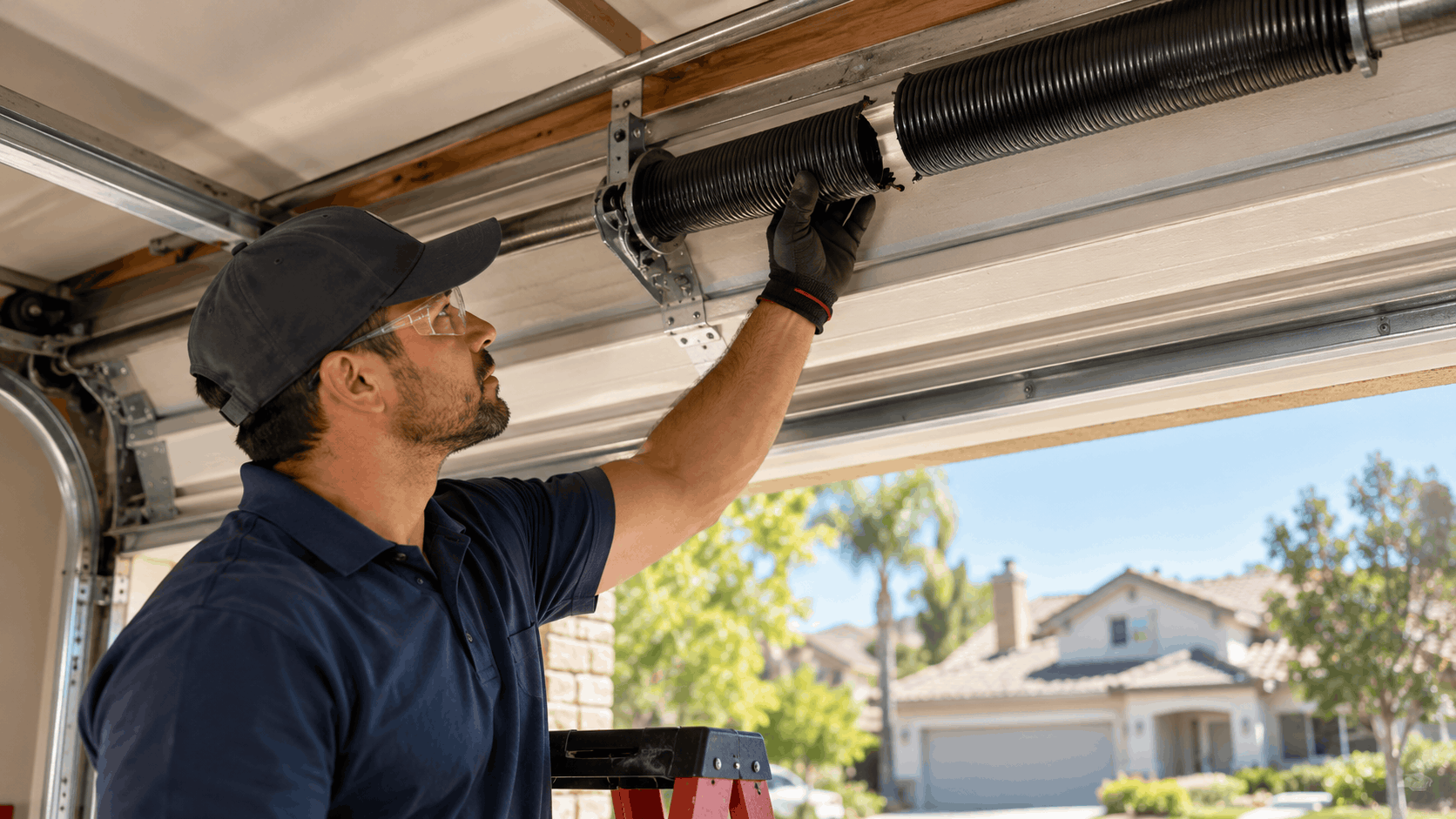
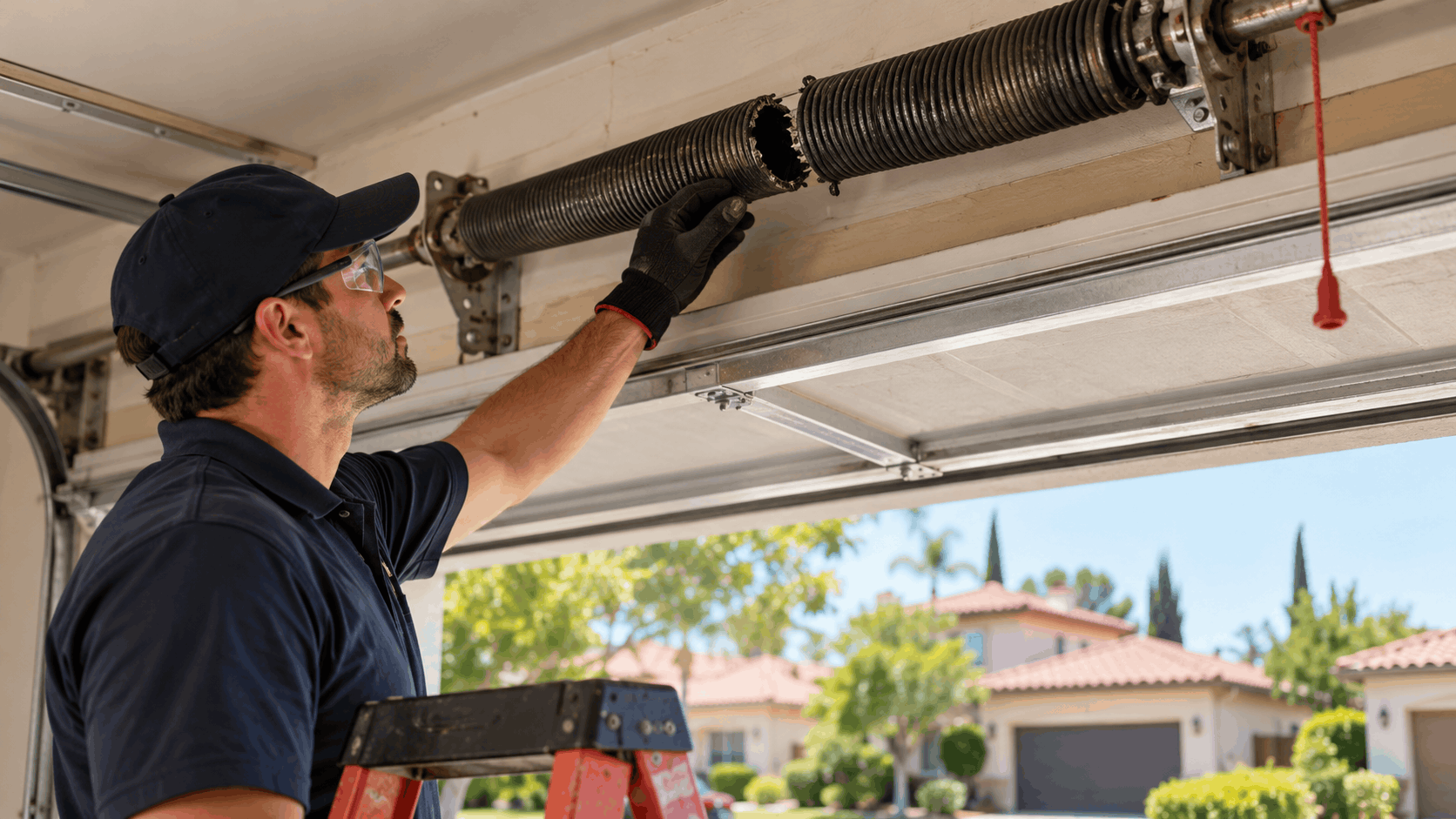
The clearest visual sign is right above the door on the torsion bar, the metal shaft the spring wraps around. On a working spring the coils sit tight against each other with no space between them. When the spring breaks, the two halves separate.
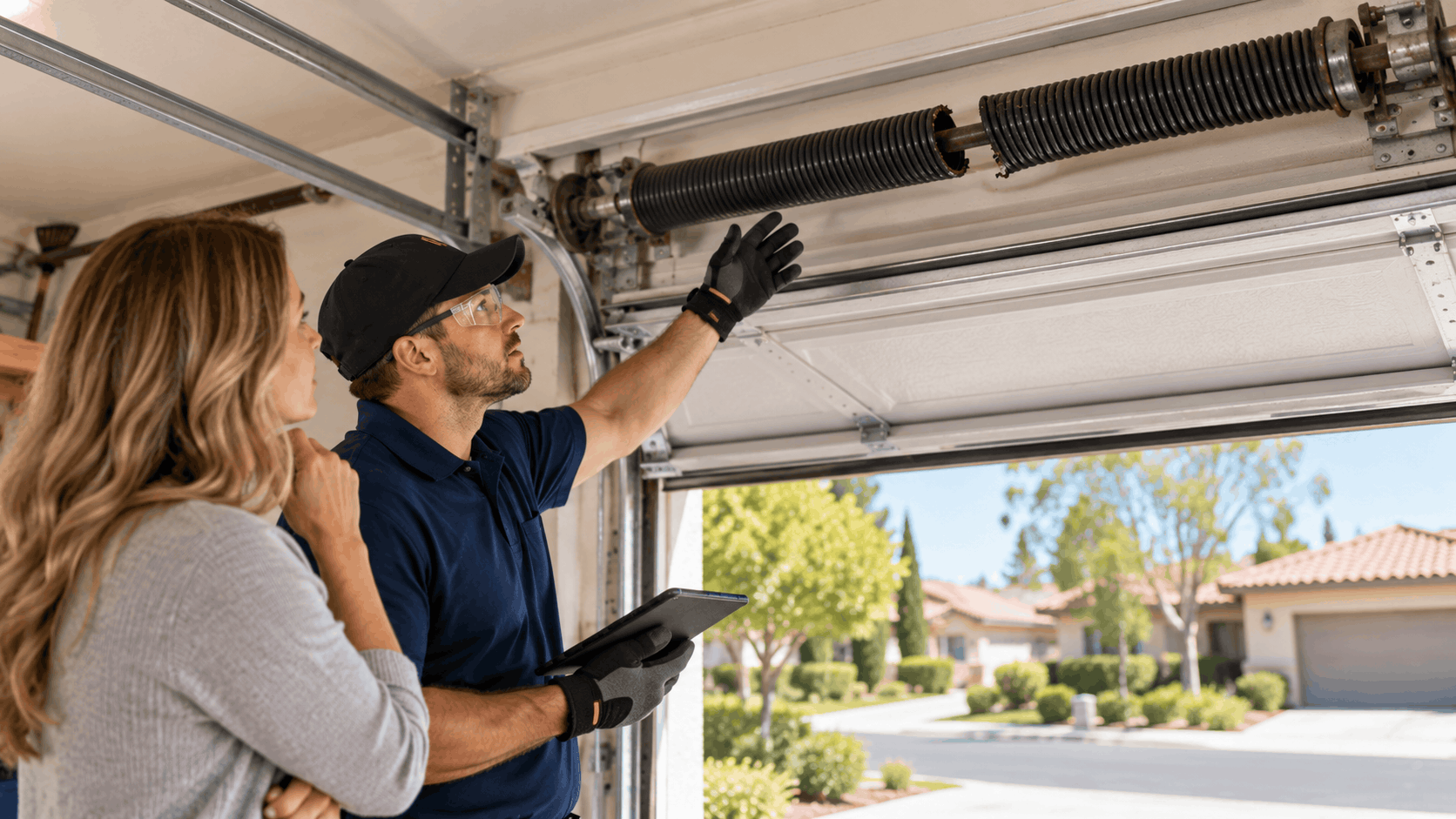
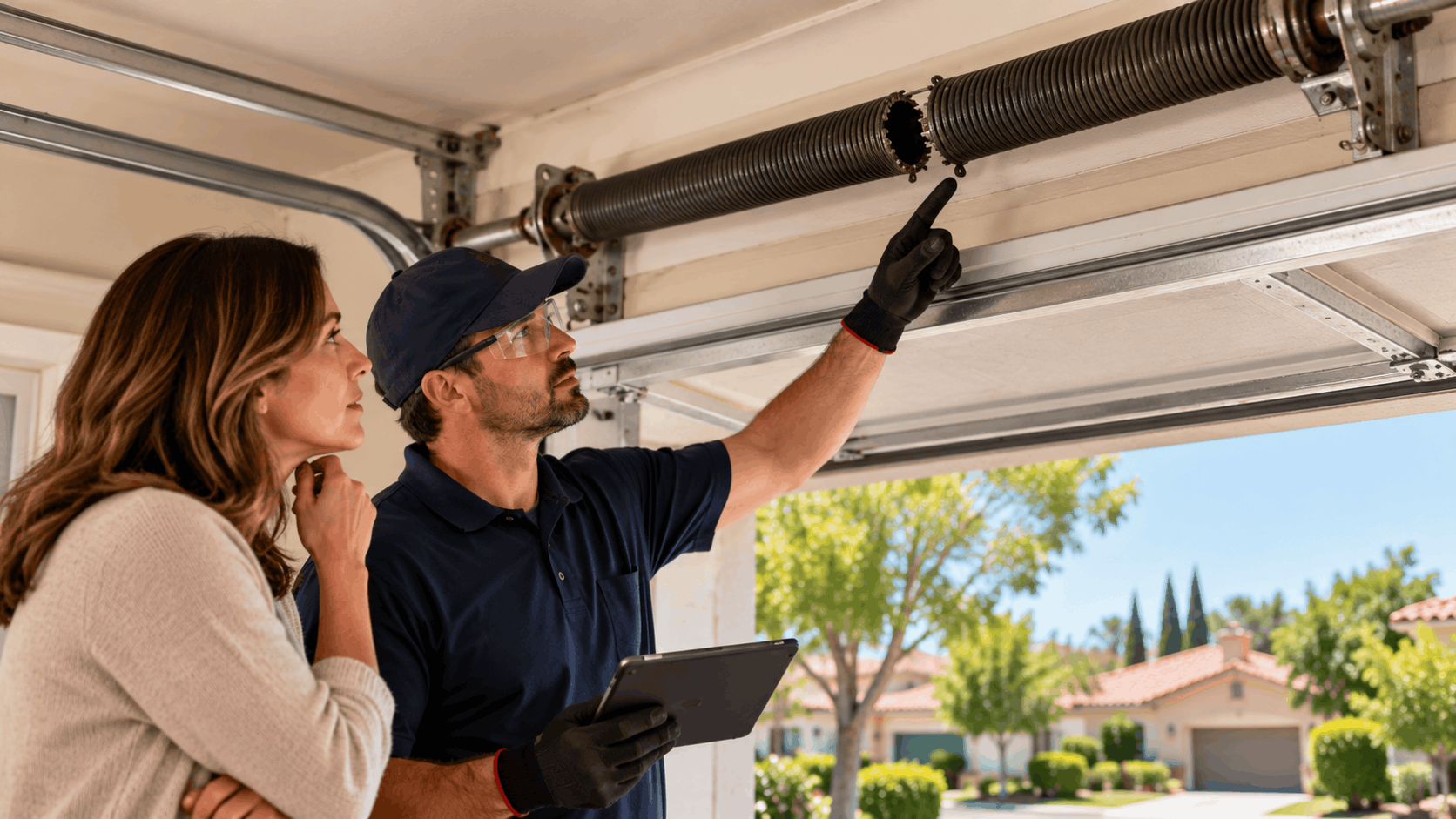
That separation shows up as a coil gap of about two to three inches in the middle of the spring. Stand on the floor, look up at the bar, and you will usually see it plainly. This visual check is the single easiest way to confirm a broken spring without any tools.
Do this from the ground and do not climb up to it or put your hands near the spring. Even a broken spring and the bar it sits on can still hold tension and move unexpectedly. Looking is safe, touching is not.
If you have two springs and only one shows a gap, both still likely need attention, because a matched pair ages at the same rate. We cover why both usually get replaced together further down.
Spring Problem Versus Opener Problem
The simplest way to separate a spring issue from an opener issue is the balance test. Pull the release cord on the opener, the one with the red handle, to disconnect the door from the motor. Now the door moves by hand.
With a healthy spring, you can raise the door to about waist height and it stays put. If you let go and the door slams down or feels like you are lifting a car, the spring is the problem, not the opener. A door that will not hold position is a spring and balance issue every time.
Opener diagnosis is a different path. If the door moves freely by hand but the motor will not run it, that points to the opener itself. And a door that reverses for no visible reason while closing is almost always a photo-eye fault, misalignment or a blocked beam, which is a separate problem from a spring and is covered later.
If you want a professional balance check rather than guessing, our team handles door balancing and tension adjustment as part of a spring call.
Get Your Free Quote
Tell us about your garage door and we'll get back to you within 30 to 60 minutes.
What to Do and Not Do in the Next Two Hours?
The window right after a spring breaks is where people either contain the problem or multiply it. Good garage door safety here is mostly about what you do not do. If you are wondering about broken spring what to do in those first two hours, the steps below keep you and the door safe.
Stop Using the Opener Right Away
The first rule is to stop pressing the button. Running the opener against a broken spring forces the motor to lift a load it was never designed to carry. That leads to motor damage, a burned-out gear, or a trolley that jumps the rail.
The strain does not stop at the motor. A door dragged up without spring support can pull a bent track, bend the top section, or snap a lift cable off its drum. Each of those is a separate repair stacked on top of the spring.
So the smart move is to stop opening the door the moment you suspect a spring. One broken spring is a routine fix. One broken spring plus a bent track, a stripped opener and a frayed cable is a much bigger day. Leaving the opener alone keeps the job small.
If the opener already strained or jumped before you realized the spring was gone, mention that when you call so the opener can be checked at the same visit.
Why the Spring Is the One Part to Never Touch
A torsion spring is the one component on the whole door that a homeowner should never touch. It stores enough energy to cause serious injury. Even after it breaks, the bar and remaining coils can carry tension.
These springs are wound with steel winding bars against a fixed cone, under high load. A slip while winding or unwinding one sends a bar flying or a hand into the hardware. This is not a job that rewards being handy or careful; the energy involved is simply too high.
That is the plain truth about torsion spring danger: no owner should adjust, wind, unwind or replace one. The right call is a licensed technician with the correct bars and the training to use them. Avoiding that serious injury is worth the service call every time.
If anyone offers to "just tighten it up" for cash, that is a red flag. Spring work belongs with a licensed spring and cable repair specialist.
The Safe Checks You Can Make Yourself
There are a few checks that are perfectly safe from the ground. A good safe inspection starts with the coil gap we described earlier: look up at the bar and confirm the break. That alone usually tells you what you are dealing with.
Next, confirm the door is fully shut and secured. A door with a broken spring can be heavy and unpredictable, so you want it down and still, not halfway up where it could drop. Keep kids and pets out of the garage until it is handled.
Then note whether a car is trapped inside. If the car trapped behind the door needs to get out for work or an appointment, say so when you call so the repair can be prioritized. Knowing the door is shut, the car's status, and the door secured gives the technician what they need before they arrive.
Write down the opener brand and roughly how old the garage is too. On Old Town properties that age matters, because very old openers raise code questions we cover later.
Getting a Trapped Car Out of a Detached Alley Garage
Old Town is full of detached garage setups behind the house, reached off a narrow alley rather than a front driveway. When a spring breaks in one of those, getting the car out is its own small project because the door is heavy and the space is tight.
The manual release cord disconnects the door from the opener so it can move by hand. On a balanced door this works well. On a door with a broken spring, remember the full weight is now on you, so lifting it is a two-person job at best and risky at worst.
A one-piece tilt-up behaves differently from a sectional when disconnected. A tilt-up swings out and up on a single panel, so it needs clearance in front and it can swing fast if the counterbalance is gone. Alley access and limited room make that swing harder to control.
If the car can wait, the safest choice is to leave the door down and let the technician raise it under control. If it cannot wait, let us know it is a detached alley garage with a trapped car so the crew arrives ready.
Need Help in Irvine?
Urgent Garage Doors serves Irvine and all of Orange County.
Why Springs Break in Old Town Tustin Garages?
Spring failures are not random bad luck. In Old Town they cluster for reasons tied to the Old Town Tustin garages themselves: when they were built, how often the doors get used, and the hardware the original builders installed. Understanding the spring cycle rating explains most of why springs break here.
Cycle Rating Is the Real Clock on a Spring
A torsion spring is rated in cycles by its manufacturer, where one cycle is a full open and close. A standard residential spring commonly carries around 10000 cycles. That number, not the calendar, is the real clock.
Do the math on four cycles a day, which is a normal household coming and going. At that rate a 10,000-cycle spring reaches the end of its rating in roughly seven years. A door used more often, as a main entrance, gets there sooner.
So the spring lifespan is really about age and daily use together, not about one cold morning or one hard pull. When a spring breaks, it has usually simply reached the count it was built for. That is why a spring that lasted years can go without warning on an ordinary Tuesday.
High-cycle springs exist for heavier duty and last longer per the rating, which matters for a door that cycles many times a day.
Old Townsite Garages and Original Hardware
Old Town is Tustin's original townsite, holding the oldest housing in the city, with the district running along Main Street from Williams Street to just past Newport Avenue. Those garages were built in an era of detached structures set behind the house off alleys, with narrow driveways.
Many carry undersized openings, original single-car widths that are small by modern standards. The springs and cables that came with those doors were sized for that era's hardware, and a lot of them are still the original set.
That is the heart of it: much of this aged hardware has been in service far longer than any 10,000-cycle rating anticipated. When a spring has quietly done its job for decades, it is running on borrowed time. A break is less a surprise than a scheduled event that finally arrived.
It also means the matched cables and drums next to that spring are the same age, which is why a careful tech looks at the whole system, not just the one broken part.
One-Piece Tilt-Up Doors Versus Sectional Doors
A detail that trips up a straight repair: many Old Town garages still carry a tilt-up door, the old one-piece style that swings out and up as a single slab. That is a different product from a modern sectional door, which rolls up in hinged panels.
The hardware is different and so are the failure modes. A tilt-up uses a different counterbalance geometry, often with springs mounted along the sides rather than a torsion bar across the top. A sectional torsion spring is not a drop-in fix for a tilt-up.
So the fix depends on which door you have. The different hardware means the technician has to match the counterbalance to that specific door rather than grabbing a standard sectional spring. It is one more reason these old garages need a tech who knows both systems.
If an owner is considering moving from a tilt-up to a modern panel door, that is a bigger decision that runs into design review, which we get to below.
What Else Wears Out Alongside the Spring
The spring does not wear alone. Cables, drums, rollers, hinges and bearings all age next to it and see the same cycles. When the spring reaches the end of its life, those parts are usually close behind.
This is why replacing a spring without inspecting the cables is how a second failure follows weeks later. A frayed cable that was hidden under spring tension can let go once the new spring loads it up. The customer is then back to a dead door, frustrated, after thinking the problem was solved.
A proper spring visit includes a look at the cables, drums, rollers and bearings so nothing obvious gets missed. We handle garage door cable repair alongside spring work for exactly this reason. Catching a worn cable during the same visit saves a second trip and a second failure.
What a Spring Replacement Costs in Old Town?
Knowing the torsion spring cost ahead of time takes the guesswork out of a stressful morning. The figures below are typical Orange County market ranges for garage door work, not a quote for your specific door. The actual spring replacement price depends on your door and is put in writing before work begins.
| Job | Typical Orange County Range |
|---|---|
| Torsion spring replacement | $150 to $300 |
| Extension spring replacement | $150 to $250 |
| Spring conversion | $150 to $350 |
| Cable repair | $150 to $300 |
| Off-track door repair | $125 to $275 |
| Door balancing and tension adjustment | $75 to $150 |
Typical Price Ranges for Springs and Cables
For the core jobs, the typical ranges are clear. A torsion spring $150 to $300 replacement is the common one. Extension spring replacement runs $150 to $250, and a spring conversion runs $150 to $350.
If the cables need attention at the same time, cable repair runs $150 to $300. These are presented as a typical range for Orange County, because the exact number depends on the spring size, the door and what else the tech finds.
None of these are a fixed price from us. The point of the range is to set expectations so you are not blindsided. The written price for your specific garage comes before any work starts, so there are no surprises once the tools come out.
For the core service details, see our torsion spring replacement and extension spring replacement pages.
What Pushes the Price on an Old Garage
A few things move an old Tustin garage toward the higher end of the range. Springs are sized to the actual door weight and height, so a heavy solid-wood tilt-up needs a stronger, correctly matched spring than a light modern panel door. Getting that match right is part of the work.
Where the door gets heavy daily use, a high-cycle spring rated beyond the standard 10,000 cycles may be the better value. Those cost more up front but last longer per the rating, which can make sense on a door that is the home's main entrance.
The biggest wildcard in Old Town is an uncommon or discontinued door. Replacement parts for early tilt-up profiles are long out of production, so repair can mean fabrication or restoration rather than pulling a part off the shelf. That added labor pushes the price up and can change the timeline.
If you are weighing a spring conversion upgrade on an older system, the tech can lay out what that involves before anything is decided.
When Related Repairs Join the Bill
Because so much hardware ages together, a spring call sometimes turns up related work. Worn cables are the common one, and cable repair $150 to $300 covers that. It is far cheaper to replace an aging cable while the door is already apart than to come back for it.
If the door jumped the rails when the spring broke or the opener strained against it, an off-track $125 to $275 repair resets it. And a door that was never quite balanced can get a balancing $75 to $150 tension adjustment so the new spring is not fighting an uneven load.
The advantage of handling these at the same visit is one trip and one setup instead of several. Nobody wants to pay a second call-out because a worn cable was left in place. A thorough first visit is the cheaper path in the long run.
If the door came off its tracks, our off-track garage door repair covers getting it running straight again.
The Design-Review Layer That Only Old Town Owners Face
Here is the part that makes Old Town different from almost every other neighborhood we serve. The district sits inside the city's Cultural Resources District, a preservation overlay centered on Main Street and El Camino Real. That means some garage door work carries a design-review step on top of the usual permit, through the Tustin Planning Division. A Certificate of Appropriateness is the mechanism.
A Spring Repair Versus Changing the Door
The good news is that most spring calls do not touch design review at all. Repairing or replacing a spring on the existing door is mechanical work. It does not change how the garage looks from the street, so the historic guidelines are not in play.
The line gets crossed when the door itself changes. Swapping a one-piece tilt-up for a modern sectional door changes the street-facing appearance, and that is exactly what the design guidelines scrutinize. The guidelines address both the driveway and the door as features of a contributing property.
So think of it this way. A like-for-like repair that keeps the existing door is straightforward. An appearance change to the door's look, material or style is where the design guidelines come in, framed by the Secretary of the Interior's Standards, with material choice the part most likely to be questioned.
If a replacement door is the goal, planning for that review early saves time later. A carriage-house style door is often chosen to keep a historic look, but the city still decides what fits.
Certificate of Appropriateness and the Building Permit
The Certificate of Appropriateness is a no-fee permit, a design-review layer that applies to exterior work on structures within the Cultural Resources District. It is required prior to or concurrent with other approvals for that exterior work. Being no-fee does not make it optional.
It sits on top of the standard building permit, not in place of it. That means an Old Town owner changing a door can need both the Certificate of Appropriateness and the building permit. This is a city process, not a homeowners association process, which is unusual for Orange County.
Permits and inspection requests run through the city's EnerGov CSS portal. For a straight spring repair you are not filing anything, but for a door change it pays to understand that two approvals may be in play before work begins.
Whether a same-size door replacement needs a building permit is decided by the city for the specific address, so confirm that position with Tustin rather than assuming.
Contributing, Non-Contributing and the Mills Act
The practical first question on any Old Town job is whether the address is inside the district and whether the building is a contributing building. That answer decides whether a change is a straightforward permit or a design-review matter. Buildings in the district that do not meet the contributing criteria are classed as non-contributing.
Being on a survey inventory is not the same as formal designation, so the inventory alone does not settle it. The protection comes from inclusion in the Cultural Resources District or recognition as a Designated Cultural Resource by city council for a property outside it.
There is one more layer for some owners. A Mills Act contract gives a property-tax reduction in exchange for actively restoring, rehabilitating and preserving the property, and the pre-approval inspection covers the exterior only. That gives a Mills Act owner an active maintenance obligation covering exterior elements like the garage door and driveway.
To confirm whether your address is inside the district and a contributor, call the Planning Division 714-573-3140. They are the authority on what a specific property triggers. Our Tustin service page has more on how we work in the area.
Need Help in Irvine?
Urgent Garage Doors serves Irvine and all of Orange County.
Checking Safety and Code After the New Spring Goes In
Once the new spring is in and the door moves again, a few checks confirm it is safe and that the opener meets current rules. These garage door safety tests are simple, and the opener laws matter here because Old Town openers are often old. The auto-reverse test and the photo eye check are the two that count.
The Two-by-Four and Photo-Eye Tests
The 2x4 test checks the contact reverse. Lay a two-by-four flat on the floor in the door's path and close the door. When the door hits the board, it must reverse within two seconds of contact. If it does not, the force setting or the opener needs attention.
The photo-eye beam test checks the non-contact system. With the door closing, break the beam with an object. The door must stop and reverse. These are the eyes mounted on each side of the opening that catch anything in the path before contact.
Those photo eyes mount no higher than six inches off the floor so they catch a child or pet low in the opening. If a door reverses for no visible reason during normal use, blocked, misaligned or faulty eyes are the usual culprit, which our safety sensor alignment and repair handles.
Running both tests after a spring job takes a minute and confirms the whole door, not just the spring, is working as it should.
Old Openers That Predate the 1993 Rule
Openers in Old Town detached garages often predate modern safety law. The federal entrapment protection mandate covers openers manufactured for the United States after January 1 1993. Units made before that date predate that requirement.
California was actually ahead of the federal timeline. AB 3600 required California openers to be manufactured with an automatic reverse device and sensor back in 1990, and Congress followed for the rest of the country after 1993. So the honest line on a very old opener is simply that it predates these rules.
What that means in practice is that a pre-1993 mandate opener without external sensors lacks the entrapment protection every modern opener has. The manufacturer position, LiftMaster for example, is that such openers should be replaced rather than repaired. If the garage still runs a unit that old, it is worth looking at.
We work on all opener brands, so if yours is from that era we can tell you plainly where it stands.
Battery Backup If the Opener Gets Replaced
If a spring repair turns into an opener replacement, a state law comes into play. SB 969 requires every residential automatic garage door opener sold or installed in California on or after July 1 2019 to have a battery backup designed to operate during an electrical outage.
The penalty for a non-compliant install is a $1,000 civil penalty, and since that date a replacement residential door may not be connected to an opener that does not comply. The law was passed after deaths in the 2017 Northern California wildfires, where people could not open their garage doors during power cuts.
What this means for an owner is simple: a replacement opener in California includes battery backup by law. It is not an add-on tier you choose, it is part of a compliant unit. We cover battery backup installation as part of opener replacement.
It does not force you to replace an opener that is simply sitting there working. It applies when the opener is sold or installed.
Some Detached Garages Have No Opener At All
A fair number of Old Town detached garages have no opener and no wiring at all. The door is operated by hand, the way it always has been. That changes the scope if an owner wants to add power.
Adding an opener to a manual door in one of these garages is an electrical work job as well as a door job. There may be no circuit, no outlet and no wiring run to the detached structure, so an electrician's work comes before the opener install.
That reality changes the scope and the timeline. A spring repair on a manual door is quick. Turning that same garage into a powered one with no wiring in place is a larger project that gets planned, not done on the spot.
If adding an opener is on your list, we can scope what the garage needs through our opener installation service.
Who Should Do the Work and How to Check the License
Spring work is not a general handyman job in California. It is licensed work, and knowing the right C-61/D-28 license lets you tell a qualified licensed garage door contractor from someone working outside the law. You can check it yourself at the CSLB for free.
The Correct License Classification
Garage door work in California is licensed by the Contractors State License Board under classification C-61/D-28, Doors Gates Activating Devices. That scope covers sectional and rolling doors, torsion and extension spring systems, operators, control boards, safety sensors and activating devices.
A common mix-up is worth clearing up. C-28 is not it: C-28 is Lock and Security Equipment, which is a different classification entirely. If someone tells you their C-28 covers your garage springs, that is the wrong license for this work.
Nor does this work require a Class B general building license. The correct, specific classification for a spring job is C-61/D-28. Knowing that one detail protects you from hiring the wrong trade for a job that stores dangerous energy.
Because spring work sits squarely inside that classification, it belongs with a contractor who holds it.
Why Spring Work Is Above the DIY Threshold
California used to let unlicensed work happen below $500. That changed. AB 2622 raised the unlicensed-work exemption in Business and Professions Code section 7048 from $500 to $1,000, effective January 1 2025.
But the $1,000 threshold has conditions. The exemption fails, at any value, if the work requires a building permit of any kind, or if the person employs anyone on the job. And a job cannot be split into smaller slices to stay under the number.
A separate rule is often confused with this one. Business and Professions Code section 7159 requires a written contract over $500 for home improvement work. That is a contract requirement, not a licensing threshold, and the two are different rules at different figures. Together they point the same direction: spring work belongs with a licensed contractor.
For urgent situations, our emergency garage door repair team handles spring failures the right way.
Verifying a License for Free
You never have to take a contractor's word on their license. At cslb.ca.gov, the license number, classification, status, bond and workers compensation are all public record. You can look them up free before anyone comes out.
It takes a minute. Type in the license number or the business name, and the board shows you whether the license is active, what classification it holds, and whether the bond and workers comp are in place. That is your protection against an unlicensed operator.
Urgent Garage Doors holds California license #1055150. You can verify free at the CSLB site before we arrive, and we encourage it. A legitimate contractor has nothing to hide on that page.
You can read more about the company on our about page.
Need Help in Irvine?
Urgent Garage Doors serves Irvine and all of Orange County.
How Urgent Garage Doors Handles a Broken Spring Call
When a spring breaks in Old Town, here is how the call actually runs. Our emergency spring repair process is built around getting the door safe, getting a written price in front of you, and often finishing on the same-visit. The way Urgent Garage Doors works in this district accounts for its narrow alleys and old hardware.
Response Across Old Town and Alley Access
We take emergency calls 24/7, every day of the year including holidays. The response window is 30 to 60 minutes anywhere in Orange County, so a dead door in Old Town does not mean waiting around all day.
Old Town has its own access quirks. The district centers on Main Street and El Camino Real, with narrow streets, alley access to many detached garages, and contested parking during community events and the farmers market near the Tustin Library on East Main Street.
Because of that, we ask owners to confirm access before dispatch rather than assume the truck can pull right up. A quick heads-up about alley width, a gate, or event-day parking lets the crew arrive ready to work instead of circling the block.
For non-emergency timing, our same-day repair service covers the same area.
Common Springs on the Truck
Our trucks carry common torsion spring sizes. That truck stock means a standard spring replacement is often finished on the same visit, so a sectional door with a typical spring can be back in service the same day.
Old Town adds one honest caveat. A discontinued one-piece tilt-up exception profile or an unusual door size may not match a stock spring. In those cases the correct spring has to be matched or fabricated, which can mean a return trip.
We would rather tell you that up front than put the wrong spring on an old door. A spring matched to the actual door weight and height is the only safe spring, so if your tilt-up needs a special part, that is the plan we lay out.
For most common sectional doors, though, the spring goes in and the door works again on the first visit.
The Diagnostic, the Written Price and the Cable Check
Every spring call starts with a look at the whole system, not just the broken part. The team inspects the cables, drums and rollers alongside the spring, because those age together and a hidden cable inspection problem is how a second failure follows weeks later.
We can give a written price before work begins, so you know the number before any tools come out. For new garage door installations, we offer a free on-site estimate.
And when a job is a full new door rather than a spring repair, the install includes removing and haul-away of the old door, so you are not left with the old slab in the alley. Each preventive maintenance visit also comes with a written report of what was found and what is recommended.
If you want the whole system checked on a schedule, our preventive maintenance plan catches aging hardware before it strands you.
Getting Your Old Town Door Moving Again
A broken spring in an Old Town garage is a routine fix when it is handled by the right trade and left alone until they arrive. Leave the opener off, keep clear of the spring, and let a licensed technician take it from there.
Call Urgent Garage Doors at (949) 529-7743 for 24/7 emergency spring service across Orange County. We will confirm alley access before we head out, inspect the cables and rollers alongside the spring, and give you a written price before any work starts.
Frequently Asked Questions
- How do I know it's the spring and not the opener?
- Three signs point to the spring. First, a loud bang when it broke. Second, the door feels like dead weight and the opener strains or clicks without lifting. Third, a two to three inch coil gap on the torsion bar above the door. The clincher is the balance test: pull the release cord and lift by hand, and a door that will not hold position is a spring problem, not an opener problem.
- Can I open my garage door with a broken spring?
- You can try, but it is heavy and risky. With the spring broken, the door becomes full dead weight because the counterbalance is gone. Do not use the opener against it, since that can burn out the motor or bend the track. Lifting by hand is a two-person effort at best, and especially risky on an old one-piece tilt-up that can swing fast. The safest choice is to leave it down and have a technician raise it under control.
- How much does a torsion spring replacement cost in Tustin?
- Typical Orange County ranges are $150 to $300 for a torsion spring replacement and $150 to $250 for an extension spring. These are typical market ranges, not a quote, because the price depends on the spring size, the door weight and anything else found at the visit. The written price for your specific garage is given before any work begins, so you see the number before the tools come out.
- Can I replace the spring myself?
- No. A torsion spring stores enough energy to cause serious injury and is wound with steel bars against a fixed cone under high load. A slip while winding or unwinding one can send a bar flying or injure a hand badly. Even a broken spring can still carry tension. This is the one part on the door that no owner should adjust, wind, unwind or replace. It belongs with a licensed technician who has the correct winding bars.
- How fast can someone come out in Old Town Tustin?
- We take emergency calls 24 hours a day, 7 days a week, including holidays, with a 30 to 60 minute response window anywhere in Orange County. Old Town has narrow streets, alley access to many detached garages, and contested parking during events and the farmers market near Main Street. Because of that, we ask owners to confirm access before dispatch so the crew arrives ready rather than circling for a way in.
- Do I need a permit to fix a broken spring?
- A mechanical spring repair on the existing door is different from changing the door itself. Inside the Cultural Resources District, swapping the door for a different look can trigger a Certificate of Appropriateness, a no-fee design-review layer, plus a standard building permit, so an owner can need both. Whether your specific address and project require either is decided by the city. Call the Tustin Planning Division at 714-573-3140 to confirm the position for your address.
- My garage door is an old one-piece. Can the spring still be replaced?
- Yes, but it is handled differently. One-piece tilt-up doors use different hardware and a different counterbalance than sectional doors, so a standard sectional torsion spring is not a drop-in fix. Springs are sized to the door's actual weight and height, so the replacement has to be matched to that door. For early tilt-up profiles, replacement parts are long discontinued, so the fix can involve fabrication or restoration rather than a stock part.
- How long will a new spring last?
- Springs are rated in cycles, commonly around 10,000 for a standard spring, where one cycle is a full open and close. At about four cycles a day, that works out to roughly seven years for a typical household. A door used more often, as a main entrance, reaches that count sooner. High-cycle springs are available for heavier use and last longer per the rating, which can be the better value on a door that cycles many times daily.
- Should the cables be replaced at the same time?
- Often, yes. Cables, drums, rollers and bearings wear alongside the spring and see the same cycles, so when the spring reaches the end of its life those parts are usually close behind. Replacing a spring without inspecting the cables is how a second failure follows weeks later, when a frayed cable lets go under the new spring's load. Inspecting and replacing them together on the same visit prevents that return trip.
- My opener is very old. Does it meet current safety rules?
- Openers made before January 1 1993 predate the federal entrapment-protection mandate for openers manufactured after that date. California required auto-reverse and a sensor earlier, under AB 3600 in 1990. A very old unit without external photo-eye sensors lacks the protection modern openers have, and the manufacturer position is to replace rather than repair it. If you replace the opener in California, the new unit must have SB 969 battery backup.
Licensed garage door repair professionals serving Irvine and Orange County.
Licensed in California · License #1055150
Why trust Urgent Garage Doors?
Founded in 2017, Urgent Garage Doors is a licensed and insured garage door services serving Irvine and Orange County. All content is reviewed by our licensed technicians.

Need Help in Irvine?
Urgent Garage Doors serves Irvine and all of Orange County.
Related Articles
Broken Garage Door Spring on Balboa Island and What Happens in the Next Two Hours
A broken garage door spring on Balboa Island needs a safe diagnosis, a balance check and a matched replacement. Here is why springs fail sooner here and what the next two hours involve.
Broken Garage Door Spring in Cowan Heights and What Happens in the Next Two Hours
A broken garage door spring in Cowan Heights is not a DIY fix. Learn the signs, what to do in the first two hours, costs, and how North Tustin county rules apply.
What Happens in the Hours After One Spring Breaks on a Two-Spring Door
A broken torsion spring on a two-spring door in Irvine brings a loud bang, a heavy stuck door, and a second spring under stress. Here is what to do next.