Mills Act Homes in Old Town Tustin and What the Maintenance Contract Means for the Garage Door

Key Takeaways
- A Tustin Mills Act contract carries an active obligation to preserve exterior features, and the state-required inspection covers only the exterior, so the garage door is a covered element.
- A visible door change in the Cultural Resources District needs a no-fee Certificate of Appropriateness for design review on top of any building permit, confirmed by the Planning Division at 714-573-3140.
- Material is the feature most likely to be questioned, and swapping a one-piece tilt-up door for a modern sectional changes the look the guidelines scrutinize.
- Old Town garages are detached, off narrow alleys, with undersized single-car openings and discontinued door profiles, so repair or fabrication often beats a stock replacement.
- Openers here often predate the January 1, 1993 federal entrapment-protection mandate, and SB 969 requires battery backup on any residential opener installed in California since July 1, 2019.
- Garage door work is licensed under C-61/D-28, not C-28, and the unlicensed-work exemption rose to $1,000 under AB 2622 but fails where a permit is required; a written contract is required over $500 under B&P 7159.
- Typical Orange County ranges run from $150 to $300 for torsion spring replacement to $1,200 to $6,500 and up for custom and carriage-house doors, with the specific price given in writing before work begins.
- Urgent Garage Doors (license #1055150) offers free estimates, haul-away with new installs, stocked trucks, and 24/7 response of 30 to 60 minutes across Orange County.
In This Article
Picture an Old Town Tustin owner standing in a narrow alley behind Main Street, looking at a garage door that no longer opens right. The home carries a Mills Act contract, the property tax is lower because of it, and the door is sagging, sticking or refusing to move. That one failing door now touches three separate things at once: the tax agreement that rewards upkeep, the exterior-only inspection the state requires, and the design review that governs how the building looks from the street or the alley.
This is what makes Old Town different from almost every other neighborhood our team serves across Orange County. There is no homeowners association here and no Mills Act equivalent of an architectural committee. Instead there is a city process, the Cultural Resources District, with published standards and a Certificate of Appropriateness. A door change that would be routine anywhere else becomes a layered decision here.
Below, we walk through what the Mills Act actually obligates, why the garage door sits squarely inside that duty, how design review stacks on top of a building permit, where material choice draws the most scrutiny, and what the work typically costs. We also cover openers, springs and the licensing rules that decide who should touch the job at all.
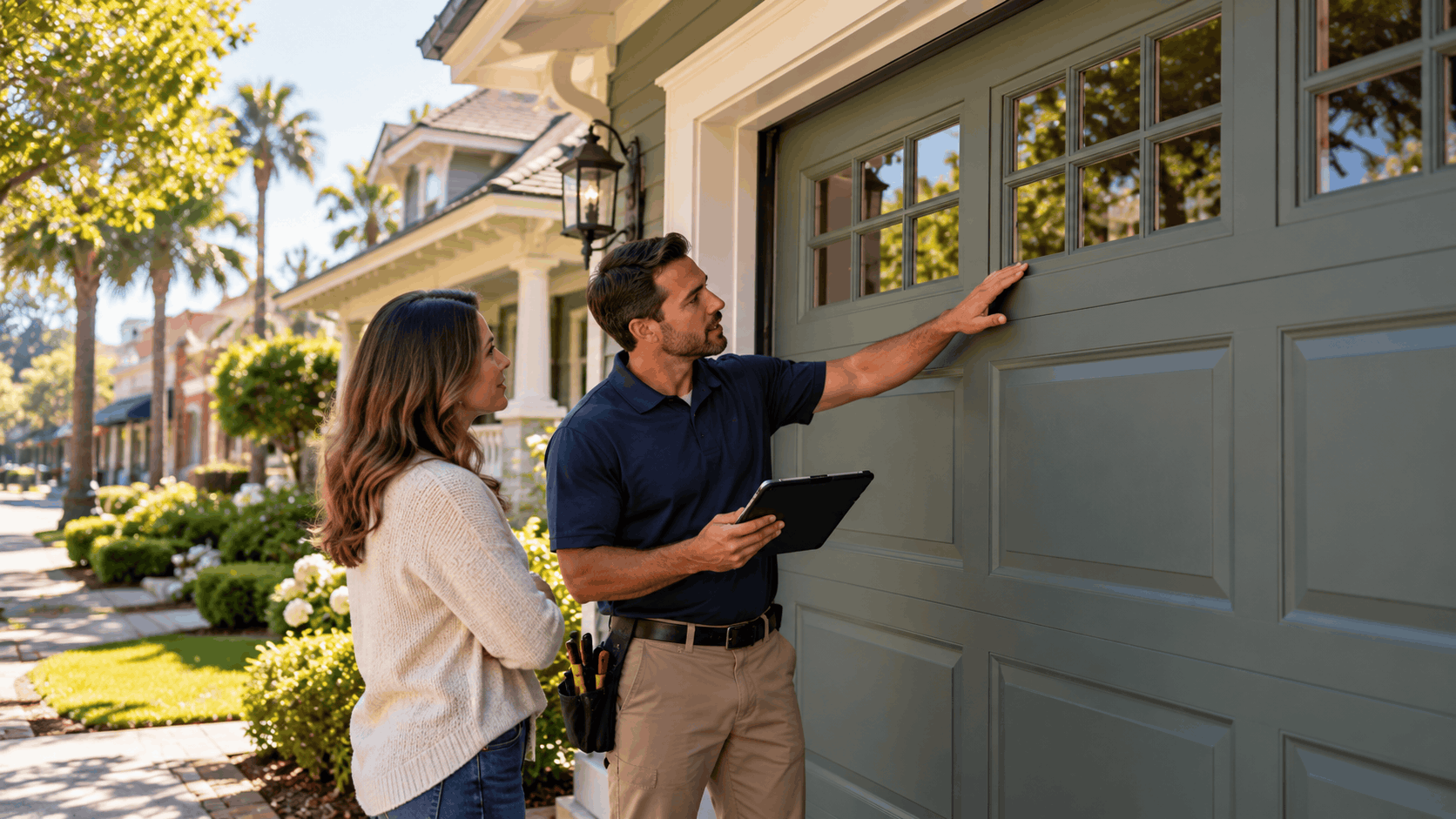
What the Mills Act Actually Is in Tustin?
The Mills Act is a tax-for-upkeep trade. A qualifying owner of a historic property agrees to actively care for it, and in return the county reassesses the property at a lower value, which lowers the annual property tax bill. In Old Town Tustin, where the city holds the oldest housing stock and the strongest preservation standards, this program reaches features most owners never think of as regulated, including the garage door off the back alley.
Tustin City Council authorized its Mills Act Program in June 1997 and established a policy for historic property preservation agreements. These contracts run under California Government Code Article 12, sections 50280 to 50290, and California Revenue and Taxation Code Article 1.9, sections 439 to 439.4. The state sets the framework; the city decides who gets in.
Because the contract is about preservation, it looks at the whole exterior of a property. The garage door is part of that exterior. Owners who understand this early avoid the surprise of finding a door swap tangled up in both a tax obligation and a design review.
| Element | Detail |
|---|---|
| Program authorized | Tustin City Council, June 1997 |
| State law | Gov. Code 50280-50290; Rev. & Tax. Code 439-439.4 |
| What the owner gets | Reduction in property taxes |
| What the owner owes | Active restoration, rehabilitation, repair and preservation |
| Eligibility | Residential significant contributors in the 2021 survey |
| Application deadline | May 31 each year, by appointment |
| Inspection scope | Exterior only |
The Tax Reduction and the Obligation Behind It
The core of a Mills Act contract is a preservation agreement between the owner and the city. The owner commits to actively restoring, rehabilitating, repairing and preserving the property, and in exchange the county assessor values the property under a formula that usually produces a lower tax bill. That property tax reduction is the incentive that pulls owners into the program.
The legal backbone comes from two parts of California law. Government Code sections 50280 to 50290 let a city enter these agreements, and Revenue and Taxation Code sections 439 to 439.4 set out how the property gets assessed once the contract is in place. Tustin built its local program on that foundation in June 1997.
What owners sometimes miss is that the tax break is not a reward for past work. It is payment in advance for ongoing care. The contract expects the owner to keep the property in good condition year after year, which is why a neglected exterior feature can become a contract concern rather than just a repair someday.
That ongoing nature is what pulls the garage door into the picture. A door that is rotting, buckling or hanging crooked is an exterior feature that the agreement expects to be kept up, not left to fail.
Who Qualifies in Old Town
Eligibility in Tustin is narrow. The program is limited to residential properties identified as significant contributors in the 2021 Tustin Historical Resources Survey. Being on a survey inventory is not the same as formal designation, but for Mills Act purposes the significant-contributor label is what opens the door.
That 2021 survey was unusually wide. The city considered all properties, buildings, structures, objects and sites constructed through 1976, meaning everything at least 45 years old by the end of 2021. That is a broader net than most Orange County cities cast, and it reflects Tustin's standing as one of only three cities in the county recognized as a Certified Local Government.
The eligibility process runs on a calendar. Applications must be received by May 31 each year, and they are taken by appointment. An owner who misses that window waits until the next cycle, so planning ahead matters if the goal is both the tax benefit and a documented exterior improvement.
For owners just outside the current district, the survey work matters too. The city has pointed toward expanding the Cultural Resources District to include neighborhoods north of First Street and Lockwood Terrace's 1950s tract housing, so a property outside today may sit inside later.
The Pre-Approval Inspection Is Exterior Only
State law requires a pre-approval inspection before a Mills Act contract is granted, and that inspection covers only the exterior. No one walks through the living room. The assessment is about the outside of the building and how well it is being preserved.
This is exactly why the garage door matters. On an Old Town lot, the detached garage and its door are exterior features in plain view, often right off the alley. The exterior inspection looks at them the same way it looks at the siding, the windows and the roofline.
The driveway is in scope as well. The Old Town guidelines address driveways alongside doors, so the surface leading up to the garage is part of the exterior picture the program reviews. An owner thinking only about the house itself can overlook these approach features.
Because the inspection is exterior only, the practical takeaway is simple. Anything visible from the outside, including a tired garage door, is fair game for the program, so it pays to keep that door in condition that reflects the care the contract expects.
Get Your Free Quote
Tell us about your garage door and we'll get back to you within 30 to 60 minutes.
Why the Garage Door Sits Inside Your Maintenance Duty?
Once an owner understands that the contract is about exterior care and the inspection is exterior only, the garage door stops being an afterthought. It becomes a covered exterior element with an ongoing maintenance obligation attached. The door is not separate from the historic home; on an Old Town lot it is one of its defining features.
That framing changes how an owner should treat door problems. A stuck opener or a frayed cable is not just an inconvenience to fix whenever. It is upkeep the contract assumes will happen, on a building the city has recognized as worth preserving.
An Active Obligation, Not a One-Time Promise
A Mills Act contract carries an active maintenance duty. The owner does not sign once and forget it. The agreement expects continuous restoration, repair and preservation of exterior features for as long as the contract runs.
That ongoing duty means a sagging, rotting or failing garage door is a maintenance item the contract anticipates being addressed. A one-piece tilt-up door that has warped, or hardware that has seized, is the kind of condition the program is set up to catch and correct.
Letting a door deteriorate works against the very reason the owner receives the tax reduction. The benefit flows because the property is being cared for, so visible decline on an exterior feature cuts against the spirit of the deal. Keeping the door functional and appropriate is part of holding up the owner's side.
None of this means an owner has to replace a door the moment it shows wear. Repair and restoration often satisfy the obligation better than replacement, which we cover further down. The point is that the door is on the list of things the contract watches.
A Street or Alley-Facing Feature the Inspection Sees
Because the inspection is exterior only, the garage door is a visible feature the program reviews. On many Old Town properties that door faces an alley rather than the street, since the original builders set garages behind the houses.
The driveway in front of the door is documented too. Together the door and driveway form part of the approach the inspection records, so both are features the program considers during the life of the agreement. An owner cannot assume an alley location puts the door out of sight.
The alley access that defines so much of Old Town is a working part of the neighborhood's character. Those alleys and narrow driveways are exactly the context the design guidelines were written for, which is why the garage door reads as a contributing piece of the historic streetscape even when it sits around back.
For owners, the lesson is to treat the alley-facing door with the same care as a front elevation. It is seen, it is documented, and it counts.
What Old Town Garages Look Like
Old Town is Tustin's original townsite and holds the oldest housing in the city, with buildings dating back to the 1880s along Main Street from Williams Street to just past Newport Avenue. The detached garage set behind the house, off an alley or a narrow driveway, is the norm here rather than the attached front-facing garage common in newer Orange County tracts.
Those garages were built for a different era of car. The original single-car opening is undersized by modern standards, which shapes what will physically fit when a door is replaced. An owner hoping to drop in a standard modern door sometimes finds the opening itself does not match stock sizes.
Many of these garages still carry a one-piece tilt-up door rather than a sectional door. A tilt-up swings out and up as a single slab, while a sectional door rides up in hinged panels. They are different products with different hardware and different ways of failing, so the fix for one is not the fix for the other.
This housing stock is why Old Town door work is rarely a simple catalog order. The combination of age, undersized openings and discontinued door styles means each job starts with figuring out what is actually there. Owners in nearby historic cores, such as those served by our maintenance work in the San Juan Capistrano historic core, see the same pattern.
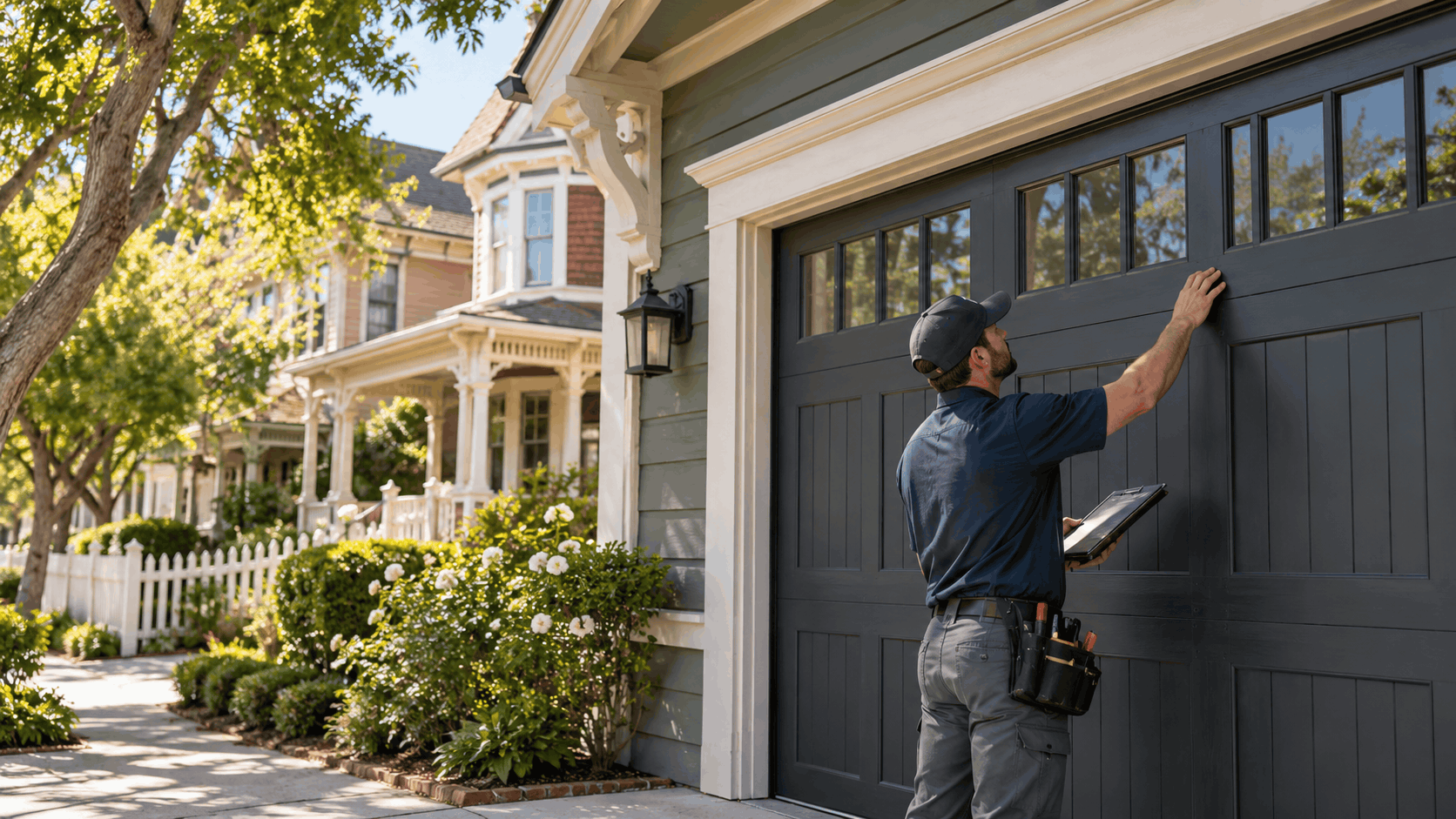
Need Help in Irvine?
Urgent Garage Doors serves Irvine and all of Orange County.
The Design Review Layer on Top of the Contract
A Mills Act door change in Old Town is not only a permit matter. It runs through design review because the property sits inside the Cultural Resources District, a preservation overlay centered on Main Street and El Camino Real. That review is handled through a Certificate of Appropriateness, and it is a city process, not an association process.
This is the layer that catches owners off guard. They expect a building permit. They do not always expect a separate design approval sitting on top of it, with published standards about how the work should look.
What a Certificate of Appropriateness Covers
A Certificate of Appropriateness is a no-fee permit that applies to structures within the Cultural Resources District, or to a designated cultural resource outside the district. It is required prior to or concurrent with other approvals for exterior work, which includes a visible change to a garage door.
The certificate is a design-review tool. Its purpose is to judge whether a proposed exterior change fits the historic character the district protects. For a garage door, that means the review looks at how the new or repaired door will appear from the alley or street.
Because it carries no fee, the certificate is not a money barrier. The cost to the owner is in time and in getting the design right, not in a charge for the permit itself. That said, the review is real, and skipping it on exterior work within the district is not an option.
Owners should treat the certificate as part of the planning stage, not a formality tacked on at the end. Working out the door's appearance before the application goes in saves back-and-forth later.
It Does Not Replace the Building Permit
The certificate is a design-review layer sitting on top of the standard building permit. It does not take the permit's place. An Old Town owner can need two approvals for the same door job: the design sign-off through the certificate and the building permit for the physical work.
Whether a given job needs a building permit is decided by the city with jurisdiction over the specific address, not by a regional rule. For a Tustin property, that is the City of Tustin. The honest answer on any specific door is to confirm the permit position for that address with the city.
Structural work is what usually drives a permit, things like widening an opening or altering the header, rather than a like-for-like swap. But in the Cultural Resources District the design review can apply even where a permit might not, because the trigger there is the exterior change itself.
The two tracks can run at the same time, which is why the certificate is required prior to or concurrent with other approvals. Coordinating them early keeps a project from stalling. You can reach us through our contact page to talk through how a job splits between the two.
Contributing Versus Non-Contributing
The first practical question on any Old Town job is whether the address sits inside the district and whether the building is a contributing building. Buildings inside the Cultural Resources District that do not meet the contributing criteria are classed as non-contributing, and that status shapes how much scrutiny a change draws.
The city uses a standard rating system for Certificates of Appropriateness. It runs from individually listed National Register properties through to district contributors listed or designated locally. Where a building lands on that scale affects how the review treats a proposed door change.
Listing on a survey inventory is not the same as formal designation. The inventory does not by itself confer historic status or protect a property from alteration. In Tustin the protection comes from inclusion in the Cultural Resources District, or from recognition as a Designated Cultural Resource by city council for a property outside the district.
So the status check decides the path. On a contributor inside the district, a door change is a design-review matter. On a non-contributing building the review may be lighter, but the status still has to be confirmed before anyone assumes anything.
Who to Ask Before Anything Starts
The authority on whether a specific property triggers design review is the City of Tustin Planning Division, reachable at 714-573-3140. That office can tell an owner whether the address is inside the district and whether the building is a contributor, which settles the path the job will take.
Permits and inspection requests run through the city's EnerGov CSS portal. That is the online system for filing and tracking the building side of the work. An owner planning a door change should expect to use it for the permit even if the design review is handled separately.
Starting with the Planning Division saves wasted effort. A five-minute call establishes whether a door swap is a straightforward permit or a design-review matter, and it keeps an owner from ordering a door that will not pass review.
This city-driven process is what makes Old Town unlike nearly every other neighborhood we serve. There is no HOA and no Mello-Roos here, but there is a municipal review with published standards, so the Planning Division is the right first call, not an architectural committee.
Material Choice Is the Part Most Likely to Be Questioned
When a Mills Act or district door change goes to review, the single feature that draws the most scrutiny is material. The design guidelines address the door directly, and the Secretary of the Interior's Standards frame the judgment on any change. Both point toward keeping a door's appearance in step with the historic home, and exterior materials are where that judgment gets tested.
Owners who go in assuming any modern door will pass sometimes hit resistance exactly at the material question. Knowing that in advance shapes a smarter plan.
What the Guidelines Address for a Door
The Old Town residential design guidelines address both the driveway and the door. These are not abstract preferences. The guidelines run to sections on new infill development and on landscaping, and they include appendices with a glossary, technical information, contractor information and a home repair checklist.
The standard behind the guidelines is the Secretary of the Interior's Standards for the treatment of historic properties. Those standards favor repair over replacement and favor changes that respect the original character. For a garage door, that framing pushes toward preserving what is there or matching it closely.
Because the driveway is addressed alongside the door, an owner planning door work should think about the whole approach. A repaved or redesigned driveway can trigger the same review attention as the door itself, so it helps to consider them together.
The guidelines were adopted based on evaluation of historic features, and they identify which elements of a property are contributing and when a certificate is required. That makes them the practical rulebook for what a replacement door can look like.
Material Guidance Is Live Right Now
The guidance on exterior materials is not static. Staff have been revisiting the sections on the appropriateness of exterior materials, so what a replacement element may be made of is current and worth confirming rather than assuming. An owner reading an older copy of the guidelines may be reading outdated material rules.
This matters because material is the heart of the question. The difference between a wood-look door and a plain steel one, or between a flat panel and a paneled profile, can decide whether a design passes. If the material rules are in flux, an owner wants the current position before ordering anything.
The city has also revised procedure in other ways. References to the former Cultural Resources Advisory Committee in older guideline documents have been updated, and the historic resources commission was disbanded some years ago. So an owner working from an old document may be reading procedure that no longer applies.
The safe move is to confirm the current material guidance with the Planning Division before committing to a door. That one check avoids buying a door that the review will not accept.
Why a Straight Swap Changes the Look
Swapping a one-piece tilt-up door for a modern sectional door changes the appearance in exactly the way the design guidelines scrutinize. The two are different products with different hardware, and they read differently from the alley or street.
A tilt-up presents as a single slab with its own proportions and shadow lines. A sectional door shows horizontal joints between panels and rides up on tracks and rollers. That appearance change is visible even to a casual eye, which is why review treats it as a real alteration rather than a like-for-like repair.
For a contributing building, that visible shift is the kind of change the Secretary of the Interior's Standards are meant to govern. A door that erases the original character of the opening works against the preservation goal the contract and the district share.
This does not rule out a sectional door in every case. It means the choice has to go through review, and the design, material and profile have to be chosen with the historic look in mind. If a new door is the right path, our carriage-house door installation options can carry a traditional appearance that reviews better than a plain modern slab.
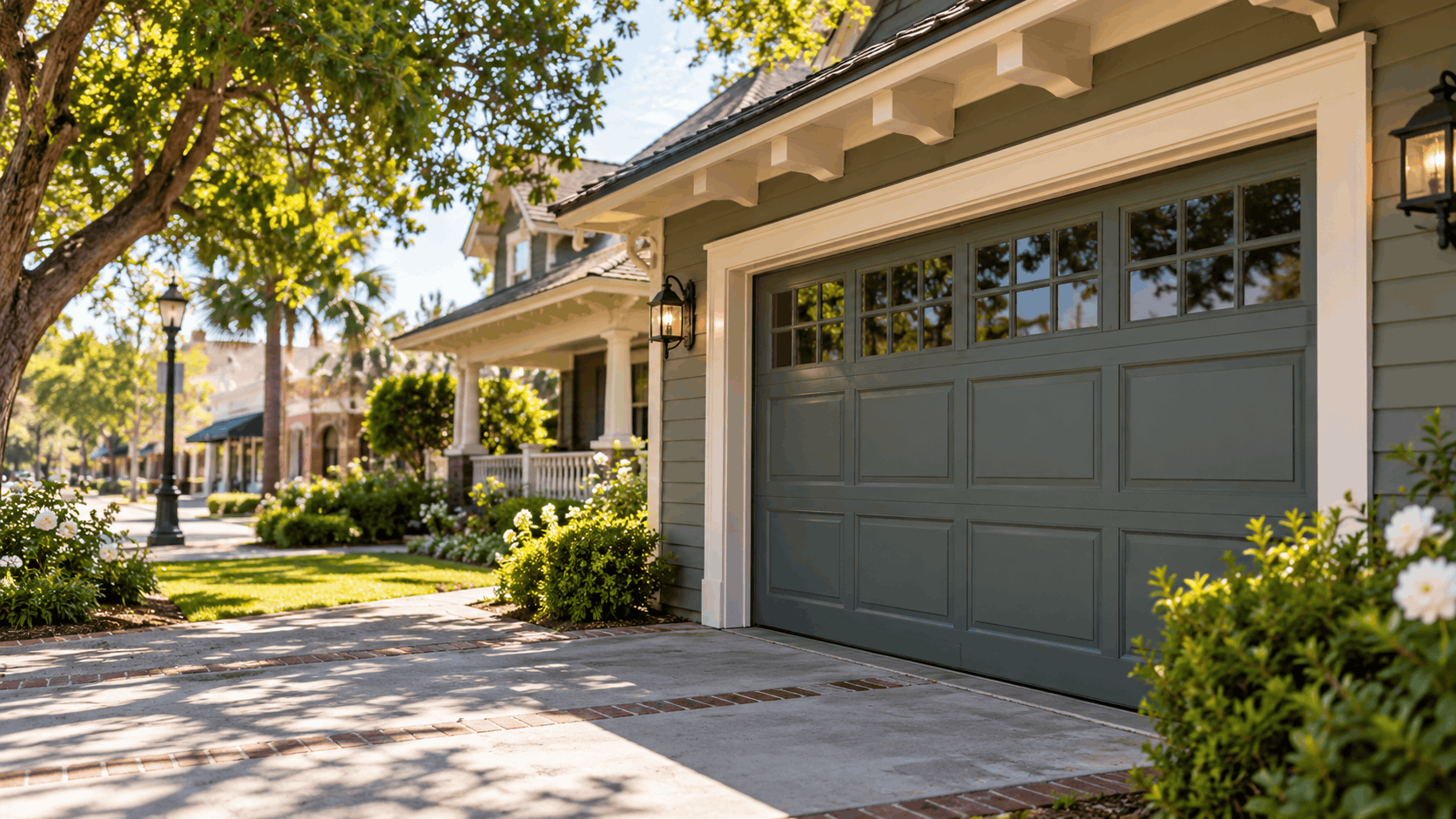
Repairing an Old Town Door Instead of Replacing It
On Old Town homes, door repair and restoration often beat replacement. The housing age, the discontinued door styles and the tilt-up hardware all point the same way: fixing or restoring the original door usually sits better with both the Mills Act obligation and the design guidelines than dropping in a new one.
There is a practical side too. Early door profiles are long gone from catalogs, so replacement is not always a simple matter of ordering a match. Repair keeps the original character and often costs less than fabricating a custom replacement.
Discontinued Panels Mean Fabrication
Replacement panels for early door profiles are long discontinued. When a single panel on an old door is cracked or rotted, an owner cannot simply order that panel from a supplier. The part no longer exists in the market.
That reality pushes repair toward fabrication or restoration. A damaged section may have to be rebuilt to match the original, or the existing material restored rather than swapped out. This is skilled work, closer to carpentry and restoration than to a parts replacement.
For a contributing building, this is often the preferred outcome anyway. Fabricating a matching panel preserves the door's historic appearance in a way a modern off-the-shelf replacement cannot. It keeps the review path simpler because the look does not change.
Owners should expect this kind of work to take longer than a stock repair and to cost more per panel than a routine fix. Our panel replacement service can assess whether a damaged section is repairable or needs fabrication.
Tilt-Up Doors Fail Differently
A one-piece tilt-up door is a different product from a sectional door, and it has different failure modes. It pivots up as a single slab on a spring and hinge arrangement at the sides, so when it fails, the symptoms are not the same as a sectional door that has come off its tracks.
Tilt-up doors can bind at the pivot points, lose spring tension unevenly, or warp across the slab so they no longer seat square in the opening. The hardware is simpler in some ways and harder to source in others, since much of it predates modern sectional systems.
Because the mechanics differ, the diagnosis differs. A technician used only to sectional doors can misread a tilt-up problem. On these older Old Town garages, knowing the product is half the job, and the fix follows from correctly reading how the specific door type is failing.
This is why we start an Old Town call by identifying exactly what is on the opening. The repair plan for a tilt-up slab looks nothing like the repair plan for a sectional door, even when the complaint sounds the same.
What Else Wears on a Door This Age
Springs get the attention, but cables, drums, rollers, hinges and bearings all wear alongside them. Replacing a spring without inspecting the cables is how a second failure follows weeks later, so a proper repair looks at the whole system, not just the part that broke.
Old Town's narrow alleys add their own wear pattern. Wind carries dust and plant debris into tracks, seals and photo-eye lenses. Grit packs into a seal so it stops flattening against the slab, and debris coats a sensor and breaks the beam, which makes a door reverse for no visible reason.
That track debris is a common cause of a door that will not close or reverses on its own. Cleaning and realigning the track, clearing the lenses and checking the seal often restores normal operation without any major part change. Our track repair and realignment work addresses exactly this.
On a door this age, the honest frame is that corrosion and grit bring parts to the end of their rating. A full inspection of cables, rollers and hinges at the same visit as a spring or seal job prevents the repeat call that comes from fixing one part and ignoring the rest.
Springs Are the One Thing an Owner Must Not Touch
A torsion spring stores enough energy to cause serious injury and is wound under high tension with bars against a fixed cone. An owner should never adjust, wind, unwind or replace one. This is the single part of a garage door where do-it-yourself goes wrong fastest and worst.
Torsion springs are rated in cycle rating, where one cycle is a full open and close. A standard spring is commonly rated around 10,000 cycles. A door cycled four times a day reaches that in roughly seven years, which is why springs age out on a predictable schedule rather than a guessed one.
On an Old Town garage where the detached building sees lighter daily use, springs may last toward the longer end. But safety does not change with usage. The energy stored in the spring is the same, and the risk of winding it wrong is the same.
The safe check an owner can do is the manufacturer's auto-reverse test, not a spring adjustment. Leave the spring to a licensed technician. Our torsion spring replacement service handles the winding and tensioning safely, with the spring sized to the actual weight and height of the door.
Need Help in Irvine?
Urgent Garage Doors serves Irvine and all of Orange County.
Adding or Updating an Opener on a Historic Garage
Openers on Old Town garages raise both practical and legal questions. Many detached garages here have a garage door opener that predates modern safety rules, some have no opener at all, and any new install has to meet SB 969 and current entrapment protection standards. Each of these shapes the scope of the work.
Because these garages were not built with modern automation in mind, adding or updating an opener is often more involved than on a newer home. Wiring, structure and door type all factor in.
Many Old Town Openers Predate 1993
Openers here frequently predate the January 1, 1993 federal requirement for external entrapment protection. A pre-1993 opener lacks the external device, such as a photo eye, that every modern opener must have.
California moved earlier than the federal government. AB 3600 (Polanco, Chapter 1336, Statutes of 1990) required California openers to be manufactured with an automatic reverse device and sensor, and Congress followed for openers made for the United States after 1993. The honest line for an old Old Town unit is that it predates the federal mandate.
The safety devices on modern openers are built to UL 325, the standard that approved photoelectric eyes and edge sensors as acceptable external entrapment-protection devices. A unit from the 1980s simply does not have this protection, which is why the manufacturer position, LiftMaster for example, is that pre-1993 openers should be replaced rather than repaired.
For an Old Town owner, an aging opener is both a safety matter and a practical one. If it is from before 1993, replacement brings the garage up to the entrapment protection every modern opener carries. Our opener repair and troubleshooting team can confirm the age and condition of a unit.
Some Garages Have No Opener or Wiring at All
Some detached Old Town garages have no wiring and no opener at all. These were built when a car owner lifted the door by hand, and nothing has changed since. Adding an opener to one of these is an electrical work job as well as a door job.
That changes both scope and cost. A powered outlet has to be run to the opener location, which on a detached garage off an alley can mean a longer run than on an attached garage. The electrical side may bring its own permit considerations with the city.
It also affects timing. A straightforward opener swap on a wired garage is a short job. Running power to an unwired detached garage adds a trade and a step, so an owner should plan for that rather than expect a same-visit install.
When we look at an unwired garage, we flag the electrical scope up front so the owner knows what the full job involves. Our opener installation service covers the door side of that work.
Battery Backup Is Required by Law
SB 969 (Dodd, Chapter 621, Statutes of 2018) requires every residential automatic garage door opener manufactured for sale, sold, offered for sale or installed in California on or after July 1, 2019 to have a battery backup designed to operate during an electrical outage. Violations carry a $1,000 civil penalty.
Since that date, a replacement residential garage door may not be installed connected to an opener that does not comply. So an Old Town owner replacing a door or opener is getting a battery backup unit as part of the install, whether or not they asked for one. It is a legal requirement, not an optional upgrade.
The law was passed after deaths in the 2017 Northern California wildfires, where people could not open garage doors during a power outage. The purpose is evacuation when the grid goes down and a resident cannot lift a heavy door by hand. It applies statewide to residential openers.
For a detached Old Town garage, the backup matters in any outage, not just a fire. We handle this under our battery backup installation service, included as part of a compliant opener setup.
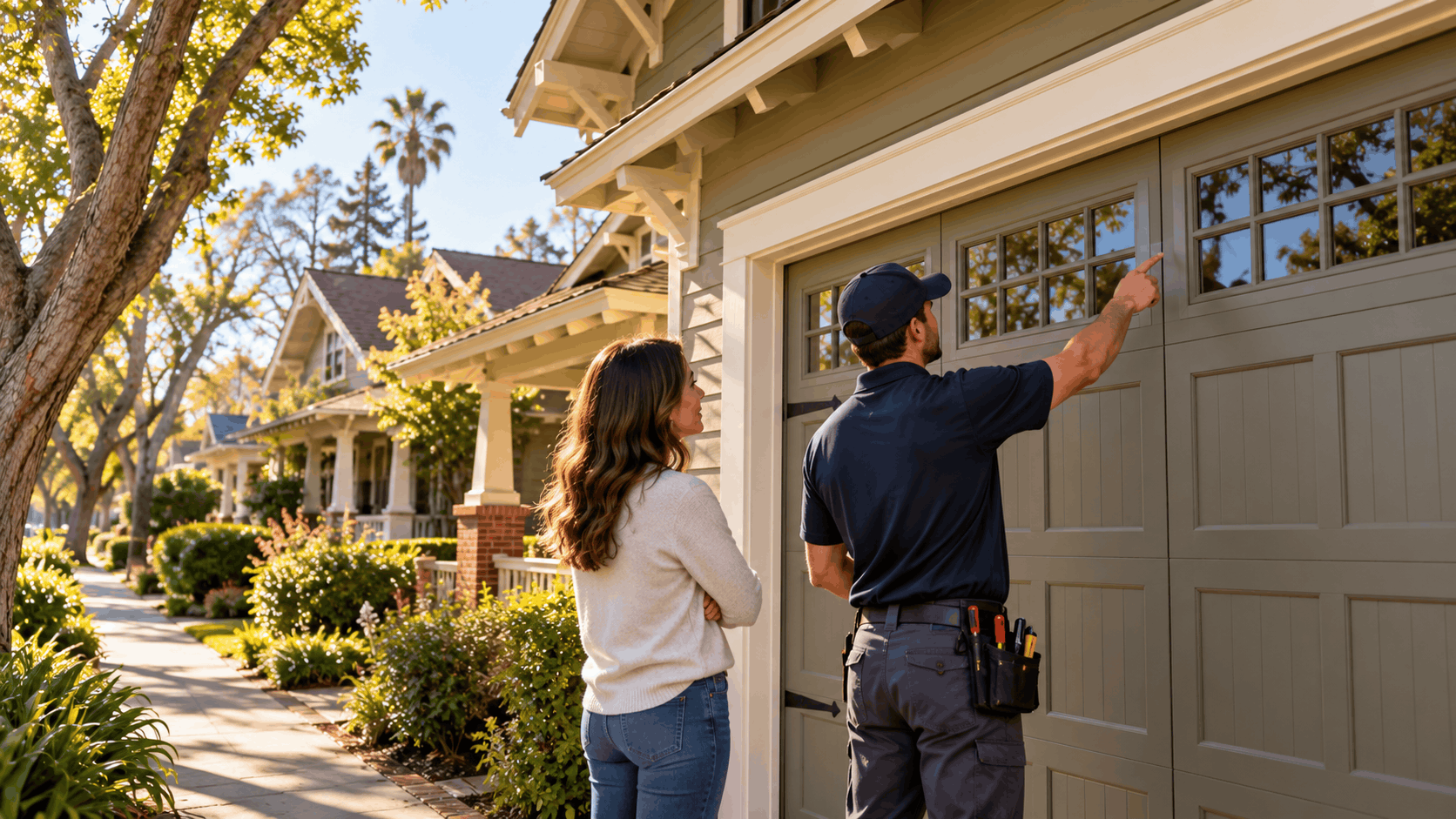
What This Work Typically Costs in Orange County?
It helps to know the typical Orange County ranges before calling anyone. The figures below are typical price ranges for the area, not a quote and not a fixed price from us. The actual garage door cost for a specific garage depends on that garage, and the price for a specific job is given in writing before work begins.
Historic work can land toward the higher end of these ranges because fabrication and matching take more time than a stock swap. Here are the published ranges that apply to Old Town door and opener work.
| Job | Typical range |
|---|---|
| Sectional garage door replacement | $800 to $2,500 |
| Carriage-house garage door | $1,200 to $4,500 |
| Custom garage door projects | $1,800 to $6,500+ |
| Panel replacement | $250 to $800 per panel |
| Torsion spring replacement | $150 to $300 |
| Spring conversion | $150 to $350 |
| Opener installation | $250 to $600 |
| Battery backup installation | $200 to $400 |
| Safety sensor alignment and repair | $75 to $150 |
| Keypad and remote programming | $45 to $85 |
Doors, Panels and Spring Conversions
For a full door replacement, sectional garage door replacement runs $800 to $2,500. That range covers a straightforward swap where a stock door fits the opening, which is not always the case on an undersized Old Town single-car opening.
When only part of a door is damaged, panel replacement runs $250 to $800 per panel. On a historic door with a discontinued profile, the higher end reflects the fabrication involved, since a matching panel may have to be built rather than bought.
A spring conversion, moving from one spring system to another, runs $150 to $350. Torsion spring replacement runs $150 to $300. These are the kinds of jobs where our trucks carry common torsion spring sizes, so a spring replacement is often completed on the same visit.
Each of these depends on what the specific door needs. A spring sized to a heavier restored door, or a panel fabricated to match an old profile, sits toward the top of its range, and the written price reflects the actual door.
Openers, Battery Backup and Sensors
Opener installation runs $250 to $600, with a belt drive costing more than a chain drive. Belt drives are quieter, which can matter where a room sits above or beside the garage, though on a detached Old Town garage that is less of a factor.
Because SB 969 requires it, battery backup cost runs $200 to $400 as part of a compliant setup. This is not a separate luxury tier; it is the legal baseline for a residential opener installed in California since July 2019.
For sensor repair, safety sensor alignment and repair runs $75 to $150. In the dusty Old Town alleys, a sensor whose lens is coated with grit or knocked out of alignment is a common cause of a door that reverses on its own, and this is often a quick fix.
Keypad and remote programming runs $45 to $85. On a garage getting a new opener, programming the remotes and any keypad is part of finishing the job, and it is the lowest-cost item on the list.
Why a Historic Door Can Land Higher
Custom door and carriage-house projects run higher, from $1,200 to $6,500 and up, because fabrication, restoration and matching a discontinued profile take more work than a stock swap. On a contributing Old Town building, this is often the realistic path when a door has to both function and satisfy design review.
The fabrication cost reflects real labor. Building a panel to match an 1880s or early 1900s profile, or restoring an original tilt-up slab, is skilled work that no catalog price covers. The time spent matching material and detail is what moves a historic job above a routine replacement.
Design review can add to the timeline, though the Certificate of Appropriateness itself carries no fee. The cost there is in planning and in getting the material and appearance right the first time, not in a permit charge.
Whatever the job, the specific price for a particular garage is given in writing before work begins. The ranges above tell an owner what to expect; the written price tells them what their door actually costs.
Licensing and the Rules That Apply to Any Door Job Here
Who should do the work, and when a written contract is required, come down to two sets of rules. The correct contractor classification is C-61/D-28, and the dollar thresholds for an unlicensed exemption and for a home improvement contract are separate numbers that get confused. Knowing both protects an Old Town owner.
Hiring the right contractor license matters more on a historic, design-reviewed property than almost anywhere. The work has to pass both the building side and the review side, and a licensed contractor who knows the classification is part of getting there.
The Classification Is C-61/D-28
California garage door work is licensed by the Contractors State License Board under C-61/D-28, Doors, Gates and Activating Devices, a subclassification of the C-61 Limited Specialty category. The scope covers sectional and rolling doors, torsion and extension spring systems, operators, control boards, safety sensors and activating devices.
That is the classification an owner should look for. It means the contractor is licensed for exactly the work a garage door job involves, from the door itself to the opener and sensors.
C-28 is a different thing entirely. C-28 is Lock and Security Equipment, not garage door work. A contractor should not describe garage door work as C-28, and the job does not require a Class B general building license either.
The CSLB is the body that issues and oversees these licenses. Checking that a contractor holds C-61/D-28 is a simple way to confirm they are licensed for the work in front of them, which matters doubly on a property under design review.
The $1,000 Threshold and the $500 Contract Rule
AB 2622 (Chapter 240, Statutes of 2024) rewrote Business and Professions Code section 7048 effective January 1, 2025, raising the unlicensed exemption from $500 to $1,000 in combined labor, materials and other costs. A great deal of older advice still prints $500; the current figure is $1,000.
That exemption also fails in two situations regardless of value. It fails if the work requires a building permit of any kind, and it fails if the person employs anyone on the job. A job cannot be split into sub-$1,000 slices to dodge the rule.
This matters in Old Town because a door change that needs a building permit removes the exemption even on a small job. On a design-reviewed property that may need both a permit and a certificate, the exemption often does not apply at all, so licensed work is the realistic path.
A separate rule is B&P 7159, which requires a written home improvement contract for work over $500. That is a contract requirement, not a licensing threshold, and the two numbers should not be merged. One governs who can do the work; the other governs when a written contract is required.
Verify a License Before You Hire
A license, its classification, status, bond and workers compensation are all public record and free to verify a license at cslb.ca.gov. An owner can check in a couple of minutes before signing anything.
Verifying at cslb.ca.gov confirms the contractor is who they say they are and is licensed for the work. On a historic property where the job has to pass design review and a building permit, that confirmation is worth the few minutes it takes.
Urgent Garage Doors holds California license 1055150. An owner can look that number up on the CSLB site and see the classification, status, bond and workers compensation for themselves.
The State Historic Preservation Office framework that recognizes Tustin as a Certified Local Government is one layer; the contractor license is another. Both exist to keep the work sound. Checking the license is the piece the owner controls directly.
Need Help in Irvine?
Urgent Garage Doors serves Irvine and all of Orange County.
How Urgent Garage Doors Handles an Old Town Tustin Job
Our approach to a Mills Act or Cultural Resources District door reflects what the neighborhood actually is. Urgent Garage Doors starts Old Town Tustin service with the questions that decide the path, offers a free estimate for new installations, and plans around the alleys and parking that define the district.
Based in Irvine at 76 Ashford, we work across Orange County, and Tustin is a short drive from our storefront. The historic core needs a different first step than a newer tract, and we build the job around that.
Free On-Site Estimate and Written Price
We offer a free estimate on site for new door installations. On an Old Town garage, that visit is where we identify what is actually on the opening, whether it is a tilt-up slab or a sectional door, and what the undersized opening will accept.
A written price is available before work begins. When the job calls for it or the customer asks, we put the price in writing so an owner knows the cost before any tools come out. Separately, California law requires a written home improvement contract for work over $500.
Removal and haul-away of the old door is included in a new door installation. On a detached garage down a narrow alley, taking the old slab away is part of the job, not an extra an owner has to arrange.
For a historic door headed through design review, the estimate visit is also where we talk through whether repair or a review-friendly replacement makes more sense. Getting that call right early saves time and money.
Stocked Trucks and Scheduling Around the Alleys
Our trucks carry common torsion spring sizes, so a spring replacement is often finished the same visit. On an Old Town garage with a standard torsion setup, that can mean the door is working again the same day rather than after a parts wait.
Not every job finishes in one visit. A fabricated panel for a discontinued profile, or an unwired garage that needs power run, takes longer by its nature. We tell an owner up front which kind of job theirs is.
Alley access shapes scheduling here in a way it does not elsewhere. The district has narrow streets and alley access to many garages, with contested parking during community events and the farmers market near Main Street and El Camino Real. We confirm access before dispatch rather than assume it.
That confirmation matters because a truck that cannot reach the garage cannot do the work. A quick check on alley width and event timing keeps the visit from being wasted, and keeps the day running for both the owner and the crew.
Response Across Orange County, Any Day
We take emergency calls 24 hours a day, 7 days a week, every day of the year including holidays. A door that will not close on an Old Town garage, leaving the contents exposed off the alley, is the kind of call that does not wait for business hours.
Our response window is 30 to 60 minutes anywhere in Orange County. From our Irvine base, Tustin is well within that reach, so an Old Town owner is not waiting half a day for someone to show up.
We work on all brands, including LiftMaster, Chamberlain, Genie, Craftsman, Clopay, Amarr, Wayne Dalton and CHI. On a historic garage, that range matters because the opener, when there is one, can be from almost any era or maker.
Whether the job is a spring, a sensor, a panel or a full review-ready door, the same crew that knows the Old Town alleys handles it. You can see more of our work across Tustin and the services we bring to it.
Getting Your Old Town Door Sorted
An Old Town door starts with the right first call to the Tustin Planning Division at 714-573-3140, then the right licensed contractor for the work itself. When you are ready for the door side, reach Urgent Garage Doors at (949) 529-7743 for a free on-site estimate and a written price before work begins.
Frequently Asked Questions
- Does my Mills Act contract require me to maintain the garage door?
- Yes. A Mills Act contract carries an active obligation to restore, repair and preserve exterior elements of the property, not a one-time promise. Because the state-required pre-approval inspection covers only the exterior, the garage door is one of those elements the program looks at. A sagging, rotting or failing door is a maintenance item the contract expects you to address, since the tax reduction is payment for ongoing care of the building's exterior.
- Do I need a Certificate of Appropriateness to replace my garage door?
- A Certificate of Appropriateness is required for exterior work on structures within the Cultural Resources District, and a visible garage door change is exterior work. It is a no-fee design-review permit required prior to or concurrent with other approvals. Whether your specific property triggers it depends on whether the address sits inside the district and is a contributor, and the City of Tustin Planning Division at 714-573-3140 is the authority that confirms that for your address.
- Can I swap my old tilt-up door for a modern sectional one?
- Possibly, but it goes through design review. A one-piece tilt-up door and a sectional door are different products that look different from the alley or street, so a straight swap changes the appearance the guidelines scrutinize. Material choice is the part most likely to be questioned, and staff have been revisiting the material rules. Confirm the change through the Planning Division before ordering, and consider a design that keeps the historic look to improve the odds of approval.
- Is a Certificate of Appropriateness the same as a building permit?
- No. The Certificate of Appropriateness is a no-fee design-review layer that sits on top of the standard building permit, not a replacement for it. An Old Town owner can need both for the same door job. The certificate judges how the change looks against the historic standards, while the building permit covers the physical work. The city with jurisdiction confirms whether your specific job needs a permit, so check the permit position for your address.
- My garage opener is from the 1980s. Does it meet current safety rules?
- An opener made before 1993 predates the federal entrapment-protection mandate, so it lacks the external device, such as a photo eye, that modern openers must have. California required auto-reverse earlier under AB 3600 in 1990. You can run the manufacturer's safety checks: lay a flat 2x4 across the opening and confirm the door reverses within two seconds of contact, and break the photo-eye beam while the door closes to confirm it stops and reverses. A pre-1993 unit is a candidate for replacement.
- Do I have to add battery backup when replacing my opener?
- Yes, on a residential opener. SB 969 requires every residential automatic garage door opener sold or installed in California on or after July 1, 2019 to have a battery backup designed to operate during an outage, with a $1,000 civil penalty for violations. A replacement residential garage door may not be installed connected to a non-compliant opener. It is a legal requirement, not an optional upgrade, and it was passed after the 2017 Northern California wildfires.
- Can I replace a torsion spring myself to save money?
- No. A torsion spring stores enough energy to cause serious injury and is wound under high tension with bars against a fixed cone. An owner should never adjust, wind, unwind or replace one. Springs are rated in cycles, commonly around 10,000, and are sized to the actual weight and height of the door, so a replacement has to match the specific door. Leave spring work to a licensed C-61/D-28 contractor and stick to the safe auto-reverse check yourself.
- How much does garage door work typically cost in Old Town?
- Typical Orange County ranges apply: sectional garage door replacement $800 to $2,500, torsion spring replacement $150 to $300, and opener installation $250 to $600. Panel replacement runs $250 to $800 per panel. Custom and carriage-house work runs $1,200 to $6,500 and up, because fabricating a discontinued profile or restoring an original door takes more work than a stock swap. These are typical ranges, not a quote, and the specific price for your garage is given in writing before work begins.
- Who do I call first about a door change on a historic home?
- Start with the City of Tustin Planning Division at 714-573-3140 to confirm whether your property is inside the Cultural Resources District and whether the building is a contributor. That answer decides whether your door change is a straightforward permit or a design-review matter. Once you know the path, hire a contractor licensed under C-61/D-28, Doors, Gates and Activating Devices, and verify the license free at cslb.ca.gov before signing anything.
- Can you access detached garages off the Old Town alleys?
- Yes, with confirmation first. The district has narrow streets, alley access to many garages, and contested parking during community events and the farmers market near Main Street and El Camino Real. Because a truck that cannot reach the garage cannot do the work, we confirm access before dispatch rather than assume it. Let us know the alley situation and any event timing when you call, and we plan the visit around it.
Licensed garage door repair professionals serving Irvine and Orange County.
Licensed in California · License #1055150
Why trust Urgent Garage Doors?
Founded in 2017, Urgent Garage Doors is a licensed and insured garage door services serving Irvine and Orange County. All content is reviewed by our licensed technicians.

Need Help in Irvine?
Urgent Garage Doors serves Irvine and all of Orange County.
Related Articles

Best Garage Door Size and Fit Guide for Orange County Homes
Garage door size and fit guide for Orange County. Single vs double, standard sizes, custom widths. Old Town Tustin narrow lots to Northwood Pointe 3-car.
Quiet Garage Door Openers for Tustin Townhomes With Shared Walls
A local guide to quiet garage door openers for Tustin townhomes with shared walls: belt vs jackshaft drives, HOA review, SB 969 battery backup law, and Orange County costs.
What Our Tustin Garage Door Calls Show About Old Town, the Ranch and Legacy
What our Tustin garage door calls reveal district by district, from Old Town approvals and North Tustin county permits to high-wear Tustin Ranch springs and the state rules behind every opener swap.