Smart Opener Security: How Hackers Replay 315MHz vs Rolling Code Signals
Key Takeaways
- The 315MHz frequency is safe; whether your opener uses fixed code or rolling code decides your real security.
- Fixed code openers can be recorded once and replayed forever, making them easy targets for cheap radio gear.
- Rolling code changes the signal every press, so a captured code expires almost instantly and becomes useless.
- Older Irvine homes near El Camino Real and Northwood often still run vulnerable fixed code openers.
- Smart WiFi openers add convenience but shift risk to your home network, so strong passwords and clean app access matter.
- Never leave a remote in a parked car, and use vacation mode plus a manual lock during travel.
- Reprogramming helps rolling code systems but will not fix a fixed code opener's replay weakness.
- Our Irvine team can identify your opener type and complete most rolling code upgrades the same day.
In This Article
A homeowner near Woodbridge called us last month, worried that someone had cloned her garage remote. She had come home twice to find the door already open, and she was sure she had closed it. She wanted to know if a stranger was quietly recording her signal from the street.
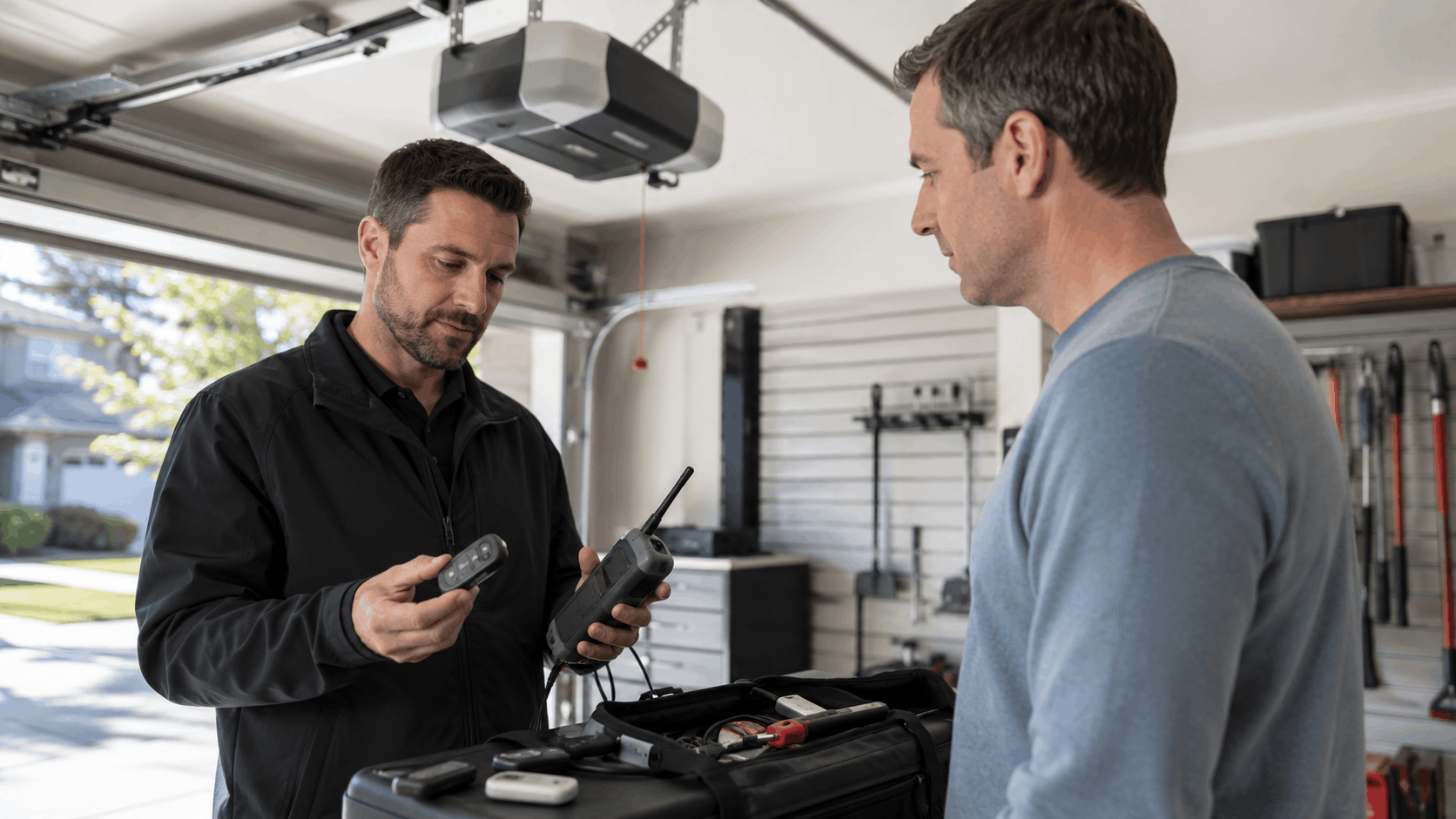
Her concern was reasonable, and it is one we hear often across Irvine. Older garage openers can be surprisingly easy to fool with cheap radio gear, while newer systems shrug off the same attack. The difference comes down to how the remote and opener talk to each other.
How Garage Door Remotes Actually Talk to the Opener
Every time someone presses a garage remote, a short burst of radio travels through the air to a receiver inside the opener. That receiver checks the message, and if it matches what it expects, the motor runs. The whole exchange takes a fraction of a second.
The garage remote signal is just data riding on a radio wave. A hacker who wants to break in is trying to grab that data and copy it. Here is what the exchange involves in plain terms:
- The remote broadcasts a small code on a set opener radio frequency.
- The opener listens on that same band for a matching code.
- If the code checks out, the wireless door control tells the motor to move.
- Range is usually a few dozen feet under normal conditions.
Not all openers handle this exchange the same way. The safety of a home depends heavily on how that code is built and whether it changes over time.
What a 315MHz Signal Is and Why Openers Use It
The 315MHz frequency is a radio band that most North American garage openers use to send their signals. It sits in a slice of the spectrum that the FCC allows for low-power devices like remotes, sensors, and tire pressure monitors. Because it is unlicensed, manufacturers can use it freely.
Openers use this band because it travels well through walls and garage doors without needing a lot of power. A small battery in a remote can push a signal on the opener radio band across a driveway with ease. That balance of range and low power made it a natural fit decades ago.
Some newer units use 390MHz or 433MHz instead, but 315MHz remains extremely common in Irvine garages. The frequency itself is not the problem. What matters far more is how the code carried on that frequency is designed.
Think of the frequency as the road and the code as the car. A busy road is fine. The real question is whether the car has locked doors or leaves the keys inside.
The Difference Between Fixed Code and Rolling Code
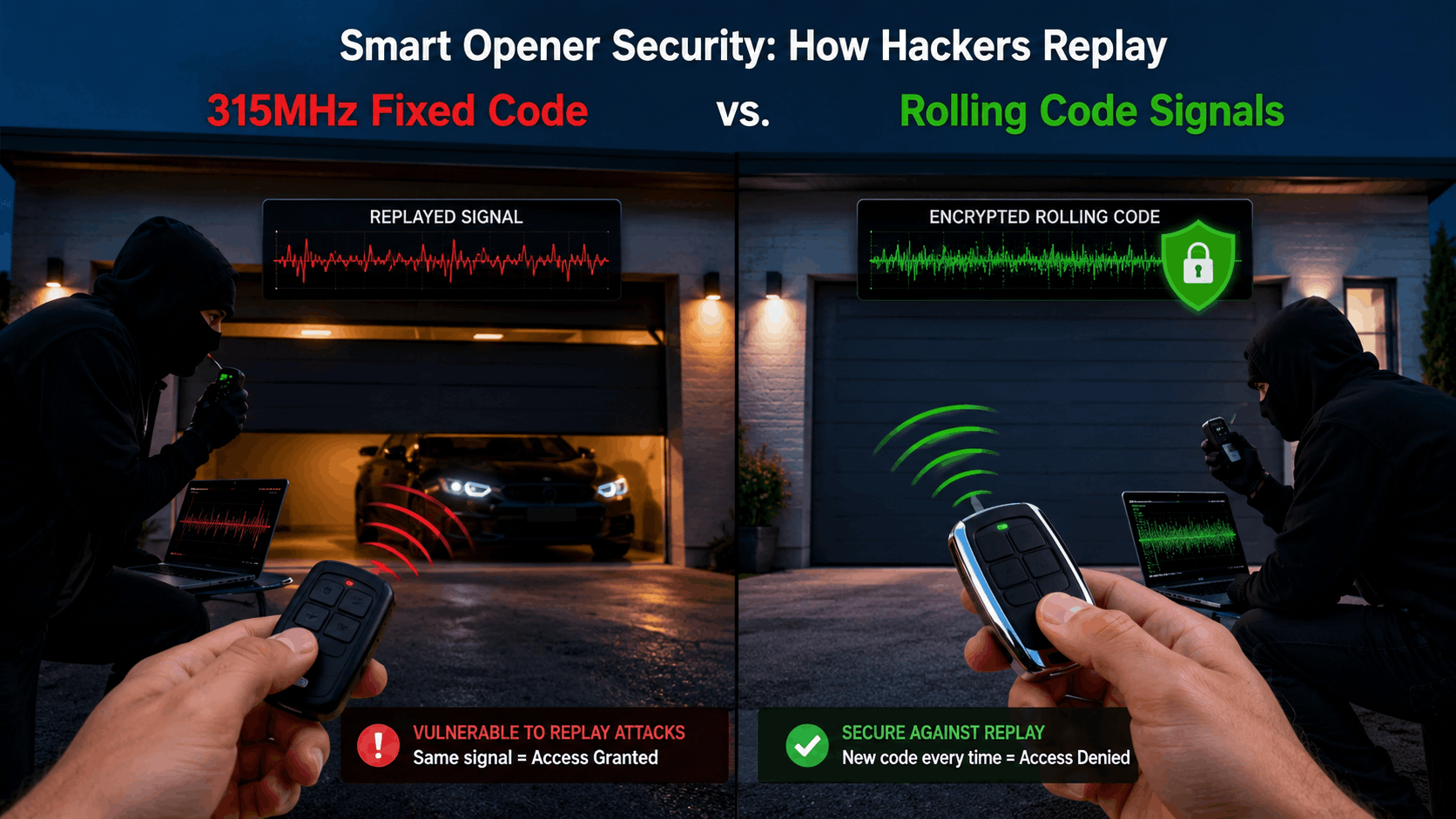
A fixed code opener sends the exact same message every single time the button is pressed. The code never changes, day after day, year after year. Once a receiver learns that code, it accepts it forever.
A rolling code opener works differently. Every press generates a new code from a shared sequence known only to that remote and that opener. The last code used is thrown away and never accepted again.
This single detail decides how safe a home really is. A fixed code can be recorded once and played back anytime. A rolling code recording is useless minutes after it is captured.
We tell Irvine homeowners this is the most important thing to check about their system. Everything else, from apps to cameras, sits on top of this basic question of fixed versus rolling code.
How to Tell Which Type Your Opener Uses
Age is the first clue. Openers made before the late 1990s almost always use fixed code, while most units built after the mid-2000s use rolling code. If your opener is older than about 20 years, assume it is fixed code until proven otherwise.
Look inside the remote or on the motor unit for small DIP switches. A DIP switch remote with a row of tiny sliding pins is a strong sign of a fixed code system, since you set the code manually by moving those switches. Rolling code remotes have no such switches and often carry a small learn button on the opener instead.
Brand and model help too. LiftMaster, Chamberlain, and Genie units with a yellow, purple, or orange learn button generally use rolling code. Older Stanley, Sears Craftsman, and Multi-Code units are common fixed code offenders in Irvine homes.
If checking opener age and switches feels uncertain, our team can identify the type in a couple of minutes during a visit. Knowing what you have is the starting point for any security decision.
Why Older Irvine Homes Often Have Weaker Openers
Homes around El Camino Real and parts of Northwood were built decades ago, and many still run their original opener hardware. When we service these houses, we regularly find fixed code units that have never been touched since installation.
The pattern is simple. If nobody ever had a reason to replace a working opener, the old fixed code system stayed in place. The door still opens, so the security risk goes unnoticed.
These older El Camino Real homes were built before rolling code was standard. That means the technology inside the garage predates the attacks that now target it. A door that has worked fine for 25 years can still carry a serious weak spot.
We see the same story across older tracts near the original Irvine village centers. Reliable does not always mean secure, and an old opener that never fails may still be trivially easy to copy.
Get Your Free Quote
Tell us about your garage door and we'll get back to you within 30 to 60 minutes.
How a Replay Attack Works on a 315MHz Opener
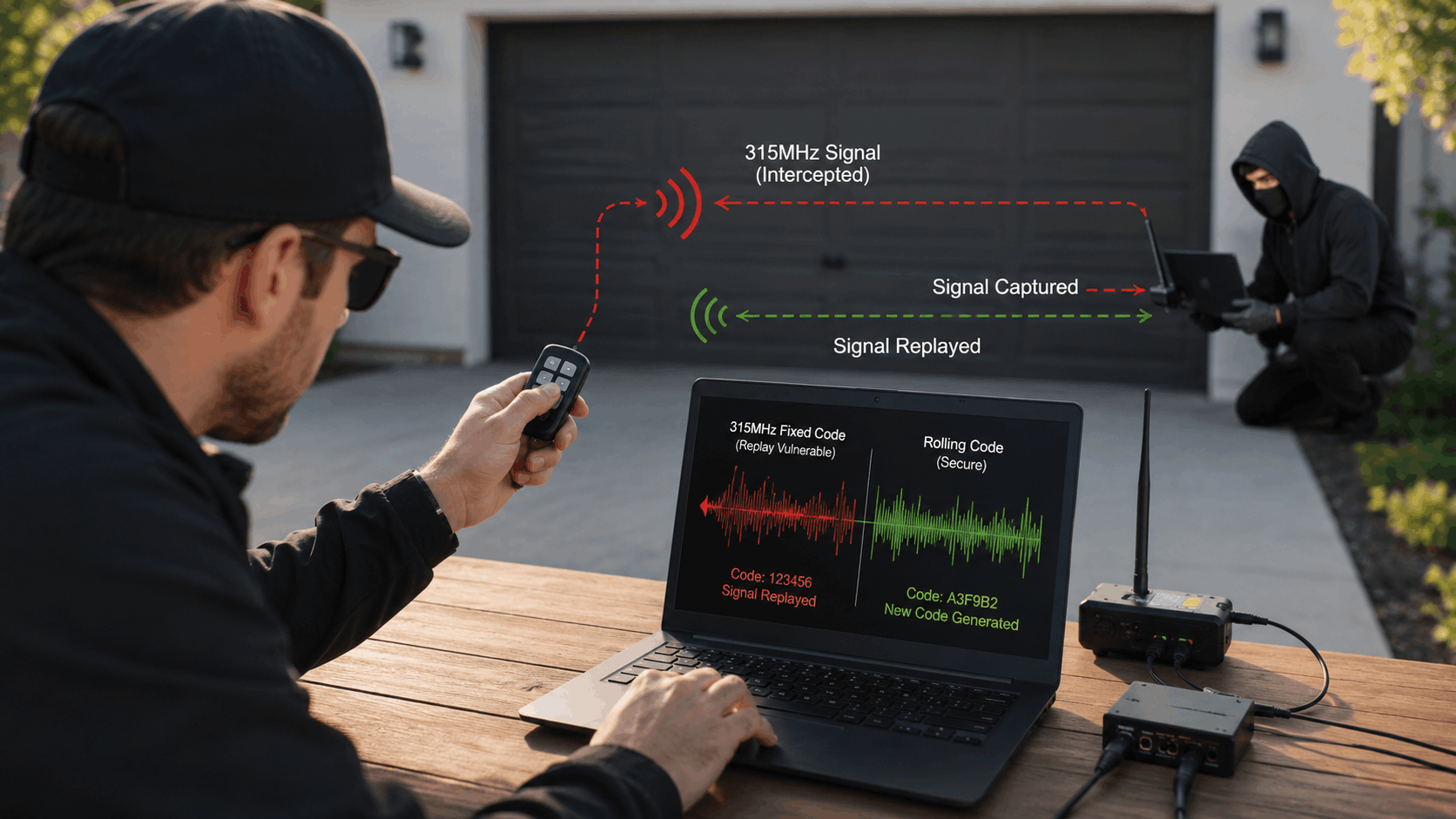
A replay attack is exactly what it sounds like. A hacker records a signal, then plays it back later to trigger the opener. Against a fixed code system, this works every time because the code never changes.
The reason this 315MHz hack is so effective is that older openers cannot tell the difference between the real remote and a recording. To the receiver, both look identical. Here is how the basic signal capture attack breaks down:
| Step | What Happens | Why It Works |
|---|---|---|
| 1. Listen | A recorder waits near the driveway for the remote to be used | The opener broadcasts on a known band |
| 2. Capture | The device saves the fixed code signal | The code is unencrypted and static |
| 3. Wait | The hacker leaves and returns later | The code stays valid forever |
| 4. Replay | The saved signal is transmitted back | The opener accepts the identical code |
This chain only works against fixed code systems. Rolling code breaks it at step four, which is why the upgrade matters so much.
The Cheap Devices Hackers Use to Capture Signals
The uncomfortable truth is that the gear needed to record a signal is cheap and widely sold for legitimate hobby use. A basic signal grabber can cost less than a dinner out. Radio enthusiasts use these tools for entirely legal projects.
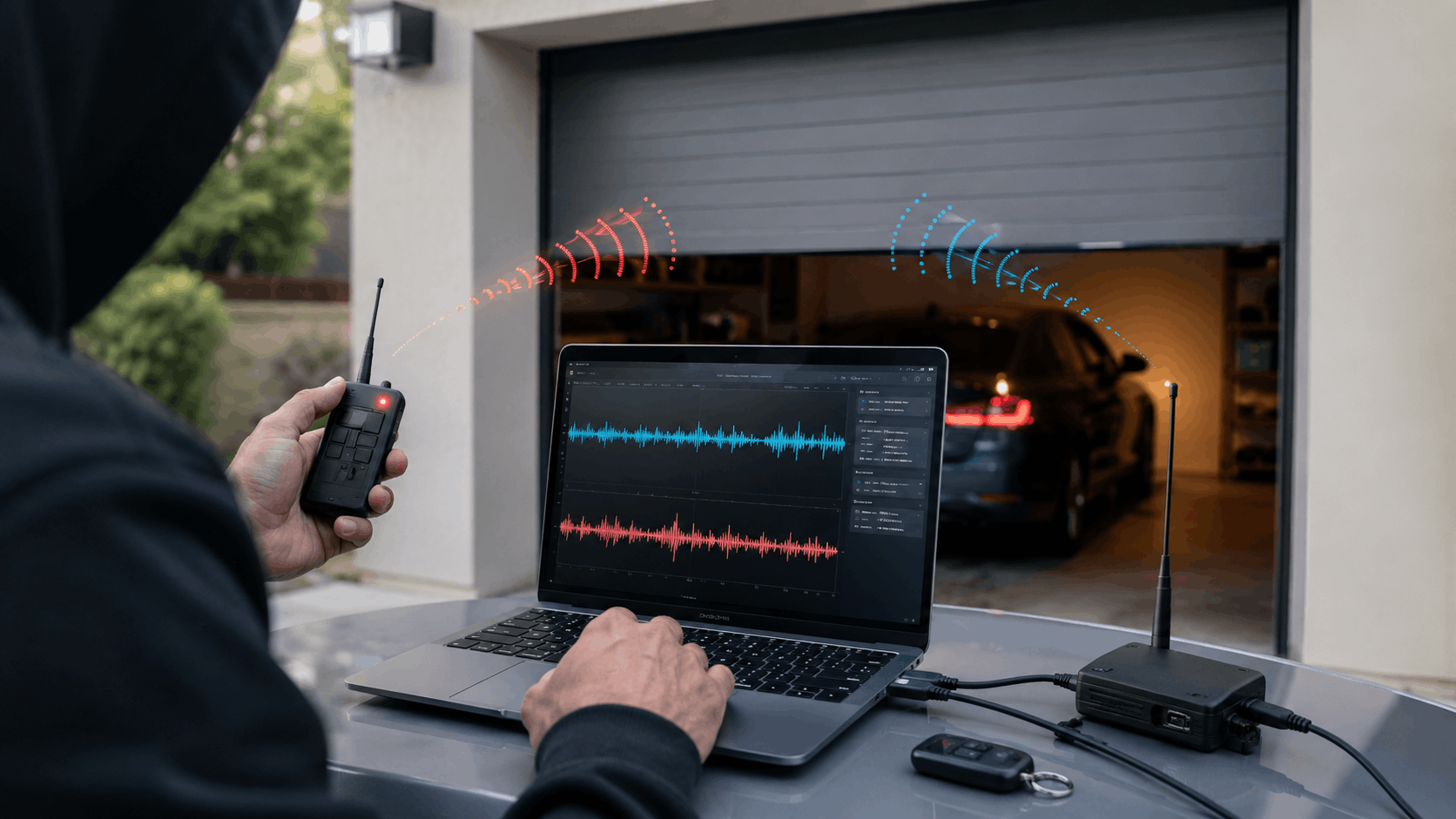
A software defined radio, often called an SDR, is a small dongle that lets a computer tune into many frequencies. In the wrong hands, it can be pointed at the 315MHz band to log garage signals. The devices themselves are not illegal, which is part of what makes this a real risk.
We are not going to explain how to run such an attack, and the point here is awareness, not instruction. Homeowners deserve to know that the barrier to entry is low. A fixed code opener is not protected by the attack being difficult, because it simply is not difficult.
That low cost is exactly why we treat fixed code as a genuine vulnerability rather than a theoretical one. When the tools cost less than a tank of gas, the risk stops being hypothetical.
Why Fixed Code Openers Fall for the Same Trick Every Time
The fixed code weakness comes from repetition. Because the opener accepts one unchanging code, a single recorded signal is a permanent skeleton key. There is no expiration and no second check.
Imagine a door lock where the same key shape always works and copies are trivial to make. That is what a recorded signal becomes against a fixed code unit. Once captured, it can be replayed next week, next month, or next year.
The opener has no memory of past presses and no way to notice a duplicate. It only asks one question, which is whether the code matches. A recorded signal answers yes just as convincingly as the real remote.
This is the core reason we push older homes toward an upgrade. No amount of careful habits fully fixes a system that trusts a code which never changes.
How Close a Hacker Needs to Be
Signal range depends on the equipment and antenna, but realistic capture happens within roughly 30 to 100 feet under normal conditions. A basic setup needs to be fairly close, often within view of the driveway. Better antennas extend that reach somewhat.
This is where dense parking raises the stakes. Near Irvine apartment communities and townhome clusters, cars and people sit close to garages all day. A driveway capture becomes easier when a stranger loitering nearby draws no attention at all.
In a spread-out single family neighborhood, an unfamiliar person parked at the curb might stand out. In a packed lot near an apartment complex, they blend in completely. The physical layout of a property affects the real world risk.
That does not mean detached homes are immune. It means homeowners in tighter parking situations have one more reason to prioritize a rolling code system.
Real Warning Signs Your Opener May Be Targeted
The clearest opener tampering sign is a door found open when you know you closed it. That is the exact call that brought the Woodbridge homeowner to us. One occurrence might be a mistake, but a pattern is worth taking seriously.
Another sign is a remote that suddenly behaves oddly, such as needing multiple presses or working from strange distances. Interference from a nearby device can sometimes cause this, but it is worth ruling out tampering. Trust your instincts if something feels off.
We also hear from callers who notice their door cycling at odd hours or find belongings in the garage disturbed. None of these prove an attack on their own. Together, they justify a closer look.
If any of this sounds familiar, our opener repair and troubleshooting service can inspect the unit and check whether a security upgrade makes sense. A door that opens by itself is worth investigating right away.
Need Help in Irvine?
Urgent Garage Doors serves Irvine and all of Orange County.
Why Rolling Code Signals Are Much Harder to Hack
Rolling code security was created specifically to defeat the replay attack. Instead of one fixed code, the system uses a code that hops to a new value every time the button is pressed. The industry often calls this a hopping code.
An encrypted opener that uses rolling code makes a recorded signal worthless almost instantly. Here is why the difference is so dramatic:
- Each press produces a brand new code from a shared secret sequence.
- The opener remembers recent codes and rejects any repeat.
- A captured signal is already expired by the time it is replayed.
- Guessing the next code without the secret is not practical.
This is the single biggest upgrade most Irvine homeowners can make. Moving from fixed to rolling code closes the door on the simplest and common attack.
How the Code Changes With Every Button Press
Rolling code systems share a secret starting point between the remote and the opener when they are first paired. From there, both sides follow the same math to calculate the next code in the changing code sequence. Neither side needs to broadcast the secret itself.
Each button press advances the sequence by one step. The remote sends the current code, the opener confirms it fits the expected pattern, and both quietly move to the next value. To an outside recorder, the codes look random and unrelated.
Because the code sequence is synchronized privately, an eavesdropper only sees a stream of one-time values. There is no obvious pattern to copy. That private math is what turns a simple radio signal into something far harder to abuse.
The system also tolerates a few extra presses out of range, so the remote still works if a child mashes the button in the car. It keeps a small window of valid future codes to stay in sync without opening a hole.
Why a Captured Code Becomes Useless
The magic of rolling code is the expired code problem for the hacker. Once a code has been used, or once the real remote sends a newer one, the opener refuses the old value. A recording captures a one time use signal that has already been spent.
Picture a hacker who records a signal on Monday. By the time they try to replay it, the homeowner has already used the remote to leave for work, which advanced the sequence. The recorded code is now behind the opener and gets rejected.
This flips the whole economics of the attack. With fixed code, one recording lasts forever. With rolling code, a recording is stale almost as soon as it exists.
That practical safety gain is why we recommend rolling code for nearly every home we service. It does not require the homeowner to change any habits to get the benefit.
Popular Rolling Code Brands We Install in Irvine
Most modern rolling code systems around Irvine come from a handful of well-known makers. LiftMaster and Chamberlain use Security+ and Security+ 2.0, which are proven rolling code technologies. Genie uses its Intellicode system, and these are common rolling code brands we install and service locally.
On the remote, look for branding like Security+, Security+ 2.0, or Intellicode printed on the case. The learn button on the opener motor is usually colored, such as yellow, purple, orange, or red depending on the era. A missing DIP switch bank is another good sign.
When homeowners ask about an opener upgrade in Irvine, we match the new unit to their door and needs. Our garage door opener installation service covers selecting, mounting, and pairing a rolling code system correctly.
We also handle remote and keypad setup so every device in the household is synced. Getting the pairing right the first time avoids the odd behavior that leads to nuisance calls later.
The Limits of Rolling Code and Advanced Attacks
No system is perfect, and honesty matters here. There are advanced techniques, sometimes described as a jamming attack combined with capture, that target even rolling code in specific conditions. These are far more complex than a simple replay.
At a high level, an attacker might block the opener from hearing a press while recording the code the homeowner just sent. Because the opener never received it, that code has not been spent yet. This requires precise timing, specialized gear, and physical presence, which puts it well beyond casual thieves.
The practical point is that advanced opener security still calls for layers. Rolling code stops the common attack cold, but cameras, alerts, and good habits cover the rare edge cases. Depth beats relying on any single feature.
We frame it this way for Irvine families. Rolling code handles the everyday threat, and the extra layers handle the unlikely determined one. That combination is what real protection looks like.
Smart Openers, WiFi Control, and New Security Concerns
A smart garage opener adds an app and internet connection on top of the normal radio system. Homeowners can open the door from their phone, check its status from work, and get alerts. The convenience is genuine and popular in Irvine tech households.
That convenience comes with new considerations. WiFi opener security depends on the home network, not just the garage. An app controlled door introduces questions that a plain remote never raised.
How Smart Openers Differ From Basic Rolling Code Units
A basic rolling code unit only talks to physical remotes and keypads over radio. A smart opener keeps all of that and adds a WiFi connection to the internet. The radio side usually still uses rolling code, so the core signal protection stays the same.
The smart opener features live in the extra layer. The opener connects to your router, then to a cloud service, which talks to an app on your phone. That path is what lets you open the door from miles away.
So the cloud connected opener is really two systems in one. The old rolling code radio handles the local remotes, while the network handles remote app access. Both need to be secure for the whole thing to be safe.
Understanding this split helps homeowners see where the risks live. The radio side is well protected by rolling code, so attention shifts to the network side.
Network Risks Beyond the Radio Signal
With a smart opener, a weak home WiFi password becomes a new soft spot. If someone gets onto your network, the garage is just one more connected device they might reach. Network security now includes the garage.
Many Irvine homes run busy networks with laptops, cameras, streaming devices, and smart plugs all sharing one router. A reused or simple password across those accounts creates a WiFi password risk that has nothing to do with the 315MHz radio. The attack surface moved indoors.
Good practice is a long, unique WiFi password and a separate guest network for visitors. Keeping the router firmware updated closes known holes. These steps protect far more than the garage.
We remind customers that a smart opener is only as secure as the network behind it. The radio can be perfect while the router is the weak link.
App Permissions and Shared Access Mistakes
A common smart opener problem we see is stale shared access. Homeowners invite a guest, a dog walker, or a contractor to the app and then forget to remove them. That old login can still open the door months later.
Review app permissions a few times a year. Most opener apps show a list of users with access, and removing anyone who no longer needs it takes seconds. Treat it like changing a lock after handing out too many keys.
Contractor logins deserve special attention. After a remodel wraps up, revoke any temporary access that was granted during the work. It is easy to grant and easy to forget.
A simple cleanup habit prevents most of these issues. Once each season, open the app, read the access list, and cut anyone who does not belong there.
Are Smart Openers Worth It for Irvine Homeowners?
For many local families, a smart opener earns its keep. Parents who want to let a kid in after school, or homeowners expecting deliveries, get real value from remote access and alerts. The smart opener value is highest for busy households.
The tradeoff is upkeep. A smart opener asks you to manage passwords, updates, and access lists, which a plain remote never did. Homeowners who dislike fiddling with apps may prefer a solid rolling code unit without the extras.
Our honest Irvine homeowner advice is to match the choice to the household. If you value remote control and will maintain the network, a smart opener is a fine pick. If you want simple and reliable, rolling code alone is already a big step up.
We install both and help homeowners decide during a visit. Our opener and smart access service walks through the options without pressure.
Need Help in Irvine?
Urgent Garage Doors serves Irvine and all of Orange County.
Steps Irvine Homeowners Can Take to Protect Their Garage
Good garage security tips mix free habits with a few smart upgrades. Not every step costs money, and the most valuable ones are often the simplest. Here is a practical list to protect a garage opener and the home behind it.
- Replace any fixed code opener with a rolling code unit.
- Never leave a remote clipped in a parked car.
- Use the vacation lock switch when traveling.
- Add a manual lock bar for extra protection.
- Install door sensors and cameras for early alerts.
Working through this list covers the common attacks and the everyday risks. An opener upgrade handles the technical side, while habits handle the human side.
Upgrade From Fixed Code to Rolling Code
The single biggest improvement is swapping a fixed code opener for a rolling code one. This one change removes the simple replay attack entirely. For older Irvine homes, it is the highest value move available.
Opener replacement cost typically runs in a moderate range depending on the model, horsepower, and any smart features. A basic rolling code unit sits at the lower end, while smart WiFi models cost more. Most homeowners find the price reasonable for what it fixes.
Our team handles most rolling code upgrades in a single visit, often within a couple of hours. That includes mounting the new opener, pairing remotes and keypads, and testing the safety sensors. You leave with a working, secure system the same day.
We cover this through our maintenance and upgrades service. If your opener is old and fixed code, this is where we usually start.
Never Leave a Remote in a Parked Car
A remote left in a car is an open invitation. If someone breaks the car window, they now have both your garage remote and, often, your address from the registration. A stolen remote makes a car break in a direct path into your home.
This matters near street parking around Woodbridge and University Park, where cars sit at the curb overnight. A thief who spots a clipped-on remote knows exactly what it opens. Removing the remote in car theft risk is as simple as taking it inside.
Carry a small keychain remote or use a keypad and phone app instead of a visor clip. If you must keep a remote in the car, hide it out of sight and lock the doors. Better yet, keep nothing garage-related visible in the vehicle.
We have seen too many break-ins that started with a smashed car window and an easy remote. This is a free fix that prevents a serious problem.
Use a Vacation Lock and Physical Lock
Most modern openers include a vacation mode switch on the wall control. Flipping it disables all remotes while you are away, so no signal, captured or not, will open the door. It is a simple toggle that adds real protection during travel.
For even more security, a manual garage lock bar physically blocks the door from lifting. Even if the opener were defeated, the door cannot move. These low-cost devices are especially reassuring for long trips.
We suggest combining both for peace during vacations. Vacation mode stops the electronics, and the manual lock stops the mechanics. Together they make the door genuinely hard to open.
Before a long trip, run through a quick checklist. Flip vacation mode, set the manual lock, and confirm the door is fully down and sealed.
Add Cameras, Sensors, and Alerts
A garage door sensor that reports open and closed status gives early warning if something is wrong. Paired with a phone, it can send a door open alert the moment the door moves. That is how you catch a problem in minutes instead of hours.
Cameras add another layer, letting you see who is near the garage and review footage later. Many smart openers integrate directly with camera and alert systems. This is where the smart opener extras genuinely earn their place.
For the Woodbridge homeowner worried about her door opening on its own, alerts changed everything. She now gets a notification for every open and close, so nothing happens without her knowing. That visibility restored her confidence quickly.
We can advise on sensors and alert setups that fit your opener and network. These tools cover the rare advanced attacks that rolling code alone does not stop.
When to Repair, Reprogram, or Replace Your Opener
Deciding between repair, reprogram, and replace comes down to age, symptoms, and security. Sometimes a quick fix solves everything, and sometimes only a new unit will do. Weighing opener repair vs replace correctly saves money and headaches.
The security angle changes the math. A worn but working fixed code opener may run fine mechanically while still being easy to copy. Opener lifespan and opener security are two separate questions worth asking together.
Signs Your Opener Is Too Old to Trust
Old opener signs include loud grinding, slow or jerky movement, and remotes that need repeated presses. If your unit has DIP switches, it is almost certainly fixed code and past its security prime. Age alone tells you a lot.
As a rough opener age limit, most units last around 12 to 15 years mechanically. Anything approaching 20 years is likely both worn and fixed code. At that point, patching it rarely makes sense.
We also watch for openers that lack safety sensors or auto-reverse, which are older and less safe by modern standards. These units predate current safety and security expectations. Replacing them upgrades protection on several fronts at once.
If your opener checks several of these boxes, replacement is usually the smarter path. You gain security, reliability, and safety together.
When Reprogramming Solves the Problem
Sometimes the fix is simple. If a rolling code remote acts up or you want to remove a lost remote from the system, reprogramming is the answer. Clearing the opener memory and re-syncing the remotes takes only minutes.
To reprogram a remote, you typically clear all learned codes on the opener, then re-pair each device you still have. This is smart after losing a remote, moving into a new home, or ending a contractor relationship. It ensures only your current remotes work.
Reprogramming and resync will not help a fixed code opener against a replay attack. Because the code still never changes, re-syncing just teaches the opener the same static code again. In that case, only an upgrade fixes the underlying weakness.
Our keypad and remote programming service handles resyncs quickly. We will also tell you honestly when programming alone is not enough.
What a Full Opener Replacement Includes
A full opener installation covers more than bolting up a new motor. We remove the old unit, mount the new opener, install the rail and hardware, and connect the wall control. Then we pair all remotes, keypads, and any app access.
We also align and test the safety sensors and set the travel and force limits so the door stops and reverses correctly. On smart models, we connect the WiFi and confirm the app works. The goal is a system that is ready to use before we leave.
The replacement timeline for a straightforward job is usually a couple of hours. Complex setups with heavy doors or extra accessories can take longer. We give a realistic estimate before starting so there are no surprises.
Most Irvine homeowners are back to normal the same afternoon. You end up with a secure rolling code system tested from top to bottom.
How Our Irvine Team Handles Security Upgrades
Our Irvine garage service starts with a quick assessment of your current opener and door. We identify whether you have fixed or rolling code, check the mechanical condition, and discuss your security goals. From there we recommend repair, reprogram, or replace.
Because we work across Irvine daily, we offer fast same-area response for neighborhoods like Turtle Rock and Northwood. Being local means shorter drive times and same-day help when it is available. We know these streets and the homes on them.
For an opener upgrade service, we bring common rolling code and smart models so we can complete most jobs in one trip. That avoids the wait of ordering parts and returning later. Efficiency matters when your garage is your main entry.
If your situation is urgent, such as a door stuck open, our same-day garage door repair gets a technician out fast. Security and access both get handled in the same visit.
Need Help in Irvine?
Urgent Garage Doors serves Irvine and all of Orange County.
Local Factors That Affect Garage Security in Irvine
Irvine garage security is shaped by more than just technology. Neighborhood layout, HOA rules, and the coastal climate all influence which opener makes sense. Local conditions here differ from other parts of the country.
Knowing these factors helps homeowners choose wisely. A townhome near the Spectrum faces different pressures than a detached home in Turtle Rock. HOA opener rules and salt air both play a part.
HOA Rules That Affect Opener and Door Choices
Many Irvine neighborhoods sit inside master planned community associations with detailed standards. HOA garage rules near Woodbridge and around the Great Park often govern door style, color, and sometimes hardware. These rules keep the streetscape uniform.
Openers themselves are usually not restricted, since they live inside the garage. The door face, however, frequently is. Before replacing a full door, homeowners should check their community guidelines to stay compliant.
We are familiar with the common design standards across Irvine master planned community tracts. When a door needs replacing along with an opener, we help pick options that fit the rules. That avoids fines or forced redos later.
If you are unsure, your HOA management office can confirm approved styles. A quick check before ordering saves trouble.
Dense Parking and Shared Driveways Raise Risk
Townhome parking near Irvine Spectrum is tight, with cars and foot traffic close to garage doors. That density raises the shared driveway risk of signal capture, since a stranger near the garages is unremarkable. Close quarters help an attacker blend in.
In these settings, rolling code matters even more. A fixed code opener in a busy shared lot is exposed to far more passing devices and people. Upgrading removes the easiest attack in exactly the place it is most likely.
Homeowners in these communities should also avoid leaving remotes in cars, since parked vehicles sit in full view. Keypads and phone apps reduce the number of physical remotes floating around. Fewer remotes means fewer things to steal or copy.
We service many townhome communities across Irvine and understand these layouts well. The right opener and a few habits go a long way in dense parking.
How Coastal Climate Wears Down Opener Parts
Irvine sits close enough to the coast that mild, slightly salty air reaches many neighborhoods. Over years, that air contributes to circuit board corrosion inside openers and remotes. Climate opener wear is slow but real.
Heat cycles add to it. Garages get hot in summer and cool at night, and that repeated expansion stresses solder joints and plastic housings. Batteries in remotes also drain sooner in heat.
The result is that Irvine openers sometimes show their age a little sooner than units in dry inland areas. Intermittent faults and flaky remotes can trace back to corrosion. Cleaning contacts helps for a while, but aging boards eventually fail.
During service visits we check for corrosion and worn contacts. Catching it early can extend the life of an otherwise good unit.
New Development Areas and Modern Opener Standards
Newer Great Park homes and other recent Irvine developments almost always ship with modern rolling code units, and many are smart-ready. Buyers of these homes usually start with strong signal security by default. That is good news for the replay attack question.
Even so, new does not mean set-and-forget. Smart openers in new homes still need good WiFi passwords and clean access lists. The radio is secure, but the network side needs attention like any other.
We also help new homeowners in Portola Springs and similar areas set up remotes, keypads, and app access correctly from day one. Starting clean prevents leftover builder or contractor access from lingering. A quick setup review is worth the time.
For buyers of older resale homes, the story flips. Those may still hide a fixed code opener, so a security check early on is a smart move.
Final Thoughts
The core lesson is simple. The 315MHz frequency itself is fine, and the real question is whether your opener uses fixed code or rolling code. Fixed code is easy to replay, while rolling code shuts that attack down.
Older homes near El Camino Real and Northwood are the most likely to still run fixed code, and dense parking near the Spectrum raises the stakes further. Smart openers add convenience but shift some risk to your home network. Layered protection, from an upgrade to alerts to good habits, covers all the angles.
If you are unsure what your garage uses, or you have found your door open when it should not be, reach out to our team. We know Irvine's neighborhoods and can check your opener, recommend the right upgrade, and often finish the work the same day. Call or contact us for a straightforward consultation on your garage security.
Frequently Asked Questions
- Can hackers really open my garage from the street?
- With an older fixed code opener, yes, a recorded signal can be replayed to open the door, usually captured within about 30 to 100 feet. With a rolling code opener, this simple attack fails because the code changes every press and expires immediately. The frequency is not the issue. The coding method decides whether a street-level replay attack can succeed against your home.
- How do I know if my opener uses rolling code?
- Check the age and look at the remote. Units older than about 20 years, or remotes with rows of small DIP switches, are usually fixed code. Rolling code brands like LiftMaster Security+, Chamberlain, and Genie Intellicode have colored learn buttons and no DIP switches. If you are unsure, our team can identify the type in a couple of minutes during a quick visit.
- Is a 315MHz opener automatically unsafe?
- No. The 315MHz frequency is a standard radio band used by countless safe openers. What matters is the coding method riding on that frequency. A 315MHz opener using rolling code is well protected against replay attacks. A 315MHz opener using fixed code is the one to worry about. Focus on fixed versus rolling code, not the frequency number itself.
- How much does it cost to upgrade to a rolling code opener?
- Costs vary with the model, horsepower, and whether you want smart WiFi features. A basic rolling code unit sits at the lower end of the range, while smart models cost more. Installation is usually included in a single visit. We give a clear estimate before starting so you know the total, including remotes, keypads, and testing, with no surprises.
- Are smart WiFi openers safer than regular ones?
- They offer more convenience and alerts, but they add network risk. The radio side usually still uses rolling code and stays secure. The new soft spot is your home WiFi, so a weak or reused password becomes the weak link. With a strong password, updated router, and clean app access, a smart opener can be both convenient and secure.
- What should I do if I think my remote was cloned?
- First, clear the opener's memory and reprogram only the remotes you currently have, which removes any copied or lost remotes. If your opener is fixed code, reprogramming will not stop a replay attack, so plan a rolling code upgrade. Then review app and keypad access. Call our team and we can inspect the unit and recommend the right fix.
- Does keeping my remote in the car increase my risk?
- Yes. A remote clipped to a visor is easy to grab if the car is broken into, and registration paperwork often reveals your address. Near street parking around Woodbridge and University Park, this is a common path into a home. Carry a keychain remote, use a keypad or app instead, and never leave a remote visible in a parked car.
- How long does a garage opener usually last?
- Most openers last around 12 to 15 years mechanically, sometimes a bit less near the coast due to salt air and heat cycles. Signs it is time to replace include loud grinding, slow movement, remotes that need repeated presses, or DIP switch fixed code hardware. If yours shows several of these, replacement usually beats repeated repairs.
- Can you service my opener the same day in Irvine?
- Often, yes. Because we work across Irvine daily, we offer fast same-area response for neighborhoods like Turtle Rock, Northwood, Woodbridge, and Portola Springs. We stock common rolling code and smart models so many upgrades finish in one trip. For urgent situations like a door stuck open, our same-day and emergency repair service gets a technician out quickly.
- Do HOA rules affect which opener I can install?
- Openers live inside the garage, so they are rarely restricted. The door face, color, and style often are, especially in master planned communities near Woodbridge and the Great Park. If you are replacing the full door along with the opener, check your community guidelines first. We help select compliant options and can confirm approved styles before any work begins.
Licensed garage door repair professionals serving Irvine and Orange County.
Licensed in California · License #1055150
Why trust Urgent Garage Doors?
Founded in 2017, Urgent Garage Doors is a licensed and insured garage door services serving Irvine and Orange County. All content is reviewed by our licensed technicians.

Need Help in Irvine?
Urgent Garage Doors serves Irvine and all of Orange County.
Related Articles
Smart Garage Door Openers: WiFi vs Cellular vs Z-Wave Reliability in OC
Compare WiFi, cellular, and Z-Wave smart garage door openers for reliability across Orange County homes, plus local climate and outage factors to weigh before you buy.

Smart Garage Door Openers: Are They Worth It for OC Homeowners
Smart garage door openers offer OC homeowners remote access, real-time alerts, and auto-close features. Find out what they cost and whether the upgrade makes sense for your home.
UL 325 Safety Standard for Garage Door Openers: What OC Inspections Check
Learn what the UL 325 safety standard requires, how OC inspectors test garage door openers, and how Irvine homeowners can prepare their doors to pass.