Safety & Prevention
Car Trapped Behind a Dead Garage Door in OC: Safe Manual-Release Steps and the One Time NOT to Pull the Red Cord
Key Takeaways
- During a power outage with healthy springs, the red manual release cord safely frees a trapped car in minutes.
- Always release the door fully closed or fully open, lift evenly with two hands, and prop it before driving out.
- Never pull the red cord when a spring is broken and the door is up - the door can crash down on your car or you.
- Spot a broken spring by a gap in the coil, a loud bang or firecracker sound, or a door that suddenly felt heavy.
- Re-engage the opener by resetting the trolley latch, then test the photo-eye sensors and auto-reverse safety feature.
- Battery backup openers, now required on new California installs, keep doors working during SCE outages.
- Yearly spring and cable inspections plus regular lubrication prevent most trapped-car emergencies in dry inland Irvine.
- Urgent Garage Doors offers same-day spring, cable, and opener service across Woodbridge, Northwood, Portola Springs, and nearby OC cities.
In This Article
It is 7:45 on a Tuesday morning in Woodbridge. An Irvine resident grabs their coffee, hits the wall button, and nothing happens. The garage door sits dead in the tracks with their car parked behind it, and there is a meeting downtown they cannot miss.
A quick power blip from the grid overnight left the opener without electricity. The car is trapped, the clock is running, and the only thing standing between them and the road is a door that will not move.
Why Garage Doors Suddenly Stop Working in Orange County?
A dead garage door rarely gives warning. One morning it works fine, and the next it will not budge with a car stuck inside. Knowing the common causes helps homeowners decide whether they can safely use the manual release or whether they need to keep their hands off the door entirely.
Most trapped-car calls we take in Irvine trace back to a handful of problems:
- Power outages that cut electricity to the opener
- Broken springs or snapped cables that jam the door
- Failed opener motors or fried circuit boards
- Doors that jumped off track or ride on worn rollers
Each cause behaves differently. A power outage is harmless to release by hand, while a broken spring can turn the same release into a dangerous move. That difference is why every homeowner needs to know how their door works before they pull anything.
Power Outages and SCE Grid Blips
Southern California Edison serves nearly every home in Irvine, and their grid sees its share of short flickers. A quick brownout or a full power outage during a summer heat wave can leave a garage opener with no electricity to run the motor. When that happens, the door itself is usually fine - it just has no power source.
We see this a lot around Woodbridge and Northwood after evening storms or transformer trips. Homeowners wake up, press the button, and assume the whole system failed. In reality, the garage opener simply lost its feed and the door needs to be moved by hand until power returns.
These outages are the most common reason a garage door won't open in the morning. The good news is that a door with a working spring and no power is safe to release manually. The motor is off, the springs still carry the door's weight, and lifting by hand is straightforward.
If the neighborhood lost power overnight, check whether streetlights or neighbors' porch lights are out too. That quick look tells you the problem is the grid, not your door hardware, and it points you toward a simple manual release.
Broken Springs and Snapped Cables
A broken torsion spring is a whole different story. Springs do the heavy lifting on a garage door, counterbalancing the weight so the opener only has to guide it. When one snaps, the door can stop dead mid-track or feel like it weighs 200 pounds.
A snapped cable causes similar trouble. Cables run alongside the springs and help control the door as it travels. When a cable frays and breaks, the door can sit crooked in the garage door track or refuse to move at all.
This differs from a power issue in a big way. With a spring or cable failure, the door has lost its counterbalance, so lifting by hand becomes dangerous. If you ever hear a loud bang from the garage and then the door will not move, a broken spring is the likely culprit. Our spring and cable repair team handles these repairs daily, and we always urge homeowners to stop before touching the release in this case.
Older homes near El Camino Real and around Turtle Rock often run on original springs that have cycled tens of thousands of times. Metal fatigue catches up with them, and they tend to fail without much warning.
Opener Motor and Circuit Board Failures
Sometimes the door hardware is perfect but the brain of the system dies. An opener motor failure or a fried circuit board can kill a door with no warning at all. The wall button goes dead, the remote does nothing, and the motor sits silent.
Inland Irvine gets hot in the summer, and garages trap that heat. We have pulled melted circuit boards out of openers along quieter streets where afternoon temperatures climb into the 90s. Heat is hard on electronics, and older openers are the first to go.
When the motor or board fails, the door itself is usually fine to release by hand as long as the springs are intact. The manual release lets you bypass the dead opener and lift the door normally. After that, a technician can test the board and decide whether a repair or a full opener repair and troubleshooting makes sense.
If your opener is more than 12 to 15 years old and it dies during a heat spell, the board or motor is the usual suspect. That is a repair worth scheduling before the trapped-car problem becomes a weekly event.
Off-Track Doors and Bent Rollers
An off-track door is one of the more dramatic ways to get a car stuck. When a door jumps off its track, the panels bind and jam against the frame. The opener may strain, grind, or stop entirely, and the door can end up wedged at an angle.
Bent rollers cause the same kind of trouble more slowly. Rollers guide the door smoothly up and down the track, and when they wear or bend, the door starts to catch and drag. Over time a bad roller can pull the door out of alignment enough to jam it completely.
A jammed garage door from an off-track issue should not be forced. Trying to muscle it can bend panels or damage the track further. Our off-track garage door repair crew resets these safely and checks the rollers and track for hidden damage.
We see off-track doors most often after something bumps the door - a basketball, a bike, or a car that rolled forward a few inches. If your door looks crooked in the opening, leave it alone and call a pro rather than risking more damage.
Get Your Free Quote
Tell us about your garage door and we'll get back to you fast.
What the Red Cord Actually Does
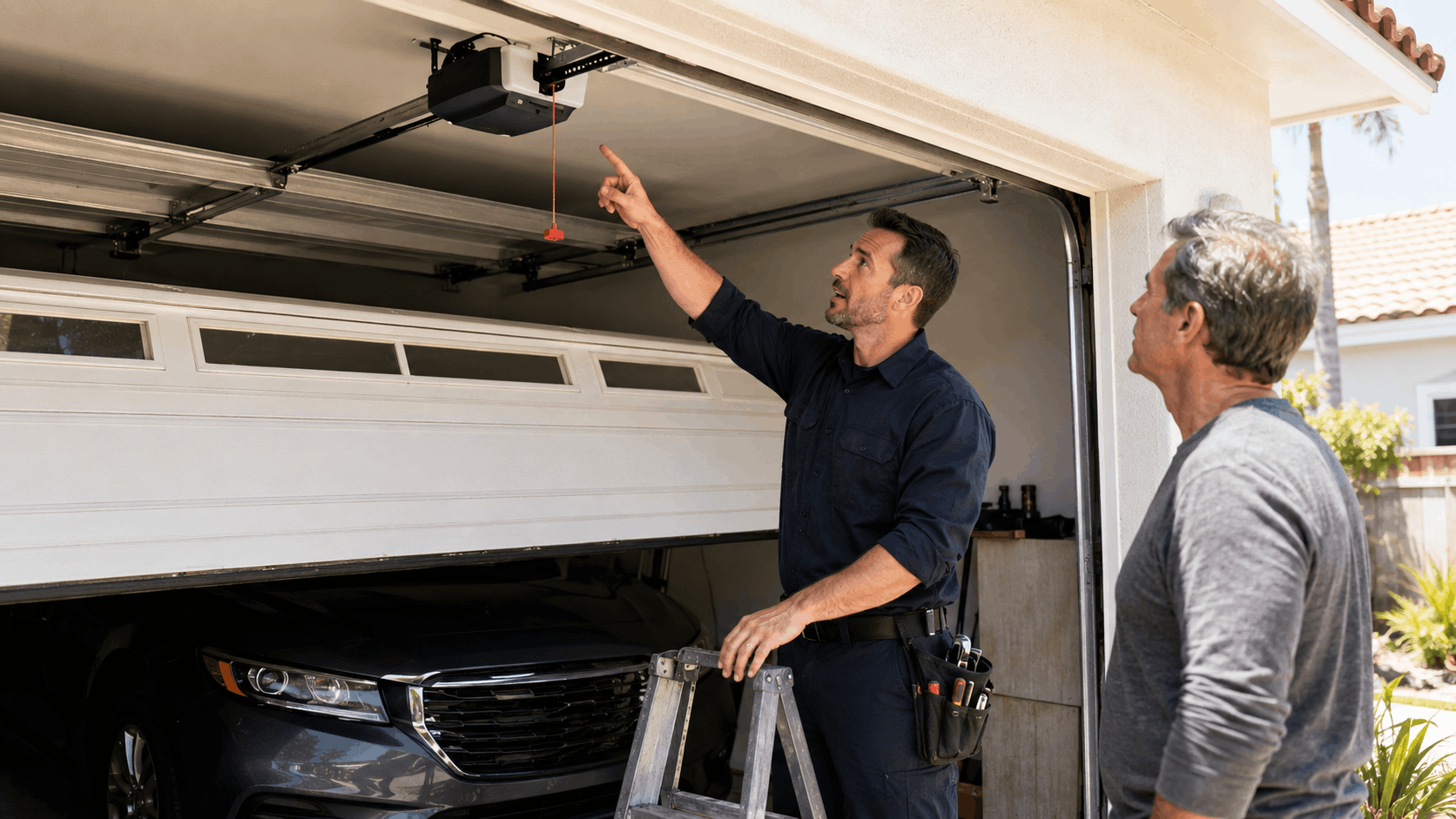
That red rope hanging from the ceiling rail is the manual release cord, and most homeowners have never touched it. Before pulling it in a panic, it helps to understand exactly what it disconnects and why. A little knowledge here prevents a lot of injuries.
The red emergency cord is a simple mechanical device with an important job. It separates the door from the motor so you can move the door by hand. That is all it does, but the timing of when you use it matters enormously.
How the Emergency Release Disconnects the Trolley
Inside your opener system, a part called the trolley rides along the rail and connects to the door arm. The opener carriage pushes and pulls this trolley to open and close the door. The red cord attaches to a spring-loaded latch on that trolley.
When you pull the emergency release, the latch pops open and the trolley disconnects from the carriage. At that point the door is no longer linked to the motor at all. The opener could run and the door would stay put, because the two are now separate.
This is exactly what you want during a power outage. The door drops into manual mode, and you can lift it yourself. The motor stays out of the picture until you reconnect the trolley later.
The design is intentional and standardized across brands so emergency responders and homeowners can free a door quickly. The catch is that the release assumes the door's springs are holding its weight. When they are not, that same release becomes hazardous.
Where to Find the Cord on Most OC Homes
On nearly every home we visit, the red cord hangs from the center rail that runs from the opener motor toward the door. It usually dangles a few feet in front of the motor unit, often with a red plastic handle on the end. If you look up at the ceiling of your garage, it is hard to miss once you know what you are looking for.
Most Irvine garages run one of a few common opener brands - LiftMaster, Chamberlain, Genie, or Craftsman. All of them use a similar red release handle in roughly the same spot. The exact latch design varies slightly, but the pull-down motion is nearly universal.
In taller garages, the cord may hang high enough that you need to reach up or use the handle rather than grab the trolley directly. Never tie the cord up out of the way permanently, since you may need it fast in an emergency.
If you cannot find the cord, check the manual for your opener model. Knowing your opener and smart access setup ahead of time saves precious minutes when a car is trapped and you are late.
Manual Mode vs Motor Mode Explained
Manual mode means the door is disconnected from the opener and you move it by hand. Motor mode means the trolley is latched to the carriage and the opener drives the door up and down. The red cord is the switch between these two states.
In manual mode, the door glides on its springs and rollers with no motor involved. This is how you get a trapped car out during an outage. It is meant to be a temporary state, not a permanent way to run the door.
To re-engage the trolley and return to motor mode, you either pull the cord back toward the door or run the opener until the carriage clicks back into the latch. Once it snaps back together, the opener takes over again.
Understanding this difference keeps homeowners from getting confused when the door works by hand but not by remote. If the door lifts manually but the opener does nothing, you are simply still in manual mode and need to reconnect the trolley.
Need Help in Irvine?
Urgent Garage Doors serves Irvine and all of Orange County.
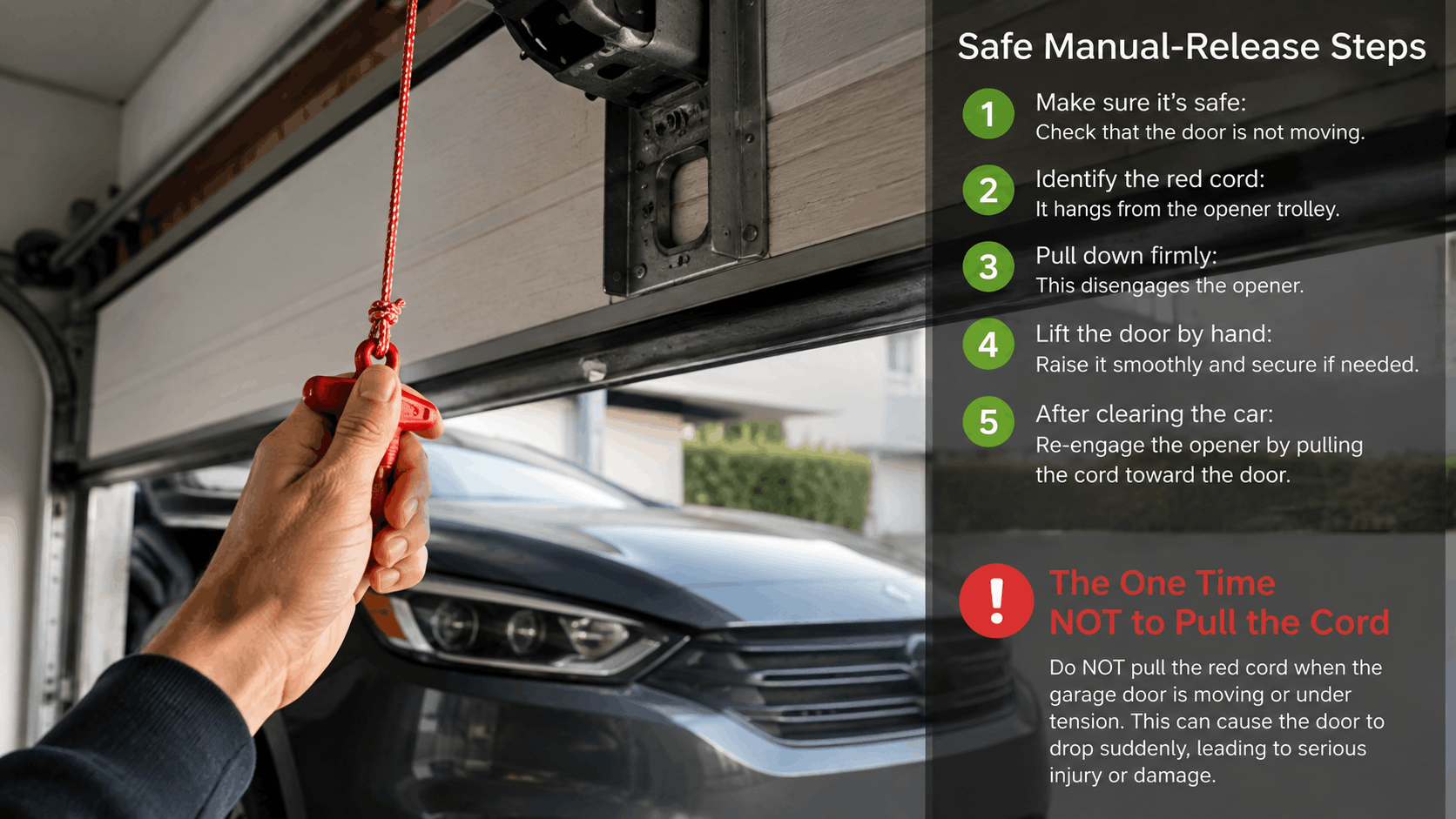
Safe Manual-Release Steps When Your Car Is Trapped
When a car is stuck and the clock is ticking, it is tempting to yank the cord and heave the door up fast. Slow and careful wins here. A garage door weighs between 130 and 350 pounds, and rushing the manual release steps is how people get hurt.
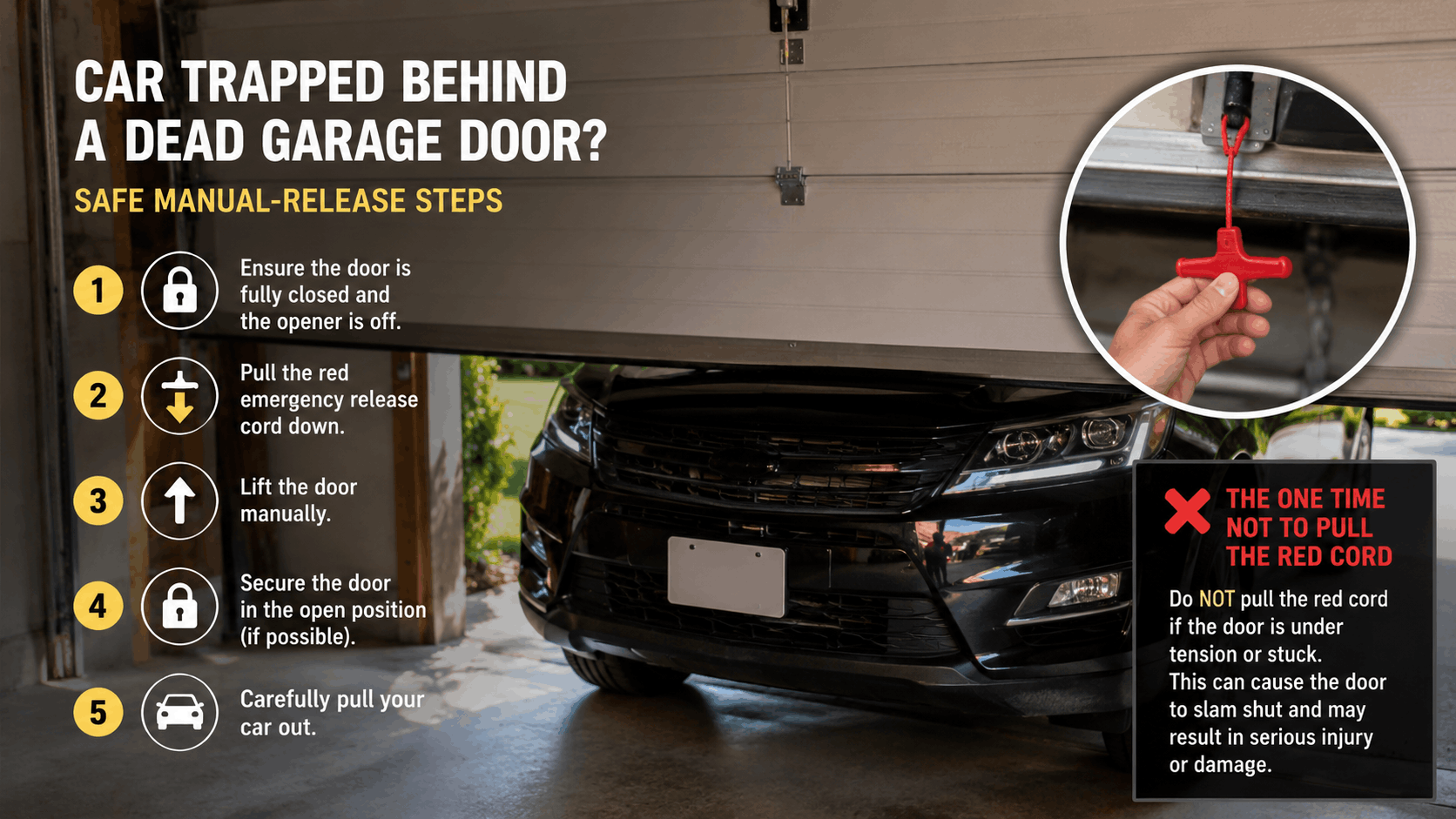
Here is the safe order our technicians follow every time:
- Confirm the door is fully closed or fully open first
- Pull the cord straight down and back to release the trolley
- Lift evenly with two hands and test the balance
- Secure the door before driving the car out
Walk through each step deliberately. If anything feels heavy, stuck, or wrong, stop and reconsider before you commit to lifting a trapped car free.
Step 1: Fully Close or Fully Open Before Pulling
Door position matters more than most people realize. The safest time to pull the release is when the door is all the way down. A closed door has nowhere to fall, so releasing the trolley cannot cause a sudden drop.
If the door happens to be stuck fully open, that changes things. A door held open only by the opener with a weak or broken spring can slam down the moment you release it. We cover that dangerous scenario in detail in the next section, so read it before acting.
When the door sits halfway, get it to a full stop position first if you safely can. A partly open door under release is the setup for a sudden drop that can crush anything underneath, including a car hood or a person.
The rule we teach every Irvine homeowner is simple. Release a door that is fully closed with confidence, and treat any door that is up or partway with real caution.
Step 2: Pull the Cord Straight Down and Back
Once you confirm the door position is safe, pull the red cord with the correct technique. Grip the handle and pull it straight down, then slightly back toward the opener motor. This motion trips the latch cleanly.
Avoid yanking sideways or swinging on the cord. A hard sideways pull can bend the release lever or damage the trolley assembly, which turns a simple outage into a repair bill. A firm, controlled tug is all it takes to release the trolley.
You should hear or feel a distinct click as the latch opens. That click confirms the door is now in manual mode and free of the motor. If nothing happens, check that you are pulling the actual release cord and not a light pull chain.
After the release, the door should move freely by hand if the springs are intact. If it still feels locked or grinds, stop and inspect for a broken spring or an off-track panel before forcing anything.
Step 3: Lift Evenly and Test the Balance
Lift the door with two hands, gripping near the bottom on both sides. Raise it slowly and pay close attention to how it feels. A properly balanced door on healthy springs should lift with only 10 to 15 pounds of effort and stay put when you let go.
Feel for resistance as you lift evenly. If the door fights you, feels like dead weight, or wants to slam back down, that is a warning sign. A heavy door almost always means a spring problem, and forcing it can strain your back or drop the door.
Stop immediately if the door feels unbalanced or dangerously heavy. Do not try to power through it. A door that will not hold its position on its own is telling you the counterbalance system has failed.
When the balance feels off, this is the moment to call our team rather than risk injury. A quick door balancing and tension adjustment restores safe hand operation and protects the opener too.
Step 4: Secure the Door and Get Your Car Out
Once the door is up and holding, do not trust it to stay there on its own. Prop the door open with locking pliers clamped to the track just below a roller, or use a sturdy support. This keeps it from drifting down while your car is underneath.
With the door secured, back the vehicle out carefully and slowly. Watch the mirrors and give the door plenty of clearance. A trapped car freed this way should roll out with no drama as long as the door is fully raised and blocked.
After the car is clear, decide what to do with the door. If it was a power outage, you can leave it closed in manual mode until electricity returns. If a part failed, the door needs a repair before it is safe to use again.
Never leave the door propped halfway open and unattended, especially with kids or pets around. Secure it fully closed or fully open, and remove your prop only when you are ready to re-engage the opener.
The One Time You Should NOT Pull the Red Cord
Here is the part that keeps people out of the emergency room. There is one situation where pulling the red cord can cause serious injury or wreck your car. Garage door safety comes down to recognizing this scenario before you touch anything.
The rule is short: do not pull the red cord if a spring is broken and the door is up. Understanding why saves fingers, hoods, and worse.
When a Spring Is Broken and the Door Is Up
Picture a door stuck in the open position. The springs are what normally hold that weight, but if a spring is broken, the opener motor may be the only thing keeping the door up. It is holding the full weight through the trolley latch.
Now imagine pulling the release cord. The latch pops, the door loses its only support, and 200-plus pounds of steel comes crashing down with nothing to stop it. If your car is underneath, the hood and windshield take the hit. If you are underneath, the outcome is far worse.
This is the exact scenario that turns a simple release into a hospital visit. The opener holding a door with a broken spring is a trap, and the red cord is the trigger. We cannot stress this enough to homeowners.
The safe move is to leave the door up and disconnected from your hands entirely. Keep everyone and every vehicle out from under it until a technician relieves the load properly.
How to Spot a Broken Spring Before You Touch the Cord
Look up at the springs before you reach for the release. Torsion springs sit on a metal bar above the door. A broken spring usually shows a clear two-to-three inch gap in the coil where it snapped apart. That gap is the most obvious sign.
Think back to any loud bang you heard recently. Many homeowners describe a sound like a firecracker or a gunshot from the garage, sometimes in the middle of the night. That bang is the spring breaking, and it is often the first clue something is wrong.
Another tell is a door that suddenly felt heavy the last time it moved, or an opener that struggled and strained more than usual. These signs of a broken spring show up before the door quits entirely. Catching them early prevents the trapped-car scare.
If you see a gap in the coil, remember a loud bang, or the door felt heavy, treat the spring as broken. Do not test your theory by pulling the cord with the door up.
What to Do Instead: Wait and Call a Pro
When you suspect a broken spring with the door up, the smartest thing to do is nothing. Keep clear of the door path, move your car if it is safely parked outside the fall zone, and keep kids and pets away from the garage.
Call a technician who can secure the door and replace the spring with the right tools. Torsion springs hold enormous tension, and releasing that load safely takes clamps, winding bars, and training. This is not a DIY job even for handy homeowners.
Our emergency garage door repair team handles broken-spring calls across Irvine and the surrounding cities, often the same day. We stabilize the door first, then swap the spring and check the balance before anyone stands under it.
Waiting an hour for a garage door pro beats a lifetime of regret from a door that came crashing down. When in doubt, keep your hands off the cord and let a trained tech take over.
How to Re-Engage the Opener After Power Returns
Once the power comes back or the repair is done, you do not want to keep lifting the door by hand forever. Re-engaging the opener puts the door back in motor mode so the remote and wall button work again. The process is quick once you know the steps.
Resetting the garage door after an outage takes only a few minutes. The main job is getting the trolley reconnected to the carriage and confirming the safety features still work.
Reconnecting the Trolley to the Carriage
There are two easy ways to reconnect the trolley. The first is to pull the red cord back toward the door, which resets the latch into the ready position. Then run the opener and the carriage will slide into the trolley and click back together.
The second method is even simpler on many models. With power restored, just press the wall button or remote. The carriage travels down the rail, meets the waiting trolley, and snaps into place with an audible trolley click.
Either way, listen for that click that tells you the two parts have latched. Once connected, the opener drives the door normally again and manual mode is over. Test it with one full open and close cycle.
If the carriage passes the trolley without catching, pull the cord toward the door one more time to reset the latch and try again. It usually connects on the first or second attempt.
Resetting Travel Limits and Remotes
After a power outage, some openers lose their travel limit settings. Travel limits tell the door how far to open and close. If the door stops short or pushes too hard into the floor, the limits need a quick reset following your opener's instructions.
Remotes can also drop their programming after a power event, though most keep their memory. If a remote stops working, reprogramming it usually takes pressing the learn button on the opener and then the remote button within a few seconds. The manual for your model lists the exact steps.
Brands common in OC homes like LiftMaster and Genie each have slightly different reset routines. Keeping your opener manual in a drawer near the garage makes this a five-minute fix instead of a frustrating guessing game.
If the door behaves oddly after a reset - reversing early or not closing fully - the opener settings may need professional attention. Our keypad and remote programming service sorts these out fast.
Testing the Auto-Reverse Safety Feature
Before you consider the job done, test the auto-reverse safety feature. Every opener made since the early 1990s has photo-eye sensors near the bottom of the tracks. These sensors stop and reverse the door if something crosses the beam.
Test it by waving a broom or a box through the door path while it closes. The door should stop and go back up immediately. If it keeps closing, the photo-eye sensors are misaligned or dirty and need attention right away.
Also test the mechanical reverse by laying a roll of paper towels on the floor under the door. When the door hits it and reverses, the pressure setting is correct. If it crushes the roll, the force is set too high.
These safety tests protect kids and pets who might dart under a closing door. If either test fails, our safety sensor alignment repair gets the auto-reverse working the way it should.
Need Help in Irvine?
Urgent Garage Doors serves Irvine and all of Orange County.
Preventing a Trapped-Car Emergency in Irvine Homes
The best trapped-car story is the one that never happens. A little garage door maintenance goes a long way toward keeping your car free and your mornings calm. Irvine's climate and home conditions create a few specific challenges worth planning around.
Preventing a trapped car comes down to a handful of habits. Battery backups, yearly inspections, regular lubrication, and knowing your equipment all keep the door reliable.
Battery Backup Openers for Outages
A battery backup opener is the single best defense against a power outage trapping your car. These units keep the door working for dozens of cycles on battery power when SCE cuts out. No electricity, no problem - the door still opens on command.
California now requires battery backup on all new opener installations statewide. If your home was built or updated in the last several years, you may already have one. Older Irvine homes with original openers usually do not.
We install battery backup units on homes across Woodbridge, Northwood, and University Park all the time, especially after a neighborhood loses power and residents get tired of manual release drills. The upgrade pays for itself the first time the grid blinks and your car rolls out on schedule.
If your opener is aging anyway, replacing it with a battery-backup model through our garage door opener installation service solves two problems at once.
Annual Spring and Cable Inspections
Springs and cables wear out on a predictable schedule. A yearly spring inspection and cable check catches fraying, rust, and metal fatigue before they snap. Most springs are rated for around 10,000 cycles, which for a busy family is roughly seven to ten years.
Older homes near El Camino Real and up in Turtle Rock often run original hardware that has cycled well past its rated life. Those springs are living on borrowed time, and an annual inspection tells you when replacement is due before you get stranded.
During a cable check, our technicians look for frayed strands, loose drums, and uneven tension. Catching a bad cable early is far cheaper than dealing with an off-track door and a jammed car later.
A preventive maintenance plan puts these annual checks on autopilot so you never have to remember to schedule them. It is the easiest way to avoid a spring failure at the worst possible moment.
Lubrication and Roller Care in Dry OC Weather
Inland Irvine runs dry and hot for much of the year. That dry weather wears garage door parts faster than you might expect. Rollers, hinges, and springs run rough when they dry out, and grit builds up in the tracks.
Regular lubrication keeps everything moving smoothly. We recommend a lithium-based garage door lubricant on the rollers, hinges, and springs every three to four months. Skip the WD-40 - it cleans but does not lubricate for long.
Roller care matters too. Worn nylon or steel rollers get noisy and start to bind, which stresses the opener and pulls the door out of alignment over time. Swapping tired rollers for quiet nylon ones smooths out operation and cuts the noise.
Our quiet roller hardware upgrade is popular with homeowners who share a wall with a bedroom. It also extends the life of the whole system by reducing friction and strain.
Knowing Your Opener Brand and Manual
When something goes wrong, knowing your opener model saves time. Each brand has its own reset steps, remote programming, and release mechanism. Having that information handy turns a stressful morning into a quick fix.
Keep your opener manual somewhere easy to reach, like a drawer in the garage or a folder with your home documents. If you lost the paper copy, most manufacturers post PDFs online by model number.
Snap a photo of the label on your opener motor with the model and serial number. When you call for service, giving us that detail lets our team bring the right parts and knowledge on the first visit.
A little preparation makes a real difference during an emergency. Homeowners who know their equipment recover from a dead door far faster than those scrambling to figure out what they even own.
When to Call Urgent Garage Doors in Irvine
Some garage door problems are safe to handle yourself, and some are not. Knowing the difference protects you from injury and protects your home from further damage. When a repair involves high-tension parts or a door that will not move safely, a same-day pro is the right call.
Urgent Garage Doors serves Irvine and the surrounding Orange County cities with fast, careful service. Here is when to pick up the phone.
Broken Spring and Cable Repairs
Spring repair and cable repair top the list of jobs that need trained hands. Torsion springs store tremendous tension, and a mistake during replacement can cause serious injury. This is the definition of a call-a-pro situation.
Our trained technicians use proper winding bars, clamps, and safety procedures to swap springs and cables without incident. We match the new spring to your door's exact weight so the balance is right and the opener does not overwork.
We stock common spring sizes on the truck, which means most broken-spring calls get fixed on the same visit. For homes needing a longer-lasting setup, our torsion spring replacement uses high-cycle springs that last far longer than standard hardware.
If you heard a bang and now the door will not lift, do not experiment with the release. Let our team handle the tension safely and get you back on the road.
Same-Day Response Across OC Neighborhoods
A trapped car cannot wait until next week. Our same-day response covers Irvine neighborhoods like Woodbridge, Northwood, and University Park, along with Portola Springs and Turtle Rock.
We also reach nearby cities including Tustin, Lake Forest, and the communities around Old Town Tustin. Whether you are near the Woodbridge lakes or up in the hills, a technician is usually not far away.
Because we work these streets every day, our team knows the common opener brands and door styles in each community. That local familiarity speeds up diagnosis and repair when a car is stuck and you are running late.
Serving Irvine and the wider region, we aim to reach most homes within a few hours of your call. Our same-day garage door repair keeps a trapped-car emergency from wrecking your whole day.
Opener Replacement and Upgrades
When an opener dies for good, replacement is often smarter than repeated repairs. Modern openers run quieter, connect to your phone, and include the battery backup that keeps you moving during outages. That combination solves several problems at once.
We help homeowners pick the right opener for their door weight and household needs. A heavier insulated door needs more lifting power, while a family sharing a wall with the garage benefits from a quiet belt-drive unit.
Upgrading also brings newer safety features and smarter access. Our smart wifi opener and MyQ setup lets you check and control the door from anywhere, so you always know it is closed.
If your opener is over 15 years old or dies during a heat wave, ask about a replacement. A modern battery-backup model is a lasting fix for the trapped-car problem.
Need Help in Irvine?
Urgent Garage Doors serves Irvine and all of Orange County.
Final Thoughts
A dead garage door with a car trapped behind it feels like a crisis, but most cases have a safe, simple solution. If the power is out and the springs are healthy, the manual release gets your car free in minutes. Just take it slow, check the door balance, and secure the door before driving out.
The one rule to burn into memory: never pull the red cord when a spring is broken and the door is up. That single mistake can send a heavy door crashing down. When you see a gap in the coil or remember a loud bang, keep clear and call a pro.
Urgent Garage Doors is here for Irvine and Orange County whenever a door leaves you stranded. Reach out to our team at our contact page for same-day help, an inspection, or an opener upgrade that keeps your car free the next time the grid blinks.
Frequently Asked Questions
How do I get my car out if the garage door won't open?
If the door is fully closed and the springs are intact, pull the red manual release cord straight down to disconnect the door from the opener. Then lift the door evenly with two hands and prop it open with locking pliers on the track before backing your car out. If the door feels extremely heavy or a spring looks broken, stop and call a technician instead of forcing it.
Is it safe to pull the red emergency cord?
Yes, pulling the red cord is safe when the door is fully closed and the springs are working, which is the usual case during a power outage. The one time it is not safe is when a spring is broken and the door is up, because the opener may be the only thing holding it. Releasing then can drop a heavy door onto your car or you.
Why is my garage door so heavy to lift by hand?
A heavy door almost always points to a broken or weak spring. Springs counterbalance the door's weight so it lifts with only 10 to 15 pounds of effort. When a spring fails, you feel the full 150 to 300 pounds of the door. Do not keep forcing it, since that strains your back and risks a sudden drop. A technician can replace the spring and restore easy operation.
Will my garage door work during a power outage?
Not with the motor, unless you have a battery backup opener. During an SCE outage, a standard opener loses power and the door must be operated manually using the red release cord. Battery backup units, now required on new California installs, keep the door running for dozens of cycles without electricity. Adding one is the easiest way to avoid a trapped car during future outages.
How do I reconnect the opener after using the release?
Once power is back, pull the red cord back toward the door to reset the latch, then press the wall button or remote. The carriage will travel along the rail and click back into the trolley, returning the door to motor mode. On some models, simply running the opener reconnects it automatically. Test with one full open and close cycle to confirm the trolley re-engaged.
What does a broken garage door spring sound like?
Most homeowners describe a broken spring as a loud bang, like a firecracker or a gunshot from the garage. It often happens at night when temperature changes stress the metal. After the bang, the door usually feels much heavier or will not open at all. If you heard that sound and the door now struggles, treat the spring as broken and keep clear of the door path.
How much does an emergency garage door repair cost in Irvine?
Costs vary by the part and door size, but general ranges in Orange County run from about $150 to $350 for a spring replacement and $130 to $250 for cable repair. Opener repairs range widely depending on the fault, and full opener replacements typically fall between $400 and $700 installed. We provide clear pricing before any work begins so there are no surprises.
Can I leave the garage door in manual mode?
You can for a short time, but it is not a good long-term plan. In manual mode the door is disconnected from the opener, which means it will not lock automatically and can be forced open more easily. That creates a security and safety gap. Reconnect the trolley once power returns or the repair is done so the door secures properly again.
How fast can Urgent Garage Doors get to my home?
Our team offers same-day service across Irvine and nearby OC cities, and we reach most homes within a few hours of your call. We cover neighborhoods like Woodbridge, Northwood, University Park, and Portola Springs, plus Tustin, Lake Forest, and the surrounding area. A trapped car is an urgent problem, and we prioritize getting you back on the road quickly.
How often should I have my garage door inspected?
We recommend a yearly inspection to catch worn springs, frayed cables, and misaligned sensors before they fail. Annual maintenance is especially smart for older homes near El Camino Real and Turtle Rock that still run original hardware. A quick yearly check spots problems early and prevents most trapped-car emergencies, saving you money and stress in the long run.
Frequently Asked Questions
- How do I get my car out if the garage door won't open?
- If the door is fully closed and the springs are intact, pull the red manual release cord straight down to disconnect the door from the opener. Then lift the door evenly with two hands and prop it open with locking pliers on the track before backing your car out. If the door feels extremely heavy or a spring looks broken, stop and call a technician instead of forcing it.
- Is it safe to pull the red emergency cord?
- Yes, pulling the red cord is safe when the door is fully closed and the springs are working, which is the usual case during a power outage. The one time it is not safe is when a spring is broken and the door is up, because the opener may be the only thing holding it. Releasing then can drop a heavy door onto your car or you.
- Why is my garage door so heavy to lift by hand?
- A heavy door almost always points to a broken or weak spring. Springs counterbalance the door's weight so it lifts with only 10 to 15 pounds of effort. When a spring fails, you feel the full 150 to 300 pounds of the door. Do not keep forcing it, since that strains your back and risks a sudden drop. A technician can replace the spring and restore easy operation.
- Will my garage door work during a power outage?
- Not with the motor, unless you have a battery backup opener. During an SCE outage, a standard opener loses power and the door must be operated manually using the red release cord. Battery backup units, now required on new California installs, keep the door running for dozens of cycles without electricity. Adding one is the easiest way to avoid a trapped car during future outages.
- How do I reconnect the opener after using the release?
- Once power is back, pull the red cord back toward the door to reset the latch, then press the wall button or remote. The carriage will travel along the rail and click back into the trolley, returning the door to motor mode. On some models, simply running the opener reconnects it automatically. Test with one full open and close cycle to confirm the trolley re-engaged.
- What does a broken garage door spring sound like?
- Most homeowners describe a broken spring as a loud bang, like a firecracker or a gunshot from the garage. It often happens at night when temperature changes stress the metal. After the bang, the door usually feels much heavier or will not open at all. If you heard that sound and the door now struggles, treat the spring as broken and keep clear of the door path.
- How much does an emergency garage door repair cost in Irvine?
- Costs vary by the part and door size, but general ranges in Orange County run from about $150 to $350 for a spring replacement and $130 to $250 for cable repair. Opener repairs range widely depending on the fault, and full opener replacements typically fall between $400 and $700 installed. We provide clear pricing before any work begins so there are no surprises.
- Can I leave the garage door in manual mode?
- You can for a short time, but it is not a good long-term plan. In manual mode the door is disconnected from the opener, which means it will not lock automatically and can be forced open more easily. That creates a security and safety gap. Reconnect the trolley once power returns or the repair is done so the door secures properly again.
- How fast can Urgent Garage Doors get to my home?
- Our team offers same-day service across Irvine and nearby OC cities, and we reach most homes within a few hours of your call. We cover neighborhoods like Woodbridge, Northwood, University Park, and Portola Springs, plus Tustin, Lake Forest, and the surrounding area. A trapped car is an urgent problem, and we prioritize getting you back on the road quickly.
- How often should I have my garage door inspected?
- We recommend a yearly inspection to catch worn springs, frayed cables, and misaligned sensors before they fail. Annual maintenance is especially smart for older homes near El Camino Real and Turtle Rock that still run original hardware. A quick yearly check spots problems early and prevents most trapped-car emergencies, saving you money and stress in the long run.
U
Licensed garage door repair professionals serving Irvine and Orange County.
Licensed in California · License #1055150
Why trust Urgent Garage Doors?
Founded in 2017, Urgent Garage Doors is a licensed and insured garage door services serving Irvine and Orange County. All content is reviewed by our licensed technicians.

Need Help in Irvine?
Urgent Garage Doors serves Irvine and all of Orange County.
Related Articles
Safety & Prevention
Emergency Garage Door Repair in Huntington Beach: What to Do at Night
A local guide to emergency garage door repair in Huntington Beach at night - safe first steps, common causes, honest costs, and how Urgent Garage Doors responds after hours.
Safety & Prevention
Why You Should Never Pull the Emergency Release With a Broken Spring - The Crash Risk Explained
Pulling the emergency release with a broken spring can send a heavy garage door crashing down. Learn the crash risk, spring mechanics, and safe steps for Irvine homes.
Safety & Prevention
UL 325 Safety Standard for Garage Door Openers: What OC Inspections Check
Learn what the UL 325 safety standard requires, how OC inspectors test garage door openers, and how Irvine homeowners can prepare their doors to pass.