How-To Guides
Garage Door Won't Close Irvine: Photo Eye and Sensor Quick Fixes
Key Takeaways
- A door that opens fine but reverses on the way down is almost always a photo eye sensor issue, not a broken opener.
- A steady blinking opener light signals a blocked, dirty, or misaligned sensor beam.
- The safety reverse is a required federal feature that stops the door when the low infrared beam is broken.
- Most sensor problems clear up by removing floor blockages, wiping lenses with a dry cloth, and realigning the eyes until the light turns solid.
- Irvine's Santa Ana dust, marine layer moisture, west-facing sun glare, and greenbelt rodents are common local triggers for sensor faults.
- Damaged wiring, worn opener logic boards, bent tracks, and broken springs mimic sensor failure and need a technician.
- Never attempt torsion spring or cable repairs yourself due to the high tension involved.
- Monthly lens cleaning, a clear floor path, and a yearly professional tune-up prevent most repeat sensor problems.
In This Article
It is 7:15 on a Tuesday morning in Woodbridge. A homeowner is already running late, backs the car out, and taps the remote. The garage door starts down, then jerks back up before it ever reaches the ground. They try again. Same thing. Now they are stuck in the driveway watching the door refuse to close, with a meeting they cannot miss and no idea what is wrong.
We hear this story almost every week across Irvine. The good news is that a door that opens fine but reverses on the way down is rarely a broken opener. Most of the time, the problem lives with the two small photo eye sensors near the floor. And most of those problems can be fixed in a few minutes without any tools.
Let's talk about exactly what is happening, how the safety sensors work, and the quick fixes any homeowner can try before calling for help. We will also cover the cases where the sensor is not the real culprit, and when it makes sense to bring in a technician from our Irvine team.
Why Your Garage Door Won't Close in Irvine
When a garage door won't close but opens without any trouble, the safety system is almost always the reason. The opener has a built-in rule: if it thinks something is in the doorway, it refuses to lower the door and sends it back up. That protection is doing its job even when nothing is actually there.
The trigger is usually the photo eye sensor pair mounted low on each side of the door. When that beam is broken, blocked, or misaligned, the opener assumes a child, pet, or object is under the door. Irvine homeowners run into a handful of common causes, and the table below sorts them by how often we see them.
| Common Cause | How Often We See It | Quick Check |
|---|---|---|
| Blocked beam (boxes, bikes, bags) | Very common | Clear the floor path |
| Dirty sensor lens | Very common | Wipe with dry cloth |
| Misaligned sensors | Common | Check for steady light |
| Sun glare on the eye | Seasonal | Test later in the day |
| Loose or damaged wiring | Occasional | Trace wires to opener |
The Blinking Light Warning Sign
The first thing to look at is the light on the opener motor or the wall control. If the door reverses and the opener light starts flashing on and off, the machine is trying to tell you something. That blinking light is not random. It is a coded signal that the safety circuit has been interrupted.
On most openers, the light will blink a set number of times, then pause, then repeat. Many models flash around ten times when the photo eye sensor beam is blocked or the eyes cannot see each other. The exact count varies by brand, so the owner's manual or the sticker on the motor lists what each pattern means.
When we get calls in University Park or Northwood, the homeowner often mentions the flashing before anything else. That blinking light is your best early clue. It points straight at the sensors rather than the motor, the spring, or the remote.
If the opener light stays solid and the door still will not close, the problem may live somewhere other than the sensors. We cover those cases later. But a steady blink almost always means it is time to check the two eyes near the floor.
Door Reverses Before Touching the Ground
The classic pattern looks like this: the door glides halfway down, then stops and rolls back up on its own. Sometimes it makes it within a foot of the floor before reversing. Homeowners often think the opener is broken because the movement feels sudden and jerky.
This is the safety reverse feature working as designed. Federal rules have required this system on residential openers since the early 1990s. The moment the photo eye beam breaks during closing, the opener reverses the door to avoid trapping anything underneath.
So when a door reverses on its own, the opener is not failing. It is refusing to close because it believes the doorway is not clear. That is an important distinction, because it means the fix is usually simple and does not involve replacing the motor.
We remind Irvine customers that a working safety reverse is a feature to be grateful for, especially in homes with kids and pets. The goal is not to disable it. The goal is to clear whatever the sensors think they are seeing so the door can close normally again.
Irvine Weather and Dust That Trip Sensors
Irvine's climate is hard on sensor lenses in a way many people do not expect. When the Santa Ana winds kick up in fall and winter, they push fine, dry dust across the whole city. That grit settles on the small glass lenses and slowly clouds the infrared beam.
Homes up near Turtle Rock and University Park sit closer to the open hills, so they tend to collect more of that windblown dust. Meanwhile, the marine layer moisture that rolls in some mornings leaves a thin film that traps dirt on the lens surface. Over a season, that buildup adds up.
Sensor lens dust is one of the most common triggers we find on the whole eastside of Irvine. The buildup does not have to be thick. Even a light haze can be enough to weaken the beam so the receiving eye cannot lock onto it.
The same dry seasons also coat garage door tracks with grime, which is worth wiping down at the same time. Homeowners in the Turtle Rock area often tell us their sensors act up right after a windy stretch, and a quick lens cleaning solves it.
Get Your Free Quote
Tell us about your garage door and we'll get back to you fast.
How Photo Eye Sensors Actually Work
Understanding the basics of the sensor system makes the fixes much easier to follow. The whole setup is simpler than it looks, and once a homeowner sees how it works, the troubleshooting steps make sense instead of feeling like guesswork.
Here is the short version of what these safety sensors do:
- Two small units sit near the floor, one on each side of the door opening
- One unit sends an invisible infrared beam across the doorway
- The other unit receives that beam and confirms the path is clear
- If the beam is broken while closing, the opener reverses the door
The Sending and Receiving Eye
The photo eye system uses two separate parts that work as a team. One is the sending eye. It projects a steady infrared beam straight across the bottom of the doorway toward the other side.
The second part is the receiving eye. Its only job is to watch for that beam and confirm it is coming through cleanly. When the receiving eye sees the beam, it tells the opener the path is clear and closing is safe.
The moment something crosses the doorway, the beam between the sending eye and receiving eye is broken. The receiving eye loses the signal and immediately signals the opener to stop and reverse. That is why a door will not close if even a small object sits in the beam's path.
Most sensors use small colored lights to show their status. Usually one light glows to show the sending eye has power, and a second light shows the receiving eye is locked onto the beam. When both are steady, the system is happy.
Why the Beam Must Stay Aligned
For the system to work, the two eyes have to point almost directly at each other. The infrared beam travels in a narrow line, so both sensors need to aim across the doorway within a small margin. If one gets knocked off angle, the beam misses its target.
This is where daily garage life causes trouble. A bike handlebar, a rolling trash can, a kid's scooter, or a stack of boxes can bump a sensor and shift it just enough. The sensor still has power, but the beam no longer lands on the receiving eye.
Sensor alignment matters down to a fraction of an inch because the units sit so far apart. A tiny tilt on one side becomes a big miss by the time the beam reaches the other side of a nine or sixteen foot door. That is why a light bump can knock a door out of service.
When we do a safety sensor alignment repair, most of the work is getting both eyes aimed perfectly and locking them so they hold that aim. It is precise but not complicated once you know what a good alignment looks like.
The 6-Inch Rule Required by Law
There is a reason the sensors sit so low on the track brackets. Federal safety standards require the photo eyes to be mounted no higher than six inches above the floor. That low placement is intentional and it protects the people most at risk.
At six inches or lower, the beam crosses right where a small child, a crawling toddler, or a pet would be. If the door started to close on them, they would break the beam and trigger the reverse. Placing the eyes higher would leave a gap where a child could be caught below the beam.
This 6-inch height rule is why you always find the sensors bolted to the vertical track near the ground rather than higher up. It also explains why they are so exposed to floor-level dust, bumps, and yard tools.
Homeowners sometimes ask if they can move the sensors up to avoid clutter. We never recommend that. Raising them defeats the safety purpose and violates the standard the opener was built to meet.
How Sensors Connect to the Opener
Each sensor connects back to the opener motor through a pair of thin, low-voltage wires. These wires usually run up the track, across the ceiling, and into terminals on the opener unit. They carry the signal that tells the motor whether the beam is clear.
Because the wires are thin and often stapled along the wall, they are easy to damage. A pinched wire behind a shelf, a staple driven too deep, or a nick from a tool can break the circuit. When that happens, the opener reacts as if the beam is blocked even though the eyes are clean and aligned.
The sensor wiring is low voltage, so it is not a shock hazard the way a wall outlet would be. Still, the connections have to be solid and correct for the system to read properly. A loose strand or a corroded contact can cause the same reversing behavior as a dirty lens.
Rodents are another common problem in Irvine garages, especially homes backing onto greenbelts. Mice and rats sometimes chew the insulation on these wires, which breaks the connection to the opener motor and takes the door out of service.
Need Help in Irvine?
Urgent Garage Doors serves Irvine and all of Orange County.
Quick Fixes You Can Try Before Calling
Before reaching for the phone, there are several simple checks worth trying. These sensor troubleshooting steps solve most Irvine garage door problems within a few minutes, and none of them require tools or special skills. Work through them in order.
Clear the Path of Blockages
Start with the easiest possibility. Walk the full width of the doorway and look at floor level for anything sitting in the beam's path. A blocked sensor is the single most common reason a garage door won't close.
The usual suspects are stored boxes, recycling bins, sports gear, garden bags, and folding chairs. In busy Woodbridge and Northwood garages, we often find a stray soccer ball or a leaf blower resting right in the beam line. Even a small item counts if it crosses that low infrared path.
Do not just glance at the middle of the doorway. Check the whole floor path from one sensor to the other, including the corners near each track. A garbage bag leaning against one side is enough to break the beam.
Once the path is clear, try the door again. If it closes normally, that was the whole problem. This quick fix resolves a surprising share of the calls we would otherwise get.
Wipe the Sensor Lenses Clean
If the path is clear and the door still reverses, look at the lenses next. Given Irvine's dust, cleaning the lens is often all it takes. Use a soft, dry cloth and gently wipe the small glass face of each sensor.
You are removing dust buildup, spiderwebs, pollen, and the thin film that the marine layer leaves behind. A microfiber cloth or even a clean cotton shirt works well. Wipe both the sending and receiving eye since either one can be clouded.
Avoid harsh cleaners, glass spray, or water. Liquids can seep into the housing and damage the electronics, and strong chemicals can cloud the plastic lens over time. Dry is the safe choice for these small parts.
After wiping, check the sensor lights. If a light that was off or flickering now glows steady, the lens was the issue. Test the door and it should close on the first try.
Realign the Sensor Eyes
If cleaning does not fix it, the eyes may be out of alignment. Look at the indicator light on the receiving sensor. If it is off, flickering, or a different color than normal, the beam is not connecting.
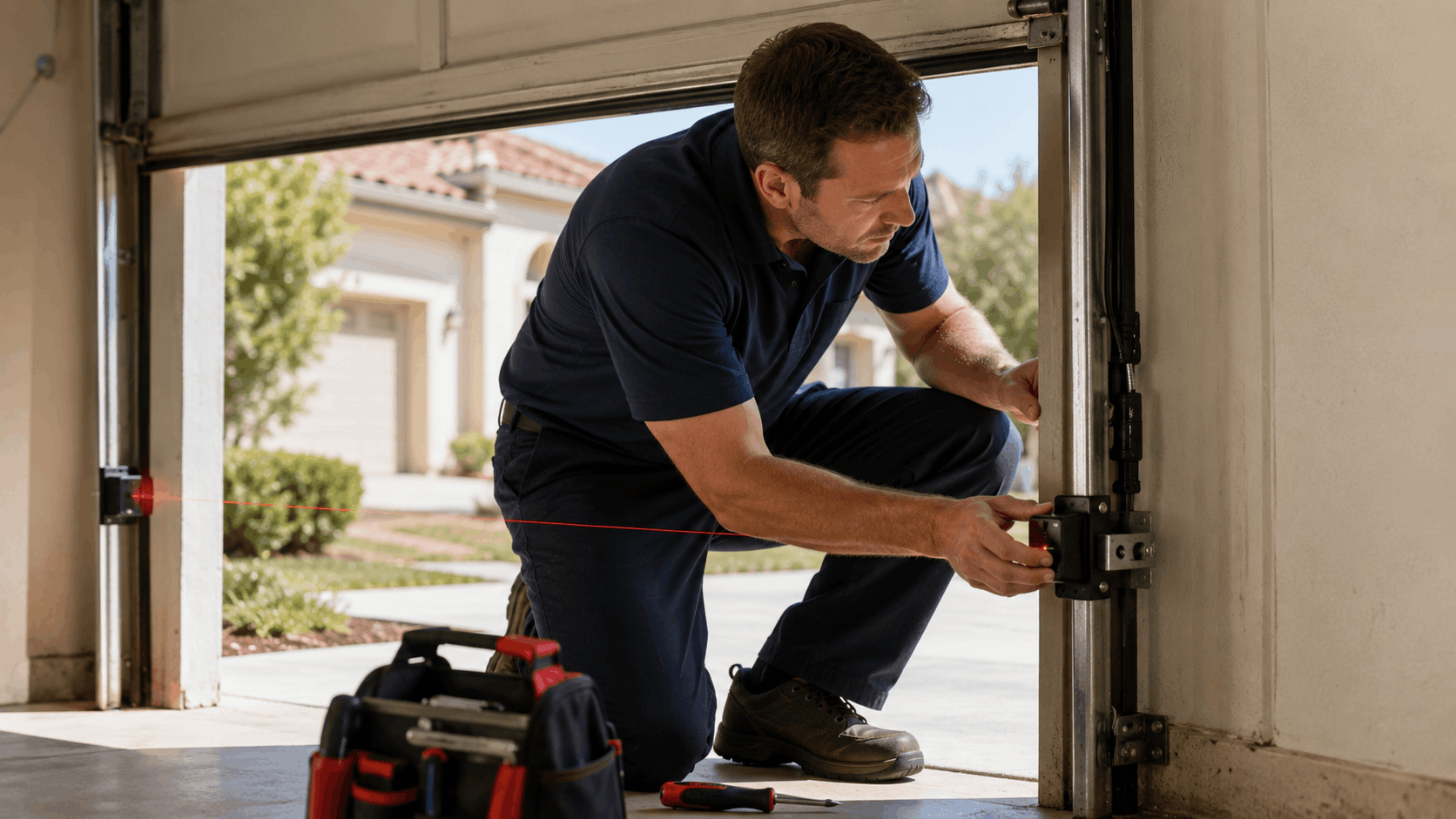
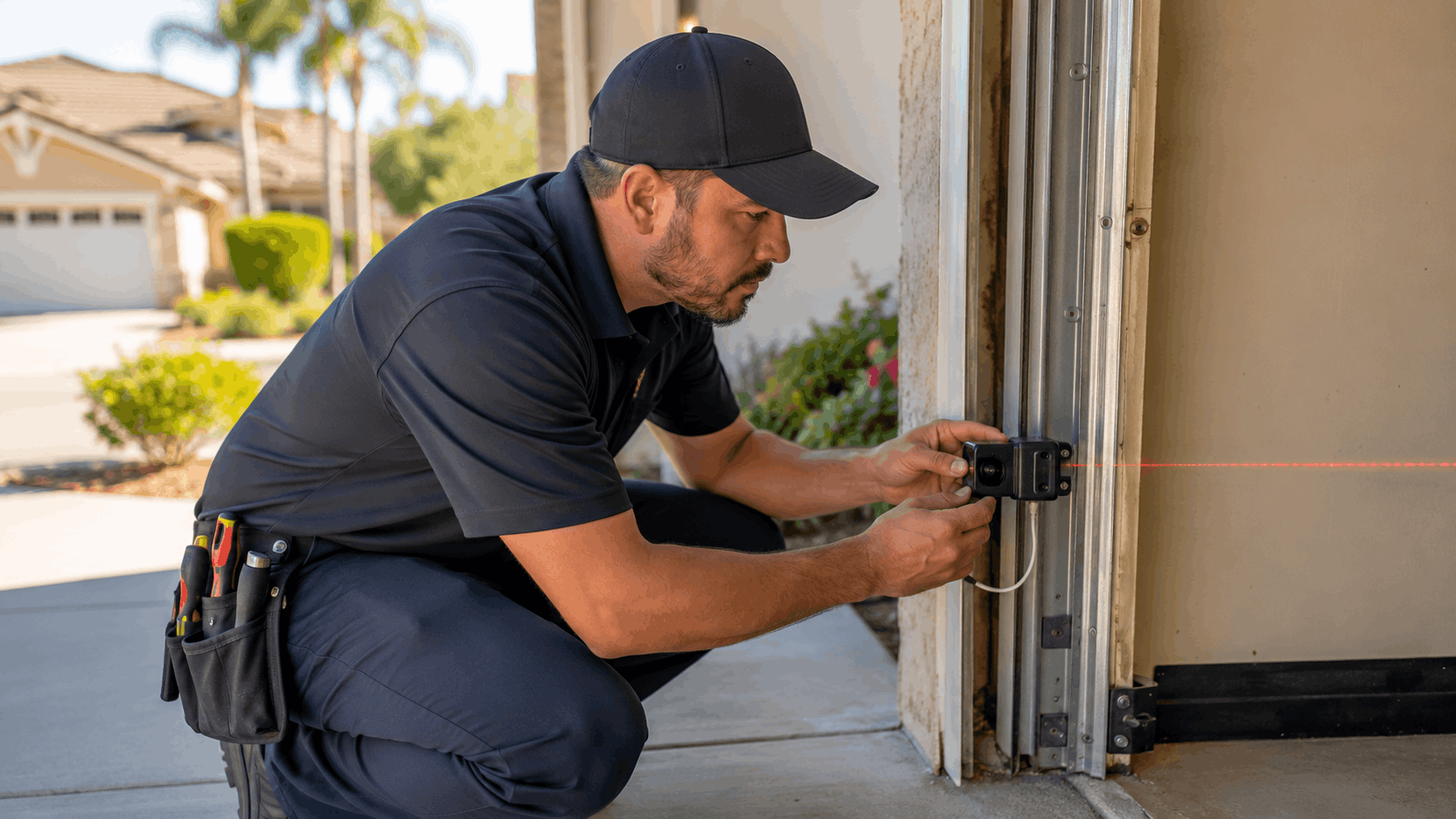
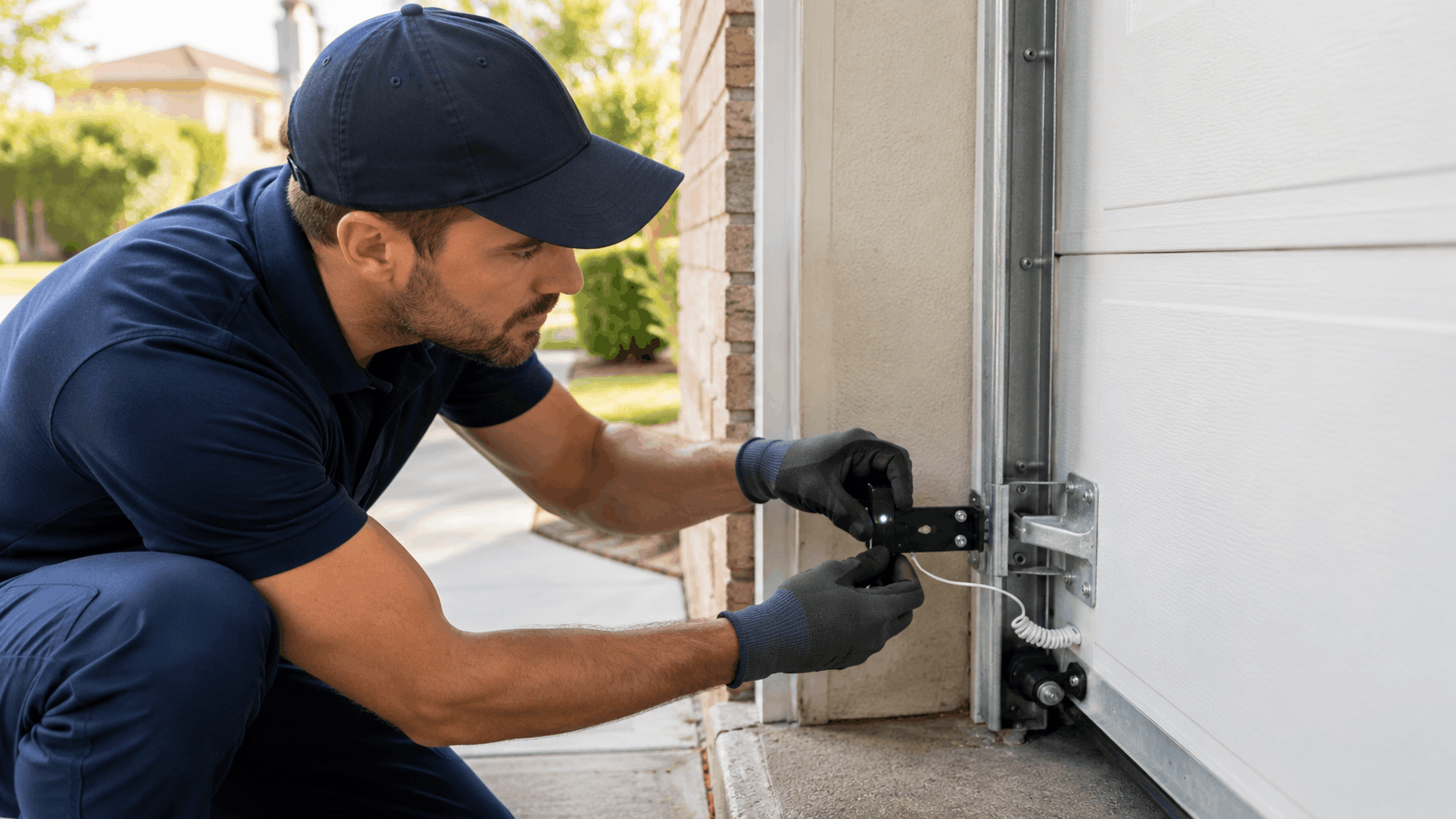
Each sensor sits in a bracket held by a wing nut or a small screw. Loosen it just enough that the sensor can pivot, then gently nudge the sensor until the indicator light turns solid. A steady green or amber light, depending on the brand, means the eyes have found each other.
Move slowly and in small amounts. Because the beam is narrow, a tiny adjustment makes a big difference. Once the light is steady and stays steady, retighten the wing nut without shifting the sensor.
Then run the door to confirm it closes fully. If you can get a solid indicator light but the door still reverses, the trouble may be in the wiring, which is the next thing to inspect.
Check for Sun Glare
Here is a sneaky one that catches a lot of Irvine homeowners. Direct afternoon sun can wash out the receiving eye and mimic a blocked beam. West-facing garages get hit hardest.
Many homes in Northwood and along the western edges of Irvine have driveways that face the setting sun. In the late afternoon, low sunlight pours straight into the sensor and overwhelms the infrared beam. The receiving eye cannot pick out its own signal against all that glare.
The tell for sun glare is timing. If the door refuses to close at 5 pm but works fine in the morning or after dark, sunlight is the likely culprit. It is one of the few sensor problems that comes and goes with the clock.
A simple test is to try the door at a different time of day or shade the sensor with your hand for a moment. If it closes when the sun is off it, a small sun shield over the receiving eye usually solves it for good.
Checking the Wiring and Connections
When cleaning and alignment do not fix the problem, the wiring is the next place to look. The sensor wires are low voltage and safe to inspect, but they need solid connections to work. These checks stay simple and do not involve the spring, cables, or high-voltage power.
Look for Loose or Corroded Wires
Start by tracing the thin wires from each sensor. Follow them up the track and along the wall toward the opener. You are looking for spots where a wire has come loose from its staple, pulled away from the sensor, or shows green or white corrosion at a connection.
A loose wire is a common find. Over years of vibration, a staple can work free or a connection can loosen just enough to break contact intermittently. That explains a door that closes some days and reverses others with no obvious reason.
Corroded connection points are another issue, especially in older Irvine homes. Neighborhoods with original openers from the 1990s often have aging wiring that has oxidized at the terminals. The green crust on a copper contact blocks the signal even when the wire looks intact.
If you spot a loose splice or a bare wire touching metal, that is worth fixing. Simple loose staples are easy to re-secure. Corroded or damaged connections usually need a technician to clean, re-strip, and reconnect properly for a lasting repair.
Spotting Pest or Weed Whacker Damage
Because the sensors sit low, their wires live right in the danger zone for two things: pests and yard tools. Both leave the same result, a nicked or chewed wire that breaks the circuit and stops the door from closing.
Rodents are a real problem in Irvine garages that back onto greenbelts and open space, which describes a lot of homes in Portola Springs and along the trails. Mice and rats chew wire insulation, and a chewed wire near the sensor is a frequent cause we trace on service calls in the Portola Springs area.
Weed whackers and edgers cause the other half of this wire damage. When a gardener trims along the base of the garage, the spinning line can catch a low sensor wire and slice it. The cut is often small and hard to see at a glance.
If you find a chewed or cut wire, do not tape over it and hope. A clean splice or replacement section restores a reliable connection. For pest damage that keeps coming back, sealing the entry points matters as much as fixing the wire.
Testing the Opener Terminal
The sensor wires end at small terminals on the opener motor unit. This is worth a look if everything else checks out. Find where the two sensor wires attach to the opener and make sure each is seated firmly under its screw or in its slot.
A wire that has slipped partway out of the opener terminal breaks the circuit the same way a chewed wire does. Push each wire in gently and confirm it is held. Sometimes reseating a loose terminal wire is the entire fix.
Be careful about swapped or reversed terminals if wires were ever disconnected. Many openers have a specific terminal pair for the sensors, and putting a wire on the wrong screw can keep the door from closing. Matching the wiring diagram on the motor cover prevents this mistake.
If the terminals look right, the wires are seated, and the door still reverses, the problem may be deeper than the sensors. At that point it is usually time to have a technician test the opener logic and the rest of the system.
When the Problem Isn't the Sensor
Sometimes a garage door won't close for reasons that have nothing to do with the photo eyes. It helps to rule these out so no one spends an hour wiping clean sensors when the real issue is elsewhere. Here are the common problems that mimic a sensor failure.
A Stuck or Bent Track
A door that binds on a bent section of track can stop mid-travel and look exactly like a sensor reverse. The door hits the tight spot, the opener senses resistance, and it stops or backs off. Homeowners assume it is the sensors when the metal track is the real problem.
The roller track can warp from a small impact, a loose bracket, or years of a heavy door running through it. Older Irvine homes with original wood or heavy steel doors put more stress on the tracks, and that wear shows up as bends and flat spots over time.
You can often spot a bent track by looking down its length for a kink or a gap where the roller sticks. If the door struggles at the same point every time, the track is the likely cause. A track repair and realignment gets the door moving smoothly again.
Do not try to force a door through a bent track. That can bend it further or pull the door off its rollers entirely. This is a repair best handled by a technician with the right tools.
Faulty Wall Button or Remote
The control you use to operate the door can also be the culprit. A wall button that is stuck or a remote with a dying battery can hold the door open or send confusing signals. It is an easy thing to overlook.
A wall button with a jammed contact can keep the opener from accepting a close command. If the button feels mushy or stays pressed, that could be the whole issue. Cleaning around it or replacing the wall control often solves it.
A weak remote battery is even more common. As the battery fades, the remote may open the door reliably but struggle to send a strong close signal. Swapping in a fresh battery is a two-minute test worth trying.
The simple check is to test both control points. If the wall button closes the door but the remote will not, the remote or its battery is the problem. If neither works, the issue is more likely in the opener or the sensors.
Worn Opener Logic Board
Inside every opener is a circuit board that reads the sensor signals and decides when to move the door. As it ages, that logic board can start to misread inputs. It may think the beam is broken when it is not.
This tends to show up on openers past the ten to fifteen year mark. Heat in an uninsulated Irvine garage speeds up the aging, and a board that has cooked through many summers can behave erratically. The door may close fine one day and reverse for no clear reason the next.
A failing board is hard to diagnose from the outside because it mimics sensor and wiring faults. When we have cleaned the eyes, confirmed alignment, and tested the wiring with no luck, the board becomes the prime suspect. Our opener repair and troubleshooting service can test the board directly.
If the opener is old and the board is failing, replacement is often the smarter move than repeated repairs. A newer unit also brings quieter operation and smart features many Irvine homeowners want.
Broken Spring Making the Door Too Heavy
A snapped torsion spring can stop a door from closing properly and feels unrelated to the sensors at first. The springs carry the weight of the door, and when one breaks, the opener suddenly has to lift and lower far more weight than it was built for.
With a broken spring, the door may close partway then stop, or the opener may strain and give up. Some units read the extra resistance as an obstruction and reverse. A loud bang from the garage, followed by a door that will not move right, is a classic sign of a broken spring.
We tell every Irvine homeowner the same thing: never try to touch or adjust the springs yourself. Torsion springs hold enormous tension and can cause serious injury if they release. This is not a DIY job under any circumstances.
If you suspect a spring, leave the door alone and call for service. Our torsion spring replacement is handled safely with the proper tools and training.
Need Help in Irvine?
Urgent Garage Doors serves Irvine and all of Orange County.
When to Call Urgent Garage Doors in Irvine
Many sensor issues are DIY-friendly, but some clearly need a professional. Knowing where that line falls saves time and prevents a small problem from turning into a bigger one. Our team at Urgent Garage Doors covers all of Irvine and handles the repairs that go beyond a quick wipe-down.
| Situation | Try It Yourself? | Call a Pro? |
|---|---|---|
| Blocked or dirty sensor | Yes | No |
| Minor sensor realignment | Yes | No |
| Damaged or chewed wiring | No | Yes |
| Faulty opener logic board | No | Yes |
| Bent track or broken spring | No | Yes |
Signs You've Reached a DIY Limit
There are clear moments when it is time to stop and call a technician. Damaged wiring is the first. If you find chewed, cut, or corroded wires, splicing them for a lasting repair takes the right materials and connections.
A faulty logic board is another. There is no home fix for a failing opener circuit board, and guessing at it wastes time. A technician can test it and tell you whether a repair or a new opener makes more sense.
The clearest sign is a door that still reverses after you have cleared the path, cleaned the lenses, aligned the eyes, and checked the wiring. When all the easy fixes fail, something deeper is going on. That deserves a professional repair rather than more trial and error.
Anything involving the springs, cables, or a bent track also belongs to a technician. Those parts carry tension and weight that make them genuinely dangerous to handle without training. Calling for help there is the safe and smart choice.
Same-Day Service Across Irvine
We built our service around fast response because a stuck door is a real disruption. Our team covers Irvine from end to end, from the Great Park and Portola Springs on the north side down to Quail Hill and the University area near campus.
Same-day service is the standard we work toward for sensor and door problems. In most cases we can reach a home the same day the call comes in, often within a few hours. A door that will not close is a security concern, so we treat it with urgency.
Because we work these neighborhoods every week, our technicians know the common issues by area. The dust problems near the hills, the pest-chewed wiring near the greenbelts, and the aging openers in older tracts are all patterns we see and fix regularly.
For after-hours situations, our same-day garage door repair keeps homeowners from leaving a door stuck open overnight. Wherever you are in Irvine, help is close.
What a Sensor Repair Visit Includes
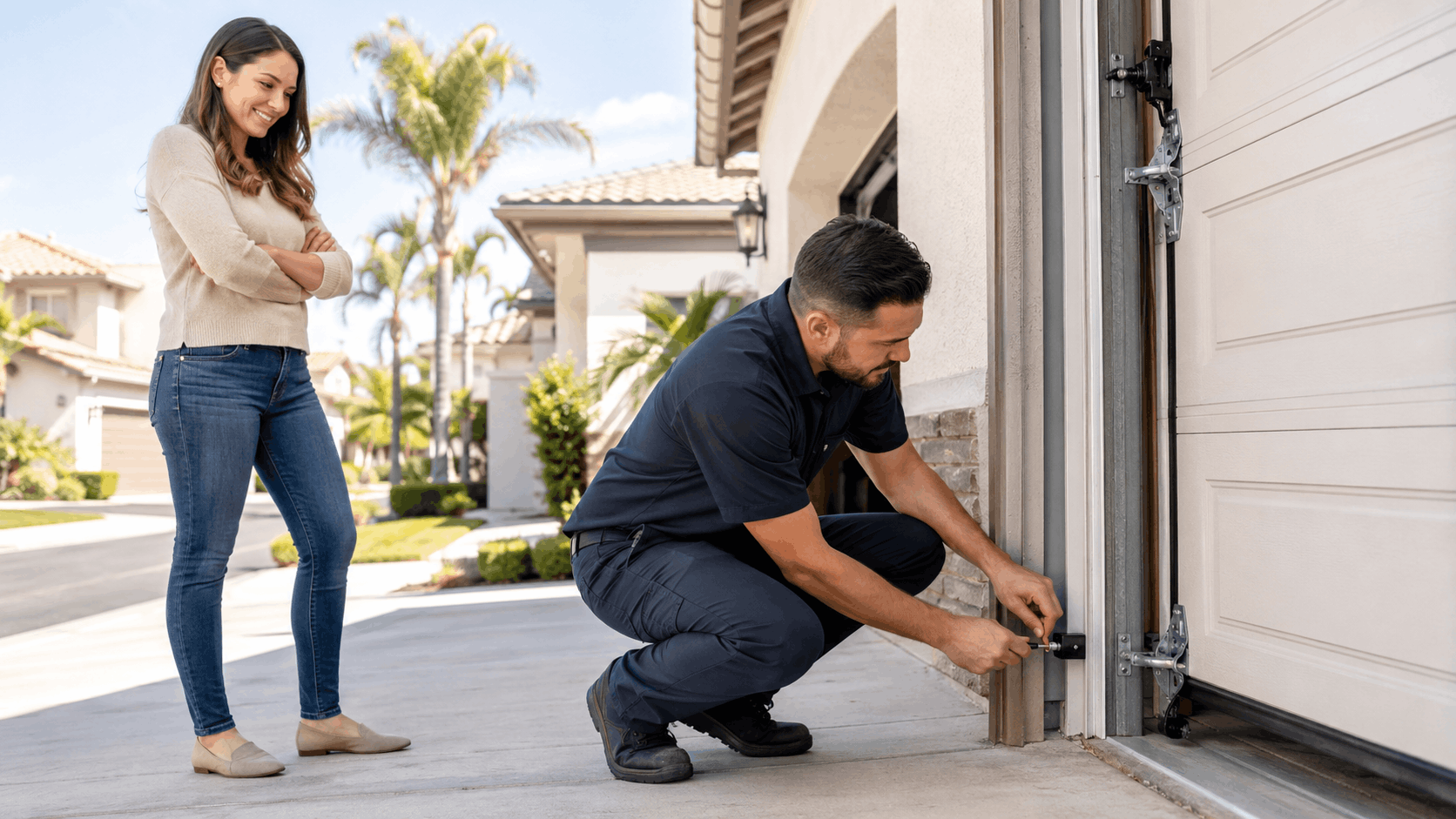
When a technician arrives for a sensor issue, the visit follows a clear routine so nothing gets missed. First comes a full inspection of both photo eyes, their brackets, and their mounting height to confirm they meet the six-inch standard.
Next is precise alignment. The technician aims both eyes until the indicator lights are solid and stable, then locks them so they hold. This is the step that fixes doors that only reverse now and then.
Then comes the wiring check. The technician traces the wires from each sensor to the opener terminals, looking for loose staples, corrosion, pest damage, or a bad connection. Any faults get repaired or replaced on the spot when possible.
Finally, the technician tests the door through several full cycles to confirm it closes reliably every time. They also check the safety reverse itself to make sure it still trips correctly. You end up with a door that works and a safety system you can trust.
Keeping Sensors Working Year-Round
A little upkeep keeps sensor problems from coming back. These habits fit Irvine's dusty climate and typical garage layouts, and they take only minutes. Consistent sensor maintenance is far cheaper than repeated repair calls.
Monthly Lens Cleaning Routine
The single most useful habit is a monthly wipe of both sensor lenses. It takes under a minute with a dry cloth and stops the dust buildup that causes most reversing problems in Irvine.
During dry seasons and Santa Ana wind events, grime accumulates faster, so a monthly schedule keeps ahead of it. Homes near Turtle Rock and University Park collect more windblown dust and benefit most from staying on top of this.
Pair the lens cleaning with a quick glance at the indicator lights. If both glow steady, the system is healthy. If one is flickering, you have caught a problem early before it leaves you stuck in the driveway.
Make it easy to remember by tying it to another monthly task, like changing an air filter or paying a bill. A one-minute lens maintenance routine prevents the majority of sensor headaches.
Keeping the Floor Path Clear
Since the beam sits only six inches off the ground, floor clutter is a constant threat. Keeping the floor path clear on both sides of the doorway prevents accidental beam blocks that stop the door.
Store bins, sports gear, and seasonal items well back from the door opening rather than along the tracks. Give each sensor a clear zone of at least a foot or two so nothing drifts into the beam. Shelving along the back wall keeps things off the floor entirely.
In busy family garages in Woodbridge and Northwood, this is worth a monthly reset. Bikes, scooters, and bags of soil have a way of creeping toward the door over time.
Good garage storage habits also make it easier to spot the sensors and their wires when you do your monthly check. A tidy floor path is one of the simplest ways to avoid a door that won't close.
Yearly Professional Tune-Ups
Once a year, a professional inspection catches the problems homeowners cannot easily see. A technician checks sensor alignment, wiring condition, spring balance, track condition, and opener health all in one visit.
Alignment drift and loose wiring build up slowly, and an annual tune-up catches them before they leave you stranded. The same visit spots worn rollers, fraying cables, and aging springs while they are still cheap to address.
Over the long run, this saves money. Small fixes caught early cost far less than emergency repairs or a full opener replacement after a failure. A door that gets yearly attention also lasts longer.
Our preventive maintenance plan makes this easy by scheduling the inspection for you. For a full breakdown of what a garage door inspection covers, our maintenance and upgrades team can walk you through it.
Need Help in Irvine?
Urgent Garage Doors serves Irvine and all of Orange County.
Final Thoughts
A garage door that opens but will not close is one of the most common problems we see in Irvine, and it is usually one of the easiest to fix. The photo eye sensors are almost always the reason, and clearing the path, wiping the lenses, and realigning the eyes solves the vast majority of cases in minutes.
When those quick fixes do not work, the cause may be wiring damage, a bent track, a worn opener board, or a broken spring. Those need a trained technician, especially anything involving the springs or cables. Knowing where the DIY line falls keeps you safe and saves time.
If your door is stuck and you have run out of easy fixes, our team is ready to help. Reach out to Urgent Garage Doors for same-day sensor and door repair across Irvine, from the Great Park to Quail Hill. We will get your door closing safely again.
Frequently Asked Questions
Why does my garage door open but not close?
The most likely cause is a blocked or misaligned safety sensor. When the door reverses on the way down, the photo eye system thinks something is in the doorway and refuses to close. Start by clearing any objects from the floor path, wiping the sensor lenses with a dry cloth, and checking that both indicator lights glow steady. Those three steps solve most cases.
What does a blinking garage door sensor light mean?
A steady, repeating blink on the sensor or opener light signals that the infrared beam is broken. It usually means the path is blocked, the lens is dirty, or the two eyes are out of alignment with each other. Many openers flash a set number of times as a code. Cleaning and realigning the sensors until the light turns solid normally clears the blink.
Can I close my garage door with a broken sensor?
Yes, most openers let you override the sensors by pressing and holding the wall button until the door fully closes. Release it and the door stops. This bypasses the safety feature, so use it only as a short-term workaround and never when children or pets are nearby. Get the sensor repaired quickly so the safety reverse works again.
How do I realign my garage door photo eyes?
Loosen the wing nut or screw holding the sensor bracket just enough to move it. Gently nudge the sensor while watching its indicator light. When the light turns solid green or amber and stays steady, the eyes are aligned. Retighten the bracket without shifting the sensor, then test the door. Move in small amounts, since the beam is narrow and small changes matter.
Does sunlight affect garage door sensors?
Yes. Direct sun shining into the receiving eye can wash out the infrared beam and mimic a blocked sensor. This hits west-facing Irvine garages hardest in the late afternoon, common in Northwood and along the west side of the city. If the door refuses to close at sunset but works in the morning, glare is the cause. A small sun shield over the sensor fixes it.
How much does sensor repair cost in Irvine?
Costs vary by the work involved. A simple cleaning or realignment is at the low end since it takes little time. Repairing damaged wiring or replacing a sensor pair costs more because it involves parts and labor. Most sensor repairs fall in a modest range compared with major opener or spring work. Our team gives a clear quote before starting any repair.
Why does my door reverse right before it closes?
Reversing just above the floor often means the beam is partly blocked near the ground, or the opener's travel limit setting is off. A slight obstruction, a bit of debris, or a sensor aimed slightly low can trip the reverse in the last few inches. Check the floor and sensor aim first. If the door still reverses near the ground, the travel limits may need adjusting by a technician.
How long do garage door sensors last?
Photo eye sensors typically last around ten to fifteen years, though many go longer. Dust, moisture, sun exposure, and physical bumps shorten that life. Irvine's Santa Ana dust and marine layer moisture speed up lens wear, so local sensors may need attention sooner. Regular cleaning extends their life, and replacement is straightforward when they finally wear out.
Can I replace garage door sensors myself?
A basic sensor swap is possible for a handy homeowner, since the units mount with simple brackets. The tricky parts are matching the wiring to the correct opener terminals and getting both eyes aligned so they hold. Mistakes there leave the door reversing anyway. For a lasting result, especially with older wiring, a technician usually gets it right the first time.
How fast can Urgent Garage Doors reach my Irvine home?
We offer same-day service across Irvine for sensor and door problems in most cases, often within a few hours of your call. Our coverage runs from the Great Park and Portola Springs down to Quail Hill, Turtle Rock, and the University area. A stuck door is a security concern, so we prioritize getting to you quickly and closing your door safely.
Frequently Asked Questions
- Why does my garage door open but not close?
- The most likely cause is a blocked or misaligned safety sensor. When the door reverses on the way down, the photo eye system thinks something is in the doorway and refuses to close. Start by clearing any objects from the floor path, wiping the sensor lenses with a dry cloth, and checking that both indicator lights glow steady. Those three steps solve most cases.
- What does a blinking garage door sensor light mean?
- A steady, repeating blink on the sensor or opener light signals that the infrared beam is broken. It usually means the path is blocked, the lens is dirty, or the two eyes are out of alignment with each other. Many openers flash a set number of times as a code. Cleaning and realigning the sensors until the light turns solid normally clears the blink.
- Can I close my garage door with a broken sensor?
- Yes, most openers let you override the sensors by pressing and holding the wall button until the door fully closes. Release it and the door stops. This bypasses the safety feature, so use it only as a short-term workaround and never when children or pets are nearby. Get the sensor repaired quickly so the safety reverse works again.
- How do I realign my garage door photo eyes?
- Loosen the wing nut or screw holding the sensor bracket just enough to move it. Gently nudge the sensor while watching its indicator light. When the light turns solid green or amber and stays steady, the eyes are aligned. Retighten the bracket without shifting the sensor, then test the door. Move in small amounts, since the beam is narrow and small changes matter.
- Does sunlight affect garage door sensors?
- Yes. Direct sun shining into the receiving eye can wash out the infrared beam and mimic a blocked sensor. This hits west-facing Irvine garages hardest in the late afternoon, common in Northwood and along the west side of the city. If the door refuses to close at sunset but works in the morning, glare is the cause. A small sun shield over the sensor fixes it.
- How much does sensor repair cost in Irvine?
- Costs vary by the work involved. A simple cleaning or realignment is at the low end since it takes little time. Repairing damaged wiring or replacing a sensor pair costs more because it involves parts and labor. Most sensor repairs fall in a modest range compared with major opener or spring work. Our team gives a clear quote before starting any repair.
- Why does my door reverse right before it closes?
- Reversing just above the floor often means the beam is partly blocked near the ground, or the opener's travel limit setting is off. A slight obstruction, a bit of debris, or a sensor aimed slightly low can trip the reverse in the last few inches. Check the floor and sensor aim first. If the door still reverses near the ground, the travel limits may need adjusting by a technician.
- How long do garage door sensors last?
- Photo eye sensors typically last around ten to fifteen years, though many go longer. Dust, moisture, sun exposure, and physical bumps shorten that life. Irvine's Santa Ana dust and marine layer moisture speed up lens wear, so local sensors may need attention sooner. Regular cleaning extends their life, and replacement is straightforward when they finally wear out.
- Can I replace garage door sensors myself?
- A basic sensor swap is possible for a handy homeowner, since the units mount with simple brackets. The tricky parts are matching the wiring to the correct opener terminals and getting both eyes aligned so they hold. Mistakes there leave the door reversing anyway. For a lasting result, especially with older wiring, a technician usually gets it right the first time.
- How fast can Urgent Garage Doors reach my Irvine home?
- We offer same-day service across Irvine for sensor and door problems in most cases, often within a few hours of your call. Our coverage runs from the Great Park and Portola Springs down to Quail Hill, Turtle Rock, and the University area. A stuck door is a security concern, so we prioritize getting to you quickly and closing your door safely.
U
Licensed garage door repair professionals serving Irvine and Orange County.
Licensed in California · License #1055150
Why trust Urgent Garage Doors?
Founded in 2017, Urgent Garage Doors is a licensed and insured garage door services serving Irvine and Orange County. All content is reviewed by our licensed technicians.

Need Help in Irvine?
Urgent Garage Doors serves Irvine and all of Orange County.
Related Articles
How-To Guides
Garage Door Replacement in Woodbridge and Turtle Rock Irvine: Village Standards and HOA Approvals
A local guide to garage door replacement in Woodbridge and Turtle Rock Irvine, covering village standards, HOA approvals, city permits, door choices, and real cost ranges.

How-To Guides
Garage Door Safety Sensors: How to Test and Fix Alignment in Your OC Home
Learn how to test and fix garage door safety sensor alignment issues in your Orange County home with this comprehensive guide covering troubleshooting, maintenance, and repair.
Cost Guides
Garage Door Sensor Repair Cost Orange County: Photo Eye Replacement Pricing
Real garage door sensor repair costs in Orange County, plus photo eye replacement pricing, warning signs, DIY checks, and how to pick an honest Irvine repair team.