Tips & Advice
High-Cycle Commercial Springs: Why Busy OC Businesses Break Standard Springs in a Year
Key Takeaways
- Standard springs are rated for about 10,000 cycles, which a busy commercial door burns through in under a year.
- One cycle is a full open and close, so cycle count matters far more than how many months a spring has been installed.
- A door opening 40 times a day reaches a standard spring's limit in about a year; 80 times a day does it in roughly five months.
- High-cycle springs rated for 25,000 to 100,000 cycles use thicker wire and larger coils to last years instead of months.
- Coastal OC air near Newport Beach rusts and fatigues unprotected springs faster, so galvanized or coated options extend life.
- Warning signs include a loud bang, grinding noise, a heavy or crooked door, a visible 2-inch coil gap, and a straining opener.
- Cheap springs cost more over time through downtime, repeat service calls, and damage to cables, tracks, and openers.
- Lubrication every three months, regular balance tests, and yearly inspections keep commercial springs working longer.
In This Article
A busy print shop near the Irvine Business Complex called our team on a Tuesday morning. Their roll-up door had opened and closed for eight months without a hitch, then it quit cold with a delivery truck idling in the lot. The spring above the door had snapped clean in two, and the whole operation stalled while orders piled up.
This story plays out across Orange County more often than most owners realize. A door that works fine at home fails fast in a warehouse or retail space because business doors move far more often. The parts a builder installs are usually rated for light home use, not the pounding a commercial door takes every single day.
Below, our team breaks down why standard springs give out in under a year, what high-cycle springs do differently, and how to pick the right upgrade for your Irvine business. We cover the warning signs, the real costs of cheap parts, and the steps that keep a door running long past its first service call.
What Garage Door Springs Actually Do
Most business owners never think about springs until one breaks. That is understandable, since springs sit quietly above the door and do their work out of sight. But they carry the entire load of a heavy door, and knowing their job helps explain why they wear out.
When you press a button and the door glides up, springs are doing the heavy lifting - not the motor. The opener mostly guides the door. The springs supply the force. On commercial doors, that force is enormous because the doors themselves weigh far more than a home model.
Torsion Springs vs Extension Springs
Garage door springs come in two main styles. Extension springs stretch along the horizontal tracks on each side of the door and pull as the door moves. They are common on older and lighter residential doors around Orange County.
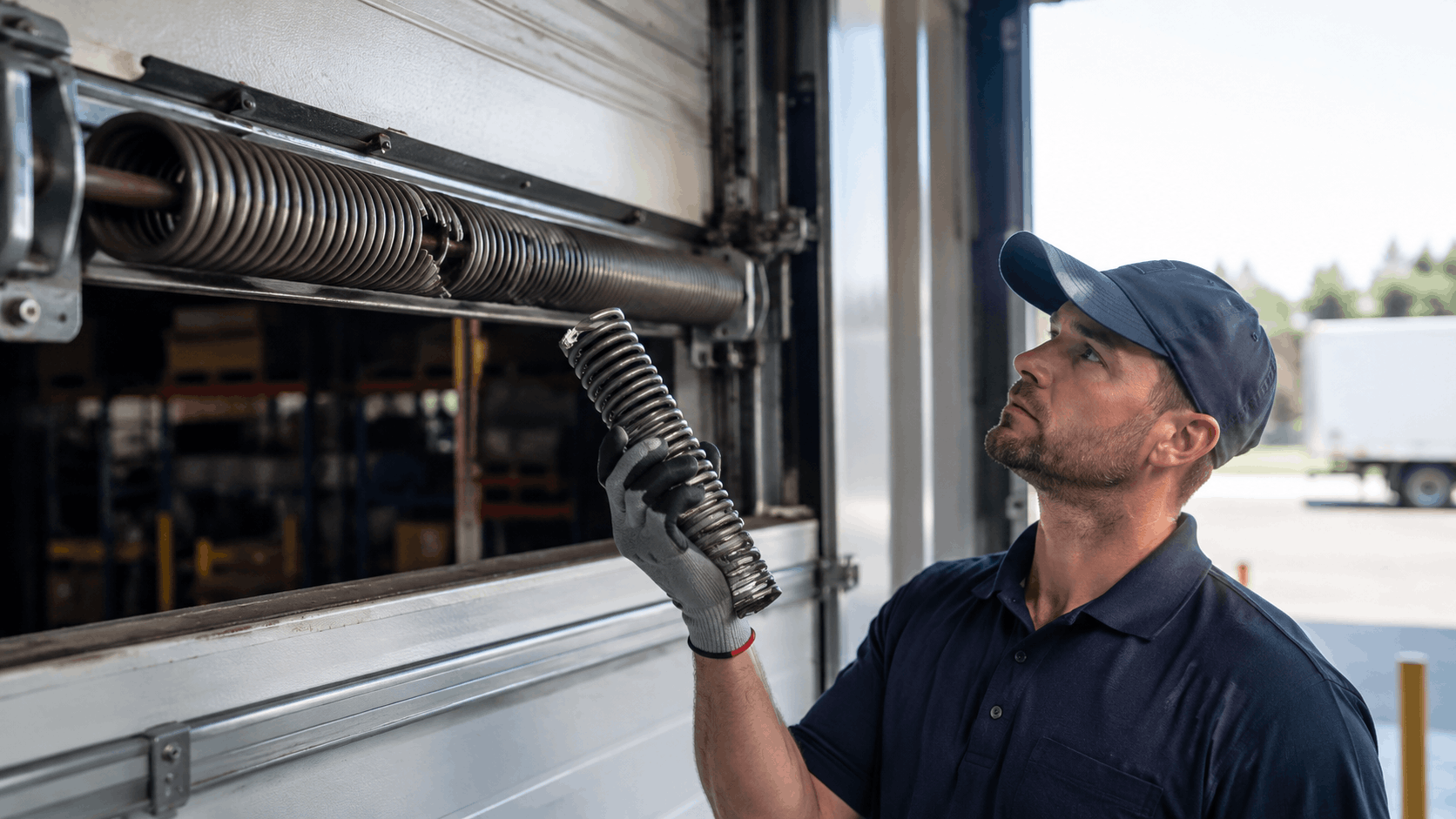
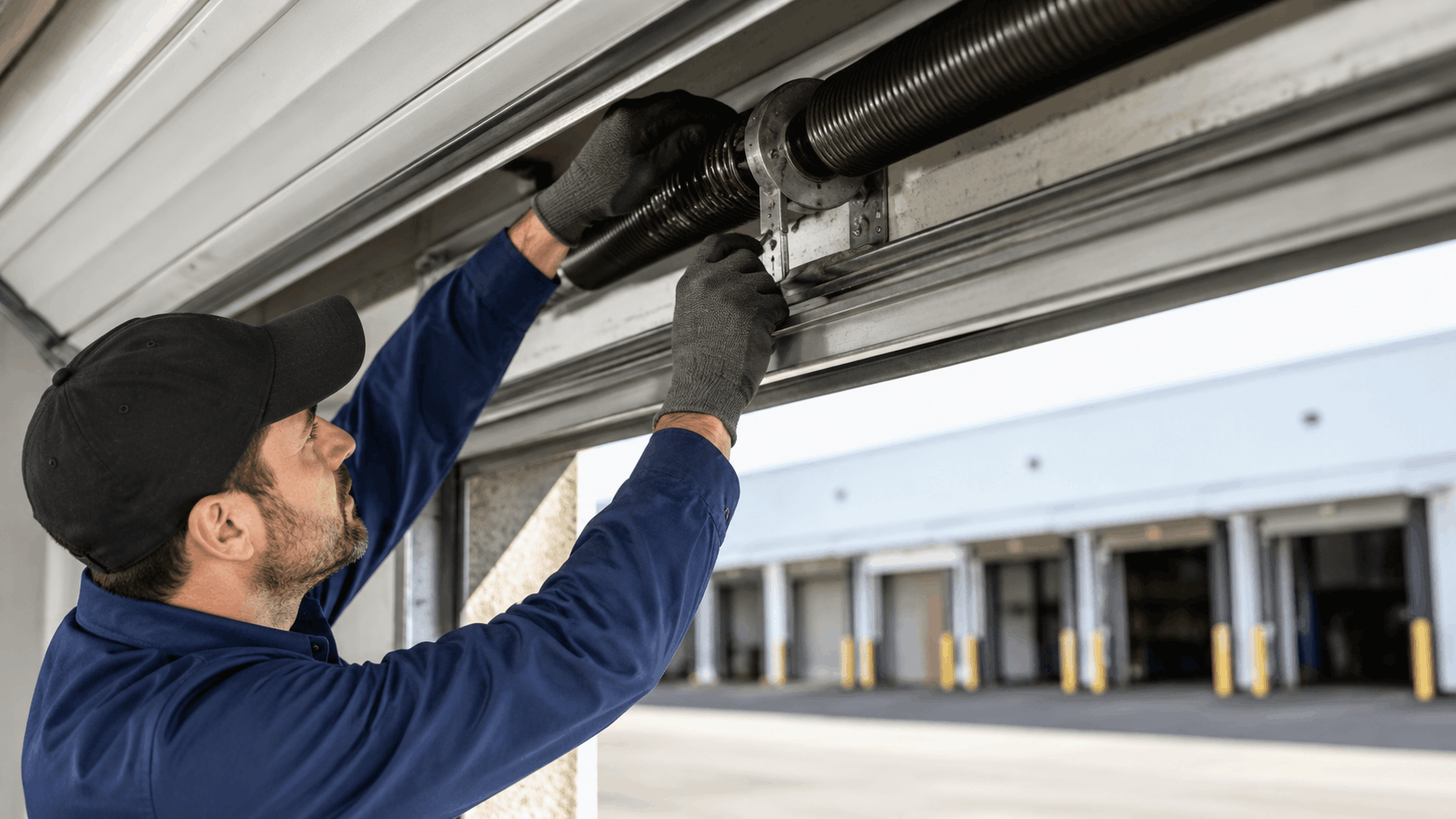
Torsion springs mount on a metal shaft above the door opening and twist to store energy. They are stronger, last longer, and handle heavier loads with better control. Most commercial roll-up and sectional doors in Irvine business parks near Alton Parkway and Barranca use torsion springs for that reason.
If your business door has a shaft with one or two large coils above it, you are looking at torsion springs. If you see long stretched springs running back along the ceiling tracks, those are extension springs. Our team handles both, and we often recommend switching lighter setups over with a spring conversion upgrade when a door sees heavy use.
The style matters because it sets the ceiling on how much the spring can take. A torsion system built for a commercial door offers more room to install a stronger, longer-lasting spring than a basic extension setup ever could.
How Springs Carry the Door's Weight
A commercial door can weigh several hundred pounds. Springs counterbalance that weight so the door feels close to weightless when it moves. Without them, no motor or cable could lift the door safely.
Here is the trick. As the door closes, the springs wind up and store energy. As the door opens, they release that energy to offset the door weight. The system stays balanced so the door pauses in place instead of slamming shut.
When springs are matched right, the cables and motor barely strain. When springs are worn or wrong, the cables and opener take on load they were never built to carry. That extra stress is where costly damage begins, and it is why proper door balancing and tension adjustment matters so much on business doors.
Think of the springs as the muscle and the motor as the brain. The brain tells the door when to move. The muscle does the actual lifting. Weaken the muscle, and everything else works overtime.
What a Single Cycle Means
One cycle equals a full open and a full close. Open the door and shut it once, and you have used one cycle. That single number tells you far more about spring life than any calendar date.
A home door might run four or five cycles a day. A busy loading dock might run forty or more. That is why cycle count matters more than how many months a spring has been installed.
Spring lifespan is measured in cycles, not years. A spring rated for a set number of cycles will reach that limit fast if the door moves constantly. Two identical springs can last five years or ten months depending only on how often the door runs.
When our team talks with a business owner about a new spring, the first question is always how many times the door moves each day. That single answer shapes every choice that follows.
Get Your Free Quote
Tell us about your garage door and we'll get back to you fast.
Why Standard Springs Fail Fast in Busy OC Businesses
Standard springs are built for homes, not for high traffic. A commercial garage door that opens all day burns through a home-grade spring long before the owner expects it. Spring failure in a business setting almost always traces back to a mismatch between the part and the workload.
We see this pattern week after week across Irvine, from auto shops off Sand Canyon to distribution bays near the Great Park. The reasons repeat themselves, and most are avoidable.
- The spring is rated for far fewer cycles than the door actually runs
- A residential spring got installed on a heavy commercial door
- The warm, salty coastal air rusts and weakens the metal early
- The door was never balanced properly, adding constant strain
Standard Springs Are Rated for 10,000 Cycles
A typical standard spring is rated for about 10000 cycles. That sounds like a big number until you count how a business uses a door. On a home, 10000 cycles might last seven years.
On a commercial door, that same spring rating gets eaten up in months. The spring does not know it is on a business. It simply winds and unwinds until the metal fatigues and gives out.
The spring rating is a hard limit, not a suggestion. Once the coil has flexed its rated number of times, failure is a matter of when, not if. Pushing past that limit is what leads to the sudden snap owners hear from across the shop.
This is the single biggest reason busy businesses break standard springs in a year. The part was never built for the mileage a commercial door puts on it.
Do the Math on Daily Openings
Let us run the numbers on a real delivery bay. Say the door opens 40 times a day for trucks, staff, and pickups. That is 40 cycles daily.
Multiply 40 daily cycles by a six-day work week and you reach about 240 cycles a week. Over a year, that lands near 12000 cycles. A 10000-cycle spring is already past its limit before the year ends.
Now picture a warehouse that runs two shifts with a door opening 80 times a day. That spring reaches its limit in roughly five months. The spring wear stacks up fast when a door never gets a rest.
This math is why our team asks about daily cycles before anything else. The number of openings tells us exactly how long a spring will survive before it fails.
Residential Springs on Commercial Doors
Some builders and low-bid installers put home-grade springs on business doors to save money upfront. It looks fine on day one. The door opens and closes, and the owner has no reason to suspect a problem.
The trouble comes months later when the wrong spring gives out early. A residential spring on a commercial door is a setup for repeat failure. The part simply cannot handle the load or the frequency.
We often find this during a first service call at a new client's shop. The spring size and rating do not match the door weight or the daily use at all. Once we point it out, the pattern of early breaks finally makes sense to the owner.
Getting the right spring on the door from the start saves money over the life of the building. A proper torsion spring replacement matched to the door's real workload ends the cycle of surprise breakdowns.
Heat and Salt Air Along the OC Coast
Orange County's climate adds another layer of wear. Warm days and coastal air speed up metal fatigue and rust on unprotected springs. Businesses closer to the coast feel this most.
A shop near Newport Beach or the coastal edge of Costa Mesa deals with salt in the air that a spring in an inland warehouse does not. Salt corrodes steel, and corroded steel snaps sooner. Even a few miles from the water, the marine layer carries enough moisture to matter.
Heat cycles also play a part. Metal expands and contracts with temperature swings, and that motion adds tiny stresses over time. Combine that with heavy daily use, and the coastal climate quietly shortens spring life.
This is why we recommend rust-resistant coatings for businesses anywhere near the shore. A coated spring holds up far better against the salty air that rolls in from the Pacific.
Need Help in Irvine?
Urgent Garage Doors serves Irvine and all of Orange County.
How High-Cycle Springs Solve the Problem
High-cycle springs are built for exactly the workload that breaks standard parts. They are a straightforward commercial upgrade that trades a bit more cost upfront for years of reliable service. For a busy door, the durability difference is night and day.
Our team installs high-cycle springs on doors all over Irvine and nearby cities. The goal is simple. Match the spring to how hard the door works so it lasts as long as the business needs it to.
- Ratings run from 25000 up to 100000 cycles
- Thicker wire and larger coils resist fatigue longer
- The spring gets sized to the door's actual daily use
- Coated options fight rust in coastal air
What a High-Cycle Rating Means
A high-cycle rating tells you how many open-and-close cycles the spring is built to survive. Common levels are 25000, 50000, and 100000 cycles. Each step up buys a business more years between replacements.
Take that 40-cycle-a-day delivery bay from earlier. A 50000 cycle spring on that door lasts roughly five years instead of ten months. A 100000 cycle spring could run a decade or more.
The higher rating costs more than a standard spring, but it slashes how often the door goes down. For a business that cannot afford surprise closures, the math favors the stronger spring almost every time.
Our team helps owners pick the level that fits their traffic. There is no reason to pay for 100000 cycles if 50000 covers your use with room to spare.
Thicker Wire and Larger Coils
What makes a high-cycle spring last longer comes down to physical build. The wire is thicker and the coil is often larger in diameter or longer overall. Heavier wire handles the same load with less stress on the metal.
Picture bending a thin paperclip back and forth versus a thick steel rod. The thin one snaps quickly. The thick one takes far more flexing before it fails.
Spring construction follows the same logic. A larger wire size spreads the stress of each cycle over more metal, so fatigue builds up slower. That is the core reason a high-cycle spring survives so many more open-and-close cycles.
These springs also tend to run smoother and quieter because they are not straining at the edge of their limits. A door that moves smoothly puts less wear on cables, rollers, and the opener too.
Matching the Spring to the Door's Use
The right spring is the one sized to your door and your traffic. Our team looks at the door weight, its size, and the usage rate to spec the correct spring. Guessing here is how doors end up with the wrong part all over again.
Spring sizing starts with measuring how much the door weighs and how tall it is. Then we factor in how many times it opens on a typical day. Those numbers point straight to the cycle rating that fits.
A quiet storage unit that opens a few times a week needs a very different spring than a produce warehouse running all day. One size does not fit every business. Matching the spring to the real use pattern is what makes the upgrade pay off.
When we finish the assessment, the owner knows exactly what they are getting and why. No mystery, just a spring built for the way their door actually works.
Warning Signs a Commercial Spring Is About to Break
A spring rarely fails without warning. Most give off signs for days or weeks before they snap. Catching these broken spring signs early keeps a truck from getting trapped or a storefront from staying shut during business hours.
Train your staff to notice these garage door warning signals. A quick call for commercial repair at the first sign beats an emergency shutdown later. Our team would rather fix a tired spring on a slow afternoon than an emergency at your busiest hour.
Loud Bangs and Grinding Noises
When a spring snaps, it makes a sharp bang like a firecracker or a gunshot. Owners often think something fell or someone dropped a heavy load. That loud bang is the sound of stored energy releasing all at once.
Before the break, you often hear grinding or squealing as the door moves. That spring noise means the coil is straining and the metal is fatiguing. It is the door asking for help before it quits entirely.
Do not ignore new sounds from an overhead door. A door that used to run quietly and now grinds is telling you something is wearing out. The sooner it gets checked, the smaller the repair tends to be.
If you hear that bang while nobody is near the door, stay clear and call for service. A snapped spring leaves the door under uneven load and unsafe to operate.
A Door That Feels Heavy or Uneven
A failing spring stops carrying its share of the load. The door then feels heavy, sags on one side, or jerks as it moves. A door that used to glide and now fights back is a clear signal.
You might notice the door opening crooked, with one side higher than the other. That uneven door movement points to a spring losing tension or a broken cable. Either way, the balance is off.
A heavy door also puts extra strain on the opener and cables. What starts as a spring issue can spread into a bigger repair if the door keeps running. Stopping use early limits the damage.
Try lifting the door by hand with the opener disconnected. If it feels heavy or will not stay put halfway, the spring is failing and needs attention soon.
Gaps in the Spring Coils
The easiest way to spot a broken spring is to look at the coil. A healthy torsion spring is tightly wound with no space between the loops. A broken one shows a visible gap.
If you see a gap of about 2 inches in the coil, the spring has already snapped. The two ends pulled apart when the metal failed. That coil gap is proof the spring can no longer do its job.
Grab a flashlight and check the spring above the door. This one-minute look tells you plenty. A solid coil is fine, while a broken spring with a clear gap needs replacement before the door gets used again.
On dual-spring doors, one may break while the other holds. The door might still move, but it is overloading the surviving spring and inviting a second failure fast.
The Opener Straining or Stalling
When a spring weakens, the opener picks up the slack it was never built to carry. You hear the motor strain, work harder, or stall partway through a lift. That opener strain is a symptom, not the root problem.
An opener forced to lift a heavy door burns out early. The gears wear, the motor overheats, and eventually the unit fails. Now you are buying a spring and an opener instead of just a spring.
If your motor struggles or the door stops halfway, do not keep hitting the button. Each strained lift shortens the opener's life. A quick check can save the whole unit, and our opener repair and troubleshooting team can tell whether the spring or the opener is the culprit.
Motor burnout from a worn spring is one of the most common preventable repairs we see. Fixing the spring in time protects the more expensive opener behind it.
The True Cost of Cheap Springs for OC Businesses
A cheap spring looks like a bargain on the invoice. The real cost shows up in downtime, repeat repairs, and damage to other parts. For a busy business, a stuck door costs far more than the spring ever did.
When our team lays out the numbers for owners, the case for spending more upfront becomes obvious. The commercial spring cost is small next to a day of lost work.
| Cost Factor | Cheap Standard Spring | High-Cycle Upgrade |
|---|---|---|
| Spring lifespan | Under 1 year (heavy use) | 5 to 10 years |
| Replacements per 5 years | 5 or more | 1 |
| Emergency downtime | Repeated closures | Rare |
| Risk to cables and opener | Higher | Lower |
Downtime When the Door Won't Open
A stuck loading dock brings a business to a halt. Trucks cannot unload, staff stand idle, and orders back up. Along the Irvine Spectrum area, a single blocked dock can stall deliveries for a whole crew.
Business downtime hits the wallet from every direction. You pay payroll for workers who cannot work. You may miss delivery windows and lose customer goodwill on top of it.
The math is brutal. A few hundred dollars saved on a cheap spring means nothing against a half day of stalled operations. That is why our same-day garage door repair exists, though the better fix is never breaking down at all.
A door that stays open reliably keeps the whole operation moving. That reliability is what a high-cycle spring buys.
Repeat Service Calls Add Up
Say a standard spring fails twice a year on a busy door. Each service call cost adds up in parts, labor, and the hassle of scheduling around your work. Over five years, that is a stack of invoices.
Compare that to one high-cycle upgrade that runs for years. You pay more once instead of a little over and over. The repeat repair pattern almost always costs more in the long run.
There is also the hidden cost of your time. Every breakdown means a phone call, a wait, and a disruption to your day. Fewer failures means fewer interruptions to your actual business.
When owners tally the true five-year cost, the high-cycle spring wins on price and on sanity. One good part beats five cheap ones.
Damage to Other Door Parts
A broken spring rarely fails alone. When it snaps, the sudden load shift can bend tracks, snap cables, and strain the opener. What could have been a simple spring swap becomes a full repair.
Cable damage is common after a spring break because the cables suddenly bear weight they were not carrying. A frayed or snapped cable then needs its own cable repair. Track damage from a door dropping unevenly adds even more to the bill.
The opener also takes a hit. A door slamming down or hanging crooked forces the motor to fight, and that shortens its life. One cheap spring can trigger a chain of failures across the whole system.
Replacing the spring before it breaks protects everything around it. That is the quiet savings a proper spring delivers.
Need Help in Irvine?
Urgent Garage Doors serves Irvine and all of Orange County.
Choosing the Right High-Cycle Spring for Your Irvine Business
Picking the right spring is not guesswork. It comes down to a few clear factors about your door and how you use it. Get these right, and the spring will outlast the next few tenants.
Our team walks every Irvine business owner through spring selection step by step. A good commercial door upgrade fits the door, the traffic, and the location all at once.
Counting Your Real Daily Cycles
Start by estimating your actual daily openings. A restaurant back door might open 60 times a day between deliveries and staff. A warehouse dock could run 100 or more across shifts.
An auto shop with a service bay might open the door 30 to 50 times as cars come and go. Watch the door for a normal day and count, or ask your crew for a rough number. That cycle estimate drives the whole decision.
Do not lowball the count. It is better to size up than to install a spring that runs out early. A little cushion in the cycle rating protects against busy seasons.
Once we have your real daily cycles, we translate that into an expected lifespan for each rating level. Then you can choose with clear eyes.
Door Weight and Size Factors
Door weight is a major factor in which spring is correct. A solid steel door weighs far more than a light aluminum one. Heavier doors need stronger springs even at the same cycle count.
Door size matters too. A tall, wide dock door stores and releases more energy than a small single door. The spring must match both the weight and the dimensions for a proper spring match.
Material plays a part as well. Insulated doors, glass-panel doors, and heavy wood-look doors all carry different weights. We weigh and measure so nothing is left to a rough guess.
This is why we never quote a spring over the phone without details. The right answer depends on the specific door in front of us, whether it is a new commercial overhead door or an older sectional model.
Galvanized and Coated Options for Coastal OC
For businesses near the coast, rust protection is worth the small added cost. Galvanized springs carry a zinc coating that resists corrosion from salty air. They hold up far longer near the water.
A shop near Newport Beach or along the coastal edge of Orange County faces marine air every day. Uncoated steel springs rust and weaken there faster than inland. A coated spring pushes back against that wear.
Even a few miles inland, the morning marine layer carries moisture. For any business within reach of the coast, rust protection extends spring life noticeably. It is cheap insurance against an early break.
We stock galvanized and coated options for exactly this reason. Our team will tell you honestly whether your location needs them.
Balancing Cost and Cycle Life
The goal is a cycle rating that fits your budget and your use without overpaying. A door that opens 20 times a day does not need a 100000 cycle spring. That would be paying for life you will never use.
On the other hand, a heavy-traffic dock earns back the cost of a high rating in avoided downtime. The cost balance tips toward the stronger spring when the door works hard. We help you find the sweet spot.
Cycle life should roughly match how long you plan to hold the space. If you have a ten-year lease on a busy warehouse, a spring built for ten years makes sense. Short-term users can size differently.
There is no single right answer, only the right answer for your business. Our job is to lay out the options so you spend wisely, not just spend more.
How Urgent Garage Doors Serves Irvine Businesses
Our team handles commercial garage door service across Irvine and the surrounding OC cities. We focus on fast, safe work that gets a business back to running quickly. From Irvine repair calls to high-cycle installation, we treat every stalled door as urgent.
Commercial doors demand a different approach than home doors. Heavier parts, higher tension, and no room for downtime shape how we work. That experience is what business owners count on when a door quits.
Same-Day Response Across Orange County
When a business door fails, waiting days is not an option. Our same-day service reaches business districts near the Irvine Business Complex and the neighborhoods around Woodbridge and Turtle Rock. Our trucks work the 405 and 5 freeway corridors daily.
That freeway access lets us reach shops across Orange County fast. Whether you are near the Spectrum, off Jamboree, or out toward Lake Forest, help is close. Speed matters when every closed hour costs money.
We keep common commercial springs and parts on our trucks so many jobs finish in one visit. No waiting a week for parts to arrive. That stock is part of how we keep response times short.
For after-hours breakdowns, our 24/7 emergency repair line keeps a stalled door from becoming an overnight problem.
On-Site Cycle Assessments
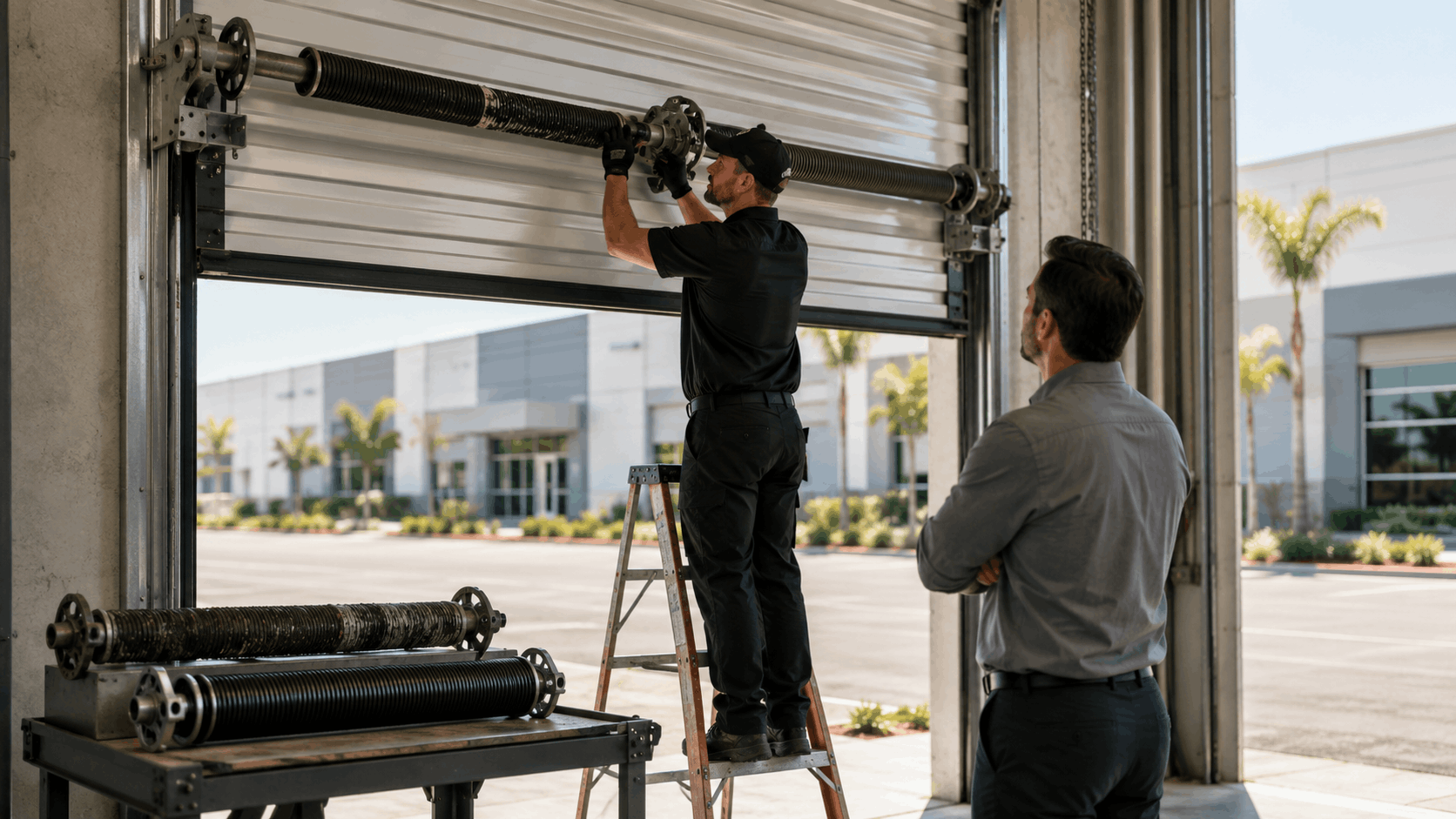
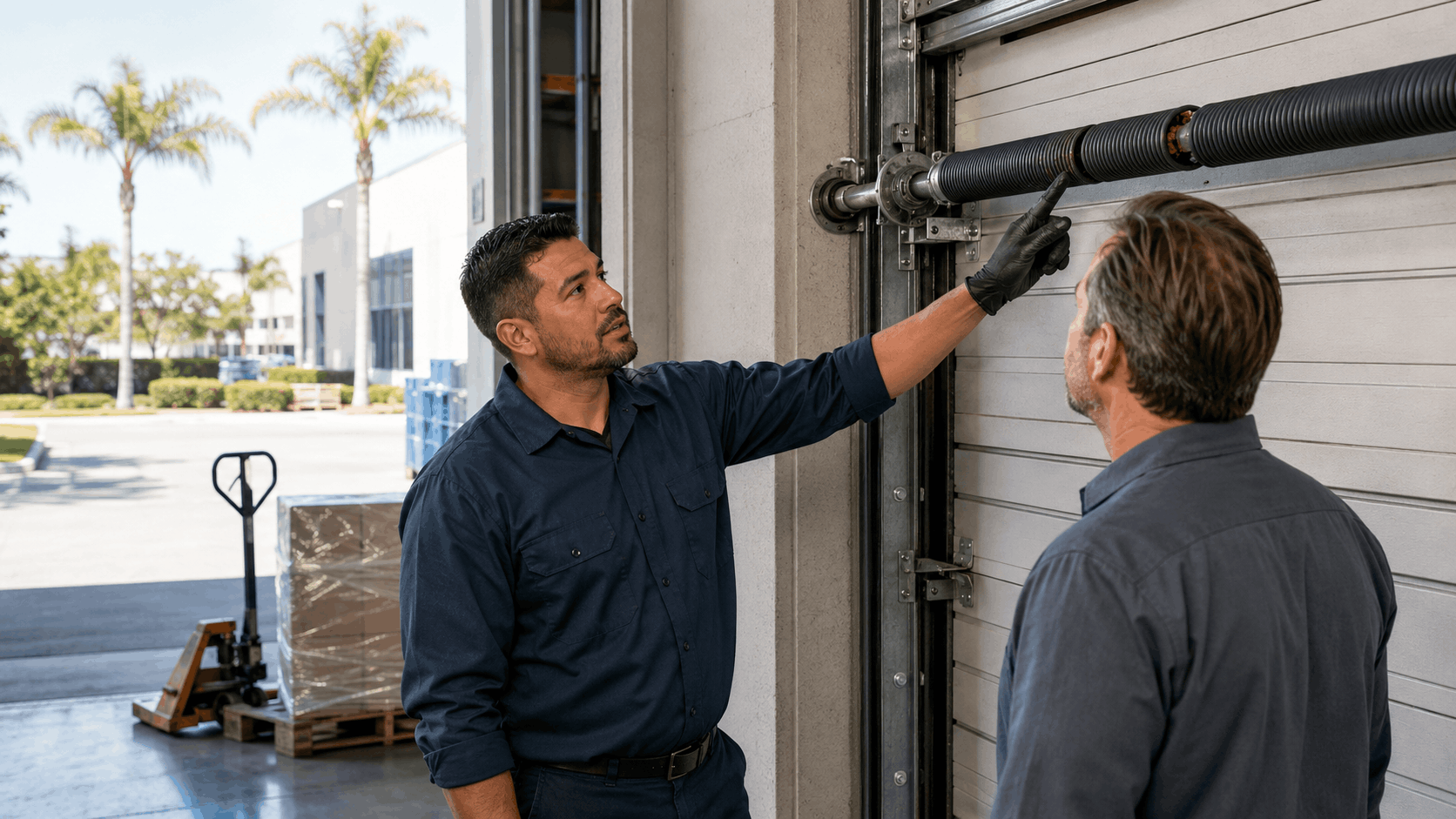
Getting the spring right starts with an on-site assessment. Our team measures the door weight, checks the dimensions, and asks about your daily use. Those numbers let us spec the exact high-cycle spring your door needs.
We do this in person because guessing leads to the wrong part. A quick visit gives us the full picture that a phone call cannot. The spring spec that results actually fits your door and traffic.
During the visit, we also look at cables, rollers, and the opener. If something else is wearing out, you learn about it before it fails. One assessment covers the whole system, not just the spring.
You walk away knowing what your door needs and why. No upsell, just a clear plan matched to how you actually use the door.
Safe Removal of Springs Under Tension
A loaded spring holds enough force to cause serious injury. Torsion springs under tension can whip or snap if handled wrong. This is not a job for untrained hands.
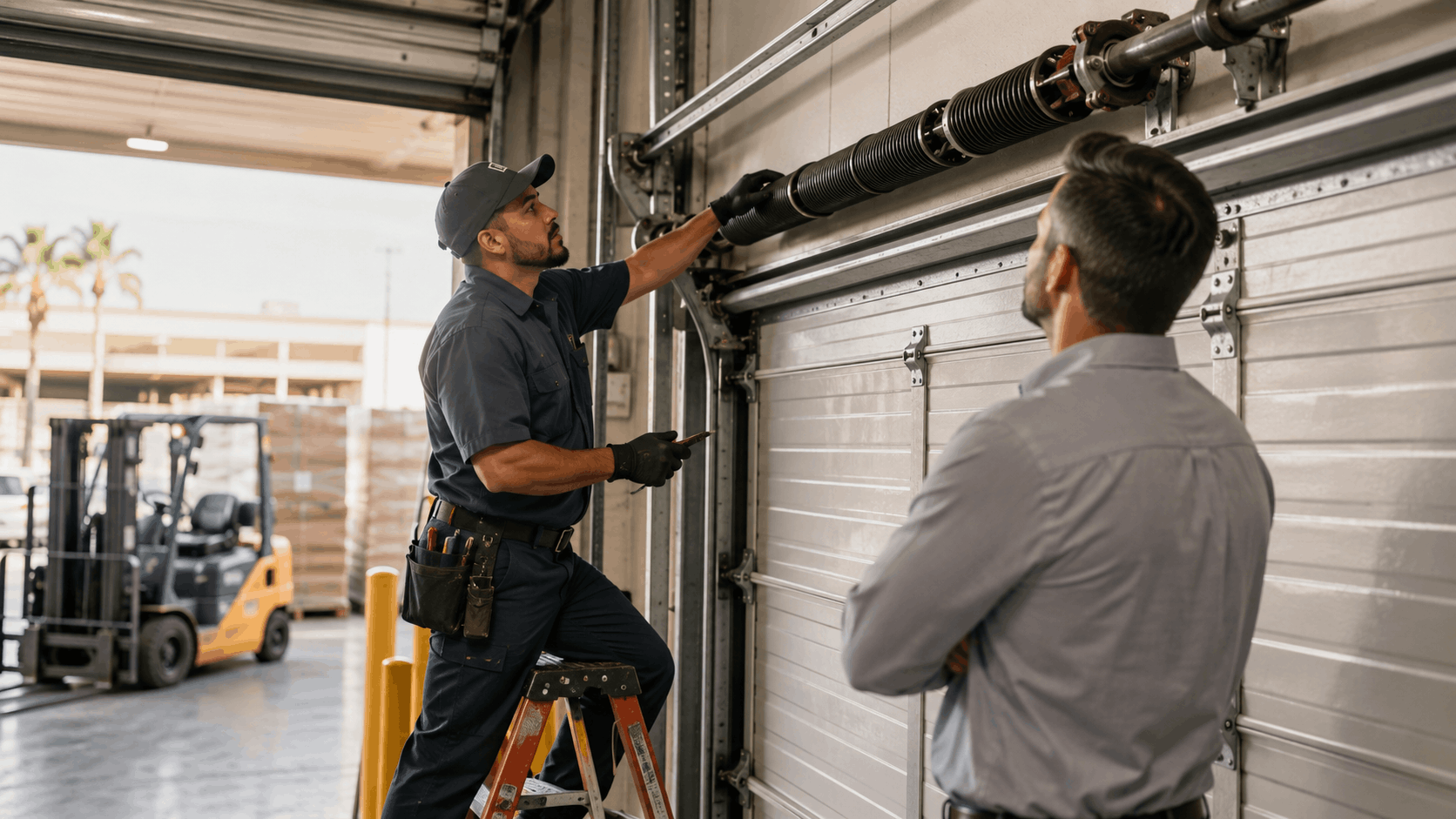
Our techs use the right winding bars and follow a careful process to release spring tension safely. We control the energy in the spring before we ever remove it. That training is what keeps the job safe.
Every year, people are hurt trying to swap springs themselves. The tools look simple, but the tension is unforgiving. A safe replacement means the right gear, the right steps, and the experience to know what can go wrong.
We handle both spring and cable repair on commercial doors so the whole tensioned system gets serviced correctly and safely.
Preventive Maintenance Plans
The best repair is the one you never need. Our preventive maintenance plans include scheduled tune-ups that catch wear before a door fails during business hours. A tech checks the spring, balance, and hardware on a set schedule.
Preventive service costs far less than an emergency call and a stalled dock. Catching a tired spring early means we replace it on your schedule, not in a crisis. That predictability is what busy operations value.
During each visit, we lubricate parts, test the balance, and flag anything showing wear. Small fixes now head off big failures later. Our preventive maintenance plan keeps commercial doors running through the busy seasons.
Owners on a plan rarely face surprise shutdowns. The door just keeps working, which is exactly the point.
Keeping Commercial Springs Working Longer
Even the best spring lasts longer with a little care. A few simple habits stretch spring life between service visits. Owners can do some of this in-house without any special tools.
Good commercial upkeep is about small, regular attention rather than big fixes. Spring maintenance, done right, keeps a door reliable for years. Here is what our team recommends.
Lubricating Springs the Right Way
Springs need the right lubricant to move smoothly. Use a garage-door-specific lubricant, not a general degreaser like WD-40, which can dry out the metal. A silicone or lithium-based spray works well.
In a dusty warehouse setting, apply the spring lubricant about every three months. Dust settles on the coils and works into the moving parts, adding friction. Regular lubrication cuts that wear.
Spray a light coat along the coil and wipe away any excess. Too much lubricant just catches more dust. A thin, even film is the goal.
Keep a maintenance schedule posted so it does not get forgotten. A quick lube every quarter is one of the cheapest ways to extend spring life.
Keeping the Door Balanced
An off-balance door wears springs faster because the springs fight harder on every cycle. A simple balance test tells you where things stand. Disconnect the opener and lift the door halfway by hand.
A balanced door stays put when you let go. If it falls or shoots up, the door balance is off and the springs are working too hard. That imbalance shortens their life quickly.
Run this balance test every few months. It takes a minute and flags trouble before it becomes a break. If the door does not hold its position, call for a tension check.
Our team can adjust the balance during a service visit. A properly balanced door protects the springs, the cables, and the opener all at once.
Scheduling Yearly Inspections
Set a yearly inspection window and stick to it. Pick a slow season for your business so the check never disrupts a busy day. A yearly rhythm keeps small issues from turning into shutdowns.
During a spring check, a tech inspects the coils for gaps or rust, tests the balance, and measures remaining cycle life where possible. They also look over cables, rollers, and the opener. One visit covers the whole system.
The tech will tell you if a spring is nearing its cycle limit so you can plan a replacement on your terms. That heads off the surprise snap during business hours. Planning beats reacting every time.
A yearly inspection paired with quarterly lubrication is the formula for a door that just keeps working. For businesses that want it handled, our maintenance and upgrades team keeps the schedule for you.
Need Help in Irvine?
Urgent Garage Doors serves Irvine and all of Orange County.
Final Thoughts
Standard springs break fast in busy Orange County businesses because they were never built for the mileage a commercial door puts on them. A door that opens dozens of times a day burns through a 10000-cycle spring in months. High-cycle springs, sized to your real traffic, end that cycle of surprise breakdowns.
The right upgrade saves money on downtime, repeat calls, and damage to cables and openers. Add rust protection near the coast and a simple maintenance routine, and a commercial door can run reliably for years. That reliability is what keeps trucks moving and doors open.
If your business door is on borrowed time or has already broken more than once, our team can spec the right high-cycle spring for your door and use. Call Urgent Garage Doors or contact us for an on-site assessment across Irvine and nearby OC cities. One good spring beats a year of breakdowns.
Frequently Asked Questions
What is a high-cycle garage door spring?
A high-cycle spring is built to survive far more open-and-close cycles than a standard part. Where a typical spring is rated for about 10000 cycles, high-cycle springs run from 25000 up to 100000 cycles. They use thicker wire and larger coils to resist metal fatigue. For busy commercial doors, they last years instead of months, which is why heavy-traffic businesses choose them.
How long do commercial garage door springs last?
Lifespan depends on the cycle rating and how often the door runs, not on the calendar. A standard 10000-cycle spring on a door opening 40 times a day may fail in under a year. A 50000-cycle spring on that same door lasts around five years. In a busy shop, matching the rating to daily use is the only way to predict real lifespan.
Why did my business spring break in less than a year?
Three causes come up most often. High traffic burns through a standard spring's cycle limit fast when a door opens dozens of times a day. A residential spring installed on a heavy commercial door fails early because it cannot handle the load. Coastal climate along the OC edge adds rust and metal fatigue that speed up the break.
How much does a high-cycle spring upgrade cost?
Pricing varies with the door weight, spring size, cycle rating, and whether you need coated springs for coastal air. A high-cycle upgrade costs more upfront than a standard spring, but it replaces several future repairs. Most commercial owners find the higher rating pays for itself by avoiding downtime and repeat calls. Our team gives an exact quote after an on-site assessment.
Can I replace a commercial spring myself?
We strongly advise against it. A torsion spring holds enough tension to cause serious injury if it slips or snaps during removal. Proper replacement needs winding bars, the right technique, and experience releasing the load safely. Every year people are hurt attempting this. A trained tech handles the tension safely and gets the correct spring sized for your door.
How do I count how many cycles my door needs?
Count how many times the door fully opens and closes on a typical day. A delivery dock might run 40 to 100 cycles, while a small service bay runs 20 to 30. Multiply the daily count by your work days per year to get annual cycles. Then pick a rating that covers several years of that use, with a little cushion for busy seasons.
Do both springs need to be replaced at once?
On a dual-spring door, yes, replacing both together makes sense. Both springs have run the same number of cycles, so if one broke the other is close behind. Replacing only one leaves you facing a second service call and downtime soon after. Doing both at once saves a return visit and keeps the door balanced with evenly matched parts.
Are high-cycle springs worth the extra cost?
For a busy business, almost always. The upfront cost is small next to a single day of a stalled loading dock and idle payroll. One high-cycle spring can replace five or more standard spring failures over the same period. Factor in avoided damage to cables and openers, and the stronger spring wins on total cost for high-traffic doors.
How fast can Urgent Garage Doors respond in Irvine?
We offer same-day service across Irvine and nearby OC cities. Our trucks work the 405 and 5 freeway corridors and carry common commercial springs, so many jobs finish in one visit. For after-hours breakdowns, our 24/7 emergency line keeps a stalled door from becoming an overnight problem. Response times stay short because we cover the local business districts daily.
What maintenance keeps commercial springs from breaking early?
Three habits make the biggest difference. Lubricate the springs with a garage-door-specific product about every three months, more often in dusty settings. Run a balance test by lifting the door halfway with the opener disconnected to catch imbalance early. Schedule a yearly inspection so a tech can flag a spring nearing its cycle limit before it snaps during business hours.
Frequently Asked Questions
- What is a high-cycle garage door spring?
- A high-cycle spring is built to survive far more open-and-close cycles than a standard part. Where a typical spring is rated for about 10000 cycles, high-cycle springs run from 25000 up to 100000 cycles. They use thicker wire and larger coils to resist metal fatigue. For busy commercial doors, they last years instead of months, which is why heavy-traffic businesses choose them.
- How long do commercial garage door springs last?
- Lifespan depends on the cycle rating and how often the door runs, not on the calendar. A standard 10000-cycle spring on a door opening 40 times a day may fail in under a year. A 50000-cycle spring on that same door lasts around five years. In a busy shop, matching the rating to daily use is the only way to predict real lifespan.
- Why did my business spring break in less than a year?
- Three causes come up most often. High traffic burns through a standard spring's cycle limit fast when a door opens dozens of times a day. A residential spring installed on a heavy commercial door fails early because it cannot handle the load. Coastal climate along the OC edge adds rust and metal fatigue that speed up the break.
- How much does a high-cycle spring upgrade cost?
- Pricing varies with the door weight, spring size, cycle rating, and whether you need coated springs for coastal air. A high-cycle upgrade costs more upfront than a standard spring, but it replaces several future repairs. Most commercial owners find the higher rating pays for itself by avoiding downtime and repeat calls. Our team gives an exact quote after an on-site assessment.
- Can I replace a commercial spring myself?
- We strongly advise against it. A torsion spring holds enough tension to cause serious injury if it slips or snaps during removal. Proper replacement needs winding bars, the right technique, and experience releasing the load safely. Every year people are hurt attempting this. A trained tech handles the tension safely and gets the correct spring sized for your door.
- How do I count how many cycles my door needs?
- Count how many times the door fully opens and closes on a typical day. A delivery dock might run 40 to 100 cycles, while a small service bay runs 20 to 30. Multiply the daily count by your work days per year to get annual cycles. Then pick a rating that covers several years of that use, with a little cushion for busy seasons.
- Do both springs need to be replaced at once?
- On a dual-spring door, yes, replacing both together makes sense. Both springs have run the same number of cycles, so if one broke the other is close behind. Replacing only one leaves you facing a second service call and downtime soon after. Doing both at once saves a return visit and keeps the door balanced with evenly matched parts.
- Are high-cycle springs worth the extra cost?
- For a busy business, almost always. The upfront cost is small next to a single day of a stalled loading dock and idle payroll. One high-cycle spring can replace five or more standard spring failures over the same period. Factor in avoided damage to cables and openers, and the stronger spring wins on total cost for high-traffic doors.
- How fast can Urgent Garage Doors respond in Irvine?
- We offer same-day service across Irvine and nearby OC cities. Our trucks work the 405 and 5 freeway corridors and carry common commercial springs, so many jobs finish in one visit. For after-hours breakdowns, our 24/7 emergency line keeps a stalled door from becoming an overnight problem. Response times stay short because we cover the local business districts daily.
- What maintenance keeps commercial springs from breaking early?
- Three habits make the biggest difference. Lubricate the springs with a garage-door-specific product about every three months, more often in dusty settings. Run a balance test by lifting the door halfway with the opener disconnected to catch imbalance early. Schedule a yearly inspection so a tech can flag a spring nearing its cycle limit before it snaps during business hours.
U
Licensed garage door repair professionals serving Irvine and Orange County.
Licensed in California · License #1055150
Why trust Urgent Garage Doors?
Founded in 2017, Urgent Garage Doors is a licensed and insured garage door services serving Irvine and Orange County. All content is reviewed by our licensed technicians.

Need Help in Irvine?
Urgent Garage Doors serves Irvine and all of Orange County.
Related Articles
Cost Guides
High-Cycle Springs Explained: 10,000 vs 25,000 vs 50,000 Cycles and Who Should Pay for More
Compare 10,000, 25,000, and 50,000 cycle garage door springs, learn how long each lasts for Irvine homes, and find out who should pay for the upgrade.
Tips & Advice
The Orange County Garage Door Guide by Home Era: 1950s Tract, 70s-80s South County, 90s Irvine, 2010s Great Park
A garage door guide for Orange County by home era - 1950s tract homes, 70s-80s South County, 90s Irvine villages, and 2010s Great Park builds.
Tips & Advice
Spring Replacement on Custom and Wood Doors in OC - Why Heavy Doors Need Engineered Setups
Heavy custom and wood garage doors in OC need engineered spring setups, not standard swaps. Learn why weight matters, what proper systems include, and how our Irvine team measures every door.