One Spring or Two on a Double Door: The Safety and Longevity Math
Key Takeaways
- A double garage door weighs 150 to 250 pounds, and the torsion springs, not the opener, carry that weight.
- A single spring is a single point of failure; when it breaks, the door becomes dead weight with no backup.
- Two springs share the load, wear more slowly, run quieter, and keep the door partly supported if one fails.
- Springs are rated in cycles (10,000 to 30,000); a busy Irvine household gets roughly 5 to 13 years depending on the rating.
- Coastal moisture and salt air in areas like Turtle Rock and Quail Hill speed up spring corrosion and shorten lifespan.
- When one spring in a pair breaks, replace both to keep tension matched and avoid a second failure soon after.
- Never force a door with a broken spring or attempt DIY spring work, since stored tension can cause serious injury.
- Urgent Garage Doors offers measurement-based spring sizing and same-day service across Irvine neighborhoods.
In This Article
A homeowner in Woodbridge called our team on a Tuesday morning, half-frozen in her driveway. Her double garage door had refused to budge, and she could not get her car out to make the school run near Meadowbrook Elementary. When we arrived, the story was familiar: one torsion spring had snapped clean in two, and the door was too heavy to lift by hand.
She had a single-spring setup, and the moment that one spring failed, her whole morning stopped. This is one of the more common calls we handle across Irvine, and it raises a question we get asked all the time. Should a double door run on one spring or two?
How Torsion Springs Actually Lift a Double Door?
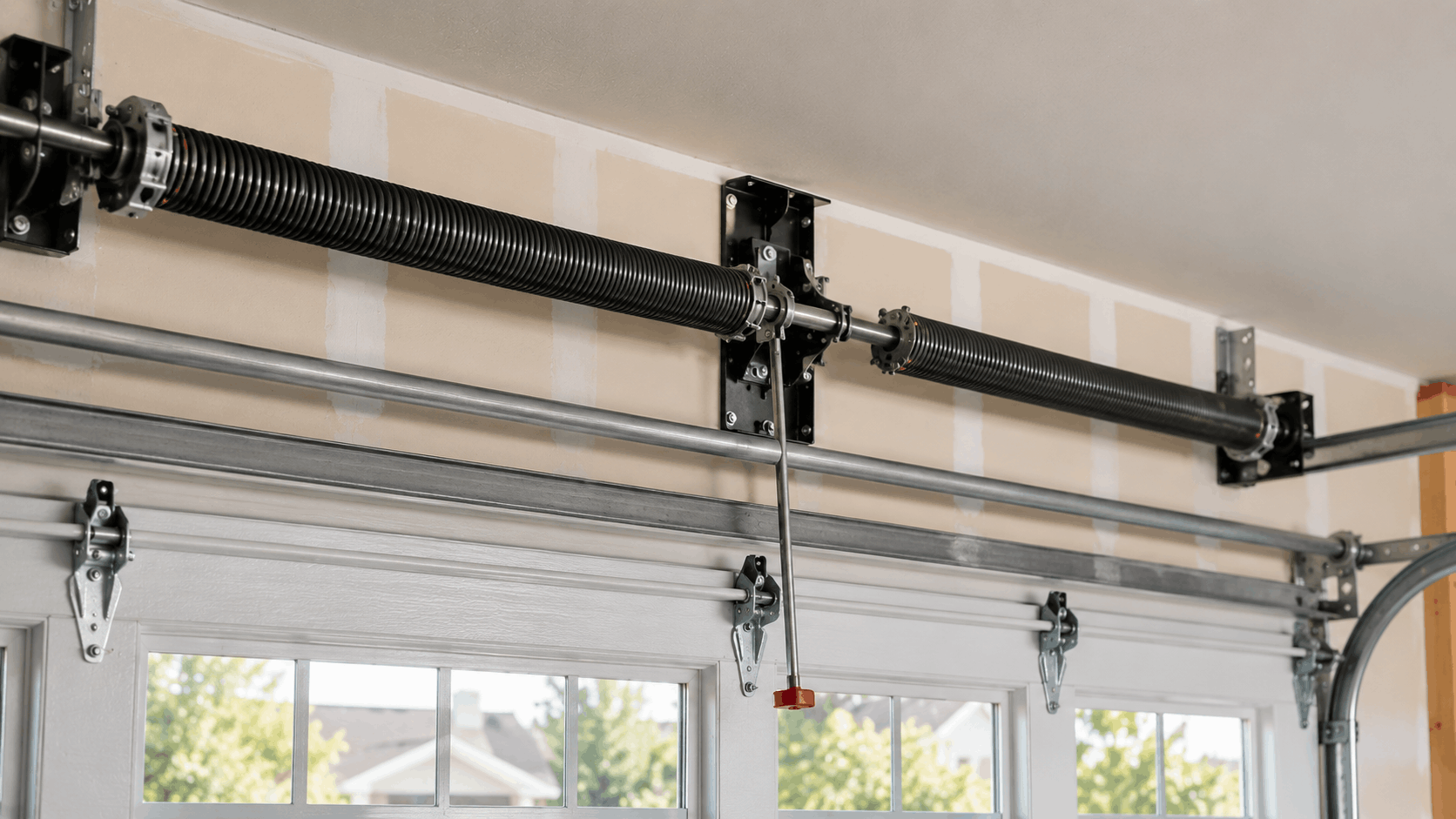
Most people think the motor lifts the door. It does not. The springs do almost all the work, and the mechanics behind that are worth understanding before you pick one spring or two.
What a Spring Is Really Holding Up
A standard double garage door weighs a lot more than people expect. A single-layer steel door might come in around 150 pounds, while a heavier insulated or wood door can push past 250 pounds. That door weight has to be lifted and lowered dozens of times a week, and something has to offset it.
The torsion spring stores energy when the door closes. As the door comes down, the cables wind the spring tighter, and that stored energy is what makes the door feel almost weightless when it goes back up. Without that stored energy, you would be hoisting a couch-sized slab of steel by hand every single time.
This is why a broken spring makes a door feel like it weighs a ton. The counterbalance is gone, and suddenly you are fighting the full door weight with no help. On a 250-pound door, that is not something anyone should try to muscle open.
The whole system is a balance act. The spring is sized to match the exact weight of your door, which is why guessing at spring size or reusing a mismatched spring almost always causes problems down the line.
Torsion vs. Extension Springs
There are two main spring types on residential doors: torsion and extension. Torsion springs mount on a metal shaft above the door opening and twist to store energy. Extension springs run along the horizontal tracks on each side and stretch out to do their work.
Most double doors in Irvine use torsion systems, and for good reason. Torsion springs offer better control, more even lifting, and a longer service life than extension springs on heavy doors. They also tend to fail more safely because the spring stays contained on the shaft.
The torsion vs extension question usually comes down to door size and headroom. Larger and heavier double doors almost always call for torsion. If you have an older door still running on extension springs, our team can talk you through an extension spring replacement or a full conversion to a torsion setup.
Both types wear out over time, but they wear differently. Understanding which one you have helps you know what to expect when it is time for service.
Why the Opener Is Not Doing the Heavy Lifting
Here is the misconception we correct most often. Homeowners believe a stronger garage door opener will fix a heavy door. It will not, and pushing a weak opener against an unbalanced door only burns out the motor sooner.
The opener is a guide, not a lifter. Its job is to move the door the last bit and hold it in place. The spring load carries the actual weight. When the springs are balanced correctly, you should be able to lift the door halfway by hand and have it stay put.
When a spring breaks, the opener suddenly has to fight the full door weight. That strain shows up as grinding sounds, slow movement, or an opener that gives up entirely. If your garage door will not open or close, a failed spring is one of the first things we check.
Treating the opener as the muscle of the system leads people to ignore the springs until they snap. The springs are where the real forces live, and they deserve the attention.
Get Your Free Quote
Tell us about your garage door and we'll get back to you within 30 to 60 minutes.
The Case for a Single Spring Setup
A single spring setup is not automatically wrong. There are situations where it works fine, and there are trade-offs that every homeowner should weigh before choosing it.
| Factor | Single Spring | Two Springs |
|---|---|---|
| Upfront cost | Lower | Higher |
| Load per spring | Full load | Half load each |
| Backup if one fails | None | Partial support |
| Typical lifespan | Shorter | Longer |
| Best for | Light doors | Most double doors |
Lower Upfront Cost
The most obvious appeal of a single torsion spring is cost. One spring means less material and slightly less labor, so the installation cost comes in lower than a dual setup. For a builder trying to hit a price point, that savings adds up across a whole tract.
We see this a lot in newer Irvine developments. Builder grade doors in some Portola Springs and Great Park neighborhoods were spec'd with a single spring to keep construction costs down. It passes inspection and works on day one, so nobody questions it.
The problem is that the savings are front-loaded. A single spring carries the full load, so it wears out sooner and often needs replacing before a dual setup would. What looked like a bargain at build time can cost more over the life of the door.
For homeowners weighing the numbers, it helps to think in total cost over ten years rather than the price on the first invoice. That longer view usually changes the answer.
When Door Weight Allows It
A single spring can be the right call on a genuinely light door. A single-layer, non-insulated steel door on the lighter end of the range may function fine on one spring within the manufacturer spec. The math simply works out when the load is low enough.
The manufacturer spec is the deciding line here. Door makers publish weight ranges and spring requirements, and a light door that falls comfortably inside those limits does not need a second spring to operate safely. Forcing a second spring onto a very light door can even make balancing trickier.
The trouble starts when people add weight to a door and never revisit the spring. Adding insulation, a new decorative overlay, or swapping to a heavier panel changes the weight the spring has to carry. A single spring that was fine at 140 pounds is undersized at 190.
Before assuming a single spring is enough, our technicians weigh the door and check it against the manufacturer numbers. Guesswork here leads to premature failures and unsafe operation.
The Hidden Risk of a Single Point of Failure
The biggest drawback of one spring is that it is a single point of failure. When that lone spring breaks, there is no backup. The door becomes dead weight, and it is stuck wherever it was when the spring let go.
That is exactly what happened to the Woodbridge homeowner we mentioned. Her broken spring left the door shut with her car trapped inside. On a busy morning, that is more than an inconvenience, and it is why single-spring doors generate so many emergency calls.
A door stuck by a broken spring is also unsafe to force. The full door weight is unsupported, and trying to muscle it open risks injury and can damage cables, tracks, and the opener. This is when people call for emergency garage door repair.
With a single spring, every break is a full failure. There is no partial support, no warning cushion, and no way to limp along until a technician arrives. That risk is the core reason we usually steer homeowners toward two springs.
Need Help in Irvine?
Urgent Garage Doors serves Irvine and all of Orange County.
The Case for a Two Spring Setup
For most double doors in Irvine, two springs is the setup we recommend. The reasons come down to balance, safety, and a longer service life, and the extra spring buys real protection.
Splitting the Load Between Two Springs
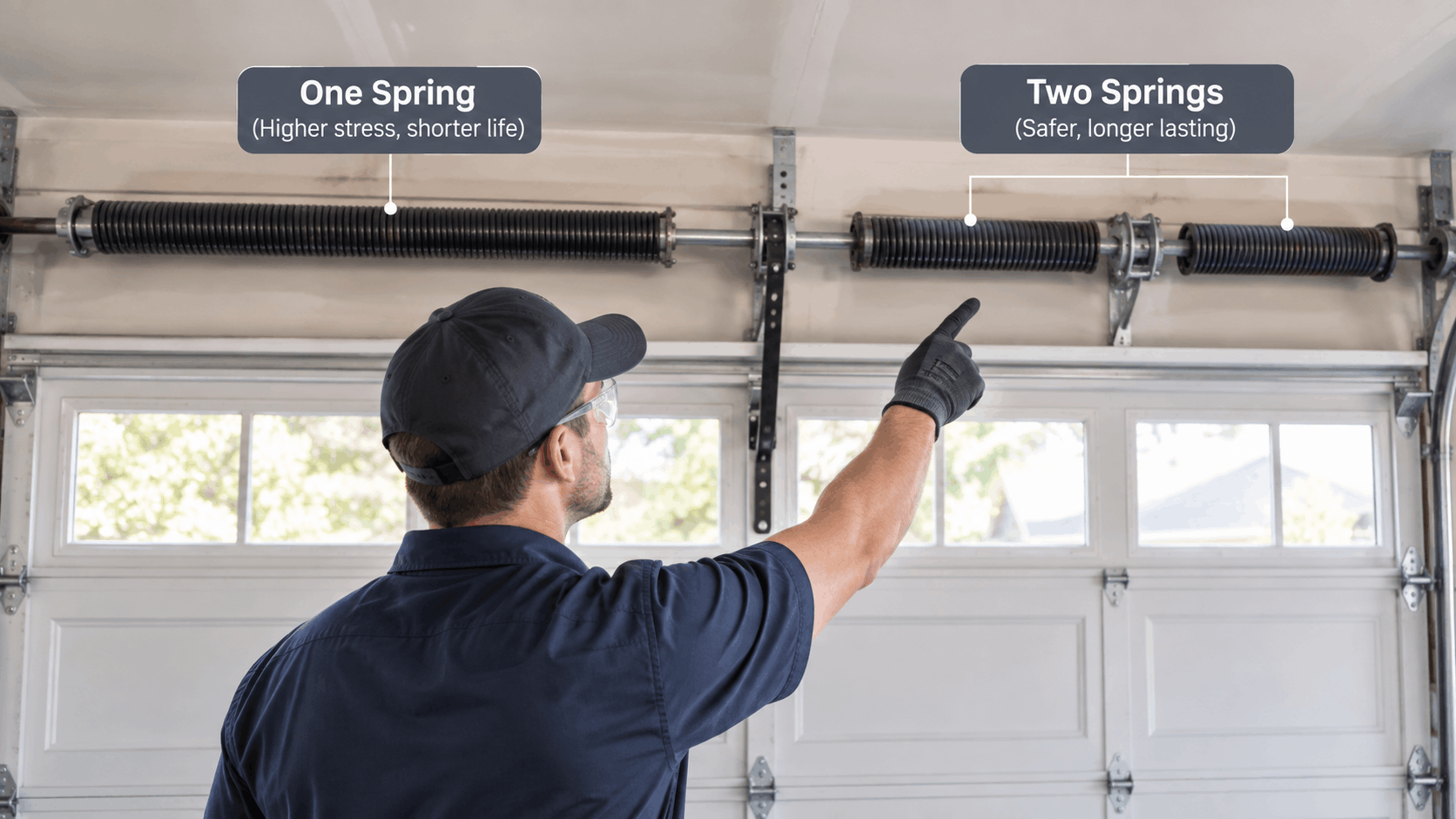
With a dual spring system, each spring carries a share of the tension. Instead of one spring straining against the full door weight, two springs share the job. That load sharing means reduced tension on each individual unit.
Less stress per spring translates directly into less wear. A spring that only fights a share of the load flexes less on each cycle, so the metal fatigues more slowly. This is the mechanical reason two springs tend to last longer than one.
Balanced load also keeps the door moving evenly. When one spring handles everything, the door can pull slightly harder on one side, which stresses the cables and rollers unevenly. Two matched springs pull in balance and keep the whole system aligned.
Our team often recommends two springs during a torsion spring replacement for exactly this reason. Sharing the work extends the life of every part, not just the springs.
What Happens When One of Two Breaks
The safety benefit shows up the moment a spring fails. On a two-spring door, if one breaks, the second spring still provides backup support. The door does not become full dead weight the way it does with a single spring.
That partial support gives you a safety margin. The door may feel heavy and it should still be serviced right away, but it is far less likely to slam down or trap a vehicle. The remaining spring cushions the failure instead of leaving you with nothing.
This matters most when the door is open. A single spring that fails over a parked car or a person creates real danger. With two springs, the surviving spring helps hold the door until help arrives.
We still advise homeowners not to keep using a door with one broken spring, because the good spring is now overloaded. But that backup buys time and lowers the risk of injury and damage compared to a total failure.
Smoother, Quieter Operation
Two balanced springs also make a door run better day to day. Balanced tension reduces wobble, shudder, and the side-to-side pull that makes a door noisy. The result is quiet operation that neighbors appreciate.
In Irvine's planned communities, noise matters. A door that bangs and rattles every morning is the kind of thing that draws comments in HOA-managed neighborhoods. A balanced door glides more smoothly and stays quieter over its life.
Smoother travel also protects the opener. When the door moves evenly, the motor works less and the drive system takes less abuse. Pairing balanced springs with a quiet roller hardware upgrade can make an older door feel almost new.
If your door has grown loud or shaky, a balance issue is often behind it. Our door balancing and tension adjustment service brings the two springs back into sync.
The Longevity Math: Cycles and Lifespan
Springs are rated in cycles, not years, and that is where the longevity math gets interesting. Once you understand cycle ratings, the case for two springs becomes clearer.
What a Cycle Rating Means
A cycle is one full open and one close. Every time the door goes up and comes back down, that counts as a single cycle. Springs are engineered to survive a set number of these before the metal gives out.
Standard springs usually carry a cycle rating between 10,000 and 30,000 cycles. A basic builder spring often sits near the 10,000 cycle mark, while better springs are rated higher. The cycle count is the honest measure of how much life a spring has in it.
That rating is not a promise, but it is a solid planning number. Corrosion, temperature swings, and poor balance can shorten it, while good maintenance can help a spring reach its full rating. Knowing your spring's cycle count tells you roughly what to expect.
When we quote springs, we always talk about cycle ratings rather than just price. A cheaper spring with a low rating is not a better deal if it fails in a few years.
How Many Years That Really Buys
Cycle ratings turn into years once you factor in daily use. Take a busy household that opens the door 4 to 6 times a day. That is roughly 1,500 to 2,200 cycles a year.
On a 10,000 cycle spring, that daily use works out to about 5 to 7 years of service. Bump up to a 20,000 cycle spring and the same household gets closer to 10 to 13 years. The math scales directly with how often the door moves.
Now consider a household that treats the garage as the main entrance. Some families cycle their door 8 to 10 times a day between work, school, and errands. At that rate, a low-cycle spring can wear out in three or four years.
This is why we ask about usage before recommending springs. Two families with identical doors can have very different lifespans based purely on how often they come and go.
Why Two Springs Often Outlast One
Here is where load sharing pays off again. Because each spring in a dual setup only carries a share of the load, the metal fatigue per spring is lower. Slower fatigue means each spring reaches its cycle rating over a longer stretch of time.
A single spring absorbs the full stress on every cycle, so it wears at the maximum rate. Two springs splitting the same work each experience gentler stress, which extends the total service window before either one fails.
There is a practical benefit here too. Even if the springs are rated for the same number of cycles, the reduced per-spring strain in a dual setup tends to deliver more real-world years. The extended life often offsets the higher upfront cost.
That is the heart of the longevity math. Two springs cost more at install but typically buy more years and more even wear across the whole door.
Upgrading to High-Cycle Springs
For heavy users, a high-cycle spring upgrade can be worth every dollar. High-cycle springs are rated for 30,000 cycles or more, sometimes reaching 50,000 or higher. They use more metal and a different winding to survive that much use.
The upgrade pays off fastest for families who cycle the door constantly. If your door moves 8 or more times a day, standard springs may need replacing every few years, while high-cycle springs can last a decade or more. Fewer service calls offset the higher spring price.
High-cycle springs also suit anyone who wants to install a door and forget about it. Owners of custom or expensive doors often choose them so they are not opening the mechanism up every few years. It is a set-it-longer approach.
Our team can walk you through whether high-cycle springs make sense for your household during a spring and cable repair visit. The right choice depends on how hard you use the door.
Need Help in Irvine?
Urgent Garage Doors serves Irvine and all of Orange County.
The Safety Math: Injury and Damage Risk
Beyond cost and lifespan, there is a safety math that every homeowner should weigh. Springs hold enormous force, and the difference between one and two springs affects real injury and property damage risk.
The Danger of Stored Spring Energy
A wound torsion spring holds a startling amount of stored energy. That spring tension is what lets it lift a 200-pound door, and it does not disappear when the spring breaks or when someone starts loosening hardware. It is coiled and ready to release.
This is why DIY spring work is so dangerous. A slipped winding bar or a wrong turn can send metal flying with enough force to break bones or worse. Every year, garage door springs cause serious injuries to homeowners who did not respect that stored force.
The U.S. Consumer Product Safety Commission has long tracked garage door injuries tied to springs and improper repair. The forces involved are simply too high for a homeowner tool kit.
Trained technicians use the right winding bars, clamps, and procedures to control that energy. That training is the difference between a routine repair and a trip to the emergency room.
Falling Doors and Dropped Vehicles
The scariest failures happen when a spring breaks while the door is open. On a single-spring door, a break can let the door drop with almost nothing holding it back. That door drop can crush whatever is beneath it.
Picture a car pulling out with the door raised overhead. If the lone spring lets go at that moment, the door can come down onto the vehicle, causing serious vehicle damage. Worse, if a person or pet is underneath, the consequences can be tragic.
A two-spring door lowers this risk because the surviving spring still holds part of the weight. The door may sag, but it is far less likely to freefall. That backup is one of the strongest safety arguments for a dual setup.
The International Door Association and door safety groups stress regular inspection precisely because these open-door failures are preventable with maintenance and proper spring choice.
Cable and Track Wear From Imbalance
A single strained spring does not just risk sudden failure. It also adds wear to everything around it. When one spring fights the full load, the extra force adds cable wear and grinds on the rollers and tracks.
Cables that carry uneven tension fray sooner and can snap, which brings its own hazards. If you spot fraying strands, our garage door cable repair service should be the next call before the cable fails completely.
Opener strain is another quiet casualty. An unbalanced door forces the motor to work harder on every cycle, shortening its life and leading to burned-out gears. The imbalance turns a spring problem into a whole-system problem.
Balanced two-spring setups spread the forces evenly and protect these supporting parts. Keeping the springs matched keeps the cables, rollers, tracks, and opener living out their full lifespans too.
Local Conditions in Irvine That Affect Your Choice
Spring choice is not just a spec sheet decision. Irvine's climate, neighborhoods, and family routines all shape what setup will serve a door best over time.
Coastal Moisture and Salt Air
Irvine sits close enough to the coast that marine layer moisture drifts inland most mornings. That damp, slightly salty air is hard on bare metal springs. Salt air corrosion pits the steel and eats into the spring surface over time.
Neighborhoods on the higher, more open ground feel this most. Homes around Turtle Rock and Quail Hill often catch that morning marine layer, and we see more rust on springs there than in more sheltered inland pockets. Corroded springs fail earlier than their cycle rating would suggest.
When corrosion is a factor, the durability of a two-spring setup matters even more. Spread load plus quality coated springs buy back some of the life that salt air takes away. Our spring and cable repair team in Turtle Rock sees this pattern regularly.
Regular lubrication also slows corrosion. A light coat on the springs during maintenance keeps moisture from settling into the coils.
Heavy Custom Doors in Established Neighborhoods
Irvine's older, established neighborhoods tend to have bigger and heavier doors. Larger wood doors and heavy insulated doors are common in areas like Northwood and University Park, and that added weight changes the spring math.
An insulated door can weigh far more than a builder-grade single-layer panel. Once a door crosses into that heavier range, two springs are almost always required to carry the load safely. A single spring on a heavy custom door is a failure waiting to happen.
Homeowners upgrading to a heavier door should plan for the spring change at the same time. If you are considering an insulated steel garage door, the added weight is a strong reason to spec two springs from the start.
Matching springs to a heavy door is exactly the kind of measurement our technicians handle on every install. Guessing at spring size on a 250-pound door is not something anyone should risk.
Daily Use in Family-Heavy Communities
Some Irvine communities cycle their doors far more than average. Family-heavy neighborhoods near Woodbridge and along Jeffrey Road see the garage used as the main door in and out of the house. That high usage adds up fast.
When a door opens 8 or more times a day, low-cycle single springs wear out quickly. Durable two-spring setups, and often high-cycle springs, make far more sense for these busy households. The extra investment pays back in fewer failures.
We have replaced many springs for families in these areas who were surprised how short their builder springs lasted. The culprit is almost always heavy daily cycling on undersized springs. Our Woodbridge spring and cable repair visits often end with an upgrade recommendation.
Matching the spring count and cycle rating to real usage is the difference between a door that lasts and one that keeps failing.
HOA Appearance and Noise Rules
Many Irvine communities are governed by HOAs with expectations around appearance and noise. A door that rattles, sags, or looks neglected can draw an HOA notice. Balanced springs help a door meet those standards.
HOA rules in planned communities often push for well-maintained, quiet-operating doors. A balanced two-spring door runs smoothly and stays quieter, which keeps both neighbors and the HOA happy. It is a practical reason beyond pure mechanics.
Quiet operation also comes from good balance more than from a fancy opener. When the two springs share load evenly, the door glides instead of jerking. Pairing that with routine service keeps the door looking and sounding its best.
Our maintenance and upgrade visits keep HOA-community doors quiet, balanced, and free of the wear that draws complaints.
Need Help in Irvine?
Urgent Garage Doors serves Irvine and all of Orange County.
Making the Right Choice for Your Home
Choosing one spring or two comes down to your specific door, your usage, and your budget. Here is the framework our team uses to guide Irvine homeowners toward the right call.
Weighing and Measuring the Door First
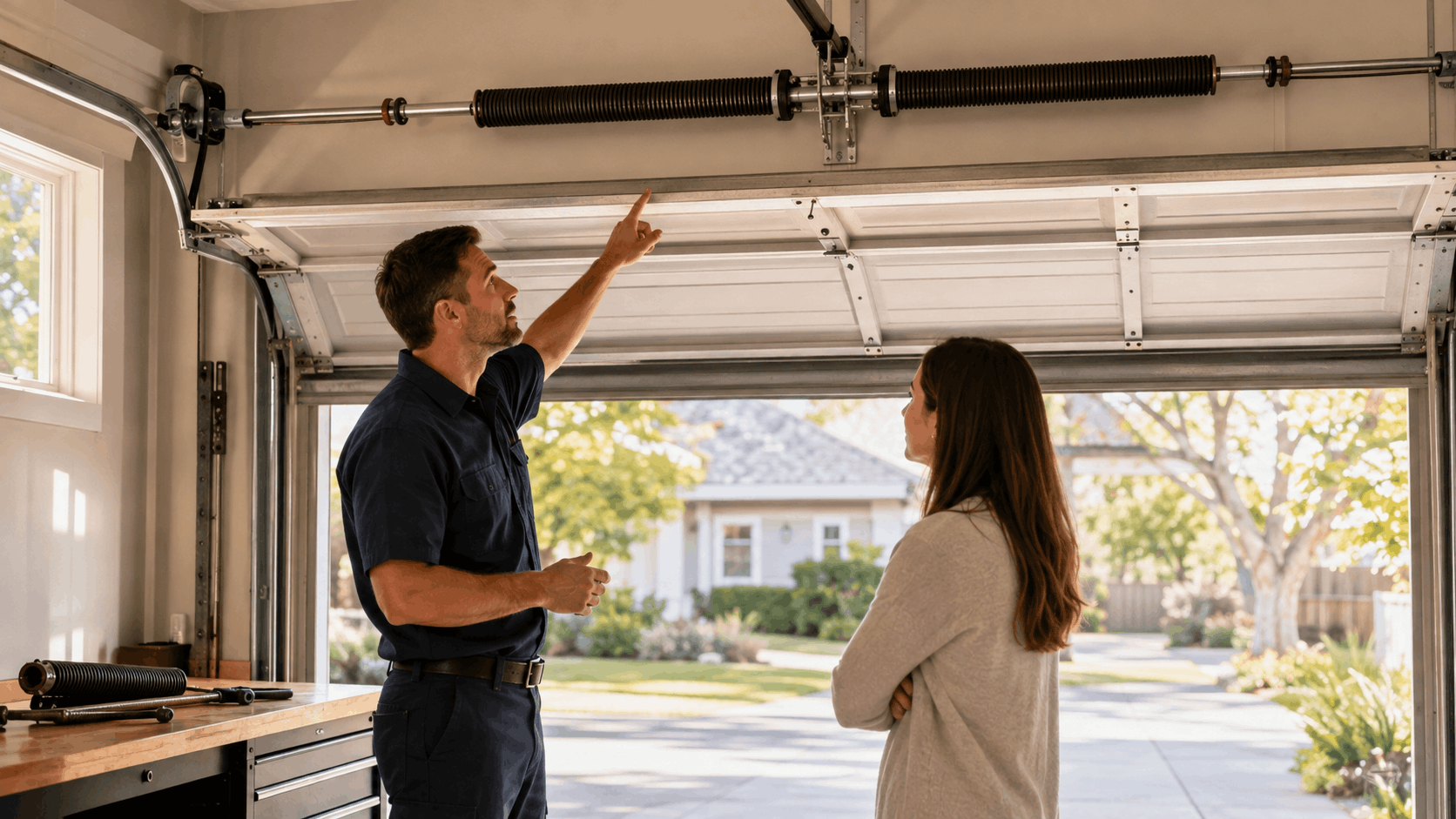
Every proper spring recommendation starts with measurement, not guesswork. Our technician weighs the door with a scale to get its true door weight. That number is the foundation of correct spring sizing.
Weight alone is not enough, though. We also measure the drum size, the shaft length, and the door height, because those figures determine the right spring wire size, inside diameter, and length. Skipping these measurements is how mismatched springs end up on doors.
Getting spring sizing right the first time prevents a cascade of problems. An undersized spring wears out early, and an oversized one strains the opener and hardware. Precise numbers keep the whole system in balance.
This measurement step is standard on every spring replacement we perform. It is quick, and it makes the difference between a door that lasts and one that fails early.
Matching Springs to Your Usage
After measuring the door, we talk about how you use it. A usage assessment tells us whether standard springs will serve you or whether a higher cycle rating makes sense. This is where the count and rating decision gets personal.
A retiree who opens the door twice a day has very different needs than a family cycling it ten times daily. For light use, a standard two-spring setup may last well past a decade. For heavy use, high-cycle springs often prevent repeat failures.
We would rather ask these questions up front than have you call us back in three years. Matching springs to real habits is the most reliable way to get the lifespan you expect. It costs nothing to plan correctly.
This honest conversation is part of every professional assessment our team provides. The goal is the right spring for your life, not the most expensive one on the shelf.
Why Replacing Both Springs at Once Makes Sense
When one spring in a pair breaks, we almost always recommend replacing both. The springs were installed together and have cycled the same number of times, so the surviving spring is close to failing too. Replacing both keeps them a matched pair.
Mixing a brand new spring with a worn one creates uneven tension. The old spring cannot match the new one's strength, which throws the door out of balance and stresses both. That mismatch defeats the purpose of a dual setup.
There is also a simple cost logic. Replacing both springs during one visit avoids a second callout when the old spring fails a few months later. You pay one trip charge instead of two.
Replacing both springs together is the standard we follow because it keeps the door balanced and saves you money over time. It is the choice we would make on our own homes.
How Our Irvine Team Handles Repairs
When you call Urgent Garage Doors, we move quickly. Broken springs are one of the more common reasons Irvine homeowners need us, and we keep quality springs stocked for fast turnaround. In many cases we offer same-day service across Irvine.
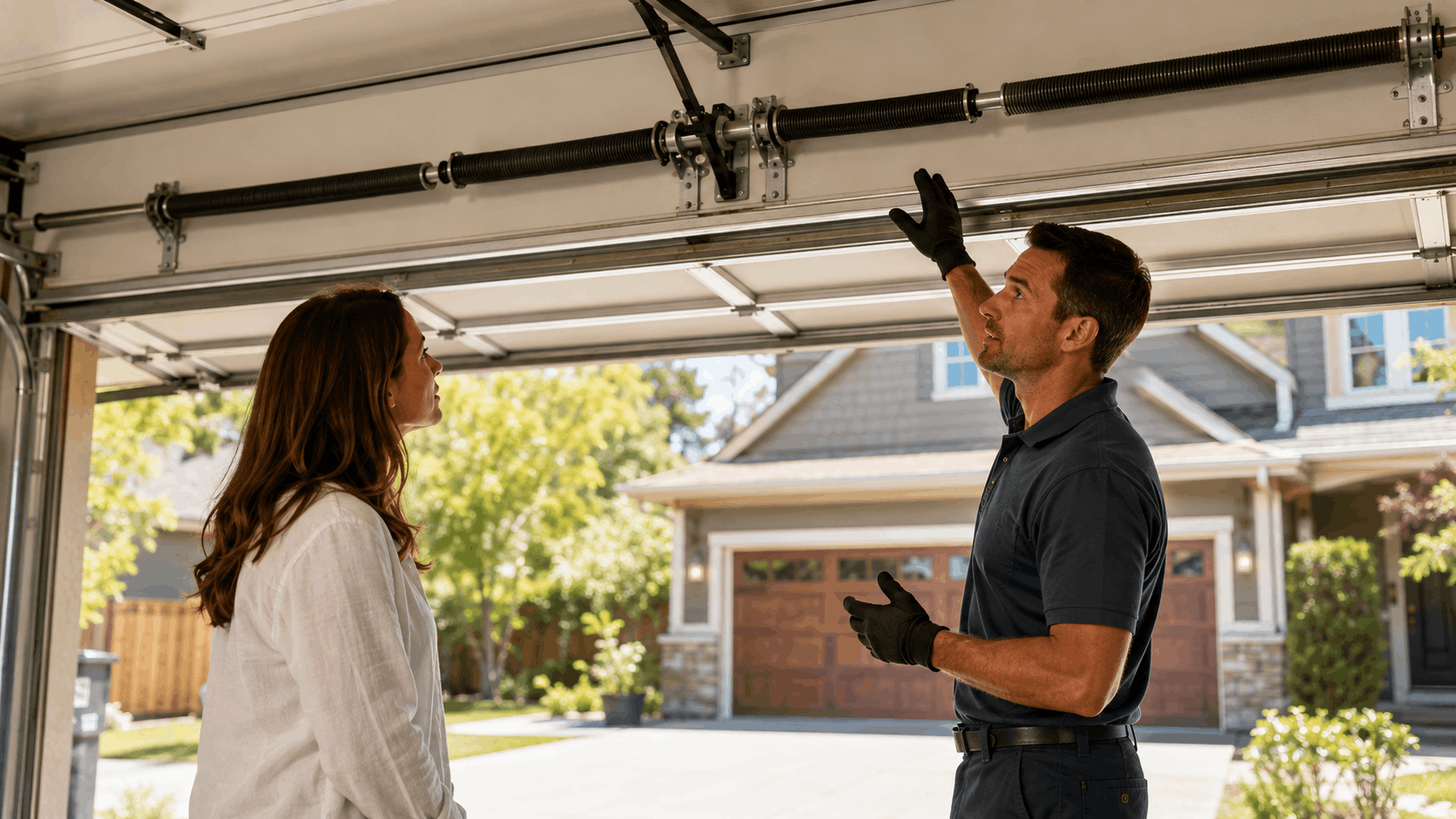
Our process starts with a full inspection of the door, springs, cables, and opener. We identify the failure, measure the door, and recommend the right spring count and cycle rating for your situation. No upsells, just the honest fix.
After the repair, we test the balance by hand and cycle the door to confirm smooth, quiet operation. We check the cables and rollers while we are there so a small issue does not become the next emergency. You can reach our team through our contact page any time.
We serve every corner of the city, from Portola Springs to Woodbridge to Turtle Rock. Our Irvine service area covers the full range of neighborhoods and door types you will find here.
Final Thoughts
For most double doors in Irvine, two springs is the setup that adds up. It splits the load, lasts longer, runs quieter, and gives you a safety cushion when one spring wears out. A single spring can work on a genuinely light door, but the single point of failure risk is real.
The math on cost, cycles, and safety usually points the same direction. Two matched springs cost a little more up front and buy more years, fewer emergencies, and a safer door for your family.
If your spring has broken or you are not sure whether your door is set up right, our team is ready to help. Call Urgent Garage Doors for a professional assessment and same-day spring replacement across Irvine. We will measure the door, explain your options, and get you back to your routine safely.
Frequently Asked Questions
- Is one spring enough for a double garage door?
- One spring can work on a lighter single-layer door that falls within the manufacturer weight spec. For most double doors, though, two springs are the safer standard. A single spring is a single point of failure, so when it breaks the door becomes dead weight with no backup. Two springs share the load, last longer, and keep the door partly supported if one fails.
- How much does it cost to replace one spring versus two?
- Pricing varies by spring size and cycle rating, but replacing a single spring costs less up front than a pair. That said, replacing both together is often more cost effective long term. When one spring in a pair breaks, the other is close behind, so doing both in one visit avoids a second trip charge and keeps tension matched. We provide clear quotes before any work begins.
- If one of my two springs breaks, do I need to replace both?
- We strongly recommend it. Both springs cycled the same number of times, so the surviving spring is near the end of its life too. Pairing a new spring with a worn one creates uneven tension, throws the door out of balance, and stresses both units. Replacing both as a matched pair keeps the door balanced and prevents a second failure just months later.
- How long do garage door springs last in Irvine?
- Springs are rated in cycles, typically 10,000 to 30,000. A household opening the door 4 to 6 times a day gets roughly 5 to 13 years depending on the rating. Irvine's coastal moisture and salt air can shorten that, especially in higher areas like Turtle Rock and Quail Hill where the marine layer settles. Regular lubrication and balanced two-spring setups help springs reach their full rated life.
- Can I open my double door if a spring breaks?
- You should not force it. With a broken spring, the counterbalance is gone and the door carries its full weight, often 150 to 250 pounds. Trying to muscle it open risks serious injury and can damage cables, tracks, and the opener. If the door is stuck, leave it and call for professional emergency repair rather than fighting the unsupported weight by hand.
- Is it safe to replace a garage door spring myself?
- We advise against it. Torsion springs hold intense stored tension even after they break, and a slip during removal or winding can launch metal with bone-breaking force. Homeowner spring injuries are common and severe. Trained technicians use proper winding bars, clamps, and procedures to control that energy safely. Spring work is one repair where hiring a professional is worth every dollar.
- What are high-cycle springs and are they worth it?
- High-cycle springs are rated for 30,000 cycles or more, sometimes 50,000 plus, using more metal and heavier winding. They cost more up front but last far longer. For busy households cycling the door 8 or more times a day, they prevent repeat failures and pay off through fewer service calls. For light users, standard springs are usually enough.
- How do I know if my spring is worn out before it breaks?
- Watch for warning signs. A door that suddenly feels heavy, opens slowly, or jerks as it moves often points to a tired spring. Visible gaps in the spring coil, rust, or a spring that looks stretched are red flags. If the door will not stay put when raised halfway by hand, the balance is off. Call for an inspection before it snaps.
- Do heavier insulated doors always need two springs?
- Weight is what drives the decision, not insulation by itself. Most insulated doors are heavier, so they usually need two springs, but the deciding factor is the actual measured door weight against the manufacturer spec. A heavy wood door without insulation still needs two springs. Our technicians weigh the door to confirm the right spring count rather than assuming.
- How fast can Urgent Garage Doors replace a broken spring in Irvine?
- In most cases we offer same-day service across Irvine, from Portola Springs and Woodbridge to Turtle Rock and University Park. We keep quality springs stocked so we can measure, size, and replace in a single visit. Broken springs are among a common calls, so our team is set up for fast response. Call us and we will get your door working safely again.
Licensed garage door repair professionals serving Irvine and Orange County.
Licensed in California · License #1055150
Why trust Urgent Garage Doors?
Founded in 2017, Urgent Garage Doors is a licensed and insured garage door services serving Irvine and Orange County. All content is reviewed by our licensed technicians.

Need Help in Irvine?
Urgent Garage Doors serves Irvine and all of Orange County.
Related Articles
California Garage Door Spring Replacement Law: Why DIY Is Often Illegal
California law lets you fix your own garage door spring but not pay an unlicensed worker. Learn the CSLB rules, spring dangers, Irvine permits, and how to hire right.
Garage Door Spring Replacement Cost Irvine: Single vs Double Torsion Pricing
Compare single vs double torsion spring replacement costs in Irvine, from honest price ranges to warning signs, DIY dangers, and how to spot a fair quote.
Why Springs Are Matched to Your Exact Door Weight - The Danger of the Wrong Replacement
Garage door springs must match your exact door weight down to the wire size. Learn the real dangers of the wrong replacement and how Irvine homeowners can stay safe.