Same-Day Repair in Anaheim Colony and Historic Anaheim: Older Framing and One-Piece Door Surprises
Key Takeaways
- Homes in the Anaheim Colony Historic District date from the early 1900s to the 1950s and often keep original doors, framing, and hardware.
- One-piece tilt-up doors use side-mounted springs and pivot hinges that behave very differently than modern torsion-spring sectional doors.
- Decades of foundation settling near streets like North Claudina and West Cypress can pull openings out of square and cause doors to bind.
- Rotted jambs, termite damage, weak headers, and painted-over hardware are common surprises found once an old door is opened for repair.
- Most repairs finish same day, but discontinued parts, custom-size doors, and framing work may require a follow-up visit.
- Old springs, cables, and openers without auto-reverse pose real injury risks, so DIY fixes on aging systems often backfire.
- Modern carriage house doors can mimic the historic look while adding safety, though historic district guidelines should be checked first.
- Yearly professional tune-ups plus simple seasonal checks and lubrication keep older Anaheim garage doors working for decades.
In This Article
It is 7:45 on a Tuesday morning in Anaheim Colony. A homeowner on North Claudina Street backs the car up, hits the wall switch, and the old garage door groans up a foot before it jams sideways. The kids need to get to school, work starts in twenty minutes, and that heavy wooden slab is stuck at an angle it has never stuck at before.
This scene plays out more often than people think in the historic core of Anaheim. The homes here are beautiful and full of character, but many still carry the same doors, springs, and framing they had decades ago. That mix of age and originality creates problems newer homes in Irvine or east Anaheim rarely see.
Why Older Anaheim Homes Have Different Garage Door Problems
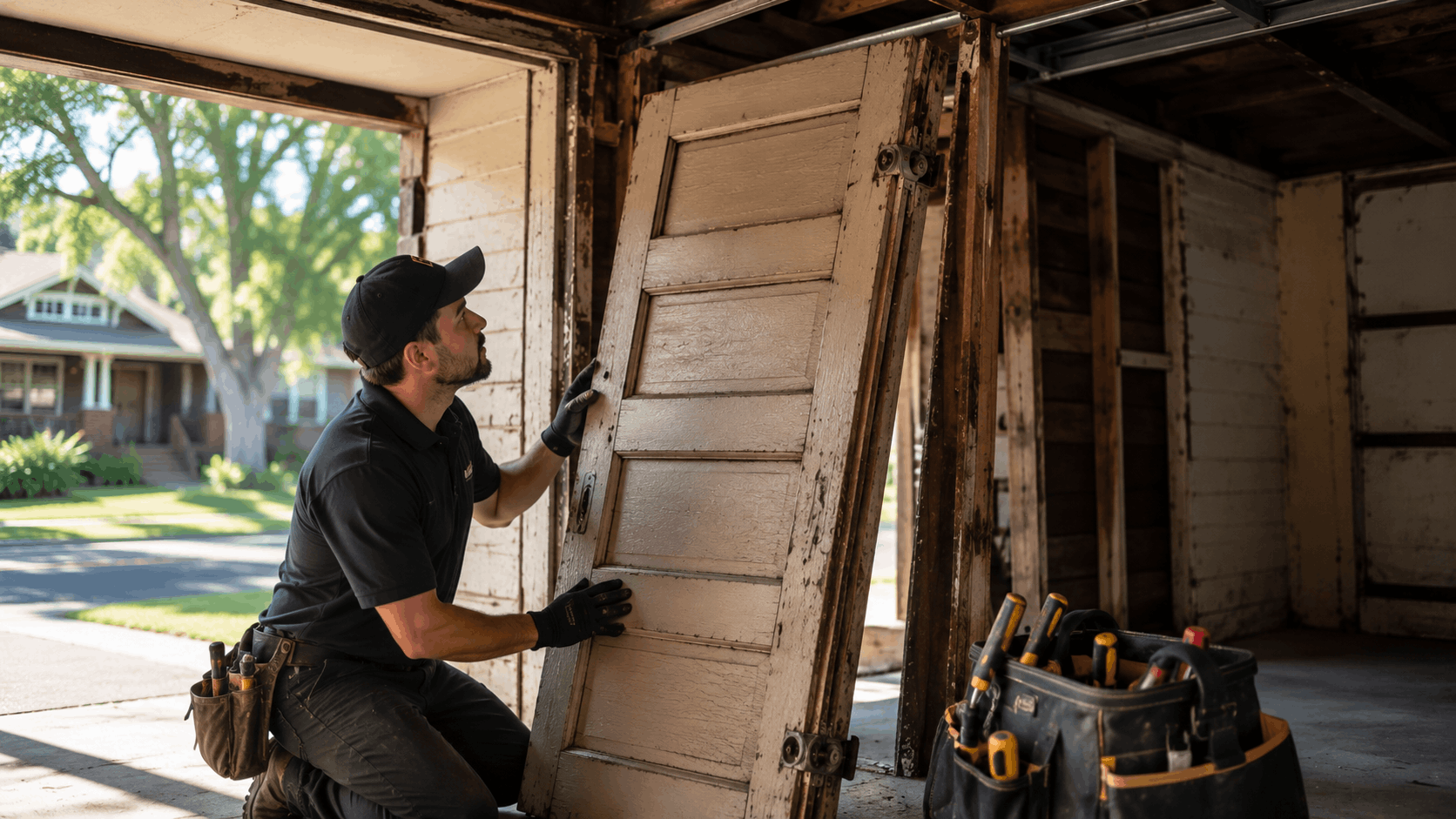
The homes in Anaheim Colony and the surrounding historic district were built in a different era with different rules. Many still run on original framing, original doors, and hardware that has been repainted a dozen times. That means garage door repair Anaheim homeowners need here looks nothing like a standard job on a 2005 tract home.
Historic Anaheim garage doors often combine wood, hand-set hardware, and openings that were framed by hand. Older home framing shifts, dries out, and sometimes hides rot behind the trim. Before any repair starts, the whole structure deserves a careful look.
| Home Feature | Newer Anaheim/Irvine Homes | Anaheim Colony Historic Homes |
|---|---|---|
| Typical build year | 1980s to present | Early 1900s to 1950s |
| Common door type | Sectional roll-up | One-piece tilt-up or original wood |
| Framing | Standard dimensional lumber | Old-growth wood, non-standard sizes |
| Opening size | Standard 8 or 16 foot | Often narrow or custom width |
| Spring system | Torsion above the door | Side-mounted extension springs |
The Building Era Behind Anaheim Colony Homes
The Anaheim Colony Historic District holds one of the largest collections of older homes in Orange County. Many date from the early 1900s through the 1950s, with a strong showing of 1900s bungalows, Craftsman cottages, and postwar builds. Each era brought its own construction habits.
Old garage construction from those years rarely followed the standards we take for granted today. Builders framed openings to fit the lot and the door on hand, not to a catalog size. Wood was heavier and denser, but it was also left exposed to decades of weather.
That history matters the moment a repair begins. A door hung in 1928 may sit on framing that has never been touched since. When we approach these homes, we treat them like the pieces of local history they are, not like a quick swap job.
Homeowners in nearby cities like Orange Park Acres and Old Town Tustin face similar older-home puzzles, so the approach carries across the county's historic pockets.
How Decades of Settling Affect Door Alignment
Ground under these old streets has moved for a hundred years. Foundation settling is normal near streets like North Claudina and West Cypress, where mature trees and old soil shift with each wet and dry season. Over time, that movement pulls a garage opening out of square.
An out of square opening throws everything off. A door that used to close flush now catches on one side or leaves a gap at the bottom corner. Track alignment suffers because the tracks were set to a frame that is no longer straight.
We see this constantly in the historic core. A homeowner thinks the door is broken when the real issue is the opening itself has drifted a half inch over the years. Fixing the symptom without checking the frame leads to the same jam a month later.
Correcting alignment on these doors takes patience and measurement, not force. When the framing has moved, we adjust the hardware to the new reality or reinforce the opening so the door tracks true again.
Detached Garages and Narrow Driveways
Much of the historic district was built before two-car attached garages were the norm. Detached garages sit at the back of the lot, reached by a long, narrow driveway that barely fits a modern SUV. That layout changes what repair equipment can even reach the door.
Historic Anaheim garages often have tight side clearances and low headroom inside. A big roll-up door with a standard opener may not physically fit where a one-piece tilt-up once swung. We measure the space carefully before recommending any replacement.
The narrow driveway also affects how we work. Long extension ladders, full-size door panels, and heavy tools have to be walked back by hand rather than rolled off a truck at the curb. We plan for that on every historic-district call so the visit runs smoothly.
Get Your Free Quote
Tell us about your garage door and we'll get back to you within 30 to 60 minutes.
One-Piece Doors: What They Are and Why They Surprise Homeowners
Plenty of homeowners in Anaheim Colony have never heard the term one-piece garage door until we say it. They just know their door swings out as one big slab instead of rolling up in sections. Recognizing what you have makes the repair conversation far easier.
The one-piece tilt-up door was standard for decades before the sectional door took over. The sectional door difference is easy to see once you know what to look for. Knowing your door type helps our team bring the right parts on the first trip.
How to Tell a One-Piece Door From a Sectional
The simplest test is watching how the door moves. A one-piece vs sectional check comes down to one question: does the whole door tilt out and up as a single slab, or does it bend and fold into panels? If the bottom of the door swings out toward you as it lifts, you have a tilt-up.
Tilt-up identification also shows in the tracks. A swing-up door usually rides on short tracks near the top of the garage, while a sectional door runs on long curved tracks that bend from vertical to horizontal along the ceiling. Look up at the ceiling inside the garage to spot the difference.
The face of the door offers another clue. One-piece doors are typically a single flat or paneled surface with no horizontal seams, since there are no separate panels. Sectionals show clear horizontal joints between each section.
Once you know which type you have, repair planning gets much simpler. If you are unsure, a quick photo sent to our team clears it up before anyone drives out.
Jamb Hardware and Spring Systems on Older Doors
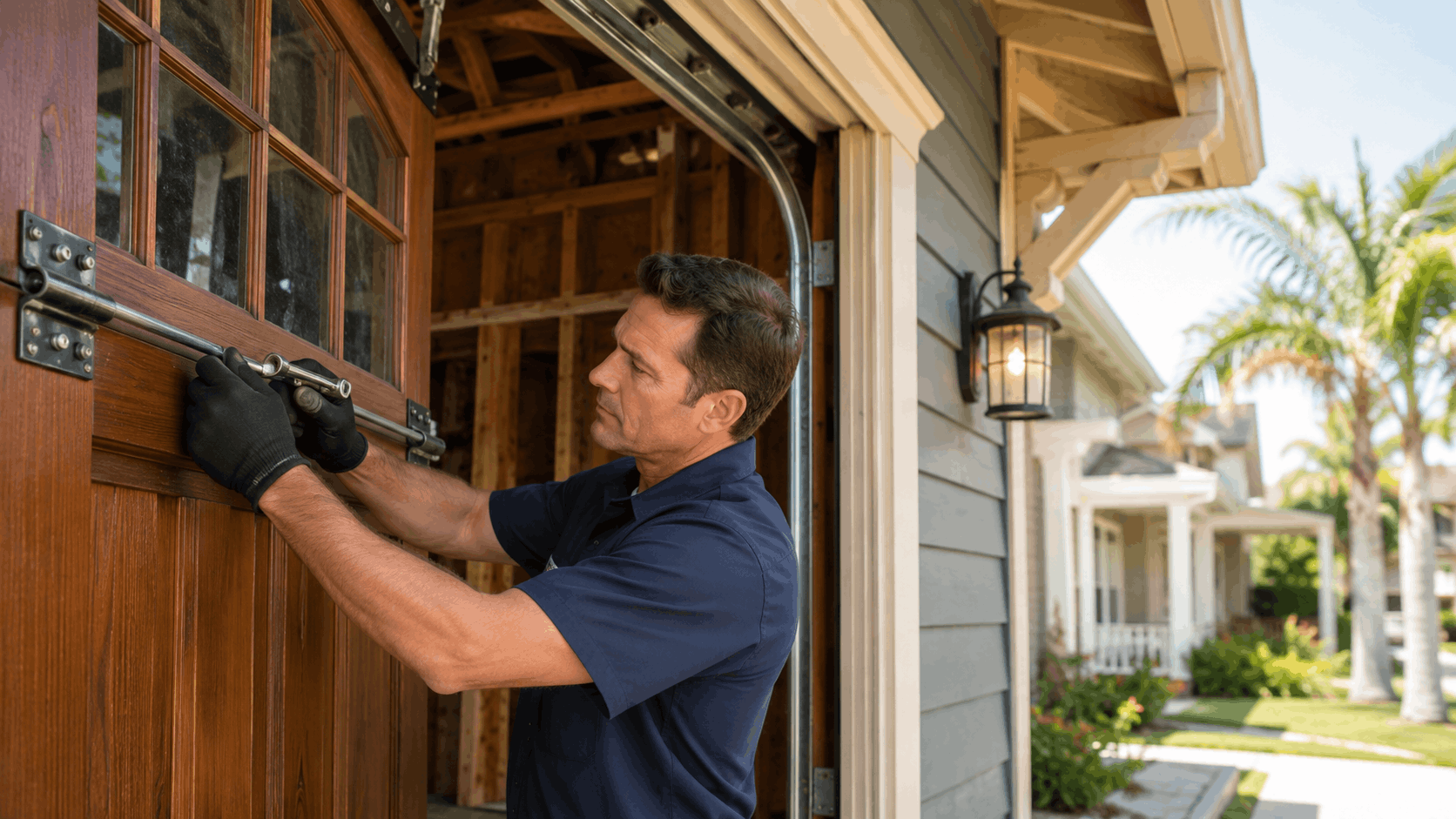
One-piece doors carry their weight differently than modern doors. Instead of a torsion spring above the opening, they use side springs mounted along the jambs. This jamb hardware pivots the door out and up as it opens.
The side spring and pivot hinge system relies on tension arms and pivot points on each side of the door. When one of these springs weakens or breaks, the door becomes dangerously heavy and lopsided. It is a very different setup from the torsion spring systems on newer sectional doors.
Because the hardware sits at the sides, adjustments must be balanced left to right. A pivot hinge that is worn or bent on one side will make the door rack and bind halfway. Our team checks both sides together rather than fixing just the one that failed.
These systems can absolutely be repaired, but they demand experience. Working on a side spring under tension without the right tools is how people get hurt, which is why we handle the spring work ourselves.
Why Parts for One-Piece Doors Are Harder to Find
Many original one-piece door parts are discontinued. The companies that made them are often long gone, and big-box stores do not stock vintage garage door parts. That reality catches homeowners off guard when a simple-looking bracket cannot just be bought off a shelf.
Hardware sourcing for these doors is a craft of its own. Our team keeps relationships with suppliers who carry legacy parts and universal hardware that can be adapted to older mounting points. Sometimes we fabricate or modify a bracket to fit the original holes.
When an exact match does not exist, adaptation is the answer. A modern spring or pivot arm can often be fitted to an old door with careful measurement and the right anchor points. The goal is to keep the original door working without changing its historic look.
This is where local experience pays off. A crew that only handles new tract-home doors may tell a homeowner the door is unfixable, when in truth it just needs the right sourced part.
Need Help in Irvine?
Urgent Garage Doors serves Irvine and all of Orange County.
Common Framing Surprises Behind Old Garage Doors
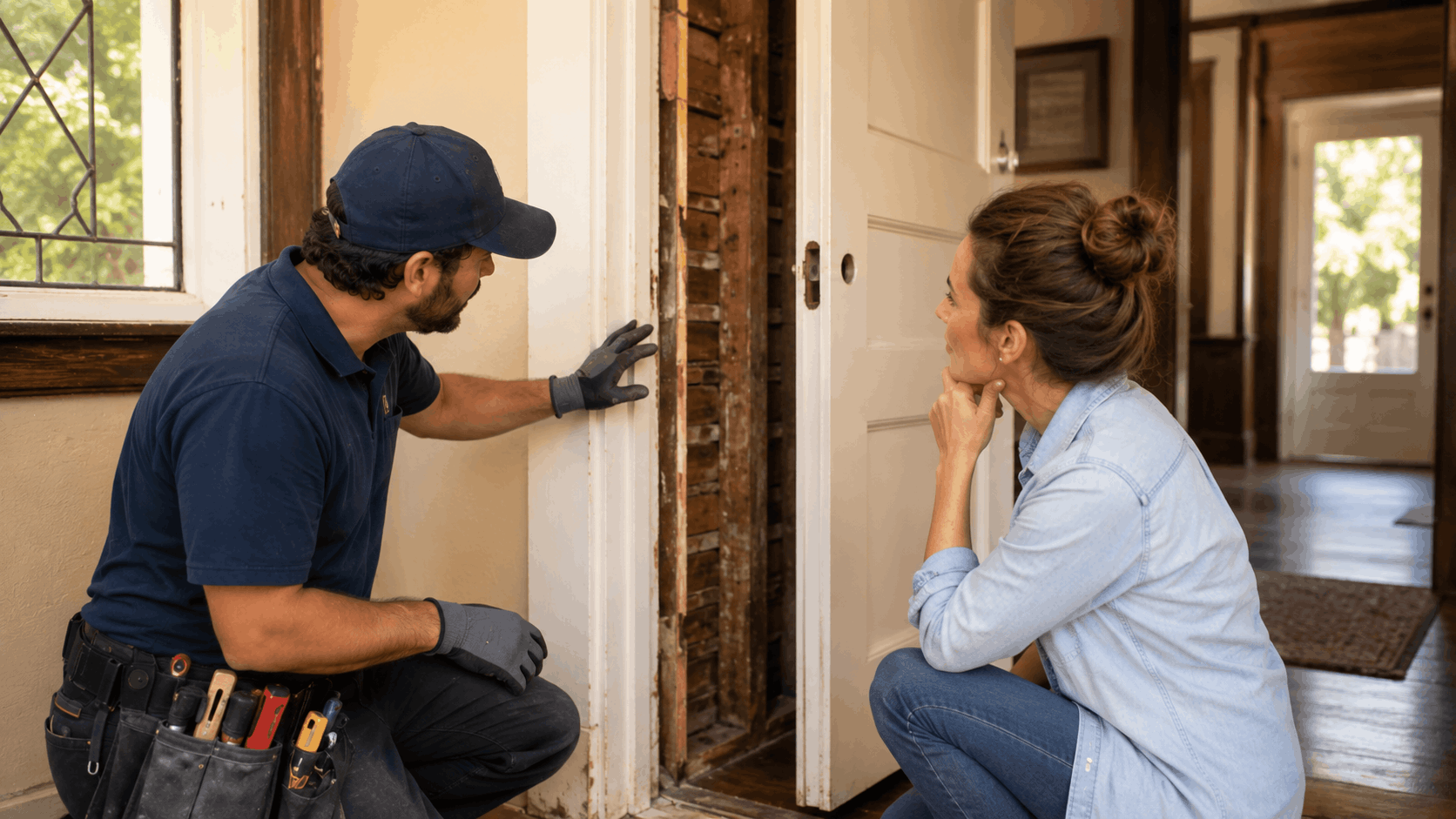
The door is only part of the story. Once we pull hardware away for a repair, the garage door framing behind it often tells a longer tale. Homeowners deserve to know what a technician might uncover so there are no shocks mid-job.
Old wood frame repair is common in the historic district because the framing has stood for eighty or ninety years. A rotted jamb or a split header can turn a quick fix into a slightly bigger project. Knowing the possibilities ahead of time keeps expectations grounded.
Rotted or Termite-Damaged Wood Jambs
Wood jambs take the brunt of moisture and pests over the decades. Termite damage is widespread across older Anaheim neighborhoods, and a jamb that looks fine under paint can be hollow underneath. Rotted jamb wood cannot hold hardware securely.
The problem shows up when a bracket or hinge is anchored into a jamb that crumbles. Screws spin freely instead of biting. That means the door was never as securely mounted as it looked, which is a safety issue on a heavy one-piece slab.
When we find soft or damaged wood frame material, we point it out right away. Sometimes a small section can be cut out and replaced with new lumber the same day. Larger rot may need more material and a return visit.
Catching this early protects the whole repair. There is no point bolting new hardware to wood that will fail again in a season.
Undersized or Non-Standard Openings
Old garage dimensions rarely match today's standard door sizes. A non-standard opening might measure a few inches off in width or height from any stock door. That matters most when a homeowner wants to replace the door entirely.
A custom door size may be required to fit correctly. This affects both the quote and the timeline, since custom doors are ordered rather than pulled from inventory. We always measure the true opening before promising anything.
Sometimes an opening was widened or narrowed by a previous owner in a way that complicates the fit. We look for those past changes because they explain why a standard door will not seat properly. Honest measurement upfront saves everyone the headache of a wrong-size door showing up.
For homeowners set on a modern replacement, a sectional door replacement can still work with the right prep and measurements. The trick is matching the door to the real opening, not the assumed one.
Old Header Beams and Weak Mounting Points
The header beam above the opening carries a lot of load. On homes from the 1920s and 1930s, that beam may be original and starting to split or sag. A weak header makes for weak opener mounting points.
Modern openers pull hard on the header when the door starts and stops. Hanging a new opener on aging, split framing without reinforcement invites failure and even injury. We inspect the header before mounting anything to it.
Reinforcement is often the answer. Adding a solid mounting board or sistering a new beam alongside the old one gives the opener a safe anchor. It is a small extra step that prevents a dangerous pull-out later.
If a homeowner wants a new opener installed on a historic garage, we treat the framing check as part of the job, not an afterthought.
Layers of Paint and Sealed Hardware
Historic homes get repainted every few years, and garages get the same treatment. Decades of paint build up over bolts, hinges, and brackets. Painted-over hardware turns simple removal into slow, careful work.
Seized bolts are a common delay we hit. A bolt buried under six coats of paint may need cutting or heating before it turns. That adds time to any repair, and we account for it in our estimate.
Historic home paint can also hide the true condition of the metal underneath. Rust and corrosion sit under that painted shell until the hardware is worked free. We plan for the extra minutes rather than rushing and breaking a fitting.
None of this is a dealbreaker. It just means an honest repair on a painted historic door takes a little longer than a bare-metal modern one.
How Same-Day Repair Actually Works in the Historic District
Same-day garage door repair is very doable in Anaheim Colony, and most calls we take from the historic core get handled the same day. The process runs from the first phone call to a working door, and we like to set realistic expectations along the way.
An emergency garage door left stuck open is a security worry, so speed matters. Our Anaheim Colony repair calls follow a simple flow that respects both the urgency and the age of these homes.
| Step | What Happens | Typical Timing |
|---|---|---|
| Phone call | Describe the door, share photos if possible | 5 to 10 minutes |
| Dispatch | Tech assigned with likely parts loaded | Same morning or afternoon |
| Arrival | Drive from Irvine via 5 or 57 freeway | 35 to 55 minutes |
| Diagnosis | Inspect door, springs, and framing | 15 minutes to half an hour |
| Repair | Most one-piece and spring fixes finish on site | 1 to 3 hours |
Driving Routes From Irvine to Anaheim
Our team is based in Irvine, and the drive from Irvine to Anaheim is a familiar one. We usually take the 5 freeway north or the 57 depending on traffic, then cut over toward Anaheim Boulevard to reach the historic core. Side routes near Lincoln Avenue help when the freeways bog down.
Arrival time on a typical day runs 35 to 55 minutes from our base. Morning rush and afternoon backups on the 5 can stretch that, so we give an honest window when we dispatch. We would rather quote a real time than a hopeful one.
Our service area covers the historic district and the surrounding Anaheim neighborhoods without any trouble. We keep a tech routing through north county most days, which shortens the wait for Anaheim Colony calls.
Homeowners near Fullerton and other north-county spots share these same corridors, so our routing already covers them well.
What the Team Carries for Older Doors
A stocked truck is the difference between a one-visit fix and a return trip. For one-piece and older doors, our vehicles carry side springs, pivot arms, universal brackets, cables, rollers, and assorted vintage-compatible hardware. We also keep lumber and mounting boards for quick framing patches.
The repair parts we load depend on the phone description. If a homeowner reports a broken side spring on a tilt-up door, we bring extension spring options and pivot hardware to match. Good questions on the call mean the right parts arrive with the tech.
Beyond parts, we carry the tools that historic doors demand. Bolt cutters, penetrating oil, and heat for seized painted hardware ride along on every historic-district call. That prep is what lets us finish so many jobs in one visit.
When a common repair like a spring replacement is needed, having the part on the truck saves the homeowner a second day of a broken door.
When a Repair Can and Cannot Finish the Same Day
Most repairs finish the same day. Broken springs, frayed cables, off-track doors, and worn rollers on a one-piece door are usually done in one visit. A same-day repair is the norm for these calls.
Some jobs hit same-day limits, though, and honesty matters here. A discontinued part that must be tracked down through a supplier may push into special order parts territory. A door on badly rotted framing may need a framing repair timeline of a day or two while new lumber cures or is fitted.
Custom-size replacement doors also cannot finish same day, since they are built to order. In those cases we secure the garage, make it safe, and schedule the follow-up as soon as the parts land. Nobody gets left with a wide-open garage overnight.
We tell homeowners exactly which bucket their job falls into during the diagnosis. That way there are no surprises about what wraps up today and what needs a second visit.
Need Help in Irvine?
Urgent Garage Doors serves Irvine and all of Orange County.
Repair or Replace: Making the Call on an Old Door
The repair vs replace garage door question comes up on nearly every historic-district call. Many owners love their original door and want to keep it, and we respect that. Others are ready for something new that still fits the neighborhood.
There is no single right answer. The decision balances the door's condition, safety, cost, and the historic character of the home. Here is how we help owners weigh it.
| Situation | Lean Toward Repair | Lean Toward Replace |
|---|---|---|
| Door structure | Solid wood, minor wear | Warped, split, or rotted |
| Failure history | First real problem | Repeated breakdowns |
| Framing | Sound or easily patched | Unsafe or failing |
| Historic look | Owner wants original preserved | Modern lookalike acceptable |
When Restoring the Original Door Makes Sense
If the door is structurally sound, restoring it often makes the most sense. A solid wood one-piece door adds real historic character to an Anaheim Colony home, and that character is hard to buy back once it is gone. Owners who value the original aesthetic usually want to keep it.
A door refurbish can address most issues without a full swap. New springs, fresh cables, rebuilt pivot points, and a coat of paint can bring an original door back to smooth operation. The slab itself may have decades of life left.
Restoring also tends to cost less than a custom replacement. When the wood is healthy and only the hardware is tired, restoration is the practical and respectful choice. We are glad to keep a piece of the district's history in service.
The main requirement is honest wood. As long as the door body is not rotted or splitting, restoration is usually on the table.
Signs It Is Time for a New Door
Some doors send clear replacement signs. Repeated failures month after month mean the door is fighting a losing battle. If we are back every few weeks patching the same slab, replacement is the smarter spend.
An unsafe door is another signal. A slab so warped it binds every time, or framing so weak the door cannot mount safely, points toward a new setup. Safety always outranks nostalgia.
Door failure that leaves the garage unsecured is also a factor. If the door will not seal, latch, or close reliably, the home's security suffers. At that point a reliable new door earns its keep.
We lay out the pattern of past repairs so owners can see whether they are throwing good money after bad. The numbers usually make the choice clear.
Matching a New Door to a Historic Home
A new door does not have to look modern. Today's carriage house doors mimic the historic style beautifully while adding modern safety and insulation. From the street, a well-chosen door reads as period-correct.
Curb appeal matters in a district where homes are admired for their looks. A historic style door in the right color and panel pattern keeps the block's character intact. We help owners pick styles that honor the era of their home.
Before ordering, owners should check any historic district guidelines that may apply. Some historic areas have rules on materials or appearance for street-facing features. A quick check with the city avoids trouble later.
The City of Anaheim's historic preservation office can clarify what applies to a given property before a replacement goes in.
Safety Concerns With Aging Garage Door Systems
Garage door safety deserves real attention on old systems. The springs, cables, and openers on these doors store energy and carry weight in ways that can hurt someone who does not know the hazards. Knowing what not to touch is worth a lot.
Old spring danger and outdated openers are the two biggest risks we see in the historic core. A little caution here prevents serious injury.
The Danger of Old Springs and Cables
Springs on any garage door hold enormous force. On a one-piece door, the side springs are under high tension the entire time the door is closed. A frayed cable or a corroded spring can let go suddenly and violently.
Spring tension is what makes these parts dangerous. When an old spring snaps, it releases stored energy in an instant, and anything in the path can be struck. The injury risk is real, which is why spring work is a job for trained hands.
Cables carry the same warning. A frayed cable near failure can whip when it breaks or drop a heavy door without notice. We inspect cables closely on every older door because they hide their wear until the last moment.
Our spring and cable repair team handles this work with the proper tools and technique. It is not a place for guesswork on an eighty-year-old door.
Openers Without Modern Safety Features
Many historic garages still run openers installed decades ago. These older units often lack a photo-eye sensor and auto-reverse, the features that stop a door from closing on a person or pet. Federal safety rules have required these features on new openers since 1993.
An opener without auto-reverse will keep pushing down even if something is under the door. For families with kids or pets, that is a hazard worth removing. An opener upgrade adds these protections and modern convenience at the same time.
Photo-eye sensors mounted near the floor stop the door if the beam is broken. Pairing them with a modern opener brings an old garage up to current safety standards. We can add a safety sensor setup during an opener replacement.
The U.S. Consumer Product Safety Commission has long stressed the importance of these reversing features. Upgrading an old opener is one of the most direct safety wins for a historic home.
DIY Fixes That Often Backfire
DIY garage door work on old systems often goes sideways. Common mistakes include trying to adjust a side spring by hand, forcing a stuck door, or re-seating a cable while the door is under load. These attempts can injure the homeowner or damage the door further.
The trouble is that old hardware behaves unpredictably. A part that looks solid may fail the moment tension shifts. What starts as a small fix can turn into a snapped spring or a door off its pivots.
Knowing when to call a pro saves both money and skin. A quick service call usually costs less than repairing the damage from a DIY attempt gone wrong. We would rather get a call before the improvisation than after.
If a door is stuck, the safest move is to leave it and phone for help. Our emergency repair team can take it from there without anyone getting hurt.
Need Help in Irvine?
Urgent Garage Doors serves Irvine and all of Orange County.
Keeping an Older Anaheim Garage Door Working Longer
Good garage door maintenance stretches the life of an old door by years. Older door care in Anaheim is not complicated, and a little preventive maintenance goes a long way in this climate. A few habits keep these historic doors moving smoothly.
The mild but humid air near the coast quietly works on old metal. Simple attention keeps rust and wear from taking over.
Simple Seasonal Checks Homeowners Can Do
A seasonal check takes only a few minutes and catches problems early. Listen for new noises like grinding, popping, or scraping when the door moves. Fresh sounds usually mean something is wearing or loosening.
A balance test is safe and telling. With the door about halfway open, it should hold its position rather than falling or rising on its own. A door that drifts hard in either direction has a spring or balance problem worth a call.
Track cleaning is another easy win. Wipe leaves, dirt, and cobwebs out of the tracks, since debris in the historic district's older garages can throw a door off. Keep the path clear so rollers move freely.
These checks cost nothing and give an early warning before a small issue becomes a stuck door on a busy morning.
Lubrication and Rust Control in Older Hardware
Older metal hardware needs regular lubrication to keep from seizing. The coastal-influenced humidity around Anaheim encourages rust on springs, hinges, and rollers. A light coat of proper garage door lubricant a couple times a year makes a real difference.
Rust control starts with the right product. Use a silicone or lithium-based garage door lubricant on springs, rollers, and pivot points, not a heavy grease that collects grit. Wipe off excess so dust does not build up.
Pay special attention to the pivot hinges on one-piece doors. These points carry the door's motion and seize first when neglected. A few minutes of hardware care keeps them turning freely for years.
Owners who prefer a hands-off approach can add this to a preventive maintenance plan so it never gets forgotten.
When to Schedule a Professional Tune-Up
Older doors benefit from a professional inspection at least once a year. A tune-up covers the parts a homeowner should not touch, like spring tension, cable condition, and pivot hardware. A trained eye catches wear before it becomes a failure.
Our tune-up includes checking balance, tightening loose hardware, lubricating moving parts, and inspecting the framing behind the door. On a historic one-piece door, that framing check is part of every visit. We flag any rot or weakening early.
A yearly maintenance schedule suits most older doors. Homes with heavy daily use or visible wear may want a check every six months. Regular attention keeps small problems from turning into stuck-door emergencies.
A short maintenance visit costs far less than an emergency repair, and it keeps a historic door serving the home for decades more.
Final Thoughts
Older homes in Anaheim Colony and the historic district come with garage doors that deserve care and respect. One-piece doors, aging framing, settled openings, and painted-over hardware all call for a repair approach built around experience, not shortcuts.
Same-day help is realistic for most repairs here, as long as everyone knows which jobs finish today and which need ordered parts. Our team drives these streets, carries the right hardware, and treats each historic door like the piece of local character it is.
If your old door is stuck, noisy, or overdue for a look, reach out. Call our team or contact us for a consultation, and we will get your historic Anaheim garage door working safely again.
Frequently Asked Questions
- Can a one-piece garage door still be repaired today?
- Yes, most one-piece doors can still be repaired. While many original parts are discontinued, our team sources legacy hardware or adapts universal parts to fit the original mounting points. Springs, cables, and pivot arms are commonly replaceable. Replacement only makes more sense when the wood slab itself is rotted, warped, or split beyond safe use. A quick inspection tells us which path fits your door.
- How fast can a technician reach Anaheim Colony from Irvine?
- From our Irvine base, arrival to Anaheim Colony usually runs 35 to 55 minutes. We take the 5 or 57 freeway north depending on traffic, then cut toward Anaheim Boulevard to reach the historic core. Morning and afternoon rush can stretch that window, so we quote an honest time when we dispatch. Most historic-district calls get handled the same day they come in.
- Why does my old garage door stick or bind halfway?
- Sticking halfway usually points to a few older-home issues. Settled framing can pull the opening out of square, so the door catches partway. Worn pivot hinges or a weak side spring make the door rack to one side. Debris in the tracks and dry, seized hardware add to the bind. On a one-piece door, an uneven spring left to right is a frequent cause we check first.
- Is it safe to keep using a door with a broken spring?
- No, a door with a broken spring should not be operated. The spring carries the door's weight, and without it the door becomes extremely heavy and unbalanced. Trying to open it can strain the opener, snap a cable, or drop the door suddenly. The safest move is to leave it closed and call for repair. Broken springs are one of a common same-day fixes.
- How much does same-day repair on an older door usually cost?
- Costs vary with the job. A spring or cable repair on an older door often falls in a few-hundred-dollar range, while pivot hardware or track work may run higher. Framing surprises like rotted jambs or a weak header can raise the final price since they add labor and materials. We give an honest estimate after diagnosis, so you know the number before work begins.
- Will a modern opener work on my historic garage?
- In most cases, yes. Modern openers can operate older sectional doors well, and one-piece doors can often use a compatible opener with the right hardware. The main concern is the framing. An aging or split header beam may need reinforcement before an opener is mounted safely. We inspect the header first and add a solid mounting board when needed to hold the opener securely.
- Do historic district rules limit what door I can install?
- They can. Some historic areas have guidelines on the appearance of street-facing features, which may include garage doors. Before replacing a door on a home in the Anaheim Colony Historic District, owners should check with the City of Anaheim's historic preservation office. Many modern doors mimic period styles closely enough to satisfy those guidelines while adding safety and insulation.
- What framing problems delay a same-day repair?
- The main delays are rotted wood jambs, termite damage, and a weak or split header beam. If the framing cannot hold hardware safely, we have to repair or reinforce it first. Undersized or non-standard openings can also delay a door replacement, since a custom-size door must be ordered. We secure the garage and schedule the follow-up quickly when framing work is needed.
- Can the team match a new door to my home's original style?
- Yes. Modern carriage house and paneled doors are made to mimic the historic look while adding modern safety features and insulation. We help owners choose a color, panel pattern, and style that fits the character of their Anaheim Colony home. From the street, a well-chosen replacement reads as period-correct. It keeps the curb appeal while operating far more smoothly than the original.
- How often should an older garage door be inspected?
- We recommend a professional inspection at least once a year for older doors. Homes with heavy daily use or visible wear may want a check every six months. A tune-up covers spring tension, cable condition, balance, hardware, and the framing behind the door. Regular attention catches small problems early and keeps a historic door out of emergency-repair territory for years longer.
Licensed garage door repair professionals serving Irvine and Orange County.
Licensed in California · License #1055150
Why trust Urgent Garage Doors?
Founded in 2017, Urgent Garage Doors is a licensed and insured garage door services serving Irvine and Orange County. All content is reviewed by our licensed technicians.

Need Help in Irvine?
Urgent Garage Doors serves Irvine and all of Orange County.
Related Articles
Anaheim Hills Garage Door Repair: Hillside Foundation Settling Issues
Learn how hillside foundation settling causes garage door problems in Anaheim Hills, how to spot the warning signs, and the repair options that actually solve them.

Emergency Garage Door Repair in Irvine Villages: Gate Codes, Association Quiet Hours, and Our Protocol
How Urgent Garage Doors handles emergency garage door repair in Irvine's gated villages, from gate codes and guard lists to HOA quiet hours and our step-by-step repair protocol.
Emergency Garage Door Repair in Newport Coast: Same-Day Service for Pelican Hill and Crystal Cove
A local guide to emergency garage door repair in Newport Coast, covering common failures, same-day service for Pelican Hill and Crystal Cove, costs, and prevention.