The 5 Garage Door Failures That Count as True Emergencies - and the 5 That Can Wait for Morning
Key Takeaways
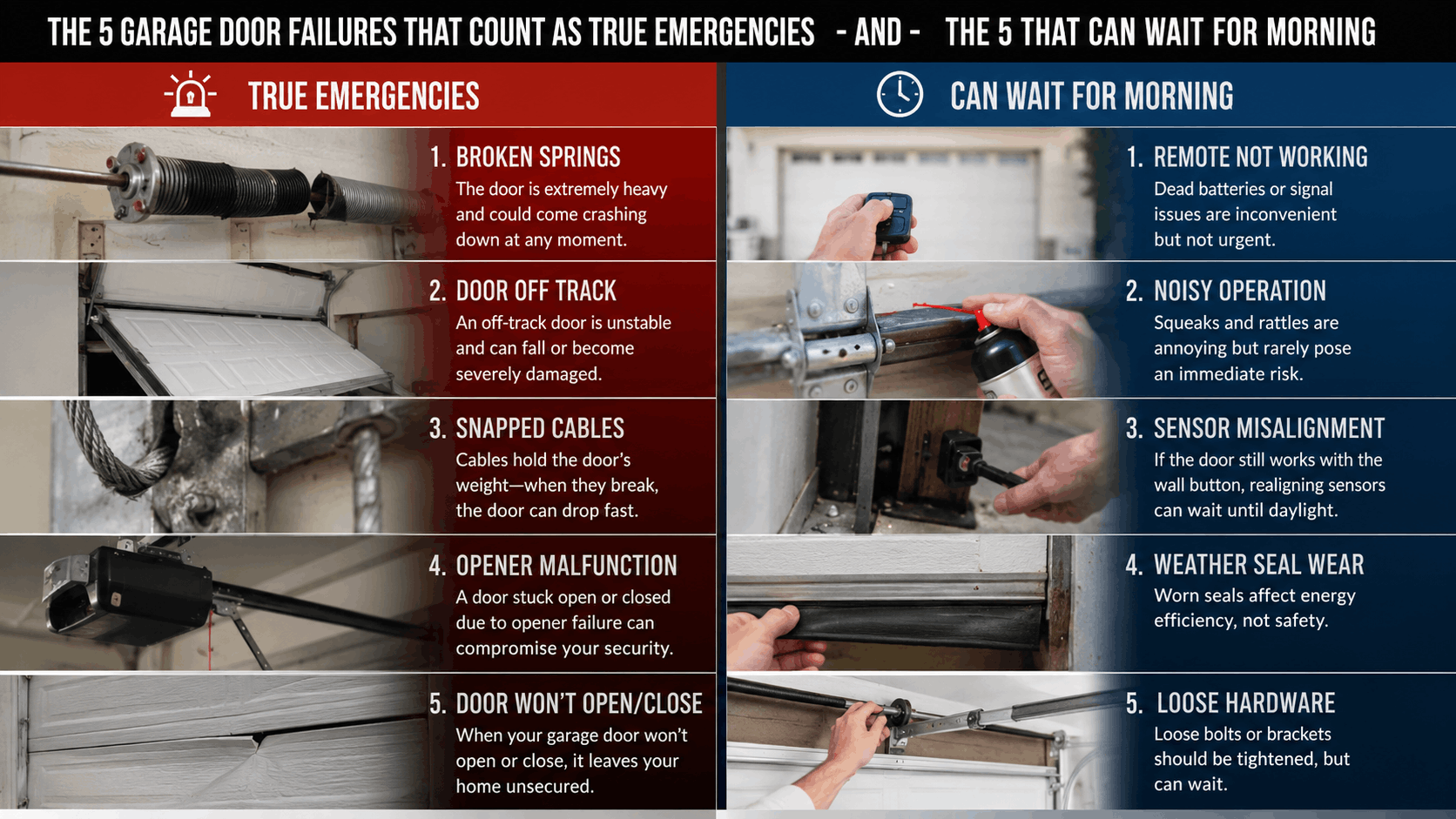
- A broken torsion spring, a door stuck open overnight, a derailed door, a snapped cable, and a failed auto-reverse are the five true garage door emergencies.
- Noisy doors, dead remotes, slow opening, cosmetic dents, and a single bounce-back from a dirty sensor can safely wait for a scheduled morning appointment.
- After-hours service in Irvine costs more than daytime repair, so match the urgency of the problem to the price before you call.
- Never try to manually lift a door with a broken spring or reset a door that has come off its track - both can cause serious injury.
- An open garage door overnight is a security and weather risk, especially where garages connect directly to the home.
- Coastal marine air near the Irvine and Newport border speeds corrosion on cables and hardware, shortening their lifespan.
- Urgent Garage Doors stocks common parts like springs, cables, rollers, and sensors so most repairs finish in one visit.
In This Article
It is 10 p.m. in Woodbridge. A homeowner hits the remote to close the garage after a late grocery run, and the door groans, jerks, then hangs there crooked. Now comes the question every Irvine family eventually faces: is this a real garage door emergency, or something that can wait until morning?
Getting that answer right matters. Call a technician out at midnight for a problem that could have waited, and you pay a premium you did not need to spend. Wait until morning on a genuine safety hazard, and you risk an injury, a break-in, or a car stuck in the garage when you need to be on the 405 by 6 a.m.
Why Knowing the Difference Saves Irvine Homeowners Money and Stress
Telling a real garage door emergency apart from a minor annoyance is the single skill that keeps your repair bill fair. After-hours repair costs more because a technician is driving out on nights, weekends, and holidays. That premium is worth paying when your home is exposed or your car is trapped, and a waste when the door just squeaks.
Across Irvine, from Turtle Rock to the Great Park, we get both kinds of calls. The homeowners who save the most money are the ones who pause, check a few signs, and decide with a clear head instead of panic. The table below shows how the two categories break down.
| Situation | Category | Recommended Action |
|---|---|---|
| Broken spring, car trapped inside | True emergency | Call for same-night service |
| Door stuck open overnight | True emergency | Secure and call |
| Squeaky or noisy door | Non-emergency | Schedule daytime visit |
| Dead remote battery | Non-emergency | Use manual key, schedule later |
What After-Hours Service Actually Costs
Scheduled garage door repair in Irvine usually runs a fair, predictable rate during normal business hours. Emergency service cost carries a premium because of the timing, the travel, and the parts a technician must carry to finish the job on the spot. Homeowners often see an after-hours charge on top of the standard repair pricing.
That premium is money well spent when the alternative is a night with your home wide open or a car you cannot move. It is a poor trade when the problem is cosmetic or a simple battery swap. A quick way to decide is to ask whether the failure threatens safety, security, or access to your vehicle.
We always give a clear price before any work starts, day or night. If a problem can wait, we tell homeowners honestly and book a normal appointment instead. That transparency is why so many Irvine families keep our number saved.
For failures tied to high-tension parts, our emergency garage door repair team can quote the fix over the phone before rolling out.
Safety and Security Risks That Change the Math
Sometimes the higher after-hours cost is easy to justify. A door that will not close leaves your garage, and often the interior door to your home, exposed to anyone walking by. In that case, home security concerns outweigh the premium every time.
Weather adds another layer. A door stuck open during a rare Irvine downpour can let water reach stored belongings, drywall, and electrical outlets. Garage safety is not only about theft - it is about protecting what sits inside.
We look at the whole picture when a homeowner calls. If a broken door leaves a family car half in and half out with no way to secure it, that is a same-night job. If the garage is sealed and safe, morning is usually fine.
How Irvine's Climate Affects Urgency
Irvine weather works in a homeowner's favor most of the year. The mild coastal climate means a stuck door rarely faces freezing temperatures or heavy snow load. Near neighborhoods like Turtle Rock and Woodbridge, the biggest weather factor is the morning marine layer, not extreme cold.
That mild pattern is why some failures can safely wait here that would be urgent in colder states. A door frozen half-open overnight in Irvine faces damp air, not ice damage. The coastal climate lowers the weather-driven urgency for many repairs.
The exception is salt air closer to the Newport border, which speeds corrosion on metal parts. We factor local conditions into every recommendation, because a home in Woodbridge faces different wear than one near the coast.
Get Your Free Quote
Tell us about your garage door and we'll get back to you within 30 to 60 minutes.
Emergency #1: A Broken Torsion Spring That Traps Your Car
A broken torsion spring is a common true emergency we handle in Irvine. The spring sits above the door and does the heavy lifting, so when it snaps, the door becomes too heavy for the opener to raise. If your car is inside, it is now stranded.
This is not a repair to attempt yourself. The garage door spring holds intense stored energy, and a failed replacement can cause serious injury. The table below covers what a broken spring looks like and how to respond.
| Sign | What It Means | Do This |
|---|---|---|
| Loud bang from garage | Spring likely snapped | Do not operate the door |
| Visible gap in coil | Confirmed break | Call for replacement |
| Door will not lift | No spring tension | Leave car inside, call |
How to Tell a Spring Has Actually Broken
The clearest spring failure sign is a loud bang, often heard from inside the house, that sounds like a firecracker or a snapping cable. Many homeowners think something fell or broke into the garage before they realize it was the spring.
The next clue is visual. Walk out and look at the coiled spring above the door. A broken one shows a clear two-to-three inch gap where the coil separated.
The final test is simple. Try the opener once. If the motor strains and the door barely moves or does not lift at all, the spring is done and the door is now its full weight.
Why You Should Not Force the Door Open
When a spring breaks, the door can weigh 150 pounds or more, and a double door even heavier. Trying to muscle it up by hand is how people crush fingers or hurt their backs. The manual lift danger is real, especially on heavier double doors common in newer Irvine homes.
There is also the damage angle. Forcing a door with no spring support can bend panels, damage the opener, and pull cables loose. What started as a spring job can grow into a much larger repair.
The safe move is to leave the door where it is and keep everyone clear. Let a technician release the tension properly and install a matched replacement. Our torsion spring replacement service handles the tension safely.
When It Truly Cannot Wait Until Morning
The case for a same-day spring replacement is strongest when your only car is trapped inside. If you commute along the 405 or the 5 at dawn, or you have an early medical appointment, waiting until midday is not an option.
For a family with a second vehicle parked in the driveway, the calculus changes. If the garage is secure and you have another way to get where you need to go, a first-thing-morning appointment often makes more sense than an after-hours call.
We help homeowners weigh this on the phone. If the trapped car matters for tomorrow, we come out tonight. If not, we book you early and save you the premium.
Need Help in Irvine?
Urgent Garage Doors serves Irvine and all of Orange County.
Emergency #2: A Door Stuck Open Overnight
A garage door stuck open is a genuine security risk that should be handled quickly. An open garage overnight is an invitation, and in most Irvine homes the garage connects directly to the living space. That makes an open door a doorway into your home.
The good news is there are temporary steps to secure the opening while you wait. The table below breaks down the risk and the short-term fixes.
| Concern | Risk Level | Temporary Fix |
|---|---|---|
| Break-in through open garage | High | Manually close and lock |
| Interior door exposed | High | Lock the door into the house |
| Weather intrusion | Moderate | Close manually if possible |
The Break-In Risk in Residential Neighborhoods
Quieter communities like Northwood and Quail Hill feel safe, and they largely are, but an open garage changes that overnight. Thieves look for easy targets, and a lit, open garage full of tools, bikes, and boxes is exactly that.
The bigger worry is the attached garage. In most Irvine homes, once someone is in the garage they are a single door away from the kitchen or laundry room. An open garage is not just a storage risk - it is a whole-home security gap.
That is why we treat an open door that will not close as a same-night priority. Even in low-crime areas, the break-in risk is too high to leave overnight.
Temporary Ways to Secure the Opening
If the door will not close on its own, a homeowner can often close it manually. Pull the red emergency release cord to disconnect the opener, then lower the door by hand and engage the manual lock or slide bolt if your door has one.
If the door will not stay down, secure the interior door between the garage and the house instead. Lock it and add a chair or bar if the lock is weak. That keeps the exposure to the garage only.
Once the opening is secure, the urgency drops. You may still want a same-day fix, but a locked door buys you time to avoid the highest after-hours rate.
Common Reasons a Door Refuses to Close
The most frequent cause is a blocked or misaligned photo-eye sensor near the floor. If the little lights are not aligned or something is in the beam, the door reverses as a safety measure and refuses to close.
Other causes are more serious. A snapped cable can throw the door off balance so it will not seat, and a burned-out opener motor leaves the door dead. These need a technician rather than a quick cleaning.
Our door won't open or close service diagnoses the exact cause fast, whether it is a sensor, a cable, or the opener itself.
Emergency #3: A Door Off Its Tracks or Hanging Crooked
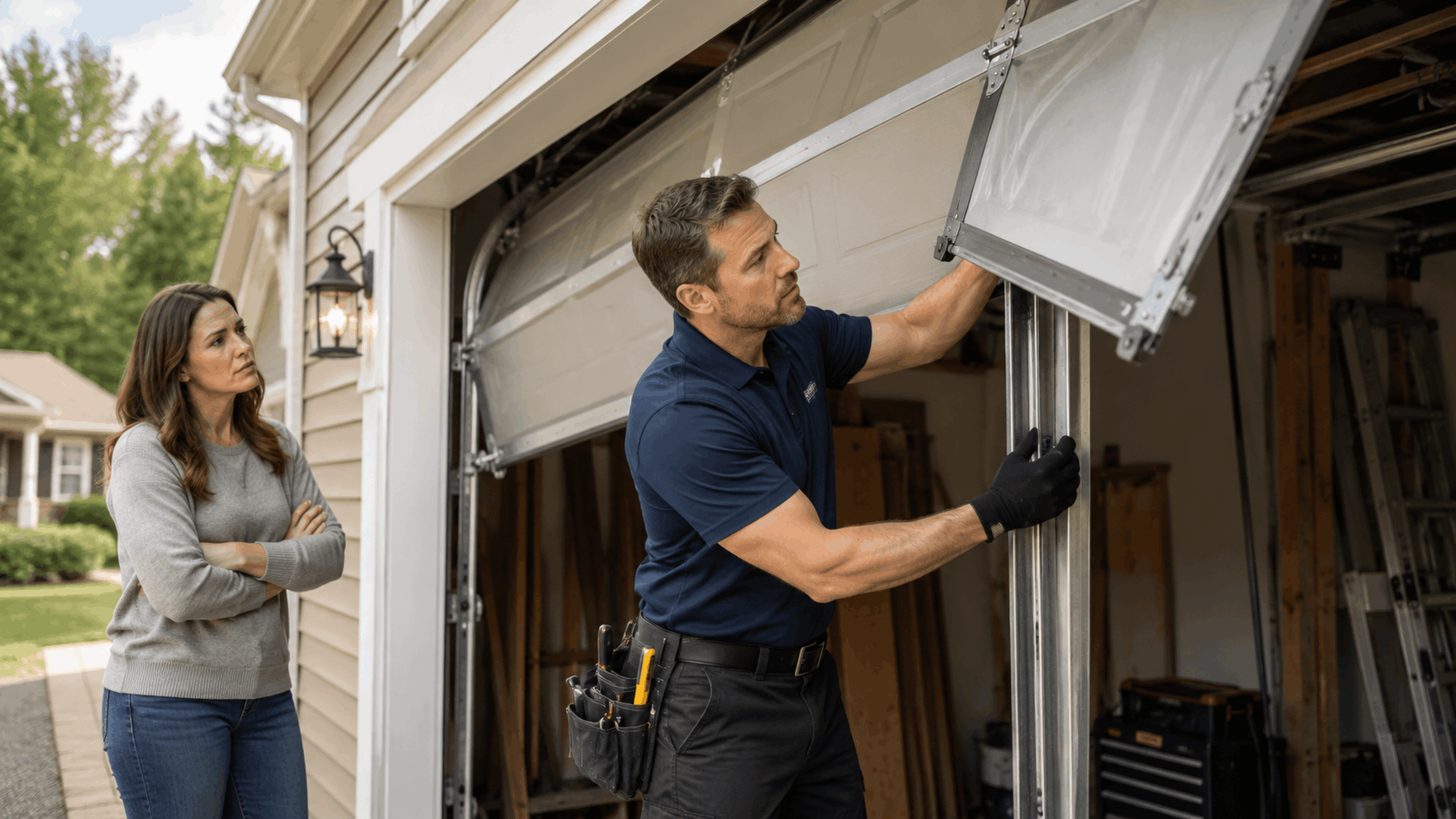
A door off track is one of the most dangerous failures we see. A derailed door can fall, and a heavy panel dropping onto a car or a person causes real harm. This is always urgent.
Do not try to wrestle a crooked door back into place. The table below explains the danger and the right response.
| Situation | Danger | Action |
|---|---|---|
| Panel out of track | Door can fall | Clear the area, call |
| Door hanging at an angle | Sudden collapse risk | Do not operate |
| Roller off rail | Uneven load | Keep cars clear |
Why a Derailed Door Can Fall
A garage door panel is heavy, and the track is what holds all that weight in a controlled path. When a panel leaves the track, that weight is no longer supported evenly and gravity takes over.
A falling door can crush a vehicle hood or seriously injure anyone standing under it. This is not a slow failure - a partly derailed door can drop without warning.
Panel damage often follows too, which turns a track fix into a panel replacement. Keeping everyone away and calling for help is the only safe path.
What Usually Knocks a Door Off Track
A common cause we find is a driver backing into the door before it fully opened. That single bump can bend the track and pop the rollers loose.
Worn rollers are another culprit. Over years of use, rollers wear down and eventually jump the rail, especially if the door has never been serviced. A broken cable can also yank a panel sideways and pull it out of alignment.
Whatever the cause, the fix belongs to a technician. Our off track garage door repair crew resets the panels, straightens the track, and checks the rollers in one visit.
Steps to Take Until Help Arrives
The first step is to clear the area. Move cars out of the path if you can do so safely, and keep children and pets well away from the door.
Do not touch the opener. Trying to run the motor on a derailed door can drag the panel further off track or cause it to fall. Leave the door exactly where it is.
Resist the urge to fix it yourself. A door under cable tension can snap into motion when you least expect it, and that is how home DIY attempts end in the emergency room.
Emergency #4: A Snapped Cable or Broken Bottom Bracket
Lift cables and bottom brackets hold serious tension, which makes failures here dangerous. A snapped cable throws the door off balance, and a broken bottom bracket releases stored energy in an instant. Both call for a professional, and often a same-night visit.
The table below shows the warning signs and why these parts demand caution.
| Part | Failure Sign | Why It Is Risky |
|---|---|---|
| Lift cable | Door hangs at an angle | Uneven load, can derail |
| Bottom bracket | Loud snap, loose bracket | High tension release |
| Cable spool | Cable pooled on floor | Door unsupported |
How Tension Makes These Parts Risky
Garage door cables carry the weight of the door in partnership with the springs. That cable tension is under constant load, so a cable or bracket that lets go does it with force.
The bottom bracket is where the cable attaches near the floor, and it holds spring tension directly. Loosening the wrong bolt on a bottom bracket is one of the more common ways home DIY attempts end in injury.
This DIY danger is why we tell every Irvine homeowner to step back from cables and brackets. Our garage door cable repair team handles the tension with the right tools.
Signs the Cable Has Failed
The clearest sign is a door that hangs unevenly, with one side lower than the other. That uneven door tells you a cable on one side has let go and the door is no longer balanced.
Look for a frayed cable near the drum or bottom bracket. Strands that have started to unwind mean a full break is coming soon.
Sometimes you will see loose cable pooled on the garage floor. That means the cable has come off its drum entirely, and the door has lost part of its support.
Why Salt Air Near the Coast Speeds Wear
Homes closer to the coast and marine air see more cable corrosion than inland Irvine areas. Salt in the air settles on metal parts and eats away at them over time, which shortens the life of cables and hardware.
Neighborhoods nearer the Newport border feel this more than areas like the Great Park or Portola Springs. The same door might last years longer inland than it does within reach of steady ocean air.
We recommend more frequent inspections for coastal-adjacent homes. Catching cable corrosion early through a preventive maintenance plan is far cheaper than an emergency after a snap.
Need Help in Irvine?
Urgent Garage Doors serves Irvine and all of Orange County.
Emergency #5: A Door That Slammed Shut on a Person, Pet, or Car
If a garage door slammed shut on someone or something, that signals a failed safety system and is a true emergency. Modern doors are built to reverse when they hit an object, so a door that closes on a person, pet, or car has a broken auto-reverse.
Stop using the door until it is fixed. The table below explains the safety feature and how to check it.
| Symptom | What Failed | Response |
|---|---|---|
| Door closed on object | Auto-reverse failure | Stop using, call |
| No reverse on contact | Sensor or force setting | Test and repair |
| Sensors misaligned | Photo-eye issue | Realign, test again |
Why the Auto-Reverse System Matters
Since the early 1990s, federal law has required garage door openers to include an auto-reverse safety feature. The U.S. Consumer Product Safety Commission pushed this standard after too many injuries from closing doors.
The system works two ways. Photo-eye sensors near the floor detect anything in the path, and a force setting reverses the door if it meets resistance. When either stops working, the door loses its ability to protect people.
A door that no longer reverses is not just annoying, it is a hazard. That is why we treat a failed auto-reverse as a same-night safety repair.
Testing Whether the Door Is Safe to Use
There is a simple safety test any homeowner can run. Place a solid board or a roll of paper towels flat on the ground in the door's path, then close the door with the opener.
A working door will touch the object and immediately reverse. If it keeps pressing down or does not reverse cleanly, the auto-reverse has failed and the door should not be used.
Also check the photo-eye alignment. The two small sensors near the floor should face each other with steady lights. If a lens is dirty or knocked out of line, our safety sensor alignment repair restores the protection.
Protecting Kids and Pets in Family Neighborhoods
Families near University High or in Portola Springs have kids and pets moving in and out of the garage all day. A failed safety reverse in a busy household is a same-night fix, not something to test your luck on.
Children often dart under a closing door, and pets do not understand the danger at all. The auto-reverse is the last line of defense between a moving door and a small body.
If you have any doubt about whether your door will stop for a child, stop using it and call. The National Safety Council stresses that working safety features are what prevent home injuries like these.
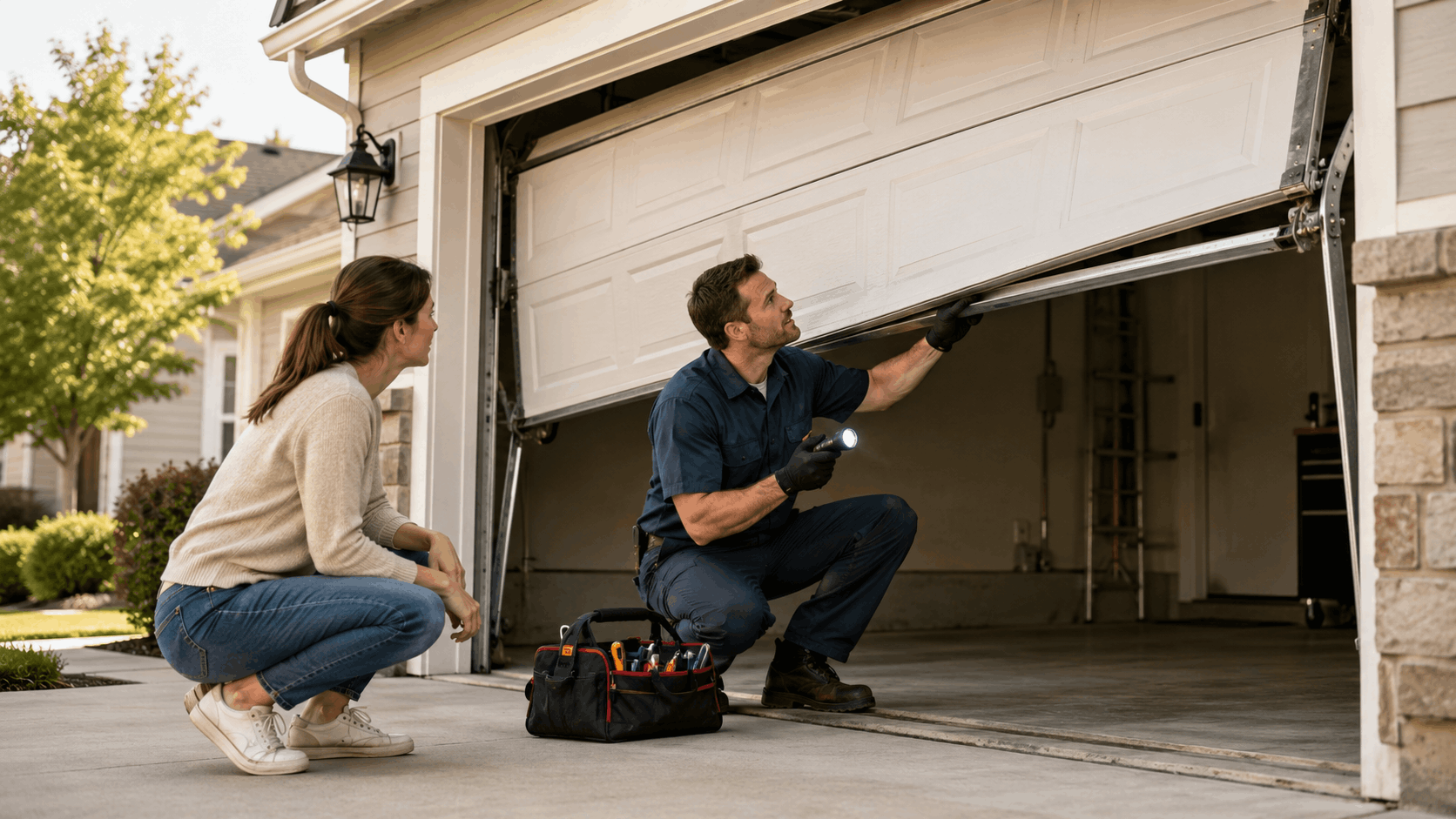
The 5 Problems That Can Safely Wait for Morning
Not every garage door hiccup is an emergency. Many of the calls that come in at night are for problems that feel alarming but pose no real danger. These are non-emergency repairs that fit fine into a scheduled service window, saving you the after-hours premium.
Here are the five common issues that can wait for morning.
A Noisy or Squeaky Door
Grinding, squealing, or rattling is the classic sound that makes homeowners think something is failing. In most cases, a noisy garage door just needs lubrication on dry rollers and hinges.
The noise comes from metal parts moving against each other without enough grease. It is a maintenance item, not a safety problem, and the door still works.
A morning appointment and some proper lubrication usually silences it. If the noise persists, worn rollers may be the cause, and a quiet roller hardware upgrade is worth considering.
A Remote or Keypad That Stopped Working
A remote not working is almost always a dead battery or a unit that needs reprogramming. Neither is an emergency, because you still have other ways into the garage.
Start with a fresh battery in the remote. If the keypad has stopped responding, a simple keypad reset following the manufacturer steps often brings it back.
Meanwhile, the manual key or the interior door still gets you in. When you are ready, our team can handle keypad and remote programming during a normal visit.
Slow Opening or a Door That Hesitates
A slow garage door that hesitates or crawls is usually telling you something needs attention, not that it will fail tonight. Worn rollers, dry tracks, or opener settings that need adjusting are the common causes.
As long as the door still opens and closes fully, it is safe to use for another day. A sluggish door is a comfort issue more than a safety one.
A technician can adjust the opener settings and inspect the rollers during a scheduled visit. That is often all it takes to get smooth travel back.
Minor Cosmetic Dents and Peeling Paint
A cosmetic dent from a stray basketball or peeling paint from years of Irvine sun looks bad but changes nothing about how the door works. Surface damage is a scheduled repair, never an emergency.
The door still opens, closes, and protects your home. There is no safety or security reason to pay an after-hours rate for a dent.
When the look bothers you, a panel replacement during a planned appointment restores the appearance. There is no rush to do it at night.
A Door That Closes but Bounces Back Once
A door that closes but reverses once before finishing is often reacting to a dirty sensor lens. A little dust or a spider web in the photo-eye beam can trigger a single reversal.
Homeowners can often fix this themselves. Wipe both sensor lenses with a soft cloth and make sure nothing is blocking the beam near the floor.
After cleaning, test the door again. If it closes cleanly, you have solved it for the night and can schedule a proper sensor check later if it returns.
Need Help in Irvine?
Urgent Garage Doors serves Irvine and all of Orange County.
How Urgent Garage Doors Responds Across Irvine
When an Irvine homeowner calls with a real emergency, knowing what to expect makes the wait easier. Our local technicians cover the city and the surrounding communities, and we structure every emergency response to be fast and clear.
Here is how our process works and where we go.
Neighborhoods and Routes Our Team Covers
Our team serves the full spread of Irvine, from Woodbridge and Turtle Rock to Northwood, Quail Hill, and the Great Park. We know the surface streets and the shortcuts that shave minutes off a late-night call.
Culver Drive and Jamboree Road are our main arteries for reaching most neighborhoods quickly. Easy access to these routes is part of why we can hit tight response windows across the service area.
We also cover nearby cities when needed. Homeowners can see the full list on our Irvine service page.
What Happens During an Emergency Call
Every emergency call starts with phone triage. We ask a few targeted questions to figure out whether you have a broken spring, a derailed door, or something that can wait, and we give an honest recommendation.
If it is a true emergency, we dispatch a technician with a clear arrival window and a price quoted up front. On site, the technician diagnoses the exact fault before any work begins.
Response times vary with traffic and time of day, but our central Irvine coverage keeps most windows short. Our 24/7 emergency repair line is answered around the clock.
Parts We Stock for Same-Night Fixes
Most emergency repairs come down to a handful of parts, so we keep our trucks stocked with them. Torsion springs, lift cables, rollers, brackets, and safety sensors ride with every technician.
Carrying stocked parts means we finish most jobs in one visit instead of a return trip. A snapped spring or a failed sensor gets fixed the same night, not days later.
For the parts we do not carry on the truck, we source them fast and schedule the follow-up. Our goal is always a one-visit repair whenever the situation allows.
Final Thoughts
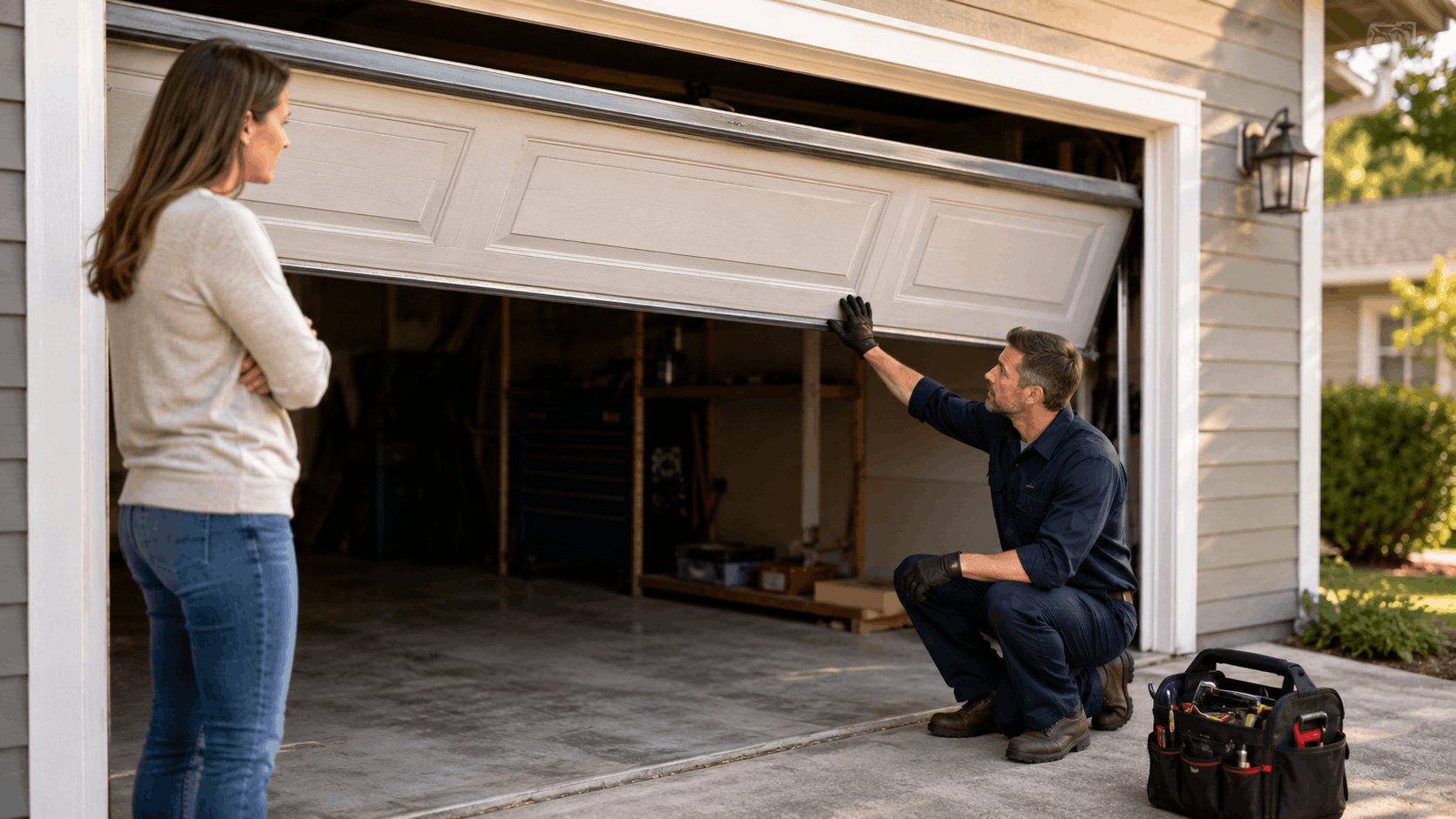
The difference between a true emergency and a wait-until-morning problem comes down to safety, security, and access to your car. A broken spring, an open door overnight, a derailed door, a snapped cable, and a failed auto-reverse all deserve a same-night call. Noisy doors, dead remotes, slow travel, dents, and a single sensor bounce can wait.
Knowing which is which keeps Irvine homeowners safe without overpaying for after-hours help. When you are unsure, a quick phone call gets you an honest answer either way. Contact Urgent Garage Doors any time, and our local team will help you make the smart call.
Frequently Asked Questions
- What counts as a garage door emergency?
- A true emergency is any failure that threatens safety, security, or traps your vehicle. The top examples are a broken torsion spring that strands your car, a door stuck open overnight, a door off its track, a snapped cable or broken bottom bracket, and a failed auto-reverse system that let the door close on a person or pet. Anything that leaves your home exposed or a door likely to fall belongs in this group.
- How much does emergency garage door repair cost in Irvine?
- After-hours service carries a premium over scheduled daytime repair because of the timing, travel, and parts a technician must carry. Scheduled repairs cost less and are predictable. The total depends on the failed part, whether it is a spring, cable, sensor, or opener, and the size of your door. We always quote the full price before starting any work, so there are no surprises whether you call at noon or midnight.
- Can I open my garage door if the spring is broken?
- No. With a broken spring, the door can weigh 150 pounds or more and offers no counterbalance, so lifting it by hand risks crushed fingers, a hurt back, or a dropped door. Forcing it can also bend panels and damage the opener. Leave the door where it is, keep everyone clear, and call for a professional torsion spring replacement. A technician can release the tension and install a matched spring safely.
- Is it safe to leave my garage door open overnight?
- It is a real risk. An open garage exposes tools, vehicles, and the interior door into your home, which most Irvine houses have. If the door will not close, pull the emergency release, lower it by hand, and engage any manual lock. If it will not stay down, lock the interior door into the house and call for a same-night repair to close the security gap.
- Why does my garage door reverse before it closes?
- The usual cause is a blocked or misaligned photo-eye sensor near the floor. Dust, a spider web, or a knocked lens can break the beam and trigger the safety reverse. Wipe both sensor lenses with a soft cloth, clear anything in the path, and check that the small lights face each other steadily. If it keeps reversing after cleaning, the sensors likely need professional realignment.
- How fast can a technician reach my Irvine home?
- Response windows vary with traffic and time of day, but our central Irvine coverage keeps most arrivals short. Main routes like Culver Drive and Jamboree Road let our technicians reach neighborhoods from Woodbridge to the Great Park quickly. When you call, we give you a clear arrival window during phone triage so you know exactly what to expect.
- Should I fix a noisy garage door right away?
- No, a noisy door is a maintenance item, not an emergency. Grinding or squealing usually means dry rollers and hinges that need lubrication, and the door still works safely. Book a scheduled visit to save the after-hours premium. If the noise continues after lubrication, worn rollers may be the cause, and a roller upgrade during a normal appointment will quiet things down.
- What should I do if my door came off its track?
- Treat it as urgent. A derailed door can fall, so move cars out of the path if it is safe and keep children and pets well away. Do not run the opener, since that can drag the panel further off track or cause it to drop. Do not try to reset it yourself because of the cable tension involved. Call for prompt professional off-track repair.
- Does the coastal air really damage garage door parts?
- Yes. Salt in marine air settles on metal parts and speeds corrosion on cables, springs, and hardware. Homes closer to the Newport border feel this more than inland areas like the Great Park or Portola Springs. The same door can last years longer inland than near steady ocean air. Coastal-adjacent homes benefit from more frequent inspections to catch cable corrosion before a part snaps.
- Can most repairs be finished in one visit?
- Yes. We stock our trucks with the parts behind most emergencies, including torsion springs, lift cables, rollers, brackets, and safety sensors. That means a snapped spring or a failed sensor usually gets fixed the same night without a return trip. For less common parts, we source them quickly and schedule a fast follow-up, but the majority of Irvine calls finish in a single visit.
Licensed garage door repair professionals serving Irvine and Orange County.
Licensed in California · License #1055150
Why trust Urgent Garage Doors?
Founded in 2017, Urgent Garage Doors is a licensed and insured garage door services serving Irvine and Orange County. All content is reviewed by our licensed technicians.

Need Help in Irvine?
Urgent Garage Doors serves Irvine and all of Orange County.
Related Articles
Garage Door Failure Modes in Earthquake Country: What Actually Breaks First
A local guide to how garage doors fail during earthquakes near Irvine, what breaks first, and how to prepare your door before the next tremor hits.
Garage Door Panel Replacement vs Full Door Replacement in Orange County
Should you replace one damaged garage door panel or the entire door? This guide covers costs, timelines, HOA rules, and local Orange County factors to help you decide.
Quail Hill Irvine Garage Door Repair: Common Failures in 2000s Construction
Quail Hill homes built in the 2000s share predictable garage door failures. Learn the common problems with springs, cables, rollers, openers, and panels - and how to fix them.