HomeKit, Alexa, and Google Integration for Garage Doors - What Actually Works
Key Takeaways
- Apple HomeKit fits Apple-heavy homes with Meross or Refoss controllers, since myQ dropped native HomeKit support.
- Amazon Alexa supports the widest range of controllers and suits mixed iPhone and Android households.
- Google Home has the weakest native garage support and often needs a third-party bridge or Nest camera pairing.
- Voice PINs and safety codes exist because UL 325 rules require safe handling before a heavy door closes.
- Weak Wi-Fi in detached garages causes more dropped commands than any platform flaw, and a mesh node usually fixes it.
- Openers made before 1993 or 2011 may lack sensors or rolling codes and often need an adapter or replacement.
- Smart setup costs range from about 40 dollars for a controller to 600 dollars for a new smart opener, plus install.
- Urgent Garage Doors assesses the opener, Wi-Fi, and platform goals, then installs, tests, and trains across Irvine.
In This Article
It happens on Jeffrey Road every morning. A homeowner pulls onto the 405 ramp, then freezes with that sinking feeling: did the garage door actually close? Now they are tapping an app at a red light near the Irvine Spectrum, hoping the little icon turns green. That single moment is why so many families around here ask us about smart garage door control.
The problem is that the three big platforms - Apple HomeKit, Amazon Alexa, and Google Home - do not treat garage doors the same way. Some let voice commands close the door. Some flat out refuse. Some need a code, a hub, or a controller you have never heard of. Picking the wrong combination means paying for hardware that only half works.
How Smart Garage Door Integration Actually Works?
Before choosing a platform, it helps to know what is happening behind the scenes. A garage door is not a light bulb. It is a heavy moving object with safety rules baked into how any smart system controls it.
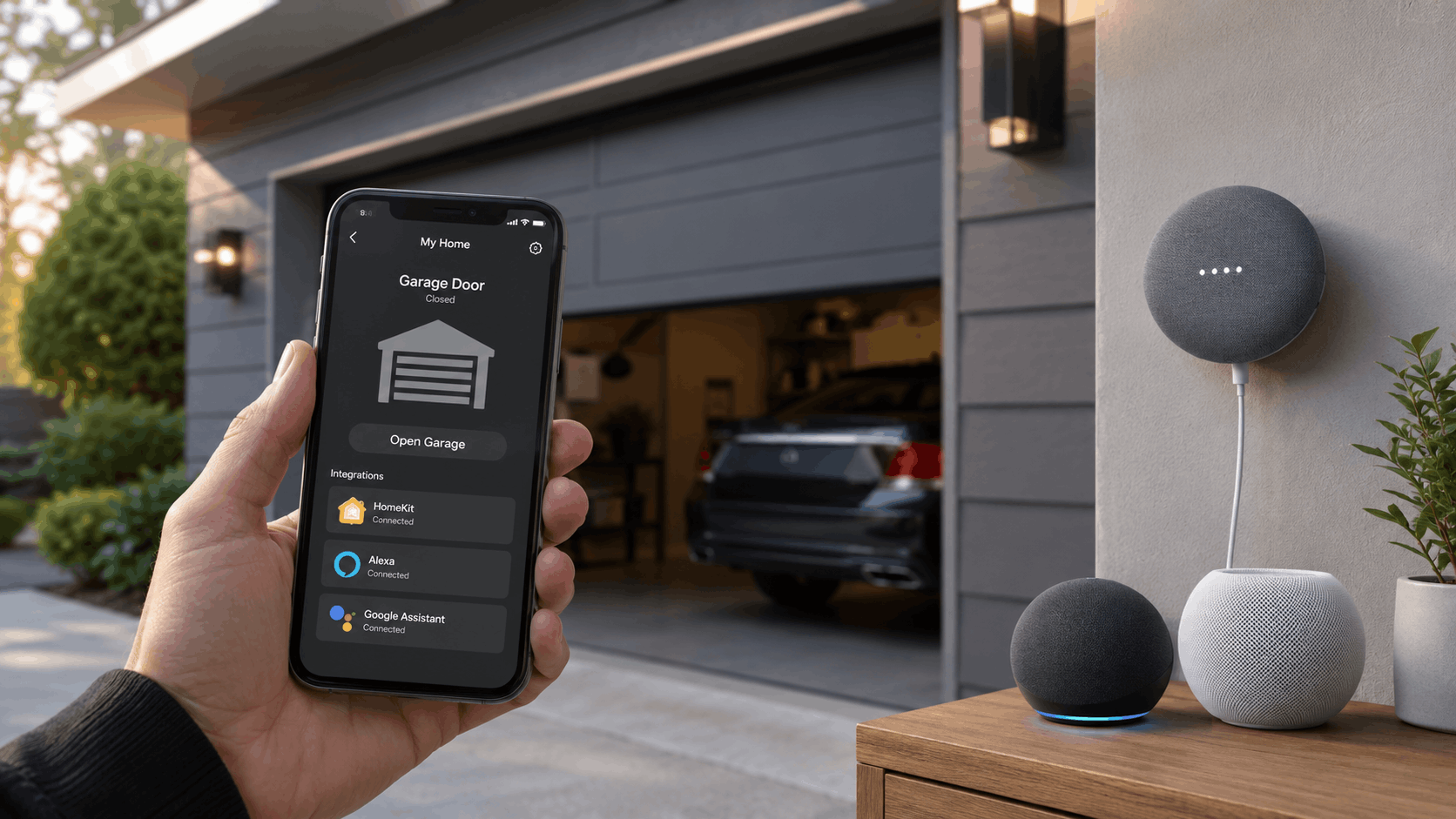
At its simplest, a smart garage door opener or add-on device connects your door's motor to your home Wi-Fi. That connection lets your phone or a voice assistant send an open or close signal, and lets the door report back whether it is up or down. The pieces that make this work usually include:
- A Wi-Fi garage controller or a built-in radio inside the opener
- A door position sensor that tells the app if the door is open or closed
- A cloud account tied to a phone app
- A link between that app and your home automation platform of choice
Once those parts are in place, the door becomes another device your smart home can see and control. The differences between platforms come down to how safely and reliably they handle that final step of actually moving a heavy door.
The Difference Between a Smart Opener and an Add-On Controller
There are two roads to a connected garage. The first is buying a new opener with Wi-Fi built in. The second is adding a small add-on controller to the opener you already own. Both get you to app and voice control, but the cost and effort differ a lot.
A brand-new smart opener with built-in Wi-Fi, like current LiftMaster or Chamberlain models, is the cleaner option if your current unit is aging or noisy. You get factory integration, quieter operation, and often battery backup in one shot. The trade-off is price, since a full opener plus professional opener installation costs more than a small gadget.
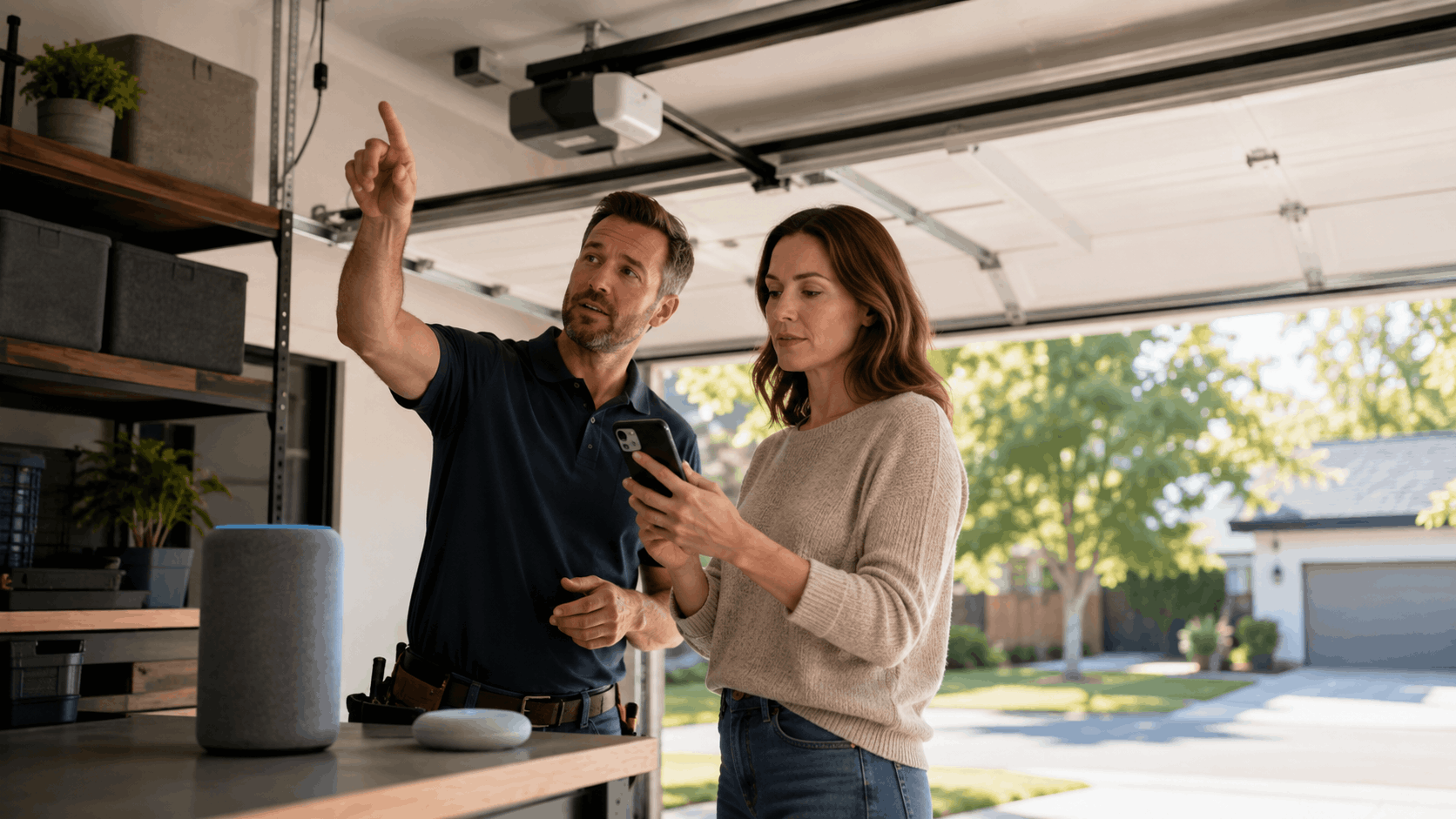
An add-on controller such as myQ, Meross, or Refoss wires into a working opener and adds Wi-Fi for a fraction of the cost. For a Woodbridge family whose opener runs fine but lacks any app, this is usually the smart move. These controllers mount near the motor unit, connect to a door sensor, and bring the whole system online in about an hour.
We help homeowners weigh these two paths every week. If the opener is pre-2011 or already showing wear, we often recommend replacement instead of patching an old unit with a controller that may fight the hardware.
Why Garage Doors Have Extra Safety Rules
A light switch can turn on from anywhere with zero risk. A garage door is different, because a closing door can trap a child, a pet, or a car bumper. That is why the industry follows a safety standard called UL 325.
UL 325 requires modern openers to have a safety sensor near the floor that reverses the door if something breaks the beam. It also shapes how smart platforms behave. Many systems will not allow remote closing unless a working sensor is present and a warning beep or light sounds first.
This is why Alexa asks for a code before closing, and why HomeKit forces a security prompt. The platforms are not being difficult on purpose. They are following rules meant to keep a heavy door from closing on someone who cannot see it move. You can read more about these requirements from the U.S. Consumer Product Safety Commission.
When our techs set up a system, we always confirm the sensors are aligned and functioning first. A misaligned sensor not only blocks smart closing, it can leave the door stuck open. Our safety sensor alignment service handles that step so the smart features work as intended.
How Voice Assistants Talk to the Door
When someone says "Alexa, close the garage," a lot happens in a second or two. The voice assistant does not talk to the door directly. It routes the command through several layers before the motor moves.
The chain usually runs like this: your voice hits an Echo, Google Nest, or iPhone, which sends it to a cloud account for that platform. That platform then talks to the controller maker's cloud, which finally pings the Wi-Fi garage controller in your garage. Only then does the door respond.
Some setups use a local smart home hub, like an Apple HomePod or Home Hub, to speed things up and keep more processing inside the house. HomeKit leans heavily on this local approach, which is part of why Apple fans like it. Alexa and Google rely more on the cloud, which works well but adds a step.
For voice control to feel instant, every link in that chain needs a solid connection. When Irvine Wi-Fi gets congested in the evening, that is often where delays and dropped commands show up. We test each link during setup so the door responds the first time, not the third.
Get Your Free Quote
Tell us about your garage door and we'll get back to you within 30 to 60 minutes.
Apple HomeKit and Garage Doors in Irvine Homes
Plenty of families in Woodbridge and Turtle Rock already live inside Apple's world. iPhones, iPads, an Apple TV, maybe a HomePod. For them, Apple HomeKit is the natural first choice for the garage.
HomeKit shows the garage as a tile in the Home app, lets Siri garage door commands open or close it, and ties into automations based on location or time. It does all this with a strong focus on privacy. The catch is that HomeKit is picky about hardware, so choosing the right controller matters more here than on any other platform.
- HomeKit shows real-time open or closed status on iPhone and Apple Watch
- Siri handles voice commands hands-free
- Automations can close the door when the last family member leaves
- Only certain controllers are certified to work
Which Openers and Controllers Support HomeKit
Not every controller speaks Apple's language. The list of HomeKit compatible garage hardware is shorter than for Alexa or Google, so this is where research pays off before buying.
The most reliable picks right now are Meross and Refoss smart garage door openers. Both are affordable add-on controllers that appear natively in the Home app once paired. They connect to your existing opener, add a door sensor, and show up alongside your other Apple devices without extra bridges.
The big change families need to know: myQ HomeKit support is gone. Chamberlain removed native HomeKit integration from myQ, so a myQ controller no longer shows up in the Home app on its own. Homeowners who want Siri control should plan around Meross or Refoss instead.
We keep current on which controllers hold their HomeKit certification, since brands change firmware often. During an opener and smart access visit, we match the hardware to the platform the family actually uses so nobody buys a device that will not connect.
Using Siri and the Home App to Open and Close
Once a compatible controller is paired, control feels natural. A homeowner can say "Hey Siri, open the garage" from the driveway, or tap the tile in the Home app from the couch. The door status updates in real time.
For closing, Apple adds a safety step. The Home app asks for confirmation, and Siri commands to close may require a passcode or Face ID depending on the device. This security PIN style prompt exists so a heavy door never closes by accident or by a stranger shouting through a window.
Home app automation is where HomeKit shines for busy households. You can set the door to close automatically at 10 p.m., or trigger a reminder if it sits open too long. Families near University Park often set a rule that flashes indoor lights if the garage is still up after dark.
These automations run partly on the local hub, so they often keep working even during brief internet hiccups. That local reliability is a real advantage when the neighborhood network gets busy.
The Privacy Trade-Off HomeKit Users Like
Apple built HomeKit around keeping data inside the home. For families near University Park and Northwood who care about privacy, that design is a big reason they choose it.
With HomeKit privacy, much of the processing happens on your home hub rather than a distant server. This local processing means fewer of your garage habits get logged in the cloud. Apple also encrypts the data end to end.
The trade-off is that this tighter data security comes with the shorter hardware list mentioned earlier. You give up some device choice in exchange for stronger privacy. Many Apple households find that a fair deal.
For a family that already trusts Apple with their photos and messages, extending that same privacy to the garage feels consistent. We simply make sure the controller they pick supports the local, private setup they expect.
Need Help in Irvine?
Urgent Garage Doors serves Irvine and all of Orange County.
Amazon Alexa Garage Door Control
Alexa is a common voice assistant we see in Irvine homes, especially in the newer Great Park neighborhoods. Amazon Alexa supports the widest range of garage controllers, which makes it flexible, but it comes with a few quirks that surprise first-time users.
With an Echo garage door setup, you can ask for status, open the door, and close it by voice. The main surprise is the voice code Alexa demands before closing. Once families understand why that exists, they usually appreciate it.
Setting Up the myQ and Meross Alexa Skills
Getting Alexa to see the garage starts with enabling a skill. This is a simple app step, but the smoothness depends on which brand you own.
For Alexa skill setup, a homeowner opens the Alexa app, searches for the myQ or Meross skill, and enables it. The account linking step asks you to sign into your controller's account so Alexa can talk to it. After that, the door appears as a device Alexa can control.
Both myQ and Meross work well with Echo device lineups, though myQ remains the most polished for Alexa specifically. Since myQ lost HomeKit, many mixed-platform families pair a myQ controller with Alexa and skip Apple entirely. That combination runs reliably in most Great Park homes we visit.
Our team handles this linking during a smart setup so families do not fight with login loops. We also confirm the door reports the right status, since a mislabeled sensor can make Alexa think an open door is closed.
Voice PINs and Why Alexa Asks for a Code
The moment that trips people up: they say "Alexa, close the garage," and Alexa asks for a code. This is not a glitch. It is a required safety feature.
Amazon requires a four-digit voice PIN for garage commands that could move the door. You set this Alexa security code in the app under the device settings. From then on, any voice command to open or close asks for those four digits.
The reason ties back to UL 325 and simple common sense. A door that closed on a spoken command alone could be triggered by a TV, a guest, or someone outside the window. The PIN keeps casual voices from moving a heavy door.
We recommend choosing a code the whole family can remember but that is not obvious, like a birth year. During training, we walk each household through setting and testing the code so nobody gets locked out of their own garage.
Routines That Actually Help Busy Families
Beyond opening and closing, Alexa's real value is in routines. These automations handle the door in the background so families stop worrying about it.
Alexa routines can close the garage every night at bedtime, so a door left up on Sand Canyon never stays open until morning. Parents near the school zones off Sand Canyon love this, since a forgotten open door is a common safety worry.
Another popular one is a door left open alert. If the garage stays open longer than fifteen minutes, Alexa announces it on every Echo in the house. That single automation has saved more than one family from an open garage overnight.
We set up these routines during installation based on how each family actually lives. A household with teens who forget the door gets a stricter auto-close rule than a couple who rarely leaves it open.
Google Home Integration for Garage Doors
Android families across Irvine lean on Google Home and Google Assistant for everything else, so they expect the garage to fit in too. The honest answer is that Google's garage support is the weakest of the three, though workarounds exist.
Google handles status and, for some brands, opening. Native closing support is limited, and myQ dropped its direct Google integration much like it did with Apple. Knowing these gaps up front saves frustration.
What Google Assistant Can and Cannot Control
Google Assistant is great at answering questions and running lights, but garage doors are a soft spot. Its Google Assistant control of doors depends heavily on the controller brand.
For some controllers, Google can report garage status and open the door on command. For others, closing is blocked or unsupported entirely. The device compatibility picture shifts as brands add or drop official Google support, so what worked last year may not this year.
Meross remains one of the better options for Google users, offering more complete control than many rivals. Even then, families should test both open and close functions before assuming everything works. We verify this during setup rather than leaving it to chance.
For an Android-heavy household, we are upfront that Google may need a helper to reach the same level as Alexa or HomeKit. That helper usually comes in the form of a bridge.
Working Around Gaps With Third-Party Bridges
When Google alone falls short, a bridge can fill the gap. These small apps or devices translate between the controller and Google so more functions become available.
A third-party bridge such as Starling Home Hub or similar tools can connect controllers that Google does not natively support. This smart bridge approach adds full control, including reliable closing, for households committed to the Google ecosystem.
The trade-off is added cost and one more device to maintain. For most families this workaround is worth it only if they are firmly Android and unwilling to add an Echo. We help them decide whether a bridge or a simple Echo Dot is the cheaper, steadier path.
During a consultation, we lay out both options with real numbers so the family picks what fits their budget and comfort with tech. Sometimes a fifteen dollar Echo Dot beats a pricier bridge for pure garage control.
Pairing Google Home With Nest Cameras at the Garage
Where Google does pull ahead is visual confirmation. If a family already runs Nest gear, the garage benefits from a camera view before any remote command.
A Nest camera or Nest doorbell aimed at the driveway lets a homeowner check the garage before closing. Pulling up the feed on a phone or smart display gives real visual confirmation that no car, bike, or child is in the doorway.
This pairing solves the biggest fear of remote closing: shutting the door on something you cannot see. A quick glance at the Nest Hub in the kitchen shows the coast is clear before the door moves. That extra step turns a risky command into a safe one.
We often suggest this combo to Google families as the best of what the ecosystem offers. Paired with a Meross controller and a Nest camera, the garage becomes both controllable and verifiable.
Need Help in Irvine?
Urgent Garage Doors serves Irvine and all of Orange County.
Comparing the Three Platforms Side by Side
Choosing a platform gets easier when you see them lined up. This platform comparison reflects what our team sees on real Irvine service calls, not lab tests. The right pick depends on the phones your family carries and how your smart home ecosystem already looks.
| Feature | Apple HomeKit | Amazon Alexa | Google Home |
|---|---|---|---|
| Hardware choices | Limited (Meross, Refoss) | Widest | Moderate |
| Reliable closing | Yes, with PIN | Yes, with voice code | Partial, may need bridge |
| Privacy | Strongest | Cloud based | Cloud based |
| Voice speed | Fast (local) | Fast | Fast |
| Best for | Apple homes | Mixed homes | Android with Nest |
No single platform wins every category. The best garage integration is the one that matches the devices already in the home.
Reliability and Response Speed
Speed matters when you are sitting at a light hoping the door closed. All three platforms respond in a second or two under good conditions, but response speed can slip when the network is busy.
HomeKit often feels the snappiest for local commands because it can process on a home hub. Alexa and Google depend more on the cloud, so their Wi-Fi connection quality shows up more directly in how fast the door reacts.
In parts of Irvine, evening network congestion is real, especially in dense Great Park blocks where many homes stream at once. That congestion is the top cause of the dropped commands we troubleshoot. Strong, well-placed Wi-Fi does more for reliability than the choice of platform.
When a family complains that their door lags, the fix is usually better Wi-Fi coverage in the garage, not a different app. We check signal strength before blaming any platform.
Security and Remote Access
Opening a garage from a phone is convenient, but it is also a door into your home. How each platform handles remote access matters for safety.
HomeKit ranks highest on security thanks to local processing and end-to-end encryption. Alexa and Google are secure too, but they route more data through the cloud. All three support family sharing, so multiple household members can control the door under proper accounts.
Good security also depends on the homeowner. Strong passwords and two-factor login on the controller account matter as much as the platform. A weak password undoes any built-in protection.
We set up family sharing correctly during installation so each member has their own access, and we never leave a controller on a default password. That single step blocks a common way accounts get compromised.
Best Fit by Household Type
The simplest way to choose is to look at the phones in your house. The best fit almost always follows the devices the family already owns.
Apple-heavy homes should go HomeKit with a Meross or Refoss controller. The privacy and local speed reward families already invested in iPhones and HomePods. That is the natural device match for Woodbridge and Turtle Rock Apple households.
Mixed-device homes, where some carry iPhones and others Android, do best with Alexa. Its wide support and simple skills bridge both worlds. For Android families with Nest gear, Google Home plus a Meross controller and a Nest camera fits their household type well.
When families are unsure, we walk their driveway, look at their gear, and recommend the platform that will give the least friction. The goal is a door that just works, not a science project.
Common Setup Problems We See in Irvine Garages
Smart garage projects rarely fail because of the app. They fail because of the garage itself. Here are the real setup problems and connection issues our team runs into on service calls around the city.
- Wi-Fi too weak to reach a detached garage
- Older openers that cannot support smart control
- HOA rules that limit exterior changes
Most of our garage door troubleshooting on smart installs traces back to one of these three. Spotting them early saves the homeowner money and frustration.
Weak Wi-Fi Reaching Detached Garages
A very common issue we find is weak Wi-Fi. A controller cannot work if it cannot hold a signal, and garages are often the worst-covered spot in the house.
Older Turtle Rock homes with a detached garage at the end of a long driveway are classic offenders. Thick stucco walls and distance from the router drop the signal to almost nothing by the time it reaches the opener. The controller connects, then drops, then frustrates everyone.
The fix is usually a mesh extender or a mesh node placed between the house and the garage. A single well-placed node can turn a spotty connection into a steady one. We test signal strength at the opener itself, not just near the door.
We often recommend a mesh point in the garage before installing any controller. It is cheaper to fix the network first than to chase dropped commands later.
Older Openers That Will Not Connect
Some openers simply cannot go smart. Age is the deciding factor, and the cutoff matters for safety and compatibility.
An older opener made before 1993 likely lacks the safety sensors that modern controllers require. Units made before 2011 may lack rolling code security, which many controllers need to pair. In these cases, an adapter sometimes bridges the gap, but not always.
When an adapter will not work, replacement is the honest answer. A new opener with built-in Wi-Fi often costs little more than an adapter plus labor, and it comes with modern safety and quieter operation. We lay out both numbers so the family decides.
If your opener predates rolling codes, we usually suggest a fresh opener and door upgrade rather than forcing old hardware to do something it was never built for. It saves headaches down the road.
HOA and Community Rules That Affect Installs
Irvine loves its planned communities, and those HOA rules can shape a garage install. Most smart controllers stay inside the garage, so they rarely raise flags, but some cases do.
Communities in Great Park and Woodbury have community guidelines that limit visible exterior hardware or changes to the door face. If a project involves a new keypad, a camera, or wiring on the outside wall, the HOA may need to approve it first.
These installation limits almost never block the smart features themselves, since the controller lives inside. But adding an exterior Nest camera or a new keypad is where a quick check with the HOA saves trouble. We flag anything that might need approval before we start.
Our familiarity with Irvine's newer developments means we know which additions typically clear and which draw questions. That local knowledge keeps projects on schedule.
Need Help in Irvine?
Urgent Garage Doors serves Irvine and all of Orange County.
How Our Team Sets Up Smart Garage Integration
A smart garage should work the first time and keep working. That is why Urgent Garage Doors offers full smart garage installation rather than just dropping off a controller. Our Irvine garage service covers picking the hardware, wiring it, and testing every command.
Our professional setup follows the same three steps on every job, so nothing gets skipped. The result is a door that responds to the family's phones and voices without the trial and error of a weekend DIY attempt.
The On-Site Assessment We Run First
Every smart project starts with a look at the actual garage. No two setups are identical, so we never guess at hardware before seeing the door.
During the on-site assessment, our tech checks the opener model and its age, since that decides whether a controller or a new unit makes sense. We confirm the safety sensors work, because smart closing depends on them. We also run a Wi-Fi check right at the opener to measure real signal strength.
Then we ask about goals. Does the family want Siri, Alexa, or Google? Do they already own an Echo or a HomePod? These answers steer the whole plan.
This assessment usually takes under thirty minutes and prevents a common failures. Knowing the opener age and Wi-Fi strength up front means we bring the right gear the first time.
Choosing Hardware That Matches the Home
Hardware choice is where experience saves money. Buying the wrong controller is the top reason DIY smart garages fail, and we see the returns pile up.
Our hardware selection starts with the family's phones. Apple households get a HomeKit compatible controller like Meross or Refoss. Mixed homes get a myQ or Meross paired to Alexa. Android families with Nest gear get a Meross with a bridge or camera as needed.
If the opener is old or failing, we recommend a new smart opener with built-in Wi-Fi instead of patching a tired unit. It costs a bit more upfront but avoids repeat service calls. We show both options with clear pricing.
We stock the controllers that hold up in real use, not just the cheapest ones online. That means fewer callbacks and a garage that keeps working past the first month.
Testing, Training, and Follow-Up
Installation is only part of the job. A smart garage is useless if the family cannot use it, so we finish with real training.
We run full testing of every function: open, close, status, and each voice command on the platform the family chose. We confirm the safety PIN or code works and that the door reverses on the sensor. Nothing gets signed off until it works three times in a row.
Then comes customer training. We teach the family the voice commands, help them set useful routines like nightly auto-close, and show them how to add other household members. Everyone leaves knowing how to run their own door.
Our follow-up service means if the connection acts up in the first weeks, we come back and sort it out. Whether it is a Wi-Fi tweak or a firmware update, we do not consider the job done until the door behaves. Families across Irvine can reach us through our contact page anytime.
Final Thoughts
The best platform is the one that matches the phones already in your home. Apple families gain the most from HomeKit with a Meross controller, mixed households do well with Alexa, and Android homes with Nest gear fit Google Home. The hidden factor behind all three is Wi-Fi strength in the garage.
Whatever platform you choose, the safety codes and sensors are there for good reason. A smart garage should make life easier without ever putting a closing door where it should not be. Getting the hardware and network right the first time is what makes it feel effortless.
If you want a smart garage that simply works, our team knows every neighborhood from Woodbridge to Portola Springs and sets these systems up right. Call Urgent Garage Doors for a consultation, and we will match the platform, controller, and Wi-Fi to your home so the door listens the first time you ask.
Frequently Asked Questions
- Can any garage door be made smart?
- Most garage doors can be upgraded for a smart upgrade , but the opener matters more than the door itself. Openers made after 1993 with working safety sensors are usually good candidates for an add-on controller. Older units without sensors or rolling code security often need an adapter or full replacement. Compatibility comes down to the opener's age and safety features, which our team checks during the on-site visit.
- Does myQ still work with HomeKit?
- No, native myQ HomeKit support has ended. Chamberlain removed the direct integration, so a myQ controller no longer appears in Apple's Home app on its own. Apple families who want Siri control should choose a HomeKit-certified controller instead. Good alternatives include Meross and Refoss, both of which pair natively with HomeKit and handle open, close, and status commands reliably in the Home app.
- Why does my voice assistant ask for a PIN to close the door?
- The voice PIN exists for safety. A garage door is heavy and could hurt someone if it closed on a spoken command by accident. This safety rule ties back to the UL 325 standard, which shapes how platforms handle door movement. Requiring a four-digit code before closing keeps a TV, a guest, or a stranger outside the window from triggering the door. You set the code once in the app.
- Which platform is most reliable for garage doors?
- Honestly, reliability depends more on the controller brand and your Wi-Fi than the platform itself. HomeKit feels fast thanks to local processing, but a strong network makes all three dependable. Weak Wi-Fi in the garage causes far more dropped commands than any app flaw. The best platform choice is the one matching your phones, paired with solid signal at the opener. Fix the Wi-Fi first, then pick your app.
- How much does a smart garage setup cost in Irvine?
- The cost ranges based on what your garage needs. An add-on controller like Meross or myQ runs roughly 40 to 100 dollars for the device. A new smart opener with built-in Wi-Fi typically costs 300 to 600 dollars plus labor. Professional installation price for setup, wiring, and testing usually falls in the 100 to 250 dollar range. We give a firm quote after the on-site assessment.
- Do I need strong Wi-Fi in my garage?
- Yes, a steady Wi-Fi signal is what keeps a smart garage working. Controllers need consistent coverage at the opener, not just near the house. Detached or distant garages, common in older Turtle Rock homes, often lose signal through thick walls. The usual fix is a mesh node placed between the house and garage. We test garage coverage at the opener itself before installing any smart hardware.
- Can I control multiple garage doors with one app?
- Yes, most controllers and platforms support multiple doors under a single account. A three-car garage with two openers can show both doors as separate tiles in the same app. You can name them, control each independently, and set routines per door. Managing all of it from one app keeps things simple. We set up naming and grouping during installation so the doors are easy to tell apart.
- Is it safe to open my garage remotely?
- It is safe with the right habits. For remote safety , use a strong password on your controller account and turn on two-factor login. Add a camera at the driveway so you get visual confirmation before closing. These security tips block the common ways accounts get compromised. We set up family sharing correctly and never leave a controller on a default password, which is the biggest weak spot we see.
- Will a power outage affect my smart garage door?
- Yes, a power outage cuts both the opener and your Wi-Fi, so app and voice control stop until power returns. The door can still be operated manually with the release cord. Openers with battery backup keep working through short outages, including smart control if the router also has backup power. We often recommend a backup-equipped opener for homes that lose power during storms.
- Can Urgent Garage Doors set this up for me?
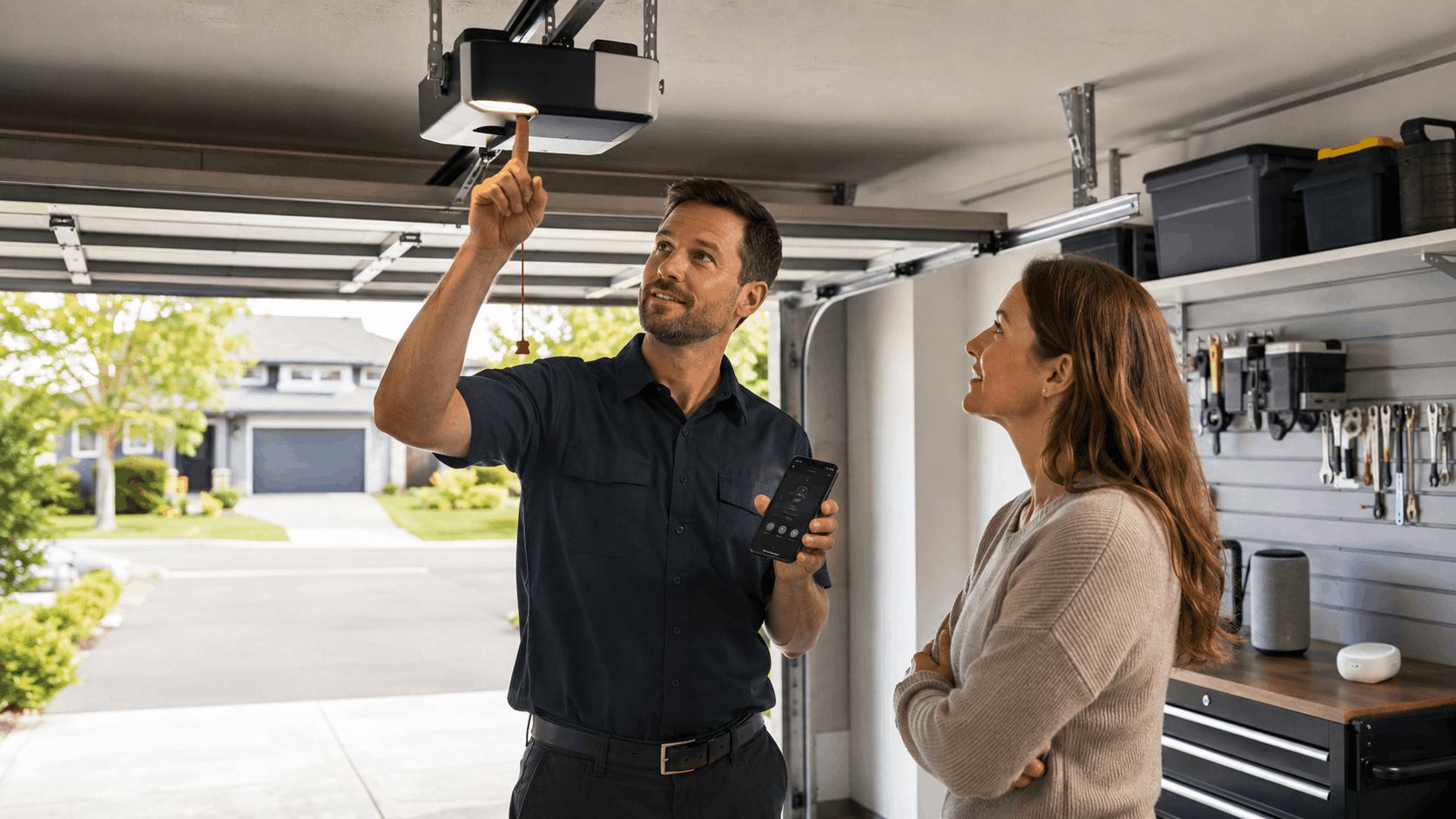
- Absolutely. Our smart integration service handles everything from picking the right controller to testing every voice command and training your family. We provide professional setup across all of Irvine, including Woodbridge, Turtle Rock, University Park, Northwood, Great Park, and Portola Springs. Our Irvine service team checks your opener, Wi-Fi, and platform goals first, then installs and tests the whole system. Call us to schedule a consultation.
Licensed garage door repair professionals serving Irvine and Orange County.
Licensed in California · License #1055150
Why trust Urgent Garage Doors?
Founded in 2017, Urgent Garage Doors is a licensed and insured garage door services serving Irvine and Orange County. All content is reviewed by our licensed technicians.

Need Help in Irvine?
Urgent Garage Doors serves Irvine and all of Orange County.
Related Articles
Adding a Garage Door to an ADU or Workshop: The OC Permit Path and Opening Prep
A local guide to adding a garage door to an Irvine ADU or workshop, covering the Orange County permit path, rough opening prep, door choices, and realistic costs.
Low-Headroom Garages in Older OC Homes: The Track Kits That Make Modern Doors Fit
Older Orange County homes often have low-headroom garages that block modern doors. Learn how low-clearance track kits, measuring tips, costs, and pro installation make a new door fit.
Pedestrian Pass Doors Built Into Garage Doors: When a Door-Within-a-Door Makes Sense
A local guide to pedestrian pass doors built into garage doors in Irvine: how they work, when a door-within-a-door makes sense, costs, safety, and HOA rules.