Why Northwood Garage Door Rules Differ Street by Street in Irvine's Only Non-Irvine-Company Village
Key Takeaways
- Northwood is the one Irvine village not developed by the Irvine Company, built from roughly 23 separate ranch parcels, so approval varies street by street with no single rulebook.
- Park Paseo, Park Place, and Woodside have HOAs with architectural committees, while portions of Northwood have no HOA but still carry recorded CC&Rs a neighbor or developer can enforce.
- More than 60 percent of Northwood homes were built from 1977 to 1979, so many original openers predate the January 1, 1993 federal entrapment protection mandate and have no photo eyes.
- Eucalyptus windrows planted as crop shelter drop bark and leaf litter into tracks and sensors, and Santa Ana winds push debris into the photo-eye beam, causing doors to reverse for no visible reason.
- A same-dimension garage door swap falls under the City of Irvine permit exemption, while widening the opening or altering the header needs a permit and removes the under-$1,000 unlicensed-work exemption.
- Every new California opener must include SB 969 battery backup and UL 325 external entrapment protection; battery backup is law, not an upgrade.
- Springs are rated around 10,000 cycles, roughly seven years at four cycles a day, and must never be adjusted by a homeowner; owners can safely run the photo-eye, 2x4, and balance tests.
- Garage door work is licensed under C-61/D-28, not C-28; Urgent Garage Doors holds license #1055150 and offers 24/7 service with a 30 to 60 minute response across Orange County.
In This Article
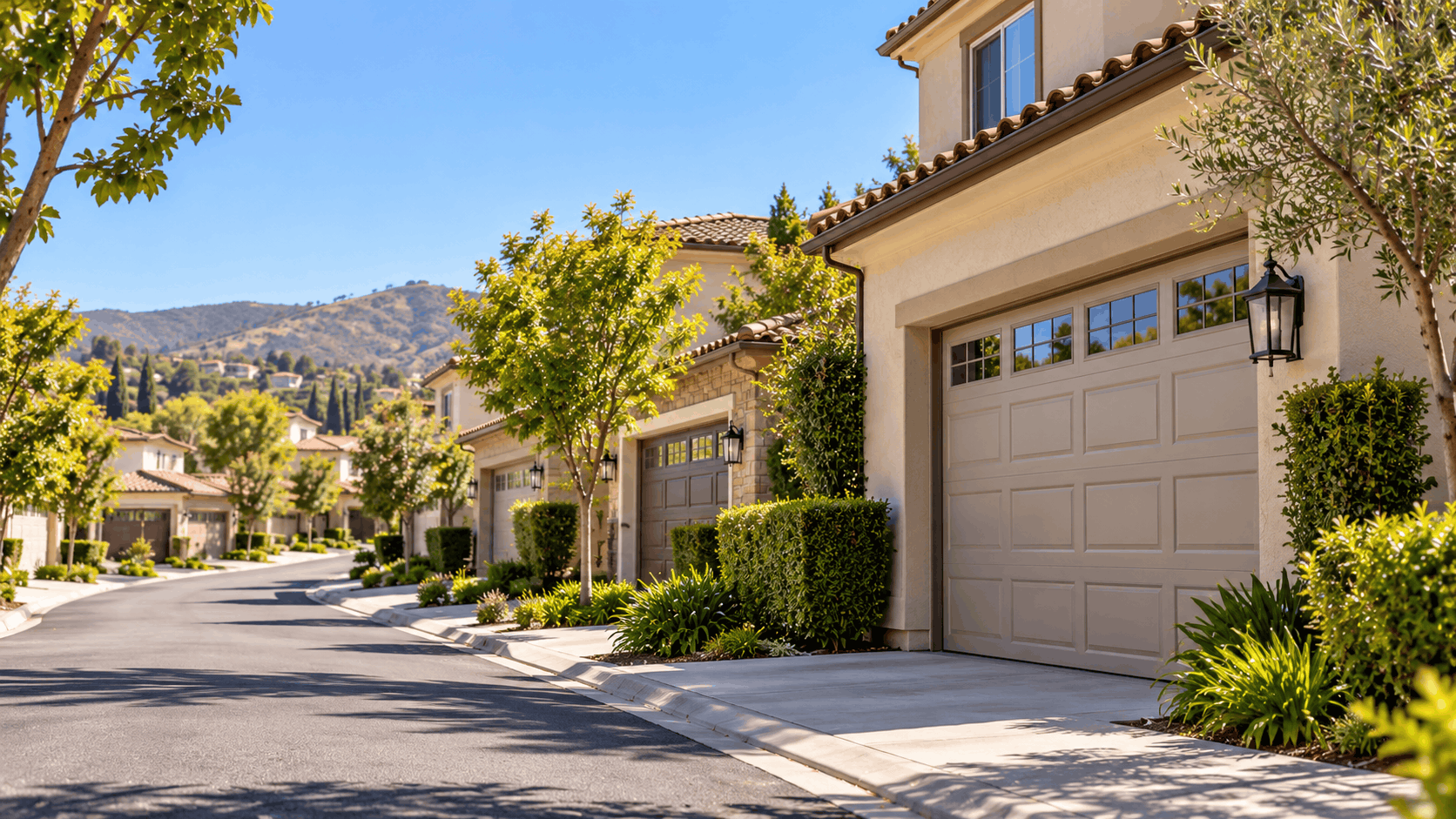
Two neighbors on two different Northwood streets can replace the same garage door and face completely different approval paths. One submits a written request to an architectural committee. The other has no committee to apply to at all, yet a recorded restriction still binds the home. That is not a mistake or an oversight. It is the direct result of how Northwood came to exist.
Northwood is the one Irvine village not developed by the Irvine Company. The land was part of the Irvine Ranch, handed out in some 23 separate parcels to ranch foremen and employees before a single developer organized those owners and named the area. Multiple builders worked here across two build eras roughly twenty years apart. That left the village with no single master plan and no single rulebook, so the answer to "who approves my door" genuinely changes with the address.
Why Northwood Has No Single Rulebook?
Most Irvine villages were planned from the top down. One developer drew the map, set the colors, and recorded one set of rules. Northwood is the exception. The land that became the village was part of the Irvine Ranch, and the Irvine family gave or sold parcels as bonuses and gifts to ranch foremen and other employees.
That scattered start is the root of everything that follows. When ownership is spread across many hands instead of held by one company, there is no master plan to apply to the whole area. The approval path, the builder, and even the opening sizes end up tied to the individual tract rather than the village as a whole.
For a homeowner, the practical lesson is simple. Before you order a door or schedule any work, you have to find out what governs your specific parcel. Northwood origins explain why that step matters here more than in any other part of Irvine.
The 23 Parcels That Became One Village
The story starts on the Irvine Ranch, the working agricultural land that covered much of what is now Irvine. As the family rewarded ranch foremen and other employees, roughly 23 separate chunks of that land ended up in different hands. These were land bonuses and gifts, not lots carved from a single development plan.
Later, a single developer organized those scattered owners and pulled the pieces together under one name, Northwood. That organizing step gave the village its identity, but it did not erase the fact that the land had arrived in separate parcels with separate histories. The seams between those old parcels still show up in how approval works today.
This is why the street-by-street differences are not random quirks. They trace back to real property lines and real ownership histories that predate the village name. When we work in Northwood, we treat each address as its own case because, historically, that is exactly what it is.
Understanding that history helps a homeowner ask the right question from the start. Instead of assuming the village has one rule, the smarter move is to confirm what governs the parcel at the specific address. That single habit saves time and avoids ordering a door that later runs into a restriction.
Multiple Builders, Multiple Tracts
Because the Irvine Company did not develop Northwood, multiple builders worked across the village. Each builder put up its own tracts, with its own construction details and its own approval arrangements. The result is a patchwork where construction and approval vary tract to tract rather than following one standard.
The named tracts show the scale of that variety. Arbor Crest, Arbors, Bainbridge, Bella Rosa, Camellia, Canyon Creek, Collage, Cristal, Fairmont, Georgetown, Greystone Villas, Lexington I, Lexington II, Mahogany, Mayfield, Oakhurst, RoseGate, Serissa, Silverado, Somerton, Tremaine and Windstream all sit within Northwood. Each carries its own character.
That tract variation matters for garage doors in concrete ways. Opening sizes, framing details, and the paperwork needed before installation are not guaranteed to match from one tract to the next. A door and an approval path that fit a home in Oakhurst are not automatically right for a home in Bainbridge or Windstream.
When we quote a job, we confirm the tract and the specifics at that address rather than assuming the neighboring tract tells us what we need. For a wider look at how installation choices differ, our garage door installation page covers the door types that suit different openings.
How This Compares to Woodbridge and Other Villages
Contrast Northwood with a single-master-plan village like Woodbridge. In those villages, one architectural committee reviews exterior changes against one published set of standards. A homeowner knows exactly where to send a request and what the standard will be, because the whole community runs on the same rulebook.
Northwood does not work that way. The answer to who approves your door is not a village-wide answer. It depends on which street you live on and what was recorded against your parcel. One owner has a committee, the next owner has no committee but a binding deed restriction, and a third may have something different again.
This is the single most important mental shift for a Northwood owner. Do not assume the rule your friend two streets over followed applies to you. The architectural review process that governed their door may not exist for your home at all.
For owners in the newer companion neighborhood, our Northwood Pointe maintenance and upgrades page addresses that area's own approval path, which differs again from the older core. Knowing which side of that divide your home sits on is the starting point for any job.
Get Your Free Quote
Tell us about your garage door and we'll get back to you within 30 to 60 minutes.
Who Actually Reviews a Garage Door Change at Your Address?
Before anyone measures a door or writes a quote, one question has to be answered: which body, if any, reviews your address. In Northwood this is not a formality. Get it wrong and you can order the wrong door or install a change that a neighbor can later challenge.
There are three situations a Northwood owner can land in. The home may sit in a neighborhood with an HOA and an architectural committee. It may sit where there is no HOA but recorded CC&Rs still apply. Or the enforcement may fall to the original developer or neighboring residents where no committee exists.
Each situation changes how a garage door change is reviewed and who can enforce the result. We work through all three below so an owner knows which one applies before choosing a door.
Streets With an HOA and an Architectural Committee
Some Northwood neighborhoods do have homeowners associations. Park Paseo, Park Place and Woodside are the named Northwood neighborhoods with HOAs, complete with community pools and jacuzzis. Park Place and Park Paseo share a clubhouse, which gives a sense of how those communities are organized.
Where an HOA exists, a garage door is treated as a street-facing exterior change. That means a written approval request goes to the architectural committee before installation, not after. The committee reviews the proposed door against the community's standards and either approves it or asks for changes.
For these owners the path is clear, even if it adds time. You confirm the current review process with the association, submit the request with the door details, and wait for written approval before work begins. Starting the paperwork early keeps the installation from stalling.
We help owners in these neighborhoods by setting the door specification before the request goes in, so the approval and the order line up. Association review can add time to a project, so building it into the schedule from the start keeps the job moving.
Streets With No HOA but Recorded CC&Rs
The City of Irvine states plainly that not all single-family neighborhoods are covered by a homeowners association. It names portions of Northwood specifically, alongside Lower Peters Canyon and El Camino Real. These homes have no HOA.
No HOA does not mean no rules. These homes remain subject to deed restrictions recorded as CC&Rs, which regulate the kind of changes permissible to a home, including exterior paint colors and additions. The restriction is recorded against the property and still binds the owner.
The twist that catches people out is that there may be no architectural committee to apply to at all. The restriction exists on paper, but there is no committee office, no submittal form, and no meeting to attend. An owner can read the recorded CC&Rs for their parcel but cannot send a request to a body that does not exist.
This is the opposite of the Woodbridge arrangement, and it is why we check the recorded documents for the parcel rather than looking for a committee that may not be there. Knowing a home falls in this category changes how we advise the owner on documentation.
Who Can Enforce a Restriction When There Is No Committee
If there is no committee, it is fair to ask who can actually enforce the rule. The answer comes from how these developments were set up. Under the Davis-Stirling Act, a developer of a common interest development creates the association and records the CC&Rs against the parcels with the county recorder.
Where no HOA is present, enforcement of those recorded deed restrictions may lie with the original developer, neighboring residents, or other eligible parties. In other words, the lack of a committee does not make the restriction toothless. A neighbor can enforce it.
That is a real consequence for a garage door choice. A homeowner who installs a non-conforming door on a street governed by CC&Rs with no HOA can still face a challenge from a neighbor or the original developer. The restriction did not go away just because no committee was watching.
For this reason we treat the recorded CC&Rs as binding on these streets and advise owners to choose a door that fits the recorded restrictions. It is far easier to confirm the restriction up front than to undo an installation later.
Confirm the Reviewing Body Before Choosing a Door
The practical step pulls all three situations together. Before quoting or ordering, find out which body reviews the address. That single check decides whether you submit to a committee, read recorded CC&Rs, or confirm who holds enforcement rights.
For HOA neighborhoods like Park Paseo, Park Place and Woodside, confirm the current review process with the association. For portions of Northwood with no HOA, check the recorded CC&Rs for your parcel to see what the deed restrictions allow. A garage door is a street-facing exterior modification, so these restrictions commonly reach it.
We build this confirmation into the start of every Northwood job. Establishing the reviewing body first means the door we specify and the approval path we follow match from the beginning. That avoids the costly mistake of ordering a door that the governing documents will not allow.
If an owner is unsure where their home falls, the City of Irvine's Homeowners Associations page is a useful starting point for which neighborhoods have an HOA and which rely on recorded CC&Rs. From there, confirming the parcel's status is the groundwork for everything else.
Need Help in Irvine?
Urgent Garage Doors serves Irvine and all of Orange County.
Why the Build Era Changes What You Can Install?
Northwood spans two build eras roughly twenty years apart. That gap is not a footnote. It shapes opening sizes, opener technology, and what a replacement actually needs. A door that fits one era's homes is not a match for the other.
The older core of the village came up in the late 1970s. The companion neighborhood, Northwood Pointe, was built by the Irvine Company in the late 1990s. Between them sit twenty years of changes in how garages were framed, sized, and equipped.
Knowing which era a home belongs to tells us a great deal before we even arrive. It points to the likely opening size, the type of opener originally installed, and whether that original opener predates modern safety law.
The 1977 to 1979 Core of the Village
More than 60 percent of Northwood homes were built between 1977 and 1979. At one point, 66 models across 18 tracts were selling at the same time. That is a remarkable concentration of construction packed into a very short window.
The consequence shows up decades later in a predictable way. Because so many homes went up within a few years, so many doors and openers reach end of life within the same few years rather than spread out across a longer span. When one street's openers start failing, the surrounding streets are often not far behind.
We see this pattern across the older core regularly. A home built in 1978 with an original opener is running hardware that has been cycling for decades. Springs, cables, rollers, and the opener itself all age on a similar clock when they were all installed at the same time.
For owners in this core, planning ahead makes sense. If a neighbor's original opener has given out, yours may be close behind. Our opener and smart access page covers what a modern replacement includes, which matters a great deal for these late-1970s homes.
Original Openers That Predate Entrapment Protection
Here is where the build era meets safety law. Those 1977 to 1979 openers predate the January 1, 1993 federal requirement for external entrapment protection. A large share of original Northwood openers have no photo eyes at all.
The dates tell the honest story. California required openers to be manufactured with an automatic reverse device and sensor under AB 3600 in 1990, and federal law covers openers manufactured for the United States after 1993. An opener installed when a Northwood home was built in 1978 simply predates the mandate entirely.
Photo eyes are the small sensors mounted on each side of the opening, no higher than six inches off the floor. They stop and reverse the door when something breaks the beam. An original late-1970s opener without them relies only on older mechanisms and lacks the external protection every modern opener carries.
The manufacturer position, LiftMaster for example, is that pre-1993 openers should be replaced rather than repaired. For a home still running its original opener, replacement is the route that brings the safety hardware up to current law. We walk owners through what that involves without pressure, because the age of the unit makes the decision fairly clear.
Northwood Pointe and the Late 1990s Companion Neighborhood
Northwood Pointe is the other half of the story. The Irvine Company developed it in the late 1990s as a companion neighborhood, so the village spans two build eras roughly twenty years apart. That gap means different opening sizes, different opener technology, and a different approval path.
A quote for one era is not a quote for the other. A door sized for a late-1970s opening in the older core will not necessarily fit a Northwood Pointe opening. The opener technology in a late-1990s home already reflects the post-1993 safety requirements, so the starting point is different.
The approval path differs too, because Northwood Pointe sits within the Irvine Company's later development pattern rather than the scattered-parcel history of the original core. That changes who reviews a change and how, which ties back to the address-first approach we take across the whole village.
When an owner calls from Northwood Pointe, we treat it as its own case rather than carrying over assumptions from the older tracts. The opening, the opener, and the review process all need to be confirmed for that specific home. Our dedicated Northwood Pointe service page reflects that difference.
The Eucalyptus Windrows and What They Do to Door Hardware
Northwood's most recognizable feature affects garage doors directly. The village is enclosed and lined by eucalyptus windrows, and they are more frequent and closer together here than anywhere else in Irvine. Those rows of tall trees are beautiful, and they also shed material right into the path of a garage door.
The windrows drop bark, leaf litter, and debris into driveways and door tracks. On exposed streets, Santa Ana wind events push that debris against doors and into photo-eye beams. The result is a set of hardware problems that are common across the village.
Understanding where the windrows came from, and what their debris does to tracks, seals, and sensors, helps an owner keep ahead of the most frequent faults. None of this means hardware fails faster here. It means the specific debris in this environment creates specific problems worth watching for.
Why the Windrows Are Here at All
The windrows are not decorative plantings added by a developer. They were planted when the land was farmed, as crop protection against Santa Ana winds. When this was ranch and farmland, rows of eucalyptus sheltered crops from the hot, dry winds that sweep down from the mountains.
Those old windrows still run between tracts and along the main thoroughfares. They also line Hicks Canyon Trail and the adjoining open space that runs along the village. The trees that once protected crops now enclose neighborhoods and frame the streets.
That agricultural past is tied to Northwood's whole origin story. This was Irvine Ranch land, and the windrows are a living reminder of how it was used before the homes went up. They are part of what gives the village its distinct look, with the Santa Ana Mountains visible to the north.
For a garage door technician, the windrows are not just scenery. They are a steady source of the bark and leaf litter that ends up in the tracks and on the sensors of the homes beneath them. Knowing that shapes how we inspect doors in the village.
Bark and Leaf Litter in the Tracks
Eucalyptus is a messy tree. It sheds strips of bark and a constant supply of leaf litter, and gravity carries that debris straight down into driveways and door tracks. On a home sitting beneath a windrow, that material accumulates where the door hardware moves.
Debris packs into tracks where the rollers run, and it works into the seal at the bottom of the door. Grit builds up in a bottom seal so the seal stops flattening cleanly against the slab. Once the seal cannot flatten, it no longer closes the gap the way it should, and the door no longer seats tightly.
In the tracks, built-up bark and leaf matter get in the way of smooth roller travel. The door can bind, run rough, or sound harsher than it should. Clearing the tracks and checking the rollers restores the smooth operation the door is supposed to have.
The fix is straightforward but worth doing regularly in Northwood. Keeping tracks clear and inspecting the bottom seal keeps the door moving cleanly and sealing properly. Our weatherseal retrofit service addresses a bottom seal that has stopped doing its job.
Santa Ana Winds and the Photo-Eye Beam
Santa Ana winds turn the windrow debris into a sensor problem. During a wind event, those dry, strong gusts push bark and leaf litter against doors and into photo-eye beams on exposed streets. The same beam that keeps the door from closing on a child or a pet gets interrupted by flying debris.
The photo eyes sit low, no higher than six inches off the floor, right in the path of ground-level debris. When litter coats a sensor lens or something breaks the beam, the opener reads it as an obstruction. The door reverses even though nothing you can see is in the way.
Photo-eye faults, misalignment, and blocked beams are the most common cause of a door that reverses for no visible reason. On Northwood's exposed streets near the windrows, that debris is a frequent trigger. An owner sees the door start down, stop, and roll back up with the driveway apparently clear.
The solution is usually a sensor cleaning and realignment. Wiping the lenses clean and confirming the two sensors are aimed correctly at each other restores the beam. Our safety sensor alignment and repair service handles exactly this fault.
Permits in Northwood and What Actually Triggers One
City permits and association rules are two separate layers, and in Northwood both can apply to the same job. An owner needs to understand how the City of Irvine treats a garage door change and how that interacts with the HOA or CC&R question covered earlier.
The city has a clear position on what does and does not need a permit. The association question sits on top of that, independent of the city. A job can be exempt from a city permit and still need HOA approval, or it can clear the association and still require a permit for structural work.
We work through both layers below so an owner knows what triggers a permit, what does not, and why a required permit changes the licensing picture.
The City of Irvine Permit Position
The City of Irvine generally requires a permit to erect, construct, enlarge, alter, repair, move, improve, remove, convert, or demolish a building or structure. That is the broad rule. Against it, the city lists specific exemptions.
One exemption covers replacement windows and doors having the same dimension as those being replaced, where the work does not require any change to the structural frame or opening size. A like-for-like garage door swap falls under that exemption. The replacement must still conform to all technical codes and city, county, and state ordinances on weatherproofing, security, and energy efficiency.
So a same-dimension garage door replacement in an existing opening falls under the city's exemption. The door still has to meet the applicable codes, but the swap itself does not require a permit under that provision. The city also advises consulting the homeowners association, which in portions of Northwood may mean consulting the recorded CC&Rs instead.
Owners can confirm the current position for a specific job with the city. The Permit Processing Center is reachable at 949-724-6313. Because the city is the authority on any given job, that call settles the permit question for an address.
Widening the Opening or Altering the Header
The exemption has a clear boundary. Structural work such as widening an opening or altering the header does not fall under it. If the job changes the opening size or the structural frame, the exemption no longer applies and a permit comes into play.
The line is drawn by whether the structure changes. A like-for-like swap in an existing opening stays within the exemption. Cutting the opening wider, moving the header, or otherwise altering the framing crosses into work that the city treats differently.
This matters in Northwood because owners sometimes want a larger or different door than the original opening allows. The moment the opening or header has to change, the project is no longer a simple door swap. It becomes structural work with its own permit path.
As always, the city with jurisdiction confirms the position for the specific job. If an owner is considering a wider opening, we flag that the project likely needs a permit and point them to the Permit Processing Center to confirm before any framing is touched.
Why a Required Permit Changes the Licensing Picture
A required permit does more than add paperwork. It changes who can legally do the work. The unlicensed-work exemption in Business and Professions Code section 7048 was raised from $500 to $1,000 by AB 2622 effective January 1, 2025. Below that figure, in limited cases, unlicensed work was allowed.
That exemption now fails at any value if the work requires a building permit of any kind, or if the person employs anyone on the job. So the moment a project needs a permit, such as widening an opening, the dollar exemption disappears entirely. The work has to be done by a licensed contractor regardless of cost.
Garage door work in California is licensed under classification C-61/D-28, Doors, Gates and Activating Devices. That scope covers sectional and rolling doors, torsion and extension spring systems, operators, control boards, safety sensors, and activating devices. C-28 is Lock and Security Equipment and is not the garage door license.
A license can be verified free at cslb.ca.gov, where classification, status, bond, and workers compensation are all public record. Urgent Garage Doors holds California license #1055150. Separately, Business and Professions Code section 7159 requires a written home improvement contract for work over $500, which is a contract requirement rather than a licensing threshold.
Need Help in Irvine?
Urgent Garage Doors serves Irvine and all of Orange County.
What a Replacement Opener Must Include in California
Because so many original Northwood openers date from the late 1970s and lack photo eyes, replacement is a frequent reality across the older core. When an owner replaces an opener today, current California law sets what that new opener must include.
Two requirements stand out. Every new residential opener installed in California must have a battery backup, and it must have external entrapment protection. Both are law, not optional extras. The table below summarizes what a compliant replacement opener includes.
| Requirement | What it means | Law or standard |
|---|---|---|
| Battery backup | Operates the opener during a power outage | SB 969, required since July 1, 2019 |
| External entrapment protection | Photo eyes mounted no higher than six inches off the floor | UL 325 |
| Contact reverse | Door reverses within two seconds of hitting an obstruction | UL 325 |
| Compliance proof | UL listing mark or CPSC entrapment protection label | Federal rule |
Battery Backup Is Now the Law, Not an Upgrade
SB 969 (Dodd, Chapter 621, Statutes of 2018) requires every residential automatic garage door opener sold or installed in California on or after July 1, 2019, to have a battery backup designed to operate during an electrical outage. The battery keeps the opener working when the grid goes down. Violations carry a $1,000 civil penalty.
The law was passed after deaths in the 2017 Northern California wildfires, where people could not open garage doors during power cuts. The purpose is evacuation when the electrical utility service fails and a resident cannot lift a heavy door by hand. It applies to installation and replacement.
This is a statewide, residential requirement. It is not a fire-zone rule, a city ordinance, or an association condition. A Northwood owner replacing an opener gets a battery backup unit because the law requires it, whether or not they asked for it.
Because it is a legal requirement rather than a tier to buy up to, we install it as standard with a replacement opener. Our battery backup installation page covers how this works for homes that need it added.
External Entrapment Protection on Every New Opener
A new opener must carry external entrapment protection built to UL 325. In practice that means photo eyes mounted on each side of the opening, no higher than six inches off the floor. When something breaks the beam during closing, the door stops and reverses.
UL 325 is satisfied two ways at once. The opener must reverse the door within two seconds of contacting an obstruction, which is the contact reverse. On top of that, nearly all openers add the non-contact system, the photo eyes. Together they provide the layered protection modern law expects.
This connects directly to Northwood's late-1970s core. Those original openers predate the 1993 federal mandate and have no photo eyes at all. A replacement brings the home from no external protection to a fully compliant system with both contact reverse and photo eyes.
Compliance is confirmed by a UL listing mark or the CPSC-required entrapment protection label on the product. When we install a new opener, that protection comes built in. It is one of the main reasons replacing a pre-1993 unit is worthwhile beyond just restoring function.
Drive Types That Suit Northwood Homes
Openers come in three drive types: chain, belt, and jackshaft. Chain drives are the traditional workhorse and tend to be the budget choice. Belt drives run quieter, which matters for a bedroom or living space above the garage.
Jackshaft units are wall-mounted and drive the torsion bar directly. They are used where headroom is limited or where storage occupies the ceiling. For a garage with overhead storage racks or a low ceiling, a jackshaft keeps the mechanism off the ceiling entirely.
Northwood's homes are predominantly single-family detached on somewhat larger lots than most Irvine villages. That gives owners more room and more drive-type options than a tight attached-garage layout would. A belt drive for quiet operation or a jackshaft for ceiling clearance are both practical choices here.
We match the drive type to how the garage is used and what sits above or around it. For homes with rooms over the garage, the quieter belt drive is often the better fit. Our opener installation service covers all three drive types.
Simple Safety Checks a Northwood Owner Can Run
Owners of aging Northwood doors can run a few checks themselves to catch problems early. These are simple tests that need no tools and no special skill. They also draw a hard line at what an owner should never touch.
The checks matter most in the older core, where original hardware has been cycling for decades. A door from a 1978 home has a lot of cycles behind it. Running these tests now and then tells an owner whether the safety systems still work and whether the balance is holding.
We cover the three key checks below, along with the one component an owner must leave to a technician.
The Photo-Eye and 2x4 Reverse Tests
The photo-eye test checks the non-contact safety system. With the door closing, break the beam with an object such as a broom handle. The door must stop and reverse. If it keeps closing, the sensors need attention.
The two-by-four test checks the contact reverse. Lay a 2x4 flat across the opening under the door. On closing, the door must reverse within two seconds of contacting the board. If it does not reverse promptly, the opener's force settings or reverse mechanism need service.
These two tests tie directly back to the windrows. On exposed Northwood streets, debris coats sensor lenses and Santa Ana winds break the beam, so photo-eye faults are common here. Running the photo-eye test after a windy spell is a smart habit for homes near the eucalyptus rows.
Both tests take only a minute. If either one fails, the door is not reversing the way it should, and that is a safety issue worth fixing promptly. A failed photo-eye test often comes down to dirty or misaligned sensors, which is a straightforward repair.
The Balance Test and What a Failure Means
The balance test checks whether the door is properly supported by its springs. Disconnect the opener with the release cord, then raise the door by hand to about waist height and let go. A correctly balanced door stays put rather than falling or rising.
If the door drops or climbs on its own, that is a spring problem, not an opener problem. The springs carry the weight of the door. When they cannot hold it balanced, no amount of opener adjustment fixes the underlying issue.
This distinction saves owners from chasing the wrong repair. A door that slams shut or drifts up is telling you the springs need attention. Treating it as an opener fault would miss the real cause and leave the hazard in place.
If the balance test fails, that is the point to call a technician. Our door balancing and tension adjustment service addresses exactly this, restoring the balance so the door holds position again.
Why Springs Are the One Thing to Leave Alone
Springs are the one component an owner must never touch. A torsion spring stores enough energy to cause serious injury and is wound with bars against a fixed cone. Adjusting, winding, unwinding, or replacing one without the right tools and training is genuinely dangerous.
The numbers explain why springs wear out. Standard residential springs are commonly rated around 10,000 cycles, where one cycle is one full open and close. A door cycled four times a day reaches 10,000 cycles in roughly seven years. Where the garage is the main entrance and cycles more often, that span is shorter.
Northwood's late-1970s core sees this clearly. Original springs that have been cycling since the home was built are well past their rated life. When they go, the door loses its balance and the balance test fails.
Springs do not fail alone. Cables, drums, rollers, hinges, and bearings wear alongside them. Replacing a spring without inspecting the cables is how a second failure follows weeks later, so we check the cables at the same time. Our torsion spring replacement service handles this safely.
What Northwood Garage Door Work Typically Costs?
Owners want a sense of cost before they call. The figures below are typical market ranges for garage door work in Orange County. They are ranges for the area, not a quote or a fixed price from us.
The actual price for a specific garage depends on that garage. It is given in writing before work begins when the job calls for it or the customer asks. Use these ranges to know what to expect, then confirm the real figure for your door.
| Job | Typical range |
|---|---|
| Sectional garage door replacement | $800 to $2,500 |
| Insulated steel garage door | $900 to $2,500 |
| Carriage-house garage door | $1,200 to $4,500 |
| Opener installation | $250 to $600 |
| Battery backup installation | $200 to $400 |
| Smart Wi-Fi opener and MyQ setup | $150 to $300 |
| Torsion spring replacement | $150 to $300 |
| Extension spring replacement | $150 to $250 |
| Cable repair | $150 to $300 |
| Off-track door repair | $125 to $275 |
| Track repair and realignment | $125 to $300 |
| Safety sensor alignment and repair | $75 to $150 |
| Door balancing and tension adjustment | $75 to $150 |
Doors and Openers
For new doors, a sectional garage door replacement typically runs $800 to $2,500. An insulated steel garage door falls in the $900 to $2,500 range. A carriage-house garage door runs higher, at $1,200 to $4,500, reflecting the added style and construction.
On the opener side, opener installation typically runs $250 to $600, with a belt drive costing more than a chain drive. That belt premium buys the quieter operation that suits a home with living space over the garage.
Battery backup installation runs $200 to $400. For Northwood homes replacing a late-1970s opener, remember that the battery backup is required by SB 969, so it is part of a compliant replacement rather than a separate choice. A smart Wi-Fi opener and MyQ setup runs $150 to $300.
These ranges cover the common paths a Northwood owner takes, from a simple sectional swap to a full opener upgrade. The sectional door replacement and insulated steel door pages cover those options in more detail.
Springs, Cables and Common Repairs
Repairs are where many Northwood owners start, given the age of the hardware in the older core. Torsion spring replacement typically runs $150 to $300. Extension spring replacement runs $150 to $250. Both are common on doors that have been cycling since the late 1970s.
Cable repair typically runs $150 to $300. Since cables wear alongside springs, they are often addressed at the same time as a spring job. Off-track door repair runs $125 to $275, and track repair and realignment runs $125 to $300.
For the sensor and balance issues the windrows tend to cause, safety sensor alignment and repair runs $75 to $150. Door balancing and tension adjustment runs the same $75 to $150. These smaller repairs keep an aging door running correctly.
These ranges give an owner a realistic picture before any work starts. For cable work specifically, our cable repair service pairs with spring work so a second failure does not follow weeks later.
What Moves the Price in Northwood Specifically
Two things move the price in Northwood more than elsewhere. The first is the build-era split. Northwood Pointe openings and the older 1970s openings call for different doors and different springs, so a figure for one era does not transfer to the other.
The second is spring sizing. Springs are sized to the actual weight and height of the door. A replacement door in a heavier material requires springs matched to it rather than reuse of the existing set. Switch from a light original door to a heavier insulated one, and the old springs cannot carry it.
That is why reusing old springs with a new heavier door is not an option. The new weight needs new springs sized for it. Our spring and cable repair service matches springs to the actual door.
Two other factors can add time rather than a fixed cost. A required permit for structural work adds a permit step, and an architectural review in an HOA neighborhood adds an approval step. Both are worth building into the schedule from the start in Northwood.
Need Help in Irvine?
Urgent Garage Doors serves Irvine and all of Orange County.
How Urgent Garage Doors Handles a Northwood Job
Northwood's street-by-street differences shape how we approach every job here. The village's scattered-parcel history, two build eras, and mix of HOA and CC&R streets mean we cannot assume one approach fits every address. We build the groundwork into the start of the job.
Urgent Garage Doors was founded in 2017 and works across Orange County from the storefront at 76 Ashford in Irvine. We work on all garage door brands and bring common parts on the truck. Here is how a Northwood job runs.
Confirming the Address Before the Work
The first step is establishing which body reviews the address. For an HOA neighborhood like Park Paseo, Park Place, or Woodside, that means the architectural committee. For portions of Northwood with no HOA, it means the recorded CC&Rs for the parcel. We settle this before ordering anything.
At the same time, we confirm whether the opening is being changed. A like-for-like swap in the existing opening follows one path. Widening the opening or altering the header follows another, with a permit and a licensed structural approach. Knowing which applies sets the door and the paperwork correctly from the start.
For new installations, we offer a free on-site estimate. We measure the opening, check the existing hardware, and confirm what the home actually needs rather than guessing from the curb. In a village where opening sizes vary by era and tract, that on-site measurement matters.
When the job calls for it or the customer asks, we provide a written price before work begins. That written price, along with the confirmed review path and opening details, means an owner knows what is happening before any tools come out.
Truck Stock and Same-Visit Spring Work
Our trucks carry common torsion spring sizes. For the many Northwood homes running original late-1970s springs, that means a spring replacement is often completed on the same visit rather than requiring a return trip for parts. Having the spring on the truck is a real advantage in the older core.
We check the cables at the same time as the springs. Since cables wear alongside springs, replacing a spring without inspecting the cables invites a second failure. Addressing both together keeps the door reliable rather than fixing one part and leaving the next to fail.
For new door installations, removing and hauling away the old door is included. An owner replacing a late-1970s original door does not have to arrange disposal separately. The old door leaves with us as part of the installation.
Each preventive maintenance visit also includes a written report of what was found and what is recommended. For an aging Northwood door, that report gives an owner a clear picture of the hardware's condition. Our preventive maintenance plan covers these visits.
Response Across Northwood and Nearby Villages
We take emergency calls 24 hours a day, 7 days a week, every day of the year including holidays. A broken spring or a door stuck open does not wait for business hours, and neither do we. Emergency response is 30 to 60 minutes anywhere in Orange County.
That coverage reaches Northwood and the villages bordering it. We serve Northwood Pointe, Eastwood Village, Stonegate, and Woodbury, along with the rest of the surrounding area. Because we are based in Irvine, the response window across these nearby villages holds up well.
We work on all garage door brands, including LiftMaster, Chamberlain, Genie, Craftsman, Clopay, Amarr, Wayne Dalton, and CHI. Whatever brand of opener or door a Northwood home carries, from an original late-1970s unit to a modern smart opener, we service it.
For urgent problems, our emergency garage door repair service covers the whole area. A door that will not open or a spring that has snapped gets a fast response any day of the year.
Get the Right Answer for Your Northwood Address
Every Northwood garage door job starts with confirming which body reviews your address and whether the opening is changing, so the right door and the right approval path are set before anything is ordered. Call Urgent Garage Doors at (949) 529-7743 to schedule a free on-site estimate for a new installation or to book a repair, and we will confirm the details for your specific street.
Frequently Asked Questions
- Does my Northwood street have an HOA or just CC&Rs?
- It depends on your street. Park Paseo, Park Place, and Woodside are Northwood neighborhoods that have homeowners associations with pools and jacuzzis. Portions of Northwood have no HOA but still carry recorded CC&Rs, the same category the city names alongside Lower Peters Canyon and El Camino Real. Confirm your parcel's status, by checking with the association or the recorded CC&Rs, before changing your garage door.
- Do I need architectural approval to replace my garage door?
- Most street-facing exterior changes need written approval where an HOA exists, and a garage door is a street-facing exterior modification. Where only recorded CC&Rs apply and there is no committee, the restriction still binds you even though there is no body to apply to. Under the Davis-Stirling Act, a neighbor or the original developer can enforce that recorded restriction, so the door still has to conform.
- Do I need a city permit to replace my garage door in Irvine?
- A same-dimension replacement that does not change the opening or structural frame falls under the City of Irvine's exemption for replacement doors, as long as it meets weatherproofing, security, and energy codes. Widening the opening or altering the header does not qualify and brings a permit into play. The city with jurisdiction confirms the position for the specific job. The Permit Processing Center is 949-724-6313.
- My opener has no photo eyes. Is it safe to keep using?
- Original 1977 to 1979 Northwood openers predate the January 1, 1993 federal entrapment protection mandate, so many have no external photo eyes at all. They lack the non-contact protection every modern opener carries. The manufacturer position, LiftMaster for example, is that pre-1993 openers should be replaced rather than repaired. Replacing the unit brings the safety hardware up to current law with both photo eyes and contact reverse.
- Why does my garage door reverse when nothing is in the way?
- Photo-eye faults, misalignment, and blocked beams are the most common cause of a door that reverses for no visible reason. On exposed Northwood streets near the eucalyptus windrows, bark and leaf litter coat the sensor lenses, and Santa Ana winds push debris into the beam. A cleaning and realignment of the two low-mounted sensors usually fixes it and restores normal closing.
- Does a new opener have to include battery backup?
- Yes. SB 969 requires every residential automatic garage door opener sold or installed in California on or after July 1, 2019, to have a battery backup for power outages, with a $1,000 civil penalty for violations. It comes with a replacement opener whether or not you asked for it. It is a statewide residential requirement passed after the 2017 wildfires, not a fire-zone or association rule.
- Can I reuse my old springs with a new door?
- Springs are sized to the actual weight and height of the door, so a replacement in a heavier material needs springs matched to it rather than reuse of the existing set. If you move from a light original door to a heavier insulated one, the old springs cannot carry it. Cables should be inspected at the same time, since replacing a spring without checking the cables invites a second failure weeks later.
- Is a Northwood Pointe quote the same as an older Northwood quote?
- No. Northwood Pointe is a late-1990s Irvine Company neighborhood with different opening sizes, different opener technology, and a different approval path than the older 1977 to 1979 core. A quote for one era does not carry over to the other. The door, the springs sized to it, and the review process all need to be confirmed for the specific home rather than assumed from the neighboring era.
- How fast can someone come out for a broken door?
- We take emergency calls 24 hours a day, 7 days a week, every day of the year including holidays. The response window is 30 to 60 minutes anywhere in Orange County, including Northwood and the bordering villages. Our trucks carry common torsion spring sizes, so a spring replacement is often completed on the same visit rather than needing a return trip for parts.
- What classification should my garage door contractor hold?
- Garage door work in California is licensed under classification C-61/D-28, Doors, Gates and Activating Devices, covering spring systems, operators, sensors, and activating devices. C-28 is Lock and Security Equipment and is not the garage door license, and this work does not require a Class B general building license. Verify any license free at cslb.ca.gov, where status, bond, and workers compensation are public record. Urgent Garage Doors holds license #1055150.
Licensed garage door repair professionals serving Irvine and Orange County.
Licensed in California · License #1055150
Why trust Urgent Garage Doors?
Founded in 2017, Urgent Garage Doors is a licensed and insured garage door services serving Irvine and Orange County. All content is reviewed by our licensed technicians.

Need Help in Irvine?
Urgent Garage Doors serves Irvine and all of Orange County.
Related Articles
The 19th Street and Triangle Pockets: Garage Door Access on Costa Mesa's Busiest Blocks
Garage door access, build era and the west-side marine layer shape door work on Costa Mesa's busiest blocks near 19th Street and the Triangle. Costs, rules and fixes.

Emergency Garage Door Repair in Irvine Villages: Gate Codes, Association Quiet Hours, and Our Protocol
How Urgent Garage Doors handles emergency garage door repair in Irvine's gated villages, from gate codes and guard lists to HOA quiet hours and our step-by-step repair protocol.
Glass Garage Door Glazing Options: Frosted, Tinted, and Mirrored Privacy Choices for OC Streets
Compare frosted, tinted, and mirrored glass garage door glazing for OC homes - privacy, heat control, cost, and HOA rules explained by Irvine's local garage door pros.